
Customer Service Strategy
How to Build a Customer Service Team for Scalable Support
Learn how to build a customer service team with clear metrics, smart staffing, structured onboarding, the right tech stack, and a nearshore model that scales.
TL;DR — Quick Takeaways
- Define service metrics like FCR before hiring to avoid scaling inefficiencies.
- Structure your team based on real customer demand, not generic org charts.
- Onboarding must include milestones, QA, and certification—not just shadowing.
- Nearshore teams in Tijuana offer cost efficiency, bilingual talent, and real-time collaboration.
A common pattern looks like this. Volume rises faster than expected, response times slip, supervisors start handling frontline work, and every hard ticket turns into an escalation. At that point, a more fundamental question comes up: how do you build a customer service team that can grow without losing speed, consistency, or customer trust?
Strong support teams do not happen through hiring alone. They come from a clear operating plan: measurable service targets, defined roles, structured onboarding, the right systems, and a staffing model that fits your customers and hours of coverage. If you support North American customers in English and Spanish, the model decision has outsized impact. In-house teams give control but usually cost more and take longer to scale. Traditional offshore models can reduce cost, but time zone gaps and cultural friction often show up in QA scores and escalations. A nearshore team in Tijuana often gives companies a better balance of labor cost, schedule alignment, and bilingual talent access.
At CallZent, I have seen this trade-off firsthand. Companies usually wait too long to define what good service looks like, then try to solve a design problem with extra headcount.
For a practical benchmark framework, start with these customer service performance targets.
Bold takeaway: The fastest way to build a weak service team is to treat hiring as the starting point instead of the outcome of a clear service desig
Laying the Foundation with Goals and Metrics
A support team usually breaks long before it looks broken.
The pattern is familiar. Ticket volume rises, response times slip, supervisors jump into the queue, and leadership starts hiring fast. Six months later, the team is larger, payroll is higher, and customers still need two or three contacts to get one issue resolved. The root problem is rarely headcount alone. It is the lack of a clear definition of success.
Start with operating goals tied to customer behavior and business risk. If the business serves subscription customers, retention and repeat-contact reduction should shape the scorecard. If the company handles regulated interactions, accuracy and escalation discipline may carry more weight than speed. If the customer base is split across English and Spanish, language coverage has to be built into the target from day one instead of treated like a staffing detail.
Pick one anchor metric first
For many service teams, First Contact Resolution is the clearest anchor metric. Industry benchmarks place strong teams in the 70 to 80 percent FCR range, and teams above 70 percent tend to reduce repeat contacts and improve loyalty, according to Assembled’s customer service metrics guide.
FCR is a valuable metric because it forces discipline across the whole operation:
- Hiring quality: agents need judgment, not just script compliance
- Training depth: product knowledge has to cover edge cases, not only common flows
- System design: agents need customer history, order data, and policy guidance in one workflow
- Escalation control: frequent handoffs usually point to weak frontline enablement
Assembled also notes that each 1% improvement in FCR can yield a 0.8% increase in customer retention. That makes FCR more than a contact center KPI. It ties service quality to revenue protection.
Match the scorecard to the work
The right metric set depends on what your team handles.
An e-commerce support team can push hard on speed and resolution because many contacts follow repeatable patterns. A healthcare, fintech, or insurance team has a different trade-off. Verification steps, policy accuracy, and documentation standards can justify longer handling times if they prevent costly mistakes.
This is also where the delivery model starts to matter. A bilingual nearshore team in Tijuana often gives North American brands an operational middle ground. You get real-time collaboration, easier supervisor coverage across U.S. hours, and a labor market with strong English and Spanish capability. In practice, that makes it easier to hold teams accountable to one scorecard across languages, instead of running a separate standard for Spanish support because coverage is thin or coaching is inconsistent.
Keep the first dashboard simple
Early teams often build reports that look complex and answer nothing.
Start with a weekly dashboard built around a few decisions you know you will make. A practical version includes:
- FCR to measure whether the frontline team is resolving issues without repeat effort
- Escalation rate to show whether specialist handoffs are controlled or becoming routine
- Customer satisfaction trend to catch quality problems that productivity numbers can hide
If you need a benchmark framework, this guide on performance targets for customer service gives a useful way to set targets by function and maturity level.
Build the scorecard around decisions. If a metric will not change staffing, coaching, workflow design, or tooling, it does not belong on the first dashboard.
Budget for the model you want to run
Budget mistakes usually show up later as quality problems.
A team with weak funding cuts training hours, delays QA coverage, and asks supervisors to coach while they are buried in escalations. The result is predictable. New hires take longer to ramp, resolution stays low, and service leaders end up blaming agents for process failures.
At minimum, the operating plan should cover:
- People: frontline coverage, team lead capacity, and QA or training support as volume grows
- Technology: help desk, CRM, telephony, knowledge base, and reporting
- Ramp time: new hires need time to reach expected productivity and quality
- Management bandwidth: supervisors need protected time for coaching and calibration
For companies serving U.S. and Canadian customers, nearshore economics often become attractive. A Tijuana-based team can reduce labor cost pressure while keeping time zone overlap and cultural alignment close enough for tighter coaching, faster policy updates, and better bilingual consistency. That does not mean nearshore is always the answer. In-house teams can work well when the product is highly specialized or security rules are strict. Offshore models can lower cost further. But if your goals depend on speed, language quality, and close operational control, nearshore tends to be easier to manage at scale.
The foundation is simple. Define success, measure a few things well, and fund the operating model that can hit the target.
Designing Your Customer Service Team Structure and Roles
TL;DR: Start with a structure that matches your actual support load, not the org chart you think a “real” support team should have. Define clear ownership, set role boundaries before hiring, and build a promotion path early. For bilingual support, nearshore teams in Tijuana often make this easier to manage because coaching, schedule overlap, and language quality are easier to maintain than with a distant offshore setup.
A bad structure shows up fast in the queue. Customers get transferred twice. Agents answer the same issue in different ways. Supervisors spend the day cleaning up ownership gaps instead of coaching.
Clear lanes fix a lot of that.
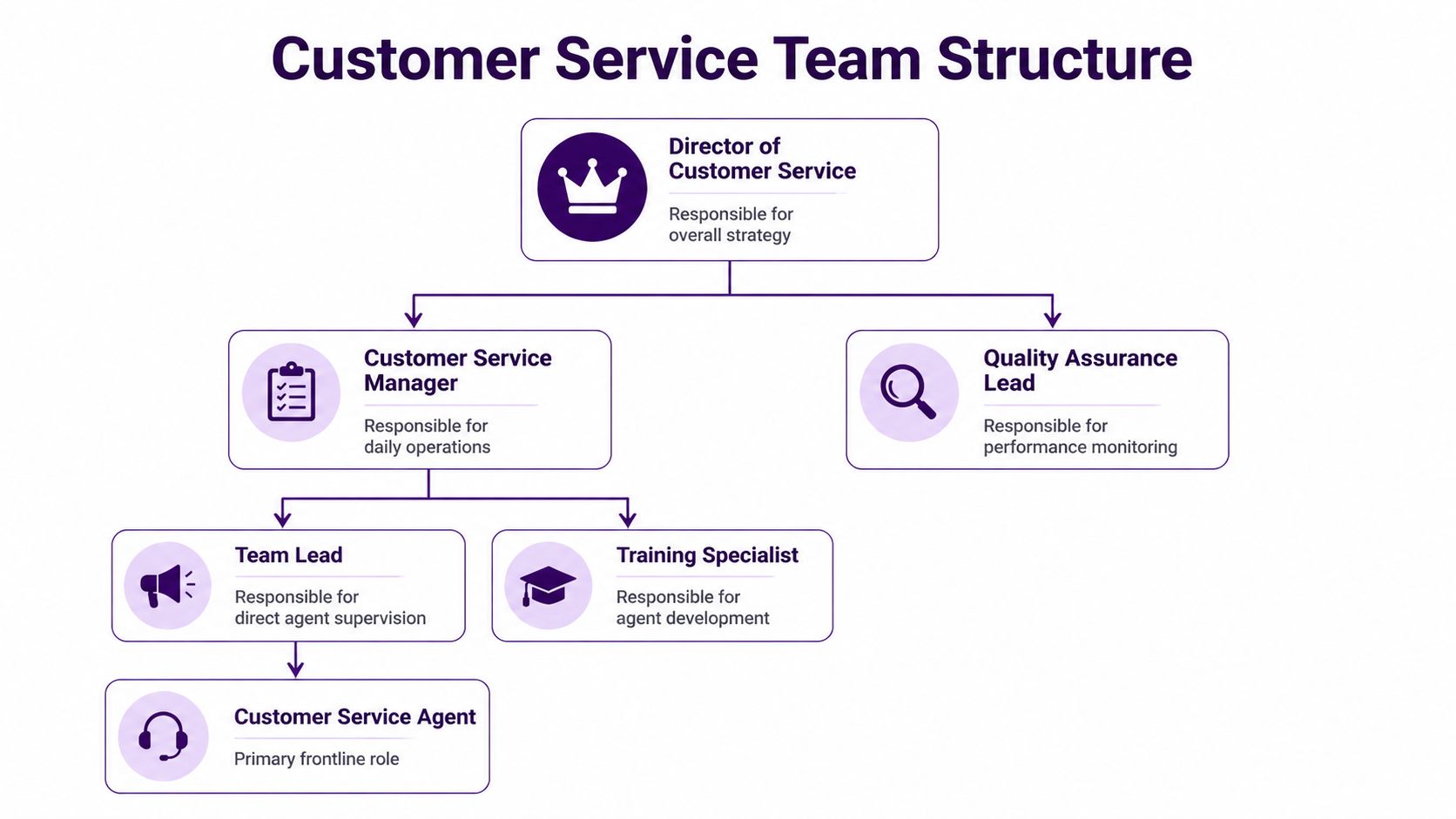
Choose the structure that fits your ticket reality
Two models are widely applicable.
Tiered support fits operations with a wide spread of issue complexity. Tier 1 handles common questions and repeatable workflows. Tier 2 takes technical issues, billing disputes, policy exceptions, or anything that needs deeper product knowledge. This structure gives managers tighter specialization, but every handoff adds delay and creates another chance for context loss.
Pod-based support fits teams that want stronger end-to-end ownership. A pod may support a customer segment, a language group, or a channel. It usually includes frontline coverage, a team lead, and access to a specialist. In bilingual environments, this is even more critical. Language fluency alone is not enough. The team also needs consistent tone, policy judgment, and cultural context across the full interaction.
For U.S. and Canadian brands, nearshore pods in Tijuana often work well because supervisors can coach in real time during the same business day, and agents can shift between English and Spanish without the disconnect that shows up in more distant offshore models. The trade-off is cost. Nearshore is usually not the cheapest labor option. It is often the easier option to run when service quality, speed, and bilingual consistency all matter.
Don’t guess at coverage for service and success roles
If your support model includes account ownership, onboarding help, renewals support, or proactive service, segmentation has to drive staffing. As noted earlier, high-touch accounts need lower books of business than low-touch or tech-touch segments. That applies beyond SaaS customer success. A retailer with VIP clients, a healthcare group with complex scheduling, or a fintech team handling sensitive account issues all face the same staffing reality.
A simple rule works well here. Match coverage to account complexity, response expectations, and the amount of human judgment your service promise requires.
If one group needs proactive outreach, exception handling, and bilingual relationship management, do not staff it like a basic inbound queue.
Define roles before you recruit
Hiring gets messy when role design is vague. Candidates hear “customer service” and picture one job. Operations leaders often need three different capabilities under that same title.
Use a role map like this before you open requisitions.
| Role | Primary Responsibilities | Key Skills |
|---|---|---|
| Customer Service Agent | Handle frontline inquiries across phone, chat, or email, document cases, resolve routine issues, follow escalation rules | Empathy, written and verbal communication, product knowledge, judgment |
| Team Lead | Coach agents, manage daily queue health, approve exceptions, monitor adherence, support escalations | Coaching, queue management, conflict resolution, decision-making |
| Quality Assurance Specialist | Review interactions, score quality, identify coaching trends, maintain standards | Analytical thinking, calibration, communication, detail orientation |
| Training Specialist | Run onboarding, refreshers, side-by-sides, role-play sessions, update learning materials | Facilitation, documentation, product fluency, patience |
| Customer Service Manager | Own staffing, service levels, process changes, reporting, and cross-functional coordination | Operations management, forecasting, leadership, prioritization |
For bilingual teams, tighten the definitions further. Decide which roles require fully fluent spoken English, which need strong written English, and which can support Spanish-first queues with limited English exposure. That prevents expensive hiring mistakes and helps recruiters screen correctly. We use that discipline at CallZent because bilingual agent training standards only work when the role design is specific.
Build promotion paths early
Retention improves when people can see a next step and understand what it takes to get there.
A practical path usually looks like this:
- Agent to senior agent
- Senior agent to team lead
- Team lead to QA, training, or operations
- Operations roles into manager-level ownership
This is especially important in bilingual hiring markets. Strong English-Spanish talent has options across BPOs, in-house teams, and remote employers. Some candidates actively find remote jobs, which means your structure has to compete on more than starting pay. Clear advancement, better coaching access, and stable schedules can keep good people longer than a small wage bump.
The strongest team structures do three things well. They reduce handoff confusion, protect manager time, and give good agents a reason to stay.
How to Recruit and Onboard Your A-Team
A support team usually breaks in one of two places. Hiring brings in people who sound polished but freeze when the customer goes off script, or onboarding sends decent hires into live queues before they can handle real friction. Both problems get expensive fast.
For companies scaling bilingual support, the margin for error is smaller. English-Spanish talent can work for local employers, large offshore BPOs, or remote companies that find remote jobs. If you want to win strong candidates in a market like Tijuana, the hiring bar and the ramp plan both need to be clear.

Recruit for judgment under pressure
Customer service resumes can be misleading. A year in a call center does not tell you whether someone can calm an upset customer, absorb policy detail, and document the case correctly while the queue is building.
Screen for the behaviors the role needs:
- Composure: The agent keeps their tone steady when the customer does not.
- Problem diagnosis: The agent can identify the issue even from incomplete or messy explanations.
- Coachability: Feedback turns into changed behavior within days, not weeks.
- Process discipline: The agent follows rules without sounding mechanical.
The interview should test live performance, not just conversational polish. Use realistic scenarios. Ask the candidate to explain a billing issue, de-escalate an angry customer, and summarize the case in writing. That gives you a much better read on how they will perform once metrics and volume are real.
For bilingual hiring, test both languages in context. A candidate may speak conversational English and still struggle to explain a policy clearly, soften bad news, or ask the right follow-up questions. In nearshore operations, that distinction matters because clients often expect the language quality of an in-house team with the cost profile of a BPO.
A practical bilingual assessment includes:
- A spoken service scenario in English
- A spoken service scenario in Spanish
- A short written reply for email or chat
- A de-escalation role-play
- A quick product-learning exercise to test comprehension speed
Teams that hire in Tijuana often get a strong advantage here. The talent pool is large, bilingual exposure is common, and agents tend to be more culturally aligned with U.S. customers than teams based farther offshore. That does not remove the need for testing. It makes precise screening more valuable, because the right hire can ramp fast and stay productive.
Write job descriptions that screen for the actual job
Weak job posts attract volume. Strong job posts attract fit.
Spell out the work in plain language. Candidates should know the channel mix, the pace, the type of customer issues, the documentation standard, and the schedule reality before they ever apply. That saves recruiter time and reduces early attrition.
Include details like these:
- You will handle order, account, or technical questions at high volume
- You will document every interaction clearly in the CRM
- You will work across phone, chat, and email
- You will escalate only when policy or complexity requires it
- You will explain the same issue differently depending on the customer’s level of familiarity
For bilingual roles, define the language requirement with more precision than “must be fluent.” State whether the role needs customer-facing spoken English, strong written English for chat and email, or mainly Spanish support with occasional English handoffs. That improves applicant quality and keeps you from overpaying for language skill the role does not use.
Onboarding needs milestones, not attendance
Orientation is not readiness. I have seen teams spend a week on product decks, policy walkthroughs, and side-by-side shadowing, then act surprised when new hires mishandle simple contacts on day one in production.
A better approach is milestone-based onboarding. Zendesk’s customer success team article highlights early onboarding markers such as account setup by Day 3 and workflow proficiency by Day 7. Those checkpoints are useful because they force managers to verify progress instead of assuming exposure equals competence.
Use a ramp plan with visible proof at each stage:
| Onboarding stage | What the new hire should complete |
|---|---|
| Early setup | System access, security basics, account configuration, communication tools |
| Product immersion | Core workflows, top issue categories, policy rules, customer scenarios |
| Guided practice | Role-playing, macro use, CRM documentation, escalation drills |
| Live transition | Monitored contacts, feedback after each block, tighter QA review |
| Readiness check | Confirmed proficiency by channel, issue type, and compliance requirement |
This is one area where nearshore teams can have an edge over both in-house and traditional offshore models. In-person coaching is easier if leadership is close to the U.S. operation, but labor costs stay well below a domestic buildout. That makes it more practical to give new hires extra nesting time, bilingual coaching, and side-by-side QA before they carry a full load.
For teams building bilingual support, this guide on how CallZent trains bilingual agents is a useful reference for combining language evaluation with service coaching.
Use live practice early and often
Classroom training has limits. New hires improve faster when they have to think, explain, and document in the same exercise.
Run scenarios that match the queue they are about to inherit:
- An angry customer who cannot explain the issue clearly
- A patient or policyholder who needs reassurance and precision
- A customer switching between English and Spanish mid-conversation
- A repeat contact where the agent must read prior notes and continue the case without forcing the customer to restart
Score the exercise the same way you would score a real interaction. Listen for accuracy, ownership, tone, note quality, and judgment. That is how weak hires show themselves early, and how promising hires prove they are ready for more.
Equipping Your Team with the Right Technology
A support team can have strong hiring, solid training, and clear goals, then still miss service targets because agents are clicking through five systems to answer one basic question. I see this problem often during transitions from in-house teams to a nearshore model. The issue is rarely effort. It is tool design.
Technology should shorten the path to resolution. For a bilingual team serving U.S. customers from Tijuana, that matters even more. Agents need one workspace that supports fast context switching between English and Spanish, clear documentation, and easy handoffs across channels without losing the customer’s history.

Build the stack around the agent workflow
Buy software based on the job your team needs to do, not based on a vendor demo.
In the first minute of a contact, an agent should be able to confirm identity, see recent interactions, understand the current issue, check the right policy or script, and know the next action. If that takes multiple tabs, duplicate logins, or manual searching, handle time rises and note quality drops.
A practical service stack usually includes five layers:
- CRM or help desk: Zendesk, Salesforce Service Cloud, HubSpot Service Hub
- Channel tools: cloud phone, chat, email, SMS, and social inboxes
- Knowledge system: internal SOPs, macros, policy guidance, troubleshooting content
- Workflow automation: routing, tagging, follow-up triggers, escalations, QA flags
- Reporting layer: dashboards for queue volume, resolution trends, backlog risk, and coaching gaps
Nearshore teams have an advantage here. Many can plug into a U.S. company’s existing systems without the long delays and overlap problems that come with offshore handoffs across distant time zones. That makes rollout, testing, and supervisor support easier, especially for fast-growing teams that need bilingual coverage without rebuilding the stack from scratch.
Use AI where it removes friction
AI should handle repetitive work and support better judgment. That is where the return shows up.
Useful applications include:
- Drafting replies for common requests
- Recommending next steps based on ticket history
- Surfacing knowledge articles during live contacts
- Tagging intent before the agent responds
- Routing simple issues to automation before they hit the queue
The management trade-off is straightforward. If AI saves time but creates bad summaries, weak recommendations, or compliance risk, the team will spend that time fixing errors later. Keep a human review step anywhere the answer affects billing, health information, policy interpretation, or account access.
Build self-service for simple tasks, not for deflection at all costs
Customers will use self-service if it is fast, clear, and easy to exit when the issue gets more complex. They will abandon it if it hides the contact path or sends them in circles.
A good reference is a well-designed self-service customer support platform that lets customers complete routine requests on their own while keeping agent support available when needed. That is the standard to aim for. Reduce unnecessary contacts, but do not trap people.
If you are comparing platforms, this guide to call center software features for frontline support teams is a practical checklist for choosing tools your agents will use every day.
One more operating point. A provider such as CallZent can work inside a client’s existing stack or help configure a standard support setup for a new program. That flexibility matters for companies that want nearshore cost savings and bilingual coverage without forcing a full system migration at the same time.
Driving Performance with Quality Assurance and Continuous Improvement
A customer service team doesn’t stay strong by accident. It stays strong because managers inspect quality, coach consistently, and fix workflow problems before they become habits.
Too many companies treat QA like a score. That’s too narrow. QA is a management system.
Review interactions for coaching value
A useful QA program checks more than courtesy.
It should answer questions like:
- Did the agent identify the issue correctly?
- Did they use the right process?
- Did they communicate clearly and confidently?
- Did they document the case so the next person won’t need to start over?
- Did they escalate only when escalation was necessary?
That last point matters. If QA only rewards politeness and script adherence, teams can look “nice” while still creating repeat contacts and operational drag.
Use a scorecard that reflects reality
A lightweight scorecard often works better than an elaborate one. Managers and QA analysts should be able to calibrate quickly and explain the result without debate over minor wording.
Here’s a practical model:
| QA area | What to review |
|---|---|
| Accuracy | Was the issue diagnosed and resolved correctly |
| Communication | Was the explanation clear, calm, and aligned with brand tone |
| Process adherence | Were verification, workflow, and documentation steps followed |
| Ownership | Did the agent move the issue forward instead of pushing it away |
| Judgment | Was escalation used appropriately and only when needed |
Reviewing calls or tickets without coaching follow-through wastes the effort. Every QA cycle should lead to one of three outcomes: reinforce a strong behavior, correct a weak one, or change a process that keeps causing the same failure.
Coaching rule: If three good agents make the same mistake, you probably have a process problem, not a people problem.
Build a closed feedback loop
Continuous improvement depends on fast loops between frontline signals and operational changes.
That means:
- Team leads flag repeat friction points
- QA identifies common failure patterns
- Operations updates workflow or knowledge materials
- Training reinforces the change
- Managers monitor whether the issue drops
Many teams stall at this stage. They collect data, but no one owns the fix.
A mature support operation treats feedback as production input. If customers keep asking the same confusing question, support isn’t just there to answer it. Support should help the company remove the confusion upstream.
For teams formalizing review criteria and coaching workflows, this resource on call center quality is a solid reference for what strong quality programs look like in practice.
 Choosing Your Model In-House Hybrid or Nearshore BPO
A common break point looks like this. Ticket volume rises, leaders add a few hires, response times improve for a month, then coverage gaps, attrition, and supervisor overload show up at the same time. At that stage, the team issue is often not effort. It is the operating model.
The model you choose changes more than labor cost. It affects hiring speed, schedule coverage, coaching quality, escalation handling, and how much management attention support will consume each week.
In-house gives maximum control and maximum ownership
In-house support makes sense when customer conversations depend on close product access, strict compliance review, or daily cross-functional contact with engineering, billing, or clinical teams. You can change workflows fast because everyone reports into the same operation.
You also absorb the full operating load. Hiring, floor management, QA, workforce planning, absenteeism, backfill, and training all stay on your balance sheet and on your managers’ calendars. For many small and mid-sized companies, that is where the in-house model gets expensive. The salary line is only part of the cost. Management drag is the hidden line item.
Hybrid works if your internal management habits are already strong
A hybrid setup usually keeps leadership, process ownership, and part of the team in-house while adding remote or outsourced capacity for coverage or scale. It can work well for companies that want direct control over policy and customer experience but need more staffing flexibility.
The trade-off is coordination. Hybrid teams need tight documentation, clean handoffs, consistent coaching, and sharper scheduling discipline than fully co-located teams. Weak managers can hide in an in-house setup for a while. Hybrid exposes those weaknesses quickly.
Nearshore BPO is often the most practical middle ground
For North American brands, a nearshore model often gives the best balance between cost relief and day-to-day control. That is especially true when the business needs bilingual support, extended hours, or faster scale than an internal recruiting team can provide.
According to the nearshore figures cited in Hiver’s customer service mindset article, locations such as Tijuana offer 20-30% lower costs than U.S. onshore, with minimal time zone differences relative to the U.S., compared with the 12+ hour gaps common in many Asia-Pacific offshore setups. The same reference notes that nearshore agent retention is often 25% higher, helping counter the 40% annual turnover seen in many offshore markets.
Those differences show up in operations fast. Shorter time zone gaps mean supervisors can coach in real time, not a day later. Bilingual recruiting is built into the labor market. Accent neutrality and cultural familiarity are usually easier to maintain for U.S. and Canadian customer bases than in a far-off offshore model.
Tijuana is a strong example because it gives companies access to Spanish-English talent near the U.S. border, with overlapping business hours and easier leadership travel. That matters more than many buying teams expect. If your QA lead, trainer, or client success manager can visit the operation without turning it into a long-haul international project, calibration gets easier and accountability gets tighter.
Nearshore is not automatically the right fit for every program. If your support work is highly specialized, very technical, or tightly tied to internal product teams, a fully in-house group may still produce better outcomes. If your only priority is the lowest possible hourly rate, offshore may still look attractive on paper. The problem is that hourly rate alone rarely captures rework, turnover, delayed escalations, and customer frustration.
A bilingual nearshore team tends to work well when you need to:
- support English and Spanish customers from the same operation
- add headcount faster than your local market can supply it
- keep supervisors and client stakeholders in overlapping work hours
- reduce overnight delays on escalations and approvals
- maintain customer interactions that feel closer to your home market
If you are comparing options in detail, this breakdown of nearshore vs offshore outsourcing costs, risks, and ROI gives a useful decision framework.
The wrong model usually fails in small ways first. Coaching lags. Handoffs slip. Escalations wait too long. Customers repeat themselves. Then the cost of fixing those gaps starts wiping out the savings that looked good in procurement.
For a lot of growing companies, nearshore is the practical choice because it keeps support close enough to manage well and flexible enough to scale.
Frequently Asked Questions About Building a Service Team
Some questions come up in almost every planning conversation. These are the ones that tend to matter most once the basics are clear.
| Question | Answer |
|---|---|
| Should I hire generalists or specialists first? | Start with strong generalists if your issue mix is still forming. Specialists make sense once you can clearly see recurring technical, billing, compliance, or language-specific complexity. Early on, broad capability is usually more useful than narrow expertise. |
| How do I know if my current team is understaffed or just poorly organized? | Look at the pattern, not just the volume. If customers repeat themselves, escalations feel routine, and supervisors keep rescuing the queue, the problem may be structure or training rather than raw headcount. If the workflows are clear and the tools are solid but queues still stay overloaded, staffing is likely part of the issue. |
| When should I outsource instead of building internally? | Outsourcing makes sense when demand is growing faster than your internal team can hire, train, and manage well. It’s also useful when you need bilingual coverage, extended hours, or more operational discipline than you currently have in-house. The key test is whether outsourcing helps you improve service quality while reducing management strain, not just whether it lowers cost. |
Building support is rarely one decision. It’s a stack of decisions that affect each other. Goals shape roles. Roles shape hiring. Hiring shapes onboarding. Onboarding shapes quality. And your operating model determines how hard all of that is to maintain.
🚀 Build Your Scalable Support Team Today
CallZent helps companies design, staff, and optimize high-performance nearshore customer service teams with bilingual agents and proven systems.
Talk to an ExpertIf you’re evaluating what your service team should look like next, CallZent can help you think through staffing, bilingual support design, and nearshore operating options for North American customer service.