Skip to content

Nearshore Customer Call Center:
A Practical Guide for Scaling Support in 2026
When customer demand grows, your support operation becomes either your biggest strength—or your biggest bottleneck.
Your support team rarely fails overnight. It starts with slower replies, repeat contacts, overwhelmed agents, and frustrated customers repeating themselves. By the time leadership reacts, the business is already paying for it through churn, lost revenue, and operational friction. :contentReference[oaicite:0]{index=0}
Nearshore Customer Call Center exist to prevent that breakdown. They are not just phone-answering teams—they are structured systems designed to absorb demand, maintain service quality, and protect growth.
TL;DR
- Nearhore Customer Call Centers manage inbound support, outbound outreach, and multi-channel communication.
- In-house = control, offshore = cost, nearshore = balance.
- Success depends on KPIs like FCR, CSAT, and consistency—not just speed.
- Scaling requires systems, forecasting, and QA—not just more agents.
Your support team usually doesn’t break all at once. It starts with slower replies, more repeat contacts, stressed agents, and customers who have to explain the same issue twice. By the time leadership decides customer service needs attention, the business has already started paying for the gap in missed revenue, churn, and internal chaos.
Customer call centres matter most at that point of strain. They aren’t just a way to answer phones. They’re an operating model for protecting growth when customer demand gets harder to predict.
Is Your Customer Service Ready to Scale
TL;DR
- Nearshore Customer Call Centers handle inbound support, outbound sales and follow-up, and increasingly blend voice with digital workflows.
- The right model depends on your priorities. In-house gives control, onshore outsourcing adds capacity, offshore lowers cost, and nearshore often balances savings with stronger alignment.
- The most useful success metrics are the ones tied to business outcomes, especially issue resolution, customer satisfaction, and service consistency.
- A scalable operation needs process discipline, not just more agents. Scheduling, forecasting, QA, and routing matter as much as headcount.
- If your team is growing fast, investing in better planning tools such as workforce management software can help prevent the common mistake of adding people before fixing coverage, forecasting, and queue design.
A lot of companies ask the wrong first question. They ask, “Do we need a call center?” The better question is, “Can our current support model absorb more volume without hurting the customer experience?”
That distinction matters. If your sales team is driving new demand, your product catalog is expanding, or your service business is adding locations, customer support becomes a growth constraint very quickly. A small team can manage low volume through hustle. It can’t scale on hustle alone.
The practical view is simple. Customer call centres give you a repeatable way to manage demand, train agents consistently, route issues correctly, and measure whether customers are getting help. That’s why businesses in e-commerce, healthcare, finance, insurance, and telecom still rely on them even as digital channels expand.
Key takeaway: A customer call centre becomes valuable when service quality needs to scale at the same pace as revenue.
If you’re already feeling pressure from longer queues, inconsistent service levels, or agents handling too many disconnected tasks, it helps to review proven ways of scaling call center operations efficiently before choosing a sourcing model.
What Are Nearshore Customer Call Center Really
A Nearshore customer Call Center is the operational core of customer communication. It’s where a business turns incoming demand and outbound outreach into something manageable. In practice, that means trained agents, structured workflows, routing logic, quality controls, and the systems that keep interactions from getting lost.
Some leaders still picture a call centre as rows of desks and ringing phones. That image is outdated. Modern nearshore customer call centers function more like a business’s communication control room. They connect customer intent to the right person, process, or system as quickly as possible.

Inbound customer call centers
Inbound teams react to customer need. The call starts because the customer wants something resolved, clarified, changed, or confirmed.
Typical inbound work includes:
- Order and account support where an agent checks shipment status, updates account details, or explains a charge
- Returns and service recovery when a buyer received the wrong product, a delivery failed, or a subscription didn’t renew correctly
- Technical help for login issues, setup questions, or product troubleshooting
- Scheduling and service coordination such as appointments, reservation changes, or claims intake
An e-commerce brand gives a clear example. One inbound call might be a return request. Another might be a customer asking whether a replacement order has already shipped. Same queue, different resolution path.
Outbound customer call centers
Outbound teams start the conversation. Their job is usually revenue, retention, collections, follow-up, or research.
Common outbound work includes:
- Lead follow-up after a form fill, ad response, or event registration
- Abandoned cart recovery for online retail
- Renewal reminders for subscriptions, insurance, or service contracts
- Payment follow-up and account recovery
- Customer feedback outreach after service interactions
A good outbound team doesn’t just dial faster. It works from clean data, clear scripts, and sensible escalation rules.
The model has deep roots. The history of the call center shows that modern call centers grew out of toll-free 800 numbers in the 1970s and 80s, which increased call volumes for sales, reservations, and banking. That expansion accelerated when First Direct launched telephone banking in 1989, and Direct Line sold insurance exclusively over the phone in 1985, proving that phone-based service could be both cost-effective and scalable.
Why the distinction matters
Plenty of businesses combine inbound and outbound work under one provider or one internal operation. That can work. But the management model changes.
Inbound service requires patience, product knowledge, and queue discipline. Outbound performance depends more heavily on list quality, scripting, timing, and compliance. When companies ignore that difference, they often end up hiring the wrong profiles and measuring the wrong outcomes.
The Modern Call Center Sourcing Models
The biggest sourcing mistake I see is treating every model as a price comparison. Cost matters, but nearshore customer call centers succeed or fail on a combination of control, speed, talent access, time-zone alignment, and operational discipline.
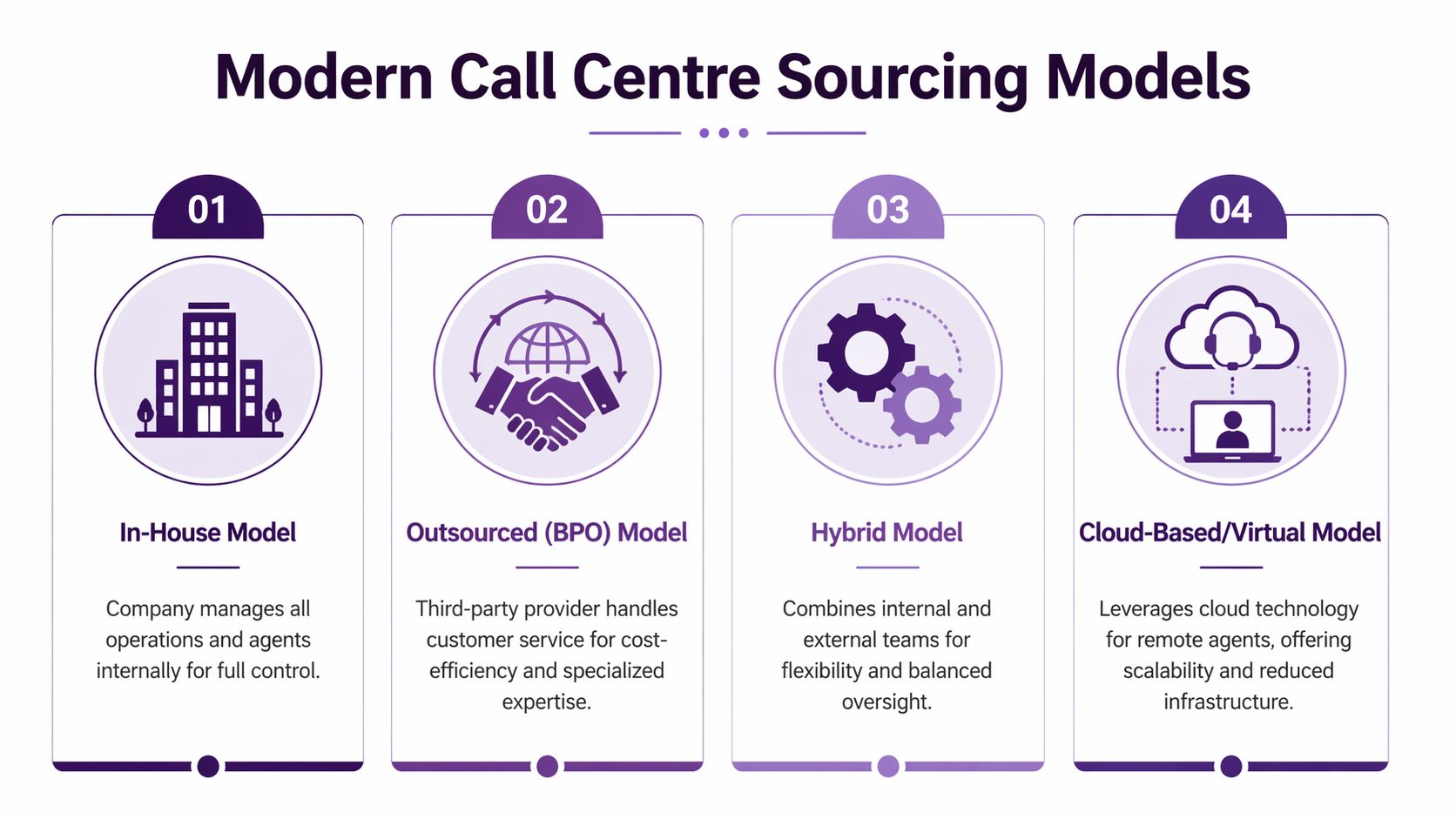
There are four practical models most companies choose from.
In-house operations
An in-house model means your company recruits, trains, manages, and supports the team directly.
This gives you the most control over hiring standards, workflows, compliance practices, and brand voice. It also creates the heaviest management load. You own staffing, attrition, technology decisions, forecasting, coaching, facilities, and performance management.
This model fits best when service is tightly tied to proprietary knowledge, strict compliance, or premium customer experience expectations that leadership wants to control directly.
Onshore outsourcing
Onshore outsourcing places your onshore customer call centers to work with a third-party provider in the same country.
The main advantage is easier alignment. Language nuance, working hours, and local market familiarity are usually straightforward. For some brands, especially those with sensitive customer interactions, that added comfort is worth the premium.
The trade-off is that onshore outsourcing often keeps many of the same cost pressures that push companies to outsource in the first place.
Offshore outsourcing
Offshore models usually appeal first on price. They can make sense for highly standardized processes with strong documentation, lower emotional complexity, and clear QA controls.
The challenge isn’t that offshore operations can’t perform. Many can. The challenge is variance. Time-zone distance, cultural mismatch, training gaps, and slower feedback loops can create friction if your workflows change often or your customer base expects conversational ease and context.
The right offshore setup needs a tighter process design than most buyers expect.
Nearshore outsourcing
Nearshore sits between onshore comfort and offshore savings. For North American companies, that often means working with teams in nearby countries where collaboration is easier and bilingual support is stronger.
The practical value shows up in day-to-day operations:
- Faster management cycles because leaders can review performance and adjust in overlapping business hours
- Better communication flow when product, QA, and operations teams need frequent interaction
- Stronger cultural alignment for sales, support, and retention work that depends on tone
- Simpler travel and oversight if you want in-person calibration with your vendor
A nearshore model isn’t automatically better. It’s usually better when quality matters enough that you can’t afford constant friction.
A simple decision lens
| Model | Cost pressure | Control | Alignment | Best fit |
|---|---|---|---|---|
| In-house | Highest | Highest | Highest | Complex, brand-sensitive operations |
| Onshore BPO | Higher | Medium | High | Outsourcing with local alignment |
| Offshore BPO | Lower | Medium to low | Lower | Standardized, process-heavy work |
| Nearshore BPO | Balanced | Medium to high | High | Growing teams that need savings without losing collaboration |
For companies actively comparing geographic models, this breakdown of nearshore vs offshore outsourcing costs, risks, and ROI is useful because it frames the decision around operating risk, not just hourly rates.
Core Services and Technology Powering Support
The strongest customer call centres are built on two things. Clear service scope and a technology stack that supports the work without making agents fight the system.
A lot of outsourcing relationships go wrong because one of those pieces is vague. The client says, “We need support.” The provider says, “We do support.” Then everyone discovers they meant different things.

Services that businesses actually buy
Most customer call centres provide some mix of the following:
- Customer service for order questions, policy explanations, status updates, complaints, and account changes
- Technical support when customers need troubleshooting, device setup help, password resets, or software guidance
- Lead generation and outbound follow-up for sales qualification, quote follow-up, renewals, and appointment setting
- Back-office processing such as data entry, verification, claim support, documentation review, and case updates
Each one solves a different business problem.
A retailer usually needs queue coverage during peak volume and return support after purchase. A healthcare group often needs appointment scheduling, intake support, and billing clarification. A financial services firm may care more about verification workflows, escalation controls, and structured call documentation.
One provider can cover several of these functions, but only if the operating model is built for it. Shared agents handling everything often look efficient on paper and weak in production.
The core technology stack
The basic stack is less mysterious than the acronyms make it sound.
ACD and IVR
Automatic Call Distribution (ACD) routes calls to the right queue or agent. Good ACD design reduces misroutes and cuts wasted time.
Interactive Voice Response (IVR) gives customers menu options or simple self-service before an agent joins. It works well for straightforward requests like balance inquiries, appointment confirmation, or payment routing. It fails when menus are confusing or built around internal departments instead of customer intent.
CRM and knowledge access
A CRM gives agents customer history. That includes prior calls, orders, account notes, service tickets, and context from other teams. Without it, every interaction starts from zero.
Knowledge access matters just as much. A script alone isn’t enough. Agents need searchable answers, escalation paths, and current policy guidance.
Practical rule: If an agent has to open five systems to answer one question, your process is the problem, not the agent.
AI in nearshore customer call centers
AI is already present in most operations, but adoption and integration are not the same thing. According to customer service statistics from AmplifAI, 88% of contact centers have adopted AI tools, but only 25% have fully integrated them into daily workflows. The same source says successful integration can reduce cost per call by 50%, improve CSAT, and handle up to 30% of service cases, with that figure projected to reach 50% by 2027.
That gap is where many operations get stuck. They buy AI for summaries, routing, chat, or quality analysis, but they don’t redesign workflows around it. As a result, agents still duplicate effort and supervisors still spend too much time cleaning up handoffs.
If you’re reviewing platforms, these call center software features are the ones worth scrutinizing because they affect daily execution far more than polished demo screens. CallZent provides bilingual inbound and outbound support with technology-enabled workflows, which is one example of how nearshore BPOs package service and systems together rather than treating them as separate decisions.
Measuring Success in Nearshore Customer Call Centers
You can spot an immature operation quickly. It obsesses over speed and talks very little about outcomes.
That usually shows up in dashboards filled with activity metrics, but no clear view of whether the customer got a real resolution. In customer call centres, the most useful KPIs are the ones that connect service behavior to cost, retention, and repeat demand.
First-call resolution matters more than most teams admit
First-call resolution, or FCR, tells you how often the team solves the issue on the first contact. That’s one of the cleanest indicators of operational health because it reflects training quality, routing quality, system access, and agent judgment at the same time.
The modern insurance call center analysis from Liveops notes that industry leaders achieve FCR rates of 74% or higher. It also states that unresolved issues can drive repeat calls that account for up to 30% of total volume, and that failing to resolve on first contact correlates with 10% to 15% higher churn in competitive sectors such as e-commerce and telecom.
That’s why low FCR is expensive in two directions. It increases service cost now and weakens customer loyalty later.
Average handle time is useful, but dangerous in the wrong hands
Average handle time, or AHT, helps you understand efficiency. It becomes harmful when leaders treat it like the primary goal.
AHT should help identify friction points such as poor documentation, weak system design, or avoidable dead air. It should not force agents to rush a customer off the line just to hit a target.
Top-performing customer call centres don’t chase low handle time. They optimize for effective resolution.
If one team has slightly longer calls and far fewer repeats, escalations, or complaints, that team is often running the better operation.
CSAT and NPS show whether service quality is landing
Customer satisfaction and promoter-style loyalty metrics matter because they tell you whether customers felt helped, not just processed.
Watch the pattern, not just the score. A single bad week in CSAT can reflect staffing gaps, a broken workflow, or a product issue surfacing through support. That’s why smart operators read survey feedback alongside QA reviews and contact drivers.
A practical KPI reading order
When I review performance, I look at metrics in this order:
- Resolution first because unresolved demand creates future volume.
- Customer sentiment next because a technically correct answer can still create churn if the experience feels poor.
- Efficiency after that because speed matters, but only after quality is stable.
- Agent-level variance because averages can hide underperforming workflows or coaching gaps.
For teams building a more disciplined scorecard, this guide to monitoring call center performance helps tie KPI reporting to operational decisions instead of vanity dashboards.
How to Choose Your Call Center Partner
A provider can have a polished sales deck, modern software, and attractive pricing and still be the wrong fit for your business.
The question isn’t whether a vendor can answer calls. Most can. The question is whether they can protect your customer experience when volume spikes, workflows change, and edge cases start piling up.
That standard is worth taking seriously. Statista’s overview of the U.S. call center services industry says poor customer service costs U.S. firms $75 billion annually. The same source states that 60% of customers leave after unfriendly interactions and 46% switch because agents lack knowledge. A bad partner doesn’t just create inconvenience. It creates revenue leakage.
What to evaluate before you ask for pricing
Start with operational fit.
-
Training depth
Ask how the provider trains for product knowledge, soft skills, escalation handling, and change management. If training sounds generic, service quality will be generic too. -
Quality assurance process
Look for calibration routines, scorecards, coaching loops, and client visibility. If QA happens only after problems explode, it isn’t a real QA function. -
Technology readiness
Confirm how they handle routing, CRM access, call recording, knowledge management, reporting, and integration with your systems. -
Security and compliance
This is critical for healthcare, finance, and insurance. Ask who can access customer data, how permissions are managed, and how incidents are escalated. -
Staffing model
Some operations rely on stable dedicated teams. Others rotate agents across accounts. That choice affects consistency, ramp time, and accountability. -
Management accessibility
You need clear ownership. Know who runs daily operations, who handles escalations, and how often business reviews happen.
Questions that expose the truth
An RFP should force the provider to describe how they operate, not just what they sell.
Ask questions like:
-
Walk me through your first 30 days of launch.
This shows whether they have a real implementation process or are improvising. -
How do you handle sudden volume increases?
You’ll learn whether they have bench capacity, cross-training, or just optimistic assumptions. -
How do supervisors coach agents who are polite but ineffective?
This separates service theatre from performance management. -
What breaks most often during integration?
Serious operators know where implementation friction lives. -
How do you prevent knowledge decay after launch?
Training isn’t a one-time event.
The best partner is usually the one that answers difficult questions directly, including where its model is strong and where it isn’t.
Don’t buy on labor rate alone
Buyers sometimes compare providers line by line as if they’re purchasing interchangeable seats. That misses the actual economics.
A cheaper team that creates more repeats, more escalations, and more customer frustration is not cheaper. It’s just less visible on the invoice.
This is also where infrastructure model matters. If your priority is speed to launch or operational flexibility, reviewing a seat leasing BPO partner can be helpful because it highlights an alternative structure for companies that want physical capacity and support functions without building their own facility footprint.
A practical shortlist framework
Use a simple traffic-light method when evaluating finalists.
| Category | Green light | Yellow light | Red light |
|---|---|---|---|
| Operations | Clear processes and ownership | Some gaps, but fixable | Vague answers |
| Talent | Thoughtful hiring and coaching | Generalized approach | High dependency on scripts |
| Technology | Can integrate and report well | Functional but limited | Separate systems with weak visibility |
| Culture | Collaborative and transparent | Polite but reactive | Defensive or evasive |
| Scalability | Credible ramp plan | Unclear assumptions | No real contingency model |
A strategic partner should make your operation easier to run, not harder to supervise.
Nearshore Customer Call Centers in Action by Industry
The value of customer call centres becomes clearer when you look at how they work under real operating pressure. Different industries need different combinations of speed, empathy, compliance, and process control.
E-commerce under peak volume
An online retailer usually feels support pain all at once. A promotion hits, order volume jumps, and then the contact reasons stack up behind it. Customers want shipping updates, delivery corrections, return labels, replacement orders, and refund timelines.
A capable call center does more than answer those contacts. It separates the easy work from the sensitive work.
For example, one queue might handle routine order status questions with scripted guidance and system lookup. Another queue takes failed deliveries, damaged goods, and high-friction complaints that need stronger judgment. If everything goes into one general support bucket, wait times rise and quality drops for the cases that need experienced agents.
Healthcare needs process discipline
Healthcare support sounds simple until you map the details. Patients call to schedule visits, confirm appointments, ask billing questions, update information, or follow up after treatment.
The difference between a useful healthcare support team and a risky one is process discipline. Agents need clear scripts, privacy-safe workflows, escalation paths, and tightly controlled documentation habits. Even basic scheduling work can become messy if handoffs to clinical or billing teams aren’t defined.
A good healthcare operation also respects the emotional state of the caller. People who are confused about coverage or worried about a visit don’t experience “efficiency” the same way a retail customer does. Tone matters more.
Financial services runs on trust
In finance, the call is rarely just informational. The customer may be reporting suspicious activity, trying to understand a payment issue, checking account status, or asking about a loan or policy process.
The service model has to balance two things at once. Security and reassurance.
Agents need to verify identity correctly, document every step, and escalate exceptions without introducing confusion. At the same time, they need to sound calm and competent. A technically correct process delivered with poor communication still damages trust.
In regulated industries, the script is only half the job. The other half is disciplined execution under pressure.
What changes by industry, and what doesn’t
The contact reasons change. The fundamentals don’t.
Across industries, the strongest customer call centres still rely on the same operational habits:
- Clear routing so the right issues reach the right people
- Current knowledge so agents don’t improvise answers
- Escalation discipline so edge cases don’t stall
- Visible QA so service standards stay consistent
- Management feedback loops so recurring problems get fixed upstream
That’s why industry expertise matters, but only when it’s paired with sound operating mechanics.
The CallZent Nearshore Advantage
Most businesses don’t need the absolute highest-control model or the absolute lowest-cost model. They need a service operation they can run well.
That’s where nearshore customer call centres make practical sense. You get cost relief compared with running everything internally or using onshore labor, but you avoid many of the communication and oversight problems that show up when teams are too far removed from your market, hours, and customer expectations.
For North American companies, Tijuana is a workable location for that balance. The overlap in business hours helps with live supervision, QA reviews, training updates, and issue escalation. Bilingual staffing also matters because many businesses don’t just need English support. They need English and Spanish support delivered with consistency.
Why location changes operating quality
Location isn’t just a line item. It affects how quickly teams align.
Nearshore teams tend to be easier to coach in real time, easier to visit, and easier to integrate into existing workflows with U.S. and Canadian stakeholders. That matters when your product changes often, when support needs close coordination with sales or operations, or when customer interactions depend on cultural nuance.
Where the model fits best
Nearshore is often the strongest fit when:
- Your business is growing quickly and service demand is getting harder to forecast
- You need bilingual coverage without splitting quality across different vendors
- Your customers expect conversational fluency and clear problem-solving
- Your leadership team wants visibility into day-to-day performance, not just monthly reports
For companies weighing these factors, the nearshore advantage is less about geography alone and more about operational closeness. That closeness usually shows up in faster decisions, smoother collaboration, and fewer quality surprises.
If your current support model feels expensive, inconsistent, or hard to scale, a nearshore structure is often the most practical middle path.
Scale Your Customer Support with CallZent
Build a call center operation that grows with your business—without sacrificing quality.
Get Started TodayIf you’re evaluating customer call centres and want a model that balances cost, quality, bilingual support, and operational visibility, talk with CallZent. A good discovery conversation should clarify your service goals, channel mix, staffing needs, and sourcing options before you commit to any buildout.