Skip to content
Lead Generation
Affordable Lead Generation Services That Deliver Real ROI
Learn how to choose affordable lead generation services that lower cost per qualified lead, avoid bad data, and use nearshore bilingual teams to boost ROI.
TL;DR — Quick Takeaways
- Affordable lead generation services should focus on qualified opportunities, not just contact volume.
- Cheap lead lists often increase costs due to wasted sales time and poor conversion rates.
- Pricing models vary—retainers and hybrid models usually deliver better long-term ROI.
- Nearshore bilingual teams improve qualification, response rates, and overall efficiency.
Leads can look cheap on paper and still be expensive in real life.
That usually happens when a business buys a list, pays for clicks, or hires a low-cost vendor, then discovers the sales team is chasing contacts who were never a fit to begin with. The spend shows up in one budget line. The wasted hours show up everywhere else.
Affordable lead generation services aren’t about paying the lowest fee. They’re about paying for a process that gives your team a realistic shot at converting interest into revenue. If the vendor sends names that never answer, never qualify, or never buy, the service wasn’t affordable. It was just cheap.
For growing businesses, especially in healthcare, finance, e-commerce, telecom, and retail, the question is simple. Are your leads costing more than they’re worth by the time your team finishes chasing them?
Affordability in lead generation is not about finding the cheapest price. It’s about achieving the lowest cost per qualified sale.
Introduction: Are Your Leads Costing More Than They Are Worth?
A familiar pattern shows up when companies start looking for affordable lead generation services. Revenue pressure rises, the pipeline feels thin, and someone says, “Let’s buy leads and fill the funnel fast.” A few weeks later, the CRM is fuller, but sales isn’t happier.
The problem usually isn’t lead volume. It’s lead quality, slow follow-up, weak qualification, or a vendor model built around quantity instead of outcomes. That’s why two services with similar price tags can produce completely different business results.
Why cheap often costs more
A low-cost list broker sells access to data. A real lead generation partner helps you identify who fits, who has interest, who should be contacted now, and what your team should do next. Those are not the same product.
Businesses that treat lead generation like a commodity often create hidden costs:
- Sales time waste: reps spend their day calling people who were never likely to buy.
- Bad forecasting: pipeline volume looks healthy while actual close potential stays weak.
- Team frustration: marketing blames sales, sales blames lead quality, and nobody trusts the numbers.
- Slower growth: your best prospects get delayed while your team sorts through noise.
What affordability should mean
A service is affordable when it improves efficiency, protects your team’s time, and lowers the cost of creating real sales conversations. In practice, that means looking at qualification standards, handoff quality, reporting, and channel fit before looking at monthly fees alone.
Businesses that get this right don’t ask only, “What does it cost?” They ask, “What are we buying, and what happens after the lead is created?”
What Affordable Lead Generation Services Really Are
A lot of confusion starts with one bad assumption. Businesses think “lead generation service” means someone hands over a spreadsheet of names and phone numbers. That’s a list purchase, not a lead generation program.
A true service combines targeting, outreach, qualification, follow-up, and reporting. It should help your team spend time on people who fit your market and show credible buying signals.
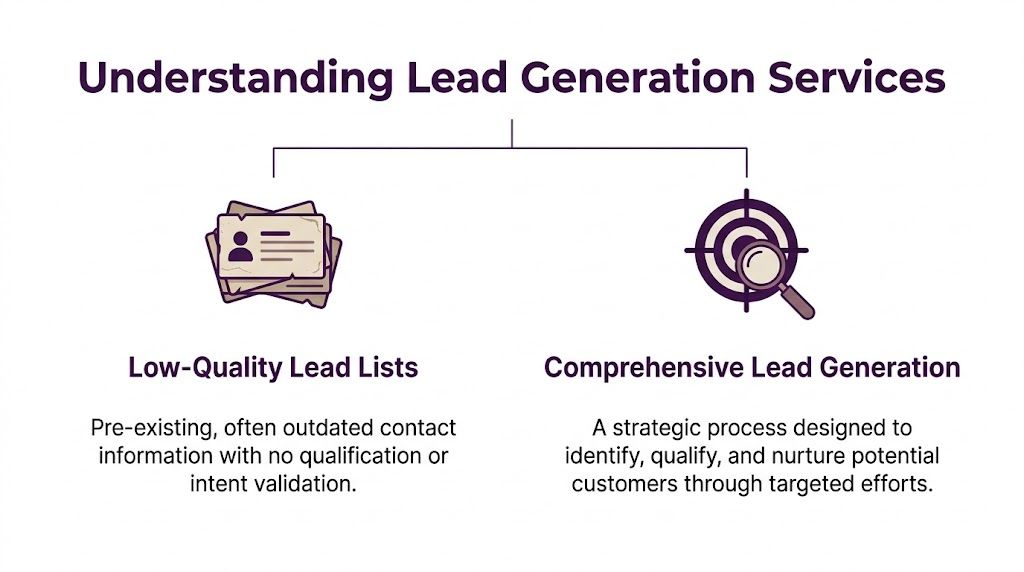
Lead lists versus lead generation
A lead list is static. It may contain outdated contacts, generic titles, or companies that match a broad category but have no current need.
A lead generation service is active. It tests messaging, filters fit, captures objections, updates records, and pushes qualified contacts into the next stage.
Here’s the practical difference.
| Option | What you get | Main risk | Best use |
|---|---|---|---|
| Lead list | Raw contact data | Low intent, stale data, no qualification | Internal prospecting if your team has time and systems |
| Lead generation service | Targeting, outreach, qualification, reporting | Higher upfront coordination | Businesses that want pipeline quality, not just volume |
Why MQLs and SQLs matter
Businesses often lump all leads into one bucket. That causes problems fast.
- Marketing Qualified Lead (MQL): a contact who fits your target profile and has shown some level of engagement.
- Sales Qualified Lead (SQL): a contact who has been vetted further and is ready for a sales conversation or appointment.
If a vendor bills you for MQLs and your sales team expects SQLs, you’ll feel misled even if the vendor technically delivered what the contract said. Alignment has to happen before campaigns launch.
A lead that looks good in a spreadsheet can still be useless in a sales calendar.
What good affordable lead generation services include
The strongest services usually combine people, process, and systems.
- Strategy: targeting by industry, role, geography, language, and offer.
- Technology: CRM workflows, dialers, sequencing tools, and reporting dashboards.
- Human qualification: live conversations that confirm fit, timing, interest, and next steps.
- Feedback loops: campaigns improve because sales outcomes feed back into targeting.
AI can provide assistance, though with limitations. Recent developments show that hybrid models combining AI tools like chatbots and predictive dialing with human oversight deliver better results. AI can boost lead volume by 35%, but conversion rates often drop by 20% without human qualification, and nearshore BPOs that pair AI with bilingual agents have been shown to yield 2.5x ROI over pure AI solutions by handling nuanced objections in English and Spanish, according to Belkins’ discussion of hybrid lead generation models.
That matters for companies selling nuanced services, regulated products, or anything that requires trust. A bot can start the conversation. A trained agent can decide whether the opportunity is real.
In regulated and relationship-driven sectors, the qualification layer matters even more. Financial institutions, for example, often need specialized workflows to qualify high-value bank clients instead of sending every inquiry straight to a banker.
Decoding Pricing Models and Setting Realistic ROI
Businesses shopping for affordable lead generation services usually ask for pricing first. That’s understandable, but price only makes sense after you know the billing model and what counts as success.
One vendor may charge per lead. Another may charge per appointment. Another may work on a monthly retainer and optimize across channels. Those aren’t directly comparable unless you know how qualification works.

The four pricing models you’ll see most often
Pay per lead
You pay when the vendor delivers a lead that meets agreed criteria.
Good fit: businesses that want a simple, predictable acquisition model.
Trade-off: the cheaper the lead target, the more pressure the vendor feels to optimize for volume. If qualification rules are weak, you can end up buying names instead of opportunities.
Pay per appointment
You pay for scheduled meetings rather than contacts.
Good fit: companies with a strong sales team that wants conversations already booked.
Trade-off: an appointment isn’t automatically a good appointment. If the vendor books loosely qualified meetings just to hit volume, the calendar fills but revenue doesn’t.
Monthly retainer
You pay for ongoing strategy, targeting, outreach, testing, reporting, and optimization.
Good fit: businesses that want a partner model and are serious about improving over time.
Trade-off: it requires trust, communication, and patience. You’re buying process quality, not just immediate transactions.
Hybrid model
This usually blends a base retainer with performance-based components.
Good fit: businesses that want shared accountability.
Trade-off: contracts need clean definitions. Otherwise, disputes show up around what counts, when it counts, and who owns performance.
What “affordable” looks like in context
Cost benchmarks vary sharply by industry and channel. Inbound marketing leads cost 61% less on average than outbound leads, and the mean cost per lead across industries is around $198, while eCommerce can be as low as $91, according to InBeat’s lead generation statistics.
That’s why channel mix matters so much. A vendor can look expensive on a monthly basis and still be efficient if they work in channels with better economics and stronger lead intent.
If you’re comparing service models, it helps to review broader communication platform costs too. For example, businesses evaluating outreach infrastructure sometimes look at tools like Call Loop pricing plans to understand how software fees fit into total campaign cost.
For a practical view of outsourcing structures, service tiers, and what different support models usually include, it’s worth reviewing call center outsourcing costs and pricing.
How to think about ROI without overcomplicating it
You don’t need a finance team to evaluate ROI. You need a working view of four things:
- Lead quality: does this vendor produce contacts your sales team wants?
- Conversion path: what happens from lead to appointment to proposal to close?
- Sales capacity: can your team follow up fast enough to capitalize on the leads?
- Customer value: a low-ticket transaction and a high-value long-term account should never be judged the same way.
Practical rule: judge affordable lead generation services by cost per qualified opportunity and downstream revenue potential, not by contact volume alone.
A simple example makes this easier. If one provider sends many low-fit leads and another sends fewer but sales-ready conversations, the second model often wins even when its monthly fee is higher. Buyers don’t feel the waste in the invoice first. They feel it in rep time, missed follow-up, and unreliable pipeline data.
Key Types of Lead Generation Channels and Tactics
When a vendor says they offer affordable lead generation services, ask what channels they use. The answer tells you what you’re buying.
A good partner doesn’t force every client into the same playbook. They choose channels that match your sales cycle, market, buying behavior, and follow-up capacity.
Outbound calling and email
Outbound works when targeting is tight and messaging is specific. It struggles when a vendor sprays generic scripts across broad lists.
Ask direct questions:
- Who builds the list? If the answer is vague, expect poor fit.
- How is messaging adapted by industry or role? A CFO, store manager, and practice administrator do not respond to the same language.
- What happens after the first touch? Real outreach needs sequencing, callback logic, and objection handling.
- How do they protect deliverability and message quality? Even details like email subject line capitalization can affect how professional and credible outreach feels.
Phone outreach remains valuable because it creates immediate feedback. You learn whether the offer is relevant, whether the timing is wrong, and whether your targeting assumptions hold up.
Inbound and content-driven channels
Inbound attracts people already looking for solutions. That usually creates better intent than broad cold outreach, but it takes structure to work.
A vendor using inbound well should be able to explain:
- What content offer they use such as guides, checklists, landing pages, or consult requests.
- How they capture and route interest into your CRM or calendar.
- What follow-up sequence runs after form submission so leads don’t sit untouched.
If you want a practical framework for that handoff, lead generation best practices is a useful reference point.
Digital campaigns and paid traffic
Paid traffic can work fast, but it can also burn budget fast. This channel makes sense when your offer is clear, your landing pages convert, and your team can follow up immediately.
What to ask:
- Do they manage targeting and landing page alignment together?
- How do they screen weak form fills?
- Are they optimizing for lead count or sales relevance?
If the answer centers on clicks, impressions, or traffic alone, keep digging.
Webinars and event-based outreach
Webinars are often overlooked by companies focused only on ads and outbound. That’s a mistake when the goal is cost-efficient education plus qualification.
Webinars have an average cost per lead of $72, and 73% of companies use event marketing to generate leads. Sign-ups also tend to be strongest on Tuesdays and Thursdays, according to Keywords Everywhere lead generation stats.
That channel works well for businesses that need to explain something before asking for a decision. Healthcare services, financial products, telecom offers, and B2B software all fit that pattern.
 How to Evaluate and Choose the Right Partner
The difference between average and high-performing lead generation vendors usually shows up in process discipline, not sales presentation. A polished pitch means very little if the team can’t define qualification, report clearly, or adapt fast when messaging misses.
Start with proof, not promises
Ask for examples from your industry or from similar buying environments. You don’t need polished vanity stories. You need practical evidence that the vendor understands your sales motion.
Strong agencies should be able to discuss:
- Target account logic: who they pursue and why
- Qualification standards: what gets passed to sales and what gets filtered out
- Common objections: what prospects say when they’re interested, hesitant, or clearly not a fit
- Reporting cadence: how often you review outcomes together
Top-tier B2B agencies achieve 45%+ open rates and 12%+ response rates on cold email campaigns, and that level of execution can produce a cost-per-qualified-lead under $50, compared with over $100 for in-house teams, according to Sales Aladin’s review of affordable lead generation services. The point isn’t that every company should expect identical numbers. The point is that process quality creates a large performance gap.
Ask operational questions that expose weak vendors
A few questions reveal a lot very quickly:
| Question | What a strong answer sounds like | Warning sign |
|---|---|---|
| How do you define a qualified lead? | Clear fit and intent criteria | “We customize that later” |
| What tools do you use? | CRM, outreach stack, reporting workflow | Tool list with no process explanation |
| How do you handle feedback? | Weekly or regular campaign adjustments | “We’ll review at the end of the month” |
| Who owns messaging? | Shared input with testing | Generic scripts for every vertical |
Look for partner behavior
A good vendor acts like an extension of your revenue team. They ask about your customer profile, offer, timing, objections, compliance requirements, and sales handoff. They don’t rush past those details to get a contract signed.
If you’re weighing outsourced support models, how to outsource lead generation offers a useful checklist for evaluating fit before you commit.
The best partner is rarely the one with the loudest promise. It’s the one that can explain exactly how a stranger becomes a qualified sales conversation.
The Nearshore Advantage Why Location Matters for Affordability
A North American company can buy cheap leads from almost anywhere. The problem shows up a week later, when response rates are weak, follow-up lags, and sales teams start rejecting handoffs because the conversations never sounded right in the first place.
Location affects more than hourly cost. It shapes working hours, manager oversight, language quality, speed of feedback, and how well agents handle buyer objections in real time. For companies selling into the U.S., Canada, or mixed English-Spanish markets, those details have direct impact on cost per qualified opportunity.

Why nearshore often beats onshore and offshore
Onshore teams are easier to coordinate with, but labor cost can make steady outbound coverage hard to sustain. That matters if your program needs daily calling, fast lead follow-up, or a larger team to test messaging across segments.
Offshore teams can lower the initial price. I have also seen that savings disappear fast when campaign revisions take too long, quality control is inconsistent, or agents struggle with the tone North American buyers expect on live calls.
Nearshore delivery tends to balance those pressures better for growing companies. The advantages are practical:
- Lower operating cost than U.S.-based SDR hiring
- Working-hour overlap with North American sales and marketing teams
- Stronger cultural and conversational fit for U.S. and Canadian outreach
- Bilingual coverage for English and Spanish qualification
That mix matters because affordable lead generation is not about the cheapest labor line. It is about getting qualified conversations at a cost your margin can support.
Why bilingual qualification changes the ROI
For many North American businesses, bilingual coverage is no longer a nice extra. It is part of basic market access.
A retail brand may need to qualify wholesale inquiries from both U.S. and Mexico-based buyers. A healthcare organization may need patient outreach that feels clear and respectful in either language. A financial services team may start a call in English and finish it in Spanish because that is how the prospect is most comfortable discussing details.
Cheap list vendors do not solve that problem. A capable nearshore partner can. The difference is operational. You are paying for live qualification, better contact rates, cleaner handoffs, and fewer missed opportunities caused by language friction.
What good nearshore onboarding looks like
The first month usually tells you whether the vendor will produce pipeline or create extra management work. Good onboarding is specific, documented, and tied to sales outcomes.
A practical setup includes:
- A clear ideal customer profile
- Shared qualification criteria for handoff
- Scripts built around real objections and buyer language
- CRM integration and reporting tied to your sales process
- Call reviews with feedback from both teams
For companies weighing location, labor model, and bilingual support, nearshore lead generation advantages for North American businesses gives a useful breakdown of what proximity changes in day-to-day execution.
CallZent is one example of this model. It is a nearshore bilingual call center and BPO in Tijuana that supports outbound and inbound programs, including lead generation, for North American companies that need English and Spanish coverage.
Industry-Specific Strategies for Maximum Impact
Affordable lead generation services work best when the workflow matches the buying behavior of the industry. Generic campaigns usually fail because they ignore what the buyer needs before saying yes to a meeting or a next step.
E-commerce
In e-commerce, not every lead is a direct retail sale. Some of the strongest opportunities are wholesale inquiries, repeat buyers, and customers who abandoned high-value transactions.
A useful model looks like this:
- Bilingual cart recovery and callback support: agents follow up with shoppers who showed strong buying intent but stopped short.
- Wholesale inquiry qualification: a team screens business buyers before they reach your sales staff.
- Customer service plus lead capture: support conversations often reveal upsell or reorder opportunities when handled well.
The value isn’t only in more outreach. It’s in knowing which contacts deserve human follow-up right now.
Healthcare
Healthcare lead generation needs tighter handling. Language, timing, and privacy expectations all shape the process.
A practical healthcare workflow may include:
- appointment request screening
- patient follow-up reminders
- preventive care outreach
- referral intake qualification
The key is consistency. A missed callback in healthcare doesn’t just cost revenue. It can damage trust and create scheduling friction for staff.
Finance and insurance
In finance, speed and clarity matter. Prospects often compare multiple providers, and they rarely wait long for a response.
That’s why financial firms often need a front-end qualification layer that can sort inquiries by product type, urgency, geography, and readiness before they hit licensed teams. For institutions focused on banking workflows, lead generation for banks offers a more specific view of how that qualification process can work.
Field note: the more regulated the industry, the less useful generic lead volume becomes. Qualification quality matters more because every handoff carries more cost and more responsibility.
Common Pitfalls and How to Avoid Them
Most lead generation disappointments are predictable. The warning signs show up early, but businesses ignore them because the offer sounds affordable or the vendor promises speed.
Five mistakes that drain ROI
-
Choosing the lowest price: low pricing often means weak targeting, recycled data, or rushed qualification.
Fix: compare based on lead definition, process depth, and follow-up quality. -
Expecting instant scale: good campaigns need calibration. Messaging, targeting, and handoff rules usually need adjustment before performance stabilizes.
Fix: treat the early phase as optimization, not final judgment. -
Never defining a qualified lead: if your team and the vendor use different definitions, frustration is guaranteed.
Fix: document fit, interest, and handoff criteria before launch. -
Failing to follow up internally: even strong vendors can’t save leads that sit untouched in a shared inbox or CRM queue.
Fix: assign ownership and response windows before the first lead arrives. -
Treating the vendor like a list supplier: lead generation improves through feedback. Silence slows that process.
Fix: hold regular reviews and share close-lost reasons, not just complaints.
Cheap lead generation fails in familiar ways. It overpromises, under-qualifies, and leaves your team to absorb the mess.
Frequently Asked Questions about Lead Generation Services
How long does it take to see results from affordable lead generation services
It depends on the channel, the quality of your offer, and how much setup is needed. Outbound programs can start producing signals earlier, but real consistency usually takes a calibration period. Teams need time to test messaging, refine targeting, and align on what counts as qualified.
Can affordable lead generation services work in a niche B2B industry
Yes, if the partner is willing to learn the market and build around it. Niche lead generation rarely works with generic scripts and broad lists. It works when the vendor understands the buyer role, the pain points, and the right trigger for outreach.
What’s the difference between a lead and an appointment
A lead is a person or company that may fit your market and has shown some level of interest or relevance. An appointment is further down the line. It usually means the person has been qualified and agreed to a scheduled meeting with your sales team.
What should I provide a lead generation partner before launch
At minimum, provide:
- Your ideal customer profile: industry, company size, geography, buyer titles, and exclusions
- Your value proposition: why someone should take the call or reply now
- Common objections: what prospects usually hesitate about
- Sales process details: who receives leads, how quickly they respond, and what happens next
- Calendar and CRM access plan: if the vendor books meetings or updates records
Should I buy lead lists to save money
Usually not as a standalone strategy. Lists may help internal prospecting when your team has strong systems and enough time to validate data, but a list by itself doesn’t create qualification, timing, or buying intent. For most growing businesses, that route creates more work than value.
Are bilingual services worth paying for if most of my customers speak English
If part of your market includes Spanish-speaking buyers, patients, account holders, or support contacts, bilingual coverage can remove friction fast. It also helps when families, business partners, or decision-makers shift languages during real conversations. In those cases, language flexibility isn’t a nice extra. It’s part of qualification quality.
🚀 Generate Better Leads, Not Just More Leads
CallZent helps businesses build high-performing lead generation systems with bilingual nearshore teams, real qualification, and measurable ROI.
Schedule a CallIf your team is sorting through low-quality leads, weak follow-up, or vendor options that all sound the same, CallZent is worth a look. As a bilingual nearshore BPO in Tijuana, it supports North American businesses with lead generation and call center services built around practical qualification, English and Spanish communication, and cost-conscious operations.