

IT OUTSOURCING COMPANIES
Top IT Outsourcing Companies in 2026: Comparing the 7 Best Providers for Growth
Explore the top IT outsourcing companies in 2026, compare enterprise, nearshore, and managed service providers, and learn how to choose the right technology partner for long-term business growth. Based on current market trends and leading providers including Accenture, Cognizant, EPAM, Globant, Softtek, ScienceSoft, and CallZent. :contentReference[oaicite:0]{index=0}
TL;DR — Quick Takeaways
- IT outsourcing is no longer a cost-saving tactic. It has become a strategic operating model used by organizations of every size. :contentReference[oaicite:1]{index=1}
- Accenture and Cognizant dominate enterprise transformation projects requiring governance, modernization, and large-scale support operations. :contentReference[oaicite:2]{index=2}
- EPAM and Globant excel in engineering-heavy and product-focused engagements where innovation and software quality drive business outcomes. :contentReference[oaicite:3]{index=3}
- Softtek and CallZent highlight the growing power of nearshore delivery models for North American companies seeking collaboration without offshore friction. :contentReference[oaicite:4]{index=4}
- The best outsourcing provider depends on business goals, operational complexity, and support requirements—not brand recognition alone. :contentReference[oaicite:5]{index=5}
Is your IT holding your business back? If projects keep slipping, support queues keep growing, and hiring for specialized roles feels slower than the business itself, the problem often isn’t effort. It’s delivery capacity. That’s why so many leadership teams are reassessing how they use IT outsourcing companies, not as a one-time labor play, but as a core operating model.
That shift is already visible in the market. By 2024, the global IT services outsourcing market reached USD 744.6 billion, with a projection of USD 1.22 trillion by 2030. The same industry coverage notes that 92% of Global 2000 companies outsource IT services, which tells you this model is well past the experimental stage. Buyers aren’t asking whether outsourcing is acceptable anymore. They’re asking which partner fits the work, the risk, and the pace of change.
Choosing an outsourcing partner isn’t a cost-cutting tactic. It’s a strategic growth decision. The best fit depends on your scale, needs, and operating model.
If you want another useful perspective on delivery trade-offs, Rite NRG’s software outsourcing guide is worth a read. But if you need a practical short list fast, start here.
1. Accenture
Accenture is what large enterprises choose when the scope is broad, the governance burden is high, and the business wants one partner that can handle both transformation and long-term run operations. It spans applications, cloud and infrastructure, data, AI, and managed operations at a scale few vendors can match.
This isn’t the firm I’d point a smaller company toward for a narrow support need or a quick pilot. It makes more sense when you’re modernizing core platforms, consolidating vendors, or redesigning how IT and business operations work together. In regulated industries, that maturity matters.
Where Accenture fits best
The simplest way to think about Accenture is this. It’s built for complexity. If your environment includes legacy systems, multiple business units, internal compliance teams, and executive stakeholders who expect formal governance, Accenture usually feels familiar rather than overwhelming.
A common use case is a company that needs cloud migration, application modernization, cybersecurity support, and operating-model redesign under one umbrella. That’s a very different buying decision from hiring a boutique dev shop.
- Best use case: Large, multi-year transformation programs with managed services layered in
- Strong point: Deep industry playbooks for healthcare, finance, retail, and communications
- Watch-out: Smaller buyers can end up paying for process overhead they don’t really need
Practical rule: If your RFP is more about risk control and service continuity than hourly rates, Accenture deserves a serious look.
What works and what doesn’t
What works is the depth. You can move from advisory work into delivery and then into managed support without re-platforming your vendor relationship. That continuity helps when executive teams want fewer handoffs.
What doesn’t work as well is speed for small decisions. Enterprise-grade discovery, statements of work, and procurement cycles can slow down buyers who just need targeted delivery support. If your team is still figuring out whether it needs managed services or staff augmentation, read this guide on finding technology support companies before you jump into a heavyweight engagement.
2. Cognizant
Cognizant is a strong option when the underlying problem isn’t just staffing. It’s operational drag inside applications, support, and process-heavy technology work. Its pitch is AI-led modernization paired with business process depth, which makes it useful for firms that want to improve both the software stack and the operating layer around it.
That matters because outsourcing itself has changed. Recent industry reporting says 46% of businesses already outsource technology services, while another 42% are considering it within the next 12 months. The same research stream says organizations deliver an average of 76% of IT work through external providers, shared services, or other third-party models, and 81% outsource at least some cybersecurity activity. That’s not fringe behavior. It’s mainstream delivery design.
Why Cognizant stands out
Cognizant is strongest when application services, modernization, and intelligent operations need to work together. Its AI-led services model will appeal to companies that want better incident handling, more automation in support, and tighter DevSecOps or SRE discipline.
In practical terms, that could mean an enterprise modernizing an aging application portfolio while also improving ticket flow, production reliability, and service management. Buyers often underestimate how much value sits in those operational layers.
- Best use case: Enterprises and upper mid-market firms modernizing applications and service operations together
- Strong point: Broad reach across app development, maintenance, digital engineering, and operations
- Watch-out: Onboarding can feel procurement-heavy if your scope is modest
The trade-off buyers should understand
Cognizant makes sense when you want a partner with enough scale to own recurring operations, not just ship code. But that same scale can create friction if your team wants a lightweight, highly flexible pilot.
If your biggest pain is internal support responsiveness rather than platform transformation, compare a large integrator against a more specialized service model first. This page on IT help desk support services is a good example of the narrower operating approach some companies need.
3. EPAM Systems
EPAM Systems is the engineering-led choice on this list. If your outsourcing decision revolves around product quality, complex builds, platform architecture, or long-term software evolution, EPAM often feels stronger than firms that lean more heavily into operations or consulting-led transformation.
This is the company I’d shortlist when the backlog is technically hard. Think multi-system integrations, cloud data platforms, customer-facing digital products, or modernization efforts where weak engineering discipline will get expensive fast.
Where EPAM earns its place
EPAM has a reputation for serious software engineering. That matters when the project can’t survive generic staffing. Many buyers say they want “outsourcing,” but what they need is a product engineering partner that can work like an extension of an internal architecture team.
The company is also notable because it offers a path for smaller organizations through EPAM Startups & SMBs. That lowers the barrier for buyers who want quality engineering without stepping into a full enterprise-style engagement on day one.
- Best use case: Complex software products, modern platforms, and engineering-heavy modernization
- Strong point: Strong technical depth and credible long-term product partnership potential
- Watch-out: Premium engineering usually costs more than generalist or lower-cost alternatives
Good engineering partners save money by preventing rework, not by being the cheapest line item in procurement.
Best buyer profile
EPAM is a fit for product-minded companies. If your leadership team talks about architecture debt, release quality, observability, and roadmap execution, EPAM will likely resonate.
If the core need is ongoing application support after the build, not the build itself, make sure the vendor’s maintenance model is as strong as its delivery team. This practical guide to application maintenance support is useful because a lot of outsourcing relationships stumble after launch, not before it.
4. Globant
Globant wins on a different axis. It combines strong digital product delivery with a nearshore-friendly model across the Americas, and that makes it especially appealing to U.S. companies that care about collaboration speed, design quality, and product momentum.
Its value isn’t just the engineering. It’s the mix of experience design, agile delivery, and time-zone alignment. That’s often more useful than a lower-cost model that struggles with feedback loops and iteration speed.
Why nearshore matters here
Recent industry coverage says hybrid outsourcing is now the dominant U.S. strategy, blending onshore, nearshore, and offshore teams to balance cost, collaboration, and risk. The same analysis describes nearshoring as a “Goldilocks” zone for U.S. firms because of overlapping work hours and lower costs, which is exactly the kind of operating context where Globant tends to perform well for North American buyers in customer-facing or regulated environments. You can see that framing in Blackthorn Vision’s review of hybrid outsourcing and delivery models.
Globant is a strong option when product managers, designers, and engineers need real-time interaction. That’s common in app redesigns, customer portals, and digital experience initiatives.
The real trade-off
Globant can be a great fit if your company values design-forward discovery and iterative workshopping. But buyers should understand that those strengths can add time and cost early in the engagement. If your leadership team is impatient with discovery and wants fixed-scope delivery immediately, that can create tension.
- Best use case: Nearshore digital product work with strong UX, CX, and agile collaboration needs
- Strong point: Good mix of design, engineering, and Americas-based collaboration
- Watch-out: Discovery-heavy approaches can frustrate teams that want fast, tightly bounded execution
If you’re comparing partners for SaaS product work specifically, this guide on how to develop software as a service is a good lens for evaluating whether the vendor thinks like a product builder or just a staffing provider.
5. Softtek
Softtek deserves attention because it represents a mature version of nearshore delivery, not a lightweight alternative to global outsourcing. Founded in Mexico, it has long been associated with serving U.S. clients through a model that blends onshore, nearshore, and offshore delivery.
For buyers in North America, that’s a practical advantage. The conversation is easier when teams share working hours, language coverage, and business context. Softtek tends to appeal to organizations that want those benefits but still need broad enterprise capability.
Where Softtek is strongest
Softtek is a good fit for application development and management, cloud services, quality engineering, and next-generation operations. It often sits in the middle ground between a massive global integrator and a smaller niche nearshore provider.
That middle position is useful. Some companies need mature governance and broad service coverage, but they don’t want the weight of a top-tier global giant.
- Best use case: U.S. buyers who want bilingual, time-zone-aligned delivery with enterprise discipline
- Strong point: Strong cultural alignment for North American programs and broad service scope
- Watch-out: Governance can feel heavy if your project is very small or highly experimental
What I’d verify before signing
With Softtek, I’d focus due diligence on the actual delivery team structure. Nearshore can mean very different things in practice. Ask which roles are client-facing, where the core engineering team sits, and how escalation works across locations.
That matters because market demand is now broad-based across specialized managed services. One industry estimate places the U.S. IT outsourcing market at USD 185.33 billion in 2026, with a projection of USD 235.63 billion by 2031 and a 4.92% CAGR. The same source reports that 77% of companies outsource IT infrastructure services and cybersecurity, 72% outsource software development, and 69% outsource application support. Buyers aren’t outsourcing one isolated function anymore. They’re building service portfolios.
6. ScienceSoft
ScienceSoft is the practical choice for companies that want managed IT services without stepping into a mega-vendor relationship. It’s especially relevant for SMBs and mid-market teams that need infrastructure support, DevOps, ITSM, or custom development with a clearer sense of scope and governance.
Many outsourcing searches go wrong. Buyers compare only brand recognition, then ignore whether the vendor’s delivery model fits the company’s budget, team maturity, and internal decision speed.
Why ScienceSoft often makes the shortlist
ScienceSoft tends to work well when the company wants flexibility in commercial structure and doesn’t need an enormous global footprint. Fixed price, time and materials, or managed services with defined KPIs can be easier for smaller organizations to digest than a broader transformation program.
That doesn’t mean it’s only for smaller firms. It can also suit larger organizations that need a specialized support partner for a contained area of IT operations.
- Best use case: SMBs and mid-market firms needing managed IT operations or targeted software support
- Strong point: More approachable scoping than tier-one consultancies
- Watch-out: Buyers should still verify seniority in specialized stacks and regulated use cases
Smaller vendors often win because they fit the work better, not because they do less.
One smart way to evaluate ScienceSoft
Run a test around operating discipline. Ask how incidents are triaged, how change approvals work, and what the first month of transition looks like. Those answers tell you more than a polished capabilities deck.
The market context supports that specialization trend. One industry estimate places the global IT outsourcing market at USD 622.8 billion in 2025, with a projection of USD 856.1 billion by 2034 at a 3.49% CAGR, and identifies SaaS as the leading service-model segment. For many buyers, that means application-layer support and recurring managed services deserve more scrutiny than infrastructure-only thinking.
7. CallZent
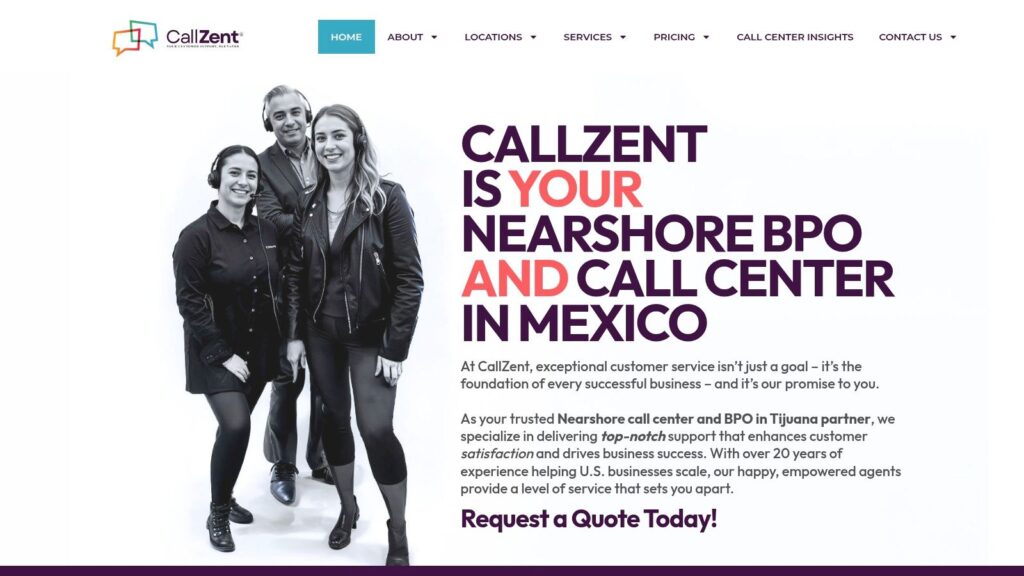
CallZent is the most distinctive entry on this list because it doesn’t try to be a giant global integrator. It’s a nearshore call center and BPO partner built for North American companies that need responsive, bilingual customer support and back-office execution with tighter collaboration than distant offshore models usually provide.
That distinction matters. Many leadership teams searching for IT outsourcing companies are trying to solve adjacent service problems at the same time. Technical support, customer care, lead handling, reservations, collections, back-office work, and bilingual coverage often sit right next to IT operations in the customer experience. If you pick vendors in silos, handoffs get messy fast.
Where CallZent fits best
CallZent is strongest when customer-facing operations and support quality are central to the business. E-commerce, healthcare, telecom, finance, insurance, and retail teams often need a partner that can cover voice and digital support while scaling around seasonality, campaign surges, or service-hour expansion.
Its nearshore model in Tijuana is a real operational advantage for U.S. and Canadian businesses. Teams can collaborate in overlapping business hours, managers can communicate quickly, and bilingual English-Spanish support is easier to build into the workflow from the start. That’s different from trying to retrofit language and cultural alignment after launch.
The company also offers a broad BPO stack. Inbound and outbound customer service, technical support, lead generation, debt collection, virtual assistants, reservation support, answering services, back-office support, and telephone data collection can all sit inside one operating relationship. For the right buyer, that reduces fragmentation.
What works in practice
The biggest practical strength is flexibility. CallZent presents itself as a collaborative extension of the client team, not a rigid enterprise program. That tends to work well for growing businesses that need support coverage without waiting through a long procurement cycle.
Another advantage is the focus on agent experience. In customer support outsourcing, quality depends heavily on hiring, training, retention, coaching, and day-to-day motivation. A vendor can have solid software and still deliver poor customer outcomes if agents aren’t supported well. CallZent’s agent-centric culture is worth noting because buyers often underweight it during vendor selection.
- Best use case: Nearshore bilingual support, customer service operations, and BPO programs tied closely to North American customers
- Strong point: Time-zone alignment, English-Spanish coverage, and a service mix that goes beyond basic call handling
- Strong point: Flexible onboarding and customizable workflows, including CRM and operational integrations
- Watch-out: If you operate in a heavily regulated environment, confirm compliance documentation and referenceability directly
- Watch-out: You’ll still need a custom quote for an apples-to-apples comparison against larger vendors
What I’d ask before signing
I’d ask three things. First, who manages performance day to day, and how often are clients involved in calibration? Second, what integrations are standard versus custom? Third, how are ramp-up plans handled for peak periods or multi-channel support?
Those questions matter more than polished sales language. They tell you whether the provider can really function as part of your operating model.
There’s also a broader industry reason this position makes sense. Trend coverage says generic full-service outsourcing is losing ground to specialists, and Gartner-based reporting cited in that analysis says 68% of companies prioritize industry-specific experience over general capabilities when selecting partners. The same source says micro-outsourcing is growing for discrete skills, while AI is raising productivity on routine outsourced development tasks. That shift pushes buyers toward providers that know a specific domain well and can integrate into a focused service area cleanly.
For businesses weighing Mexico as a strategic delivery location, this overview of technology in Mexico adds useful context. In practice, CallZent is the right fit when you want a high-value nearshore partner for support and BPO operations, not a sprawling transformation consultancy.
Top 7 IT Outsourcing Firms Comparison
| Provider | 🔄 Implementation Complexity | ⚡ Resource Requirements | ⭐ Expected Outcomes | 📊 Ideal Use Cases | 💡 Key Advantages / Tips |
|---|---|---|---|---|---|
| Accenture | High, large, multi‑year transformations; structured governance | Extensive, cross‑functional global teams, enterprise budget | Very high, robust SLAs, compliance, mature delivery | Core systems modernization, regulated industries, full outsourcing | Scale and industry playbooks; expect discovery/SOW and limited pricing transparency |
| Cognizant | Medium–high, enterprise onboarding with AI‑led accelerators | High, application/devops teams, modernization tooling | High, faster modernization, DevSecOps/SRE practices | App modernization, digital engineering, intelligent operations | Strong app outsourcing credentials; procurement typically required |
| EPAM Systems | Medium, engineering‑led product engagements, variable sizing | Moderate–high, senior engineers, platform expertise | Very high, quality engineering for complex products | Software product development, cloud/data platforms, startups via SMB arm | Excellent for complex builds; premium rates and planning for niche skills |
| Globant | Medium, design‑led, agile pods with discovery/experimentation | Moderate, nearshore design + engineering, AI pods | High, strong CX/EX and iterative innovation outcomes | CX transformation, AI‑powered products, nearshore collaboration | Nearshore time‑zone benefits and design strength; discovery can add cost/time |
| Softtek | Medium, mature nearshore governance with blended delivery | Moderate, bilingual LATAM teams, DevSecOps and observability | Reliable, time‑zone alignment, bilingual support quality | Nearshore application management, bilingual CX, cloud ops | Good cultural proximity and bilingual staffing; governance may be heavy for very small projects |
| ScienceSoft | Low–medium, SMB‑friendly, transparent collaboration models | Moderate, focused managed services, DevOps, ITSM | Solid, practical outcomes for mid‑market with clear KPIs | SMBs, specialized healthcare/retail/finance needs, L2/L3 operations | Transparent pricing/models and defined KPIs; check seniority for niche domains |
| CallZent | Low, quick nearshore BPO onboarding, scalable staffing options | Moderate, bilingual agents, 24/7 coverage, CRM/telephony integrations | High (support), cost‑efficient service and reported labor savings (~50%) | BPO: customer service, tech support, collections, virtual assistants, back‑office | Nearshore bilingual advantage and flexible pricing; verify certifications/references for strict compliance needs |
Beyond the List Making Your Strategic Choice
How do you separate a credible vendor from the right vendor for your business?
The answer usually has less to do with brand recognition and more to do with fit. The comparison table and checklist matter because these firms solve different problems, serve different budgets, and introduce different levels of delivery risk. A large enterprise program with multiple stakeholders, compliance gates, and cross-border rollout needs one kind of partner. A support operation that has to go live quickly, hit service levels, and stay cost disciplined needs another.
Start with the commercial and operating reality. Accenture and Cognizant make sense when the work is broad, political, and process-heavy. EPAM is a stronger fit when the hard part is engineering depth. Globant and Softtek stand out when nearshore collaboration and speed of iteration matter. ScienceSoft often fits mid-market buyers that want tighter scope control and clearer accountability.
Then pressure-test execution.
Who owns delivery after the sale? Who approves staffing changes? How fast do issues escalate? What documentation is standard, and what costs extra? Buyers that skip these questions often end up with a capable vendor and a weak operating model. That is an expensive mismatch.
One rule holds up in practice: choose the delivery model before you choose the logo.
That matters even more in service-heavy outsourcing. Customer support, technical help desks, collections, and back-office processing live or die on response times, language quality, supervision, and schedule overlap. For those programs, the article does not treat nearshore as a side note. It compares global firms against a narrower, high-value option, including CallZent, because a specialized provider can be the better choice for North American businesses that need bilingual coverage, faster launch cycles, and simpler vendor management.
Use the table to cut the long list. Use the checklist to test rollout risk, governance load, and budget fit. Then talk to the two or three firms that match your company size, industry, and service model, not just the ones with the strongest brand presence.
🚀 Scale Smarter With CallZent
CallZent helps North American businesses improve customer support, technical support, virtual assistant services, lead generation, collections, and back-office operations through scalable nearshore outsourcing solutions from Mexico.
Get a Free QuoteFor another outside view on how to evaluate technical partners, these tips for selecting a software partner are a useful companion read.