Skip to content

NEARSHORE TECHNOLOGY & BPO
Technology in Mexico for Nearshoring in 2026 | Strategic Guide for US Businesses
Explore technology in Mexico through a nearshoring lens. Learn how Mexico’s tech economy, digital infrastructure, bilingual talent, and proximity support smarter BPO and call center operations.
TL;DR — Quick Takeaways
- Mexico’s technology sector is large enough to support serious nearshore operations. ICT output has grown consistently and now represents a meaningful part of the national economy.
- Nearshore outsourcing works best when collaboration speed matters. Shared business hours, bilingual staffing, and faster oversight improve execution quality.
- Tijuana, Guadalajara, Monterrey, and Mexico City each support different operational models. Companies should choose locations based on workflow fit instead of branding.
- The best Mexico partnerships combine technology infrastructure, workforce management, and operational discipline.
Most companies ask the wrong question about technology in Mexico.
They ask whether Mexico is “good for outsourcing.” That’s too vague to help you make a serious operating decision. The better question is this: Can Mexico give you dependable talent, faster collaboration, and lower operational friction without creating new management problems?
For many North American businesses, the answer is yes. But only if you understand where the value sits. It’s not just in lower labor cost. It’s in the combination of tech talent, internet scale, public-sector digitization, proximity to the U.S., and the ability to build customer-facing operations that don’t feel detached from your core business.
TL;DR
- Mexico’s tech base is real and durable. Its ICT sector averaged 3.2% of GDP and grew faster than the overall economy over the long run, according to IntechOpen’s 1994 to 2024 analysis.
- The talent pool is deep, but specialization matters. Mexico produced 211,460 ICT graduates in the last five years and has a large digital market, according to Intugo’s review of the current state of technology in Mexico.
- Nearshoring works best when speed matters. Mexico offers an estimated 800,000 software developers and 41–59% cost savings versus onshore engagement, according to Alcor’s industry overview.
- Government digitization reduces friction. Roughly 90% of government transactions can be initiated online and 75% can be completed digitally, according to the OECD review of digital government in Mexico.
- You still need the right local partner. Talent availability doesn’t eliminate hiring friction, especially in specialized roles.
Bottom line: Technology in Mexico is no longer a side conversation for procurement teams. It’s an operating model decision.
Is Mexico the Answer to Your Tech Talent Shortage?
If your U.S. or Canadian team is struggling to hire bilingual support staff, technical support agents, QA talent, or back-office specialists, you don’t have a labor problem alone. You have a location strategy problem.
Mexico deserves serious attention because it gives companies something rare: a way to add capacity without moving critical work so far away that collaboration suffers. That matters in customer service, tech support, claims handling, fintech operations, and e-commerce support, where delays between teams quickly turn into customer-facing issues.
What executives should focus on first
Don’t start with wage comparisons. Start with operating fit.
- Role fit matters more than geography alone. Customer support, technical support, revenue operations, and back-office workflows usually benefit from nearshore models because they require frequent coordination with product, compliance, and customer success teams.
- Management bandwidth is part of the cost. A cheaper labor market isn’t a savings win if your managers spend their week fixing communication gaps.
- Hiring structure affects outcomes. If you’re building internal recruiting capability, this practical look at talent acquisition teams is useful because it clarifies who should own sourcing, screening, and workforce planning.
A simple example: an e-commerce brand handling U.S. and Spanish-speaking customers often needs agents who can move between order status questions, payment issues, return workflows, and basic technical troubleshooting. That setup works better when support leads, QA supervisors, and client stakeholders can communicate in real time.
A better way to judge the opportunity
Use three filters before you choose Mexico.
- Do your teams need same-day collaboration? If yes, nearshore usually beats offshore.
- Are your workflows customer-facing or compliance-sensitive? If yes, distance and delay become expensive.
- Do you need flexibility without opening your own operation immediately? If yes, a BPO or managed team model makes more sense than direct market entry.
If you’re still comparing broad outsourcing models, this breakdown of nearshore vs offshore outsourcing costs, risks, and ROI will help you frame the decision correctly.
Mexico’s Tech Economy at a Glance
How do you tell whether Mexico’s tech sector can support a nearshore operation at scale, instead of just looking good in a pitch deck?
Start with durability. A detailed 1994 to 2024 analysis from IntechOpen found that Mexico’s ICT sector grew faster than the broader economy over the period, reached 933,690 million pesos in 2024 at 2018 prices, and averaged 3.2% of total GDP. ICT output also rose from 366,870 million pesos in 1994 to 933,690 million pesos in 2024. For a North American buyer, that matters because long-run sector growth usually points to better vendor depth, stronger management layers, and a larger base of workers already operating inside digital systems.
That is the operational test.
A country does not need to be Silicon Valley to be a smart nearshore choice for BPO, customer care, and back-office delivery. It needs enough tech capacity to support hiring, training, QA, reporting, workflow automation, and client communication without constant friction. Mexico clears that bar.
Why this matters for BPO and customer operations
The same analysis shows a structural shift inside the sector. ICT goods accounted for 63.0% of ICT GDP and services for 37.0%, reflecting a gradual move toward services over time.
That shift improves Mexico’s fit for service-heavy operating models, especially for companies building or expanding:
- Technical support teams tied to SaaS, fintech, and telecom workflows
- Customer operations that rely on CRM platforms, ticketing systems, and knowledge bases
- Back-office support for billing, documentation, claims review, and account maintenance
Here is the comparison buyers should make. Do you need a market that can supply labor alone, or a market that can support service delivery with digital process discipline? Mexico is stronger in the second category, and that is what usually matters more once volume rises and service-level targets tighten.
For businesses running product-adjacent support, that distinction is even more important. A fintech company, for example, may need customer service, fraud review, KYC support, and connected product work at the same time. That is why many operators look at Mexico for both service teams and related capabilities such as fintech app development.
The executive read on technology in Mexico
Use this framework.
| Factor | What it means for operators |
|---|---|
| Long-run ICT growth | More stability for long-term outsourcing and managed team decisions |
| Meaningful GDP share | A sector large enough to matter in hiring, training, and supplier availability |
| Shift toward services | Better alignment with support, CX, trust and safety, and back-office work |
| Link to North American markets | Faster coordination with U.S. teams and easier operating oversight |
Companies should also assess automation early, not after launch. If your scope includes support workflows, routing logic, or AI-assisted service delivery, examples of AI automation solutions can help you separate roles that need human judgment from tasks that should be automated from day one.
Exploring Mexico’s Epicenters of Innovation
Technology in Mexico isn’t concentrated in one city. That’s a strength. It gives buyers options based on the kind of operation they want to build.
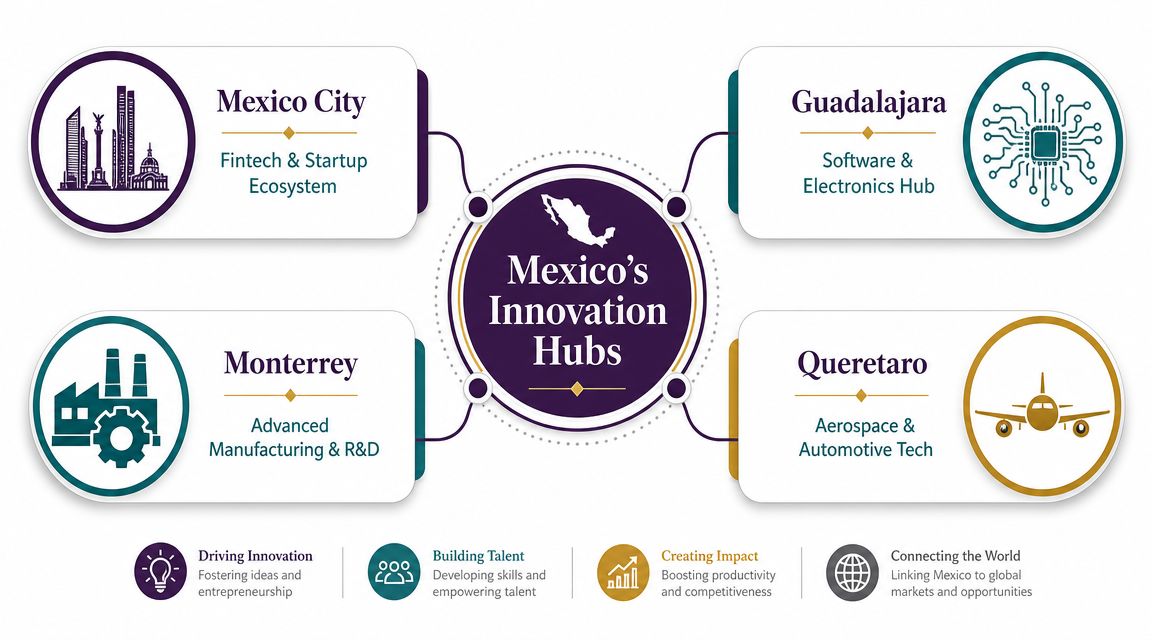
Mexico City for fintech and startup energy
Mexico City is where many companies look first when they want density. You get a large professional workforce, financial services activity, startup networks, and access to decision-makers.
This city fits companies that need:
- Multifunction teams combining operations, support, and business analysis
- Fintech support capacity where customer experience and compliance often intersect
- Corporate partnerships with banks, insurers, and enterprise service firms
If your business needs broad exposure to business services and digital operations, Mexico City is usually a logical short list market.
Guadalajara for software and electronics depth
Guadalajara is widely associated with software, engineering, and electronics. For executives, the main advantage is ecosystem fit. If your customer support environment is heavily tied to product troubleshooting, device support, software release cycles, or QA coordination, that type of market matters.
A hardware-enabled SaaS company is a good example. It may need technical support agents who can work with product teams on firmware-related issues, escalation paths, and recurring defect patterns. A city with stronger engineering density gives you more options for that kind of operation.
Monterrey and Querétaro for industrial discipline
Monterrey tends to attract companies that value process discipline, industrial links, and enterprise execution. Querétaro often enters the conversation when aerospace, automotive, and advanced technical operations matter.
These cities are especially relevant when support work touches:
- Supply chain coordination
- Warranty or field service processes
- Industrial customer care
- Documentation-heavy workflows
Choose the city based on workflow complexity, not brand recognition. The “best” hub is the one that matches your operating model.
Why Tijuana matters more than many buyers realize
Tijuana doesn’t get discussed enough in generic technology in Mexico articles. That’s a mistake.
For North American companies, Tijuana offers a practical edge: direct proximity to the U.S. border, easier executive travel, and a natural fit for bilingual BPO, customer support, and tech-enabled service teams. If you’re running a support operation that needs close oversight, rapid ramp-up, and regular client interaction, border access isn’t a convenience. It’s an operating advantage.
A healthcare support team, for example, may need QA reviews, compliance checks, scripting adjustments, and fast retraining. That becomes easier when leaders can visit without treating every trip like a major international project.
Fueling the Future with Talent and Connectivity
Can Mexico give you enough qualified people and enough digital reliability to run customer operations without constant friction? In many cases, yes. But you should judge that advantage by execution, not by headline talent counts.
Mexico’s talent pipeline is large enough to support more than basic staffing. One industry overview from Intugo reports that the country produced 211,460 ICT graduates over the past five years, with annual totals close to 40,000 for most of that period. That same source also points to broad digital reach, including 98.6 million internet users, growth of roughly 16 million from 2021, and projected access of 118.2 million by 2026.
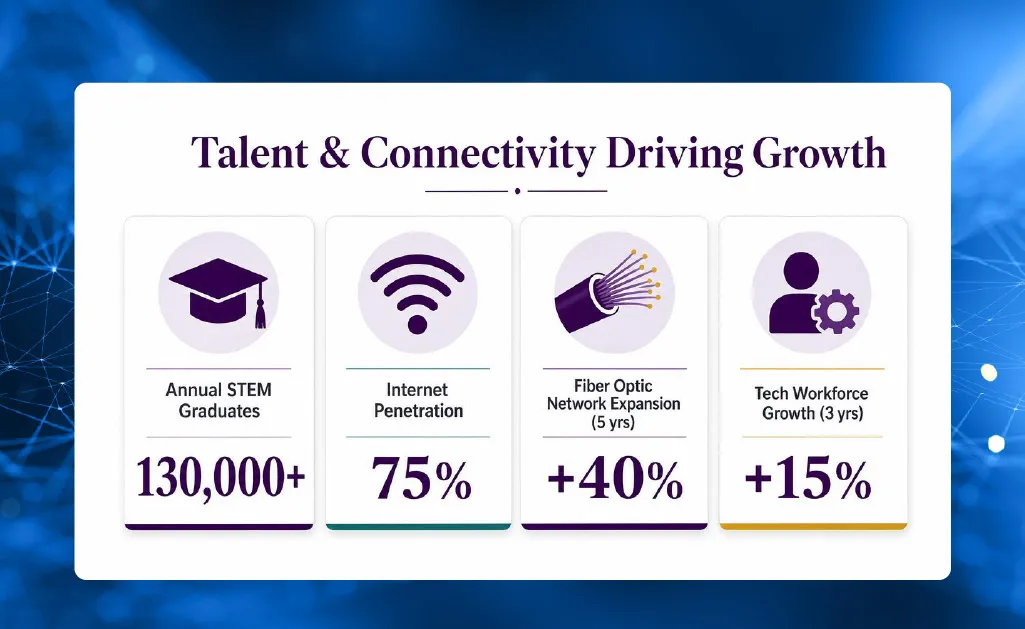
What those numbers mean in operations
For a nearshore BPO or call center buyer, those figures matter because they lower delivery risk.
A larger technical and digitally fluent labor pool gives you more room to build teams for customer support, technical support, back-office operations, QA, workforce management, and CRM-heavy service work. Wide internet adoption matters for another reason. It supports a service environment where cloud tools, digital ticketing, omnichannel workflows, and remote supervision are already normal parts of day-to-day operations.
That is the practical test. Can the market support stable hiring, tool adoption, and day-to-day service delivery at the same time?
Intugo also describes Mexico as a country with strong technology readiness, meaningful high-tech export capacity, and a recognized position in global network readiness. For executives evaluating providers, that matters less as a branding point and more as a signal that modern service operations can scale there with fewer structural constraints.
Talent volume helps. Role design matters more.
Buyers make expensive mistakes in this situation. They assume a large labor market means every role will be easy to fill.
It will not.
A bilingual customer care agent is easier to hire than a bilingual technical support lead who can handle platform troubleshooting, fraud review, policy-based escalation, or onboarding flows inside a CRM. If your process depends on judgment, documentation accuracy, and clean handoffs to product, compliance, or engineering, then generic hiring criteria will hurt you.
Use a narrower screening model. Hire for workflow fluency, tool familiarity, and communication discipline. English matters, but it is only one filter.
Operational fit also improves when your provider can train, calibrate QA, review performance, and manage escalations during your business day. That is one reason time-zone alignment in call center outsourcing affects service quality, not just convenience. The same logic applies if your model includes blended teams for support and engineering. Companies that need to hire latam developers often see better results when those technical hires can work in close rhythm with customer-facing teams.
A telecom support program makes the point clearly. Agents may need to explain plan changes, walk customers through device setup, document tickets correctly, and recognize when a problem belongs with engineering instead of frontline support. That requires a connected operating model, not just a filled seat count.
The Nearshore Advantage for US Businesses
Is Mexico just a lower-cost option, or is it the faster way to run customer operations that depend on technical accuracy, same-day decisions, and close coordination with U.S. teams?
For serious buyers, the answer is speed with control.
Mexico stands out because it supports a nearshore operating model that works well for BPO, call center, and support programs tied to product, payments, compliance, and engineering. You get real working-hour overlap, simpler travel for training and oversight, and teams that can work in sync with North American service expectations instead of adapting after the fact.
According to Alcor’s overview of the technology industry in Mexico, the country has an estimated 800,000 software developers, and nearshoring technology services to Mexico can produce 41–59% cost savings versus onshore engagement. That matters because cost savings alone do not fix execution problems. A nearby team that can coordinate with your internal operators, analysts, and technical staff during the same business day does.
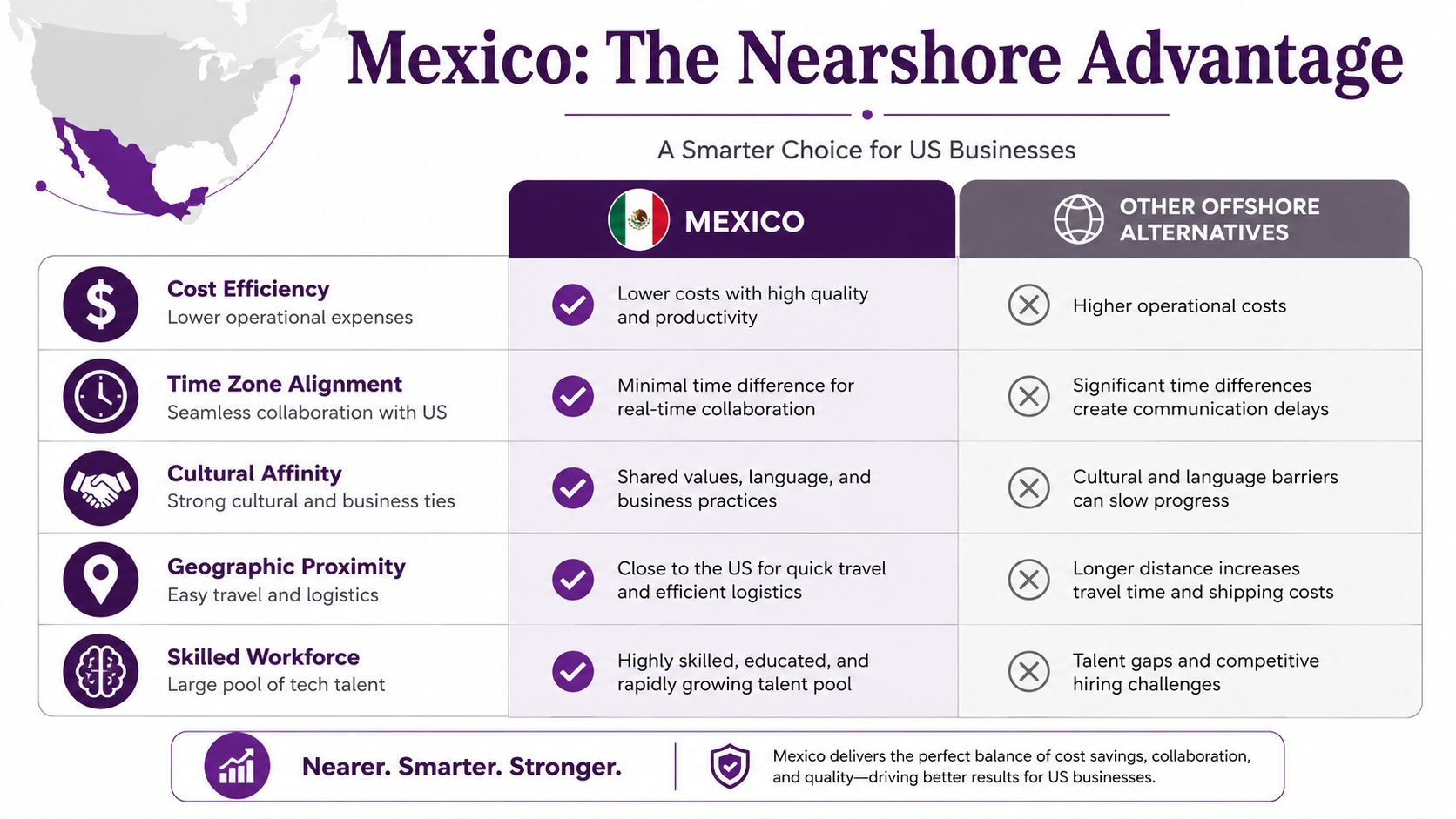
The practical benefit is simple. Mexico shortens the gap between customer contact and operational response.
Consider a fintech or telecom support environment. Customers call about account access, disputed charges, device activation, billing errors, or app failures. In Mexico, a nearshore team can flag patterns to QA, route product defects to engineering, and adjust frontline handling while your U.S. stakeholders are still online. That shortens resolution cycles and reduces the handoff delays that hurt CSAT, compliance consistency, and first-contact outcomes.
Executives should compare operating models, not just rate cards.
| Decision factor | Nearshore Mexico | Distant offshore model |
|---|---|---|
| Team overlap | Same-day collaboration with U.S. managers and client teams | More asynchronous communication |
| Travel and oversight | Easier site visits, calibrations, and launch support | Slower and more expensive in-person management |
| BPO and call center execution | Better fit for North American workflows, escalation paths, and customer expectations | More process translation and slower adjustment |
| Issue resolution speed | Faster coordination across support, QA, and technical teams | Longer feedback loops |
There is also a market maturity point that buyers should not ignore. Alcor also reports $81.4 billion in high-tech exports in 2023. That signals a business environment connected to advanced operations, technical services, and enterprise delivery, not a market built only on basic labor arbitrage.
That distinction matters for nearshore partnerships. If your service model includes technical support, onboarding, back-office review, fraud operations, or customer care tied to internal systems, Mexico gives you a better chance of building one connected operation instead of separate vendor silos.
So push harder in provider interviews.
- Ask how escalations move: Support issues should reach QA, client stakeholders, and technical teams fast, with clear ownership.
- Ask how retraining works: Product updates, policy changes, and new workflows should reach agents quickly and consistently.
- Ask how performance is segmented: You need reporting by queue, issue type, channel, and customer profile, not a generic dashboard.
- Ask how far the team can go technically: Many programs need more than script handling. They need agents and leads who can work inside CRMs, billing tools, admin panels, and support platforms.
If your operating model also includes software-adjacent hiring, companies that need to hire latam developers often evaluate Mexico as part of a broader regional staffing strategy.
For service leaders focused on response speed, oversight, and tighter execution, the business case is straightforward. This guide to the nearshore advantage for customer operations lays out the model in practical terms.
Navigating Government Support and Digital Infrastructure
Can your Mexico operation scale cleanly if permits, payroll setup, privacy controls, and vendor documentation break down across multiple entities?
That is the true test. Talent gets attention, but operating reliability decides whether a nearshore BPO or call center partnership performs at 50 seats, 200 seats, and beyond. Mexico’s public-sector digitization matters because it cuts administrative drag in the parts of the business that slow launches, delay expansions, and create avoidable compliance risk.
Earlier in the article, the OECD review highlighted Mexico’s progress in digital government. The practical takeaway is simple. More services can be started and completed online, and the country has built stronger digital-service capacity than many US buyers expect.
For executives evaluating Mexico for customer support, trust and safety, claims intake, or back-office processing, that changes the risk profile. You are not just buying labor. You are setting up an operating environment that needs legal registration, payroll coordination, tax handling, security policies, vendor controls, and documented workflows to function without constant exceptions.
Here is the decision framework I recommend:
- Check administrative speed, not just hiring speed. Ask how long entity setup, payroll activation, and compliance documentation usually take in the state and city you are considering.
- Verify multi-site readiness. If you may split work across locations, confirm how the provider handles permits, reporting, and standard operating procedures across sites.
- Test process maturity early. Review how they manage onboarding documents, audit trails, access controls, and policy updates.
- Pressure-test security before launch. Customer operations often touch payment details, account records, and regulated data. Review this guide to security and compliance in Mexico BPOs before you sign.
Infrastructure deserves the same scrutiny. A polished sales pitch means nothing if the site has unstable connectivity, weak redundancy, or poor business-continuity planning. Ask direct questions about ISP diversity, failover capacity, backup power, device management, and how quickly work can be shifted if one office goes down.
Mexico excels in nearshore operations. In a market with improving digital public services and established urban connectivity, a well-chosen partner can launch faster, document processes better, and support expansion with less friction. That is a concrete advantage for North American companies that need bilingual service teams tied closely to US systems, compliance expectations, and performance targets.
Do not treat government support and infrastructure as background details. Treat them as selection criteria. They affect speed, control, and the cost of fixing mistakes later.
Your Next Steps to a Successful Mexico Partnership
Need a nearshore partner that reduces pressure on your hiring pipeline and improves service performance?
Treat Mexico as an operating decision, not a sourcing shortcut. The right partner gives you faster hiring, stronger bilingual coverage, and tighter alignment with US customers. The wrong one gives you turnover, weak supervision, and expensive rework.
One useful benchmark comes from Tendril’s analysis of borderless work and specialized hiring. Mexico produces a large volume of engineers and technologists, yet companies still struggle to hire for specialized roles in AI, cloud, and advanced business operations. For North American firms, that creates a clear takeaway. Capacity exists, but execution depends on choosing a provider that can recruit, train, and manage against your actual workflows.
A practical checklist for partner selection
-
Define the work with precision.
Split customer service, technical support, billing support, fraud review, claims intake, and back-office processing into separate scopes. Each function needs different agent profiles, ramp plans, quality controls, and manager oversight. -
Pick the city based on operating model.
Tijuana fits companies that want proximity to the US, easier executive travel, and close coordination with American teams. Other Mexican cities may be a better fit if your priority is a larger engineering base or a different labor mix. -
Audit management depth.
Recruiting matters, but frontline management decides whether service levels hold. Ask how supervisors are trained, how coaching is documented, how escalations are handled, and how attrition is tracked by account and team lead. -
Start with a controlled pilot.
Launch one queue, one channel, or one support function first. Measure training speed, QA consistency, schedule adherence, resolution quality, and communication from operations leaders.
What to review during due diligence
- Channel coverage: Can the team support voice, chat, email, and back-office workflows under one operating model?
- Platform readiness: Do agents already work inside common CRM, ticketing, and knowledge management systems?
- Leadership access: Will your team speak directly with operations managers and QA leads, or only through sales?
- Brand fit: Does the provider communicate with the tone, escalation style, and accountability your customers expect?
If you are comparing providers, review practical service models such as customer service and tech support offerings, the operating implications of a Tijuana delivery model, and the company’s approach to management and culture. Those details matter more than a polished pitch deck.
CallZent is one provider in this market. It delivers bilingual nearshore call center and BPO services from Tijuana for North American companies.
🚀 Build Smarter Nearshore Operations With CallZent
CallZent helps North American businesses improve bilingual customer support, technical support, back-office workflows, and nearshore customer operations through scalable BPO services in Tijuana, Mexico.
Talk to an ExpertThe strongest Mexico partnerships are built on operating discipline. Choose the provider that can staff the right roles, train to live processes, report clearly, and keep quality stable as volumes change. That is how Mexico’s tech growth turns into a real advantage for BPO and call center operations.