

Ecommerce Operations
How to Outsource E-commerce in 2026 for Smarter Growth
Learn how to outsource e commerce operations with a practical 2026 guide covering what to delegate, vendor selection, nearshore vs offshore, onboarding, SLAs, and ROI.
TL;DR — Quick Takeaways
- Audit your operations before outsourcing—identify repetitive, scalable tasks.
- Document SOPs and workflows before engaging vendors.
- Choose nearshore partners for better communication and responsiveness.
- Start with a pilot to test performance and workflow fit.
- Track results using SLAs and KPIs to ensure ROI.
If your store is growing but your days are disappearing into tickets, returns, order issues, and spreadsheet cleanup, you don’t have a sales problem. You have an operations capacity problem.
That’s where outsource e commerce decisions usually start. Not with some abstract cost exercise, but with a founder, operator, or ecommerce lead realizing they’re spending too much time keeping the machine running and not enough time improving conversion, retention, merchandising, and growth.
 Growing Pains The Case to Outsource E-commerce Operations
A familiar pattern shows up in ecommerce businesses right after growth starts to feel real. Orders increase, customer messages pile up, chargeback questions become more frequent, and someone on the team starts handling returns in between marketing meetings. What looked manageable at lower volume turns into daily operational drag.
I’ve seen this happen with founder-led stores, marketplace sellers, and established retail brands moving faster online. One person answers customer emails in Shopify Inbox, another updates tracking manually, and finance cleans up preventable errors at month-end. The work gets done, but the business becomes harder to scale cleanly.
That’s why outsourcing has shifted from a temporary fix to a strategic operating choice. In 2024, global spending on eCommerce outsourcing reached $731 billion, and businesses outsourcing ecommerce functions report 20-30% reductions in operational costs alongside improved service quality, especially during peak periods when internal teams are stretched thin, according to Vserve’s 2024 to 2027 outsourcing analysis.
The real question is where your attention should go
The strongest ecommerce operators protect their time. They don’t insist on owning every task. They decide which activities require internal control and which ones need process discipline, coverage, and scale.
A simple example:
- Founders should own product direction, pricing, brand positioning, and channel strategy.
- Specialized partners can own front-line support, order updates, back-office processing, and routine admin work.
That same thinking is why many companies also look at adjacent functions through a similar lens. If you’re reviewing broader delegation decisions, this guide on outsourcing marketing for your small business is useful because it frames outsourcing as focus management, not just headcount reduction.
Key takeaway: Outsourcing isn’t about admitting your team can’t handle growth. It’s about preventing growth from breaking your operation.
What changes when you outsource e commerce well
The immediate win is usually capacity. The more important win is control.
A good partner gives you:
- Consistent coverage: Customer questions and repetitive workflows don’t wait for one overwhelmed employee.
- Process discipline: Tasks move through documented steps instead of informal handoffs.
- Room to lead: Management time shifts away from inbox triage and toward revenue decisions.
For brands where support volume is the first operational pain point, outsourced service often becomes the entry point. This overview of customer service outsourcing benefits is worth reviewing if support queues are already slowing your team down.
Identifying What to Outsource in Your E-commerce Business
The wrong way to outsource e commerce is to start with a vendor list. The right way is to start with an internal audit.
Most businesses already know they’re overloaded. What they haven’t done is separate work into categories: what drives advantage, what requires oversight, and what is repeatable operational labor. That distinction matters because not all tasks belong outside your walls.
By 2025, the AI-enabled eCommerce market reached nearly $9 billion, with 89% of retailers using AI, which has accelerated outsourcing for functions like AI-assisted support and personalization that need both technical setup and operational management, according to SourceWiser’s outlook on ecommerce outsourcing.
Start with the four operational buckets
Customer support
This is often the first area to review because pain shows up fast. Customers ask where orders are, whether items can be exchanged, when refunds will post, or whether a promo still applies. If your internal team handles these inquiries inconsistently or too slowly, the damage lands directly on the customer experience.
Tasks that are commonly delegated here include:
- Front-line inquiries: Shipping updates, return questions, sizing help, order edits
- Live chat and email handling: Queue coverage during evenings, weekends, and campaigns
- Ticket routing: Sending billing, fraud, or replacement cases to the right internal owner
- Post-purchase communication: Follow-ups, status updates, and simple exception handling
If that workload already lives in scattered inboxes, a dedicated outsourced team or ecommerce virtual assistants setup can bring structure without forcing you to build a larger in-house support layer.
Fulfillment and logistics
Not every ecommerce brand should outsource fulfillment, but many should at least evaluate it. If inventory is taking over office space, returns are backing up, or order cutoffs are causing daily stress, your fulfillment process may be absorbing too much management energy.
A practical way to think about this is simple. If your team spends significant time on picking, packing, carrier issues, and return handling, then operations may be constraining growth more than customer demand is. For merchants selling through Amazon, Reddog Group’s FBA insights are a useful reference point when comparing platform-led fulfillment against a broader 3PL or hybrid model.
Back-office administration
Back-office work rarely gets much attention until it becomes a hidden tax on your team. Data entry, order reconciliation, catalog cleanup, invoice processing, content moderation, and refund verification can each look small in isolation. Together, they consume hours every week.
Because the work is process-heavy and predictable, many ecommerce businesses recover focus fastest.
Practical rule: If a task is repetitive, scalable, and not your core genius, it’s a prime candidate for outsourcing.
Technology management
Some stores need technical outsourcing as much as service outsourcing. That can include website maintenance, plugin updates, storefront QA, app support, feed management, and routine troubleshooting tied to Shopify, WooCommerce, or custom integrations.
You shouldn’t outsource strategic platform decisions blindly. You can outsource execution around stable technical workflows, especially when your internal team lacks bandwidth for maintenance and issue response.
Common E-commerce Functions to Outsource
| Function Area | Example Tasks | Key Benefit | When to Outsource |
|---|---|---|---|
| Customer Support | Email, chat, order status, returns questions | Faster response coverage and process consistency | When support volume interrupts leadership and sales work |
| Fulfillment and Logistics | Picking, packing, returns handling, inventory coordination | Less operational drag and smoother order flow | When shipping and returns absorb daily management time |
| Back-Office Administration | Data entry, refunds review, invoices, catalog updates | Cleaner workflows and fewer internal distractions | When repetitive tasks keep piling onto core staff |
| Technology Management | Site maintenance, plugin updates, QA, app support | Access to specialized execution without hiring full-time | When technical upkeep delays improvements or fixes |
What should stay in-house
Some work should remain close to your leadership team, especially:
- Brand voice decisions
- Merchandising strategy
- Promotional planning
- Pricing and margin control
- High-risk exception approvals
A simple test helps. Ask whether the task shapes your differentiation or only helps you deliver it. If it shapes your unique market position, keep strong internal ownership. If it helps execute repeatable operations, it may belong with a specialist partner.
 Building Your Outsourcing Requirements and Roadmap
Most outsourcing problems start before the contract. They start when a company says, “We need help,” but can’t define what that help looks like in practice.
That’s why preparation matters more than vendor charm. A Deloitte study found that 47% of outsourcing failures are due to misaligned expectations, a risk that can be reduced with detailed requirement documents and SLAs that define deliverables, deadlines, and quality benchmarks before signing, as summarized by Distillery’s guide to outsourcing ecommerce website development.
Write the operating brief before the vendor brief
Start with an internal document that answers five basic questions:
- What work is being outsourced
- What systems does the work touch
- What good performance looks like
- What exceptions need escalation
- Who owns the relationship on your side
If you skip this, vendors will fill in the blanks for you. That usually creates nice sales conversations and messy operations later.
A strong operating brief should include:
- Task scope: For example, “Handle order-status tickets, return inquiries, and basic replacement requests”
- Channels: Email, chat, voice, marketplace messaging
- Hours of coverage: Business hours, after-hours, weekends, holidays
- Systems used: Shopify, Gorgias, Zendesk, NetSuite, Loop Returns, Slack
- Escalation rules: Fraud flags, damaged goods disputes, VIP customers, shipping exceptions
- Brand voice guidance: Tone, refund posture, compensation limits, approved phrases
Build SOPs that a new team can actually follow
A lot of ecommerce SOPs are too vague to be useful. “Handle returns professionally” isn’t a process. “Check order status, confirm eligibility, issue label through approved workflow, tag case reason, escalate policy exceptions” is.
Good SOPs don’t need to be long. They need to be clear.
Use this simple format:
- Trigger: What starts the task
- Steps: The exact actions taken
- Decision points: What changes the path
- Escalation: When to involve your internal team
- System notes: Which tools to update
- QA check: What must be verified before closing the task
If you’re formalizing a broader sourcing model, this guide to smart sourcing and strategic outsourcing gives useful context for aligning process design with business goals.
A partner can only execute the business you’ve documented, not the one that exists in your head.
Create a practical vendor roadmap
After the internal brief, build a short roadmap for rollout. Not a giant presentation. A real operating plan.
Phase one
Choose one function with high volume and low ambiguity. Support tickets, order updates, or back-office data work are usually better starting points than complex technical projects.
Phase two
Define success conditions for the pilot. That includes turnaround expectations, quality review method, reporting format, and escalation handling.
Phase three
Prepare training assets before launch:
- Recorded walkthroughs: Loom works well for process tours
- Knowledge base articles: Notion, Confluence, or Google Docs
- System sandbox access: If available
- Sample tickets or sample orders: Use real edge cases, not only easy examples
Phase four
Decide what expansion looks like if the pilot works. That could mean extending hours, adding channels, or shifting more back-office work into the outsourced workflow.
A simple RFP outline that works
When you speak with vendors, your request should cover:
- Business context: What you sell, where you sell, seasonality, customer mix
- Scope of work: Tasks, channels, hours, expected volume pattern
- Language requirements: Especially for English-Spanish coverage
- Tech stack: Ecommerce platform, helpdesk, CRM, OMS, returns tools
- Reporting expectations: Daily summaries, weekly reviews, issue logs
- Security requirements: Access controls, authentication, data handling rules
- Ramp expectations: Pilot start, training timeline, go-live sequence
The companies that prepare this well usually outsource with fewer surprises. The companies that don’t often spend the first months fixing preventable confusion.
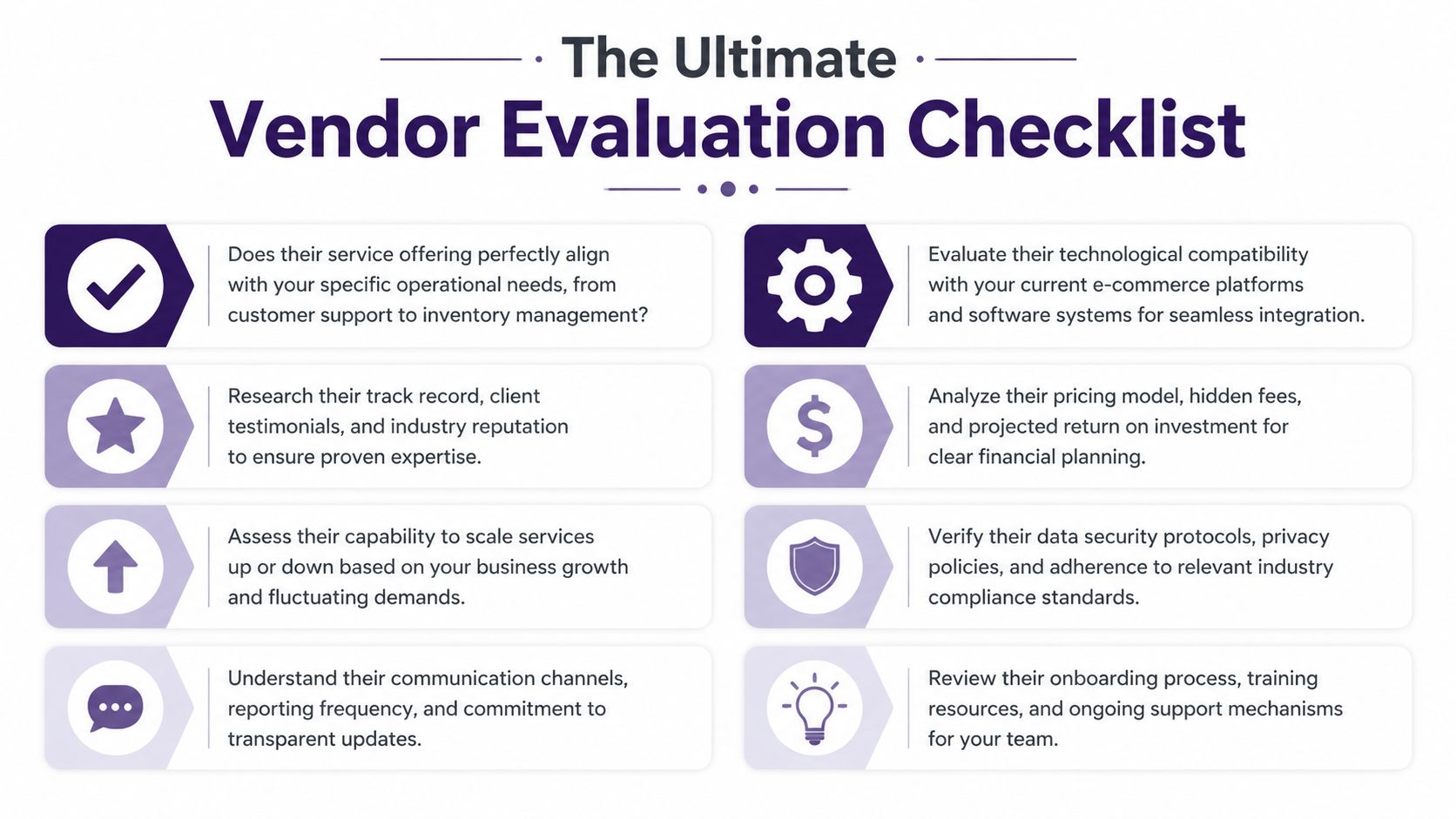
The Ultimate Vendor Evaluation Checklist
The cheapest proposal often becomes the most expensive operating decision.
That sounds harsh, but it’s common in ecommerce. A low quoted rate can hide weak training, slower communication, thin reporting, or poor escalation handling. On paper, the vendor looks efficient. In reality, your team spends time cleaning up avoidable mistakes, chasing updates, and repairing customer trust.
For North American ecommerce brands, the nearshore versus offshore decision is particularly critical. One source on this topic notes that nearshore providers can offer same-day or next-day problem resolution, while distant offshore setups often introduce delays tied to time zone separation and communication friction, as discussed in Hire With Near’s review of ecommerce outsourcing trade-offs.
What to check before you shortlist anyone
A vendor should be able to explain how they’ll run your work, not just that they’ve done “ecommerce support” before.
Use this checklist.
- Operational fit: Can they handle your exact workflows, channels, and systems?
- Platform familiarity: Have they worked inside Shopify, WooCommerce, Amazon Seller Central, Gorgias, Zendesk, or your order tools?
- Communication model: Who is your day-to-day contact, and how are issues escalated?
- Training method: How do they absorb your brand voice, policies, and exception rules?
- Quality control: How do they review interactions and correct recurring mistakes?
- Security posture: How do they manage system access, privacy expectations, and account controls?
- Scalability: Can they expand coverage during promos, launches, and holiday surges?
- Reporting discipline: What will you see weekly, and how quickly will problems surface?
One practical resource when comparing providers is this guide on how to find and vet call center outsourcing companies. It’s useful because the evaluation process is less about polished presentations and more about operating details.
Nearshore versus offshore for ecommerce execution
This decision shouldn’t be reduced to hourly rate. Ecommerce work is full of exceptions, policy nuance, fast-moving promos, and customer emotion. That makes communication speed and alignment matter.
Here’s the practical trade-off.
Offshore can look cheaper upfront
If your workflows are stable, highly documented, and not time-sensitive, offshore support may work. The challenge is that ecommerce rarely stays stable for long. Inventory changes, promotions shift, shipping issues spike, and customer sentiment can change in a single afternoon.
Nearshore usually improves responsiveness
If your customers are in the US or Canada, nearshore teams often fit the operating rhythm better. Meetings happen during the same workday. Escalations don’t wait overnight. Language nuance is easier to manage when customers ask for help in English or Spanish and expect natural communication.
According to the verified data assigned to this topic, nearshore BPO teams can reduce language barriers by 90%, boost CSAT to 92% versus 78% for typical offshore centers, and support 2-5x growth without the 30-50% cost hikes of in-house teams. That’s the core reason many ecommerce brands choose nearshore for customer-facing and coordination-heavy work.
Vendor rule: Buy reliability, visibility, and response speed. Don’t buy the lowest spreadsheet number.
Questions worth asking in every vendor interview
Ask these directly.
- How do you train agents on product and policy changes?
- How do you review quality each week?
- What happens when a customer issue falls outside the script?
- How do you handle peak volume spikes?
- What systems can your team work inside today?
- What does your reporting package include?
- Who owns onboarding and who owns ongoing account management?
- How do you secure access to customer and order data?
A vendor that answers these clearly is usually operationally mature. A vendor that stays vague will likely stay vague after launch too.
Why location still matters
For North American brands, location affects more than price. It affects collaboration.
A nearshore BPO in Tijuana, for example, can offer time-zone alignment, bilingual staffing, and easier real-time coordination for support and back-office workflows. If you’re comparing models, reviewing nearshore outsourcing options and the operating context of a Tijuana call center helps frame what that model looks like in practice.
That doesn’t mean nearshore is automatically right for every company. It means that for ecommerce brands where speed, service quality, and daily collaboration matter, total cost of ownership often favors a partner closer to the customer and closer to your operating day.
Managing a Seamless Transition and Onboarding
Most outsourcing failures don’t happen because the vendor couldn’t do the work. They happen because the handoff was rushed, access was messy, and no one defined how the new team would learn.
A smoother transition starts small. Don’t move every queue, process, and edge case on day one. Start with a contained workflow, train against real examples, and tighten the process before you widen the scope.

Set up systems access without creating risk
Your outsourced team needs enough access to work efficiently, but not so much access that security becomes an afterthought.
A clean setup usually includes:
- Role-based permissions: Give access by task, not by convenience
- Shared documentation: Keep SOPs, macros, brand guidance, and escalation rules in one place
- Secure authentication: Use approved access controls and remove unused credentials quickly
- Environment mapping: Clarify which tool is the source of truth for orders, refunds, tags, and notes
Teams often lose time because they’re working across Shopify, a helpdesk, a returns platform, Slack, and internal docs without a clear operating map. Fix that before launch.
Train on exceptions, not just the happy path
Most onboarding decks are too polished. They show ideal transactions and simple scenarios. Real ecommerce support isn’t like that. It includes missing packages, damaged items, duplicate orders, price-adjustment requests, and customers who are frustrated before the conversation starts.
Train with actual examples:
- Late delivery with active carrier scan
- Return request outside standard window
- Replacement request for limited-stock item
- Discount issue during a campaign
- Marketplace order that doesn’t match storefront policy
Train people on the awkward cases early. Easy tickets take care of themselves.
Put communication rules in writing
You need a communication cadence before launch, not after confusion appears.
A simple operating plan works well:
- Daily check-in: Active issues, blockers, policy questions
- Weekly review: Quality trends, ticket themes, process gaps, staffing notes
- Escalation path: Who gets contacted for urgent customer, system, or fulfillment problems
- Change management rule: How promo changes, policy updates, and product launches are communicated
Some teams prefer Slack for day-to-day coordination and Asana or another task tool for issue tracking. The exact tool matters less than the discipline behind it.
Run a pilot before full rollout
A pilot gives both sides a chance to calibrate. Start with a single queue, a narrow time window, or one type of back-office task. Review accuracy, tone, speed, and escalation quality. Then adjust scripts, SOPs, macros, and permissions before expanding.
This is the phase where you’ll discover practical issues no kickoff deck can predict. That’s normal. The goal isn’t perfection. The goal is controlled learning before broader dependency sets in.
Measuring Success with SLAs, KPIs, and ROI Analysis
Once you outsource e commerce operations, you need a scoreboard. Otherwise every review becomes subjective. One person says the partnership feels fine. Another says quality is slipping. Without agreed measures, both opinions float.
For ecommerce customer support, an industry benchmark for First Contact Resolution is over 85%, and for fulfillment, order accuracy should exceed 99%. These metrics belong inside your SLA, especially because 45% of businesses regret cost-driven outsourcing choices that later create rework and poor performance, according to the source assigned for this section, Visionary Solutions’ ecommerce outsourcing guide.
Build SLAs around the work customers actually feel
An SLA shouldn’t be a legal formality. It should define what reliable execution means in plain operating terms.
For support, that usually means agreements around:
- Response handling: Which queues need same-day attention
- Resolution quality: What counts as a solved case versus a deflection
- Escalation timing: How quickly policy or fulfillment issues move upward
- Coverage consistency: Which hours and channels are staffed
For fulfillment or back-office support, SLAs often focus on:
- Accuracy of order handling
- Timeliness of updates
- Return processing consistency
- Exception logging and communication
If you’re building a formal measurement model, this breakdown of service level agreement metrics and performance is a practical reference.
KPIs that matter for support and operations
Not every metric is useful. Some teams over-focus on speed and under-measure quality. Others review quality manually but fail to connect it to business outcomes.
A better KPI set looks like this.
Customer support KPIs
- First Contact Resolution: Did the customer get a complete answer without repeat contact?
- Customer Satisfaction: Did the interaction preserve trust?
- Escalation rate: How often does the outsourced team need internal rescue?
- Reopen rate: Are “resolved” tickets staying resolved?
Fulfillment and back-office KPIs
- Order accuracy: Were orders processed correctly?
- Returns handling quality: Were labels, decisions, and status updates applied correctly?
- Data accuracy: Did the team update fields, tags, invoices, or records correctly?
- Turnaround time: Are repetitive workflows moving without backlog?
The metric only matters if it changes a decision. If your team never acts on it, remove it from the dashboard.
How to think about ROI without fooling yourself
A lot of outsourcing ROI discussions are shallow. They compare labor cost to vendor cost and stop there. That misses the operational reality.
A more honest ROI review asks:
- Did support quality improve or decline?
- Did order and refund errors drop?
- Did internal managers recover time for higher-value work?
- Did peak periods become easier to handle?
- Did customer friction decrease?
For example, if a founder no longer spends large parts of the week managing tickets and order exceptions, that recovered time can go into pricing, lifecycle marketing, or channel expansion. That value is real, even if it doesn’t appear as a line item on the vendor invoice.
A simple review rhythm
You don’t need a giant business intelligence project to manage this well. Start with a weekly dashboard and a monthly operating review.
Use the weekly review to check:
- Ticket quality trends
- Open issues
- Root causes behind escalations
- Operational blockers
Use the monthly review to decide:
- Expand scope
- Retrain on recurring issues
- Revise SOPs
- Adjust staffing or coverage windows
That rhythm keeps the relationship grounded in evidence, not assumptions.
Beyond Delegation Nurturing a Long-Term Strategic Partnership
The best outsourcing relationships stop feeling like outsourcing after a while. They start feeling like a distributed operations team with clear ownership.
That shift happens when you stop treating the partner like a task bucket and start treating them like part of the operating system. Share context. Explain upcoming promotions. Tell them when inventory risk is rising. Let them see the reasons behind policy changes, not just the script update.
What strong partnerships look like
They usually have a few things in common:
- Open feedback: Problems surface early because no one is trying to hide them
- Shared context: The external team understands what the business is trying to achieve
- Process improvement: Repeated issues lead to updated SOPs, macros, and workflows
- Mutual accountability: Performance reviews are honest, specific, and tied to action
A weak relationship stays transactional. The vendor waits for instructions. Your team complains when things break. Nothing improves structurally.
A strong relationship gets smarter over time. The outsourced team notices patterns, flags friction, and helps tighten the customer experience. That’s when outsourcing becomes more than delegated labor. It becomes an operational advantage.
For North American ecommerce brands, that’s often where nearshore support stands out. The closer collaboration model makes it easier to review problems in real time, adapt fast, and maintain service quality without creating distance between your brand and your customers.
🚀 Scale Your E-commerce Operations Smarter
Partner with CallZent for bilingual nearshore support, back-office operations, and scalable ecommerce solutions.
Talk to an ExpertIf you’re evaluating how to outsource e commerce without losing control of customer experience, CallZent is one option to consider for bilingual nearshore customer support and back-office operations in North America. If you want to discuss your workflows, timelines, or current operational bottlenecks, reach out through the contact page.