
CALL CENTER PRICING & OUTSOURCING
Outsourced Customer Service Cost: The Complete 2026 Pricing Guide
Outsourced customer service cost depends on region, pricing model, hidden fees, repeat contacts, and resolution quality. Learn how to budget accurately in 2026.
TL;DR — Quick Takeaways
- Outsourced customer service may reduce labor expenses by approximately 40% to 70% compared with equivalent U.S. in-house roles, but transition and management costs can reduce first-year savings.
- The advertised hourly rate is only a starting point. Buyers must also account for training, technology, quality assurance, reporting, implementation, supervision, and repeat contacts.
- Nearshore customer service generally costs more than deep offshore delivery but can produce stronger time-zone alignment, bilingual coverage, collaboration, and cost per resolved contact.
- The most useful comparison combines hourly cost, monthly program cost, cost per contact, first contact resolution, and cost per resolved issue.
Outsourced customer service cost is rarely what the sales deck says it is. A buyer can see a low hourly rate and still end up with a higher total bill than an in-house team once training, QA, tools, management overhead, and repeat contacts are counted. The key question isn’t, “What’s the hourly price?” It’s, “What does each resolved contact cost?”
What Outsourced Customer Service Cost Means in 2026
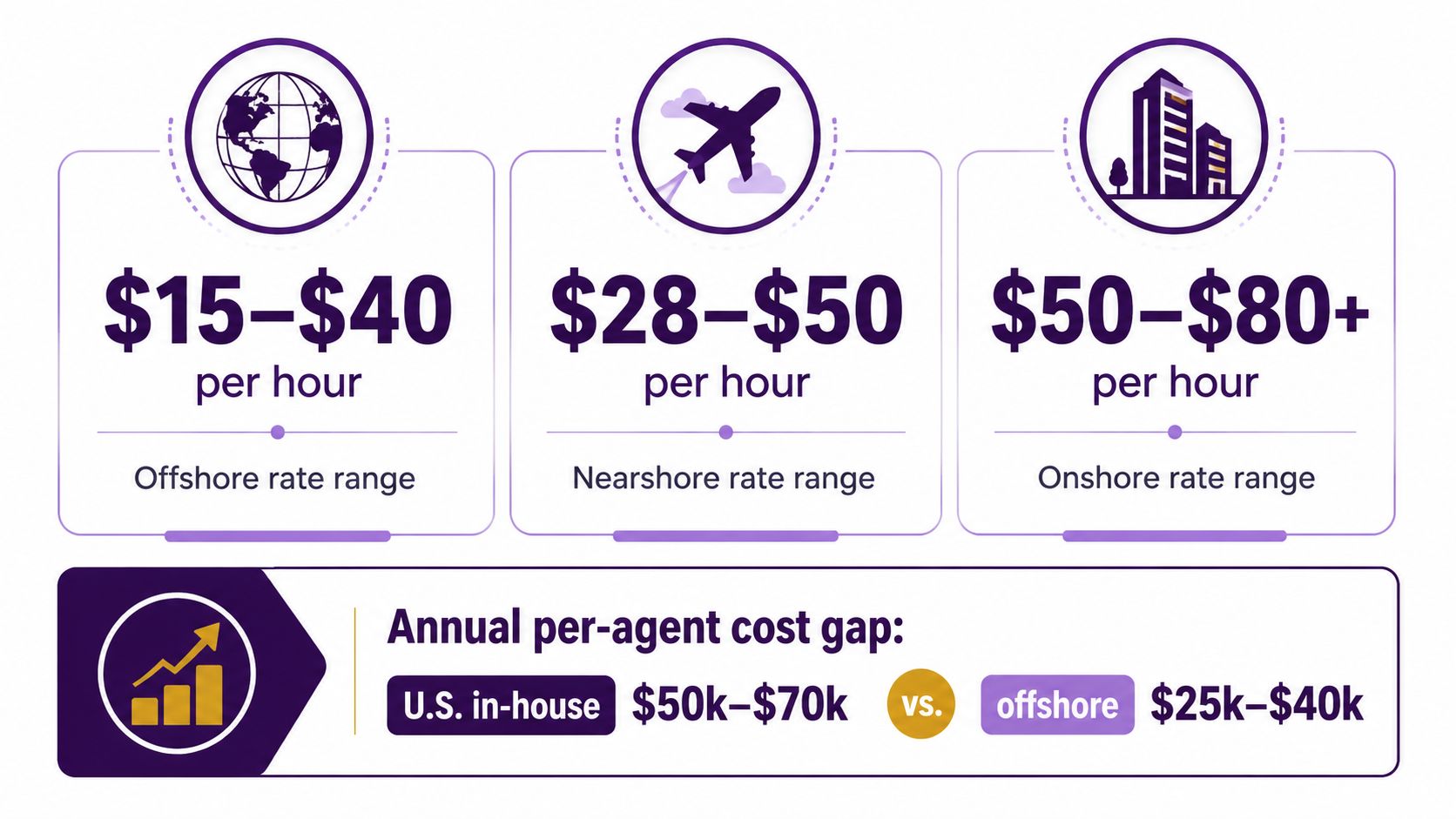
The cleanest way to think about outsourced customer service cost is to treat it as a range, not a single number. The market now prices support across a wide spread, from $6 to $14 per hour offshore, $8 to $18 nearshore, and $25 to $42 onshore in the U.S., with another 2026 comparison placing Latin America at $17 to $24 per hour, Asia at $9 to $17, and U.S. and Canada vendors at $36 to $50 (regional pricing benchmarks). Those figures tell you where vendors sit in the market. They do not tell you what your program will cost once training, coverage, and management are part of the deal.
Annual labor gives a clearer picture. A 2026 support cost source estimates $52,000 to $73,590 for a U.S. support agent, versus $14,000 to $21,120 for an outsourced agent in the Philippines and $25,000 to $38,000 for a nearshore Latin America agent (customer support outsourcing statistics 2026). That gap is why outsourcing gets attention fast. It also shows why a buyer who only compares rate cards is missing the full decision.
The number people skip
Stop thinking in agent cost and start thinking in cost-to-serve. A 2026 benchmark puts Tier 1 outsourced support at $6 to $13 per ticket, compared with about $22 per ticket for in-house North American support, and says outsourcing typically reduces per-ticket cost by 40% to 60% (outsourced customer support versus in-house statistics). That is the number that matters when you are deciding whether a proposal is worth buying.
Practical rule: If a proposal only gives you a rate card, you do not have a budget yet. You have a starting point.
The test is what each resolved contact costs. A low hourly price can still turn into a high total spend if the team needs repeat contacts, extra oversight, or separate tools to do the work. Buyers who want a budget they can defend should compare the quote against the outcome, not just the staffing line.
See how CallZent frames pricing for support programs
The Hidden Costs Behind the Quoted Hourly Rate
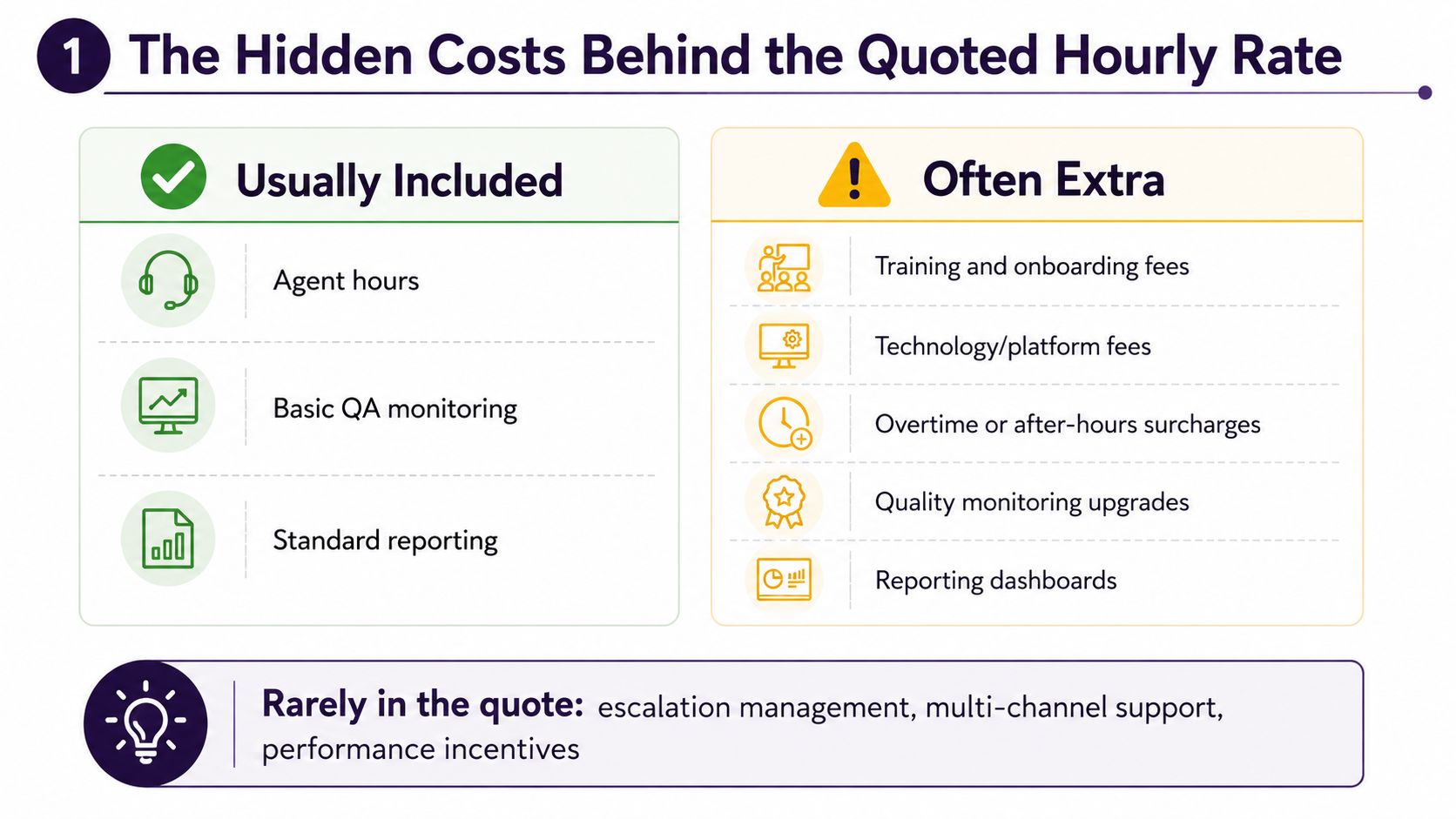
Vendors lead with a neat hourly number because it closes deals. The problem is that the sticker price rarely reflects the full program. Base agent time is only one line item. Training, onboarding, telephony, compliance, WFM tools, analytics, and account management can all sit outside the quoted rate, which is why a practical ROI guide tells buyers to compare proposals on an apples-to-apples basis and watch for management overhead, technology add-ons, and implementation cost on top of the base rate (The Real ROI of Outsourcing Customer Support).
What belongs in the rate and what usually doesn’t
A clean quote spells out the bundle. If a vendor cannot separate staffing from program operations, the pricing is already blurry. Two offers with the same hourly rate can still produce very different invoices.
Use this split when you review a proposal:
- Usually included: agent hours, basic QA monitoring, standard reporting.
- Often extra: training and onboarding fees, technology or platform fees, overtime surcharges, upgraded quality monitoring, reporting dashboards.
- Rarely in the quote: escalation management, multi-channel support, performance incentives.
That is where buyers get burned. A provider can look cheaper on paper and still charge more once the program needs the pieces that make the service usable. If core tooling is excluded, you pay once through vendor fees and again through your own internal oversight.
A buyer comparing nearshore options should also look past the headline rate and check how much work the vendor puts behind the scenes. The pricing guide for nearshore call center pricing makes the point clearly. A rate that looks modest can still become expensive if the scope leaves out onboarding, supervision, or the tools needed to keep the team on target.
Why apples-to-apples matters
A low quote only helps if you know what lands on the invoice. Ask for a one-page line-item breakdown before you compare anything. If one proposal includes QA and dashboards while another bills them separately, the supposedly cheaper option can already be the more expensive program.
A good buyer does not start with, “What is your rate?” Start with, “What do I pay to launch, manage, and keep this channel compliant?” That question exposes most pricing tricks fast. It also forces vendors to show whether their number reflects a real operating cost or just a headline designed to win the first call.
Regional Pricing Benchmarks You Can Trust
Region matters because labor, language, time-zone overlap, and specialization all affect support economics. A useful 2026 benchmark puts nearshore Latin America at about $12 to $24 per hour, offshore Asia at about $5 to $16, and U.S./Canada at about $28 to $42 for outsourced call center work (call center outsourcing cost comparison). Another 2026 guide places LATAM nearshore at $10 to $19 per hour and North America onshore at $28 to $42, which is why the mid-market sweet spot often sits in the middle instead of at the bottom (cost of outsourcing customer service).
That middle band is where bilingual support earns its keep. North American brands don’t buy nearshore only because it’s cheaper than domestic staffing. They buy it because proximity improves coordination, Spanish coverage, and handoff speed without paying full onshore rates.
The per-contact view is even more useful. A 2026 pricing guide estimates cost-to-serve per contact at about $7 to $12 for nearshore Latin America, $4 to $8 for offshore Asia, and $10 to $16 for domestic U.S. BPO (outsourced call center pricing guide). In other words, the lowest hourly labor market doesn’t always produce the best outcome for a North American brand that needs bilingual coverage and tighter customer coordination.
Outsourced Customer Service Cost by Region 2026
| Region | Hourly Rate (USD) | Cost per Contact (USD) | Typical Fit |
|---|---|---|---|
| Nearshore Latin America | $12 to $24 | $7 to $12 | Bilingual Spanish-English support, U.S. time-zone overlap |
| Offshore Asia | $5 to $16 | $4 to $8 | High-volume, cost-first programs with simpler workflows |
| U.S./Canada Onshore | $28 to $42 | $10 to $16 | Regulated work, premium specialization, strict domestic coverage |
| Western Europe | $33 to $41 | Not stated in the verified data | Higher-cost multilingual coverage for European business hours |
| Eastern Europe | $12 to $22 | Not stated in the verified data | Skilled teams, good language coverage, European overlap |
Review CallZent’s nearshore pricing context
My take is blunt. If your customer base is North American and you need Spanish, nearshore usually beats offshore on total value even when offshore wins on the spreadsheet. The right metric is not the lowest labor rate. It’s the best cost per resolved contact for your customer base.
How to Calculate Your Own Outsourced Customer Service Cost
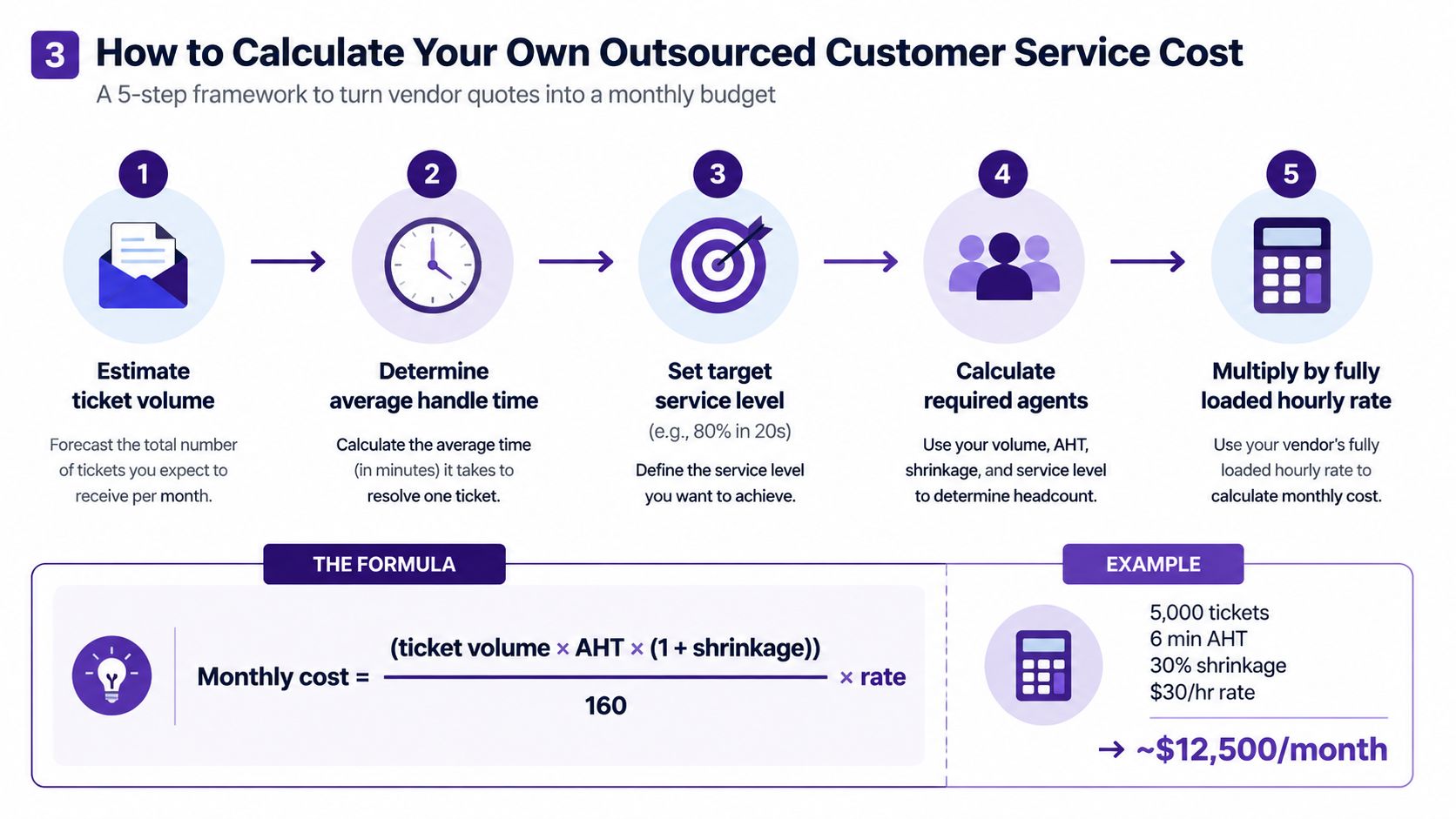
Start with volume, not headcount. If you know how many contacts you handle in a month, you can pressure-test any proposal in minutes. The basic logic is straightforward, you convert tickets into work time, adjust for shrinkage, then multiply by the fully loaded hourly rate.
A simple budgeting formula
Use this sequence:
- Estimate ticket volume. Count the monthly contacts you expect.
- Determine average handle time. Include talk time and work time.
- Set target service level. Don’t buy capacity blind.
- Calculate required agents. Translate demand into staffing.
- Multiply by fully loaded hourly rate. That gives you a monthly baseline.
A practical shortcut is this formula, provided in the brief’s planning framework, Monthly cost = (ticket volume × AHT × (1 + shrinkage)) / 160 × rate. For a sample program with 5,000 tickets, 6 minute AHT, 30% shrinkage, and $30 per hour, the rough result is about $12,500 per month.
The other number that matters is per-contact economics. Many outsourcing models now compare pay-per-resolution at $1 to $7 per resolved case and cost-to-serve per contact instead of only hourly labor. That shift matters because first-contact resolution and escalation rate change the cost more than the quote does.
If you’re still building your tool stack, a solid place to start is where to start with support tools. The right platform doesn’t lower labor cost by itself, but it makes your staffing math and reporting far less fragile.
See how CallZent approaches outsourcing cost-benefit analysis
Don’t build the model around rate alone
A support team that hits the service level but forces callbacks is still expensive. A support team that resolves the issue cleanly can justify a higher rate. That’s why I always tell buyers to budget around the work, not the vendor pitch.
Real-World Scenarios and Where Teams Go Wrong
A U.S. e-commerce brand I’d classify as a classic rate-shopper went with the lowest offshore bid. The agent rate looked great, but the contract excluded setup, QA upgrades, and enough management time to keep the queue stable. By year one, the brand’s total cost-to-serve climbed because repeat contacts and internal oversight kept stacking on top of the “cheap” quote.
The failure wasn’t offshore labor. The failure was buying on price instead of outcome.
A healthcare-adjacent SaaS company made the opposite call and chose a bilingual nearshore partner in Mexico. The hourly rate was higher than the offshore alternative, but the team improved first-call resolution and cut repeat contacts. The result was a lower cost per resolved case, which is the number that pays the bills.
The cheapest team on paper is often the most expensive team in practice.
If you run a support program in e-commerce, fintech, healthcare, or subscriptions, this pattern shows up fast. Simple tickets are where offshore can win. Complex, bilingual, customer-retention-sensitive work is where nearshore usually earns a better total return.
Actionable Ways to Reduce Outsourced Customer Service Cost
The fastest savings usually come from better operations, not harder negotiation. You can squeeze the rate card and still lose money if the team keeps reopening tickets or escalating simple issues. The levers below change the outcome, which is what you should be paying for.
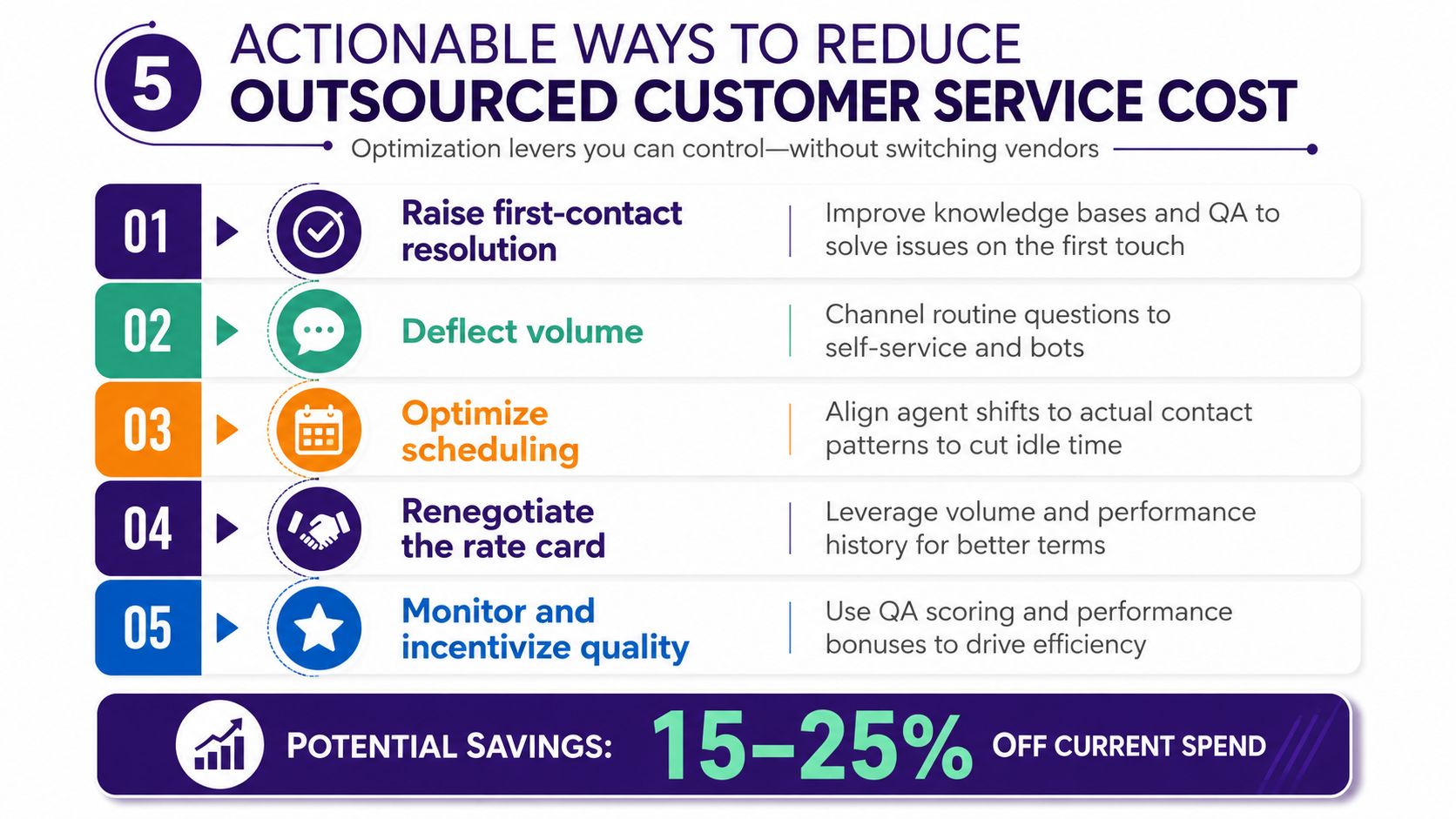
Five levers that actually move the bill
- Raise first-contact resolution. Better knowledge bases and tighter QA reduce repeats. This is the cleanest path to lower cost-to-serve.
- Deflect volume. Move repetitive issues into self-service and bot flows so agents only handle what needs a human.
- Optimize scheduling. Match shifts to real contact patterns so you’re not paying for idle coverage.
- Renegotiate the rate card. Use actual volume and performance history, not just market averages, to push terms.
- Monitor and incentivize quality. Reward clean resolution, not just speed.
A separate cost-to-serve benchmark says repeat contacts add 30% to 50% to the effective cost per resolution (customer support cost-to-serve statistics 2026). That’s why FCR matters more than a small hourly discount. If a team resolves the issue the first time, your per-contact cost drops even when the rate stays flat.
If you need a broader procurement lens, cut South African procurement costs is a useful reminder that pricing discipline is usually won through process, not panic renegotiation.
What I’d prioritize first
Start with FCR and deflection. Then tighten scheduling and KPI language in the contract. Rate cuts matter, but they’re usually a second-order win compared with better resolution quality.
Review CallZent’s cost-saving approach for support operations
Your Outsourced Customer Service Cost Negotiation Checklist
Before you sign, demand a line-item rate card. If the vendor won’t show you what’s included, they’re asking you to trust the quote instead of the contract. That’s a bad trade.
Use this checklist:
- Billable time definition. Ask what counts as paid time, including after-call work and idle time.
- Setup and exit fees. Get the launch cost and the offboarding cost in writing.
- Technology inclusions. Confirm what tools, licenses, and reporting dashboards are bundled.
- SLA credits and quality targets. Tie compensation to service outcomes, not just attendance.
- Compliance scope. Spell out data handling, access control, and escalation ownership.
- Cost-per-resolution path. Ask how pricing changes if repeat contacts rise.
Use CallZent’s vendor evaluation criteria as a comparison framework
The cheapest vendor is rarely the cheapest program. Nearshore bilingual coverage in markets like Tijuana often wins on total cost-to-serve even when the hourly rate isn’t the lowest on the page. If you want a support operation that balances cost, quality, and speed, bring your real contact volume and current pain points to CallZent, then compare the proposal against the checklist above.
🚀 Build a Customer Service Budget Based on Real Costs
Bring CallZent your contact volume, service requirements, and current pain points. We will help you evaluate a bilingual nearshore support model based on the complete cost of operating and resolving customer contacts.
Talk to an Expert