Skip to content
BPO Procurement & Cost Strategy
Total Cost of Ownership Analysis: A Better Way to Compare BPO Providers
Learn how total cost of ownership analysis reveals the true lifecycle cost of nearshore, offshore, and in-house contact center operating models.
TL;DR — Quick Takeaways
- Total cost of ownership analysis compares the complete lifecycle cost of a BPO model—not only its advertised hourly or per-minute rate.
- A complete model should include acquisition, implementation, daily operations, management, quality assurance, maintenance, compliance, transition, and exit costs.
- Low offshore pricing can be offset by additional coordination, rework, turnover, travel, training, and client-side management.
- Nearshore delivery may create value through bilingual talent, shared working hours, geographic proximity, and faster operational collaboration.
- In-house operations offer direct control but place the full cost of recruiting, benefits, facilities, technology, management, and unused capacity on the company.
- The strongest procurement decision compares productive output, management effort, quality, flexibility, risk, and lifecycle cost using the same operating scope.
A procurement team approves an offshore call center because the per-minute rate is the lowest on the spreadsheet. A few months later, supervisors are spending time clarifying instructions across time zones, quality teams are reworking calls, new agents need repeated training, and compliance reviews require more internal attention than expected. The rate looked efficient. The operation isn’t.
That gap is exactly why total cost of ownership analysis matters. In BPO, the meaningful question isn’t “What does each minute cost?” It’s “What will this operating model cost from implementation through daily management, quality control, renewal, and exit?” A nearshore partner in Tijuana may not always present the lowest headline rate, but the full lifecycle comparison can produce a more reliable business decision.
What Is Total Cost of Ownership Analysis
Consider a company launching customer support for a growing e-commerce operation. Its finance team compares offshore proposals by minute and selects the lowest quote. The first invoice fits the budget, but the operating team soon encounters communication friction, inconsistent interpretation of the knowledge base, repeat contacts, agent replacement work, and extra monitoring. None of those costs were obvious in the advertised rate.
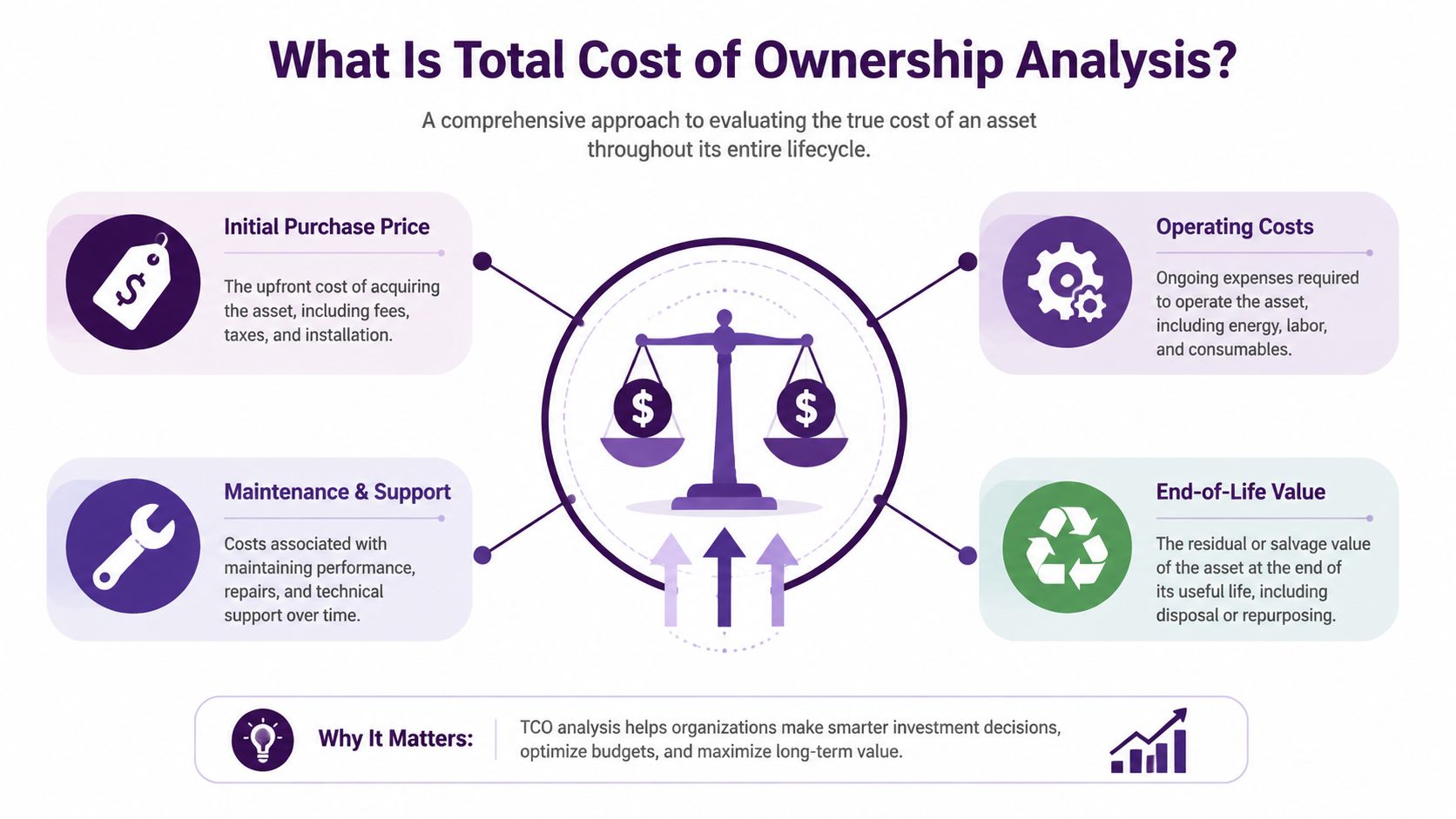
That doesn’t mean offshore outsourcing is automatically a poor choice. It means a per-minute rate measures only one slice of the decision. Total cost of ownership analysis adds the expenses that appear before service begins, during daily delivery, and when the relationship changes or ends.
Gartner helped formalize and popularize TCO in enterprise IT in 1987, building on earlier lifetime-cost thinking. A widely cited insight from that work was that the purchase price of a personal computer represented about 20% of its five-year cost, while deployment, support, training, downtime, and administration represented the remaining 80%. The lesson transferred naturally to BPO procurement, where labor is only one part of the service system. Gartner’s TCO history and foundational analysis provides the broader context.
The practical meaning for call centers
For a call center, acquisition can include recruitment preparation, technology configuration, onboarding, training, and integration. Operating costs include agent delivery, supervision, reporting, workforce management, quality assurance, and client-side coordination. Maintenance includes process updates, coaching, platform administration, compliance checks, and replacing people who leave. End-of-life costs can include knowledge transfer, data handling, contract transition, and service continuity during a move.
Government procurement guidance treats TCO as a lifecycle measure too. New Zealand guidance includes purchase, installation, operating, maintenance, and disposal costs, less residual value. UK policy includes lifetime ownership, exit, and transition costs, while Western Australia requires a TCO model for ICT proposals with estimated total cost above $5 million. The UK government’s TCO guidance shows how the framework operates beyond private-sector spreadsheets.
Core takeaway: The cheapest service rate isn’t necessarily the lowest-cost operating model.
Understanding the Cost Components of TCO Analysis
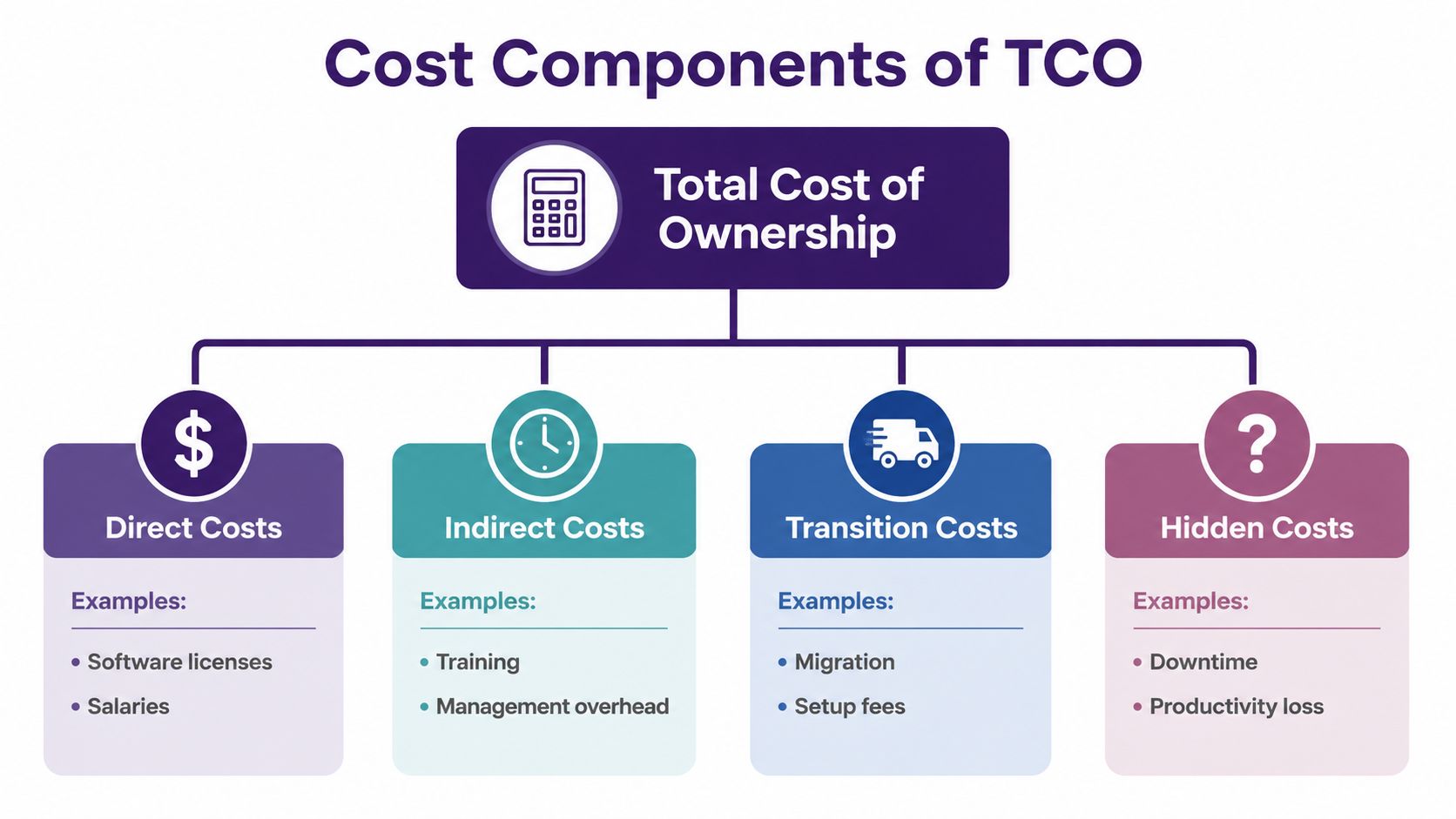
A useful call center model separates costs into four categories. The categories prevent a familiar procurement mistake, where expenses are either hidden inside vague assumptions or omitted because they don’t appear on a vendor quote.
Direct costs
These are the easiest to identify because they usually appear on invoices or internal budgets:
- Service delivery: Agent labor, team leadership, scheduling, and the contracted service unit.
- Technology: Contact center software, CRM access, telephony, recording, reporting, and security tooling.
- Facilities: Workstations, connectivity, power, physical security, and workplace administration where those items aren’t included in the provider fee.
- Quality operations: Evaluations, calibration, coaching administration, and reporting support.
A quote can make these items look complete while still leaving important responsibilities with the client. Ask whether the provider owns the technology configuration, reporting, workforce planning, and quality workflow, or whether your managers must supply them.
Indirect costs
Indirect costs are connected to the operation but aren’t always assigned to a specific call. Internal stakeholders may spend time reviewing dashboards, approving schedule changes, answering escalations, updating scripts, or resolving recurring defects. Those hours have an economic cost even when the BPO invoice doesn’t show them.
For example, two providers may offer similar staffing structures. One may require frequent client-side intervention to clarify procedures, while the other may operate with cleaner governance and stronger documentation. The headline rate doesn’t capture that management burden.
Transition costs
Transition begins before the first live interaction. It can include process discovery, knowledge-base preparation, hiring, training, nesting, system access, integration, testing, reporting design, and controlled volume migration. A rapid launch may appear attractive, but compressing preparation can transfer cost into rework, avoidable escalations, and inconsistent customer treatment.
Hidden costs
Hidden costs are often the most operationally important. They include compliance monitoring, security reviews, turnover replacement, failed quality outcomes, downtime, customer remediation, and reputational exposure. Not every item will occur, but a credible model should identify the risk and state who bears it.
A contact center choosing inexpensive software licenses may still incur high implementation, agent training, integration, and support costs. This call center outsourcing cost breakdown offers a practical starting point for separating visible pricing from the wider service expense.
How to Build a Total Cost of Ownership Model
A useful model doesn’t need to be complicated, but it must reflect the operation you’re buying. Benchmark guidance emphasizes that credible TCO comparisons require transaction-level contract information and deployment-specific variables, including implementation, support, integration, and overhead. A simple rate comparison can miss the largest cost drivers. Independent TCO benchmarking guidance explains why level-one price checks and deeper TCO analysis produce different decisions.
Start with the operating boundary
Define what you’re comparing before collecting prices. A client might compare an outsourced customer service team with an in-house team, or compare nearshore and offshore providers for the same scope. Include the channels, hours, languages, interaction types, systems, compliance obligations, service levels, reporting, and escalation responsibilities.
Choose a consistent evaluation period. Then assign owners for each assumption. Finance can validate labor and overhead, operations can estimate management effort, IT can assess integration and security work, and compliance can identify review requirements.
Build the model in lifecycle phases
Use four main columns or worksheets:
- Acquisition: Discovery, setup, implementation, recruiting, training, equipment, integration, and launch preparation.
- Operations: Service fees, supervision, workforce management, quality assurance, reporting, client oversight, technology, and recurring compliance work.
- Maintenance: Coaching, process changes, knowledge-base updates, system administration, replacement hiring, retraining, and remediation.
- Exit: Data return, knowledge transfer, transition support, contract closeout, replacement provider onboarding, and service continuity.
Estimate each item separately instead of burying it in an “other” line. Mark assumptions as confirmed, vendor-provided, internally estimated, or unknown. Unknowns deserve a sensitivity review because they can distort the comparison.
Test the assumptions
Run a base case, a conservative case, and a disruption case. Change the assumptions most likely to move the result, such as contact volume, training demand, escalation frequency, manager involvement, turnover replacement, and integration effort. Don’t present an uncertain forecast as a precise outcome.
For teams preparing a larger business case, a resource on how to justify engineering spend with data can help structure evidence, assumptions, and return calculations. For outsourcing-specific comparisons, CallZent’s outsourcing cost-benefit analysis provides another useful reference point.
Practical rule: If a vendor can’t explain who owns a cost, place that cost in the client-risk column until the contract resolves it.
The finished model should show more than a total. Include cost per productive hour, cost per resolved interaction, management hours, transition effort, and the assumptions behind each figure. That makes the model useful during negotiations and after launch, when actual operating data becomes available.
Comparing Nearshore, Offshore, and In-House Options
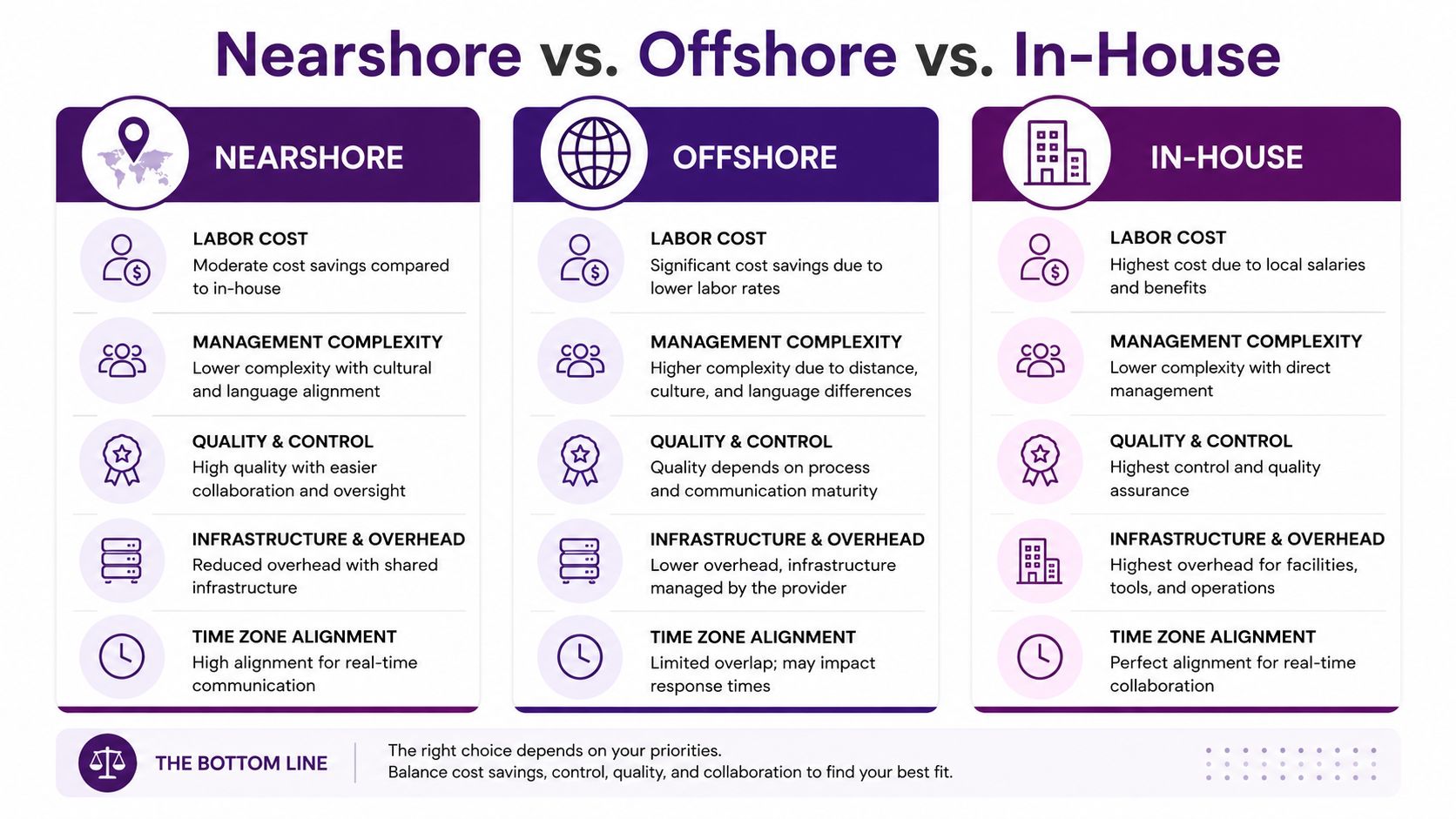
The right comparison depends on the work, not on geography alone. Nearshore, offshore, and in-house models each move costs between categories. A lower labor rate may reduce direct expense while increasing coordination, quality, travel, or oversight costs. An internal team may provide control while creating fixed facility and staffing obligations.
| Model | Where the headline advantage appears | Costs that require close examination |
|---|---|---|
| Nearshore | Regional proximity, shared working hours, bilingual delivery, and easier collaboration | Provider rate, local operating costs, travel, integration, and capacity planning |
| Offshore | Potentially lower labor pricing and access to large delivery pools | Time-zone coordination, communication friction, quality management, turnover replacement, travel, and client oversight |
| In-house | Direct control over people, workflows, and customer experience | Facilities, equipment, benefits, recruiting, management, technology, training, and unused capacity |
Nearshore delivery from Tijuana
A Tijuana-based nearshore team can work closely with North American stakeholders while supporting English and Spanish customer interactions. That proximity can reduce the practical burden of travel, meetings, issue escalation, and knowledge transfer. It can also make it easier for managers to align on tone, process interpretation, and customer expectations.
Nearshore doesn’t eliminate management or quality costs. It shifts the evaluation toward operational fit, communication, resilience, and the cost of correcting problems. A provider with a higher quoted rate may still create a lower TCO if supervisors spend less time repairing misunderstandings and if changes reach the floor faster.
Offshore delivery
Offshore providers may offer compelling rates, particularly for standardized work with stable scripts and predictable demand. The model becomes harder to evaluate when the process depends on nuanced judgment, frequent updates, sensitive customer conversations, or close collaboration with a North American team.
Time-zone differences can delay decisions and extend issue resolution. Cultural and language mismatches may increase coaching requirements. Travel and client oversight can also become recurring management expenses rather than one-time events. These aren’t universal outcomes, but they belong in the model as scenario-specific risks.
In-house operations
In-house teams avoid a vendor margin and give the client direct control over hiring, training, systems, and quality processes. They also carry the full responsibility for facilities, equipment, benefits, recruitment, management, compliance, and technology.
Capacity creates a further trade-off. A team sized for peak demand may carry unused capacity during slower periods. A team sized for normal demand may struggle during campaigns, seasonal surges, or unexpected service disruptions. Outsourcing can provide a different capacity structure, but the contract must explain how scaling, minimum commitments, and schedule changes affect cost.
Labor arbitrage can matter, but it shouldn’t be the only lens. CallZent’s explanation of labor arbitrage is useful for distinguishing wage differences from the broader operating economics. The strongest decision compares productive output, management effort, quality, flexibility, and lifecycle exposure, not just labor price.
Decision Criteria for Selecting a BPO Partner
A BPO partner should make your TCO model clearer, not harder to complete. If the proposal gives you one per-minute rate without explaining implementation, supervision, technology, quality, reporting, escalation, and exit responsibilities, you don’t yet have a comparable offer.
Evaluate the commercial structure
Request a line-by-line explanation of included and excluded services. Ask how the provider handles setup, training, nesting, schedule changes, technology access, recording, quality monitoring, reporting, compliance support, and transition. Confirm whether pricing changes by channel, language, shift, interaction type, or volume commitment.
Examine operational alignment
Review working hours, language requirements, cultural fluency, escalation coverage, and leadership availability. For a North American customer base, regional proximity can simplify collaboration, but you should still test the provider’s ability to manage your actual customer scenarios.
Use a weighted decision matrix rather than allowing price to dominate by default:
- Cost transparency: Can your team trace every material assumption?
- Operational fit: Does the provider understand your workflows and customer context?
- Quality control: Are evaluation standards, calibration, coaching, and reporting defined?
- Compliance readiness: Can the provider demonstrate appropriate controls and audit cooperation?
- Technology integration: Can it connect with your CRM, telephony, ticketing, and reporting environment?
- Scalability: Can capacity change without creating operational or financial instability?
- Exit readiness: Are data return, knowledge transfer, and transition support documented?
Validate governance before signature
Compliance shouldn’t be a late-stage checklist. Define access controls, data handling, monitoring, incident escalation, audit rights, retention, and subcontractor responsibilities during evaluation. Technovation LLC compliance insights provide useful context for building vendor-management discipline around those responsibilities.
Your matrix should assign weights based on business risk. A healthcare provider may place compliance and data handling above speed. An e-commerce company may prioritize flexible capacity and rapid issue resolution. A financial-services operation may require stronger controls around access, recording, and escalation.
Technology deserves a live demonstration, not a slide deck. Ask the partner to show how a supervisor reviews an interaction, how an agent receives a knowledge update, how a client sees performance data, and how an escalation moves through the workflow. CallZent’s vendor evaluation criteria can help organize these questions before finalist presentations.
A credible partner doesn’t hide complexity. It assigns ownership to each cost, risk, and operational responsibility.
Key Takeaways and Next Steps
Total cost of ownership analysis changes the decision from “Which provider has the lowest rate?” to “Which model produces the strongest operating value after every material cost is counted?” That distinction matters because BPO performance depends on more than agent labor. Implementation, supervision, quality assurance, technology, training, compliance, management attention, rework, and exit planning all influence the economics.
The framework also has a historical reason for its staying power. Gartner’s enterprise IT work helped establish the idea that purchase price can represent only a small portion of lifecycle cost, while public procurement guidance now treats acquisition, operation, maintenance, disposal, and transition as part of the ownership picture. In call center outsourcing, the same principle applies to a service relationship rather than a physical asset.
What operations leaders should remember
- Rate is an input, not a verdict. A per-minute quote can help establish a baseline, but it can’t answer whether the operation will require extra coaching, management, travel, rework, or compliance oversight.
- Nearshore value comes from proximity as well as labor economics. A Tijuana operation may support faster collaboration, bilingual communication, and closer alignment with North American working patterns. Those advantages should be tested against the actual workflow, not assumed.
- Offshore is a trade-off, not a failure. Offshore delivery can fit standardized processes with clear documentation and stable demand. The model requires explicit treatment of time zones, communication, quality, turnover, travel, and client-side governance.
- In-house control carries a fixed burden. Direct ownership of staff and systems can be valuable, but facilities, technology, benefits, recruiting, training, and management remain the client’s responsibility.
- Hidden costs need named owners. If a proposal doesn’t state who pays for implementation, integration, reporting, replacement training, remediation, or exit support, the risk hasn’t disappeared. It has only moved into an unclear category.
Turn the model into a procurement tool
Start with your current operation. Record internal management time, technology expenses, training work, quality activity, compliance effort, facilities, and the cost of service interruptions. Then give every prospective provider the same scope and ask for the same lifecycle breakdown.
Compare scenarios rather than relying on one forecast. Test what happens if volume changes, training takes longer, a system integration requires more work, or the client must increase oversight. Review the model with finance, operations, IT, compliance, and customer experience leaders before you select a provider.
Contract language should preserve the assumptions that made the business case work. Define service scope, pricing triggers, reporting, quality standards, data responsibilities, security obligations, change control, scaling, renewal, and exit support. CallZent’s call center contracts resource can help operations teams identify the commercial terms that deserve attention.
The best BPO decision isn’t the one with the lowest advertised rate. It’s the one that delivers the lowest credible lifecycle cost while protecting quality, compliance, and customer experience.
Nearshore providers such as CallZent can be evaluated within this framework for bilingual customer service, technical support, lead generation, debt collection, virtual assistance, and reservation management. The relevant question is whether the provider’s delivery model, technology, governance, and scaling approach fit your measured requirements.
Use the model to request complete proposals, challenge unclear assumptions, and compare productive outcomes instead of surface pricing. A disciplined TCO review won’t guarantee that one geography wins every decision, but it will show where the money goes and which risks your operating team is accepting.
Compare Lifecycle Cost—Not Just the Advertised Rate
Bring CallZent your current costs, service requirements, and operating assumptions. We’ll help you evaluate a bilingual nearshore model based on implementation, management, quality, scalability, and long-term value.
Schedule a CallCallZent provides bilingual nearshore call center and BPO services from Tijuana, including customer service, technical support, back-office support, and scalable outbound programs. Bring your current cost assumptions and service requirements to CallZent to discuss a lifecycle-based outsourcing comparison rather than a per-minute quote alone.