Skip to content

Bilingual Support & Customer Experience
Bilingual Customer Service: Models, Quality, KPIs, and ROI
Build English-Spanish support around tested language skills, clear human handoffs, comparable service outcomes, and a measurable business case.
TL;DR — Quick Takeaways
- Measure service outcomes by language, channel, and issue type—not just bilingual coverage.
- Choose direct bilingual service, qualified interpretation, or validated automation for the actual task.
- Test listening, speaking, writing, terminology, and service judgment in both languages.
- Keep clinical advice and other restricted decisions with appropriately qualified professionals.
- Pilot one queue and measure incremental benefits and costs without double counting.
Adding a Spanish option doesn’t fix a language gap if Spanish callers still wait longer, transfer more often, and get a different answer. That’s the trap many teams miss. They count coverage, not outcomes. Effective bilingual customer service combines communication skills, operational controls, and measurement. You need the right model for each task, qualified people for high-stakes conversations, and reporting that compares every result by language.
What Bilingual Customer Service Really Means
Bilingual customer service means English and Spanish conversations handled to the same standard, with matched scripts, routing rules and escalation paths. A caller should receive equivalent policy information, appropriate next steps, and accurate documentation in either language. Delivery may differ to support comprehension, accessibility, and the particular request. If the Spanish path is slower or thinner, you don’t have equal service. You have an English service with a Spanish greeting.
A bilingual agent serves customers directly in two languages and owns the service task within approved authority. An interpreter facilitates spoken communication between people who do not share a language, while a translator works with written content. These are distinct roles with different qualifications; a bilingual employee is not automatically a qualified interpreter or translator.
Five Models to Compare
| Model | How Spanish is handled | Best fit | Main risk |
|---|---|---|---|
| English-only queue | No supported Spanish service path | Not a Spanish-support solution; assess service needs and applicable access obligations | Misunderstood calls, abandonment and repeat contacts |
| Interpreter line on demand | A third-party interpreter joins the call when needed | Less frequent languages, variable demand, or situations requiring qualified interpretation | Connection and coordination requirements; maintain qualified availability |
| AI translation layer | Automated translation of speech or text, with the agent reading the English output | Approved low-risk tasks after task-specific validation | Meaning errors, privacy exposure, and failed human handoffs |
| In-house bilingual agents | Staff hired, trained and managed locally | Stable volume and strong local HR capacity | Recruiting capacity, coverage continuity, and total operating cost |
| Dedicated bilingual nearshore team | English-Spanish agents trained on the client’s brand, terminology and systems | Steady volume in both languages during U.S. hours | Requires QA and language-level reporting to stay consistent |
Say a retailer gets a handful of Spanish chats a week about store hours. Approved bilingual content may cover those low-risk requests, with a suitable human path for exceptions. Say an insurer gets daily Spanish calls about claims and denials. That queue needs qualified personnel who understand the authorized scope and coverage terminology, with appropriate interpretation or licensed escalation when necessary.
Choose with three questions. How many Spanish contacts arrive each month? How costly is one misunderstanding? How fast must the team scale during peaks? Your answers point to the model. Low volume and low risk can stay light. High volume or high risk can’t rely on workarounds.
How Bilingual Support Can Improve Retention and CSAT
Start with demand in your own channels. Measure declared language preferences, requests for language assistance, abandonment, repeat contacts, and escalation reasons. A Spanish IVR selection alone may undercount demand when customers cannot find the option or switch channels to get help.
Language preference is not the same as English proficiency, ethnicity, or nationality. Ask customers how they want to communicate, preserve that preference where appropriate, and make it easy to change. Use aggregated results to plan coverage while protecting individual information.
Three Gains That Show Up in Operations
Resolution can support retention. A Spanish-speaking customer who resolves a billing dispute in Spanish doesn’t need a second call to check what was agreed. She hears the amount, the date and the confirmation number clearly. That completed interaction gives her less reason to shop for a provider who makes the next problem easier.
Comprehension can improve the reported experience. Clear amounts, dates, conditions, and next steps help customers understand the outcome. Measure CSAT and customer effort by language, using comparable survey wording, response windows, and sampling. Differences in response rates can affect the comparison.
Access can expand through shared operations. An e-commerce brand can support Spanish-preferring shoppers with the same policies and systems while adapting communication to their needs. Confirm staffing and knowledge coverage rather than assuming a shared queue provides equal access.
In a hypothetical example, a Spanish-speaking subscriber calls about a charge. He’s transferred twice, explains the issue in English, and gets a credit he doesn’t fully understand. The charge appears again, he calls back, and this time he cancels. The company records a price cancellation. A case review may reveal language friction alongside price or policy issues; the cancellation label alone does not establish the cause.
A missing Spanish option is a retention cost, not a nice-to-have.
Keep that cost in view when you reach the ROI formula later. Estimate incremental retained contribution, validated cost savings, and the full incremental program cost. Keep assumptions and overlapping benefits visible.
Industries Where a Language Gap Carries Real Risk
Some contacts carry more risk because they mix complex terms, sensitive personal data and legal consequences. A wrong delivery date annoys a shopper. A wrong medication instruction, coverage limit or payment date can harm someone or trigger a complaint. Rank your queues by that consequence before you decide who, or what, handles them.
Assess the Specific Task and Consequence
- Healthcare: Distinguish administrative assistance from clinical communication. Bilingual scheduling agents should not interpret clinical advice, assess symptoms, or explain medication instructions beyond their qualifications and approved scope. Connect appropriately qualified clinicians and interpreters when required. The HHS communication and language assistance guide offers educational resources for planning services around language and health-literacy needs.
- Financial services: Confirm amounts, dates, and approved disclosures. Fraud disputes and hardship discussions may require specialist authority or additional safeguards.
- Insurance: Claims, coverage conditions, and denial questions should follow approved wording and route to authorized staff when advice or a decision is outside the agent’s role.
- Telecommunications: Plan changes, outage credits, and contract fees require accurate confirmation of terms and customer authorization.
- E-commerce: Store hours and routine status requests may be lower-risk starting points, while payment disputes, sensitive information, or safety concerns need stronger controls.
Language-access, privacy, notice, and disclosure obligations depend on the organization, service, jurisdiction, and current rules. Have the responsible compliance team confirm the applicable requirements before approving workflows. A bilingual queue alone does not establish compliance or replace required interpretation and accessibility services.
Don’t ask whether an industry is regulated in general. Ask what happens if this specific caller misunderstands this specific sentence.
Use the routing table in the AI section to assign tasks by risk. Requirements vary by state and program, so confirm your obligations with counsel before you finalize scripts or disclosures.
How to Recruit, Train and QA Bilingual Agents
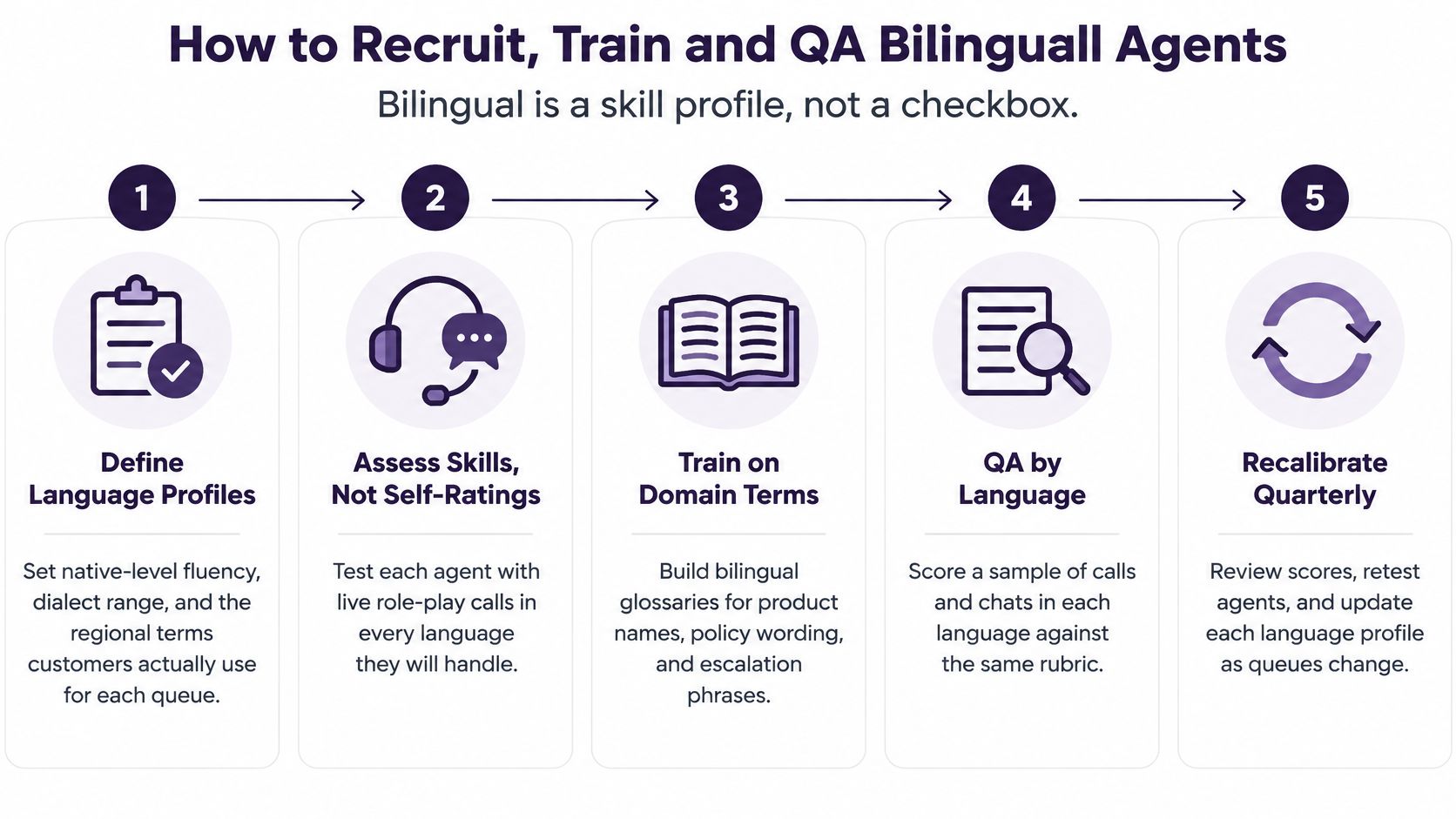
Bilingual is a skill profile, not a self-reported checkbox. An agent can chat comfortably in two languages and still fail on policy terms, complaint handling or written follow-up. Test the exact work the queue requires, then keep testing after hire.
A Seven-Step Routine That Holds Up
- Define a language profile for each queue. Set job-relevant listening, speaking, reading, and writing proficiency in each language, with intelligibility and domain comprehension matched to the audience. A benefits queue needs different vocabulary from a retail returns queue.
- Recruit with live assessments in both languages. Run a complaint role-play in English and Spanish. The common slip is testing Spanish conversation but English job skill, then discovering the gap on live calls.
- Train on brand terms and systems in both languages. Define training around the client’s brand, terminology, customer journey, systems, and service expectations. Build glossaries for product names, fees, approved administrative healthcare terms, coverage terminology, and escalation phrases customers use.
- Capture preferred language at first touch. Ask early, log it in the CRM and route the next contact correctly. Don’t make the customer negotiate for Spanish on every call.
- Align scripts and rules across languages. Qualification questions, routing logic and escalation rules should match in meaning, not word for word. Literal translation often produces Spanish that’s technically correct and operationally useless.
- Sample calls by language for QA. Score accuracy, tone and read-back confirmation with the same rubric in English and Spanish. Scoring QA only in English hides weak Spanish service behind a healthy average.
- Track alignment every week. Measure language-preference capture and first-contact language alignment alongside quality scores. If callers ask for Spanish but start in English, your routing is broken before the agent speaks.
Capture language preference early and use it to guide routing. A customer may understand some English but prefer Spanish for a complicated issue. Train agents to ask, confirm, and adapt rather than inferring preference from an accent or surname. Build these skills into ongoing agent training and review real examples in both languages.
Common hiring mistake: treating “speaks Spanish” as one skill. Listening, speaking, writing, domain vocabulary and complaint handling are separate skills, and your queue may need all five.
Code-switching also belongs in training. Many bilingual callers mix English product names or account terms into Spanish sentences. A good agent follows that mix without forcing a reset. QA reviewers should reward clear confirmation, not language purity.
Where AI Translation Helps and Where People Must Stay
Fluent Spanish output isn’t proof of good service. A system can produce a smooth sentence that drops the caller’s condition, deadline or objection. That error then enters the ticket, the summary and the next agent’s screen.
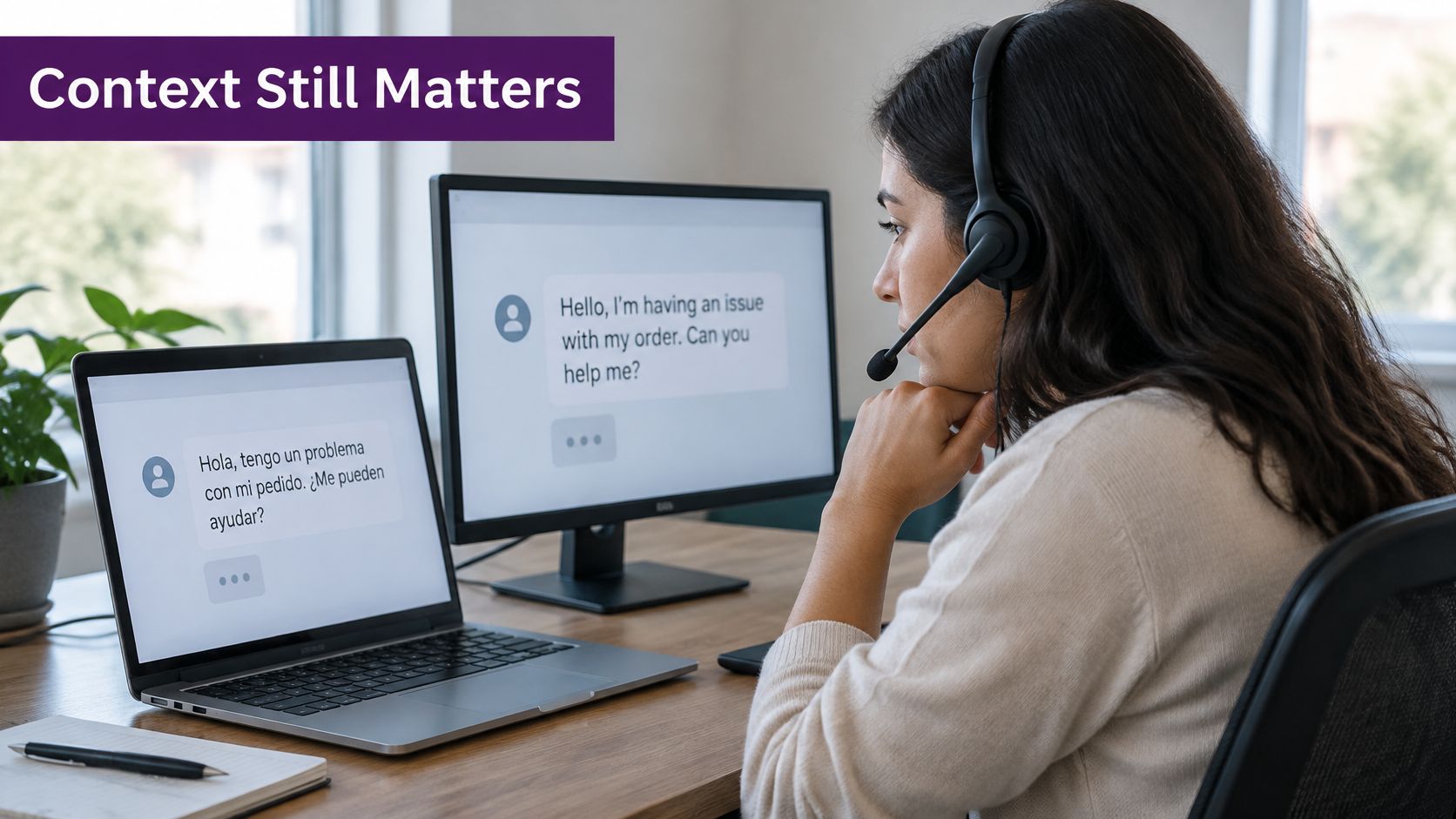
Test translation quality on the work you plan to automate: noisy audio, mixed-language statements, product names, amounts, conditions, and corrections. Assess whether meaning survives, not simply whether the output sounds fluent. Protect transcripts, prompts, and recordings under the program’s approved data-handling rules.
Use a tested hybrid model. AI may assist with routing, transcription, knowledge retrieval, and approved routine answers. Qualified people handle ambiguity, sensitive decisions, complaints, and exceptions. The NIST AI Risk Management Framework offers voluntary guidance for structuring evaluation, monitoring, and accountability; it does not certify a tool’s suitability for a specific queue.
Route by Task, Not by Hype
| Task | Handled by | Why | Check |
|---|---|---|---|
| Language identification and intent detection | Validated automation with customer correction and human fallback | Can assist routing, but mistakes can delay access | Misroute rate by language |
| Order status, store hours and FAQs | AI with approved Spanish content | Routine, scripted answers | Verified resolution, incorrect answers, repeat contacts, and failed handoffs |
| Billing disputes and complaints | Bilingual agent | Emotion and nuance decide the outcome | CSAT and complaint rate by language |
| Clinical medication questions, benefits decisions, or coverage advice | Appropriately qualified clinician or authorized specialist; qualified interpreter where required | Language proficiency alone does not confer clinical or decision authority | Correct routing, qualified review, and documented understanding |
| Collections and hardship plans | Trained, authorized bilingual agent with specialist escalation | Approved negotiation boundaries and required disclosures | Compliance audit score |
| Call summaries and transcripts | AI assistance with review matched to risk | Errors can enter the record; high-impact details may need verification before use | Sampled error rate reviewed by a bilingual analyst |
Set escalation triggers before launch:
- Repeated misunderstanding: provide a qualified human path without requiring a fixed number of failed attempts.
- High-impact or out-of-scope content: route clinical, legal, or other sensitive questions to the appropriate qualified resource.
- Caller asks for a person: honor it without another automated loop.
- Unreliable output or failed validation: stop the automated action and route appropriately. A confidence score alone is not proof of accuracy.
Define who accepts the handoff, what information travels with it, and what happens outside staffed hours. Bilingual reviewers should check omissions, changed meaning, incorrect numbers, and failed escalation as well as fluency.
Why Nearshore Tijuana Teams Suit Bilingual Support
Nearshore location is a risk-control choice, not a substitute for language quality. When agents and U.S. support leads have closer working-hour alignment, they can handle coaching, huddles and escalations during overlapping workdays rather than relying on overnight notes. Nearshore delivery can support English-Spanish programs with overlapping operating hours. Confirm staffing and coverage for the actual location and shift. Confirm local schedules when planning coverage, since time differences can vary during the year.

Compare fully scoped proposals rather than assuming a location guarantees a rate or a service level. Request written pricing for staffing, supervision, training, QA, reporting, coverage changes, and technology. For location planning, see CallZent’s Tijuana operation. Confirm included items, minimum commitments, and any additional system or integration charges.
Access to skilled bilingual talent in Tijuana and Hermosillo supports clear English, natural Spanish and familiarity with U.S. customer expectations. These strengths still need to be tested against your customers. Regional vocabulary varies, and a phrase that works in one market may confuse callers elsewhere. Build scripts and QA criteria around the language your customers use, then review English and Spanish interactions separately.
In a hypothetical example, a Texas telecom that needs evening Spanish coverage for plan-change calls after its onshore team closes. A Tijuana team can handle those conversations, record notes in the company’s CRM and join the next morning’s QA review. That can reduce overnight backlog, provided the team follows the same customer journey and escalation rules.
Vet Before You Buy the Map
- Comprehension and terminology testing: Test intelligibility, listening, and regional vocabulary against realistic customer scenarios.
- QA scored by language: Review separate samples and scores for English and Spanish.
- Data security: Confirm access controls and cross-border data handling.
- Preference logging: Record each caller’s language choice so the next interaction can follow it.
Proximity makes collaboration easier to manage, but it does not guarantee equal service. Treat location as one part of the operating model, then verify that each language queue meets the same service expectations.
Measuring Bilingual Performance and Return on Investment
Satisfaction alone hides unequal service. A strong English queue can lift the average while Spanish callers transfer more, wait longer and call back about the same issue. Compare every KPI by language, channel and issue type. That’s how you find the gap while it’s still fixable.
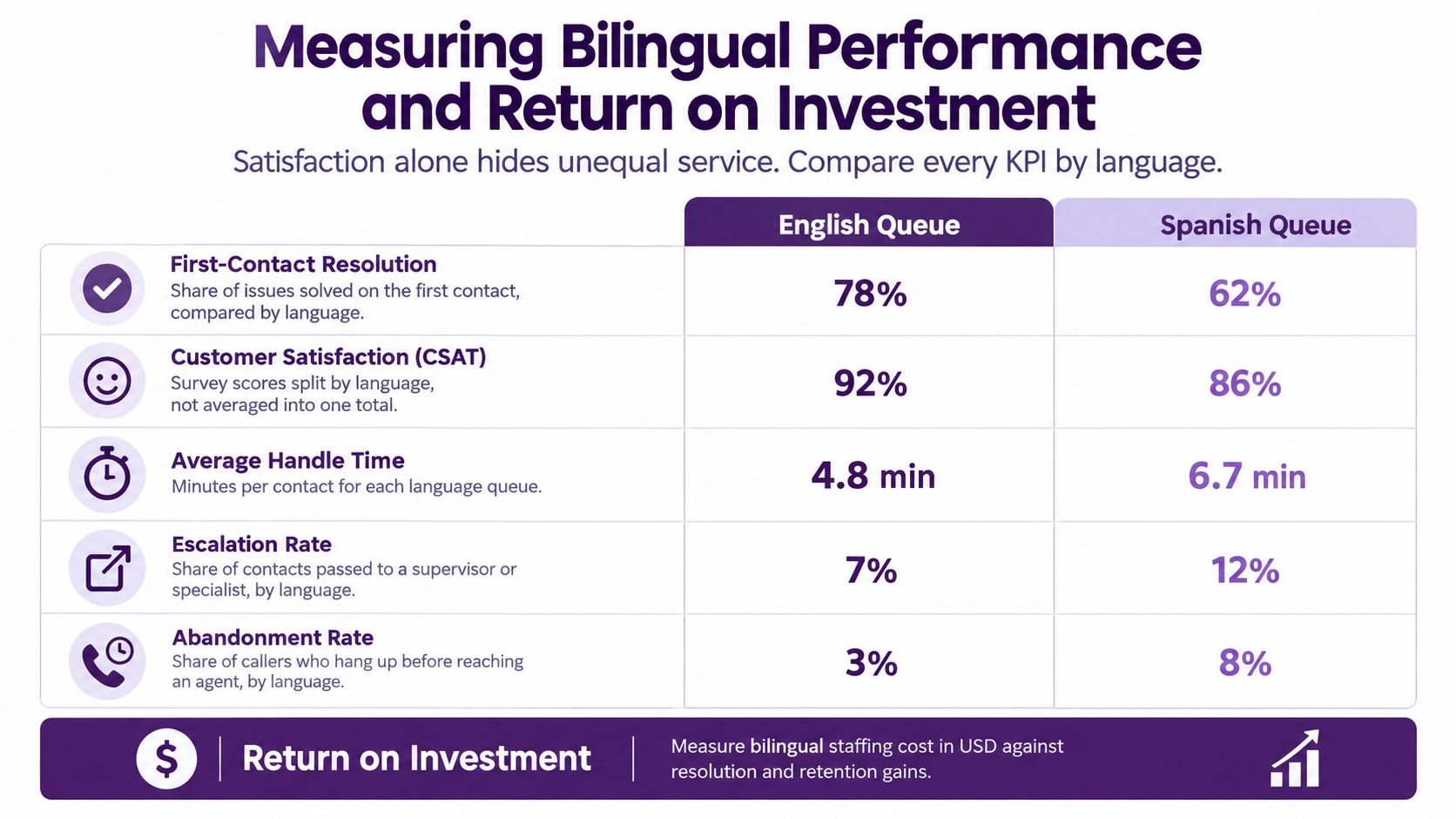
Compare like-for-like requests and required service paths. A clinically necessary interpreter handoff is not the same as an avoidable transfer, and a longer complex conversation does not automatically indicate poor performance. Review contact mix, sample size, survey response, skill availability, and quality before attributing a difference to language alone.
KPIs to Compare by Language
| KPI | Compare by language | Why it matters |
|---|---|---|
| First-contact resolution | Resolved on first contact in English vs Spanish | Shows whether the Spanish caller got a complete answer |
| Transfer rate | Share of contacts transferred, by language and queue | Separate required specialist handoffs from avoidable transfers |
| Average handle time | Minutes per contact by language and issue type | Investigate complexity, knowledge access, and interpretation requirements; do not assume a cause |
| Abandonment rate | Callers who hang up before an agent answers, by language | Review waiting demand with agreed short-abandon and callback rules |
| CSAT | Post-contact score by language | Measures perceived quality, not only resolution |
| Complaint rate | Complaints per completed contact, by language | Flags unequal service that headline scores can hide |
| Repeat contact within seven days | Share of customers who call back about the same issue, by language | Can flag incomplete resolution; define the same issue and observation window |
A “fine” average score can hide a weak Spanish queue.
Build the ROI Case With Your Own Numbers
Build the business case against a defined baseline over the same period. Include the change in vendor or internal staffing cost, onboarding, training, supervision, systems, integration, QA, and transition overlap. Distinguish released capacity from cash savings: fewer repeat contacts do not automatically reduce payroll.
Incremental net benefit = validated incremental benefits − incremental program cost.
ROI (%) = (incremental net benefit ÷ incremental program cost) × 100.
Benefits may include avoidable costs actually removed, productive use of released capacity, and incremental retained contribution over an agreed period. Use contribution after relevant variable costs rather than counting all retained revenue as profit. Do not count the same labor capacity or retention effect twice, and document how results are attributed to the program.
Hypothetical example: If a defined pilot produces $5,000 in nonoverlapping validated incremental benefits and costs $3,000 more than the baseline, its incremental net benefit is $2,000 and ROI is approximately 66.7% for that period. These are illustrative inputs, not CallZent pricing or a forecast. If incremental cost is zero or negative, report the cost and benefit change directly rather than forcing this ratio.
Review language-level results weekly during launch and at an agreed cadence after stabilization. Compare similar cohorts and allow enough time for retention outcomes. Use an outsourcing cost-benefit analysis to make assumptions, implementation costs, and sensitivity ranges visible to finance.
Pilot One Bilingual Queue Before You Scale
Don’t launch bilingual coverage everywhere at once. Pilot one queue, prove equal outcomes and fix the weak points while the team is small. A contained test gives operations, QA and finance the same evidence.
Six Steps to a Clean Pilot
- Choose the right queue. Pick the queue with the highest Spanish volume and the clearest outcome metric, such as billing questions or order status. Avoid your most regulated queue for the first test unless risk is the reason for the pilot.
- Capture a representative baseline by language. Four weeks may be a useful starting window, but seasonality, low volume, and case complexity can require longer. Record resolution, transfers, waiting, quality, satisfaction, and repeat contacts with consistent definitions.
- Build the team with tested profiles. Use the language assessments, glossaries and QA rubric from the recruiting routine. Confirm scripts, qualification questions and escalation paths match in meaning across both languages.
- Connect the existing stack. Confirm the proposed team can use the approved CRM, help desk, communication, and support workflows. Test language-preference capture, permissions, synchronization, and fallback procedures. Confirm whether integrations or extra seats are priced separately before launch.
- Choose a pilot window with weekly reviews. A 90-day period is an illustrative option, not a universal launch requirement or a guarantee. Choose duration and sample size to test the workflow, review results by language, and correct routing or terminology problems throughout the pilot.
- Apply the decision rule. Scale when both languages meet absolute service and quality requirements, and comparable results show no unexplained material gaps. Required specialist escalation should remain available; a lower escalation count is not automatically better. If they don’t, fix scripts, routing and training first. Adding volume to a broken Spanish path multiplies repeat contacts.
Confirm scope early. If a program requires a language other than English or Spanish, availability must be confirmed during planning and recruitment. Don’t assume a third language can be added from the same hiring pool on short notice.
Name the pilot owner on your side and ours. That person approves glossary changes, reviews escalations and decides whether a gap is a staffing issue, a script issue or a systems issue. Bring one queue, representative baseline data, and current scripts to a scoping call. Use them to identify the demand, hours, skills, integrations, security requirements, and further discovery needed before confirming staffing and success criteria.
Frequently Asked Questions
What is bilingual customer service?
Bilingual customer service provides direct support in two languages, such as English and Spanish. It combines language proficiency with product knowledge, approved workflows, customer-service skills, accurate documentation, and clear escalation responsibilities.
How is a bilingual agent different from an interpreter?
A bilingual agent owns an approved service task in either language. An interpreter facilitates spoken communication between people who do not share a language. Bilingual employment does not automatically establish the qualifications required for interpretation or written translation.
When should a company hire dedicated bilingual agents?
Consider dedicated agents when demand, service complexity, coverage, and continuity justify the capacity. Compare direct staffing with qualified on-demand interpretation and validated low-risk automation. Confirm proficiency and skill availability across the required shifts.
Can AI replace bilingual customer service agents?
AI may assist with approved routine answers, routing, transcription, and knowledge retrieval after validation. It should have clear limits, monitoring, and an accessible human path. Sensitive decisions and tasks requiring professional qualifications need appropriate people.
Can bilingual healthcare agents explain medication instructions?
Administrative language proficiency alone is not sufficient for clinical advice or interpretation. Route medication questions and clinical instructions to appropriately qualified clinicians and interpreters under the organization’s approved workflow. Administrative agents should remain within their assigned scope.
How should bilingual agents be assessed?
Test job-relevant listening, speaking, reading, writing, terminology, and service judgment in both languages. Use realistic role-plays and written tasks, then continue coaching and quality review after hiring. Assess comprehension and intelligibility rather than treating accent as a proxy for skill.
Which KPIs should be measured by language?
Compare waiting, abandonment, first-contact resolution, repeat contacts, transfers, handling time, quality, satisfaction, and complaints. Use consistent definitions, comparable issue types, adequate samples, and appropriate survey methods. Distinguish necessary specialist handoffs from avoidable transfers.
Does nearshore location guarantee bilingual quality?
No. Proximity and overlapping hours can support collaboration, but proficiency, domain training, supervision, system access, and quality controls determine performance. Verify actual coverage schedules, customer vocabulary, and service outcomes in both languages.
How do you calculate bilingual customer service ROI?
Compare validated incremental benefits with incremental program cost over the same period against a defined baseline. Divide net incremental benefit by positive incremental cost for a percentage. Use retained contribution rather than all revenue and avoid counting the same capacity or benefit twice.
How should a bilingual support pilot be structured?
Choose a defined queue, gather representative baseline data, assess language skills, align workflows, and test systems and handoffs. Review quality and outcomes by language during the pilot. Expand when both languages meet service requirements and material performance gaps are understood.
Bilingual Nearshore Support in Mexico
Build Bilingual Support Around Your Customers
Bring your English-Spanish demand, current workflows, coverage needs, and quality goals to CallZent. Discuss a nearshore program with tested skills, clear handoffs, and reporting by language.