Problem Solving Training
Problem Solving Training for Nearshore BPO Teams
Learn how problem solving training helps nearshore BPO teams improve FCR, CSAT, AHT, escalation quality, bilingual communication, and real customer outcomes.
TL;DR — Quick Takeaways
- Problem solving training in a nearshore BPO should be tied to real business outcomes such as FCR, CSAT, AHT, repeat contacts, and escalation quality.
- The best programs start with clear business-linked objectives, not generic course topics.
- Agents need practice with real cases, simulations, role-plays, and bilingual scenarios that mirror live service pressure.
- Managers are critical because training events create awareness, but coaching creates habits.
- Training should be measured through QA, live behavior, customer outcomes, and operational KPIs, not just attendance or course completion.
You already know the pattern. A customer repeats the same issue, the handoff breaks, the agent sounds polite but can’t get to the root cause, and the ticket comes back again. In a BPO, that’s not a soft skills problem, it’s a problem solving training problem, and it shows up fast in FCR, CSAT, and handle time.
The market backdrop matters too. The global workplace training industry was expected to reach almost $401 billion in 2024, and U.S. training expenditures reached roughly $102 billion in 2023 Statista’s workplace learning overview. That level of investment tells you something simple, companies aren’t paying for lectures, they’re paying for capability that changes daily performance.
Laying the Foundation for Effective Problem-Solving Training
A customer repeats the same issue, the handoff breaks, and the agent gives a polite answer that never reaches the root cause. In a BPO, that is not just a coaching miss. It shows up in repeat contacts, avoidable escalations, and weaker FCR and CSAT.
Start with the business problem, not the course topic
The first step is to define what problem solving must change in your operation. For a call center, that usually means fewer repeat contacts, stronger case ownership, and cleaner escalations. For back-office teams, it may mean fewer rework loops, fewer transfer errors, and faster closure on complex cases.
Tie the objective to a business outcome, then set the learning target around the behavior that drives it. If the client wants better resolution quality, the training objective should focus on issue framing, cause discovery, and decision quality under pressure. That is more useful than a vague statement like “agents will understand problem solving.”
Practical rule: if you cannot connect a training objective to a KPI, it is probably too vague to change behavior.
A current-state audit gives the program its footing. Review recent QA misses, repeat contact reasons, escalation notes, and cases where agents solved symptoms instead of causes. Then map those gaps into competencies like active listening, problem framing, root cause thinking, and customer-safe decision making.
If you want a practical starting point for building the structure around real team needs, CallZent’s customer service training program approach is a useful reference.
Build the baseline before you train
Before rollout, capture a baseline for the work you want to change. Use current QA trends, customer complaints, and escalation patterns to identify where problem solving breaks. That gives managers a reference point later, when they need to prove the training was effective, not just well received.
The other foundation is audience design. Bilingual agents need the same thinking model in both languages, but not always the same vocabulary. A strong training foundation makes space for that difference instead of assuming one script fits every interaction. It also keeps managers focused on the behaviors that matter in live work, not on whether an agent can repeat a model word for word.
Define what “good” looks like in your operation. That might mean the agent identifies the actual issue before offering a solution, confirms constraints before promising action, and documents the reasoning clearly enough for the next team to continue without rework. That level of documentation also supports broader business continuity and draws on insights on IT infrastructure resilience.
Designing a Curriculum That Builds Real-World Skills
A good curriculum doesn’t dump tools on agents. It teaches them how to move from confusion to clarity, then from analysis to action. That sequence matters because service teams don’t solve tidy textbook problems, they solve messy customer issues with time pressure, partial information, and emotional tension.
Module 1 frames the problem before anyone chases a fix
Start with problem framing and deconstruction. Agents should learn how to separate the symptom from the underlying issue. A customer might call about a “billing error,” but the actual problem could be a posting delay, a wrong service date, or a communication gap from a prior interaction.
Use live examples from your own queues. In e-commerce, an agent may need to break down a failed delivery complaint into order status, carrier handoff, and customer expectation. In insurance, a back-office specialist may need to separate a claim delay into missing documents, validation issues, and approval routing. The point is to teach agents to slow down just enough to ask better questions.
Module 2 teaches root cause work without overcomplicating it
Root cause analysis should stay practical. Tools like 5 Whys work well when they’re applied to real cases and not treated like a classroom exercise. A billing dispute is a strong example, because it often reveals whether the issue came from system setup, policy interpretation, or a prior handling error.
The training should show agents how to test assumptions, not just repeat the last answer. If the answer is “the system did it,” the next question is always whether the process let the system do it. That shift is where real problem solving starts.
Problems don’t get solved by naming the first cause that sounds plausible. They get solved when the team proves the cause holds up under scrutiny.
Module 3 trains solution choice, not random idea generation
Once the cause is clear, agents need a way to compare options. To achieve this, solution generation and evaluation are essential. Teach them to weigh customer impact, policy risk, process speed, and handoff complexity before they act.
For a technical glitch, for example, an agent may have several options, reset the case, route to a specialized queue, or coordinate with a different internal team. Good training shows them how to choose the best option for that case, not the most dramatic one.
Module 4 makes communication part of the solution
Decision making only works when the agent can explain the next step clearly. That’s why the final module should focus on confident communication. The customer needs to hear what was found, what’s being done, and what happens next. The internal team needs enough detail to continue without starting over.
For bilingual teams, keep the logic identical in both languages and localize the wording. Don’t just translate phrases, translate intent. That matters in Tijuana and across nearshore teams because clarity often decides whether the customer feels handled or abandoned.
For a broader view of structured capability building, CallZent’s agent training programs are a practical example of how to organize skill development around role-specific outcomes instead of one-size-fits-all content.
From Theory to Practice with Engaging Exercises and Role-Plays
Training only changes behavior when people feel the pressure of real work. A polished slide deck won’t teach an agent how to stay calm when the customer is angry, the system is slow, and the issue still isn’t clear. That’s why the exercises need friction.

Use simulations that mirror the job
For back-office teams, build ticket-based simulations from real histories. Give them a chain of emails, prior notes, and a messy case trail, then ask them to identify the actual issue, not just the latest complaint. That forces them to read context, notice contradictions, and decide what matters.
For front-line agents, use multi-stage role-plays that get harder as the scenario unfolds. The first stage can be simple clarification. The second introduces an upset customer. The third adds a policy constraint or an internal delay. That sequence trains the agent to adapt instead of freezing when the call becomes messy.
Make empathy and analysis work together
A weak role-play asks, “What would you say next?” A strong one asks, “What are you trying to learn, and how will you calm the customer while you learn it?” That difference matters because problem solving in service work isn’t cold logic, it’s logic delivered through human conversation.
Bilingual teams should also practice scenarios that include cultural nuance. The same phrase can land differently depending on language, tone, and customer expectation. If an agent sounds confident in English but overly literal in Spanish, the customer experience changes even if the content is technically correct.
Good exercise design rewards process discipline, not a perfect answer. Agents should be scored on how they frame the issue, test causes, and explain the next move.
The best workshops also force a few wrong turns. Let the agent make an early assumption, then see what happens when that assumption fails. That’s where the learning sticks, because the agent feels the cost of skipping steps.
For more on building practice into team development, CallZent’s call center training techniques offer a useful model for combining role-playing, simulation, and feedback in one training loop.
Measuring the True Impact of Your Problem Solving Training
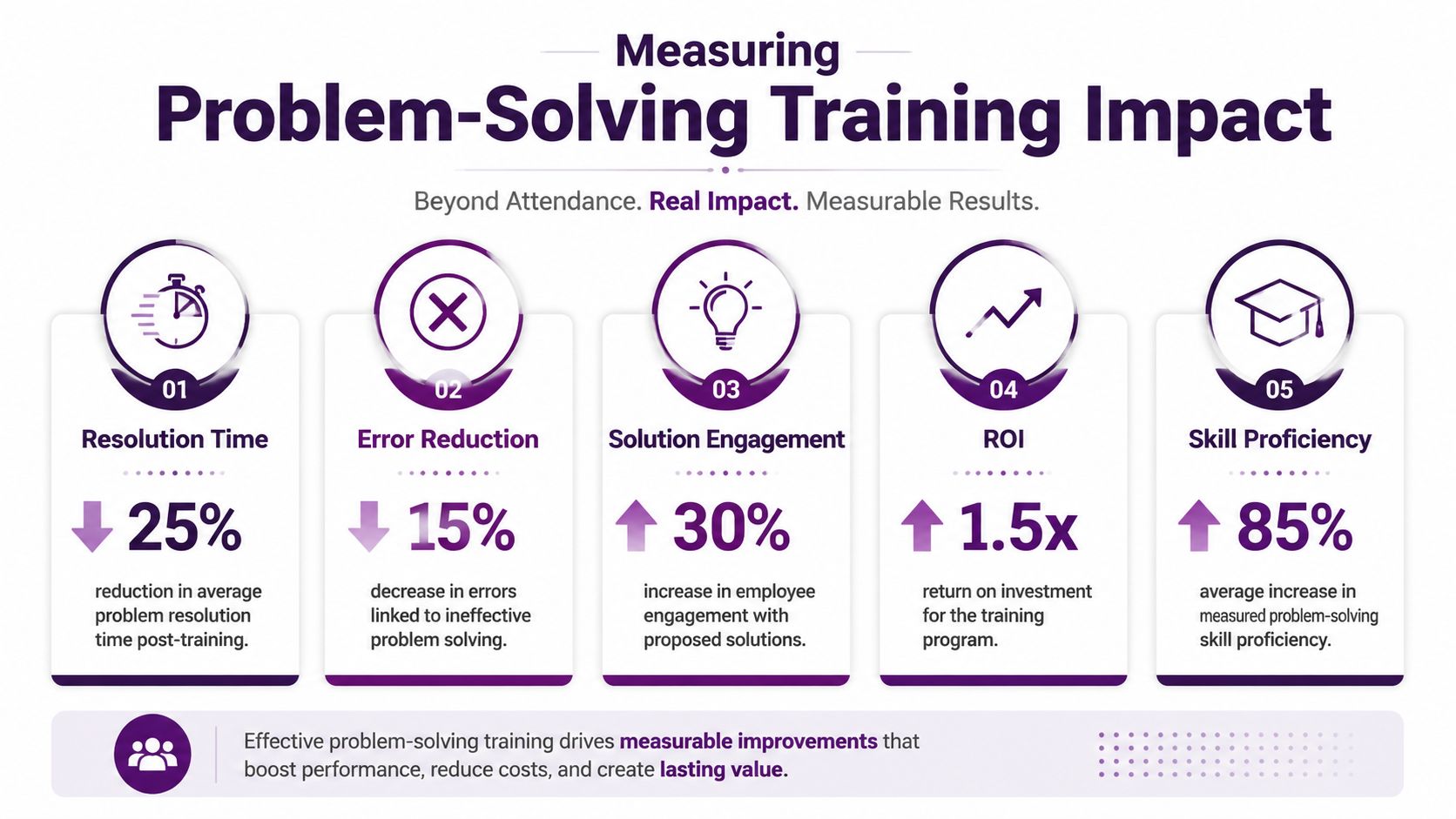
Attendance only proves people sat through the session. It does not show whether agents can use the skill on the floor, or whether the rollout improves the work. Real measurement starts when you test behavior in context and tie it to cleaner customer outcomes.
Score the behavior, not just the knowledge
Use pre- and post-training assessments that require application. Give agents a case and ask them to define the problem, identify likely causes, choose the next step, and explain why that path makes sense. That reveals far more than a multiple-choice quiz and shows whether the agent can think through a live service issue.
Then put problem solving into the QA scorecard and review it in live evaluations. Score whether the agent asked the right clarifying questions, defined the issue correctly, and left the customer with a clear next step. That makes the skill visible in daily operations instead of leaving it inside a training folder.
A good KPI framework for a nearshore call center ties this directly to CSAT, FCR, and AHT. The guidance in the CCSI nearshore contact center guide points to customer experience KPIs alongside efficiency and quality metrics, with shared dashboards and clear baselines before launch. That is the kind of structure discussed in unlocking HR strategy with data, and it fits learning programs that need to prove impact instead of relying on good intentions.
The mechanics matter too. FCR measures whether the issue was solved on the first attempt, which separates real resolution from repeat-contact volume Genesys on FCR. AHT comes from talk time, hold time, and wrap-up time, so it shows whether problem solving is reducing avoidable friction or just speeding up the wrong part of the call Zendesk on AHT.
Connect training to the work the client can see
Train one cohort, then compare that cohort against the baseline. If the training is working, managers should see stronger issue ownership, fewer repeat explanations, and better case closure. If the numbers move but the behavior does not, the training is changing the wrong thing.
A people analytics mindset helps because it forces you to connect learning signals with operational outcomes. That kind of measurement turns training from a classroom event into something managers can inspect, coach, and adjust in the weekly cadence. For BPO leaders, the clearest proof is simple. The team solves more problems at first touch, the customer hears a more confident answer, and the QA file shows a cleaner decision path. That is the evidence clients respect.
When the monitoring process needs a tighter link between skill and execution, CallZent’s quality monitoring approach is a useful reference for building that bridge.
The Manager’s Critical Role in Coaching and Reinforcement
Training events create awareness. Managers create habits. Without daily reinforcement, agents may remember the framework for a week and then revert to guessing, rushing, or escalating too early.
Research findings align with this observation. Prolonged employer-provided training doesn’t always significantly develop problem-solving skill, while informal on-the-job training and repeated exposure to real scenarios produce the biggest capability gains EJHRMS study on problem-solving development. In a BPO, that means the manager is the primary transfer mechanism.
What managers need to do every day
A manager doesn’t need to become a trainer. A manager needs to become a sharper coach. That means using call monitoring notes to ask better questions, running huddles around live cases, and turning one-on-one sessions into problem solving reviews instead of performance lectures.
The coaching checklist is straightforward:
- Listen for the reasoning: Don’t just judge the outcome, listen for how the agent framed the problem.
- Ask for the cause chain: Push the agent to explain what they ruled out and why.
- Reinforce the next best question: Show them what question would have clarified the issue faster.
- Review the customer language: Check whether the explanation was simple, calm, and specific.
- Close with a live action plan: Agree on what the agent will do differently on the next call.
A manager who does this consistently turns feedback into skill growth. A manager who only points out mistakes turns coaching into supervision.
Coach live, not just after the fact
The best reinforcement happens close to the work. When a case is still fresh, the agent remembers the decision path and can see exactly where the reasoning broke down. That’s the right moment to correct assumptions, not days later after the ticket has gone cold.
Practical rule: coach the thinking as much as the answer. If you only correct the answer, the same mistake comes back in a different form.
Team huddles should also spotlight real wins. When someone handles a tough case well, don’t praise speed alone. Call out the clarifying questions, the cause discovery, and the clean handoff. That helps the team see what good problem solving looks like in practice.
For managers who want a more structured coaching discipline, CallZent’s call center coaching techniques are a useful reference for turning feedback into reinforcement that sticks.
Your Deployment Blueprint Technology Timeline and Improvement
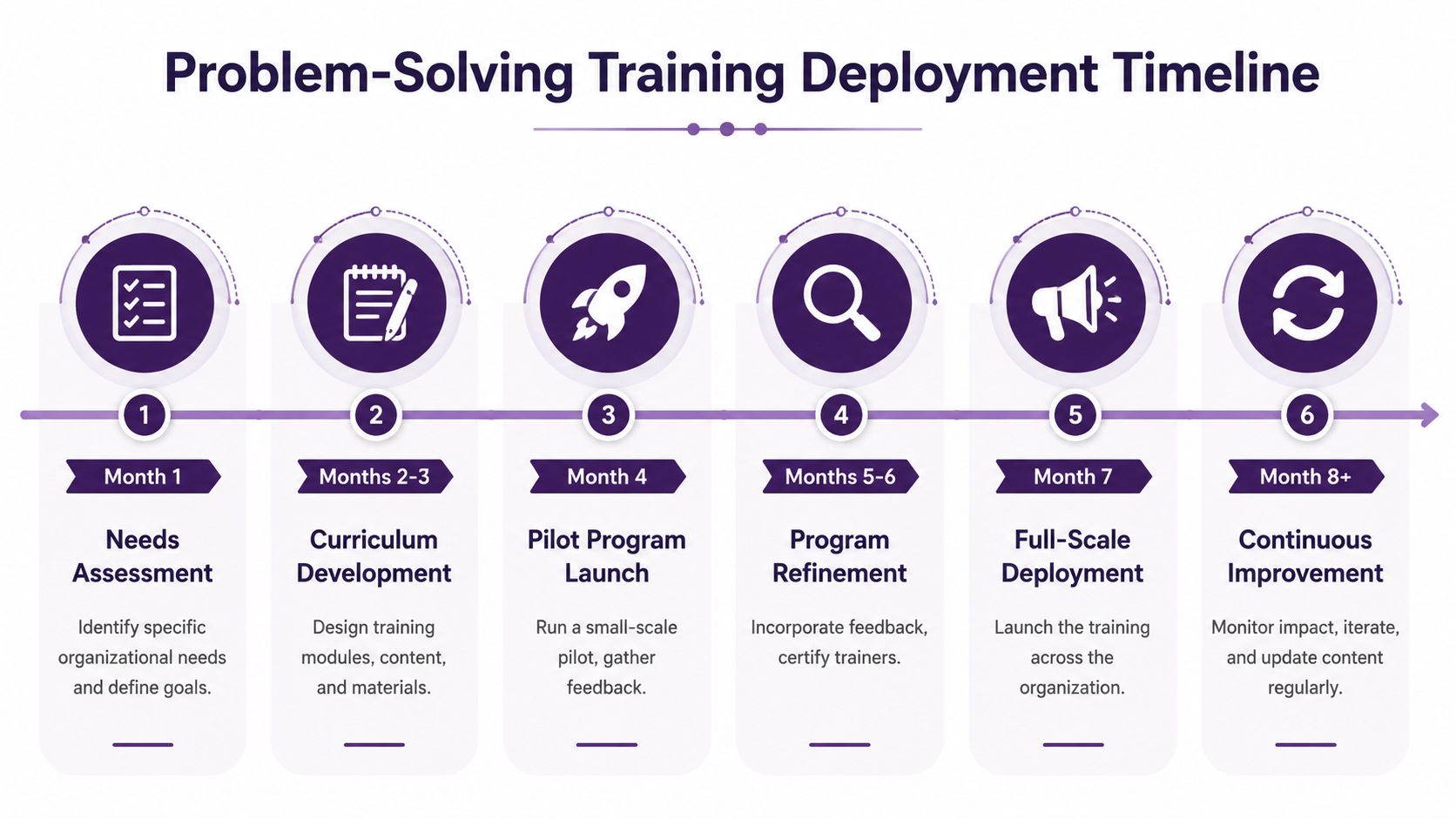
A rollout works best when it starts narrow and grows from what the operation proves. Pick one team or one issue category first, build the curriculum around that work, and use the pilot to expose gaps before you scale. That keeps the program tied to real contact center work instead of theory.
Roll out in phases and let the work shape the program
Start with a needs assessment and baseline data. Then design the curriculum, pilot it with a small group, refine it with manager feedback, and launch it broadly only after the model is stable. That sequence keeps you from scaling a weak design.
Technology should support the process, not replace it. An LMS helps with delivery, tracking, and version control, especially if your team is distributed or bilingual. Smaller teams can still run effective programs with shared documents, scorecards, and manager-led review sessions if the structure is disciplined.
Teams that need a reference point outside the contact center world can look at tutoring center software for an example of how process tracking and coaching workflows can be organized around recurring skill development.
Build a feedback loop that changes the curriculum
Training content should change with the contact reasons you are seeing. If a new issue starts appearing in the queue, add it to the next simulation set. If managers keep flagging the same decision error, put it into the next coaching guide. That keeps the program useful instead of stale.
Shared visibility matters too. Nearshore teams often depend on clear dashboards and aligned reporting, and that same discipline helps a BPO training program show whether the work is improving live performance. If the client cannot see the effect, the program is harder to defend, especially in bilingual operations where expectations can shift by queue, language, and market.
The strongest version of this model is simple. Train on real problems, coach the reasoning in the queue, measure the effect on CSAT, FCR, and AHT, then update the training based on what the data and the managers show. That is how problem solving becomes part of the operating system.
If you are ready to build that system in your own operation, connect with CallZent and ask for a training structure that links bilingual agent coaching, QA, and KPI improvement into one practical rollout.
🚀 Build Problem Solving Into Your Support Operation
If you are ready to build that system in your own operation, CallZent can help you create a training structure that links bilingual agent coaching, QA, and KPI improvement into one practical rollout.