
Voice Biometrics Authentication
Secure Call Centers with Voice Biometrics Authentication
Learn how voice biometrics authentication works in call centers, where it delivers cost savings and better CX, and what nearshore BPOs must address around deepfakes, privacy, and compliance.
TL;DR — Quick Takeaways
- Voice biometrics authentication uses a caller’s voice to verify identity instead of relying only on passwords or security questions.
- The market is growing fast. It was valued at $1.9 billion in 2023 and is projected to reach $9.0 billion by 2033, driven by the need to reduce verification costs and improve customer experience, according to Allied Market Research.
- In contact centers, teams report 42 seconds less handling time per authentication event, with potential annual savings of $3.2 million to $5.7 million in enterprise environments, according to WJARR.
- The technology can work well at scale, but it isn’t magic. GenAI deepfakes and weak data governance can undermine a rollout.
- Nearshore and bilingual operations need stricter attention to consent, storage, access controls, and cross-border data handling than many generic guides mention.
Most contact centers still treat caller authentication like a script problem. It isn’t. It’s a security, CX, and cost problem happening at the same time.
If your team is still relying on passwords, PINs, and knowledge-based questions, the key question isn’t whether those methods feel outdated. It’s whether they can still hold up against fraud, customer impatience, and bilingual cross-border operations.
Is Your Call Center Ready for the Post-Password Era
How much time does your team lose every day proving good customers are who they say they are, while still leaving openings for fraud?
A caller reaches your contact center because a card was blocked, an order never arrived, or a policy needs to be changed. Before an agent can solve the problem, the customer gets pulled through a script of personal questions. That adds handle time, increases repeat prompts, and creates a poor first impression at the exact moment the customer already needs help.
The operational problem is bigger than inconvenience. Passwords, PINs, and knowledge-based questions were built for a period when stolen data was harder to get and synthetic voice fraud was less practical. That period is over. GenAI tools have changed the threat model, especially for contact centers that handle high volumes, remote agents, and bilingual traffic across US and Latin American operations.
For contact center leaders, voice biometrics is appealing for a simple reason. It can reduce the time spent on identity checks while giving security teams a stronger control than static questions alone. Customers speak. The system evaluates the voice in the background or during a short prompted phrase. Agents get to resolution faster.
Why old authentication fails in live operations
Knowledge-based authentication often satisfies policy requirements on paper, but it breaks down in production.
Customers forget exact answer formats, agents rush through questions, and fraudsters often have the data anyway. Date of birth, address history, and account details are frequently exposed through breaches, social engineering, or oversharing on other channels. In a nearshore BPO environment, the failure points multiply. A caller may begin in English, switch to Spanish, use a nickname on one account and a legal name on another, or hit an offshore team that follows a slightly different verification script.
Those are not edge cases. They are daily contact center conditions.
Voice should not stand alone as the only control. It works best as one layer in a broader identity and fraud strategy, alongside other important IT security best practices that reduce dependence on weak, reusable credentials.
Key takeaway: The real business case for voice biometrics authentication is faster service for legitimate callers, lower verification cost, and fewer openings created by static data that criminals can buy or fake.
What decision-makers should focus on first
Start with the point of friction that hurts the business most. For some operations, that is IVR abandonment during account verification. For others, it is agent handle time, repeat callers answering the same questions, or high-risk transactions that need stronger proof of identity.
Then look at risk by call type. Billing updates, claims, healthcare inquiries, payment changes, and account recovery usually justify a different authentication design than low-risk order status calls. The right model is rarely one rule for every queue.
Nearshore operators need one more layer of planning. Consent language, voiceprint storage location, model access, and vendor support for English and Spanish workflows all affect rollout quality. Cross-border data handling can turn a promising pilot into a compliance problem if legal, security, and operations teams are not aligned early. Existing fraud tools, QA processes, CRM workflows, and documented call center security practices should shape the deployment design from the start.
A practical example makes the value clear. A repeat retail customer calling about a return should not have to recite the same static answers on every interaction. A banking or insurance caller may be verified by voice for routine service, then pushed into step-up review for address changes, payout requests, or other high-risk actions.
The post-password era is not about removing controls. It is about replacing weak ones with methods that hold up better in real contact center conditions.
How Voice Biometrics Authentication Really Works
Most executives hear “voiceprint” and picture an audio recording. That isn’t how modern systems work.
A voice biometric engine converts speech into a mathematical representation of the speaker’s unique characteristics. The system isn’t interested only in the words spoken. It analyzes patterns in how the person sounds.
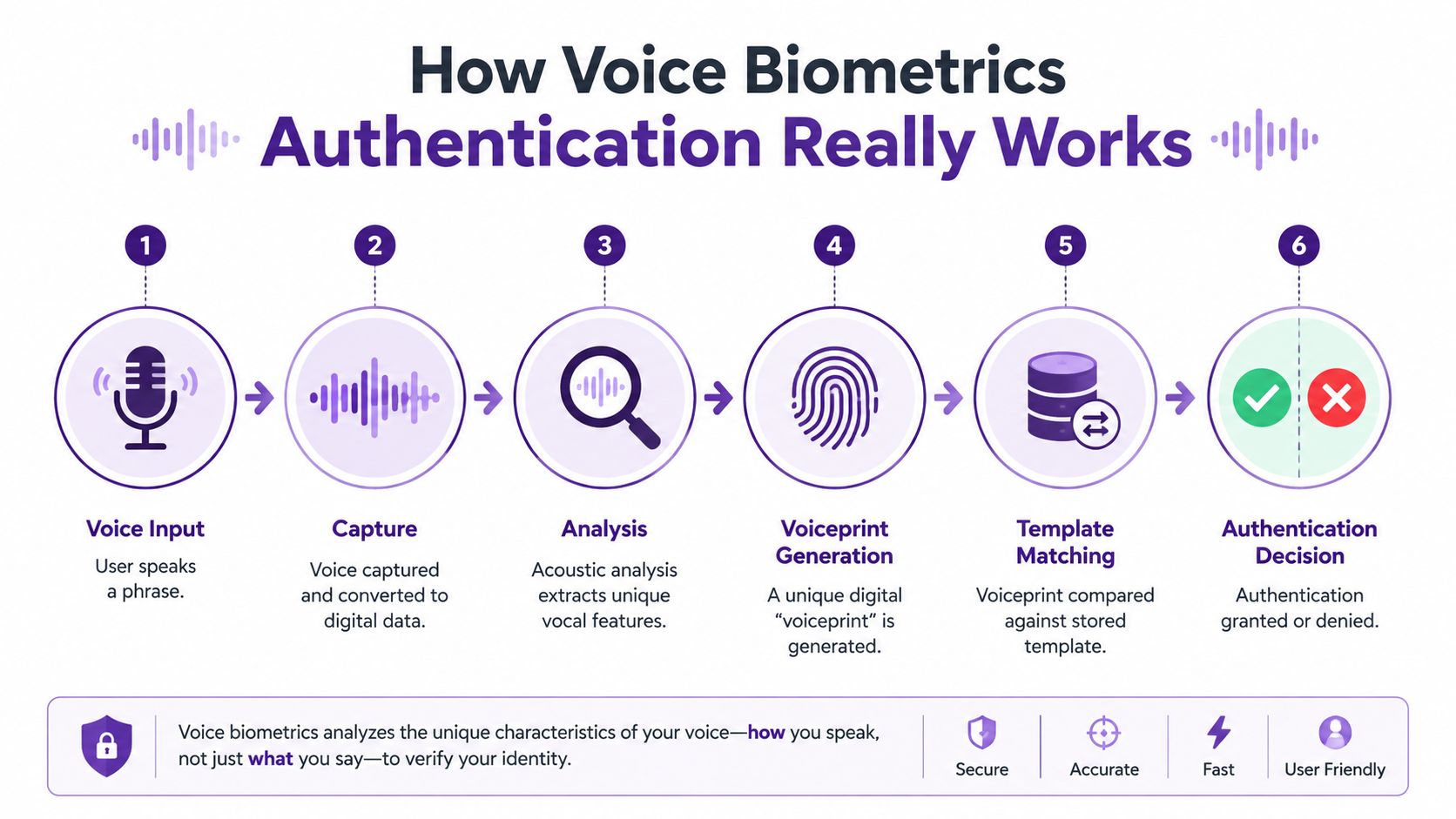
Voice biometric authentication systems analyze over 100 distinct physiological and behavioral vocal features to generate a unique voiceprint, with enterprise implementations demonstrating Equal Error Rates as low as 1.2% in ideal conditions, according to IdentityCall.ai.
What the system actually analyzes
A practical way to think about it is this: a recording captures a conversation, but a voiceprint captures a pattern.
That pattern may include:
- Physical traits: vocal tract length, larynx characteristics, resonance patterns
- Behavioral traits: pace, intonation, accent habits, pronunciation tendencies
- Acoustic markers: frequency relationships and other signal features that stay consistent enough to support matching
In the background, the system turns live speech into a numeric vector and compares it to the enrolled template. If the similarity score clears the configured threshold, the system accepts the user. If it doesn’t, the system rejects the match or triggers another verification path.
Text-dependent and text-independent methods
Both models are useful. They serve different parts of the contact center.
| Method | How it works | Best fit |
|---|---|---|
| Text-dependent | Caller repeats a specific phrase | High-risk steps such as account changes or sensitive authorizations |
| Text-independent | System analyzes natural conversation | Ongoing authentication during IVR or agent-led support |
Text-dependent flows give you a very clear moment of consent and verification. They also work well when the business wants an explicit checkpoint before releasing information.
Text-independent flows usually create the smoother customer experience. A returning caller can start describing the issue while the engine evaluates the voice in parallel. In a busy support operation, that matters because every extra script line adds friction.
A good deployment matches the verification method to the call type. It doesn’t force one workflow onto every queue.
Why real-world audio quality matters
Many demonstrations often conceal the true challenge. Lab conditions are quiet. Actual customers call from cars, warehouses, kitchens, hospital corridors, and airport pickup lanes.
Noise affects performance. So does weak telephony audio, hold music bleed, agent interruption, and aggressive compression. That’s why implementation quality matters as much as model quality. Teams need clean enrollment, strong voice activity detection, and sensible escalation rules when audio quality drops.
For operations leaders, this has a direct systems implication. Your telephony stack, routing logic, and CRM event handling need to support authentication as part of the call flow, not as an awkward add-on. That is why voice biometrics planning should sit alongside broader call center software features instead of being treated as a niche security plug-in.
A practical example: if a customer starts a call on speakerphone in a noisy parking lot, the right system shouldn’t blindly force a fail. It should detect poor conditions, continue gathering speech if possible, and route to a fallback method when confidence remains too low.
Navigating Security Privacy and Compliance
Voice biometrics authentication can strengthen call center security. It can also create a false sense of security if leadership only looks at the match score and ignores the rest of the control environment.
The biggest blind spot today is GenAI. A lot of vendor messaging still implies that voice is naturally hard to fake. That was a more comfortable assumption before low-cost cloning tools became widely available.
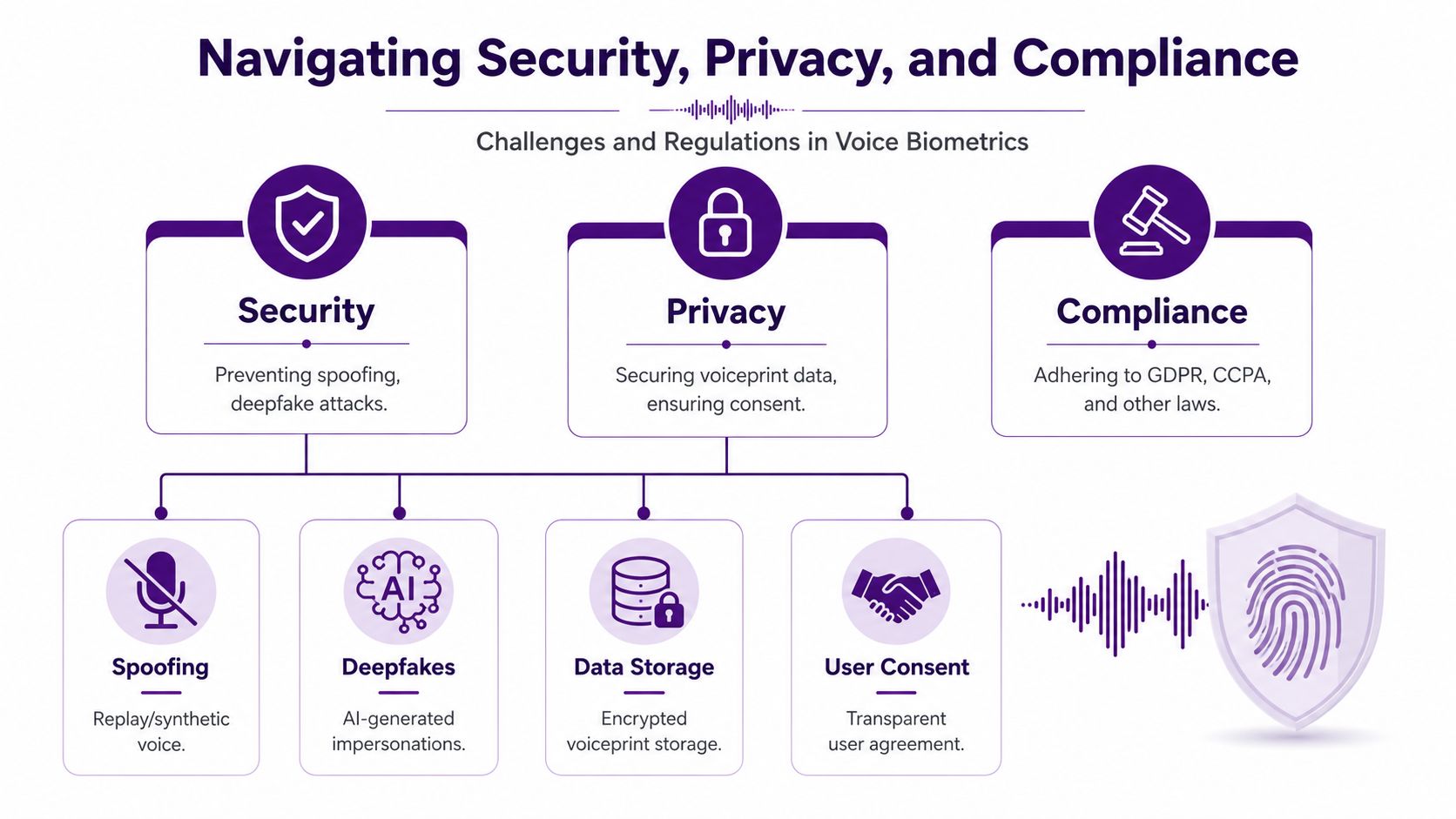
A critical, often overlooked, security gap is the threat from GenAI-driven deepfakes. Recent research shows that open-source voice cloning models can bypass existing anti-spoofing detectors, highlighting overestimated system security and the need for advanced countermeasures, according to arXiv research on deepfake bypass risk.
Deepfakes change the security conversation
A mature contact center should treat voice biometrics as a strong control, not a standalone truth machine.
That means building around the engine with:
- Liveness checks: to help detect replay attacks and synthetic inputs
- Risk-based routing: to step up verification for unusual behavior or sensitive requests
- Agent guidance: so frontline staff know when to pause, challenge, or escalate
- Fraud review loops: so suspicious samples improve future tuning and policy decisions
The weak approach is to deploy voice authentication and then remove every secondary safeguard. The better approach is to let voice handle routine identity checks while keeping layered controls for account recovery, payout changes, beneficiary updates, and other high-risk moments.
Practical rule: If a voice biometrics vendor can’t explain how its anti-spoofing performs against new synthesis methods, you’re not evaluating security. You’re reviewing marketing.
Privacy starts with the full data lifecycle
The second blind spot is privacy. Many articles explain how a voiceprint is created. Far fewer deal with what happens after enrollment.
In a nearshore BPO setting, leaders need to ask practical questions:
- Where is the voiceprint stored: in what environment, and under whose control?
- Who can access it: client team, BPO admins, vendor support, or subcontractors?
- How is consent captured: especially when the caller switches languages mid-call?
- What happens across borders: if the customer is in one country, the agent is in Tijuana, and the platform runs elsewhere?
Those questions become more serious in regulated environments. GDPR focuses attention on lawful basis, consent, access, and data subject rights. HIPAA raises the stakes when authentication is tied to protected health information. PSD2 can shape how financial institutions think about authentication rigor and fraud controls for certain interactions.
Bilingual voiceprints create extra operational risk
Nearshore operations rarely get enough guidance on this point. A customer may enroll in English, authenticate later in Spanish, and sound different when stressed, sick, or calling from a noisy environment.
That doesn’t make bilingual voice biometrics unworkable. It does mean teams should document:
| Issue | Why it matters in nearshore operations |
|---|---|
| Language variation | Pronunciation and cadence can shift between English and Spanish |
| Cross-border access | Different teams may touch the data during support, QA, or troubleshooting |
| Consent clarity | Customers need understandable disclosure in the language they are using |
| Retention policy | Stored voiceprint data needs a defined lifecycle, not open-ended storage |
A serious program should also align technical controls with documented call center compliance requirements, because regulators and enterprise clients won’t separate the algorithm from the operating model. They will assess the full chain: capture, storage, access, retention, review, and deletion.
The strongest voice biometrics programs win because governance is strong, not just because the matcher is accurate.
A Practical Guide to Contact Center Implementation
How do you roll out voice biometrics without creating a new failure point for customers, agents, and compliance teams?
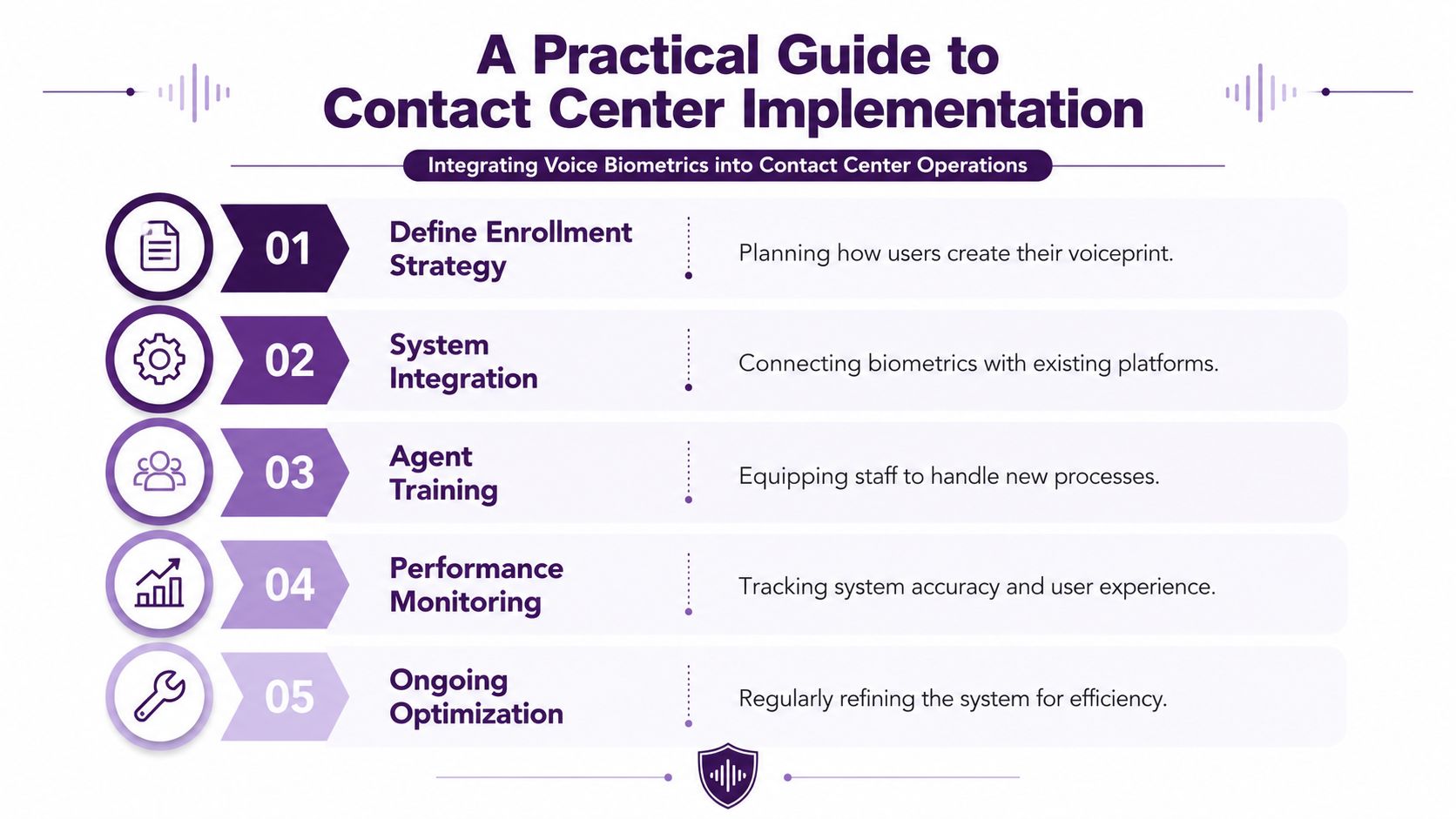
Start by treating implementation as an operating model change, not a feature launch. Voice biometrics affects IVR design, agent scripts, fraud review, QA, fallback rules, and customer disclosures. In nearshore BPO environments, it also affects which team can access voice data, where that data is stored, and how bilingual callers move between English and Spanish across the same journey.
Start with enrollment design
Enrollment usually decides whether the program scales or stalls. If the process feels awkward, happens at the wrong moment, or uses language the caller does not fully understand, completion rates drop and agents fall back to knowledge-based questions.
A practical rollout starts with a clear enrollment model.
- Active enrollment fits programs that want explicit consent and a prompted phrase.
- Passive enrollment fits teams that want to build a voiceprint during natural conversation.
- Hybrid enrollment often works well in service environments. Capture speech passively, then confirm enrollment with a direct prompt once enough audio is available.
Timing matters as much as method. An insurance contact center should ask for enrollment after a routine policy question is resolved, not in the middle of a disputed claim call. A bilingual nearshore team should also test the script in both languages, because consent language that is clear in English can become vague or too legalistic in Spanish.
Build call flows for exceptions, not just happy paths
The demo path is easy. Production is not.
Callers phone in from airports, shared offices, parked cars, and low-signal areas. Some are sick. Some switch languages mid-call. Some may be legitimate customers using a different handset than the one used during prior interactions. Others may be fraud attempts supported by GenAI voice cloning, which means the workflow needs to do more than produce a match score.
Use a decision model that reflects real operations:
- Attempt verification early once enough speech is captured.
- Keep evaluating in the background while the conversation continues.
- Step up to another factor if audio quality is poor, the request carries higher risk, or the result is uncertain.
- Route suspicious cases for review when behavior, metadata, and voice signals do not line up.
- Log every fallback reason so operations, fraud, and QA teams can fix repeated friction.
That last point matters. If a nearshore center sees repeated fallback on Spanish-language calls handled from one site, the problem may be microphone quality, script design, or acoustic conditions, not the core engine.
Train agents on decisioning, not model theory
Agents do not need a lesson in signal processing. They need to know what the result means, what to say next, and when to stop trusting automation.
Training should cover:
- Outcome handling: what accepted, uncertain, and rejected states mean in plain language
- Customer explanation: how to describe the process clearly without sounding evasive or overly technical
- Escalation rules: when to add a second factor, when to hand off, and when to trigger fraud review
- Privacy handling: what agents can say about consent, retention, deletion, and access rights
- Deepfake awareness: how to spot inconsistencies between voice results, caller behavior, and account activity
Vendor fit shapes how easy this is in production. Teams should compare reporting, case management, integration support, bilingual workflow support, and tuning options against practical vendor evaluation criteria for contact center technology.
Measure production outcomes that affect cost, CX, and risk
Pilot dashboards often get crowded with technical metrics that do not help operations leaders make decisions. Track what changes customer effort, staffing pressure, fraud exposure, and compliance workload.
Focus on:
- Containment rate: how often voice authentication completes without fallback
- Average handle time impact: whether verification gets faster in live traffic
- Fallback volume by reason: noise, low confidence, consent refusal, language shift, system latency
- Fraud escalation quality: whether suspicious interactions are identified early enough to matter
- Agent bypass behavior: whether staff trust the system or revert to manual questions
- Customer friction signals: repeat prompts, abandonment, opt-outs, and complaints by language and site
For nearshore operations, break these metrics down by location and language. That is how teams find cross-border privacy process gaps, uneven script quality, and acoustic issues that a blended dashboard can hide.
A good implementation reduces handle time, lowers pressure on agents, and removes repetitive questions for legitimate callers. A bad one creates more transfers, more exceptions, and more privacy exposure. The difference usually comes down to enrollment design, fallback logic, agent training, and site-level governance.
 Voice Biometrics in Action Across Industries
The best way to judge voice biometrics authentication is to look at where it solves a concrete problem, not where it sounds impressive in a demo.
A leading U.S. financial institution successfully deployed voice biometrics to process over 20 million annual verifications, achieving a 99.6% success rate and demonstrating reliability in high-volume, real-world operations, according to Nuance’s voice biometrics white paper.
Finance uses it to reduce friction without lowering the guard
In financial services, the classic problem is simple. Legitimate customers want quick access. Fraud teams want stronger proof.
Voice biometrics fits well when a bank wants to reduce the burden of repeated security questions for routine service calls while preserving stronger controls for actions like transfer changes or account recovery. The customer gets faster handling. The institution keeps layered security where it matters most.
Healthcare needs speed and discretion
Healthcare calls often start with urgency. A patient may be trying to confirm an appointment, discuss coverage, or reach support while distracted or stressed.
A voice-first authentication step can reduce awkward back-and-forth before discussing sensitive information, especially when paired with clearly documented workflows and compliance controls. In practice, that works best when the authentication design aligns with the realities of healthcare call center outsourcing, including privacy obligations, multilingual support, and escalation paths for protected information.
The smartest healthcare deployments don’t chase novelty. They remove delay at the exact moment a patient needs help.
E-commerce benefits from repeat-caller convenience
Retail and e-commerce teams deal with a different pain point. Many calls are low complexity but high volume: order status, returns, account access, subscription issues, and payment verification.
For repeat customers, voice biometrics can make these interactions feel less repetitive. A caller who contacts support twice in one week about a delayed package shouldn’t have to repeat a long identity script both times.
That convenience also helps the business side. Agents can move into issue resolution faster, supervisors get fewer complaints about repetitive verification, and operations teams reduce the drag that static authentication places on high-volume queues.
Choosing a Vendor and Planning Your Pilot Project
Vendor demos often look polished because they happen under controlled conditions. Clear audio. Prepared speakers. Optimized prompts. Limited edge cases.
Your environment won’t look like that. Real callers mumble, switch devices, move between quiet and noisy spaces, and alternate between English and Spanish. That’s why a buying decision should start with skepticism.
What to test instead of what to admire
A strong vendor review goes beyond the headline accuracy claim. Ask for proof of operational fit.
Focus on questions like these:
- How does the system perform with noisy telephony audio
- What happens when callers code-switch between English and Spanish
- How are liveness and anti-spoofing handled during live calls
- Can the engine support passive and text-prompted flows
- How easily does it connect to your IVR, ACD, CRM, and fraud tools
- What reporting does the platform provide for rejected matches, fallbacks, and suspected spoofing attempts
If the answers stay abstract, that’s a warning sign. Good vendors can describe failure conditions just as clearly as success conditions.
Build a pilot around real call types
A pilot should be narrow enough to control and broad enough to reveal operational truth.
A practical approach is to choose one or two queues where identity checks are frequent, repeatable, and painful enough to improve. Good pilot candidates often include account servicing, billing support, and repeat-caller customer care.
Use clear success criteria such as:
| Pilot question | What to look for |
|---|---|
| Does authentication feel faster | Fewer delays before issue resolution begins |
| Do agents trust the result | Less manual bypassing and better adherence |
| Are customers comfortable with it | Fewer complaints and cleaner enrollment completion |
| Do edge cases have a safe path | Smooth fallback when confidence is low or risk is high |
Don’t separate technical fit from governance fit
A common pitfall for many pilot plans arises from these uncoordinated efforts. The tech team validates APIs and latency. Legal reviews consent language. Operations trains agents. Fraud reviews exceptions. Everyone signs off separately, and nobody owns the whole workflow.
A better pilot brings those groups together early. That matters even more in nearshore BPO environments, where cross-border storage, bilingual consent, and client-specific compliance standards can become blockers late in the process if they aren’t addressed upfront.
A pilot should prove more than matching performance. It should prove that the business can run the process safely, clearly, and at scale.
The right vendor won’t just promise a better authentication rate. They will help you test exception handling, support operational reporting, and document how the full process works under real production pressure.
Secure Your Future with the Power of Voice
Voice biometrics authentication is no longer a niche concept for innovation teams. It’s becoming a practical way to reduce customer friction, strengthen authentication, and remove wasted effort from high-volume support environments.
Used well, it can shorten verification, improve the customer experience, and give operations leaders a stronger alternative to weak static questions. Used poorly, it can create blind spots around deepfakes, consent, and cross-border data handling.
That is the dividing line. Strong programs don’t treat voice as a magic layer. They combine it with disciplined governance, practical fallback paths, and rollout plans built around how contact centers operate.
For nearshore and bilingual BPO environments, that matters even more. The technology has to work across languages, across jurisdictions, and across different risk profiles without creating new compliance headaches.
The companies that get this right won’t just sound more modern. They’ll run faster, safer, and with less friction for both customers and agents.
🚀 Strengthen Call Center Security Without Adding Friction
If you’re evaluating how to bring voice biometrics authentication into a customer care operation, CallZent can help you design a practical approach around security, CX, compliance, and bilingual nearshore delivery.
Talk to an ExpertIf you’re evaluating how to bring voice biometrics authentication into a customer care operation, CallZent can help you design a practical approach around security, CX, compliance, and bilingual nearshore delivery.