

Survey Outsourcing Strategy
Survey Outsourcing: Your Guide
to Better Data in 2026
Learn how survey outsourcing improves data quality, speed, bilingual coverage, and oversight for North American companies in 2026.
TL;DR — Quick Takeaways
- Survey outsourcing works best when you need clean data, faster execution, bilingual coverage, or scalable fieldwork.
- The best partners do more than collect responses. They help manage programming, QA, sample handling, reporting, and workflow discipline.
- Nearshore survey outsourcing is often the strongest middle ground for North America because it supports proximity, easier communication, and bilingual execution.
- In regulated environments, keep policy, interpretation, and sensitive logic close while outsourcing execution-heavy steps with strong controls.
- Vendor selection should focus on programming accuracy, QA process, governance, and communication instead of price alone.
If your team is sending surveys, collecting responses, and still struggling to make a decision, the problem usually isn’t response volume. It’s execution quality.
A lot of companies assume survey work is simple enough to keep in-house until the cracks show up. Logic breaks. Sample quality slips. Follow-up questions fire incorrectly. The reporting deck looks polished, but nobody trusts the data underneath it. At that point, survey outsourcing stops being a staffing decision and becomes an operational one.
The real question isn’t whether you can outsource survey work. It’s whether your partner helps you collect cleaner data that your team can actually act on.
Are You Collecting Data or Gaining Real Insights
Companies often run into the same trap. They launch a customer feedback survey, a post-purchase questionnaire, or a market research project with good intentions, then discover the results are noisy, delayed, or too inconsistent to guide action.
That gap is getting more important, not less. In the 2024 Deloitte Global Outsourcing Survey, 63% of respondents reported an increase in their outsourcing budget over the past year. That tells you something important. Buyers aren’t treating outsourcing as a side tactic anymore. They’re funding it as a core operating decision.
For survey work, that shift matters because bad execution creates expensive downstream problems. Internal teams spend time rechecking skips, reconciling duplicates, cleaning responses, and explaining why different markets interpreted the same question differently. The hours don’t disappear. They just move later in the process, where they’re harder to recover.
A better model is to treat survey operations like any other business-critical workflow. Build for accuracy first. Then speed. Then scale.
Three signs you’re collecting data but not gaining insight:
- Your team debates the dataset more than the findings.
- Survey launches keep slipping because nobody owns programming and QA end to end.
- Feedback comes in, but it doesn’t connect cleanly to action plans or continuous improvement loops.
If that sounds familiar, the fix usually isn’t a prettier dashboard. It’s a stronger operating model for how surveys get designed, fielded, validated, and reviewed.
For teams trying to turn customer feedback into actual process improvement, this is the same discipline behind customer feedback for continuous improvement. The survey itself is only one piece. What matters is whether the data arrives clean enough, fast enough, and structured enough to support a business decision.
Understanding Survey Outsourcing Beyond Simple Data Collection
Upon hearing “survey outsourcing,” some might initially envision a vendor sending questions to respondents. That’s too narrow.
A better comparison is hiring a general contractor for a buildout. You aren’t paying for raw materials alone. You’re paying for sequencing, quality control, specialist coordination, and the ability to deliver something usable at the end. Survey outsourcing works the same way when it’s done well.
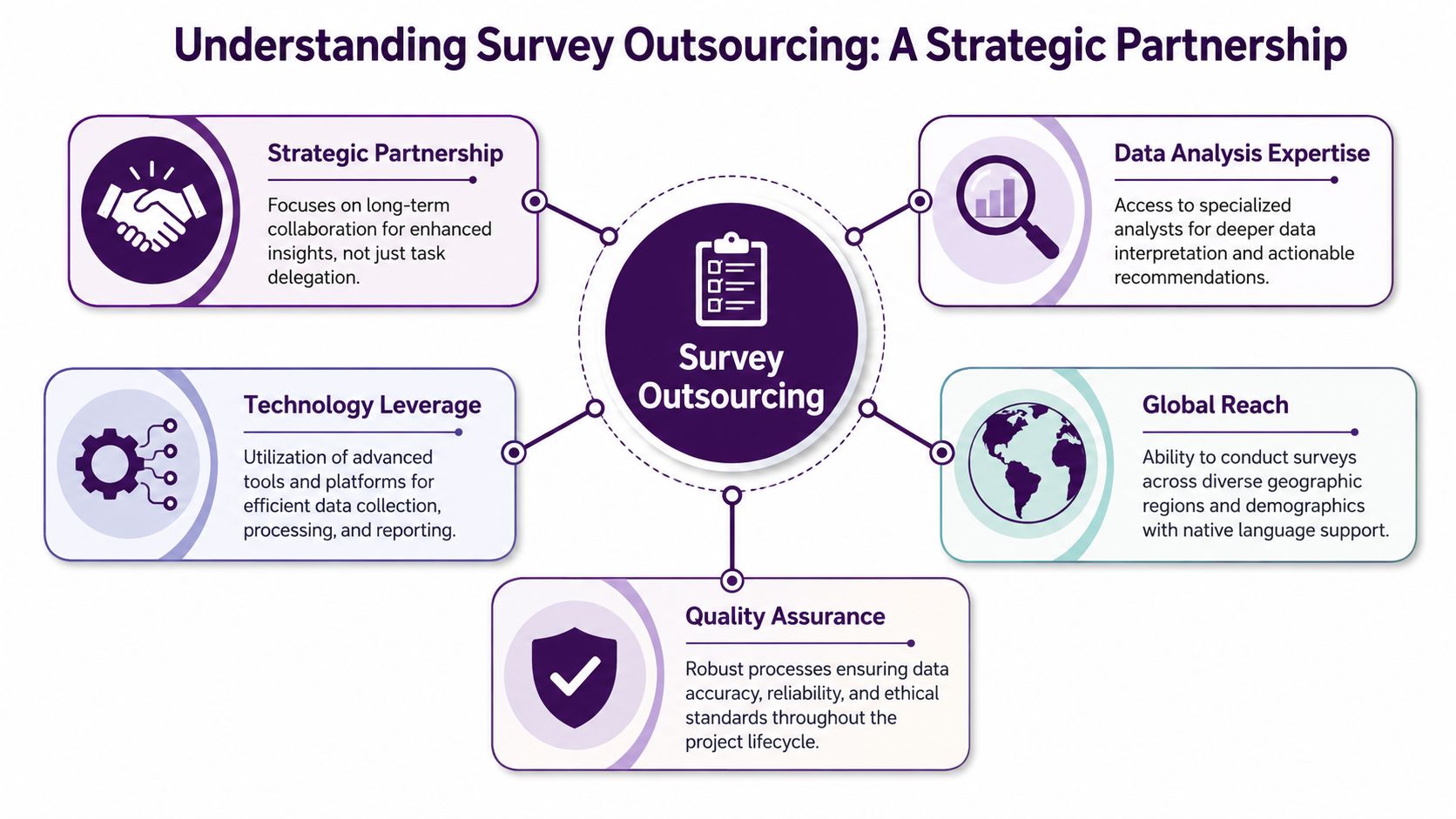
The broader market reflects that complexity. A guide to outsourcing market research from Drive Research notes that the global survey outsourcing industry sits within a broader insights sector valued at approximately $119 billion, and that delivery depends on complex sample sourcing, programming, and data-cleaning workflows.
What full-service survey outsourcing actually includes
A capable partner usually handles several layers of work, not just one:
- Questionnaire support: tightening wording, sequencing questions, and reducing confusion before fieldwork starts
- Programming and logic: routing, skip logic, quotas, randomization, and device testing
- Sample operations: sourcing respondents, managing quotas, and screening out bad fits
- Channel deployment: phone, web, email, or mixed-mode execution depending on the use case
- Data QA: duplicate checks, inconsistent-response review, and cleaning protocols
- Reporting support: structuring outputs so the client team can interpret findings faster
That last piece gets overlooked. Some vendors can field a survey but leave the client with a raw file and a mess. That’s not a strategic service. That’s task completion.
Why nearshore survey outsourcing changes the equation
Nearshore delivery gives North America-based teams a practical advantage. You can align more easily on language nuance, review scripts in real time, and solve issues during the workday instead of overnight. That matters when a live project needs a same-day logic correction or bilingual revision.
Good survey operations don’t just gather answers. They control the conditions that make those answers trustworthy.
This is also where adjacent operational tools matter. Teams that already rely on speech analytics, QA review, and interaction monitoring often understand the value faster, which is why survey work frequently pairs well with capabilities like conversational intelligence. The common thread is structured insight, not raw activity.
The Business Case for Survey Outsourcing Benefits and Risks
Survey outsourcing can reduce cost and improve execution. It can also create new risks if the wrong partner runs the work. Both things are true at the same time.
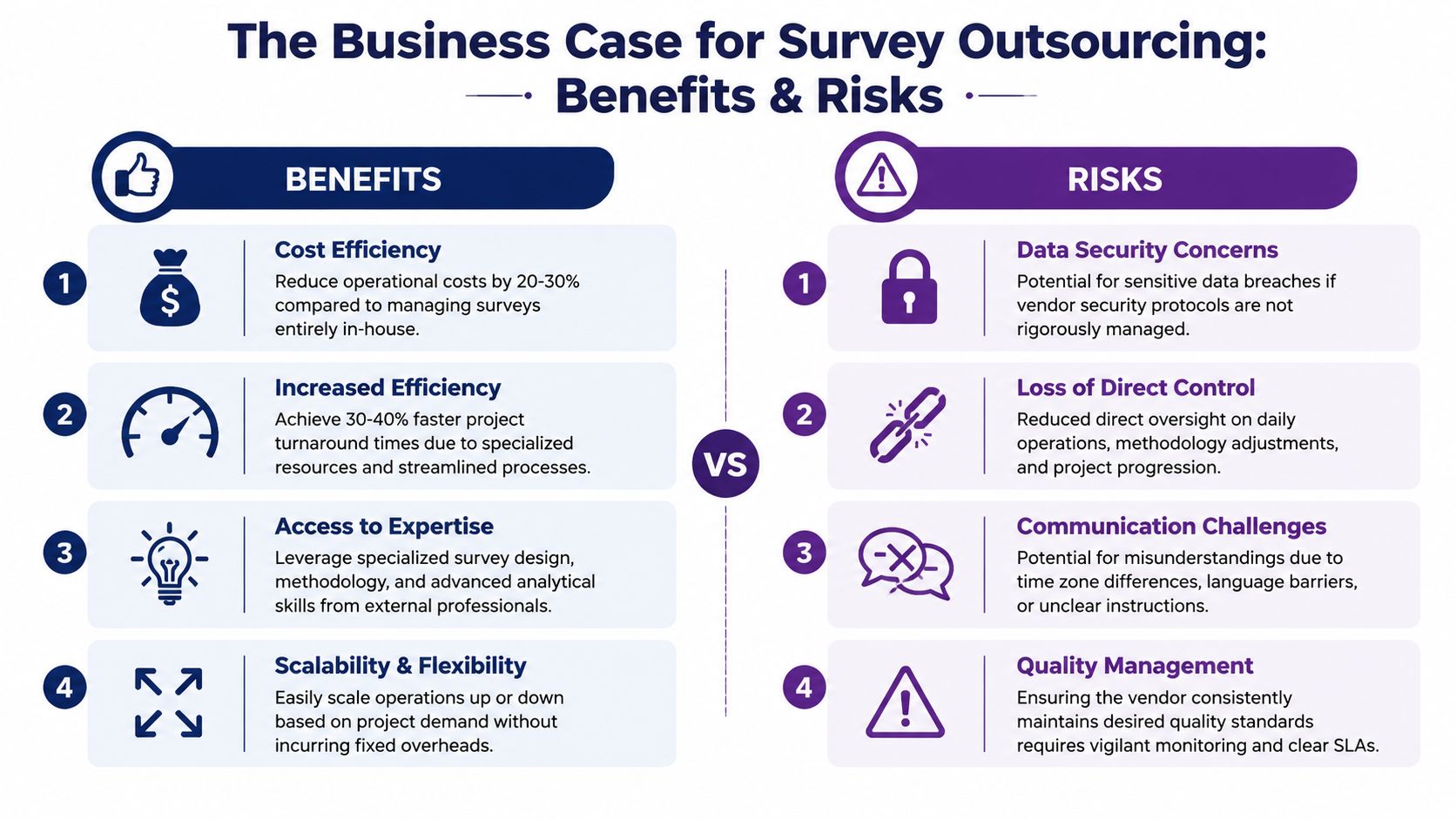
The adoption case is already strong. The 2023 Clutch Global Business Services Survey reports that 80% of businesses utilize outsourcing, with average cost savings of 15-30%, and that some achieve up to a 70% reduction in labor costs.
Where the upside is real
Cost is the easiest benefit to notice, but it isn’t the most important one in survey work.
Execution discipline is often the bigger win. A specialized partner already has people who know how to test survey links, check branching, monitor fieldwork, and catch avoidable errors before they contaminate the dataset.
Speed to launch also improves when your internal team doesn’t have to build every operational step from scratch. A retailer preparing a seasonal feedback push, for example, may need to survey customers across email and phone support channels on a tight timeline. An external team can absorb setup and fieldwork while the retailer focuses on interpreting results and adjusting the experience.
Access to talent matters too. Strong survey operations require different skill sets: questionnaire design, sample management, QA, bilingual support, and reporting discipline. Many companies need all of that only occasionally, which makes full in-house staffing inefficient.
For decision-makers comparing service models, the economics often become clearer when viewed against broader BPO benefits and delivery options such as call center pricing across the U.S., Mexico, India, and the Philippines. Survey work follows the same principle. The cheapest hourly rate rarely delivers the cleanest final outcome.
Where survey outsourcing goes wrong
The most common failures are operational, not theoretical.
| Risk | What it looks like in practice | What reduces the risk |
|---|---|---|
| Weak QA | Broken logic, duplicate responses, poor quota control | Prelaunch testing, validation rules, monitored fieldwork |
| Communication gaps | Slow revisions, misunderstood screening criteria, reporting confusion | Shared briefs, clear escalation path, regular check-ins |
| Loss of control | Vendor owns too much of the process and client can’t audit decisions | Defined approval points and documented workflow |
| Security concerns | Sensitive respondent data handled loosely | Restricted access, clear handling protocols, role-based permissions |
The nearshore advantage in risk control
Nearshore survey outsourcing helps with the practical side of risk management. Shared or overlapping business hours make approvals easier. Bilingual teams can catch wording issues that a monolingual operation might miss. Cultural proximity can also improve respondent-facing language in customer experience and market research surveys aimed at North American audiences.
Practical rule: If a vendor promises speed but can’t explain its QA process in plain English, expect to spend that saved time cleaning data later.
Deciding When to Outsource Your Survey Projects
Not every survey should be outsourced. Some should. Some should be split. That’s the answer.

The cleanest way to decide is to look at the work in layers: strategy, execution, and interpretation. Those layers don’t always belong with the same team.
In sensitive environments, that distinction matters even more. An industry note on outsourced benefits functions found that companies outsourced 40% of their benefits functions on average. The more useful lesson for survey work isn’t “outsource everything.” It’s that organizations in regulated settings need to decide what to outsource, not just whether outsourcing is allowed.
Outsource when execution is the bottleneck
Survey outsourcing usually makes sense if any of these are true:
- You need bilingual or multilingual coverage. Customer and market research across English- and Spanish-speaking audiences often breaks down when translations are literal instead of operationally reviewed.
- Your team lacks programming depth. Complex skips, quotas, and follow-up paths are easy to underestimate.
- Volume changes fast. Product launches, seasonal peaks, and post-interaction survey campaigns can spike quickly.
- Your internal team should stay focused on analysis. If analysts are stuck doing link tests and fieldwork admin, you’re using expensive talent on less impactful work.
- You need support around adjacent tasks. Some organizations bundle survey administration with back-office workflows such as outsourced data entry services so cleaned responses move into the next process without rework.
Keep key layers in-house when judgment matters most
There are also times when in-house control should stay stronger.
- Policy-sensitive surveys: healthcare, insurance, finance, and benefits-related studies often need internal review of wording, sampling rules, and consent language
- Executive or employee trust surveys: highly sensitive internal work may require tighter ownership
- Small one-off polls: if the scope is simple and the stakes are low, outsourcing may add more coordination than value
A practical split model works well for many regulated teams:
| Keep in-house | Consider outsourcing |
|---|---|
| Policy decisions | Fieldwork operations |
| Final sampling logic approval | Programming and testing |
| Interpretation of results | Response collection |
| Sensitive stakeholder messaging | Data formatting and cleanup |
That model protects judgment-heavy work while still reducing operational load.
Your Survey Outsourcing Vendor Selection Checklist
Most vendor problems start before the contract is signed. Buyers ask about cost, timeline, and language coverage, but skip the questions that reveal whether the work will hold up under pressure.
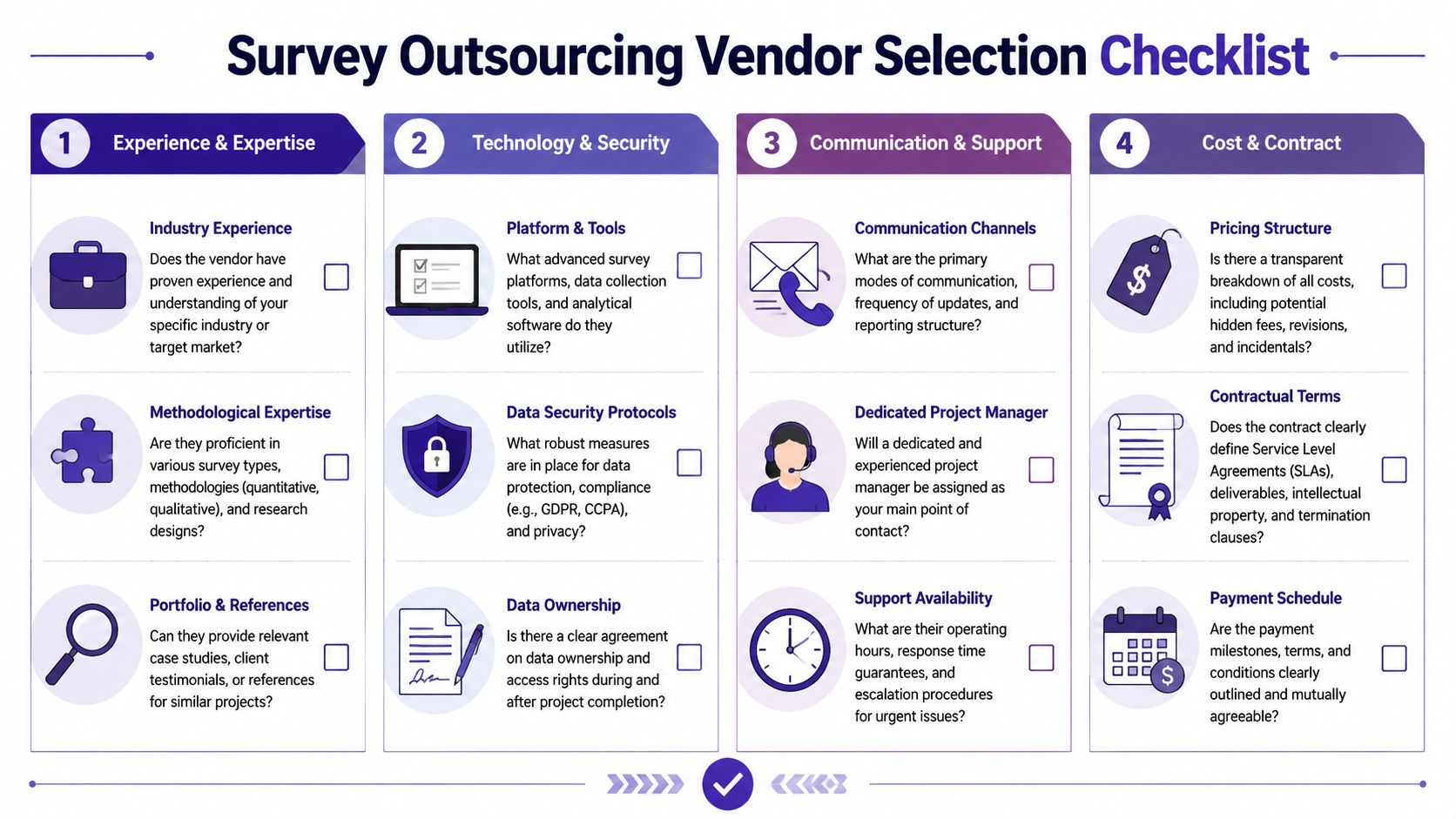
One standard matters above all: programming accuracy determines data accuracy. That’s the benchmark serious buyers should use when they assess a partner’s technical depth.
Technical and methodological questions
Start with the questions that expose real capability.
- Can they explain their programming QA process? Ask how they test skip logic, quotas, randomization, and multilingual versions before launch.
- How do they validate respondent quality? You want a clear answer on duplicate prevention, qualification checks, and bad-data handling.
- What survey modes can they support well? Phone, web, email, and mixed-mode projects all create different operational demands.
- Can they handle your study type? Brand tracking, CSAT, post-call surveys, employee feedback, and market research each require different workflows.
Operational and governance questions
A polished pitch deck doesn’t tell you how the day-to-day work will feel.
- Who owns communication? Ask whether you’ll have one accountable project lead or several rotating contacts.
- How are changes handled mid-fieldwork? Good vendors define approval paths before the first revision request arrives.
- What does reporting look like during the project? You need visibility into status, not just a final file at the end.
If a vendor can’t walk you through issue escalation, they probably haven’t managed enough live projects.
Security and commercial questions
These questions aren’t glamorous, but they save deals from going sideways.
| Category | Question to ask |
|---|---|
| Data security | Who can access respondent data, and how is access limited? |
| Ownership | Who owns raw data, cleaned data, scripts, and outputs? |
| Contracting | Are deliverables, revisions, and service levels spelled out clearly? |
| Pricing | What triggers extra charges, scope changes, or timeline shifts? |
If you’re comparing multiple providers, it helps to use the same evaluation discipline many companies already apply when they find and vet the best call center outsourcing companies. The criteria overlap more than most buyers expect: process control, communication, staffing quality, governance, and transparency.
Best Practices for Managing Your Survey Outsourcing Partner
A strong selection process helps. Management discipline is what determines whether the relationship produces reliable work quarter after quarter.
The old model was simple: choose the lowest-cost provider that could execute the survey. That buying logic is weakening. The criteria are shifting toward resilience and data quality, and modern teams need providers that can combine AI-enabled automation with bilingual human review. That changes how governance should work.
Build the relationship around controls, not assumptions
Start with a detailed operating brief. Not a vague statement of goals. A real working document that defines audience, channel, exclusions, approval owners, escalation path, language requirements, and what counts as a launch-ready instrument.
Then set a review rhythm that matches the project. For a recurring customer survey, that might mean weekly check-ins and monthly QA review. For a one-time market study, it might mean more intense prelaunch checkpoints and daily fieldwork updates during live collection.
The strongest client teams usually define these items early:
- Approval points: who signs off on wording, programming, and launch
- Quality rules: what gets flagged, what gets removed, and who makes judgment calls
- Response handling: where raw data goes, who can edit it, and when cleaned files are delivered
- AI boundaries: which tasks can be automated and which require human review
Use AI carefully and keep humans in the loop
AI can help with coding open-text responses, spotting anomalies, monitoring completion patterns, or drafting summaries. It shouldn’t replace judgment without explicit human oversight on translation nuance, compliance-sensitive wording, or suspicious patterns that need human review.
That matters even more in bilingual environments. Automated translation may be acceptable for draft workflow support. It isn’t enough by itself for respondent-facing survey language where tone, context, and local phrasing affect answer quality.
The right governance model asks two questions on every workflow. What can be automated safely? What still needs a human to review before the data is trusted?
Manage the partner like an extension of operations
Treat survey outsourcing as part of your operating system, not a side purchase. Share context. Show the vendor how survey findings will be used. Feed back the issues your analysts see in the final data. If the partner understands downstream impact, they usually make better upstream decisions.
Many projects experience improvement over time. The first wave establishes the process. The second and third waves reveal where scripts, QA rules, and bilingual review need tightening.
Survey Outsourcing in Healthcare Finance and E-commerce
The best survey outsourcing model depends on the industry. A healthcare provider doesn’t need the same workflow discipline as an online retailer. A financial services firm faces a different risk profile than a subscription brand running post-purchase surveys.
Healthcare
Healthcare teams need careful handling of patient experience, service feedback, appointment follow-up, and benefits-adjacent communication. The operational risk isn’t just poor wording. It’s mishandling sensitive information or asking questions in a way that creates confusion for vulnerable populations.
A practical model in healthcare is to keep survey intent, policy review, and interpretation internal while outsourcing the operational pieces: bilingual phone outreach, survey administration, reminder workflows, and structured data preparation. That split gives compliance and care teams tighter control over what is asked while reducing administrative load.
Nearshore support can be useful here because bilingual review isn’t optional in many North American patient populations. English and Spanish versions need to feel equivalent, not mechanically translated.
Finance
Financial institutions usually care about trust, clarity, and secure handling more than survey volume alone. Post-interaction surveys, onboarding feedback, and service recovery research all sit close to regulated processes.
A workable example is a lender or insurer that keeps question design and escalation rules in-house but outsources survey deployment and response formatting. The internal team controls what gets measured and how exceptions are handled. The external team runs the workflow reliably and returns structured data fast enough for operational follow-up.
In finance, weak governance shows up quickly. If a vendor can’t manage permissions, approvals, and documented process controls, the relationship won’t last.
E-commerce
E-commerce teams usually need speed. Product feedback, delivery experience, abandoned cart research, post-chat CSAT, and return experience surveys all move on retail timelines.
Here, survey outsourcing often pays off when the business has volume swings. A promotion launches, orders spike, support tickets increase, and suddenly the brand needs more feedback collection without pulling internal marketing or CX staff into daily fieldwork management.
Nearshore execution can help e-commerce brands that serve both English- and Spanish-speaking buyers across North America. Fast revisions, shared working hours, and bilingual support matter when offers, product questions, and service interactions change quickly.
The common thread across all three industries is simple. Keep strategic judgment close. Outsource the parts of survey work that benefit from process scale, language coverage, technical execution, and disciplined QA.
🚀 Ready to Turn Survey Data Into Cleaner Decisions?
CallZent helps North American companies build nearshore teams for survey operations, bilingual outreach, customer feedback workflows, and back-office execution.
Talk to an ExpertIf your team needs bilingual, nearshore support for survey operations, customer feedback workflows, or back-office execution tied to research and service quality, CallZent can help you design a practical delivery model. The goal isn’t to outsource for the sake of outsourcing. It’s to build a survey process that produces cleaner data, faster decisions, and fewer operational headaches.