Skip to content

Market Research Outsourcing
Market Research Outsourcing Guide for 2026: Why Nearshore Strategy Matters
Learn how market research outsourcing helps North American companies improve speed, control, compliance, and decision quality with the right nearshore partner.
TL;DR — Quick Takeaways
- Market research outsourcing is a strategic operating model, not just task delegation.
- It works best when a partner handles the full workflow, including collection, cleaning, enrichment, quality assurance, and reporting.
- Nearshore is often the strongest fit for North American firms because it balances cost, collaboration, speed, and control.
- Price matters, but methodology transparency, sampling logic, QA, compliance, and governance matter more.
- The right partner should function like an extension of your internal team, not a detached vendor producing generic reports.
Most companies think they have a market research problem when they really have an execution problem.
They know they need customer insight, competitor intelligence, survey data, and reporting. What they don’t have is a reliable way to run that work repeatedly without tying up internal teams, overhiring specialists, or creating governance headaches. That gap is exactly where market research outsourcing makes sense.
For North American companies, the bigger mistake is choosing the wrong outsourcing model. If your work touches regulated data, bilingual audiences, or time-sensitive decisions, cheap labor alone won’t solve the problem. You need a partner that can work in your time zone, understand your market, and operate with discipline.
Bold takeaway: Outsourcing market research works when you keep ownership of the business question and hand execution to a partner built to produce decision-grade data.
What Is Market Research Outsourcing Really
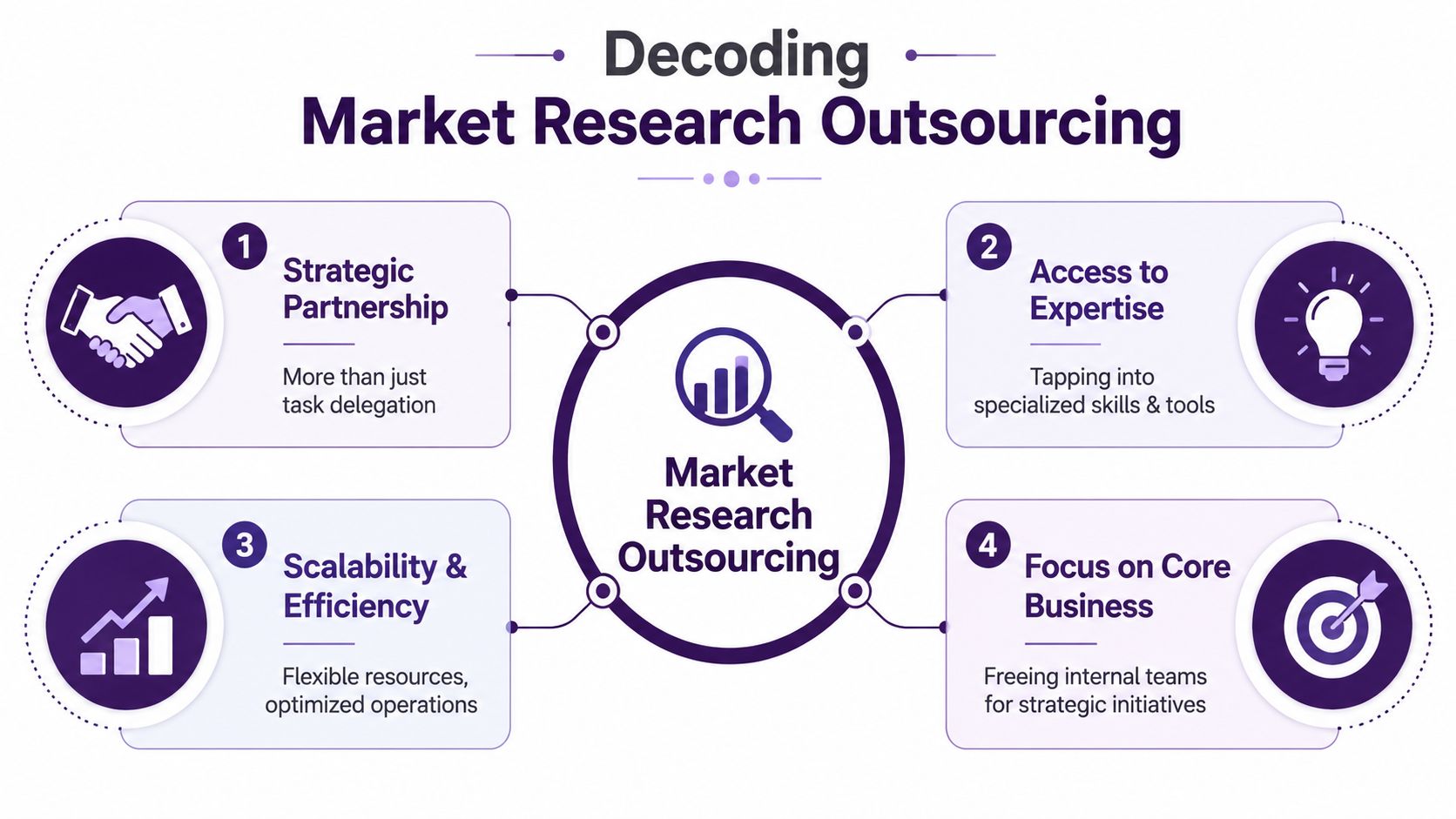
Market research outsourcing is often defined too narrowly, treating it like hiring someone to run a survey or call a list. That’s incomplete.
In practice, market research outsourcing means handing a specialized partner responsibility for part or all of your insight pipeline. That can include survey design, phone interviews, recruitment, competitor analysis, customer feedback collection, coding, data cleaning, analytics, and reporting. Done right, it’s not clerical support. It’s a structured way to get answers your team can trust.
It’s a specialist function, not overflow labor
Outsourcing market research is akin to hiring a specialist doctor instead of asking your general practitioner to handle everything. Your internal team may understand the business context better than anyone. But that doesn’t mean they should recruit respondents, build sample frames, code open-ended responses, validate data, and package executive-ready outputs every week.
That’s why smart companies outsource research the same way they outsource legal review, accounting support, or other forms of business process outsourcing. You keep strategic ownership. The external team handles the work that requires repeatable systems, trained operators, and specialized tools.
A one-off project is one version of this model. An ongoing research partnership is another. The difference matters.
- Project outsourcing: Useful when you need a single brand study, a one-time customer pulse check, or competitor benchmarking for a launch.
- Program outsourcing: Better when you need recurring market sizing, ongoing trend monitoring, voice-of-customer work, or periodic segmentation updates.
The real value is in the workflow design
The strongest outsourcing engagements don’t just produce a slide deck. They produce a clean, analysis-ready dataset and a repeatable operating model.
According to Consumer Links on market research outsourcing services, the true value comes from combining primary data collection with secondary data enrichment, then normalizing both into an analysis-ready dataset. The same source notes that the most effective engagements define deliverables at the data-model level, including sample frames, question logic, and output schema.
That point is more important than most buyers realize.
If you tell a vendor, “We need customer insight,” you’ll get vague deliverables and rework. If you specify target audience, fieldwork mode, coding rules, reporting format, and what decisions the data must support, the engagement becomes operational instead of improvised.
Buy outcomes, not activity. If a vendor can’t explain how raw inputs become a usable dataset, you’re not buying research. You’re buying motion.
A simple example. A healthcare company may need patient feedback in English and Spanish, call-based follow-up for low-response groups, secondary competitor scans, and a monthly dashboard for leadership. An internal team can coordinate that. A specialized outsourced team can run it consistently.
Onshore Nearshore and Offshore Outsourcing Models
Location shapes quality more than many buyers admit. For market research, where timing, nuance, and communication affect outcomes, the delivery model matters almost as much as the methodology.
Here’s the practical comparison.
Outsourcing models at a glance
| Factor | Onshore | Nearshore (e.g. Mexico) | Offshore (e.g. India, Philippines) |
|---|---|---|---|
| Time zone alignment | Strong | Strong to very strong | Often weaker |
| Real-time collaboration | Easy | Easy | Can be harder |
| Cultural proximity to North America | Strong | Strong | Mixed |
| Language alignment | Strong | Strong, often bilingual | Mixed by team |
| Cost structure | Highest | Moderate and efficient | Lowest in many cases |
| Speed for live revisions | Strong | Strong | Can slow down due to handoffs |
| Fit for regulated work | Often strong | Strong when governance is mature | Requires tighter oversight |
| Management overhead | Lower | Lower to moderate | Often higher |
Onshore works, but it’s expensive
Onshore outsourcing gives you the least friction. Shared language norms, shared business expectations, and full schedule overlap make project management easy. If your team wants vendors in the same country, onshore can be the simplest path.
The tradeoff is obvious. Cost.
Research itself isn’t cheap. A 2025 market research pricing guide from Main Brain Research says a single online survey can cost about US$5,000 to US$15,000, B2B surveys about US$15,000 to US$35,000+, brand-tracking programs about US$7,500 to US$120,000+ per year, and multi-market custom programs about US$150,000 to US$500,000+. The same guide says global-scale Marketing Mix Modeling can exceed US$1 million, while many mid-size brands fall in the US$25,000 to US$75,000 range for hybrid projects. If you can avoid building all that capability internally while preserving quality, you should.
Offshore can reduce cost, but control often gets harder
Offshore outsourcing can make sense for highly standardized tasks with tight process documentation. If the work is routine, turnaround expectations are flexible, and close collaboration isn’t critical, offshore can be effective.
But market research often isn’t routine. Questionnaire changes happen midstream. Quota logic gets revised. Leadership wants a same-day readout. Compliance teams need answers now, not tomorrow morning. That’s where offshore friction tends to show up.
Nearshore is the operational sweet spot
For North American companies, nearshore gives you the best working conditions without onshore cost structure. You get overlapping business hours, easier meetings, stronger cultural alignment, and smoother bilingual execution. That matters when research involves phone surveys, follow-up interviews, panel coordination, or iterative reporting.
For many buyers, this is the core decision framework:
- Choose onshore if internal stakeholders insist on domestic delivery at any cost.
- Choose offshore if the work is highly standardized and collaboration can be asynchronous.
- Choose nearshore if you need speed, flexibility, bilingual capability, and tighter oversight.
If you’re comparing models in more detail, this breakdown of nearshore vs offshore outsourcing costs risks and ROI is worth reviewing.
A Tijuana-based nearshore team is especially practical for U.S. and Canadian firms. You can run live working sessions, resolve questionnaire issues during the same business day, and keep the relationship close enough to manage like an operating partner instead of a distant vendor.
The Strategic Benefits and Risks of Outsourcing
Outsourcing market research provides strategic advantages. It also creates exposure if you choose poorly. Both things are true.
The strategic upside is real. So are the risks. Mature buyers plan for both.
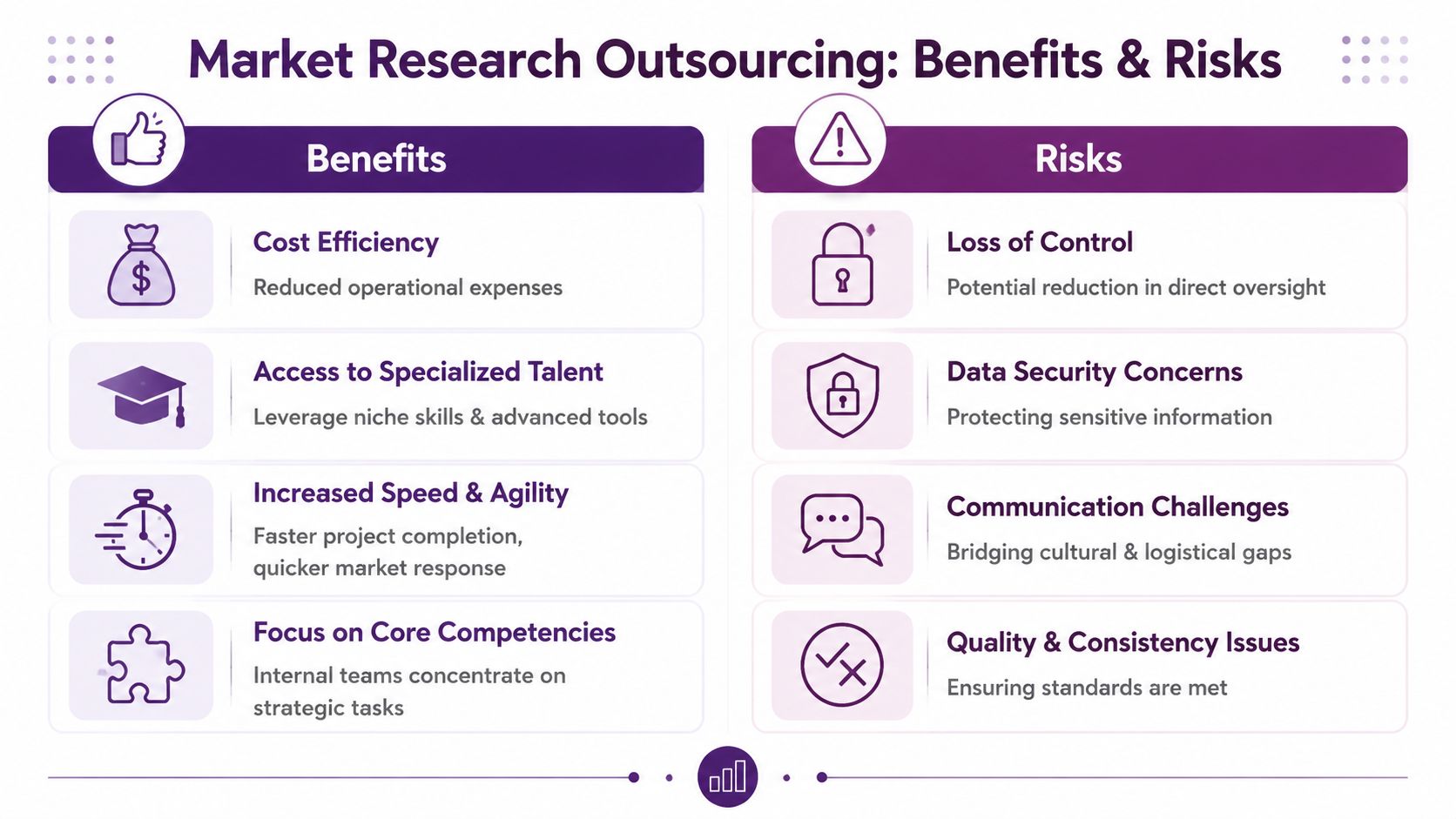
Outsourcing isn’t about giving up control; it’s about gaining specialized capabilities you don’t have in-house.
What you gain when the partner is right
The biggest strategic gain is capacity without fixed headcount. You don’t need to hire recruiters, survey programmers, QA analysts, statisticians, and reporting staff just to support intermittent demand.
According to Blackbear on the advantages of outsourcing market research activities, a key advantage is elastic capacity. External teams can scale fieldwork and analysis up or down faster than internal teams, and they often bring advanced analytics for segmentation and sentiment analysis, which reduces cycle time and improves decision quality.
That creates several practical benefits:
- Faster execution: You can launch fieldwork quickly when market conditions change.
- Specialized tooling: Vendors often already have the systems and trained people to process responses, benchmark competitors, and structure findings.
- Lower internal drag: Your product, marketing, compliance, and operations teams stay focused on decisions instead of project administration.
The broader outsourcing market also shows why companies are comfortable externalizing work that used to stay in-house. The global outsourcing services market was estimated at about US$3.80 trillion in 2024 and projected to reach roughly US$7.11 trillion by 2030, with an implied 11.3% CAGR. Within that, the global BPO segment alone was estimated at about US$302.62 billion in 2024 and projected to reach roughly US$525.23 billion by 2030 at 9.8% CAGR, according to EMAPTA’s outsourcing statistics roundup. Market research sits naturally inside that larger shift toward external operating partners.
Where outsourcing breaks down
Most failures come from one of four problems.
- Weak methodology control: The vendor delivers polished charts but can’t defend the sampling logic or coding decisions.
- Communication gaps: Stakeholders and vendor teams use the same words but mean different things.
- Shallow QA: Bad respondent data, inconsistent coding, and weak validation damage the final output.
- Governance blind spots: Sensitive data gets transferred or stored with unclear controls.
The cheapest vendor often becomes the most expensive one once rework, delays, and bad decisions hit the business.
A practical way to reduce those risks is to choose a provider with documented process discipline, not just presentation skills. That applies to market research the same way it applies to other business process outsourcing benefits buyers look for across customer support, back-office operations, and analytics work.
How to Choose the Right Market Research Partner
Why do so many market research engagements disappoint even after a polished sales process?
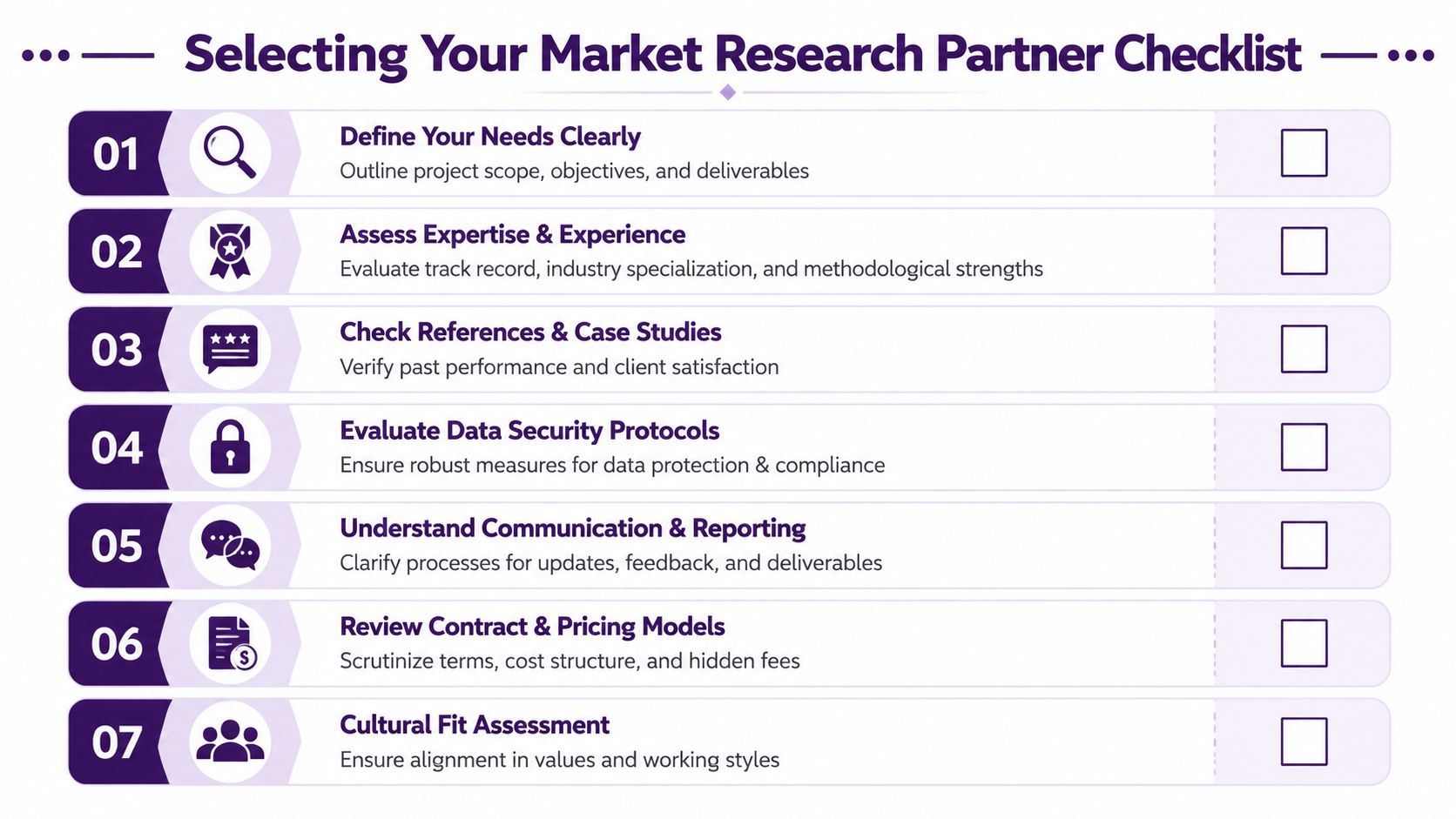
The answer is simple. Buyers screen for availability, price, and presentation skills, then act surprised when the work fails under executive review, compliance scrutiny, or real budget pressure. Choose a partner the way you would choose an operating team, not a slide factory. For North American companies, especially in healthcare and finance, that usually points to a nearshore partner with strong controls, easy collaboration, and a working understanding of U.S. business expectations.
Start with operating fit, then test research quality
Price matters. It just should not lead the decision.
A good partner can explain how the work gets done, who reviews it, where data sits, and what happens when a project changes midstream. A weak partner talks about speed, dashboards, and “custom solutions” without showing process discipline. In regulated environments, that gap becomes expensive fast.
According to SG Analytics on market research, buyers should evaluate methodology transparency, sampling logic, and statistical rigor, not just turnaround time. That standard is right, but I would push it further. For nearshore selection, also test communication quality, time-zone overlap, and the provider’s ability to work as an extension of your internal team.
If a vendor cannot explain respondent sourcing, quota management, coding rules, validation steps, and escalation ownership in plain language, remove them from consideration.
Questions that expose real capability
Use vendor interviews to find out how the team operates.
- Method design: Who writes the questionnaire, who reviews bias risk, and how are pilot changes approved?
- Sampling discipline: How do they build sample frames, control quotas, remove duplicates, and handle low-response segments?
- Data validation: What checks happen before analysis begins, and who signs off on cleaning, coding, and exception handling?
- Analytical range: Can they support segmentation, trend tracking, competitor analysis, and executive-ready synthesis, not just topline reporting?
- Program management: Who owns day-to-day communication, what is the escalation path, and how are delays flagged?
- Security and compliance: Where is data stored, who can access it, and how are consent and retention handled?
- Industry familiarity: What have they done in healthcare, finance, insurance, or another regulated field with similar constraints?
If the project includes phone interviews, bilingual outreach, appointment-setting follow-up, or contact-center execution, apply the same standards you would use to find and vet the best call center outsourcing companies. Research quality falls apart when the outreach operation is weak.
Nearshore is the better fit for North American buyers
This is the point many companies miss.
The right partner is not just a research firm with technical skill. It is a delivery team your stakeholders can reach easily, manage closely, and trust with sensitive workflows. Nearshore providers usually outperform offshore teams on that mix because they offer stronger schedule overlap, easier live collaboration, and better alignment with North American service expectations. They also avoid the cost structure and staffing rigidity that often come with fully onshore models.
That matters more in market research than buyers expect. Surveys change. Stakeholders argue over wording. Legal teams revise scripts. Sample criteria move. A nearshore partner can handle those adjustments in real time without dragging the project through long communication gaps.
Red flags that should end the conversation
Some warning signs are enough on their own.
| Red flag | Why it matters |
|---|---|
| They promise timelines before reviewing the brief | They are selling responsiveness, not research discipline |
| They stay vague on sample logic | Weak sourcing produces weak findings |
| They cannot walk you through QA | Errors will show up after delivery, when fixes are slower and costlier |
| They force a standard template onto every project | Your business question gets bent to fit their process |
| They focus on dashboards more than decisions | Reporting format is not the same as insight |
| They lack clear nearshore delivery ownership | Collaboration breaks down once revisions and stakeholder requests start piling up |
One factual option in this space is CallZent, which offers market research support alongside bilingual call center and BPO services for North American companies. That model fits buyers who need research execution tied to phone outreach, customer feedback collection, or broader back-office support.
Integration Governance and Measuring Success
Choosing a vendor is only the first decision. Running the relationship properly is what determines whether the work becomes useful, repeatable, and safe.
Too many companies focus on the final report and ignore the operating system behind it. That’s backwards. Good outputs come from good controls.

Integration has to be deliberate
Your outsourced team should know exactly who approves questionnaires, who signs off on sample criteria, who reviews interim findings, and who handles escalations. If those roles stay fuzzy, projects drift.
Set the engagement up like an operating function.
- Use shared workflows: Track briefs, approvals, open issues, and delivery dates in one visible system.
- Define ownership early: One internal owner should be accountable for business alignment. One vendor-side owner should be accountable for execution.
- Schedule working sessions: Don’t rely only on email. Live reviews prevent avoidable mistakes.
A simple example. A finance company running client perception research might require legal review of scripts, compliance sign-off on outreach language, executive review of the dashboard, and weekly adjustment to target segments. That only works when governance and communication are built in from the start.
Governance is not optional in regulated industries
Many buyers get careless, evaluating a partner on speed, enthusiasm, and price. Data privacy is then remembered only after the contract is signed.
Kantar notes in its discussion of the pendulum of market research that data governance and cross-border compliance are often overlooked, and buyers in regulated sectors need to prioritize consent, data residency, and transfer rules. That’s exactly right.
Your SLA and operating documents should address:
- Consent handling: Who collects it, how it’s recorded, and how exceptions are managed.
- Data access: Which roles can view raw respondent data and under what conditions.
- Storage rules: Where data is stored, how long it’s retained, and how deletion is verified.
- Transfer controls: What happens when data crosses borders or systems.
- Audit readiness: What documentation exists if compliance or legal teams ask questions.
If the vendor treats governance as legal fine print, they’re not ready for healthcare, finance, insurance, or any business with meaningful compliance exposure.
Measure process quality, not just final deliverables
Success isn’t “we got a report.” Success is that the report was built on sound process and arrived in time to support a business decision.
A strong management dashboard should include operational measures like turnaround consistency, defect rates in data files, revision cycles, and adherence to agreed reporting cadence. It should also show whether stakeholders used the output in pricing, service design, campaign planning, or customer experience decisions.
For teams that already manage service operations, this discipline will feel familiar. The same thinking behind call center reporting metrics dashboards and KPIs applies here. If you can’t measure the process, you can’t trust the result consistently.
Why Nearshore Is Ideal for Your Industry
Nearshore isn’t just a geography choice. It’s an operating choice.
For North American businesses, it solves the day-to-day problems that make outsourced research frustrating. You get same-day collaboration, easier supervision, bilingual capability, and fewer translation errors between business intent and execution. That matters in every industry, but it matters most when stakes are high.
Healthcare
A healthcare provider may need patient satisfaction outreach, service-line feedback, appointment experience research, and bilingual phone surveying. That work requires empathy, consistent scripting, and tight handling of sensitive information.
A nearshore team is easier to train against your compliance expectations and easier to manage when scripts or outreach criteria change. If legal or privacy teams need updates, they can get answers during the same business day.
E-commerce
E-commerce moves fast. Product teams need customer feedback quickly. Marketing teams need competitor intelligence while campaigns are still live. Operations teams need to understand why returns, complaints, or drop-off patterns are shifting.
Nearshore teams fit that pace well. They can support phone surveys, customer follow-up, sentiment review, and competitor monitoring without the lag that often comes with distant time zones. If a U.S. retailer needs a revised questionnaire by the afternoon, a nearshore partner can work inside that window.
Finance
Financial services firms can’t afford sloppy research execution. Whether you’re collecting feedback from account holders, testing product messaging, or evaluating service experience, professionalism matters.
Nearshore teams offer a practical balance. They’re close enough to support high-touch collaboration, often culturally aligned with North American client expectations, and easier to govern for secure workflows. That’s especially useful when the audience includes affluent clients, policyholders, borrowers, or investors who expect precision and discretion.
If your company operates in a regulated environment and still wants flexibility, nearshore is usually the cleanest model. It gives you room to scale without sacrificing control.
🚀 Ready to Turn Market Research Into Decision-Ready Insight?
CallZent helps North American companies build nearshore teams for market research support, bilingual outreach, customer feedback collection, and back-office execution.
Talk to an ExpertIf you’re evaluating market research outsourcing and want a nearshore operating model that fits North American teams, CallZent is worth considering. As a Tijuana-based bilingual BPO, the company supports organizations that need close collaboration, English and Spanish coverage, and practical execution across customer-facing and back-office workflows.