Nearshore Outsourcing Strategy
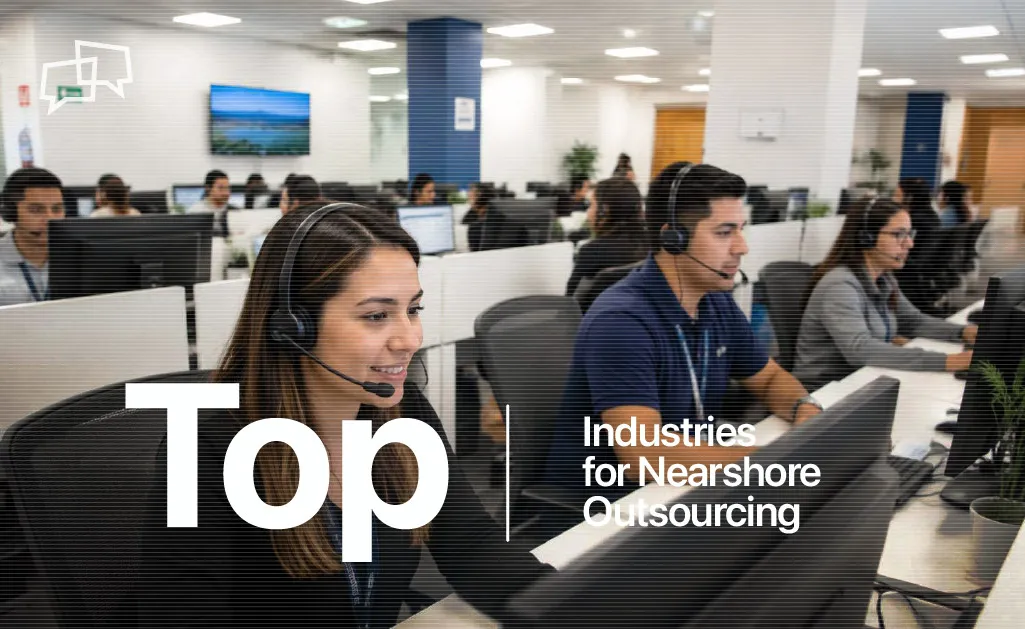
Top Industries for Nearshore Outsourcing: Where the Model Works Best
Explore the top industries for nearshore outsourcing and learn why e-commerce, healthcare, legal, finance, tech, hospitality, and home services benefit.
TL;DR — Quick Takeaways
- The top industries for nearshore outsourcing usually have high customer contact volume, seasonal demand, bilingual needs, or pressure to scale without losing service quality.
- eCommerce, healthcare, legal services, consumer finance, telecom, technology, hospitality, travel, and home services are especially strong fits.
- Nearshore outsourcing gives U.S. companies time-zone alignment, easier communication, bilingual English-Spanish support, and stronger operational control than many far-off offshore models.
- The best results come when companies outsource defined workflows, not vague job titles.
- Nearshore support works best when the partner is trained, measured, and managed like an extension of the internal team.
Here is the text with internal and external links added:
When support queues grow faster than your team can hire, the question is rarely whether you need outside help. The real question is which business models benefit most from it. The top industries for nearshore outsourcing tend to share a few traits: high customer contact volume, pressure to control labor costs, and a need for fast, flexible coverage without losing quality.
For U.S. companies, nearshore outsourcing is not just a staffing decision. It is a way to protect the customer experience while keeping operations close in time zone, language, and culture. Deloitte’s Global Outsourcing Survey notes that organizations are using sourcing models to access talent, skills, and capabilities while rethinking governance across extended workforces. (Deloitte) That matters when your customers expect quick answers, your internal team is stretched thin, and delays have a direct impact on revenue or retention.
What makes certain sectors the top industries for nearshore outsourcing
Not every industry gets the same return from a nearshore model. The strongest fit usually comes from companies that need ongoing voice, chat, email, or back-office support and cannot afford inconsistent service. If customer interactions happen all day, if demand changes seasonally, or if bilingual communication matters, nearshore teams can add value quickly.
The model is especially attractive for businesses that need an extension of their internal operation, not a disconnected vendor. Proximity to the U.S. supports faster training, easier communication with leadership, and better alignment with brand standards. For companies comparing operating models, this guide to nearshore vs offshore outsourcing costs, risks, and ROI explains why location affects more than price.
eCommerce and retail
eCommerce is often one of the clearest fits for nearshore outsourcing because the customer journey creates support demand at every stage. Shoppers ask pre-sale questions, check order status, request returns, dispute charges, and need help across phone, chat, email, and social channels. Peaks during holidays and promotions make internal staffing even harder.
A nearshore team can support order processing, customer service, upsell opportunities, returns management, and after-hours coverage without the lag that comes with more distant offshore models. The FTC’s Mail, Internet, or Telephone Order Merchandise Rule is a useful external reference for businesses handling online, phone, or mail orders because it explains seller responsibilities around shipping promises and delays. (Federal Trade Commission) Bilingual service also matters for brands serving both English- and Spanish-speaking customers in the U.S.
The trade-off is that retail support is heavily brand-sensitive. Agents need to sound like part of your company, not a generic contact center. That means scripts alone are not enough. Training, QA, and real-time communication with your internal team make the difference between basic coverage and a customer experience that drives repeat purchases. For more on this use case, see CallZent’s guide to customer support in e-commerce.
Healthcare support services
Healthcare organizations and healthcare-adjacent businesses often face a combination of high call volume, documentation demands, and strict service expectations. Patients call with questions about scheduling, billing, eligibility, reminders, and follow-up. Internal staff can easily get buried in administrative work that pulls attention away from direct care or higher-value case handling.
Nearshore outsourcing works well here for appointment setting, patient support, intake coordination, insurance verification support, and non-clinical back-office tasks. Time zone alignment is especially useful because delays in response can lead to missed appointments, lower patient satisfaction, and revenue leakage.
This industry does require careful handling. Healthcare support is not a fit for every outsourcing partner, especially when processes are poorly documented or compliance standards are not clearly defined. HHS explains that HIPAA business associates may handle protected health information only to help covered entities carry out healthcare functions, which is why secure processes and clear agreements matter in healthcare outsourcing. (HHS.gov) The benefit is strong when the partner is trained for structured workflows and escalation protocols. It is less effective when companies expect an outside team to fix broken internal processes on day one.
For a deeper look at this model, see CallZent’s guide to healthcare call center outsourcing.
Legal services
Law firms and legal service providers are under constant pressure to respond quickly to potential clients. A missed intake call can mean a missed case. Existing clients also expect updates, responsiveness, and professionalism from the first conversation onward. For firms with lean internal teams, that creates a gap between casework and communication.
Nearshore support can help with legal intake, call answering, appointment scheduling, lead qualification, document follow-up, and general administrative coordination. The American Bar Association explains that client intake helps determine whether a client is a good fit for a law practice, which reinforces why the first conversation needs structure and consistency. (American Bar Association) The value here is straightforward: more answered calls, faster response times, and better client handling without the overhead of building a larger in-house front office.
The caution is that legal support cannot be treated casually. Firms need clear boundaries around what outsourced teams can say, collect, and escalate. When workflows are defined well, nearshore teams can improve responsiveness without compromising professionalism. When expectations are vague, the risk of inconsistency goes up.
Consumer finance and collections
Consumer finance companies deal with sensitive conversations, high compliance awareness, and frequent customer outreach. Whether the focus is payment reminders, account servicing, application follow-up, or debt collection, communication quality matters. Customers need clarity, empathy, and speed, especially when money is involved.
Nearshore outsourcing can support inbound account inquiries, outbound collections efforts, payment follow-up, lead response, and back-office processing. Bilingual capability is a major asset in this sector because financial conversations are often easier and more productive when customers can communicate in their preferred language. The CFPB’s Debt Collection Rule FAQs are a useful reference for teams that need to understand how regulated collection communication is treated. (Consumer Financial Protection Bureau)
This is one of the industries where process discipline matters most. Scripts, disclosures, QA controls, and reporting have to be consistent. The upside is significant for companies that want a cost-efficient team without sacrificing supervision or accountability. A nearshore model works best when leadership stays engaged and performance is measured closely.
Telecom and technology services
Telecom providers, SaaS companies, and IT service firms all face a version of the same challenge: customer expectations move fast, and support issues can become churn risks quickly. Customers want immediate help with activation, troubleshooting, billing questions, and account management. Sales teams also need support with lead qualification and appointment setting.
Nearshore teams are a strong fit for Tier 1 technical support, customer care, help desk functions, retention outreach, and inside sales support. Zendesk’s CX Trends 2026 reports that customers increasingly expect faster response times and 24/7 service availability, which helps explain why tech and telecom support models need speed and flexibility. (Zendesk CX Trends 2026) Shared time zones make collaboration easier between internal engineering or operations teams and the outsourced support function. That reduces handoff delays and improves issue resolution.
Still, technical support is not one-size-fits-all. Highly specialized products may require deeper product training and tighter knowledge management than general customer service programs. Companies that invest in onboarding and continuous coaching tend to see better results than those looking for a quick plug-in replacement.
For companies building always-on or after-hours models, CallZent’s guide to 24/7 customer service is a useful internal resource.
Hospitality, travel, and reservations
Reservation-driven businesses live and die by responsiveness. Hotels, travel providers, restaurants, and service-based hospitality brands need phones answered, bookings confirmed, changes processed, and guest concerns handled quickly. Demand can swing sharply by season, campaign, or time of day.
That makes nearshore outsourcing especially useful for reservation services, overflow support, after-hours coverage, and bilingual guest communication. For businesses trying to improve conversion from inbound calls, a trained nearshore team can help turn missed opportunities into booked revenue.
The nuance here is that hospitality interactions are highly emotional. A guest calling about a booking issue does not just want a transaction completed. They want reassurance. The best outsourcing outcomes come when agents are trained to reflect the company’s service style, not just follow a reservation workflow.
Home services and field-service businesses
Plumbers, HVAC companies, restoration firms, electricians, and similar service businesses often lose revenue for a simple reason: no one is available to answer the phone when demand spikes. Calls come in after hours, during dispatch rushes, or while office staff are tied up. That creates missed appointments and wasted marketing spend.
Nearshore support can help with appointment setting, lead capture, answering services, scheduling coordination, and customer follow-up. For growing service businesses, this can create structure without the fixed cost of expanding a full internal admin team.
The fit is especially strong for companies that rely on speed-to-lead. The main requirement is integration with dispatch tools, calendars, and service rules. If those systems are disorganized, outsourcing will expose the problem rather than hide it.
Why these industries keep choosing nearshore over far-off alternatives
The common thread across the top industries for nearshore outsourcing is not just cost. It is control. U.S. companies want savings, but they also want teams that can communicate in real time, adapt quickly, and represent the brand with confidence.
That is why nearshore delivery continues to gain traction in customer-facing and back-office functions. It offers a more practical balance between affordability and operational alignment. For many growing companies, especially those that need bilingual service or flexible scaling, that balance is where outsourcing starts to feel less like a workaround and more like a growth strategy.
At CallZent, we see the strongest results when companies choose outsourcing based on workflow fit, customer expectations, and long-term operating goals — not just hourly rates. If your industry depends on responsiveness, consistency, and real human connections, nearshore call center support may be closer to the right answer than you think.
If your company is ready to explore bilingual nearshore support for customer service, back-office workflows, intake, scheduling, technical support, or overflow coverage, contact CallZent to discuss the right model for your industry.
🚀 Ready to Build Nearshore Support for Your Industry?
CallZent helps North American companies build bilingual nearshore teams for customer service, healthcare support, legal intake, finance workflows, eCommerce support, technical support, and back-office operations.