Skip to content

Inbound Call Center Services
Inbound Call Center Services for Smarter Support and Growth
Learn how inbound call center services improve support, protect revenue, scale operations, and help growing companies choose the right nearshore partner.
TL;DR — Quick Takeaways
- Inbound call center services handle customer-initiated calls, emails, chats, and support requests that can otherwise overwhelm growing teams.
- Good inbound support is not just call answering. It protects revenue, customer trust, retention, and internal team focus.
- The strongest inbound programs use clear routing, trained agents, escalation rules, QA, KPIs, and service-level agreements.
- Nearshore inbound call center services can give North American companies bilingual coverage, better time-zone alignment, and stronger operational control.
- The right partner should improve customer outcomes, not simply lower labor costs.
Inbound call center services handle incoming customer communications across calls, email, and chat, and they matter more than ever because the global call center industry was valued at US$340 billion in 2020 and is projected to reach US$496 billion by 2027. If your team is juggling support while trying to grow, outsourcing inbound support to a nearshore partner can protect customer satisfaction, extend coverage, and reduce operating pressure without giving up quality.
Meta title: Inbound Call Center Services for Smarter Support and Growth
Meta description: Learn how inbound call center services improve customer support, scale operations, and support growth. Get a practical outsourcing framework with a nearshore perspective.
If you’re the owner, operator, or customer experience lead at a growing company, you’ve probably seen the pattern. Sales improve, order volume rises, account count grows, and suddenly your internal team spends half the day answering status questions, billing issues, password resets, shipping calls, and upset customer escalations.
That’s when support stops being a side function and starts becoming an operational constraint.
A lot of companies wait too long to fix it. They assume inbound support is just a staffing issue. It isn’t. It’s a workflow issue, a quality issue, and often a growth issue. The wrong setup pulls managers into the queue, slows response times, and leaves customers waiting when they need help most.
Good inbound call center services don’t just answer the phone. They protect revenue, retention, and your team’s time.
Are Customer Calls Holding Your Business Back
Your team starts the day with a plan. By midmorning, that plan is gone.
The operations manager is pulled into order-status calls. A sales lead is answering billing questions. A supervisor is calming down an upset customer because nobody else has the context or the authority to fix the issue. By the end of the day, revenue-driving work is still sitting untouched.
That is what poor inbound support design looks like in practice. It drains management time, slows execution, and turns customer contact into a constant interruption instead of a controlled process.
Companies usually misdiagnose the problem. They hire one more coordinator, ask managers to help during peaks, or rotate phone duty across teams. That patchwork approach fails because inbound demand does not arrive in a neat pattern. It comes in waves, with different issue types, different urgency levels, and very little patience from the caller.
What this looks like in the real world
A retailer runs a promotion and gets buried in order tracking calls, returns, and payment problems.
A healthcare group adds providers, but the front desk cannot keep up with scheduling, confirmations, and follow-up questions.
A financial services firm grows through referrals, then watches client service requests crowd out the advisory work that drives margin.
These businesses do not have a phone problem. They have a capacity and coverage problem. More specifically, they have a model problem.
- Growth stalls: High-value employees spend their time handling repetitive contacts instead of fixing processes, closing deals, or improving operations.
- Customer trust drops: Long hold times, repeat explanations, and inconsistent answers push customers to competitors.
- Commercial focus gets weaker: Service overload makes it harder to respond well to better-fit opportunities. If your pipeline also includes too many low-intent prospects, Cherubini Company on attracting better leads is a useful companion read.
Here’s the rule I recommend to clients. If experienced managers are regularly covering inbound calls, your support setup is already costing more than it should.
The fix is not random headcount. The fix is a support model built for volume swings, clear routing, and fast resolution. For many growing companies, that points to nearshore outsourcing, not because it is cheap, but because it gives you bilingual coverage, stronger schedule overlap, and better cultural alignment than offshore-only options. That balance is why a nearshore partner like CallZent makes sense for brands that need to control costs without sacrificing customer experience.
If you want a practical starting point before redesigning the function, review this guide on how to improve customer service.
What Are Inbound Call Center Services Really
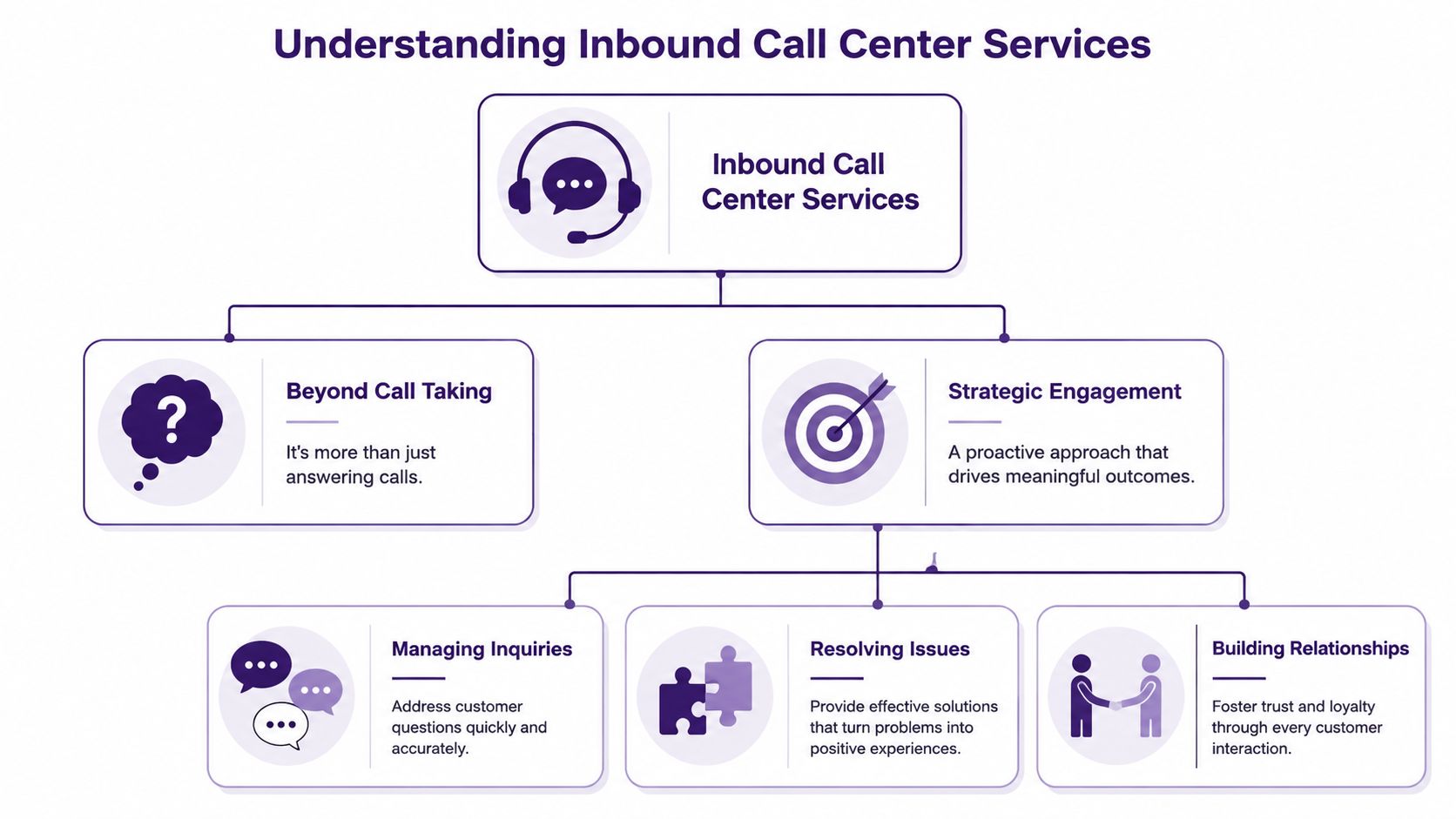
Inbound call center services are the systems and people that handle customer-initiated contact. That includes calls, emails, and chats coming in for support, product questions, account help, order updates, billing concerns, and service issues.
That sounds basic, but most companies still define inbound support too narrowly. They think it means “someone answers the phone.” That’s not enough.
It’s a resolution function, not a reception desk
Outbound teams initiate contact. They prospect, follow up, sell, or collect. Inbound teams respond to demand that already exists.
The easiest way to think about it is this:
| Function | What it does | Why it matters |
|---|---|---|
| Inbound support | Handles customer-initiated requests | Protects retention, trust, and service continuity |
| Outbound support | Initiates business-led contact | Drives pipeline, follow-up, and proactive engagement |
A strong inbound operation does three things well:
- Classifies intent quickly: What does the customer need?
- Routes the issue correctly: Who should handle it?
- Resolves it cleanly: Can the issue be solved without unnecessary handoffs?
That’s why inbound support is directly tied to customer loyalty. In urgent moments, people still want a real voice channel. A 2025 consumer survey summary reported that over half of retail customers with an urgent issue prefer phone support, while about 30% prefer text messaging, according to Sprinklr’s call center statistics overview.
Why the definition matters
If you define inbound call center services as simple call coverage, you’ll buy the wrong solution. You’ll focus on seat count instead of service design. You’ll ask about cost before asking about issue resolution.
That’s backwards.
The better view is operational. Inbound support is the front line of customer retention. It’s where confusion gets resolved, friction gets removed, and trust gets either reinforced or damaged.
Customers don’t judge your org chart. They judge whether the first person they reach can actually help.
That’s also why modern inbound support often extends beyond voice-only handling. Businesses now need phone, email, and chat coordinated together, with consistent answers and clean escalation paths. When that setup works, customers don’t have to repeat themselves and managers don’t have to jump in every time something goes sideways.
Core Inbound Offerings and How They Help You Grow
Most companies buy inbound call center services for one reason. They’re overloaded. The mistake is stopping there.
You shouldn’t outsource just to absorb volume. You should outsource the specific customer interactions that either protect revenue or drain your internal team.
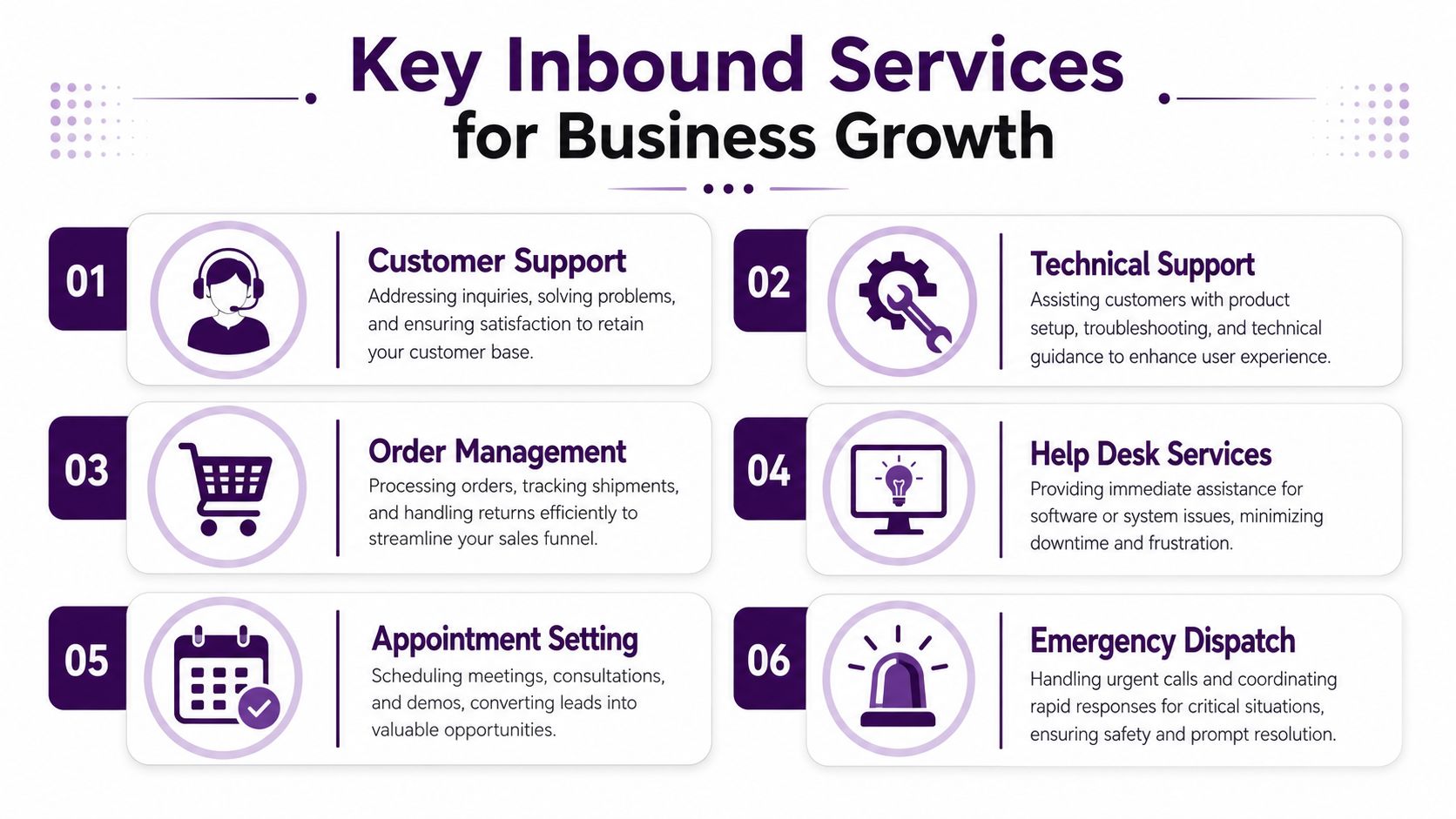
Customer service and account support
This is the core layer. Customers call with order questions, policy questions, account access issues, billing confusion, or basic service requests.
Before outsourcing, a growing business usually handles these contacts in a scattered way. Reception takes some. Operations takes some. Managers take the angry ones. After outsourcing, the flow becomes predictable. Agents handle front-line questions, follow scripts and knowledge bases, and escalate only when needed.
That matters because consistency reduces customer frustration and frees skilled staff to do work that requires their judgment.
Technical support and help desk
If your product or service creates setup questions, troubleshooting requests, or usage issues, technical support is not optional. It’s part of product adoption.
A software company might need password help, access troubleshooting, and basic navigation support. A consumer electronics brand might need setup guidance and defect triage. A service provider might need help desk intake before dispatching field teams.
These interactions shape whether customers stay confident or start shopping for alternatives.
Order management and transaction support
Inbound support directly protects revenue because customers need help placing orders, updating reservations, checking shipment status, correcting payment details, or processing returns.
When this process is clumsy, customers abandon purchases or flood your team with repeat contacts. When it’s clean, support becomes part of the sales engine.
If your business serves customers across multiple channels, omnichannel customer support becomes important because the customer doesn’t care whether the issue began by phone, email, or chat. They care about getting an answer.
Routing is where performance starts
The best inbound operations don’t rely on luck. They use intent-based workflows before the agent even says hello. According to RingCentral’s explanation of inbound call center workflows, effective inbound workflows use IVR and skills-based routing to classify caller intent before an agent answers. That reduces transfers, shortens handle times, and improves first-contact resolution by getting the customer to the right queue faster.
Here’s the practical takeaway:
- Billing questions should go to billing-trained agents.
- Technical issues should reach support-trained specialists.
- Order changes should land with agents who can act, not just apologize.
- High-emotion escalations should route to senior staff with authority.
Routing is not a technical detail. It’s one of the biggest drivers of whether customers feel helped or trapped.
The Metrics That Matter KPIs and SLAs
Your provider sends a monthly report with 20 charts, five acronyms, and no clear answer to one question: are customers getting help fast enough to stay loyal and buy again?
That report is noise. You need a scorecard tied to customer experience, labor efficiency, and revenue protection.
Track the few metrics that actually run the operation
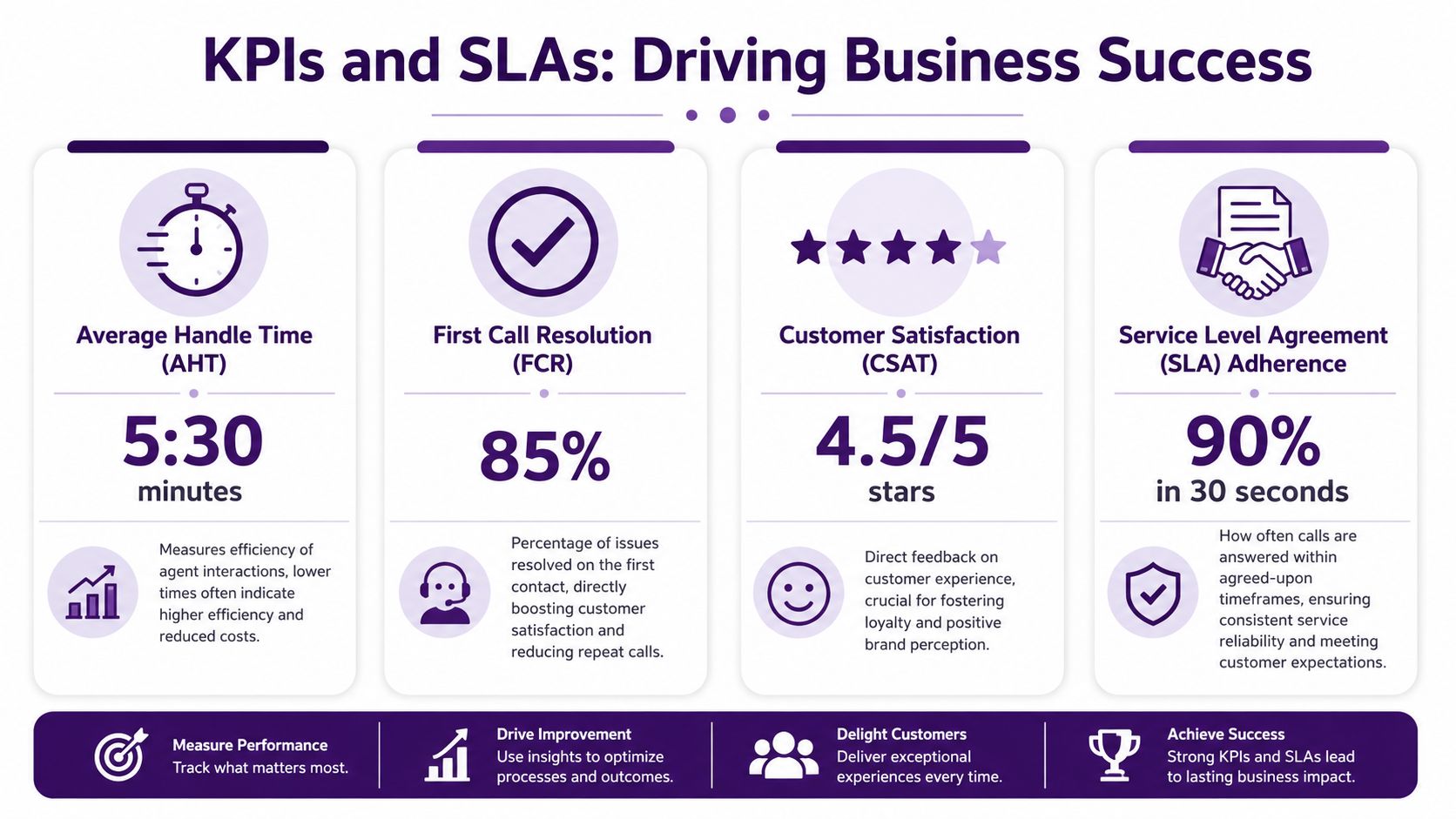
For inbound support, four numbers carry most of the weight:
- Service level: How fast calls are answered against a defined target.
- First contact resolution: Whether the customer gets the issue solved in one interaction.
- Abandonment rate: How many callers quit before reaching an agent.
- Average handle time: The full time required to complete the contact, including talk time and after-call work.
These metrics matter because they expose the tradeoffs your operation is making. A team can answer quickly and still fail customers if resolution is weak. A team can post low handle time and still create repeat contacts if agents rush callers off the phone. A healthy inbound program balances speed, resolution, and staffing discipline instead of chasing one number at the expense of the others.
Use that framework when comparing in-house support, offshore vendors, and nearshore partners. Nearshore bilingual teams, especially in a model like CallZent’s, tend to outperform on the combination that matters most to growing brands: strong communication, easier coaching, tighter schedule alignment, and lower cost than a U.S.-only team. That mix helps you protect service levels without sacrificing call quality.
KPIs are useful. SLAs create accountability.
A KPI tells you what happened. An SLA defines the minimum standard your partner is required to hit.
That distinction matters.
If a provider reports service level after the fact but refuses to contract to a target, you carry the risk. If first contact resolution is discussed but never defined, you get debates instead of accountability. Every serious outsourcing agreement should spell out target thresholds, reporting cadence, escalation rules, quality scoring, and remedies for missed performance. This guide to service level agreement metrics and performance standards covers what those commitments should include.
Here is the practical lens:
| Metric | What it tells you | Risk if misused |
|---|---|---|
| Service level | Responsiveness | Fast answers with poor solutions |
| First contact resolution | Issue-solving quality | Looks weaker if routing or training is poor |
| Abandonment rate | Queue access | Spikes when forecasting and staffing slip |
| Handle time | Efficiency | Rewards rushed conversations if quality checks are weak |
Good reporting includes context, not just averages
A monthly average can hide a bad operation. You need the provider to break performance down by hour, queue, language, call reason, and agent group. That is how you spot the underlying issue. Maybe Spanish-language billing calls are underperforming because staffing is thin. Maybe order-status contacts are inflating volume because self-service is weak. Maybe one queue hits service level while escalations sit too long.
Analysts at Working Solutions on contact center data tracking argue for combining quantitative metrics with qualitative inputs such as sentiment, voice analytics, and self-service behavior. That approach is the right one. Numbers show where pressure exists. Quality review shows why.
Ask every provider these questions before you sign:
- Which KPIs are reported daily, weekly, and monthly?
- How do you define first contact resolution?
- Are SLA targets measured by queue, by language, and by channel?
- What happens if performance slips for two straight reporting periods?
- How do QA findings change coaching, staffing, or workflow design?
If the answers are vague, keep looking.
Choosing Your Partner The In-House vs Outsourcing Decision
This decision gets framed the wrong way all the time. Companies ask, “Can we do this more cheaply outside?” The better question is, “Which model gives us the right balance of quality, control, flexibility, and customer experience?”
Cost matters. It just shouldn’t be the only filter.
In-house gives control, but it gets expensive fast
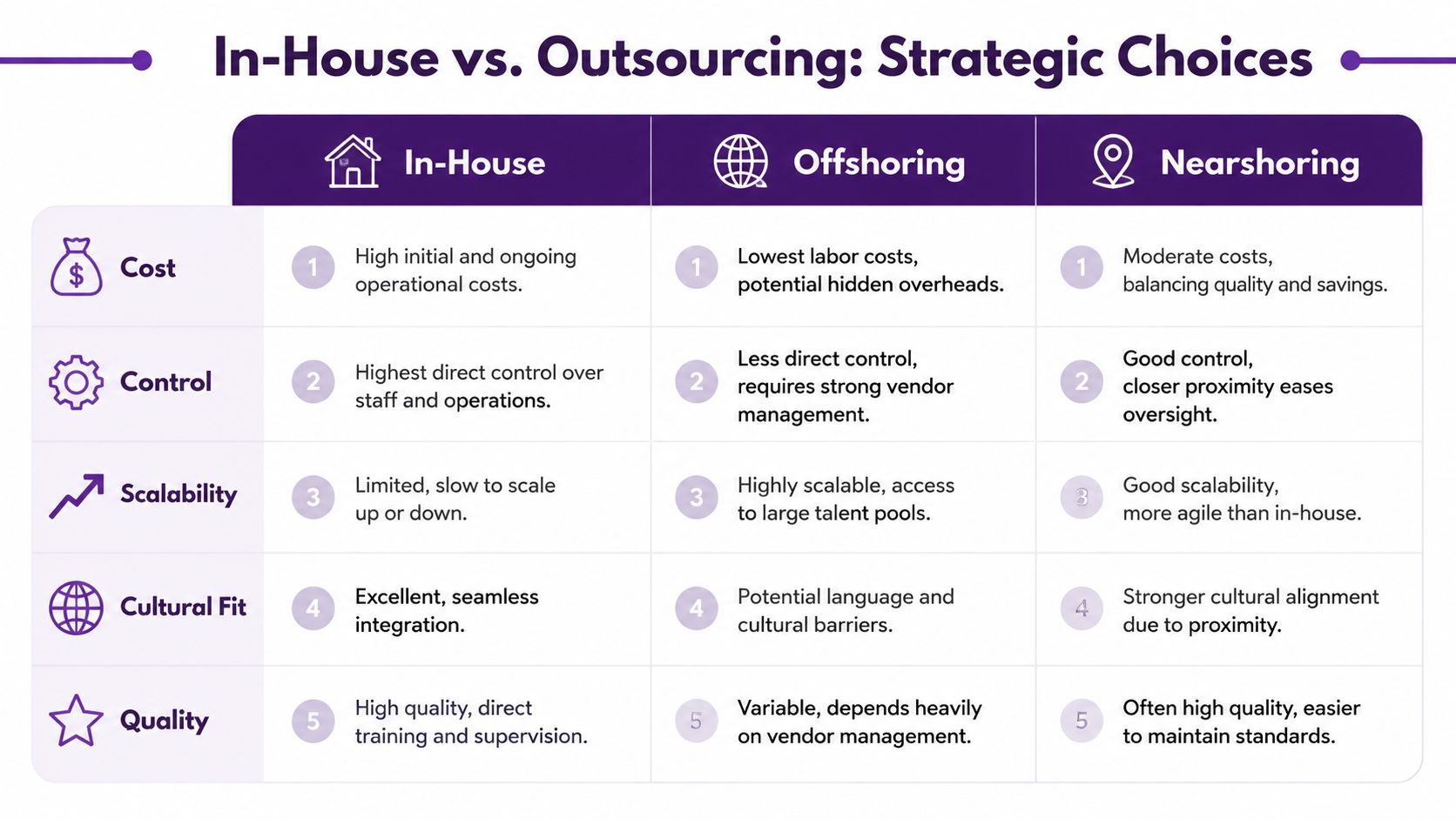
An internal team gives you direct oversight, easy access to staff, and close brand alignment. That works well when support is specialized, low-volume, or closely tied to internal systems.
It breaks down when demand becomes variable, operating hours expand, or bilingual support becomes necessary. Recruiting, scheduling, training, QA, management, and attrition all stay on your payroll. So does the burden of scaling.
Offshore can reduce labor cost, but quality risk is real
Traditional offshore models can offer lower labor costs. That’s why companies choose them.
The tradeoff is usually management complexity. Time zone distance, accent mismatch, cultural friction, and slower collaboration can all affect customer experience. Some offshore programs work well. Many underperform because companies buy a price point and assume service quality will follow.
It won’t.
Nearshore is the smarter middle ground
For North American businesses, nearshore support is often the most practical option because it balances cost discipline with operational alignment. You get easier oversight, shared time zones or close time-zone coverage, and stronger English-Spanish support.
That’s especially important if your customer base is mixed across the U.S., Mexico, or broader North America. Bilingual service isn’t a nice add-on. In many sectors, it’s part of basic accessibility.
The right outsourcing partner should improve customer outcomes, not just lower labor costs.
That’s also the core challenge buyers face. As 8×8’s inbound call center overview notes, businesses need to measure whether outsourcing improves outcomes beyond labor savings, using quality indicators such as first-contact resolution, transfer rates, and customer satisfaction across in-house, nearshore, and offshore models.
Here’s a practical decision framework:
- Choose in-house if your support work is highly specialized, tightly regulated, and relatively stable in volume.
- Choose offshore if cost pressure is extreme and you have strong vendor management capacity.
- Choose nearshore if you need cost control without sacrificing language quality, responsiveness, and collaboration.
For companies serving U.S. customers, a nearshore provider in Tijuana can be a practical fit because leadership access, training coordination, and bilingual staffing are easier to manage than with far-shore teams. One example is CallZent’s nearshore call center model for U.S. businesses, which focuses on bilingual support and operational alignment for North American companies.
What to ask before you sign
Don’t lead with price. Lead with operating fit.
Ask questions like these:
- How do you route customer intent? Poor routing creates repeat calls and transfers.
- What issues can agents fully resolve without escalation? This defines real capacity.
- How do you report quality? You want more than average speed.
- How do you handle bilingual support? Not translation. Real service fluency.
- How quickly can you scale coverage? Launches and seasonal spikes expose weak partners.
If a vendor can’t answer those clearly, keep looking.
Inbound Services in Action Industry Use Cases
The value of inbound call center services becomes obvious when you look at specific operating problems instead of generic service menus.
E-commerce needs post-purchase control
An online store usually feels the pressure after the sale, not before it. Customers call about shipping status, returns, damaged items, substitutions, and payment issues. If nobody owns those conversations, the same customers contact you again through email, chat, and social channels.
A dedicated inbound team can centralize those contacts, standardize answers, and escalate only the exceptions. That protects reviews, reduces repeat frustration, and keeps your internal e-commerce team focused on merchandising and fulfillment.
Healthcare needs non-clinical responsiveness
Medical practices and healthcare groups deal with appointment scheduling, referral intake, insurance-related questions, and follow-up communication that can swamp front-desk staff. Those aren’t side tasks. They’re part of the patient experience.
That’s why many providers separate clinical work from non-clinical communication and use structured support for intake and scheduling. If you want to see how that works in a healthcare setting, this overview of medical call center services that support patient care is a helpful reference.
A missed support call in healthcare often turns into a missed appointment, a delayed answer, or a frustrated patient.
Finance and insurance need trust and precision
A brokerage, lender, or insurance agency doesn’t just need phones answered. It needs customer questions handled accurately and calmly. Policyholder inquiries, document requests, billing concerns, and application-status calls all require discipline.
The wrong response creates confusion. A delayed response creates doubt.
That’s why inbound support in these sectors works best when the provider follows clear workflows, documented escalation rules, and quality review standards. Customers don’t expect charm first. They expect clarity.
Telecom and service businesses need triage
Telecom providers, utilities, and field service businesses all face one recurring issue. Customers call with urgency, but not every issue deserves the same path. Some need technical troubleshooting. Some need billing support. Some need dispatch coordination.
A strong inbound setup triages those calls early, sends each one to the correct queue, and prevents technical agents from drowning in non-technical work. That keeps service capacity available for the contacts that require expertise.
Your Next Steps to World Class Support with CallZent
If inbound demand is consuming your team, the answer isn’t to keep patching the problem internally. You need a support model built for scale, consistency, and customer trust.
That starts with a simple audit:
- List your top inbound contact types: Billing, order status, technical questions, scheduling, account support.
- Identify which contacts drain internal time: These are the first candidates for outsourcing.
- Set the performance standards that matter: Response speed, issue resolution, transfer control, and customer experience.
- Choose the operating model carefully: In-house, offshore, and nearshore each solve different problems.
The companies that get this right treat inbound support as part of operations strategy, not as a backup staffing decision. They design routing, define escalation rules, track meaningful KPIs, and choose partners who can support both growth and service quality.
If your customers expect responsive English and Spanish support, extended hours, and smoother issue resolution, nearshore is usually the practical move.
The next step is straightforward. Map your current pain points, define what good service should look like, and compare providers based on quality outcomes, not just hourly rates.
🚀 Ready to Scale Inbound Support Without Losing Quality?
CallZent helps North American businesses build bilingual nearshore inbound support teams for customer service, order support, technical help, scheduling, account questions, and back-office workflows.
Talk to an ExpertIf you’re evaluating inbound support options, CallZent is worth a look for businesses that need bilingual nearshore coverage, structured customer service workflows, and a more manageable path to scaling support operations.