

VIRTUAL ASSISTANT SEO SERVICES
Virtual Assistant SEO Services for SMBs: Hiring, Onboarding, and ROI Guide
Learn how virtual assistant SEO services help small and mid-sized businesses improve search visibility, execute recurring SEO tasks, manage workflows, and measure ROI without building a full in-house SEO department.
TL;DR — Quick Takeaways
- Virtual assistant SEO services help businesses execute recurring SEO work like metadata updates, content publishing, internal linking, technical monitoring, local SEO updates, and reporting.
- An SEO VA should not replace strategy. The best model keeps strategy with an owner, consultant, or marketing lead while the VA handles consistent execution.
- SEO often fails at the execution layer. Many SMBs know what needs to be done but lack the time and workflow discipline to do it consistently.
- The best SEO virtual assistants are process-driven. They follow standards, document work, escalate risks, and keep search tasks moving.
- ROI should be measured by outcomes, not task volume. Track organic leads, priority keyword movement, click-through improvements, technical issue resolution, and page-level performance.
You’re probably in one of two situations right now. Either SEO keeps sliding down the priority list because client work, operations, and hiring take over the day. Or your team is doing SEO in fragments, with blog updates in one place, technical fixes in another, and no one clearly responsible for follow-through.
That’s where virtual assistant SEO services become useful. Not as a shortcut. Not as a magic ranking fix. As an operating model that gives your business consistent execution on the parts of SEO that usually stall.
Struggling to Keep Up with SEO Demands
A common small business pattern looks like this: the owner approves blog topics on Monday, updates a service page on Wednesday, remembers Google Search Console after a traffic dip, and asks a general assistant to “help with SEO” sometime before the month ends. The intent is good. The execution is fragmented.
That’s a problem because search visibility rewards consistency. Google handles about 8.5 billion searches per day according to SEO Discovery’s overview of SEO virtual assistant work. If your pages aren’t being improved, maintained, and checked regularly, you miss chances to appear in one of the biggest commercial discovery channels available.
For many SMBs, the issue isn’t knowing that SEO matters. It’s turning that knowledge into a repeatable system. If you need a broader primer on the business case, this breakdown of why SEO is important for businesses is a useful companion read.
One practical example. A service business may know it needs better local pages, cleaned-up title tags, internal links between related services, and regular checks for indexing issues. None of those jobs are mysterious. They’re just hard to sustain when the owner is also handling sales, fulfillment, and customer support.
That’s why many companies look at a more structured support model, including specialized help like a virtual assistant for small business. The core advantage isn’t just delegation. It’s creating a defined operating lane for SEO so work gets done effectively.
SEO often fails at the execution layer, not the idea layer.
What Exactly Are Virtual Assistant SEO Services
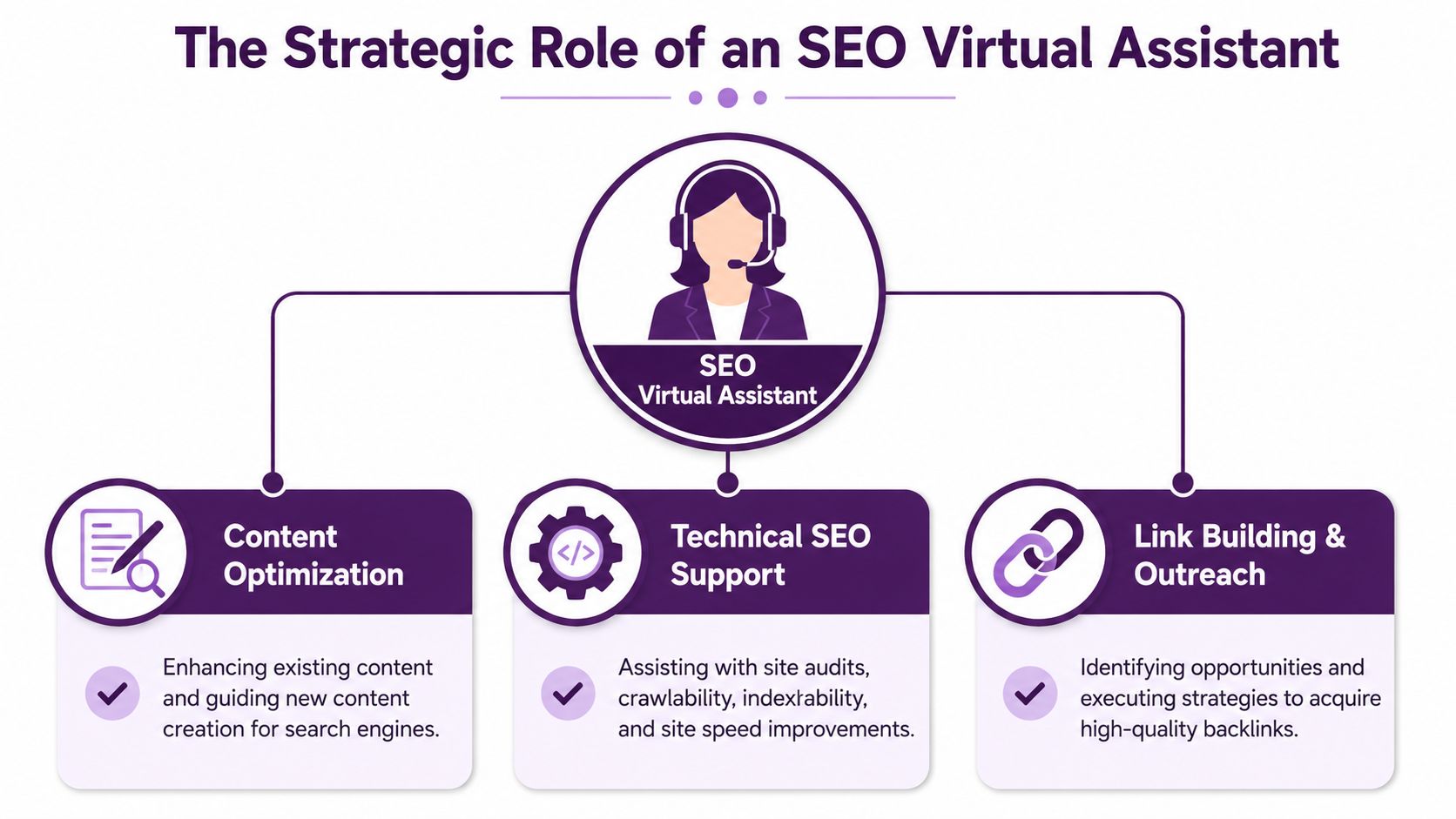
Virtual assistant SEO services are best understood as a dedicated execution function inside your marketing operation. The role isn’t to replace senior strategy. It’s to keep the machine moving.
If an SEO strategist is setting direction, the SEO VA is maintaining the engine room. They publish updates, optimize pages, review technical issues, organize keyword targets, support content workflows, and surface problems before they become expensive. That makes them different from both a full agency and a senior in-house SEO lead.
How this model differs from other options
An agency usually brings broad capability, but the business often gets a layer of account management between decision and execution. A senior in-house SEO lead can be excellent, but that role is usually too expensive for a smaller company that mainly needs disciplined implementation.
A VA sits in the middle. The business keeps more day-to-day control, while assigning clear recurring SEO tasks to one accountable resource.
For companies already familiar with flexible talent models, this works a lot like operational specialization. If you want a wider staffing lens, this guide to staff augmentation helps frame why businesses add specific skills without fully rebuilding their internal team.

What a good SEO VA is and is not
A good SEO VA is not just someone who logs into WordPress and follows random instructions. The useful version of the role includes judgment within defined limits.
They should be able to:
- Translate SEO priorities into execution by updating metadata, organizing content briefs, improving internal links, and tracking issues.
- Recognize when a task needs escalation such as a major technical error, a risky link request, or a content change that affects positioning.
- Work inside process so nothing depends on memory, scattered email threads, or vague requests.
They should not be the only person deciding your market positioning, content architecture, or authority strategy unless they’re hired specifically at that level. That’s where many businesses get disappointed. They hire for implementation, then expect strategic leadership.
Practical rule: Hire an SEO VA for consistent execution. Keep strategic decisions with an owner, marketing lead, or specialist consultant.
That distinction matters when defining the role. If you need a plain-language explanation of the broader model, this overview of what is a virtual assistant gives useful context before narrowing into SEO.
Key SEO Tasks a Virtual Assistant Can Execute
The easiest way to evaluate virtual assistant SEO services is to break the work into operational buckets. Once you do that, the role becomes much clearer. You’re not hiring “someone for SEO.” You’re assigning ownership of repeatable search tasks that support visibility, site health, and publishing velocity.
A technically solid workflow starts with crawlability and indexation controls. According to ShoreAgents’ explanation of SEO VA workflows, the VA should use tools like Google Search Console and Screaming Frog to identify duplicate pages, broken links, and crawl errors because those issues can waste crawl budget and dilute ranking signals.
On-page optimization
Many businesses get immediate value because the tasks are concrete and recurring.
- Title and meta updates for service pages, product pages, category pages, and blog posts.
- Header structure checks so H1s, H2s, and page sections match search intent and are easy to scan.
- Internal link improvements between related pages, especially from high-traffic pages to commercial pages.
- Image optimization support including alt text, filename consistency, and basic media formatting.
- URL and content formatting reviews to keep pages clean, readable, and aligned with page purpose.
A simple real-world example: an e-commerce brand may have dozens of collection pages written by different people over time. A VA can standardize metadata, tighten category copy, add internal links from blogs to collection pages, and flag thin pages for rewrite.
Content support
An SEO VA often becomes the coordination point between keyword intent and published content.
They can help with:
- Keyword mapping for blog ideas, FAQ pages, service pages, and location pages.
- Content briefs that give writers structure, target terms, internal link opportunities, and supporting questions.
- Publishing and formatting inside WordPress, Shopify, Webflow, or another CMS.
- Content refreshes on older pages that are still valuable but outdated or under-optimized.
- SERP checks to compare your page against competing result types and content patterns.
Content often dies in draft folders; a VA keeps it moving from idea to optimization to publication.
Local SEO management
For service businesses, healthcare providers, brokers, and multi-location operators, local work is often too important to leave unattended.
Typical responsibilities include:
- Google Business Profile updates for hours, services, categories, photos, and business descriptions.
- NAP consistency checks across core listings and directories.
- Local page optimization for city, service-area, or branch-specific pages.
- Review workflow support by routing responses and tracking unresolved reputation issues.
- Local citation cleanup when business details are inconsistent across platforms.
A clinic, for example, may have strong providers and a solid website but weak local visibility because listings are outdated and service pages aren’t geographically aligned. That’s operational work a trained VA can handle with the right process.
Technical SEO monitoring
The role thereby becomes more valuable than a generic assistant. Good technical support doesn’t mean coding everything personally. It means finding issues early, documenting them correctly, and escalating them when needed.
An SEO VA can manage:
- Search Console reviews for indexing problems, page exclusions, mobile usability flags, and coverage changes.
- Screaming Frog crawls to catch broken links, duplicate metadata, redirect chains, and orphan pages.
- Canonical and noindex checks for pages that send mixed signals.
- Basic site health logs so patterns are visible over time instead of discovered after rankings slip.
- Developer handoff notes that clearly state the problem, affected URLs, and required action.
The strongest SEO VAs don’t just complete tasks. They reduce friction between your content, your website, and search engine discovery.
If your internal problem is less about SEO knowledge and more about getting the right work off your plate, this guide on how to delegate tasks effectively applies directly.
The Business Case for an SEO Virtual Assistant
The case for hiring an SEO VA is operational before it’s technical. Businesses choose this model because SEO contains a large volume of work that is important, repetitive, and easy to delay.
One industry source states that a skilled SEO virtual assistant can save over 20 hours per week and reduce SEO costs by up to 70%, with representative rates as low as $4.69 per hour, according to There Is Talent’s analysis of SEO virtual assistant economics. Those numbers explain why the model appeals to SMBs and e-commerce teams that need search support without building a full in-house SEO department.
Where the ROI usually comes from
The strongest returns tend to come from a few practical shifts:
- Consistency replaces backlog because publishing, optimization, and monitoring happen on schedule.
- Senior time gets protected so owners and marketers stop spending valuable hours on metadata edits and broken link checks.
- Issues get caught earlier because someone is actively reviewing technical warnings and page-level performance.
- Execution scales faster when the business already knows what needs to happen but lacks bandwidth.
That doesn’t mean an SEO VA is always the best answer. If your business needs a complete replatform, a major content strategy reset, or advanced authority building, senior expertise still matters.
SEO implementation models compared
| Factor | DIY SEO | Marketing Agency | SEO Virtual Assistant |
|---|---|---|---|
| Cost structure | Lowest direct spend, highest owner time cost | Higher recurring spend, broader service scope | Lower operational spend with focused execution |
| Speed of execution | Often inconsistent | Depends on agency process and queue | Usually faster for recurring tasks |
| Strategic depth | Limited by internal expertise | Strong if agency is good | Depends on your internal oversight |
| Control over priorities | High | Medium | High |
| Scalability | Hard to maintain | Can scale, often at higher cost | Flexible for ongoing implementation |
| Best use case | Early-stage, very hands-on owners | Businesses needing full-service support | Teams needing execution without full agency overhead |
One trade-off deserves attention. A low-cost SEO VA can become expensive if work has to be redone. That’s especially true when no one defines what “good” looks like. Quality standards matter more than hourly price.
For businesses comparing support models more broadly, this review of cost-effective nearshore solutions helps frame the staffing and operational side of the decision.
How to Hire and Evaluate the Right SEO VA
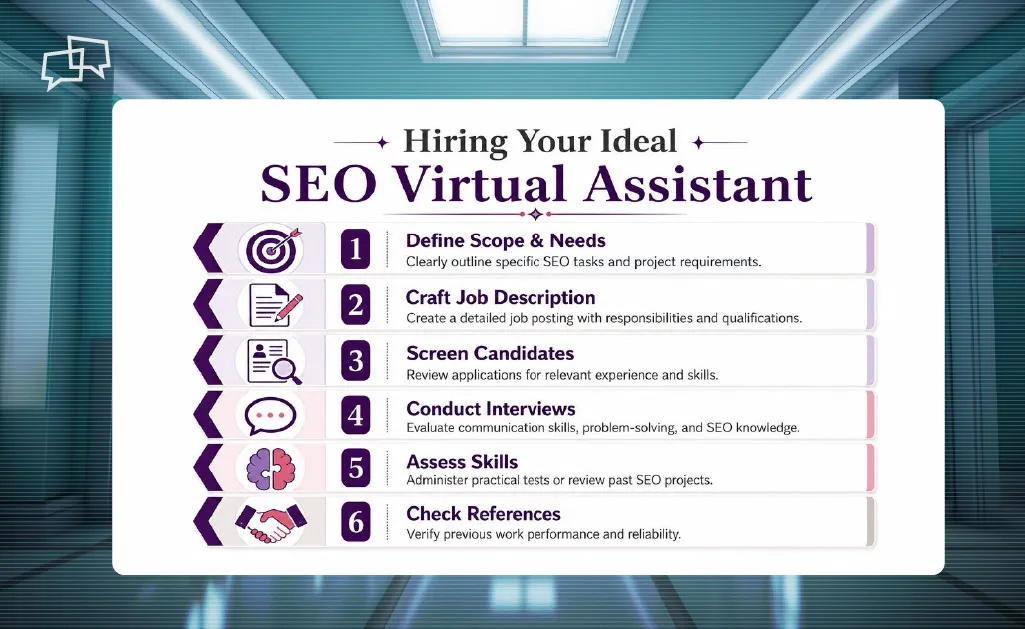
Most hiring mistakes happen before the first interview. The business posts a vague job ad, asks generic questions, and ends up with someone who can talk about SEO but can’t run a disciplined workflow.
A better approach starts with scope. Decide what the person will own weekly, what they can recommend, and what they must escalate.
A practical job description template
Use language like this:
Role title: SEO Virtual Assistant
Primary responsibility: Execute recurring SEO tasks across on-page optimization, content support, technical monitoring, and reporting.
Core duties: Update metadata, publish and optimize content, maintain internal linking, review Search Console issues, run basic crawls, support local SEO updates, and prepare monthly reporting.
Escalation areas: Technical fixes requiring development, content strategy shifts, backlink risk decisions, and major traffic changes.
Tools preferred: Google Search Console, Google Analytics, Screaming Frog, Ahrefs or SEMrush, CMS experience, spreadsheets, and task management software.
Success profile: Detail-oriented, process-driven, responsive, comfortable documenting work, and able to spot issues without overstepping strategy.
Skills that actually matter
Hard skills are important, but they aren’t enough. The best SEO VAs combine tool fluency with operating discipline.
Hard skills to verify
- Search Console familiarity and the ability to explain common issue types clearly
- Crawl analysis basics using Screaming Frog or a similar crawler
- On-page SEO competence across titles, headings, links, image handling, and content formatting
- CMS confidence in WordPress, Shopify, Webflow, or whatever system you use
- Reporting ability that turns findings into business-relevant summaries
Soft skills to screen for
- Attention to detail because small publishing and technical errors add up
- Proactivity so they flag problems without waiting for instructions
- Written communication because remote SEO work lives in tickets, notes, and reports
- Restraint because not every recommendation should be implemented without review
Interview questions that reveal real ability
Ask questions that force process, not theory.
- Walk me through how you would optimize an existing service page.
- What do you check first in Google Search Console when organic traffic drops suddenly?
- How do you decide whether a page needs a metadata refresh, content expansion, or internal link support?
- What would you document for a developer if you found crawl or indexation issues?
- How do you handle a task request that could create SEO risk?
Then give a simple test. Ask the candidate to review one live page and provide notes on metadata, heading structure, internal links, and technical concerns. You’re not looking for perfection. You’re looking for judgment.
Hire for repeatable process. Train for brand and business context.
If you’re comparing providers instead of direct hires, this list of best virtual assistant services can help frame what to ask before signing.
Onboarding Your VA and Managing Workflows
A good hire can still fail in a weak system. Most SEO VA relationships break down because access is incomplete, task ownership is fuzzy, or feedback lives in too many places.
The fix is simple. Build the role like an operational function, not a loose freelance arrangement.

A clean onboarding checklist
Set up access and context before assigning the first task.
- Platform access to CMS, Google Search Console, Google Analytics, GBP, and approved SEO tools
- Brand guidance including tone, service language, product naming, and style preferences
- Priority pages list so the VA knows which pages matter most commercially
- Approval rules that define what can be published directly and what needs review
- Communication rhythm such as daily Slack check-ins and a weekly task review
A real example: if the VA is asked to “work on SEO” without knowing which services generate the best leads, they’ll optimize whatever is easiest. If they receive a page priority list, competitor examples, and internal linking rules, their output improves immediately.
Workflow management that stays organized
Use one central system. Trello, Asana, ClickUp, and Monday all work if the team uses them.
A strong task card usually includes:
- Task name
- Page or asset URL
- Business objective
- Required action
- SEO notes
- Owner
- Deadline
- Approval status
Keep reporting separate from task execution. Task boards should answer “what’s happening now.” Monthly reporting should answer “what changed and why.”
Teams get better results when every SEO request has an owner, a deadline, and a definition of done.
This structured approach mirrors how well-run support teams and back-office operations are built. If you want a broader view of process-led outsourcing, BPO services offer a useful operational parallel.
Measuring Success with SEO KPIs and Reporting
The most overlooked part of virtual assistant SEO services is governance. According to 20Four7VA’s discussion of SEO VA oversight, businesses need standards for content quality, link risk, and performance tracking so lower-cost support doesn’t create hidden costs.
That means you shouldn’t judge success by how many tasks were completed. Judge it by whether the work improved the pages and outcomes that matter.
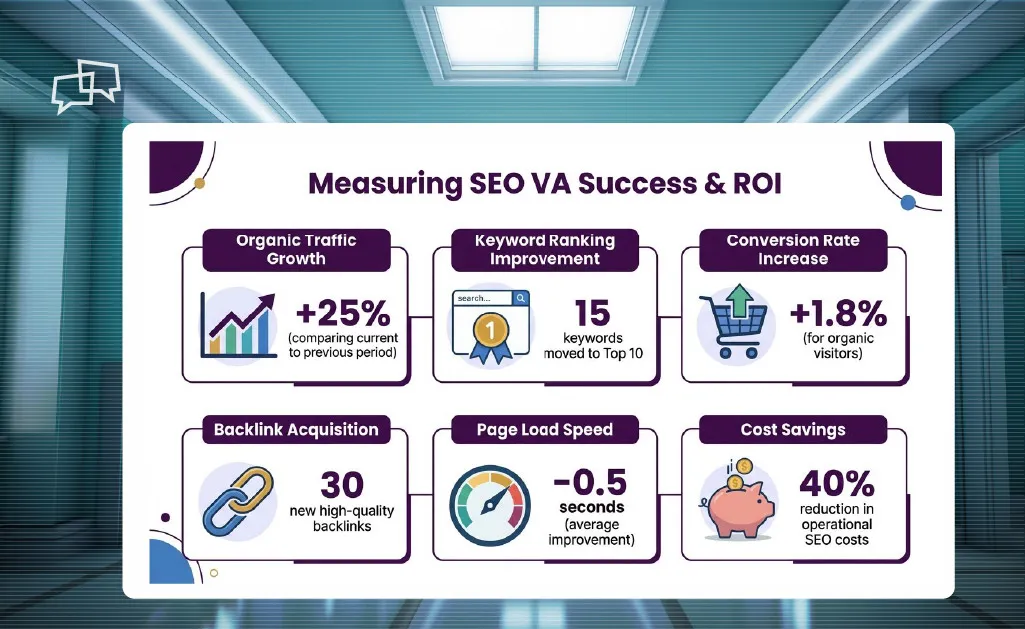
Track a small set of KPIs each month:
- Organic traffic quality by page group, not just sitewide volume
- Keyword movement for priority terms tied to services or products
- Click-through rate changes on pages where metadata was updated
- Indexation and technical issue status so technical debt doesn’t build unaddressed
- Organic leads or sales tied to pages the VA actively supported
For reporting structure, this SEO reporting guide is a helpful reference for keeping reports clear and decision-focused. If your business already values operational dashboards, the same discipline used in reporting and KPI dashboards applies here too.
The best measure of an SEO VA’s success isn’t the number of tasks they complete, but the measurable impact their work has on your website’s traffic and your business’s bottom line.
🚀 Build a More Consistent SEO Support System With CallZent
CallZent helps North American businesses scale virtual assistant support, back-office workflows, customer operations, and recurring execution tasks through flexible nearshore teams built for consistency and growth.
Talk to an ExpertIf your business needs a more disciplined way to scale support, back-office work, or virtual assistant operations, CallZent can help you build a practical outsourcing model that fits how your team works.