
CONVERSATIONAL INTELLIGENCE
What Is Conversational Intelligence? How AI Turns Customer Conversations Into Business Insight
Learn what conversational intelligence is, how it analyzes calls and chats, and why it helps customer support, sales, QA, compliance, and bilingual nearshore operations make better decisions.
TL;DR — Quick Takeaways
- Conversational intelligence uses AI to analyze customer calls, chats, and emails so businesses can understand what happened, why it happened, and what should change.
- It is not the same as conversational AI. Conversational AI conducts or simulates conversations, while conversational intelligence analyzes human interactions.
- In customer support, conversational intelligence improves QA, coaching, compliance, documentation, and trend detection.
- For bilingual nearshore teams, it helps uncover nuance across English and Spanish interactions that basic reporting or manual sampling may miss.
- The value is not just better data. The value comes when insights improve scripts, training, workflows, agent performance, and customer experience.
Conversational intelligence uses AI to analyze 100% of customer calls and chats, turning conversations into actionable insight that improves service, sales, and compliance. Organizations using these systems report 15% higher sales win rates, 69% improvement in service quality scores, and 90% reduction in manual documentation tasks for agents.
Most companies already collect customer conversations. The problem is that they still manage the operation as if those conversations are invisible. A supervisor hears a few calls, QA reviews a sample, and leadership makes decisions from partial evidence.
That gap is where costs rise, quality slips, and customers repeat themselves.
If you’re asking what is conversational intelligence, the practical answer is simple. It is the operational capability that turns calls, chats, and emails into structured data your team can search, measure, coach against, and use to make better decisions. In a nearshore environment, that matters even more because bilingual interactions often carry nuance that basic reporting misses.
The companies that win in customer support don’t just answer conversations. They learn from every one of them.
Your Untapped Goldmine of Customer Insights
What are your customer conversations telling you about churn, wasted handle time, failed transfers, and missed revenue?
For many contact centers, the answer is frustratingly incomplete. They have recordings, agent notes, QA forms, and CRM fields, but very little of it turns into a clear operating picture. Conversational intelligence changes that by converting everyday interactions into structured insight leaders can use to reduce cost, improve quality, and fix customer pain points faster.
In a nearshore BPO model, that value goes further. A bilingual operation hears where meaning shifts between English and Spanish, where agents translate correctly but miss intent, and where customer sentiment changes based on phrasing, tone, or cultural context. A domestic-only team often misses those patterns or sees them too late.
Used well, conversational intelligence helps answer practical questions that affect the business every day:
- Why are customers calling back after an issue was marked resolved?
- Which phrases are correlated with cancellations, escalations, or poor CSAT?
- Where are bilingual interactions creating confusion, delay, or compliance risk?
- Which agents need coaching on process, and which need coaching on communication?
- What product, policy, or billing issue is showing up across thousands of conversations before it reaches the dashboard?
That is why strong BPO partners do not treat conversational intelligence as a software add-on. They build it into operations, QA, training, and client reporting. The result is a sharper view of what is happening on the floor and what needs to change.
The underlying process is straightforward. Voice and chat interactions are transcribed. Natural language processing sorts topics, intent, sentiment, escalation triggers, and recurring language patterns. If you want a plain-English explanation of the language layer behind it, see ThirstySprout’s guide to NLP. What matters operationally is that supervisors no longer have to infer trends from a small sample. They can spot root causes across the full stream of customer contact.
For leaders comparing this investment with broader contact center analytics benefits, the distinction is practical. Traditional analytics tell you what happened in the queue. Conversational intelligence shows why it happened in the interaction.
That difference is where margin, service quality, and customer loyalty improve.
 What Conversational Intelligence Is And Is Not
Conversational intelligence is not a chatbot. It is not a voice bot. It is not the tool that talks to the customer.
It is the layer that listens after or around human interactions and tells you what happened, why it happened, and where the business should respond.
The easiest way to understand it
Think of a sports team reviewing game film.
The players are your agents and customers. The game is the live call or chat. Conversational intelligence is the analyst team studying every play, tagging what worked, spotting mistakes, and showing the coach exactly where performance changed.
That distinction matters because many business buyers lump everything with “conversation” in the name into one bucket. They shouldn’t.
According to AssemblyAI’s explanation of how conversational intelligence differs from conversational AI, the technical distinction matters because conversational intelligence analyzes human-to-human interactions, while conversational AI is designed to generate or simulate the dialogue itself. In practice, that separation supports post-call analytics, agent coaching, and compliance monitoring rather than live chatbot interactions.
Key takeaway: Conversational intelligence analyzes conversations. Conversational AI conducts them.
What it does in a call center
In a support or sales environment, conversational intelligence usually sits behind the scenes and helps teams:
- Review agent performance: It surfaces coaching moments instead of forcing managers to hunt for them.
- Monitor consistency: It checks whether required language, disclosures, or workflows happened.
- Find friction points: It spots where customers become confused, hesitant, or upset.
- Expose demand signals: It shows recurring product questions, objections, and service issues.
This is why it works well in BPO environments. A provider may handle healthcare scheduling, e-commerce support, collections, and sales under one roof. Human review alone doesn’t scale across those workstreams. Conversational intelligence gives operations leaders one repeatable way to inspect quality across all of them.
What it is not
It is not magic, and it doesn’t replace judgment.
A weak operation can buy the software and still get poor results if the underlying process is sloppy. If scripts are unclear, knowledge management is outdated, or coaching is inconsistent, the platform will reveal those problems. It won’t solve them on its own.
If you want a plain-language primer on the language analysis side, ThirstySprout’s guide to NLP is a useful background read. It helps explain why these systems can identify intent, phrasing, and patterns instead of just storing transcripts.
How AI Turns Conversations Into Actionable Data
The technology sounds abstract until you break it into simple operational steps. In a contact center, the workflow usually follows a clear sequence. The system captures the interaction, analyzes it, and then presents the result in a way managers can use.
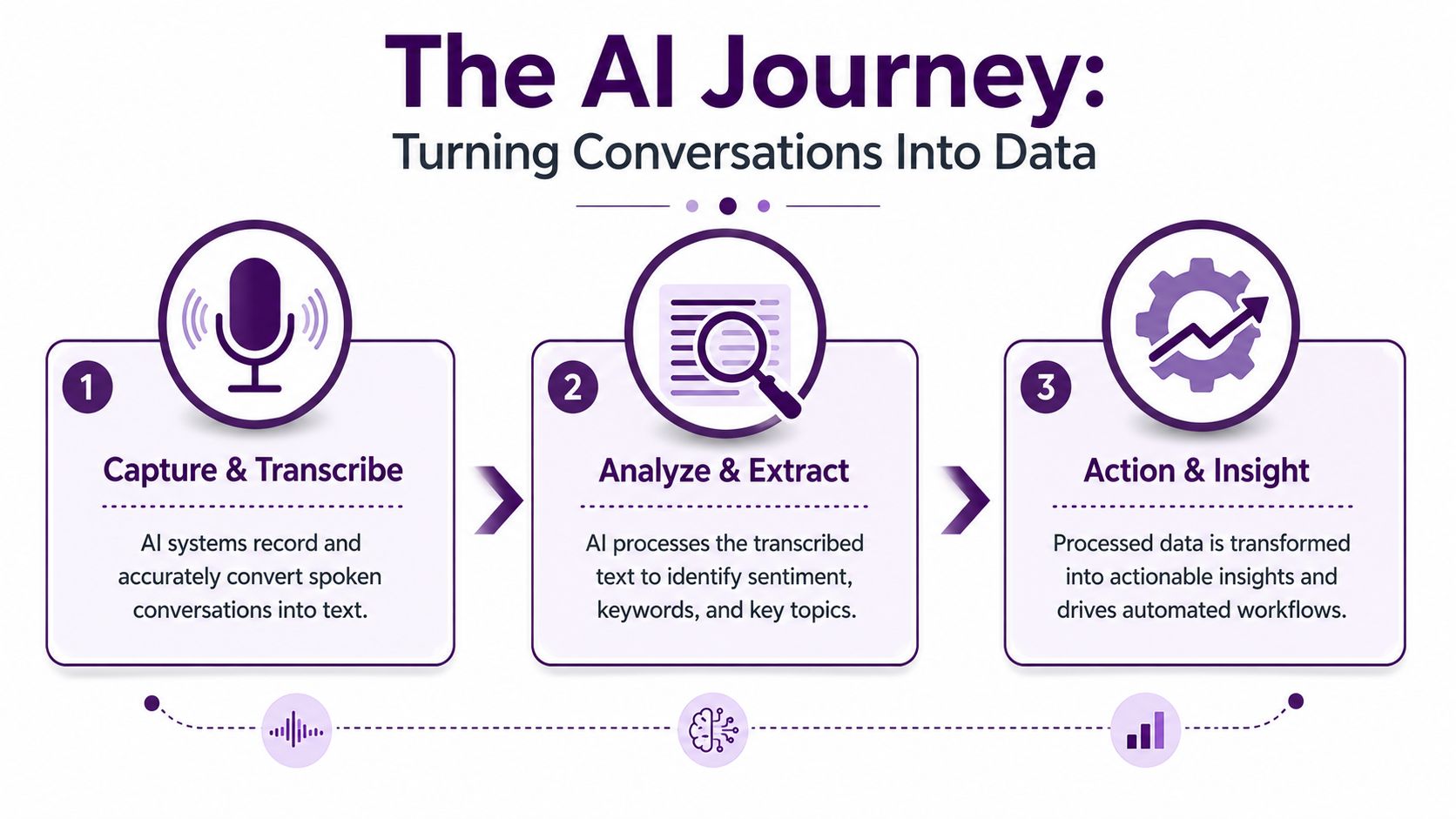
Capture and transcribe
Start with the raw interaction.
A customer calls about a delayed order. The agent explains the issue, offers a resolution, and logs the account. Traditionally, the most valuable part of that exchange vanishes into a recording no one has time to review.
Conversational intelligence changes that by converting spoken words into text. Calabrio explains in its overview of conversational intelligence in customer operations that modern systems convert spoken words into text, analyze sentiment, recognize keywords and phrases, and produce call summaries and performance metrics. It also notes that these systems can analyze 100% of conversations, replacing manual sampling with full-population analysis.
That matters operationally because a manager no longer has to guess whether the sampled calls represent what the team is really doing.
Analyze and extract meaning
Once the conversation becomes text, the AI layer goes to work.
It looks for things that matter in a business context. That might include sentiment, topic, keywords, intent, unresolved issues, policy language, or signs that the customer is about to escalate. In many environments, it also measures talk patterns such as how much the agent speaks versus how much the customer speaks.
A lot of value becomes apparent. A transcript alone is a record. Analysis turns it into management input.
A transcript tells you what was said. Analysis tells you what to do next.
In a bilingual call center, this stage becomes especially important. A simple translation doesn’t always capture urgency, hesitation, politeness, or frustration the same way a bilingual quality team would hear it. Strong conversational intelligence setups are useful because they create consistent review criteria across English and Spanish interactions instead of leaving interpretation entirely to individual supervisors.
Surface and operationalize
The final step is where many programs either become useful or become shelfware.
Insights need to show up in dashboards, QA workflows, agent coaching sessions, and service reviews. If the data stays trapped inside a transcript repository, the business gains very little. If it feeds live assistance, scorecards, and manager workflows, then it starts changing outcomes.
That’s why many contact centers pair this capability with tools like real-time agent assistance. The transcript and analysis aren’t the end goal. The end goal is faster coaching, cleaner QA, better documentation, and quicker response to customer trends.
Here’s the practical flow most operators should expect:
- Interaction captured: Voice or chat is logged automatically.
- Language analyzed: The system tags sentiment, phrases, topics, and action items.
- Operational output created: Managers get summaries, alerts, trends, and coaching signals.
If any one of those steps is weak, the program underdelivers. Good transcription without action is just storage. Good dashboards without workflow adoption become noise.
Transform Your Customer Support With Key Benefits
What changes when every customer conversation becomes operational input instead of disposable call volume?
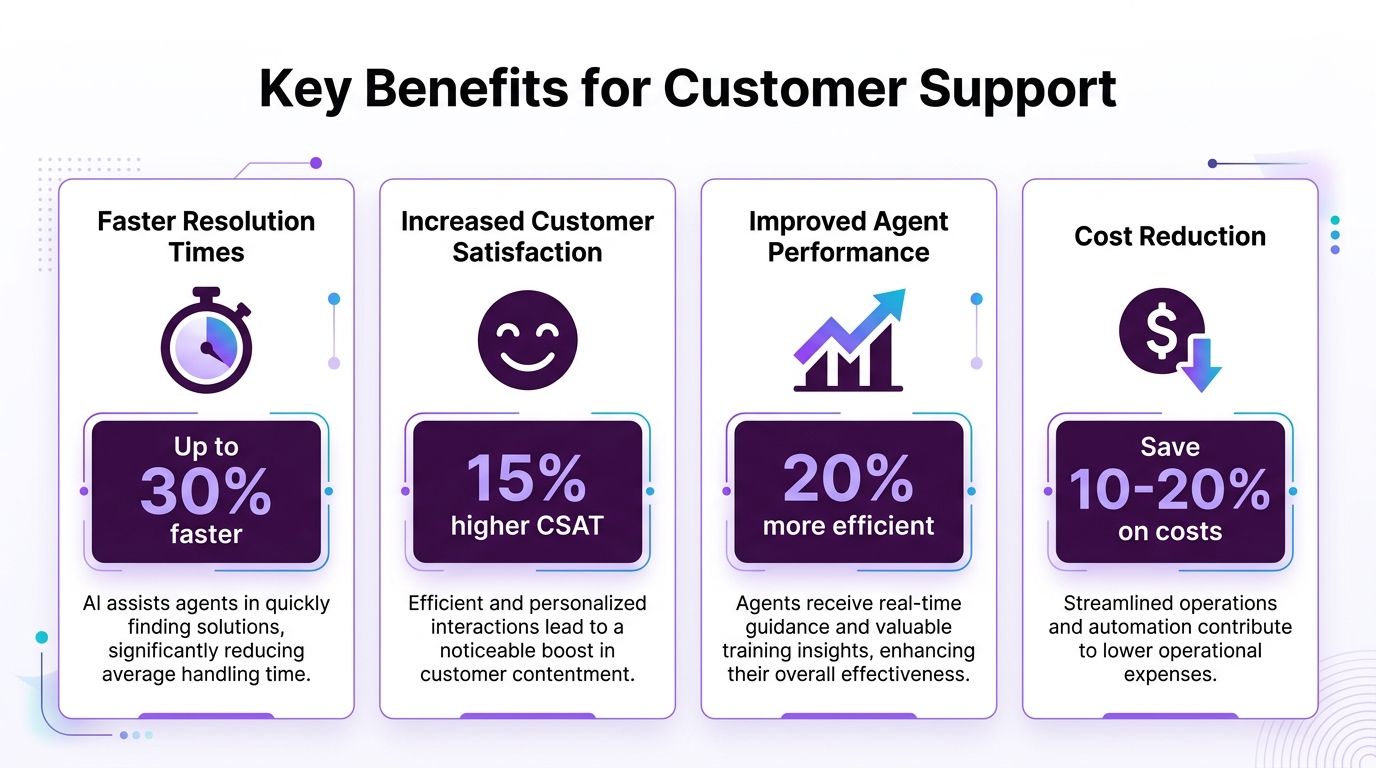
The answer is measurable in labor efficiency, QA coverage, coaching quality, and customer satisfaction. Conversational intelligence earns its place when it helps managers act faster and agents perform more consistently across thousands of interactions, in English and Spanish.
Coaching becomes specific and usable
In a manual QA model, supervisors coach from a thin sample. That creates uneven standards and slow correction. One agent gets feedback on an isolated mistake while another repeats the same problem for weeks because their calls were never reviewed.
Conversational intelligence changes that. Managers can coach to patterns, not impressions. They can see where agents lose control of a call, miss buying signals, create confusion during verification, or struggle to explain a policy in Spanish after starting smoothly in English.
That level of visibility is especially useful in a nearshore BPO environment. A bilingual operation like CallZent can review performance across both languages with the same operating discipline, then coach to the actual issue. Was it process adherence, product knowledge, tone, translation drift, or poor handoff language? Domestic-only teams often miss that distinction. It affects first-call resolution, repeat contacts, and customer trust.
Quality assurance covers what sampling misses
Compliance gaps and service failures rarely show up neatly inside a small random sample.
Broader conversation review lets QA leaders find missed disclosures, weak authentication, inconsistent empathy, dead air, transfer friction, and script breakdowns before they spread across the floor. The operating model also improves. Teams stop spending most of their time hunting for calls and start reviewing exceptions, trends, and high-risk moments.
This is also where strong process documentation pays off. Teams with disciplined knowledge management systems for customer support can turn QA findings into updated scripts, cleaner agent guidance, and fewer repeat errors.
Practical rule: If QA findings don’t lead to script updates, training updates, or workflow changes, the technology is collecting insight but the operation isn’t using it.
Documentation work drops and capacity improves
A large share of support waste happens after the conversation ends. Agents write summaries, tag calls, and enter notes while new contacts keep coming in.
Conversational intelligence can automate much of that routine work through call summaries, extracted action items, and structured disposition support. The benefit is simple. Agents spend less time on wrap-up and more time available for customers. Supervisors also get cleaner records for coaching and dispute review.
That reduction is significant because every minute spent documenting is a minute not spent serving the next customer.
The customer voice becomes usable at scale
Many companies say they listen to customers. In practice, they hear survey responses, escalations, and isolated complaints.
Conversational intelligence gives operators a wider and more accurate picture. It surfaces recurring confusion, policy friction, failed explanations, cancellation signals, and product issues that customers mention on calls but never put into a survey. In bilingual programs, that matters even more. Patterns often show up differently across English and Spanish interactions, and a nearshore partner that can interpret both well will catch issues earlier.
Here’s how the operating model typically changes:
| Metric | Before CI (Manual QA) | After CI (Automated Analysis) |
|---|---|---|
| QA coverage | Small sample of interactions | Broad visibility across interactions |
| Agent coaching | Based on limited call reviews | Based on recurring patterns and specific moments |
| Documentation | Heavy manual note-taking | Automated summaries and extracted details |
| Trend detection | Slow and anecdotal | Faster identification of service and script issues |
The practical gain is faster course correction. Costs come down when repeat contacts and manual admin shrink. Quality improves when coaching targets real behavior. Customer satisfaction rises when the operation catches friction early and fixes it before it becomes churn.
Real-World Use Cases For Nearshore Call Centers
Nearshore operations have one advantage that often gets overlooked. They don’t just lower cost. They can produce better insight when the customer base moves between English and Spanish, formal and informal language, and different communication styles.
That makes conversational intelligence especially useful in bilingual environments.
Bilingual sentiment and nuance detection
A domestic-only review team may catch the words in a Spanish call and still miss the meaning.
For example, a customer may sound calm on the surface while signaling frustration through phrasing, repetition, or indirect disagreement. A bilingual quality team using conversational intelligence can flag those patterns faster and coach agents on where empathy or clarification broke down. That’s valuable in industries where misunderstanding creates churn, callbacks, or disputes.
Compliance monitoring across complex programs
In healthcare, finance, insurance, and collections, leaders can’t rely on random review to catch every missed disclosure or process lapse.
CallMiner explains that conversational intelligence in call monitoring can assess large volumes of calls far faster than manual QA, making it practical to monitor 100% of interactions. It can also identify recurring objections, competitor mentions, and emotional cues, then feed those outputs into script optimization and performance dashboards.
In nearshore BPO settings, that’s especially useful because programs often run across multiple teams, shifts, and channels. The operation needs one consistent way to spot risk, not a patchwork of supervisor judgment.
Sales script optimization in two languages
Sales teams usually know their best agents are doing something differently. What they often don’t know is exactly what that “something” is.
Conversational intelligence helps isolate the phrases, objection-handling patterns, and call structures that appear more often in successful interactions. In a bilingual environment, this matters because a direct translation of a winning English script may underperform in Spanish, or vice versa. The system can help teams compare what language works in each setting rather than assuming one script fits both.
A practical example is outbound qualification. One team might learn that customers respond better when agents confirm business need early in English calls, while Spanish calls improve when agents spend more time building trust before moving into qualification.
Competitive intelligence from daily conversations
Competitor mentions often live in recordings no one reviews.
With conversational intelligence, leadership can track when customers mention a rival, what issue caused the comparison, and what agents said in response. Over time, that gives sales and service leaders a more grounded view of market pressure.
For teams evaluating broader AI agent use cases in contact center operations, human support and AI analysis work well together. The agents do the relationship work. The intelligence layer captures the market signals hidden inside those conversations.
In nearshore BPO environments, the strongest advantage isn’t just bilingual labor. It’s bilingual visibility into what customers actually mean.
How To Adopt Conversational Intelligence In Your Business
Most companies have two choices. They can buy the technology and build the internal process around it, or they can work with a partner that already operates with the capability built into delivery.
Neither option is automatically right. The right choice depends on how much operational maturity you already have.
When DIY works and when it doesn’t
A direct platform purchase can work well if your team already has strong QA governance, clean workflows, technical support, and managers who know how to coach from data. Without that foundation, many companies buy a platform and then use it like a more expensive call recorder.
That’s the common failure point. The issue usually isn’t the software. It’s the missing operating model.
A partner-led approach often makes more sense when you need:
- Faster deployment: You want the capability in production without building the whole process from scratch.
- Manager discipline: You need analysts, QA, and operations leaders who already know how to turn insight into action.
- Integrated tooling: You want the intelligence layer tied to existing workflows, reporting, and support management.
- Lower complexity: You don’t want to spend months evaluating platforms, integrations, and workflow design.
The underlying stack still matters, of course. Teams should review how the solution connects with routing, QA, CRM, reporting, and call center software features that already run the operation.
The first steps that actually matter
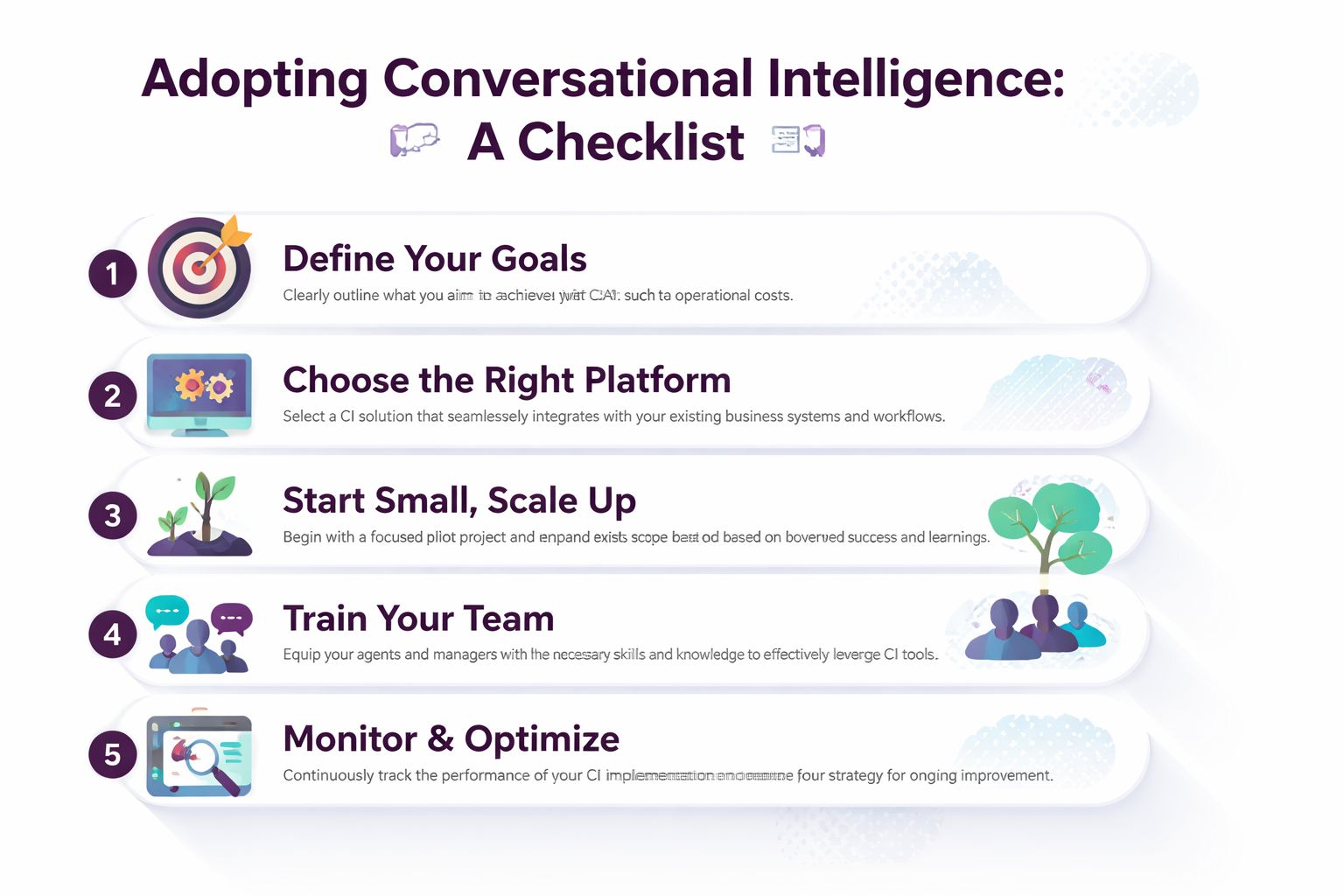
Companies usually make better decisions when they start with operational questions instead of vendor questions.
Ask these first:
- Where are you losing quality now? Look at escalations, repeat contacts, poor documentation, and inconsistent call handling.
- What should the system detect? Define the moments that matter, such as missed disclosures, cancellation language, pricing objections, or unresolved complaints.
- Who will act on the insight? If no manager, QA lead, or trainer owns follow-through, the data will sit unused.
- How will success be reviewed? Tie findings to coaching changes, script revisions, and process improvements.
Buy the tool if you want data. Build the capability if you want results.
Adoption works when leaders treat conversational intelligence as part of operations, not just part of IT. The companies that get real value use it to change coaching habits, QA workflows, and service design.
🚀 Turn Customer Conversations Into Better Decisions With CallZent
CallZent helps North American businesses scale bilingual customer support, technical support, sales support, back-office workflows, and nearshore BPO operations with strong QA, agent training, process discipline, and customer insight.
Talk to an ExpertIf you’re evaluating how to bring conversational intelligence into customer support, sales, or back-office operations, CallZent can help you assess the practical path forward. A nearshore BPO partner with bilingual expertise, strong operational discipline, and the right technology stack can help you move faster than a DIY rollout and turn customer conversations into better service, lower waste, and clearer decisions.