FINANCE & BPO OPERATIONS
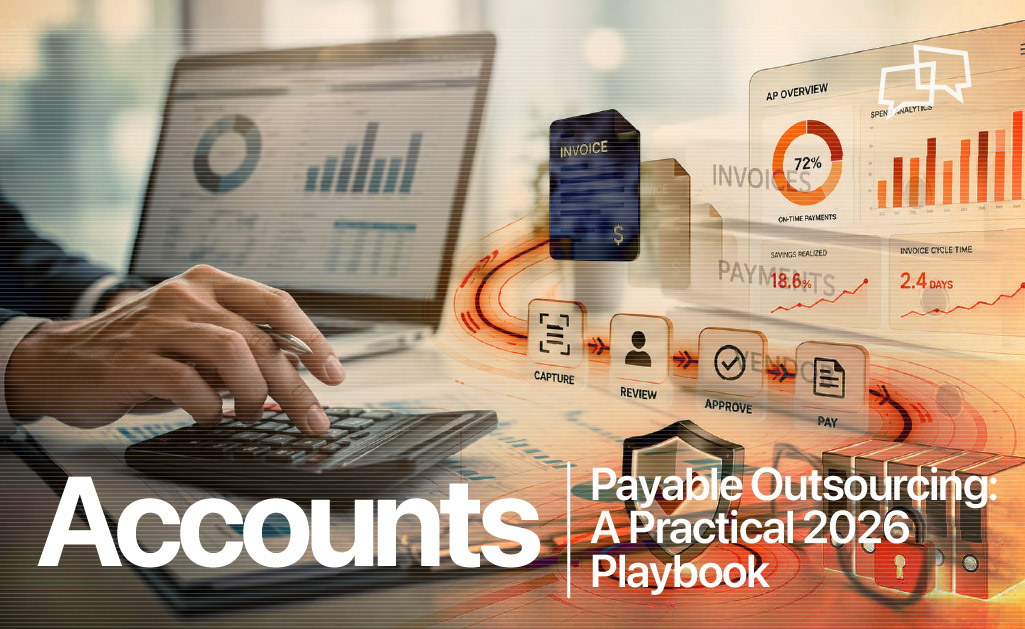
Accounts Payable Outsourcing: How to Reduce Costs Without Losing Control
Accounts payable outsourcing can reduce AP costs while improving controls, ERP workflows, vendor communication, auditability, and finance team efficiency.
TL;DR — Quick Takeaways
- Accounts payable outsourcing should be evaluated as a control, workflow, and total-cost decision—not simply a way to replace internal labor.
- Organizations should audit AP readiness before outsourcing, including invoice exceptions, ERP configuration, approval rules, vendor master data, and segregation of duties.
- The strongest providers combine security, ERP expertise, automation, transparent reporting, bilingual vendor communication, and clear exception ownership.
- Track cost per invoice, cycle time, accuracy, exception aging, vendor response time, and straight-through processing against the internal baseline.
- A nearshore model can be particularly useful when AP requires same-day collaboration, English-Spanish vendor support, and close coordination with U.S. finance teams.
Accounts Payable Outsourcing Services
Accounts payable outsourcing services can support the day-to-day workflows that consume finance team capacity while keeping approval authority and financial controls with your organization. A trained outsourced team can work within your existing ERP, approval rules, and vendor communication processes.
Common AP workflows that can be outsourced include:
- Invoice Entry: Capture and enter invoice data into your accounting or ERP system.
- Invoice Coding: Apply documented coding rules and route exceptions for review.
- PO Matching: Match invoices against purchase orders and receiving records.
- Approval Routing: Route invoices to the correct internal approvers.
- Vendor Communication: Respond to invoice-status questions and resolve routine discrepancies.
- Payment Preparation: Prepare approved payments for final internal authorization.
- AP Reporting: Maintain aging, exception, processing-time, and workflow reports.
Accounts payable outsourcing is no longer a cheap labor play. It’s a control decision, and the companies that treat it like a vendor swap usually end up paying twice, once in onboarding friction and again in exception handling, audit cleanup, or ERP rework. The global market data back that shift, with independent forecasts pointing to continued expansion through the 2030s, which is exactly what you’d expect when finance leaders start buying process control, auditability, and workflow intelligence instead of just headcount relief (market outlook).
If you’re comparing providers, don’t start with price. Start with the question that matters: Can this partner help us move AP outside the building without moving control out with it? That’s the right lens for nearshore options too, including bilingual teams in Tijuana that can sit close enough to U.S. operations to support same-day issue resolution and vendor communication. If you want a compliance-first view before you outsource, review CallZent’s AP outsourcing compliance guidance.
Why Accounts Payable Outsourcing Is a Control Decision Now
Accounts payable outsourcing covers the full invoice chain, not just bill-paying. A provider can handle invoice receipt, coding, PO matching, approvals, vendor communication, and payment execution, which means the work crosses several control points, not one simple transaction (process definition). That matters because once those steps move outside your firm, your operating model has to prove that segregation of duties, audit trails, and approval discipline still hold up.
The old pitch was labor arbitrage. That pitch is weak now. AP outsourcing still makes sense, but only if it tightens workflow quality, reduces exception noise, and gives finance a cleaner control environment instead of just replacing internal staff with external staff.
Practical rule: If a process step can trigger a dispute, a compliance issue, or a payment error, treat it as a control point, not a clerical task.
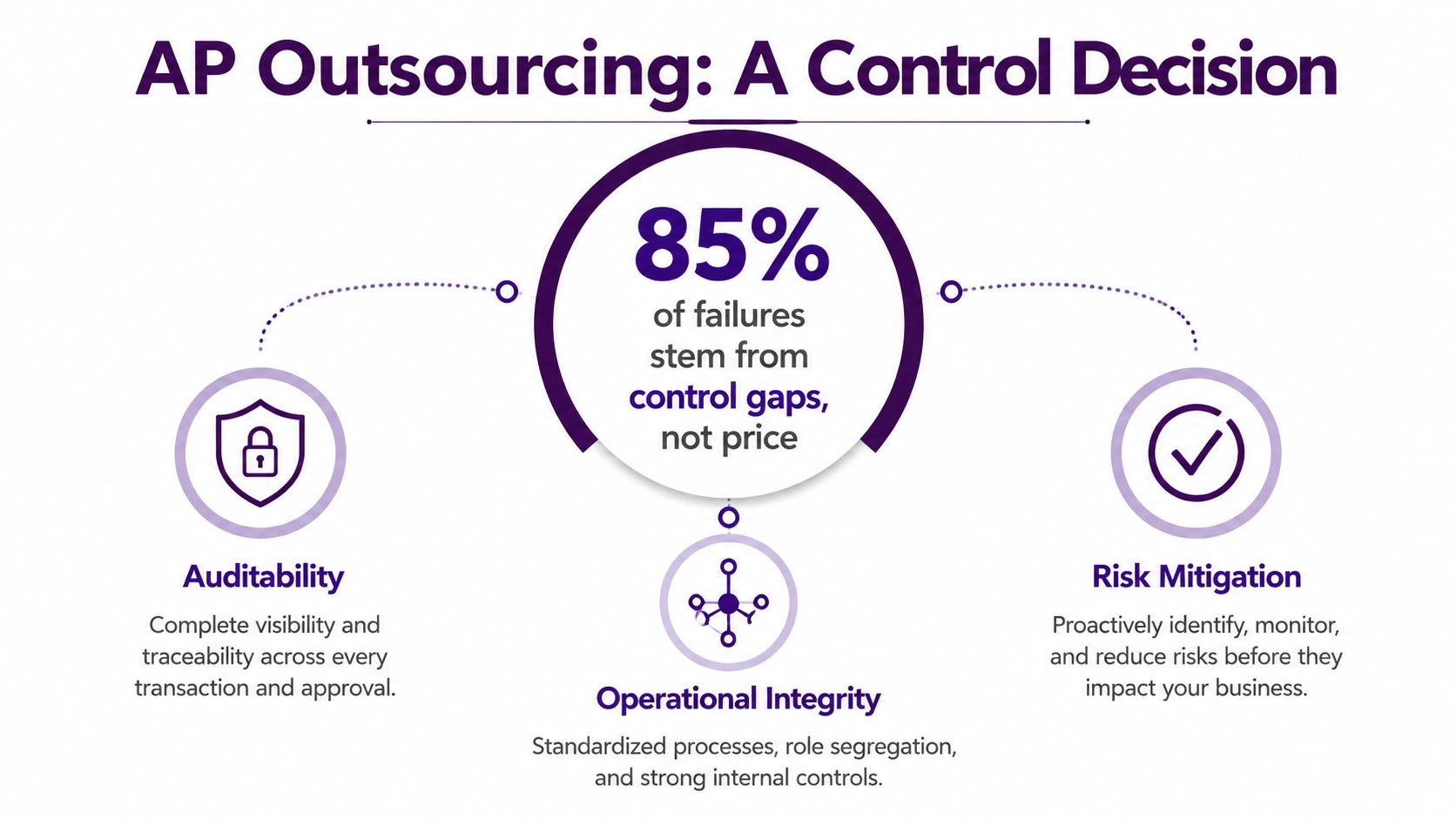
A clean AP operating model splits work into three buckets. Move now includes repeatable invoice capture, routine coding, vendor communication, and standard matching. Move after automation includes exception-heavy workflows that still depend on your internal rules engine or ERP cleanup. Keep in-house includes final policy ownership, approval design, and anything tied directly to treasury judgment or sensitive dispute resolution.
Do not outsource a broken process and call it transformation. That just hands someone else your mess, then leaves you paying for exception handling, audit cleanup, and ERP rework after go-live.
A simple readiness audit works better than a long steering-committee debate. Score each area as green, yellow, or red.
- Invoice volume and seasonality: If your intake spikes unpredictably, outsourcing helps, but only if the provider can show surge capacity.
- Exception rate: If too many invoices need manual touch, outsourcing without process cleanup just exports chaos.
- ERP maturity: If your chart of accounts, approval matrix, or vendor master is messy, fix that first.
- Segregation of duties: If the same person approves, enters, and releases payment, outsourcing won’t save you from weak controls.
- Internal politics: If department heads resist process standardization, the vendor will become a scapegoat.
The control test is simple. If you cannot explain who owns each approval, exception, and override, you are not ready to move AP outside the building.
For a useful starting point on the governance side, the 2026 AP automation overview is worth reading because it forces buyers to think about workflow design, not just processing labor.
Nearshore AP makes the most sense when you need bilingual vendor support, fast escalation, and real overlap with U.S. business hours. That fits finance teams that need same-day issue closure and live ERP troubleshooting, not delayed ticket churn. Offshore can work for stable, highly standardized queues, but the control burden rises fast when exceptions are common. Onshore only makes sense when data sensitivity, policy complexity, or internal stakeholder pressure outweigh cost.
If you need a compliance filter before you sign anything, use this outsourcing compliance checklist as a gate, not a sales aid. The question is not whether the provider can process invoices. The question is whether you can prove control ownership, auditability, and exception governance after the work leaves your team.
Nearshore vs Offshore vs Onshore for AP
Region choice affects far more than hourly cost. It shapes how fast your team can resolve exceptions, how easily vendors can communicate, and how painful ERP integration becomes. A nearshore model usually wins when your AP process depends on collaboration, bilingual coverage, and same-day issue closure.
| Dimension | Nearshore, e.g. Tijuana | Offshore | Onshore U.S. |
|---|---|---|---|
| Time-zone overlap | Strong overlap with U.S. teams | Limited overlap for many U.S. buyers | Full overlap |
| Bilingual support | Usually strong English and Spanish coverage | Varies widely | Strong English, Spanish depth depends on team |
| ERP collaboration | Easier live troubleshooting | Slower handoffs are common | Easier live troubleshooting |
| Vendor communication | Good fit for Spanish-speaking vendors | Often weaker for bilingual vendor support | Strong for U.S. vendors |
| Total landed cost | Usually lower than onshore, higher than offshore | Often lowest base labor cost | Highest cost structure |
Use that table the way a finance leader should. If your AP queue is mostly standardized and your vendors are domestic, offshore can work if governance is tight. If your team needs real-time fixes, bilingual vendor calls, and faster implementation, nearshore is the cleaner fit. Onshore only makes sense when data sensitivity, policy complexity, or internal stakeholder pressure outweighs cost.
Decision rule: Choose the region that lowers friction per invoice, not the one that looks cheapest in the proposal.
For broader outsourcing context, the nearshore vs offshore comparison is useful because the same tradeoffs show up in AP: speed, communication, and operational control. If you’re also trying to build talent capacity quickly, the GENTY recruitment guide is a decent benchmark for how fast support teams can be assembled when the model is disciplined.
Build the Vendor Shortlist and Scorecard
Most AP outsourcing deals fail at the shortlist stage because buyers compare polished sales decks instead of operational evidence. The right question isn’t whether a vendor says they handle AP. It’s whether they can run your AP workload inside your controls, on your ERP, with your approval rules, without improvising.
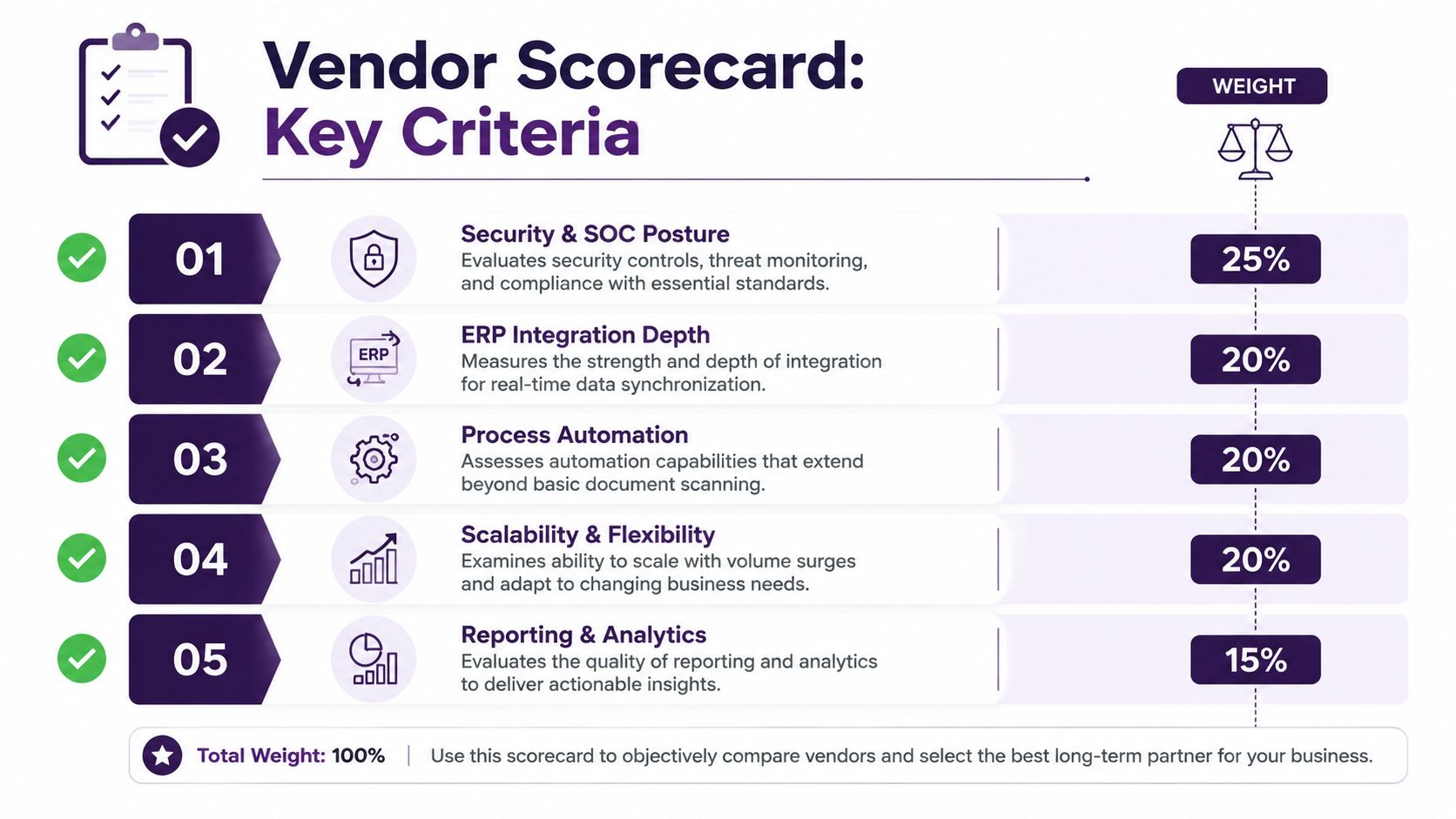
Score what actually matters
Use a weighted scorecard and force every candidate through the same lens. The most important criteria are security and SOC posture, ERP integration depth, automation capability, bilingual staffing, and commercial transparency. If a vendor can’t speak clearly about NetSuite, SAP, Oracle, QuickBooks, or Microsoft Dynamics integration, they’re not ready for real AP work.
A useful RFP question bank includes these prompts:
- Security: What SOC reports, access controls, and audit rights will we get?
- ERP fit: Which ERP systems have you integrated with directly, and what does the sync look like?
- Automation: How do you handle OCR, touchless routing, and exception logic?
- Staffing: What percentage of the team is bilingual, and how is coverage handled across shifts?
- Commercial model: What’s included, what’s extra, and how do rush items get billed?
- Continuity: What disaster recovery and backup staffing plan do you operate under?
If you want a fast template, grab the free interview scorecard downloads and adapt them to AP instead of rebuilding the framework from scratch.
Red flags that should kill the deal
Don’t rationalize away weak answers. Walk if you see vague SLAs, opaque pricing, no audit rights, or a story that sounds like basic scanning dressed up as transformation. A provider that can’t explain reporting, escalation, and backup coverage will usually become a downstream headache.
CallZent’s vendor evaluation criteria is a good internal benchmark if you want to see how a service provider should talk about controls, accountability, and fit. Use it to pressure-test the shortlist, not to admire the brochure.
Plan the Transition in Five Phases
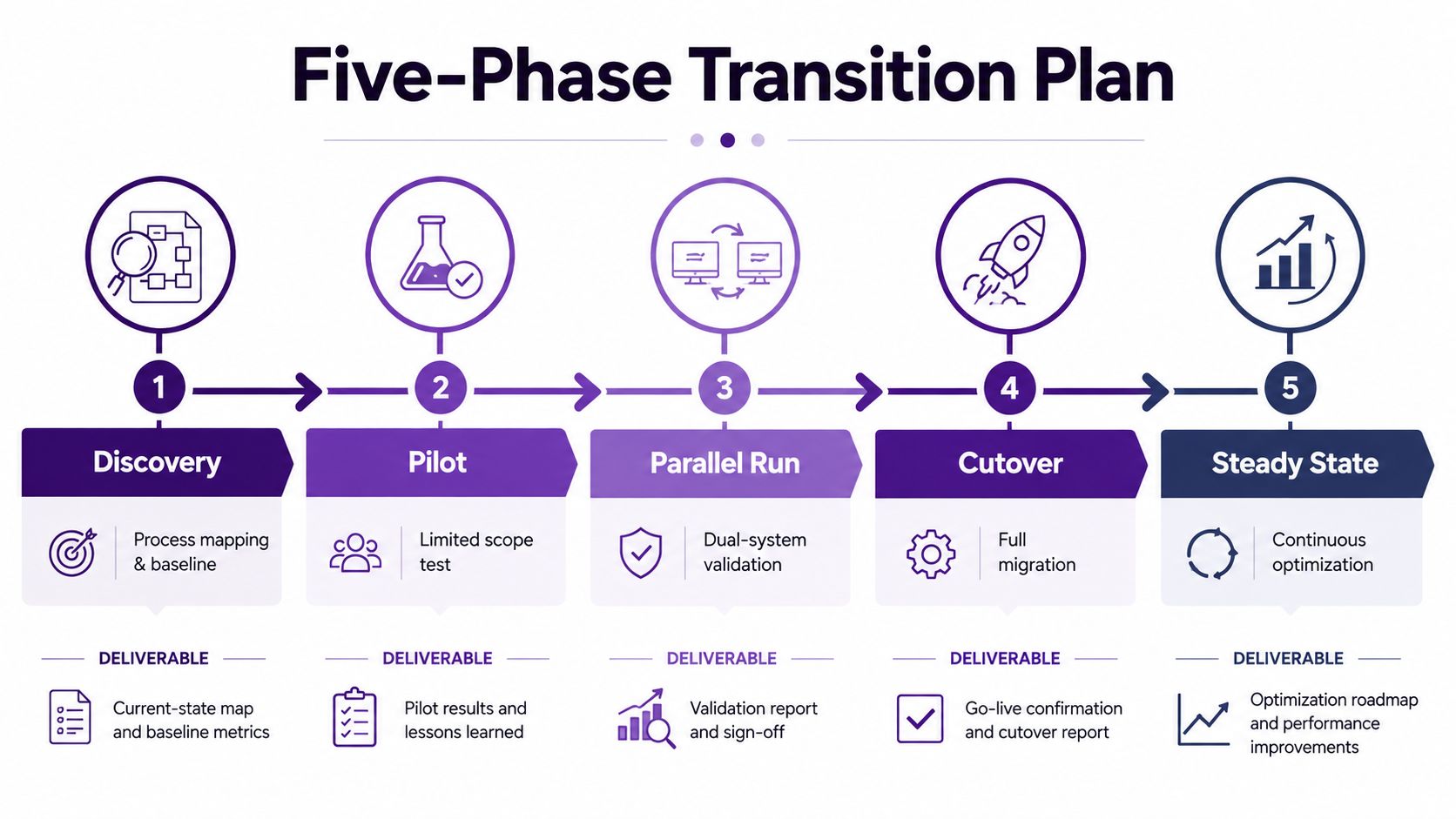
Transition is where the savings get made or lost. If the vendor is promising a fast cutover without process documentation, they’re selling you confidence, not a working operating model. The cleanest AP migrations I’ve seen follow five phases: discovery, pilot, parallel run, cutover, and steady state.
Skip documentation, and you’ll spend the next quarter paying people to rediscover your own process.
What each phase should deliver
Discovery captures process maps, exception rules, vendor master data, chart of accounts logic, approval hierarchy, and tax IDs. Your team hands over the essential operating detail, not just a PDF of a workflow.
Pilot should be narrow. Use one entity or one invoice type for 30 to 60 days so the provider can prove that routing, coding, and vendor response handling work before the scope expands.
Parallel run is the critical checkpoint. Both teams process the same invoices long enough to verify reconciliation accuracy against the in-house baseline.
Cutover should be KPI-gated, not calendar-gated. If accuracy or exception handling is off, stop and fix it.
Steady state is where the provider starts continuous improvement, but only after the process is stable.
The outsourcing cost benefit analysis is useful here because it reinforces the discipline of measuring cost against rework, not against payroll alone.
What the client team must hand over
The provider should bring a staffed transition lead, a QA lead, and a reporting owner in week one. Your side needs to provide clean source data, decision authority, and one accountable AP owner who can answer questions fast. If those pieces are missing, the transition drifts into email archaeology.
The worst mistake is assuming the vendor will document your process for you. They won’t, not well enough, and not on your timeline.
Set the KPI Dashboard and Reporting Cadence
AP outsourcing lives or dies on visibility. If the CFO only sees the monthly invoice total, the team is flying blind. The dashboard has to show whether the provider is cutting waste, or just shifting it into exceptions, rework, and delayed approvals.
Track cost per invoice, invoice cycle time, accuracy rate, and straight-through processing as the baseline. Those metrics tell you whether the outsourced model is lowering total cost or just looking cheaper on paper. For a broader control view, build the same discipline into the reporting and metrics dashboard guide so the team has a clean operating rhythm instead of scattered status updates.
Reporting should expose problems early
Add exception aging, duplicate-invoice rate, vendor inquiry response time, and audit findings to the monthly view. Those four measures catch operational drift before it shows up as late fees, frustrated suppliers, or month-end cleanup.
Use a cadence that matches the decision speed of AP, not the pace of a quarterly finance deck.
- Weekly: Open exceptions, aging, vendor complaints, and urgent escalations.
- Monthly: KPI trends, SLA compliance, and cost per invoice.
- Quarterly: Process improvement review, policy changes, and automation backlog.
The goal is control, not decoration. A dashboard that looks polished but hides exception backlogs is a liability.
Use a real escalation model
Define ownership before the first invoice hits the queue. AP operations should own workflow problems, finance controls should own approval exceptions, IT should own ERP integration, and procurement should own vendor disputes. If every issue lands in one shared inbox, reporting turns into theater and nobody fixes the root cause.
Cost per invoice, invoice cycle time, accuracy rate, and straight-through processing should sit at the top of the operating review because they show whether outsourcing is creating real savings after transition and governance costs. Keep accuracy high enough that AP no longer spends its time repairing avoidable errors, and watch cycle time closely because delays usually expose weak handoffs, not staffing shortages. Use the benchmark source as a reference point once, then manage the provider against your own baseline and exception profile.
Pitfalls and How to Dodge Them
Six failures sink AP outsourcing more often than price does. The first is weak change management. The symptom is internal users keeping old habits, the root cause is usually bad communication, and the fix is simple, a formal cutover plan with named approvers and a training calendar.
The second is no segregation of duties. If the same people can approve, enter, and release payments, you’ve exported risk instead of eliminating it. The mitigation belongs in the operating model and the contract, not in a hope-and-pray policy memo.
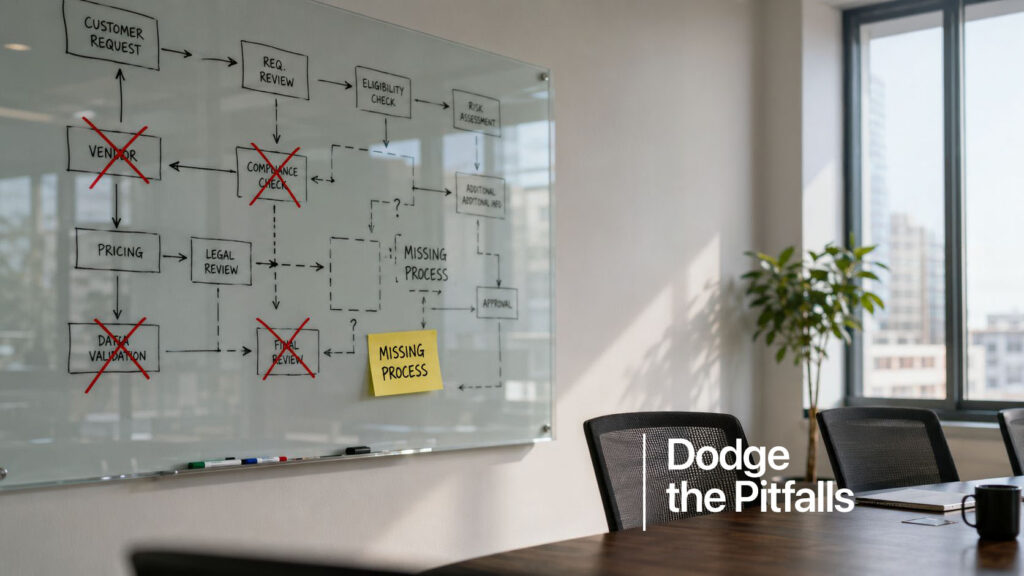
The remaining four mistakes
Undocumented approval matrices create chaos the first time a manager is out of office. Fix that by locking the approval logic before migration.
Treating the BPO as a black box kills visibility. Require standard reporting, open exception logs, and regular review meetings.
Ignoring tax and 1099 compliance creates year-end clean-up work. Put compliance checkpoints into the workflow, not into the year-end scramble.
Over-automating before controls are mapped is the contrarian trap. Automation can increase risk if it speeds up a broken process. Sequence it after the first 60 days of steady-state operations, once controls are stable and exception patterns are understood.
The benchmark metrics to monitor are the same ones auditors care about, cost per invoice, cycle time, accuracy, straight-through processing, and exception aging. If those trend in the wrong direction, the problem is usually governance, not labor.
Industry Notes and How to Decide Next
Healthcare, financial services, and e-commerce don’t buy AP outsourcing for the same reasons. Healthcare usually needs careful vendor onboarding, strong documentation, and patience with exceptions. Financial services needs tighter segregation, stronger audit trails, and consistent evidence for controls. E-commerce needs help with seasonal spikes, marketplace reconciliation, and multiple vendor currencies.
That’s why a nearshore bilingual model often fits better than a pure offshore model. Same-day collaboration matters when a vendor issue blocks payment or when your ERP queue needs immediate correction. A provider with shared-service experience can usually handle that pace better than a team operating half a world away.
AP outsourcing is worth considering when your readiness score is solid, your KPIs are defined, and your shortlist is real. If those three pieces aren’t in place, you’re not buying efficiency. You’re buying complexity. Start with one entity, one ERP, and a 90-day pilot window if you want proof of net ROI instead of a glossy claim about gross savings.
If you’re ready to test AP outsourcing without guessing, talk to CallZent about a bilingual nearshore model built for invoice workflow support, vendor communication, and control-heavy operations. Visit CallZent to review the service fit and start a structured pilot that measures whether outsourcing lowers your total cost after month twelve.
🚀 Outsource AP Without Outsourcing Control
CallZent helps North American businesses build bilingual nearshore workflows for invoice processing, vendor communication, exception management, and finance support.
Talk to an Expert