Skip to content
Contact Center Quality Assurance
Call Quality Monitoring: What Most BPO Programs Are Missing
Learn how call quality monitoring combines sampling, scorecards, speech analytics, coaching, compliance, and network data to improve BPO performance.
TL;DR — Quick Takeaways
- Traditional manual quality assurance commonly reviews only a small percentage of customer interactions, leaving most calls directly unevaluated.
- A reliable program combines random sampling, targeted reviews, live monitoring, recorded-call evaluation, and automated interaction analytics.
- Effective scorecards use a focused set of weighted criteria supported by written behavioral anchors and recurring evaluator calibration.
- Resolution, customer experience, process adherence, documentation, compliance, and efficiency should be evaluated together.
- Voice-quality metrics such as MOS, packet loss, jitter, delay, codec behavior, and burst loss can distinguish agent-performance problems from network faults.
- AI can expand monitoring coverage, but human judgment remains essential for validation, coaching, appeals, root-cause analysis, and sensitive decisions.
Are you really monitoring call quality, or only the small portion of calls your QA team has time to hear? In many BPO operations, a polished scorecard creates the impression of control while human reviewers see only a narrow slice of customer interactions. That gap can hide compliance failures, weak resolutions, network problems, and coaching opportunities until those issues appear in customer complaints or repeat contacts.
For a nearshore operation in Tijuana serving North American customers, the practical answer isn’t to ask supervisors to listen faster. It’s to combine disciplined sampling, a focused scorecard, speech analytics, and transport-level voice data. Manual review still matters, but it should be used where human judgment adds the most value, not as the only source of truth.
Why Most Call Quality Monitoring Programs Miss the Mark
A polished scorecard does not make a QA program reliable. The first question is whether reviewed calls represent the interactions your operation handles. If sampling misses routine failures, even accurate evaluations create false confidence.
Human QA teams traditionally review only a small share of interactions, commonly about 1–3%, while some manual programs use a 2–5% range. Verint documents these traditional sampling levels. The remaining conversations receive no direct human review, leaving managers to infer performance from a narrow sample.
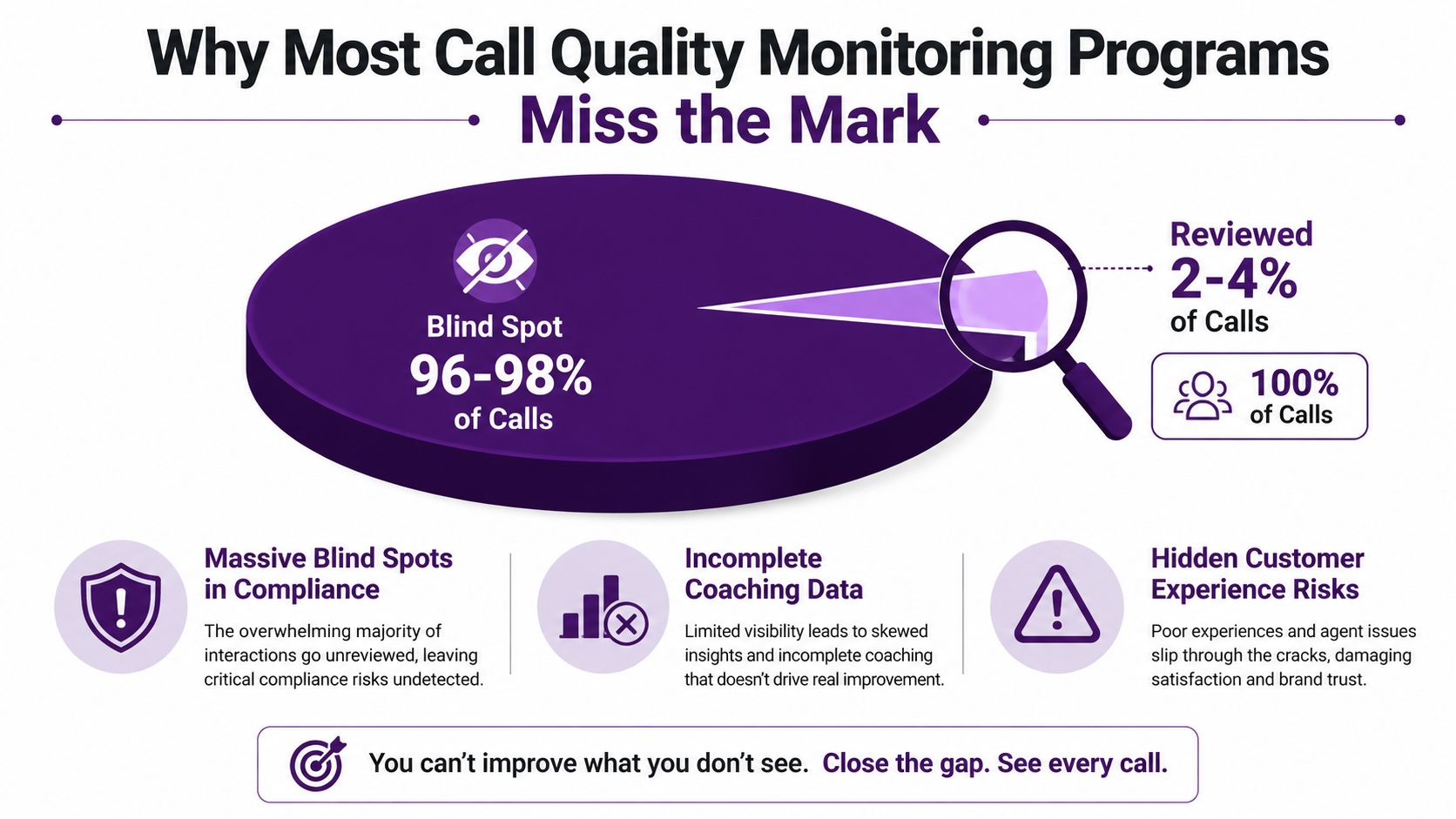
Coverage matters more than a polished checklist
A scorecard can be clear, fair, and carefully designed, yet still produce weak insight when the sample is biased. Reviewers may select easy-to-find calls, recent calls, complaint-related interactions, or calls from agents already under scrutiny. The resulting data may look precise while ordinary failures remain hidden.
One QA research page cites an ICMI survey in which 62% of QA managers said their current sample wasn’t representative. The cited contact center QA research points to a practical limitation: reviewing more calls will not fix a program that repeatedly selects the wrong interactions.
Before changing the form, a BPO should answer four operational questions:
- Who gets reviewed? Is sampling distributed across agents, queues, shifts, call reasons, and outcomes?
- What gets excluded? Are transfers, short calls, escalations, abandoned conversations, or codec-mixed intervals missing from analysis?
- What triggers review? Do random interactions sit alongside complaints, low survey scores, and compliance flags?
- What happens afterward? Does each meaningful finding lead to coaching, process correction, or a technical investigation?
Practical rule: Treat unreviewed calls as unknown, not as successful calls.
Limited coverage also distorts agent evaluation. One excellent call can create false confidence, while one difficult interaction can unfairly shape an agent’s reputation. Manual QA still has a clear role, especially for interpretation, calibration, root-cause analysis, and sensitive decisions. Use structured sampling and automation to expose patterns across the wider call set, then direct human effort toward the interactions where judgment changes the outcome.
The Metrics That Actually Drive Call Quality Monitoring
A call quality program can produce a precise score and still miss poor service. Average handle time can reward speed, customer satisfaction can miss operational details, and a QA score can hide an incomplete resolution. Managers need one connected view of agent behavior, customer experience, and the result of the interaction. That requires closing the gap between the calls humans review and the much larger set they do not.
First-call resolution deserves particular attention. It shows whether the contact solved the customer’s problem, rather than ending the conversation. SQM Group reports that 93% of customers expect their issue to be resolved on the first call, while 30% of calls aren’t resolved on the first call and 12% remain unresolved. The research also notes that 46% of customers whose issue wasn’t resolved believed the agent could have done more. Treat resolution quality as a coaching lens, not just a dashboard result.
Build the score around outcomes
Start with the business result, then work backward to observable behaviors. For billing contacts, evaluate authentication, diagnosis, explanation, action taken, and next steps. For technical support, assess whether the agent identified the cause, followed the correct troubleshooting path, and avoided an unnecessary transfer.
A practical weighting framework can look like this:
| Category | Recommended Weight | Key Metrics Included |
|---|---|---|
| Customer outcome metrics | 35–45% | First-call resolution, resolution accuracy, customer satisfaction |
| Soft skills | 20–30% | Empathy, active listening, tone, clarity |
| Process adherence | 15–25% | Call flow, authentication, script and policy adherence |
| Documentation | 10–15% | After-call work accuracy, complete notes, disposition quality |
| Compliance | Pass/fail | Required disclosures, verification, critical errors |
Use a call center KPI framework to connect scorecard categories with operational goals. The weights should reflect the queue’s risk and purpose, not a template copied from another program. Compliance may require a pass or fail outcome, while resolution accuracy may deserve more influence than conversational style.
Keep efficiency in its proper place
Average handle time matters, but it should not dominate quality. A short call that creates an avoidable repeat contact is not efficient. A longer call that correctly resolves a complex issue may protect customer loyalty and reduce later workload.
Track call resolution rate, average handle time, customer satisfaction, first-call resolution, script or call-flow adherence, attendance, punctuality, and policy compliance as related indicators, not interchangeable scores. Review them together, then examine the call evidence behind meaningful changes.
Manual evaluations remain necessary for calibration, coaching, root-cause analysis, and sensitive decisions. Speech analytics and automated sampling can scan wider patterns, flag risk, and direct reviewers toward calls where judgment matters. The metric identifies the signal. The interaction evidence determines the correction.
Comparing Call Quality Monitoring Methods
No single method gives a BPO enough coverage and context. Live listening supports immediate intervention, recorded reviews support defensible judgment, and speech analytics examines patterns across far more interactions. A practical program combines them according to the decision each method must support.
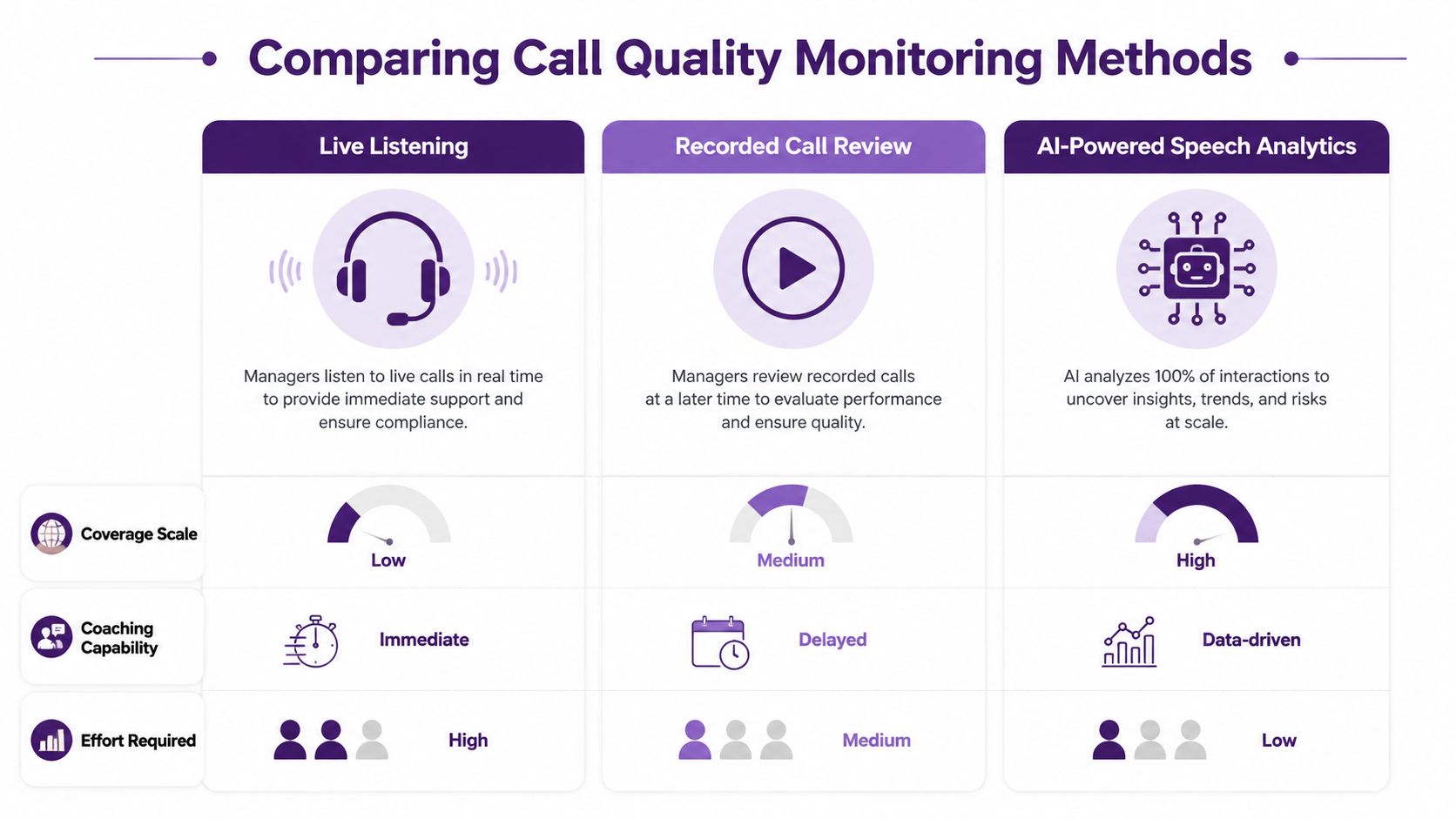
Live listening
Live monitoring helps when a supervisor needs to observe or support a sensitive interaction in real time. It can show whether an agent is struggling with a system, losing control of the conversation, or missing a required step while the call remains active.
Scale is the constraint. A supervisor can hear only a limited number of conversations, and the agent may change behavior when supervision is visible. Use live listening for targeted support, nesting, escalation handling, and immediate coaching. It should not carry the entire coverage strategy.
Recorded call review
Recorded calls give evaluators time to replay a moment, verify wording, inspect documentation, and assess a complex resolution. They work well for calibration, appeals, onboarding, complaints, and potential compliance concerns.
The trade-off is reviewer capacity. Manual evaluation takes time, and delayed feedback weakens the link between the interaction and the coaching discussion. Random sampling still has a place. OnClarity’s practical guide recommends a 5–10% random sample from the full call database or each agent, along with five to eight calls per calibration session.
AI-powered speech analytics
Speech analytics searches interactions for phrases, silence, interruptions, sentiment signals, intent, compliance language, and resolution patterns. Its main advantage is coverage. AI-assisted monitoring can extend toward 100% interaction coverage, rather than relying only on the small manual samples discussed earlier.
The software does not replace operational judgment. Weak criteria produce weak scores, while a model may flag a call without understanding the customer’s situation or the agent’s constraints. Teams assessing conversational intelligence for contact centers should examine how findings enter coaching, how supervisors validate exceptions, and how the system handles accents, bilingual conversations, transfers, and incomplete recordings.
The strongest operating model is hybrid. Analytics finds patterns and prioritizes calls, recorded review confirms what happened, and live listening supports intervention when waiting for a later review would create avoidable risk.
Building a Call Quality Monitoring Scorecard That Works
A scorecard earns its place when two evaluators reach the same conclusion about the same behavior. Vague standards such as “show empathy” or “handle the call well” create debate, inconsistent scores, and coaching that depends on personal preference.
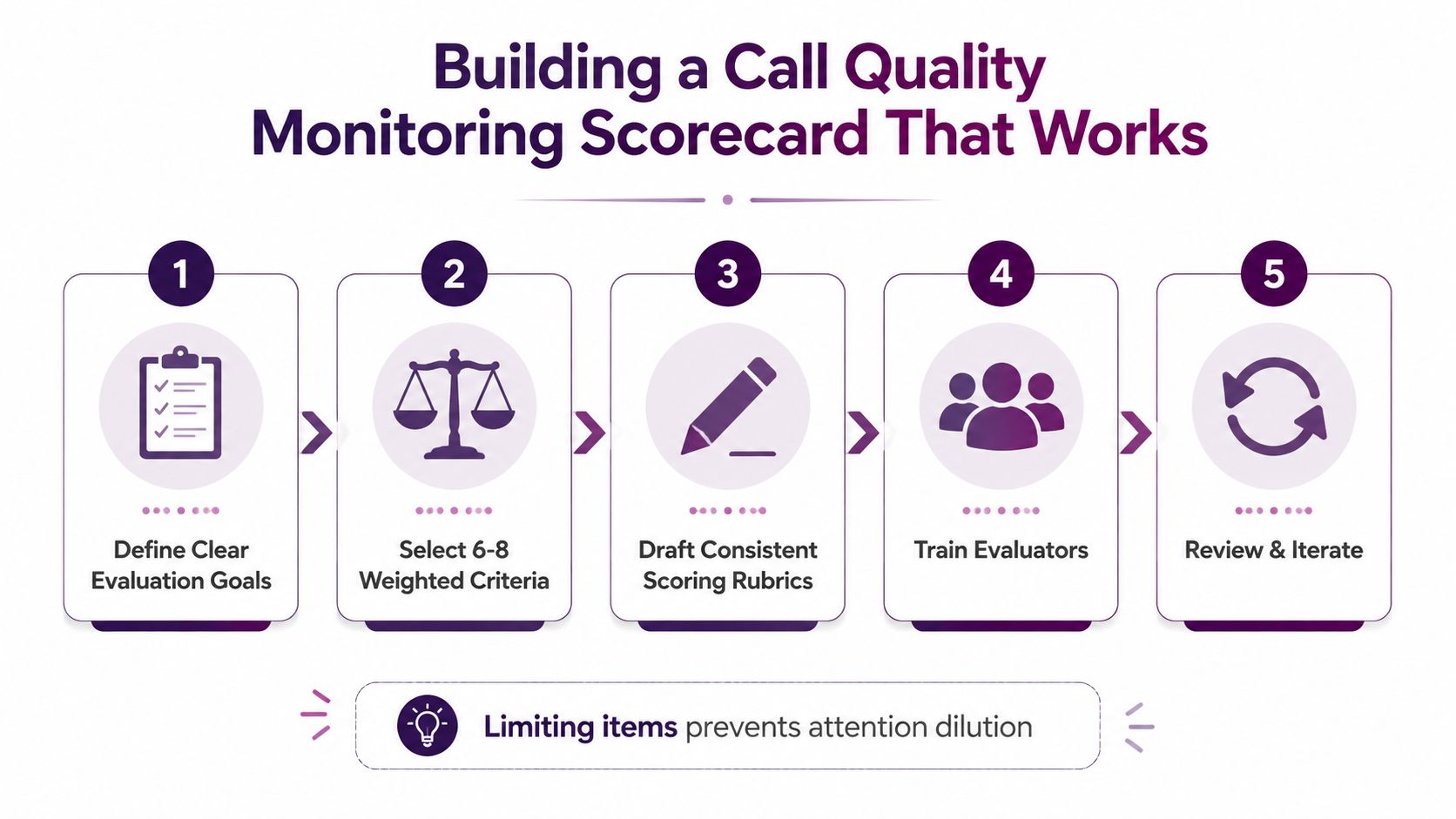
Start with a narrow set of criteria
Use 6–8 weighted criteria, rather than an exhaustive checklist. JustCall’s scorecard guidance recommends a 1–5 scoring scale supported by written behavioral anchors. A shorter form keeps evaluators focused and gives coaches a manageable discussion after the review.
A customer service scorecard might include:
- Issue diagnosis, the agent identifies the actual reason for contact.
- Resolution accuracy, the proposed action is correct and complete.
- Communication clarity, the customer receives understandable explanations and next steps.
- Listening and control, the agent lets the customer explain while keeping the conversation productive.
- Process adherence, required workflow steps are followed.
- Documentation, notes and dispositions accurately reflect the interaction.
- Compliance, required verification and disclosures are completed.
- Customer outcome, the interaction reaches the intended result.
Define what each score sounds or looks like. A “1” for clarity could mean confusing or contradictory instructions. A “3” could mean an accurate explanation that requires prompting. A “5” could mean a plain-language solution followed by confirmation that the customer understands the next step.
Calibrate before deployment
Before rolling out the scorecard, have two supervisors score the same five calls. If their scores differ by more than 15 points on one call, clarify the criteria before launch, following JustCall’s calibration recommendations.
Include at least one difficult example, such as an ambiguous resolution, a transfer, or a borderline auto-fail. Easy calls hide weaknesses in the form. Discuss the evidence behind each score, revise unclear wording, and document the agreed interpretation.
Sample deliberately
Random sampling gives baseline visibility, while targeted sampling surfaces risk. Combine random calls with interactions triggered by complaints, unusual handle times, transfers, repeat contacts, or automated compliance flags. Targeted reviews should supplement random selection, not replace it. Otherwise, the program becomes an investigation queue instead of a view of normal performance.
For teams reviewing only a small fraction of interactions, the scorecard should also guide prioritization. Speech analytics can identify calls for human review, while the scorecard gives supervisors a consistent way to validate the finding. That combination closes part of the coverage gap without pretending automated scores can replace judgment.
The scorecard should make coaching easier, not make evaluation longer.
Review the form after agents and evaluators have used it. If a criterion rarely changes coaching, remove or redesign it. If evaluators repeatedly disagree, improve the anchor before blaming consistency. A shorter, clearer scorecard usually produces more useful decisions than a detailed form that no one applies consistently.
The Network Layer Most QA Programs Ignore
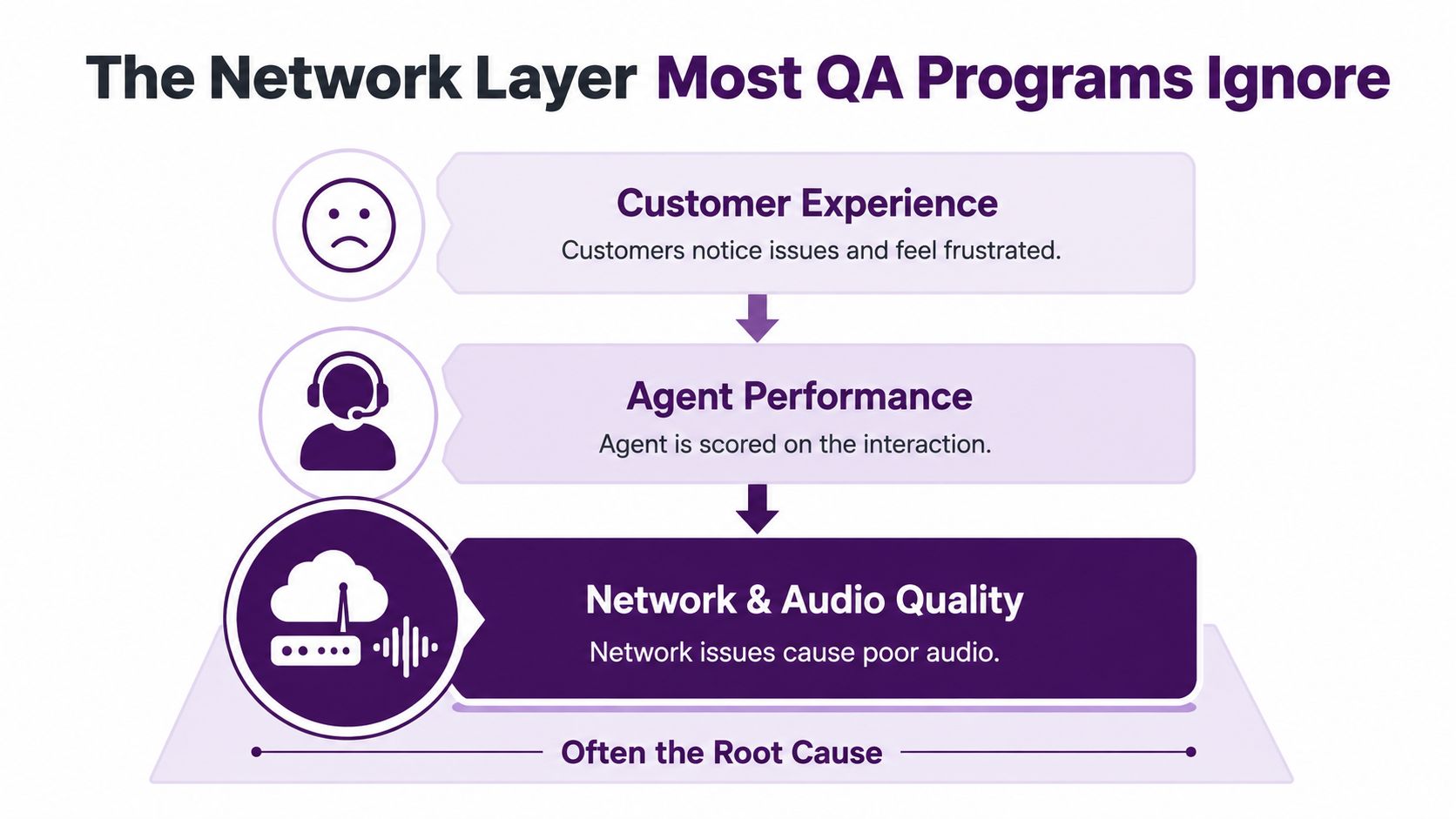
A clean scorecard cannot explain a call the customer could barely hear. An agent may follow the script, show empathy, and offer the correct resolution while packet loss or jitter produces clipped syllables and robotic audio. Yet many QA programs review only a small sample of calls, score the agent, and never inspect the transport path carrying the conversation.
Mean Opinion Score, or MOS, is a 1-to-5 summary based on the ITU-T G.107 E-model. Monitoring platforms typically derive it from packet loss, jitter, delay, burst loss, and codec behavior, rather than audio content alone. VoIPmonitor’s quality documentation explains why a perceptual score needs transport evidence behind it.
Read the quality signals together
A practical troubleshooting set watches packet loss above 1%, jitter above roughly 30 milliseconds, and MOS below about 3.5 as warning points where users may notice degradation. ViciStack’s VoIP MOS guide connects these thresholds with audible defects and conversational difficulty.
Packet loss can remove syllables or create robotic speech. Jitter changes packet arrival timing, forcing the playback buffer to conceal irregularities. Once the buffer cannot compensate, customers hear clipping, gaps, or choppiness.
Do not score an agent down for a carrier problem. Correlate the MOS decline with packet loss, jitter, and burst loss during the same interval. If one carrier route or WAN path deteriorates while another remains stable, reroute and retest before replacing endpoints or changing staffing.
Treat missing MOS values carefully
Oracle’s voice-quality implementation calculates MOS in 10-second chunks, but only when a chunk contains more than 8 seconds of RTP for a single codec. Short or codec-mixed intervals may therefore be excluded.
An absent score does not prove that the call was clear. It may mean the interval failed the scoring conditions. QA dashboards should show that distinction, so managers do not classify missing data as good performance.
Continuous monitoring also matters because voice quality changes with time of day and traffic load. One clean test call cannot represent a busy queue. For BPOs, the operating workflow should connect QA findings with carrier, WAN, endpoint, and platform evidence. CallZent’s tier 2 network support information is relevant when an investigation needs technical escalation beyond agent coaching.
Implementing Call Quality Monitoring in Your BPO
A successful rollout doesn’t begin with buying a dashboard. It begins with a controlled operating model that defines what supervisors review, how agents receive feedback, and who owns corrective action.
Phase one, pilot the decision rules
Select a small agent group that reflects the operation’s real variation. Include different shifts, call types, tenure levels, and language requirements where relevant. Run the proposed scorecard against recorded calls, compare manual findings with speech analytics flags, and identify criteria that evaluators can’t apply consistently.
Set pilot milestones around decisions, not vanity outputs:
- Scorecard clarity: Evaluators can explain why each criterion received its score.
- Exception handling: The team knows how to manage transfers, incomplete recordings, escalations, and critical errors.
- Coaching linkage: Each meaningful finding produces a defined coaching action.
- Technical separation: Audio problems are routed for network investigation rather than assigned automatically to the agent.
Phase two, calibrate and coach
Hold recurring calibration sessions using a shared set of calls. Review disagreements by evidence, not by hierarchy. Supervisors should listen for the same behavioral markers and record changes to the rubric so agents aren’t evaluated against moving standards.
Keep coaching specific. “Improve empathy” isn’t actionable. “Acknowledge the billing concern before explaining the policy, then confirm the customer’s next step” gives the agent something observable to practice.
The CallZent guide to monitoring call center performance reflects the broader principle that monitoring only creates value when performance data connects to follow-up action.
Phase three, scale with governance
Once the pilot is stable, expand coverage by queue and client program. Assign ownership for scorecard changes, compliance rules, analytics review, network alerts, and coaching completion. Supervisors need protected time for interpretation and feedback. Otherwise, automation creates more alerts for an already overloaded team.
Common failure modes are predictable:
- Evaluator burnout: Reduce unnecessary manual reviews and let analytics prioritize exceptions.
- Inconsistent scoring: Schedule calibration and revise ambiguous anchors.
- Alert overload: Group findings into patterns instead of sending every flag to a supervisor.
- No operational response: Assign an owner and due date to each recurring issue.
- Agent resistance: Explain the evidence, allow appeals, and separate coaching from unsupported assumptions.
The implementation is complete only when the organization can move from interaction evidence to a changed behavior, corrected process, or resolved technical fault.
How Call Quality Monitoring Lifts Customer Experience
Customer experience improves when monitoring identifies why an interaction failed and gives the operation a practical correction. A score alone cannot do that. A connected program shows whether the customer received the right resolution, whether the agent explained it clearly, and whether network conditions made the conversation difficult to follow.
First-call resolution illustrates the value. Unresolved interactions can leave customers feeling that the agent could have done more. Structured monitoring connects those outcomes to coaching, process changes, and broader coverage instead of treating each score as an isolated judgment.
Turn findings into operational changes
Suppose speech analytics detects repeated phrases that signal confusion about a return policy. Manual review can confirm whether agents explain the policy accurately. Customer satisfaction and repeat-contact data then show whether the issue extends beyond one representative. The appropriate fix might be a clearer knowledge article, a revised call flow, better permissions, or focused coaching.
The same loop applies to compliance. A flagged disclosure should trigger targeted review. Recurring omissions may indicate that the script, interface, or training process makes the required step easy to miss. Monitoring can therefore support agent development and process design at the same time.
Customer feedback belongs beside interaction evidence. A structured voice of the customer program connects what customers report with what agents and systems did during the call. Managers can then distinguish an isolated perception from a recurring failure in policy, workflow, or service quality.
The business value of QA comes from closing the loop between coverage, diagnosis, coaching, and process correction.
Review coverage by queue, agent, shift, call reason, and outcome. If the operation examines only a small slice of calls, scorecards alone will leave important failures invisible. Use speech analytics to detect patterns across a wider sample, then apply manual review where context and judgment matter. Manual evaluation produces depth but consumes supervisor time. AI-driven monitoring expands visibility but still needs calibrated rules and human confirmation.
Connect MOS and transport metrics to audio-related complaints. A poor customer experience may come from an agent behavior, a process defect, or a network fault. The program should identify which one before assigning coaching.
Close the Gap Between Reviewed Calls and Real Customer Experience
Talk with CallZent about bilingual nearshore support built around practical scorecards, calibrated quality reviews, targeted coaching, interaction analytics, and technical call-quality monitoring.
Talk to an ExpertCallZent provides bilingual nearshore call center and BPO services from Tijuana, including customer service, technical support, back-office operations, and quality-focused performance management. Visit CallZent to discuss practical monitoring workflows and technology for closing the gap between measured calls and delivered customer experience.