Skip to content

Debt Collection Operations & Compliance
How to Handle Debt Collection Calls: A Compliance-First Guide
Learn how to handle debt collection calls with proper verification, disclosures, de-escalation, documentation, dispute workflows, and compliance controls.
TL;DR — Quick Takeaways
- Confirm that the person reached is the intended consumer before revealing the debt, creditor, balance, delinquency, or purpose of the call.
- After completing the approved identity-verification process, deliver the required disclosure and explain the account clearly.
- Use acknowledgment, controlled choices, and realistic payment options to reduce conflict without making unauthorized promises.
- Document every contact attempt, verification result, dispute, communication preference, opt-out request, escalation, and payment commitment immediately.
- Federal call-frequency presumptions apply by particular debt, but remaining below the numerical limit does not automatically make a calling pattern compliant.
- Measure right-party contact, kept payment commitments, complaints, disputes, and quality findings—not raw dialing activity alone.
More than 70 million Americans with a credit bureau file were contacted by a creditor or debt collector about at least one debt during the prior 12 months, according to the CFPB’s debt collection survey report. That scale changes the question from “How can an agent make more calls?” to how to handle debt collection calls without sacrificing compliance, consumer trust, or legitimate recovery.
The strongest collections operation treats every conversation as both a service interaction and a regulated event. The agent must verify the person, protect confidential information, manage call frequency, respond to disputes, and still create a clear path toward payment. A rushed disclosure or an undocumented promise can damage the account long after the call ends.
Why Debt Collection Call Handling Demands a Compliance-First Approach
A poorly handled collection call creates operational cost before it creates revenue. It can trigger a complaint, open a dispute, produce a regulatory record, or end a payment conversation that might otherwise have progressed. The CFPB’s Regulation F FAQ explains that call-frequency controls must be applied with account history, consumer preferences, and documented context, rather than treated as a simple dial limit.
Compliance directly affects recovery performance. A consumer who feels exposed, pressured, or misled is less likely to share useful information, confirm an arrangement, or answer the next call. Aggressive dialing can increase abandonment, create duplicate contacts, and keep agents working accounts that should have been paused for dispute review or a cease-contact request.
The highest-risk failures usually occur during live calls. An agent may disclose too much before confirming the right party, continue after a clear dispute, or promise follow-up without recording it. Each mistake weakens trust and leaves supervisors with limited evidence when a complaint reaches quality assurance or regulatory review.
The cost of treating compliance as a checkbox
Supervisors track contacts, talk time, and payments collected because those measures show production. They become dangerous when agents reach targets by calling too often, skipping verification, or pressing ahead after a dispute. A compliance-first scorecard should give proper disclosure, right-party verification, respectful language, and accurate notes enough weight to prevent short-term recovery from creating longer-term exposure.
| Risk Factor | Average Impact |
|---|---|
| Excessive or poorly controlled contact | More complaints, lower trust, and increased review risk |
| Disclosure or verification failure | Privacy exposure, disputes, and possible FDCPA concerns |
| Unlogged promises or opt-outs | Missed follow-up, repeated contact, and weak audit evidence |
| Aggressive negotiation | Lower cooperation and more escalations |
| Incomplete dispute handling | Collection delays and avoidable regulatory risk |
A workable program connects agent training with CRM restrictions, call recording, supervisor calibration, and clear escalation rules. Teams can also use CallZent’s call center compliance resources when setting up controls for internal or outsourced operations.
The practical KPI is a documented, voluntary, workable next step. Track right-party contacts, kept arrangements, disputes, opt-outs, complaint rates, and quality findings together, so revenue goals do not hide preventable compliance failures.
Opening the Call with Proper Disclosure and Verification
The first moments determine whether the call can proceed lawfully and productively. Revealing an account purpose to a spouse, coworker, or roommate before confirming the right party creates an avoidable privacy problem and can undermine the contact record. Use a short opening that every agent can deliver consistently and every supervisor can monitor.
Follow this sequence:
-
Identify the business without revealing the debt.
“Hello, may I speak with [full name]? My name is [agent name], calling from [company name]. This is an attempt to collect a debt, and any information obtained will be used for that purpose.” -
Verify the right party.
“For security, please confirm your full name and [approved second identifier, such as the last four digits of your Social Security number or date of birth].” -
Confirm permission to continue.
“Thank you. Are you comfortable continuing this conversation now, and is this a private setting where you can discuss a personal financial matter?” -
Only then discuss the account.
“I’m calling regarding an account associated with [original creditor]. I can provide the required debt information and explain your dispute options.”
Verification must follow the client’s approved policy and applicable law. Two approved data points can reduce misidentification, but agents should not improvise identifiers or request unnecessary sensitive information. If the caller cannot verify the account, stop substantive discussion. Offer an approved callback or written-contact path, then record the outcome accurately in the CRM.
The operational goal is a clean handoff from identity confirmation to authorized account discussion. Supervisors should review whether the disclosure occurred, whether the verification fields matched policy, whether privacy was confirmed, and whether the agent stopped when verification failed.
Handling voicemail and bilingual openings
Voicemail requires restraint. A limited-content message can identify the caller and provide a callback route without disclosing the existence or nature of the debt:
“Hello, this message is for [first name]. Please contact [company name] at [approved callback number] and reference [approved reference information]. My name is [agent name]. Thank you.”
Do not mention the creditor, balance, delinquency, or “collections” unless the approved legal and operational policy permits that content. Apply the same discipline when a third party answers. State only that you are trying to reach the named person and ask for a suitable callback method.
For bilingual teams, offer a language choice without changing the required disclosure:
“Hello, may I speak with [name]? My name is [agent name], calling from [company]. This is an attempt to collect a debt, and any information obtained will be used for that purpose. Would you prefer to continue in English or Spanish?”
Keep approved disclosure versions available in supported languages, and record the version used in the CRM. Agents should not translate from memory. A natural sentence that omits the required purpose can create more compliance risk than a brief, standardized script.
Negotiation and De-Escalation Techniques That Convert
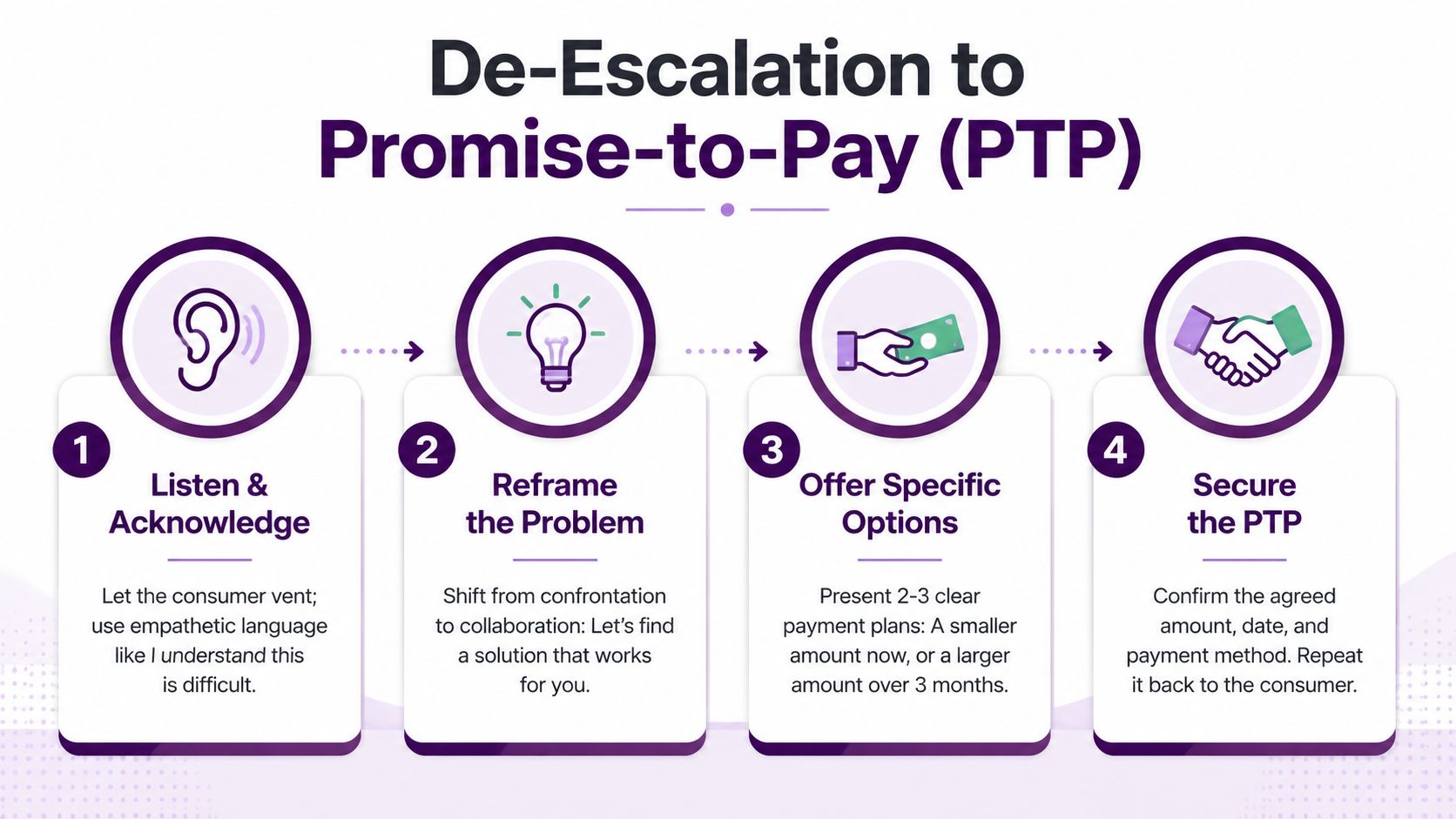
A hostile opening doesn’t mean the account is unrecoverable. It means the agent must lower emotional temperature before asking for a financial commitment. The most reliable sequence is acknowledge, redirect, resolve.
Suppose the consumer says, “You people keep calling me. I can’t pay this.” The agent shouldn’t interrupt with a payment demand. A better response is:
“I understand this is stressful, and I want to make sure we handle the account respectfully. Let’s look at what you can realistically manage, then I’ll explain the available options.”
That statement acknowledges the experience without admitting a violation or changing the account terms. After speaking, the agent should pause. Silence gives the consumer room to process and sometimes offer a useful amount or date without being pushed.
Moving from objection to a workable arrangement
Use specific questions rather than broad prompts. “How much can you pay?” can feel confrontational. “Would a smaller payment on your next pay date be more realistic, or would you prefer to review a scheduled arrangement?” gives the consumer a controlled choice while preserving the purpose of the call.
Common objections need distinct responses:
-
“I already paid this.”
“I’ll document that you believe the balance was paid. Please provide the payment date and method if you have them, and I’ll explain the next step for review.” -
“This isn’t my debt.”
“I won’t discuss account details until we resolve the identity concern. I’ll record that you’re disputing responsibility and explain how to submit the dispute.” -
“Send me validation.”
“I can explain the validation process and record your request. You’ll receive the required information through the approved channel, and we’ll follow the applicable dispute procedures.”
The de-escalation techniques for call center agents are useful beyond collections because they teach agents to separate emotion from the next operational step.
Presenting options without overpromising
Offer only options the account, client policy, and authority level support. A smaller immediate payment may be more sustainable than an ambitious arrangement that breaks quickly. If a lump-sum option is available, explain its terms plainly and avoid implying that acceptance is mandatory.
Use empathy as a bridge, not a concession: “I understand the difficulty” recognizes the consumer’s situation. It doesn’t waive the debt, admit fault, or promise an outcome the agent can’t authorize.
Before ending the call, repeat the arrangement: amount, due date, payment method, and any required confirmation. A promise-to-pay that isn’t understood by both sides is not a successful resolution. It’s a future dispute waiting for a missing note.
FDCPA and Regulation F Rules Every Agent Must Follow
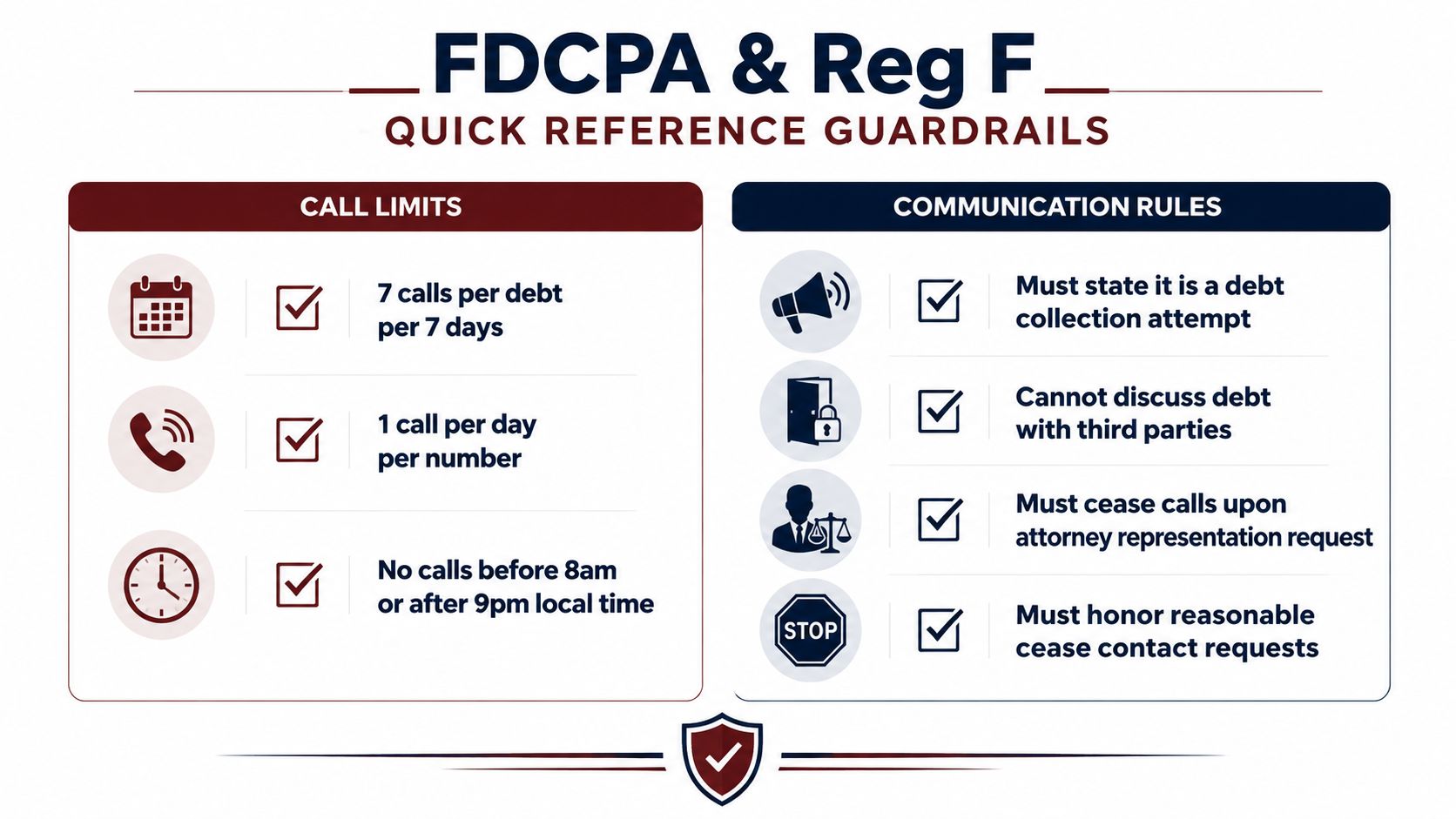
Regulation F gives collections teams a concrete control point. A collector is presumed to violate federal law if it places more than seven telephone calls about a particular debt within seven consecutive days, or calls within seven days after a phone conversation about that debt, as explained in the CFPB’s FDCPA procedures. Voicemails and certain limited-content messages count as calls for frequency purposes, so the dialer and CRM must share reliable account-level history.
The number alone isn’t a safe harbor. Repeated or continuous calls made with an intent to annoy, abuse, or harass can still violate the FDCPA even when the numerical presumption hasn’t been triggered. Supervisors should therefore review pattern, timing, consumer requests, and agent conduct instead of approving a campaign solely because the counter is below the limit.
The live-call guardrails
A supervisor’s monitoring checklist should test whether the agent:
- Uses the required disclosure: The agent states that the communication is an attempt to collect a debt before discussing the account.
- Verifies the right party: The agent completes approved identity checks before revealing creditor, balance, or delinquency details.
- Respects local time: Collectors generally can’t call before 8 a.m. or after 9 p.m. in the consumer’s local time zone, according to the CFPB’s calling-hours guidance.
- Honors inconvenient times and workplaces: The collector must stop when the consumer says a time is inconvenient and must account for known restrictions on personal calls at work.
- Protects third parties: The agent doesn’t disclose the debt to family members, employers, coworkers, or anyone else who answers.
- Avoids threats and deception: The agent never threatens arrest, uses abusive language, or misrepresents legal consequences.
- Routes stop-contact requests: The agent records the request and follows the approved workflow for phone, text, email, work, and social channels.
Digital communications also need controlled opt-out handling. A consumer’s request to stop one channel shouldn’t be lost because the agent records it in a free-text note instead of a structured preference field.
A decision rule for uncertain moments
If an agent isn’t sure whether an action is permitted, the safest sequence is simple: pause the disclosure, check the account flags, ask a supervisor, and document the decision. Never compensate for uncertainty by applying more pressure. State-specific requirements may add protections, so teams should pair federal procedures with a maintained debt collection laws by state reference.
Documentation Disputes and Escalation Workflows
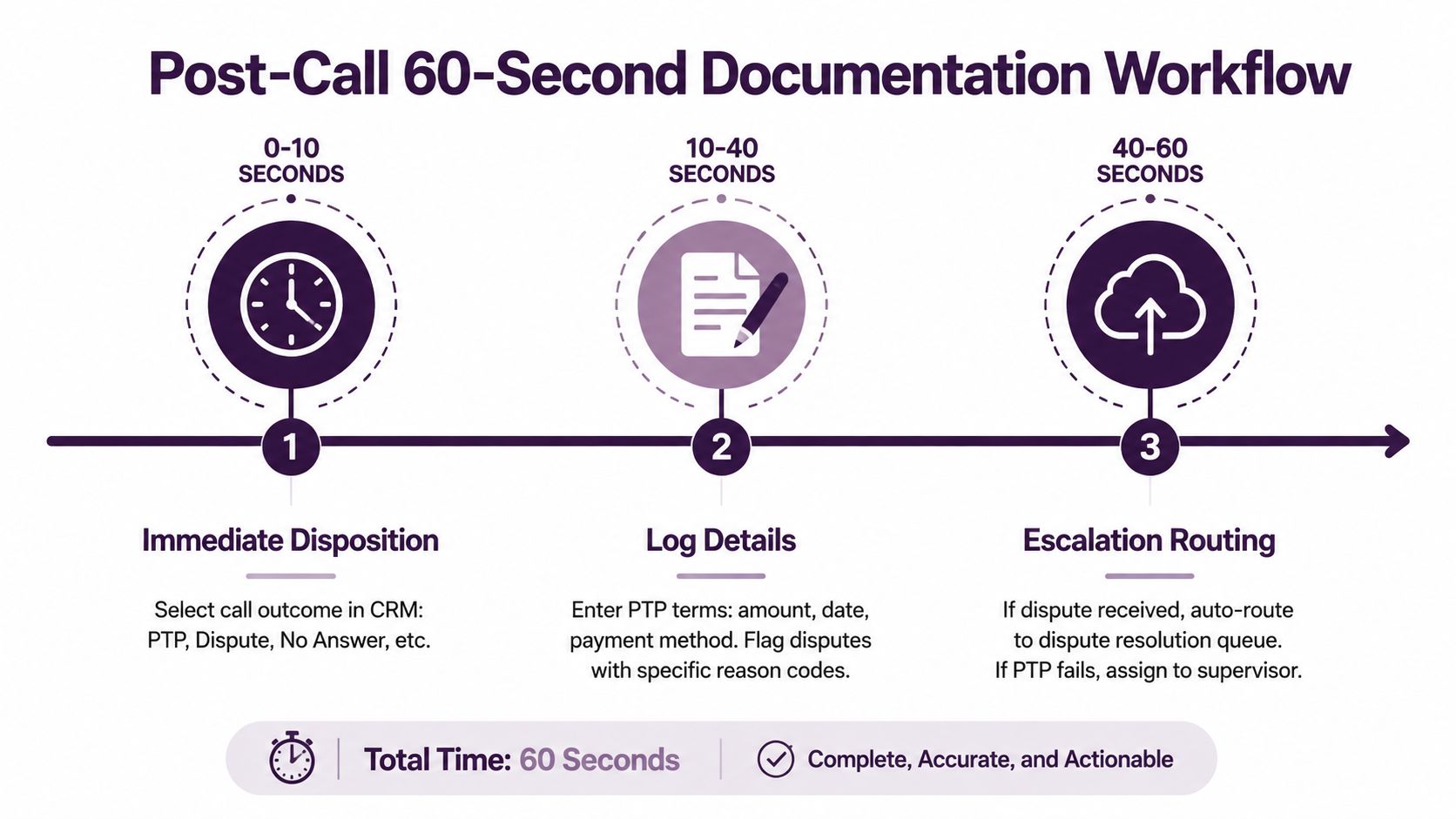
The call isn’t finished when the consumer hangs up. The next operational minute determines whether the team can honor the arrangement, suspend the account, answer a complaint, or defend its actions later.
Agents should record the disposition immediately, then capture the details that explain what happened. A useful CRM note identifies the contact result, verification outcome, disclosure status, consumer request, dispute reason, promise terms, payment method, and next action. Spanish-language conversations and disclosures should remain searchable and retrievable in the same way as English interactions.
Managing validation requests
The validation notice must be provided with the initial communication or within five days after it, and it must give the consumer a 30-day period to dispute the debt in writing, according to the CFPB’s validation-information guidance. Agents shouldn’t argue about the validity of the account during a live dispute. They should acknowledge the request, explain the approved submission method, and route it to the dispute queue.
A compliant acknowledgment can sound like this:
“I’ve recorded that you’re disputing the debt and requesting validation. I won’t make a decision about the dispute on this call. We’ll follow the required review process and communicate through the approved channel.”
That wording confirms receipt without admitting liability, resetting a limitation period, or promising a result the agent can’t control. Supervisors should distinguish verbal objections from written disputes and apply the client’s legal workflow to each.
A practical escalation matrix
| Trigger | Immediate action | Escalation path |
|---|---|---|
| Consumer disputes identity or balance | Add a specific dispute code and pause unauthorized collection activity | Dispute resolution queue |
| Consumer alleges harassment or illegal conduct | Preserve recording and complete an incident note | Supervisor and compliance review |
| Consumer identifies attorney representation | Stop ordinary collection handling and verify required routing | Legal or designated representation queue |
| Promise is broken | Confirm the failed arrangement and apply approved retry rules | Supervisor when policy requires |
| Third party receives contact | Record the event without revealing account details | Compliance review |
A dashboard should make unresolved items visible. Useful fields include dispute date, account identifier, verification status, validation status, last permitted contact, opt-out channel, resolution outcome, owner, and escalation deadline. Teams that need a formal structure for routing and ownership can also review CallZent’s escalation management resource.
Documentation rule: If the CRM doesn’t show the decision, the next agent can’t safely act on it.
Measuring Success with Collections KPIs and Quality Checks
A useful collections dashboard connects caller verification, payment outcomes, disputes, and quality review. Supervisors can then see whether agents reached the intended consumer, followed the required script, documented a realistic promise, and handled the account without creating avoidable complaints.
Track these measures:
- Right-party contact rate: The share of attempts that reach and verify the intended consumer.
- Promise-to-pay conversion: The share of qualified contacts that produce a documented payment promise.
- Promise-to-pay stickability: The share of promises completed rather than broken.
- Dispute rate per 1,000 calls: A signal for data quality, identity errors, script problems, or weak objection handling.
- Abandonment rate: The share of connected calls that end before an agent handles them. One industry KPI guide places the ideal outbound abandonment rate below 5% (Sigma Connected collections KPI guidance).
The same guide reports higher recovery ranges for structured scripts than for freestyle approaches, while also noting that scripted teams can recover more than unguided calling. Treat those findings as directional industry analysis, not a portfolio guarantee. A script still fails if the agent skips real-time identity verification, discloses account information too early, or records a promise the consumer cannot keep.
| KPI | Benchmark Range | QA Weight |
|---|---|---|
| Right-party contact rate | Portfolio-specific baseline | High |
| Promise-to-pay conversion | Portfolio-specific baseline | High |
| Promise-to-pay stickability | Portfolio-specific baseline | High |
| Dispute rate per 1,000 calls | Monitor for adverse movement | Critical |
| Outbound abandonment rate | Below 5% as an industry reference | Medium |
| Disclosure and verification | Pass required elements | Critical |
Quality checks should test the call in sequence: disclosure, verification, privacy control, contact-frequency review, dispute routing, payment terms, and documentation. Mark each required element as pass or fail. During weekly calibration, supervisors should score the same recording, resolve scoring differences, and coach the exact behavior that caused the miss. The HireParalegals quality control guide can help organize review ownership and supporting evidence.
Keep compliance and revenue measures on one dashboard. Call center KPI tracking helps connect agent behavior with contact quality, payment outcomes, complaints, and coaching priorities, without rewarding raw activity by itself.
CallZent provides bilingual nearshore debt collection call center and BPO support from Tijuana, including structured outbound follow-up, compliant documentation, and performance monitoring for North American businesses. Teams seeking support with verification, de-escalation, dispute routing, and KPI-based quality control can visit CallZent to discuss a service model aligned with portfolio and compliance requirements.
Build a More Accountable Collections Operation
Talk with CallZent about bilingual nearshore support built around your approved scripts, portfolio requirements, documentation standards, escalation procedures, and performance goals.
Talk to an Expert