
FINANCE / BPO STRATEGY
Accounts Receivable Outsourcing:
A Smarter Way to Improve Cash Flow
Accounts receivable outsourcing helps SMEs improve cash flow, reduce DSO, and scale collections with nearshore teams while maintaining control and visibility.
TL;DR — Quick Takeaways
- Accounts receivable outsourcing improves cash flow by accelerating collections and reducing DSO.
- Businesses commonly see 25–40% faster collections and 20–60% cost savings.
- Nearshore models offer the best balance of cost, communication, and control.
- CallZent provides structured, bilingual AR support tailored to North American SMEs.
Sales can be up while cash stays tight. That usually means the problem isn’t demand. It’s collections, invoicing discipline, dispute handling, and follow-up capacity.
For many North American SMEs, accounts receivable stops being a bookkeeping task and starts becoming a growth constraint. The team closes deals, ships orders, submits claims, or delivers services, then waits too long to turn receivables into cash. Meanwhile, finance staff get pulled into reminder emails, aging reports, reconciliations, and awkward collections calls that distract from forecasting and operational planning.
A practical fix is accounts receivable outsourcing. Done well, it gives you tighter process control, better visibility into overdue balances, and a more predictable path from invoice to payment. Done poorly, it creates handoff issues, customer friction, and vague reporting. The difference is usually the operating model and the partner you choose.
Is Unpaid Invoices Stalling Your Business Growth?
A familiar pattern shows up in growing businesses. Revenue climbs. Invoice volume rises with it. Then the finance team starts spending more time tracking unpaid balances than supporting decisions that move the business forward.
That drag is expensive even when it doesn’t show up neatly on a P&L. Your controller chases status updates instead of reviewing trends. Your office manager follows up on payment promises instead of supporting operations. Your leadership team sees revenue on paper, but cash arrives too slowly to fund hiring, inventory, marketing, or expansion.
Key takeaway: Faster collections matter, but control matters just as much. The right outsourcing model gives you both.
A simple example. A retail wholesaler might have a strong sales month and still delay inventory purchases because too many customer balances sit unresolved. A medical group might be profitable on paper but strained because denials and aging claims keep stretching payment cycles. An e-commerce company may process orders efficiently yet lose margin when back-office staff spend hours resolving invoice disputes instead of supporting growth.
That’s why this decision shouldn’t be framed as “Should we hand off collections?” The better question is, “What AR work should stay internal, and what should move to a specialized team so cash flow stops lagging behind performance?”
The Business Case for Accounts Receivable Outsourcing
The case for outsourcing is strongest when AR has become a bottleneck rather than a controlled process. At that point, in-house handling often looks cheaper than it really is because the hidden costs are spread across payroll, training, management time, software, and delayed cash.
Better cash flow without waiting on a hiring cycle
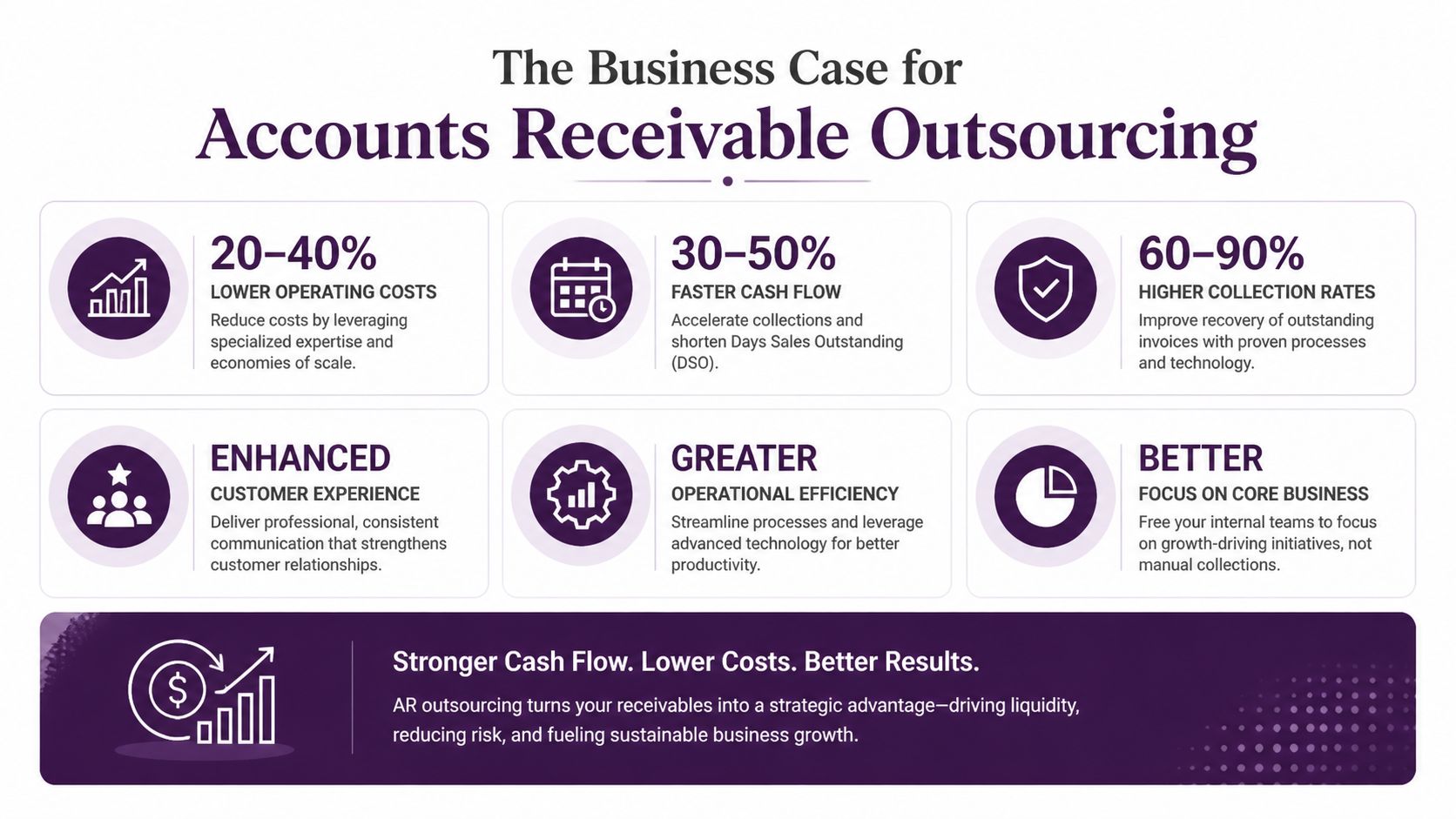
The most direct benefit is collection speed. Companies that embrace AR outsourcing typically see a 25-40% reduction in Days Sales Outstanding, while average cost savings on finance operations range from 20-60%, and the broader market is projected to reach $81.25 billion by 2030 according to this accounting outsourcing market summary.
That matters because DSO isn’t an abstract finance metric. It’s a cash timing metric. If receivables sit too long, your business ends up funding payroll, vendor obligations, and growth plans with borrowed patience.
Lower operating cost than an in-house patchwork
Most SMEs don’t run AR with a fully dedicated, fully trained team. They run it with a patchwork. Someone in accounting sends invoices. Someone else follows up. Leadership jumps in when accounts age badly. That structure works for a while, then breaks under volume.
A specialized partner replaces that reactive model with a defined workflow:
- Invoice discipline: Consistent generation, delivery, and tracking
- Follow-up cadence: Scheduled reminders instead of ad hoc outreach
- Escalation logic: Clear paths for disputes, promises to pay, and higher-risk accounts
- Reporting: Aging visibility that finance leaders can effectively utilize
If you need a framework to analyze make or buy choices, AR is a strong candidate because it’s process-heavy, measurable, and often expensive to scale internally without losing focus elsewhere.
Expertise and infrastructure you don’t need to build alone
An internal AR team can be excellent, but building one is slower than most growth-stage companies expect. You need hiring, training, scripts, QA, workflow design, and system integration. A capable outsourcing partner already has those building blocks.
That’s especially useful if you need receivables support tied to customer communication and cross-functional back-office work. For example, international receivable management services can support businesses that need a more structured collections process across different customer bases while keeping finance leadership close to performance.
Strong AR operations don’t just collect faster. They make cash flow more forecastable, which improves decision-making across the business.
The business case comes down to this. You are not outsourcing because AR is unimportant. You outsource because it’s important enough to run with consistency, reporting discipline, and dedicated attention.
Key Signals It Is Time to Outsource Your AR
Most companies don’t outsource AR because of one dramatic event. They do it after a series of smaller warnings. Collections take longer. Exceptions pile up. Reporting gets murky. Staff start handling receivables in between other priorities instead of through a real operating rhythm.

Operational signs finance leaders should not ignore
A few signals show up early and usually get dismissed as temporary growing pains:
- Your team is multitasking AR work: Invoices, reminders, and reconciliation are handled by people whose real jobs sit elsewhere.
- Collections become personality-driven: Certain customers only pay when a specific employee follows up.
- Aging reviews feel reactive: You’re reviewing overdue balances after they become a problem, not before.
- Disputes sit too long: Billing issues and deductions remain unresolved because nobody owns the process end to end.
These aren’t minor workflow issues. They tell you the process depends too much on individual effort and not enough on systemized execution.
The metric warning sign
There is one benchmark worth watching closely. Days Sales Outstanding averages around 45 days across industries, while best-in-class performers often keep it below 30 days, according to the AR performance summary published by Acobloom. If your DSO is rising or sitting well above where it should be for your business model, that’s a signal your AR process needs structural help.
That same source notes that clients commonly experience reductions in DSO by 25-40% through structured invoicing, active monitoring, and specialized follow-up. One cited example reduced DSO by 30%, and another saw a 20% drop in overdue accounts after outsourcing.
Practical rule: Outsource when AR stops being a controlled finance process and starts becoming a recurring management distraction.
Capacity and growth triggers
Timing also matters. A business may be stable with an in-house setup until one of these shifts happens:
- Seasonal volume spikes that overwhelm a small team
- New customer growth that increases invoice count and collection complexity
- Cross-border customers that require more language flexibility and service coverage
- Leadership dependence where owners or senior managers still intervene to get invoices paid
A telecom provider might need more disciplined follow-up across recurring billing accounts. A distributor may need stronger dispute handling as order volume grows. A clinic may need more consistent follow-up on claims and patient balances. Different industries hit the trigger in different ways, but the pattern is the same. The current process can’t scale cleanly anymore.
Choosing Your Partner A Vendor Selection Checklist
The provider you choose will influence customer experience, reporting quality, compliance posture, and how much control you keep. Price matters, but the cheapest option often becomes the most expensive if handoffs are sloppy and reporting is weak.

What good accounts receivable outsourcing looks like
Start with operating capability, not sales language.
- Automation that reduces repetitive work: Top-tier AR providers use automation to reduce manual follow-ups by 40-60% and can lower DSO by 15-25% through ERP integration and credit controls, according to QX Global Group’s AR outsourcing overview.
- ERP and accounting system integration: If the vendor can’t work cleanly with your existing environment, your team will create manual workarounds that erase the value.
- Business credit discipline: Good providers don’t just chase late payments. They help support smarter credit decisions and account prioritization.
- Real-time visibility: You should be able to see aging, payment status, risk flags, and activity history without waiting for a monthly summary.
The due diligence questions that matter
Ask practical questions that expose how the work is really done.
Ask about process ownership
Who sends invoices? Who handles deductions and short-pays? Who manages unapplied cash? Who speaks with customers when a payment promise is missed? If answers are vague, execution will be vague too.
Ask about reporting cadence
You want regular operating reviews, dashboard access, and a clear escalation path. A provider should be able to explain what gets tracked weekly, what gets escalated immediately, and what stays under your approval.
Ask about industry fit
Healthcare, finance, retail, e-commerce, and insurance all have different receivables friction points. The vendor should understand your documentation standards, communication constraints, and compliance requirements.
Ask about team design
A nearshore setup can be a strong fit for North American companies because it supports easier collaboration, overlapping business hours, and bilingual communication. If you’re comparing options, this guide on how to find and vet outsourcing companies is useful for pressure-testing service claims against operational reality.
One example in this category is CallZent, a Tijuana-based nearshore BPO that provides bilingual customer-facing and back-office support. In AR contexts, that kind of model can fit companies that need close collaboration with North American teams and Spanish-English communication coverage without moving the work too far offshore.
A vendor should make your AR process easier to see, easier to manage, and easier to improve. If it only makes it cheaper, the relationship probably won’t last.
Your Implementation Roadmap for a Smooth Transition
A clean transition matters more than a fast one. Most AR outsourcing problems happen during setup, when roles are unclear, customer communication rules aren’t documented, and systems aren’t aligned.
Phase one defines the operating model
The first step is discovery. Your partner should review invoice flow, aging buckets, dispute categories, payment channels, customer segments, and current bottlenecks. During this review, you decide what stays internal and what moves.
For some companies, that means outsourcing the entire receivables workflow. For others, it means starting with reminders, collections outreach, reconciliation support, or data cleanup. If your records are inconsistent, support from teams that handle outsourced data entry services can help standardize customer and invoice data before collections activity scales.
Phase two connects systems and controls
Integration doesn’t need to be dramatic, but it does need to be disciplined. The provider should have secure access rules, customer account logic, note-taking standards, and a documented workflow for exceptions.
At this stage, define:
- System permissions: Who can view, update, or escalate accounts
- Brand voice rules: How reminders and collections messages should sound
- Approval points: Which actions require your internal signoff
- Escalation paths: How legal issues, compliance issues, or major disputes are routed
Phase three trains people on your reality
This part gets overlooked. A good partner doesn’t just learn your script. They learn your customers, common invoice issues, internal approval bottlenecks, and acceptable resolution ranges.
A wholesale distributor may need a different tone than a healthcare billing team. An insurance broker may need tighter documentation language than a retail brand. The team handling AR should reflect those differences in how it communicates and escalates.
Smooth handoffs happen when the provider learns your exceptions, not just your standard process.
Phase four starts small and improves fast
A pilot is usually the safest launch format. Start with a customer segment, aging bucket, or business unit. Measure response quality, reporting accuracy, and issue resolution before broad rollout.
Watch for these early indicators:
- Visibility: Can leadership see what’s happening daily or weekly?
- Consistency: Are reminders and follow-ups being executed on schedule?
- Resolution quality: Are disputes being closed properly, not just touched?
- Internal lift: Has your finance team gained time back?
The handoff should feel controlled, not opaque. If your provider can’t show how work is moving through the system, you haven’t outsourced a process. You’ve outsourced uncertainty.
Calculating the ROI of Accounts Receivable Outsourcing
Many AR conversations break down when leadership views an outsourcing fee as a new cost line. Finance knows the underlying issue is broader. The current model already has a cost, but much of it is hidden inside labor, delays, write-offs, missed follow-up, and leadership attention.
The decision becomes easier when you use a transparent before-and-after model.
Start with the right comparison
The gap identified by TreviPay’s discussion of AR outsourcing benefits and limitations is real. Many businesses struggle to quantify value because hidden costs and ROI models are rarely discussed, especially when leaders are trying to judge whether a 20-30% improvement in collections justifies the fee.
The right framework includes more than vendor price. Compare these buckets:
- Current in-house labor cost: salaries, management oversight, training, and overtime
- Current process cost: software, administrative effort, error correction, and delayed follow-up
- Cash flow drag: slower collections that keep working capital tied up
- Outsourced future state: partner fees plus any retained internal oversight
- Performance gain: faster collections, fewer overdue accounts, and cleaner reporting
Sample ROI Calculation
Use a working model like this. Replace the entries with your own figures.
| Metric | In-House (Before) | Outsourced (After) | Impact |
|---|---|---|---|
| AR staffing cost | Add your current fully loaded payroll for AR-related work | Add vendor fee plus retained internal oversight cost | Shows direct operating cost difference |
| Technology and admin cost | Include tools, process admin, and manual reconciliation effort | Include any integration or platform-related cost | Clarifies hidden overhead |
| DSO performance | Use your current DSO | Use your post-outsourcing target based on provider scope | Shows expected cash timing improvement |
| Overdue invoice volume | Track current aging exposure | Track expected reduction after structured follow-up | Shows collections discipline gain |
| Management time spent on AR | Estimate hours spent by finance leadership or ops leaders | Estimate reduced oversight after stabilization | Captures executive time recovered |
| Customer dispute resolution speed | Note current bottlenecks qualitatively | Note expected workflow ownership qualitatively | Reveals process improvement beyond cost |
What a CFO should look for
Don’t force fake precision into the model. If a provider can’t give transparent assumptions, challenge the assumptions before you challenge the idea.
A practical review should answer:
- What does AR really cost us now?
- How much cash remains tied up because follow-up is inconsistent?
- Which internal roles are doing AR work that should not be doing AR work?
- How will we know within the first review cycle if the model is working?
The best ROI model is simple enough to maintain and strict enough to expose weak assumptions. If you can’t explain it on one page, you probably won’t use it in decision-making.
AR Outsourcing Considerations for Your Industry
AR breaks in different places depending on the industry. That’s why generic outsourcing models often underperform.
Healthcare needs denial discipline and payer follow-up
Healthcare AR is less about standard invoicing and more about claims, denials, documentation, and appeals. Specialist-managed AR can reduce claim denial rates from 8-12% for in-house teams to 4-6%, according to Acobloom’s healthcare financial management discussion.
That improvement comes from structured follow-up, denial categorization, and timely appeals. For a healthcare CFO, that means the partner must understand claim status workflows, patient balance communication, and privacy obligations.
Retail and e-commerce need speed and exception handling
Retail and e-commerce usually deal with volume. The challenge isn’t one large unpaid account. It’s many small or mid-sized invoices, short-pay situations, chargebacks, and customer service overlap. A suitable partner needs clean workflows, fast documentation, and coordination between billing and customer-facing teams.
Finance, insurance, and regulated sectors need documentation control
In finance and insurance, collections tone, compliance, and audit readiness matter as much as speed. Every contact, exception, and account note may need to stand up to internal review or regulatory scrutiny. Teams in these sectors should also stay current on debt collection laws by state when customer communication crosses jurisdictions.
Industry fit isn’t a bonus. It changes how AR should be staffed, reported, and governed.
Frequently Asked Questions about AR Outsourcing
Will outsourcing hurt customer relationships
It can if the provider uses a rigid or overly aggressive collections approach. It usually doesn’t if communication rules are clear, escalation paths are defined, and the team understands your brand tone. Good AR support sounds organized and professional, not confrontational.
How do we keep control after outsourcing
Control comes from visibility, approvals, and operating rules. Keep ownership of policy, major escalations, and KPI review. Let the provider own execution within those rules.
What should we ask about security and compliance
Ask how customer data is accessed, where activity is documented, how permissions are managed, and what sector-specific requirements the team follows. In regulated sectors, you also need a clear process for handling sensitive account conversations and payment information.
Should everything be outsourced at once
Not always. Many businesses start with a partial handoff. They outsource reminders, outbound collections, payment follow-up, or reconciliation support first, then expand once reporting and workflow are stable.
How should collections scripts be handled
Don’t treat scripts as static call-center text. They should reflect your industry, customer type, and escalation rules. If you want a practical baseline, this guide to collection call scripts is a useful reference for structuring outreach without damaging relationships.
Is nearshore better than offshore for AR
For many North American SMEs, yes. Nearshore teams usually make collaboration easier because business hours overlap, communication is faster, and bilingual coverage is easier to manage. That doesn’t guarantee quality, but it lowers some of the friction that often slows AR projects down.
🚀 Ready to Optimize Your Cash Flow?
Partner with CallZent to streamline your accounts receivable process, reduce DSO, and improve financial visibility with nearshore expertise.
Talk to an ExpertIf your cash flow looks weaker than your sales pipeline suggests, it may be time to redesign how receivables are handled. CallZent works with North American businesses that need bilingual nearshore support for back-office operations, customer communication, and collections-related workflows. A structured AR model won’t solve every finance problem, but it can remove one of the most common barriers to stable growth.