Contact Center Technology & Operations
API Integration Services: Connect Contact Center Tools With Confidence
Connect agent workflows with clear data ownership, secure access, measurable reliability, and support that continues after launch.
TL;DR — Quick Takeaways
- Start with one workflow that creates measurable customer or agent friction.
- Separate connector engineering from BPO operations and assign explicit owners.
- Map necessary data, permissions, freshness, exceptions, and reconciliation rules.
- Test timeouts, duplicate events, expired credentials, rate limits, and recovery.
- Measure customer outcomes and total operating cost before adding more connections.
An agent takes a call from a customer who needs to move an appointment, but the booking platform has not refreshed the CRM since the overnight sync. The agent sees two open slots, the customer sees none, and the queue grows while the agent reconciles the difference. That is the test of API integration services: connecting the CRM, help desk, calendar, and communications tools agents already use, then keeping those connections observable, secured, and supportable when volume climbs and a token expires.
What API Integration Services Actually Do
An agent handling a delivery question needs three facts: the order record, the carrier status, and whether the card was charged. If those live in three tools, the agent retypes the order number and asks the customer to repeat details. The call runs long, and a second call often follows because the first answer was incomplete.

An API is a defined software interface. One program requests information from another, or it triggers an action such as creating a ticket. The service is the design, build, testing, monitoring, and upkeep of those doorways. An integration may bring information into one agent workspace, coordinate background updates, or trigger an approved action; it does not necessarily replace the underlying applications.
A provider that will support the connection after launch usually hands you three things.
- A field map: which values move, which system owns them, and what happens if a value is missing.
- A tested connection: happy paths plus failures, including timeouts and bad IDs.
- Upkeep: a named person when a vendor changes the interface after go-live.
Joined screens can change daily agent work. Agents see approved order, status, and payment information without repeatedly searching separate tools. CallZent’s contact center technology stack guide helps frame the systems involved. Confirm which connections are already supported and which need separate implementation.
Roy Fielding’s dissertation on REST explains architectural constraints such as a uniform interface and stateless communication. REST is one integration approach, not a requirement for every API. A sound architecture still needs application-specific field mappings, authorization, failure handling, and ownership.
Separate the engineering role from the operating role. An integration developer or platform vendor may own connector code, while the client’s IT team owns credentials and access approval and the BPO team owns agent procedures and exception handling. Document those boundaries rather than assuming a support provider also delivers custom software engineering.
API integration services are the ongoing work of connecting agent tools so the workflow remains accurate, observable, and supportable after launch.
Common Integrations for Contact Centers and BPOs
A contact center rarely needs every app wired on day one. The five categories below are common candidates, but priorities depend on the workflow. Read the table against a live call, then decide which row removes the most repeated work.
| Integration | Systems connected | What moves | Intended benefit | Typical example |
|---|---|---|---|---|
| CRM | Customer relationship platforms | Contacts, account history, case notes | Agents see context before they answer | Account history opens when a call connects |
| Telephony | Call routing and IVR platforms | Call logs, routing rules, language preference | Calls reach the right skill group faster | Spanish-speaking callers route to bilingual agents |
| Help desk | Ticketing and service desk systems | Tickets, status, service-level timers | Potentially fewer repeated explanations and faster handoffs | Ticket created automatically when chat is escalated |
| Payment | Payment gateways and billing systems | Payment status, refund state, approved references | Clearer payment-status answers and fewer avoidable transfers | Agent confirms refund status on one screen |
| EHR | Electronic health record systems | Appointments, demographics, eligibility | Fewer scheduling errors | Appointment confirmed without re-keying patient details |
A connection that moves data but gives supervisors no visible error state is a demo, not an operating integration.
What each row looks like on a live call
CRM. The phone rings and the account history is already open, including last order and open case. The common mistake is syncing every field, so the agent hunts through clutter. Sync too little and the customer still retells the story. Map the information and identifiers required to complete the authorized task, and leave unrelated data in the system of record.
Telephony. Language preference and skill rules send a Spanish-speaking caller to a bilingual agent instead of a transfer. If you pass only the phone number and drop the language flag, the IVR did the hard work and the desktop ignored it. Include defined handling for missing preferences, unavailable skills, and fallback queues.
Help desk. A chat escalates and a ticket is created with the transcript and a service-level timer. Pushing the whole chat log into every field buries the issue. Creating a ticket with no customer ID forces the next agent to search again. The useful test is whether the next agent can act without asking the customer to repeat anything.
Payment. The agent confirms a refund on the same screen and does not transfer the caller to billing. Showing the full card number is the wrong kind of completeness. Showing only “paid” with no refund state is the other miss, and the dispute call comes back. Limit payment data to status, amount, and the reference the agent needs.
EHR. Scheduling confirms the appointment without retyping name, date of birth, and eligibility. Copying clinical notes into a contact-center CRM is usually too much. Leaving out the appointment time means the patient still repeats it. Scope the integration to the information the authorized task requires. Clinical information should be shared only where the role, workflow, permissions, and applicable requirements justify it.
Practical rule: Move only the data needed for the authorized workflow, including essential internal identifiers. Keep unrelated information in its system of record.
For a bilingual support program, confirm how agents will work within your approved CRM, help desk, communication, and customer-support platforms. Agree on supported access and any separate connector work before launch. Pick the one integration that removes the most repeated questions, and use the table to shortlist it. If callers keep asking “where is my order,” start there. If they keep asking “did you get my refund,” start with payments.
Criteria for Choosing an API Integration Provider
Use an illustrative 1-to-3 scale across the seven criteria below, with written scoring definitions. A high score should require relevant evidence, not a presentation claim. Treat critical security and ownership requirements as pass/fail gates.
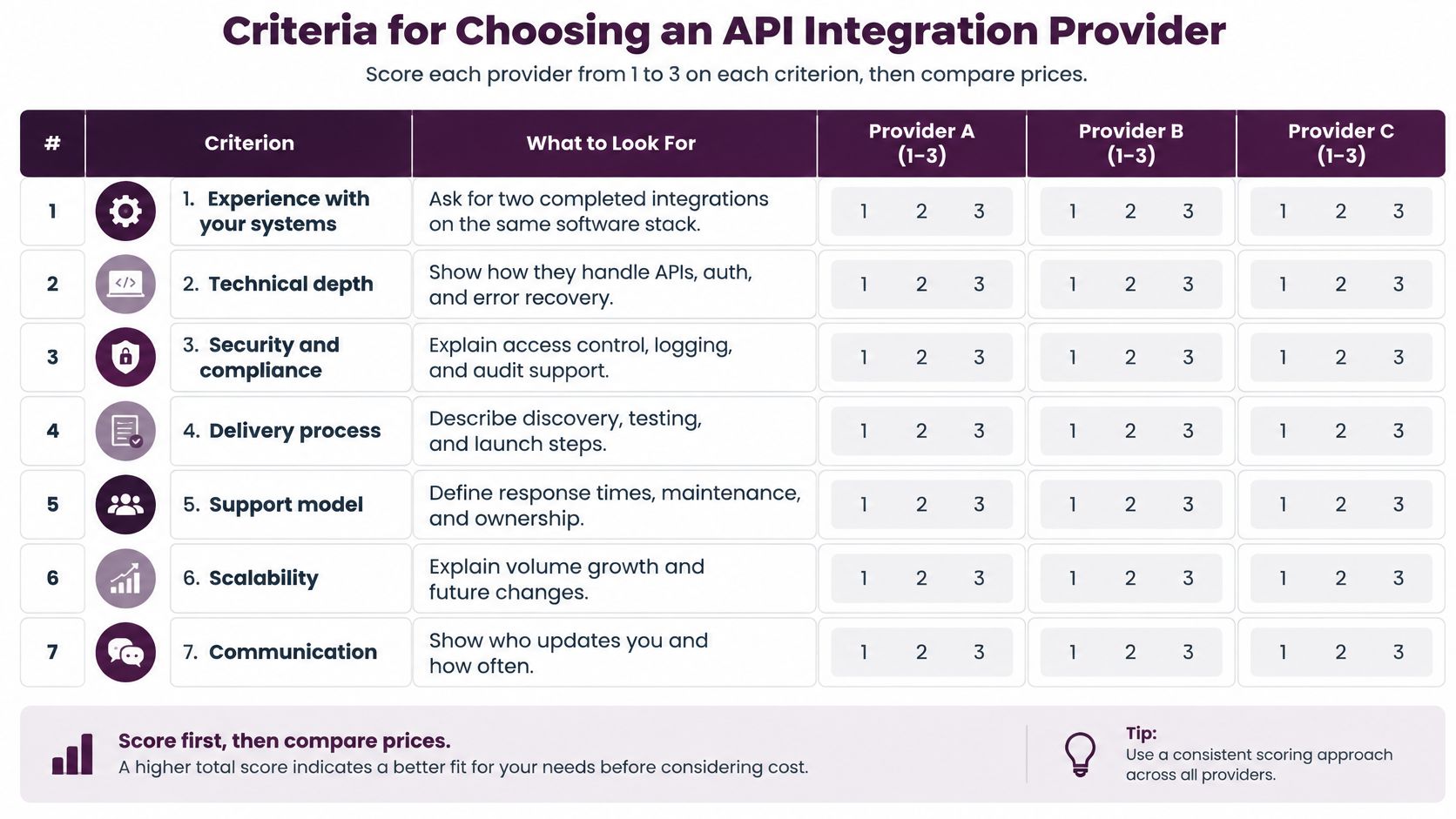
- Experience with your systems. Ask for two completed integrations on the same CRM or help desk, plus references.
- Discovery before pricing. The team should map workflows, fields, and performance goals before quoting.
- Configuration control. Ask which changes can be configured and which require development. Confirm approvals, test environments, deployment records, and rollback procedures.
- Security practice. Ask how access is tested at the record and function level, and what evidence they will share.
- Reliability commitments. Request the availability target and who is alerted when it is threatened.
- Language and time-zone fit. Match agent-language coverage to the customer workflow and technical on-call coverage to incident needs. Agents should have clear escalation paths rather than being expected to fix connector code.
- Team model. Confirm whether delivery uses dedicated or shared resources. Name the engineering owner, operating owner, backup contacts, and escalation responsibilities after launch.
Set weights and acceptance criteria around your risks. A total such as 15 out of 21 is not an industry standard and should not allow weak authorization, missing recovery plans, or unclear ownership to pass. Assess the commercial proposal alongside the operating and engineering evidence.
Red flags are easy to spot. Fixed templates with no discovery step, a promise of 100% uptime, and a refusal to share a sample runbook all fail the test. Agent training and technical delivery solve different problems; require both where the scope needs them. A perfect pipe is worthless if agents ignore the new screen and go back to the old tabs.
How Integration Projects Move from Discovery to Go-Live
Agree on phase gates before dates. Delivery time depends on access approvals, vendor limits, system count, data quality, and build complexity. The sequence below is a planning framework, not a standard CallZent implementation timeline.
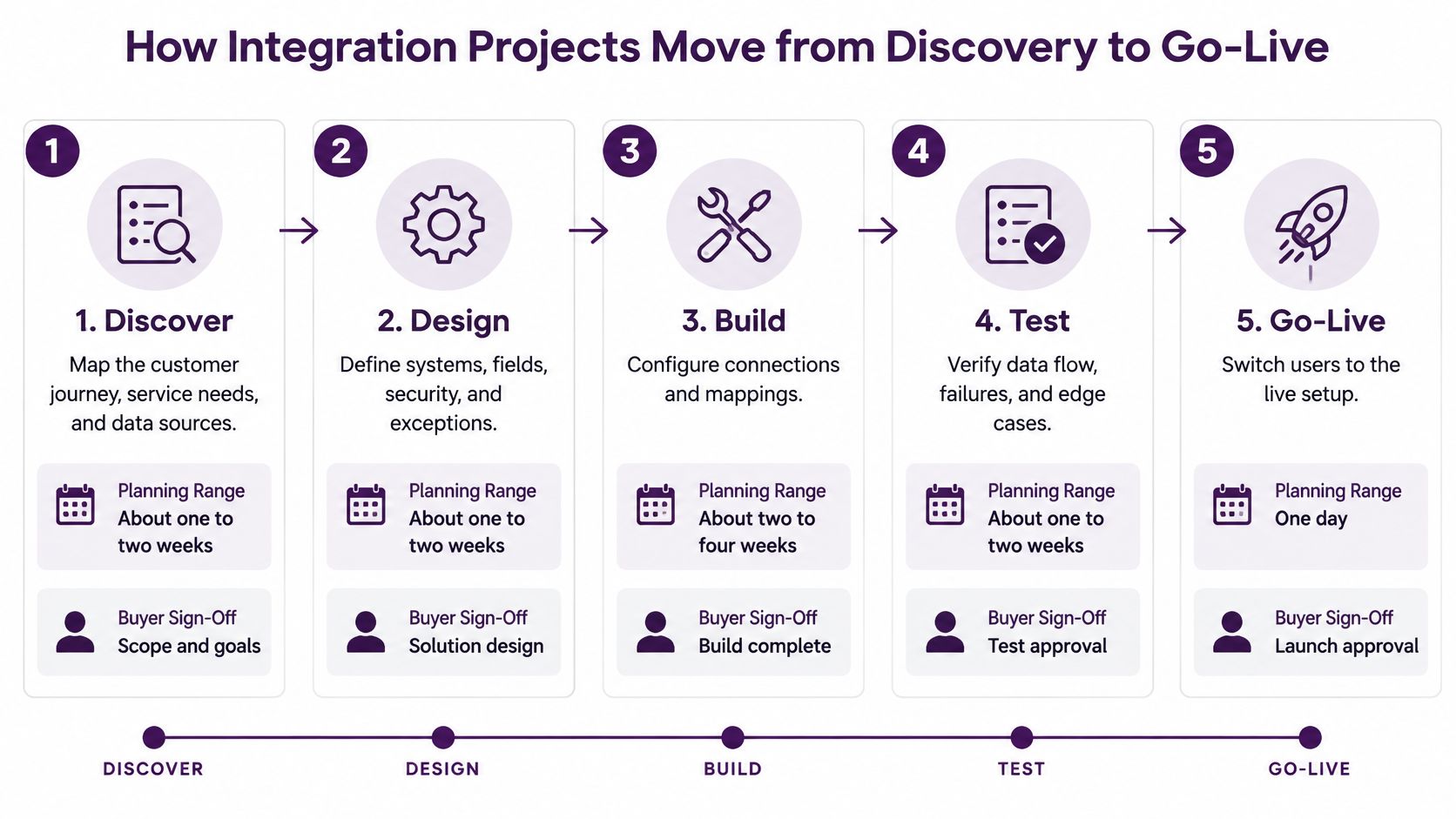
- Discover. The project team examines the customer journey, service expectations, workflows, technology, and performance goals, then list the three workflows that cost the most time. You sign the scope and the goals.
- Map and align workflows. For each field, write the trigger, the owner, and the failure path. You sign the data map. Specify event ordering, conflict resolution, data freshness, and reconciliation as well as field formats.
- Build and test. Build in a test environment. Run normal cases, timeouts, wrong IDs, expired tokens, rate limits, duplicate events, and out-of-order updates. You sign that the build matches the map.
- Train and implement. Agents learn the script and the new screen. A small pilot uses the workflow first. You sign pilot results before the wider group switches.
- Go live with a reliability target. Agree the availability number before the switch, and keep a tested rollback.
- Monitor and optimize. Review failed requests weekly. Expand only after the first workflow shows it cuts manual work. Use the same ownership discipline throughout the program. The operating detail sits in managing outsourcing projects.
Reliability Targets Before Launch
Define a service-level indicator, its target, and the measurement window. Google’s SRE guidance on service-level objectives distinguishes the measure from its goal. For an integration, success may require a correct update within a freshness limit, not merely an HTTP success response.
For a request-based SLO, a 99.9% target allows 0.1% of eligible requests to miss the defined objective during the window. A 99.99% target allows 0.01%. These illustrative budgets describe the selected measure; they are not automatically equivalent to time-based downtime allowances.
Google’s example error-budget policy shows how teams can connect reliability results to release decisions and incident review. Its thresholds are an example, not a universal contract requirement. Agree on your own escalation, release restrictions, urgent-fix exceptions, and recovery criteria.
Make Retries Safe and Failures Visible
A timeout does not prove that an action failed. A booking or payment may already have completed before the response was lost. AWS’s guidance on idempotent APIs explains how request identifiers can support safe retries. Use the vendor’s supported mechanism, bound retries, respect rate limits, and reconcile ambiguous outcomes before repeating a write.
Show agents when information is stale or an update remains pending. Route unresolved exceptions to a named owner, retain approved diagnostic evidence, and test recovery without creating duplicate tickets, bookings, or financial actions. Monitor failures during operation; a weekly review alone is not an incident response.
A finished launch includes a documented data map, defined ownership, meaningful alert thresholds, a tested rollback, and a plan to reconcile work created during a failure.
Security and Compliance Controls to Require
A login check is not an authorization check. The integration can confirm that someone signed in and still hand them any record whose ID they type. That is the flaw that shows up after a quiet quarter of “we’re fine.”

OWASP’s 2023 API Security Top 10 names Broken Object Level Authorization as API1. Endpoints often expose object IDs, so object access must be authorized for the requesting identity and context. It lists Broken Function Level Authorization as API5, which shows up when admin and ordinary permissions are not separated. Permission to read one ticket must not automatically grant access to unrelated or unauthorized records or administrative actions. Test other users’ IDs, role changes, hidden endpoints, and calls made outside the front-end app.
Controls to put in the contract
- Record and function tests: prove the agent can open only the records and actions their role allows.
- Permission split: keep administrative endpoints off the agent token.
- Inventory owner: name one person for every API.
- Secrets rotation: use approved secrets storage, short-lived credentials where supported, planned rotation and revocation, and tested recovery from expiry or compromise.
- Version retirement: set a date to turn off old versions.
- Live monitoring: alert on relevant authentication failures, unusual access, and processing errors; redact sensitive payloads and secrets from logs.
- Incident path: write who is called, in which language, and how evidence is kept.
For healthcare integrations, HL7’s FHIR overview describes a standard for electronic healthcare-information exchange. Confirm the version, profiles, supported resources, capabilities, and authorization model required by the actual systems. Using FHIR does not itself establish legal compliance or permission to disclose patient data.
Assess applicable privacy, payment, and sector requirements with the responsible client and technical teams. Define approved data flows, access, retention, contractual responsibilities, and incident procedures. CallZent’s security and compliance guide for nearshore BPOs and data security overview provide starting points for discussing the program’s safeguards; confirm the exact scope and evidence.
Hand the provider this short list before kickoff. Who owns the API inventory? Which tests cover other users’ IDs? When do secrets rotate? Which old versions die, and on what date? Who is paged at 2 a.m., and in which language is the runbook written?
A confident security slide is not the same thing as a passed authorization test.
What API Integration Services Cost and Why Prices Differ
Agent staffing and API engineering are separate budget categories. Connector licenses, custom mappings, and reliability requirements can materially affect total cost. Two quotes that look close on labor can be far apart once seats and monitoring are visible.
| Cost factor | What changes the price |
|---|---|
| Agent labor rate | Skill, language, and experience |
| Connector licenses | Per-seat CRM, telephony, or premium platform fees |
| Custom integration build | Number of data mappings and endpoints |
| Coverage hours | Extended or 24/7 operations |
| Compliance controls | HIPAA, PCI, or financial-services requirements |
| Monitoring and support | Alerting, on-call coverage, and reliability reporting |
Do not use an agent labor rate as a proxy for API development cost. Request separate estimates for discovery, implementation, platform or connector usage, testing, security review, monitoring, and maintenance. If the program includes agents, price their staffing and training explicitly. No general hourly figure establishes the full project cost.
Specialized technology, custom integrations, extended or 24/7 coverage, and specialized workflows are program-specific items that can change the rate. Additional endpoints can increase mapping and testing effort. Extended support may require additional on-call staffing; confirm what is included. Applicable requirements can add control and evidence work. If a quote hides those lines inside one blended number, you can’t tell whether you are buying agents or buying Salesforce seats.
Ask every provider for a line-item quote that separates labor, licenses, build work, and monitoring. Lay those lines next to the BPO pricing models you are already comparing so a cheap hourly rate doesn’t hide a costly connector. The first cost question is operational. Which workflow, if automated, removes the most paid manual work each month?
Start With One Workflow and Measure It
More connections do not automatically create a better program. Every added dependency needs ownership, monitoring, and recovery. Prioritize workflows that reduce measurable customer or agent friction rather than trying to connect every application.
Rank candidates by transaction volume, revenue impact, customer-experience risk, regulatory sensitivity, exception frequency, data quality, and recovery difficulty. Strong first workflows are narrow. Order-status sync for a store, appointment updates for a clinic, payment reconciliation for a lender, and CRM context on the agent desktop are the usual winners.
Track four outcomes before and after: manual handling time per comparable case, repeat-contact rate, resolution time, and processing-error rate. Include volume, case mix, observation windows, and exception/rework effort so seasonal changes do not look like integration gains. If those don’t move, stop and fix the workflow before you add another system.
Bilingual intake can serve English-speaking and Spanish-speaking prospective clients through one consistent intake workflow, which is a clean first build when both languages hit the same script. Reservation teams can work inside booking platforms, CRM tools, shared calendars, email, and the channels you already approved, instead of a second booking site.
Leave a workflow manual when volume is low or the data is unreliable. A human-in-the-loop step beats a bad sync that writes the wrong appointment into a calendar and then pages someone to undo it.
Maximum connectivity can raise failure-management cost without improving the call.
Prepare five workflows, current volumes, the systems involved, required languages, and coverage hours. Use that list to scope a discovery discussion and agree which workflow to measure first, including engineering responsibilities and the operational support needed.
Frequently Asked Questions
What are API integration services?
API integration services design, implement, test, and maintain connections between software systems. They can retrieve approved information, synchronize records, or trigger actions. A complete scope should cover field ownership, authorization, failure handling, monitoring, support, and change management.
Which contact center systems are commonly integrated?
Common candidates include CRMs, telephony platforms, help desks, payment-status tools, scheduling systems, and approved healthcare applications. Start with the workflow causing the most measurable friction. Confirm API availability, permissions, vendor limits, and supported fields before committing to a build.
Does API integration mean agents need only one application?
Not necessarily. An integration may combine selected information in one workspace or coordinate background processes while agents retain several tools. Success depends on accurate context, reduced repeated work, and reliable actions rather than the number of applications visible on screen.
How should responsibilities be divided between a BPO and an integration developer?
Name who owns connector code, platform administration, credentials, access approval, agent procedures, incident response, and vendor changes. The BPO’s operating role does not automatically include software development or technical on-call support. Confirm inclusions, backups, and escalation paths in writing.
How can retries create duplicate appointments or payments?
A server may complete an action even when the response times out. Repeating the request can then create another action. Use supported idempotency mechanisms, bounded retries, and reconciliation of uncertain outcomes. Do not assume that every failure response means the original operation did nothing.
What reliability metrics should an integration use?
Measure outcomes such as correctly completed updates, data freshness, processing latency, failed requests, unresolved exceptions, and recovery time. Define eligible events, targets, windows, and exclusions. An HTTP success response alone may not prove that the customer’s task completed correctly.
Which API security controls should buyers require?
Require authorization for permitted records and actions, least-privilege access, protected credentials, inventory ownership, and relevant monitoring. Test unauthorized requests and role changes. Keep sensitive payloads and secrets out of logs, and document credential revocation, incident escalation, and evidence handling.
Does using FHIR make a healthcare integration compliant?
No. FHIR provides a healthcare-information exchange standard, but it does not itself establish legal compliance or authorize data disclosure. Validate the required version, profiles, supported resources, access model, approved data flows, contracts, and operational safeguards for the actual program.
How much do API integration services cost?
Cost depends on scope, systems, vendor capabilities, data mappings, transaction volume, security, implementation effort, and ongoing coverage. Separate engineering, licenses or usage, monitoring, maintenance, and agent staffing where relevant. A contact center agent rate is not an API-development quote.
How should a business measure an integration pilot?
Record comparable baselines for manual work, repeat contacts, resolution time, and processing errors. Test permissions, duplicates, expiry, outages, and recovery before expansion. Review data freshness, exception effort, customer impact, and total operating cost alongside the intended efficiency gains.
Bilingual Nearshore Support in Mexico
Build Support Around Connected Workflows
Bring your systems, workflow priorities, language requirements, and support goals to CallZent. Define the operating scope, technical dependencies, and responsibilities your program needs.