Skip to content

B2B Lead Generation & Sales Operations
B2B Lead Generation Outsourcing: A Practical Buyer’s Guide
Evaluate outsourced prospecting, qualification, and appointment setting through response speed, sales acceptance, outreach controls, and measurable pilot results.
TL;DR — Quick Takeaways
- Outsource a defined coverage or qualification bottleneck, not an unresolved sales strategy.
- Agree on prospect fit, qualification evidence, and the point where sales takes ownership.
- Measure attempts, conversations, accepted handoffs, opportunities, and revenue separately.
- Approve outreach by channel and keep inspectable source and suppression records.
- Pilot a narrow segment, review quality and total cost, and expand with evidence.
Buying more meetings isn’t a strategy for building better pipeline. The usual advice about B2B lead generation outsourcing starts with lower costs and more outreach. A better starting question is whether an external team can respond quickly without weakening buyer trust.
That changes what you buy, how you evaluate providers, and what belongs in the contract. Speed matters, but so do accurate qualification, appropriate consent, and a handoff your sales team can use.
What B2B Lead Generation Outsourcing Really Means
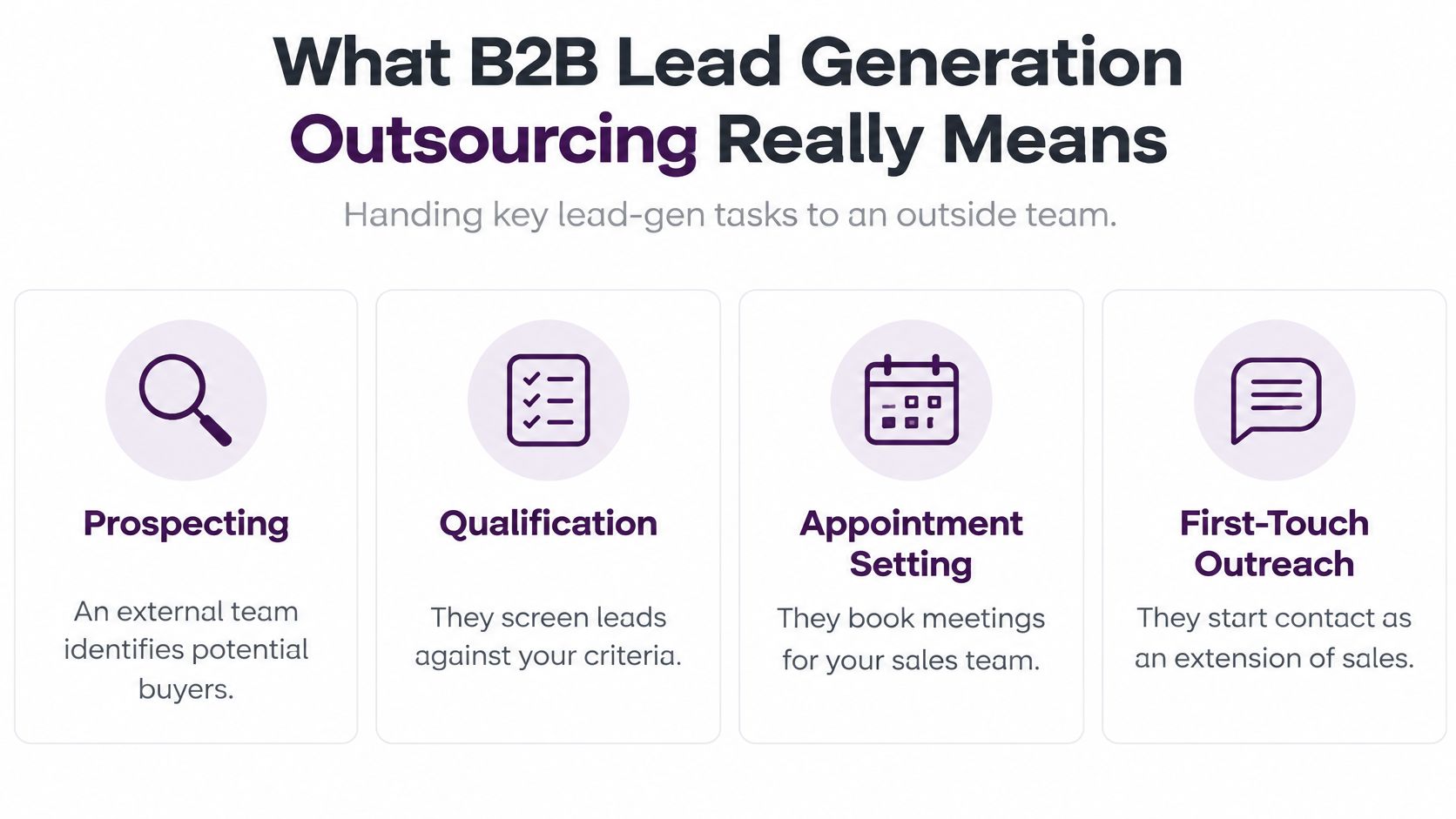
B2B lead generation outsourcing means assigning prospecting, qualification, appointment setting, and initial outreach to an external team. That team works alongside your sales department, with agreed responsibilities and a defined handoff point.
Think of a relay team. Your provider runs the opening leg, identifies suitable prospects, starts conversations, and establishes whether further discussion makes sense. Your closers receive the baton with enough context to continue, not start again.
What buyers actually purchase
The deliverable isn’t a contact. It’s a completed piece of sales work, supported by evidence.
- Prospecting: Identify organizations and people that fit your target market.
- Qualification: Establish relevant fit, business need, buying role, and a sensible next step.
- Appointment setting: Coordinate an appropriate conversation with the right internal seller.
- First-touch outreach: Represent your company accurately through approved calls and messages.
For an illustrative software campaign, the external team might identify operations managers, discuss a workflow problem, and document the prospect’s current approach. The internal seller then receives the business context and agreed meeting purpose.
That’s different from receiving a name, an email address, and an unexplained calendar booking.
Define the operating scope before buying capacity
A prospecting program, an inbound-response queue, and an appointment-setting campaign require different data, skills, and handoffs. Specify who supplies records, who validates them, which channels are approved, what agents can promise, and when sales takes ownership.
Software access and a contact list do not provide that accountability on their own. Buy a defined process with evidence of the work completed and an agreed method for handling exceptions.
Buying a list supplies records. Running automated ads attracts attention. Outsourced lead generation adds people responsible for turning suitable interest into a documented sales conversation.
Key takeaway: Buy a reliable handoff, not a larger pile of names.
Benefits, Risks, and When to Outsource
A capable internal sales team can still struggle with coverage. Prospects submit inquiries outside normal working hours, campaign launches create uneven workloads, and experienced closers spend time sorting records instead of speaking with buyers.
Outsourcing can address those capacity problems. It doesn’t automatically solve weak positioning, an unclear offer, or disagreements about which buyers matter.
The useful benefits and their trade-offs
| Potential benefit | Trade-off to investigate |
|---|---|
| Broader time-zone coverage | Who supervises quality outside your office hours? |
| Flexible campaign capacity | How does the provider train additional agents? |
| Access to sales-development skills | Can agents explain your offer beyond the script? |
| Less internal recruiting work | How much product training and management must you still provide? |
Consider an illustrative equipment supplier launching a distributor campaign. An external team could handle initial conversations while internal specialists handle technical questions. That arrangement works only if agents know where their authority ends and can transfer questions without improvising answers.
Generic outreach creates the opposite result. An agent who promises unavailable functionality or books an irrelevant buyer creates cleanup work for sales and confusion for the prospect.
Speed versus trust
The decision often concerns speed versus trust, not external versus internal staffing. Faster execution helps only when buyers receive credible answers and sellers receive useful context.
Use an outsourcing cost-benefit analysis to include internal oversight, training, systems access, and rejected-lead handling. Compare the full operating arrangement, not just an agent rate against an employee salary.
Outsource when lead volume exceeds internal capacity, response coverage is the identifiable bottleneck, and your team can document qualification standards. Wait when sales can’t explain why it accepts or rejects a prospect.
Also check closing capacity. There’s little value in accelerating initial outreach if accepted prospects then wait for an unavailable account executive.
How to Choose a Vendor With a Practical Checklist
Ask competing providers to demonstrate the same workflow using a fictional prospect. A polished presentation won’t tell you whether an agent can handle an incomplete record, an industry-specific objection, or a request to stop contact.
A practical comparison should make weak answers visible.
Compare evidence across the same criteria
| Criterion | Ask the provider to demonstrate |
|---|---|
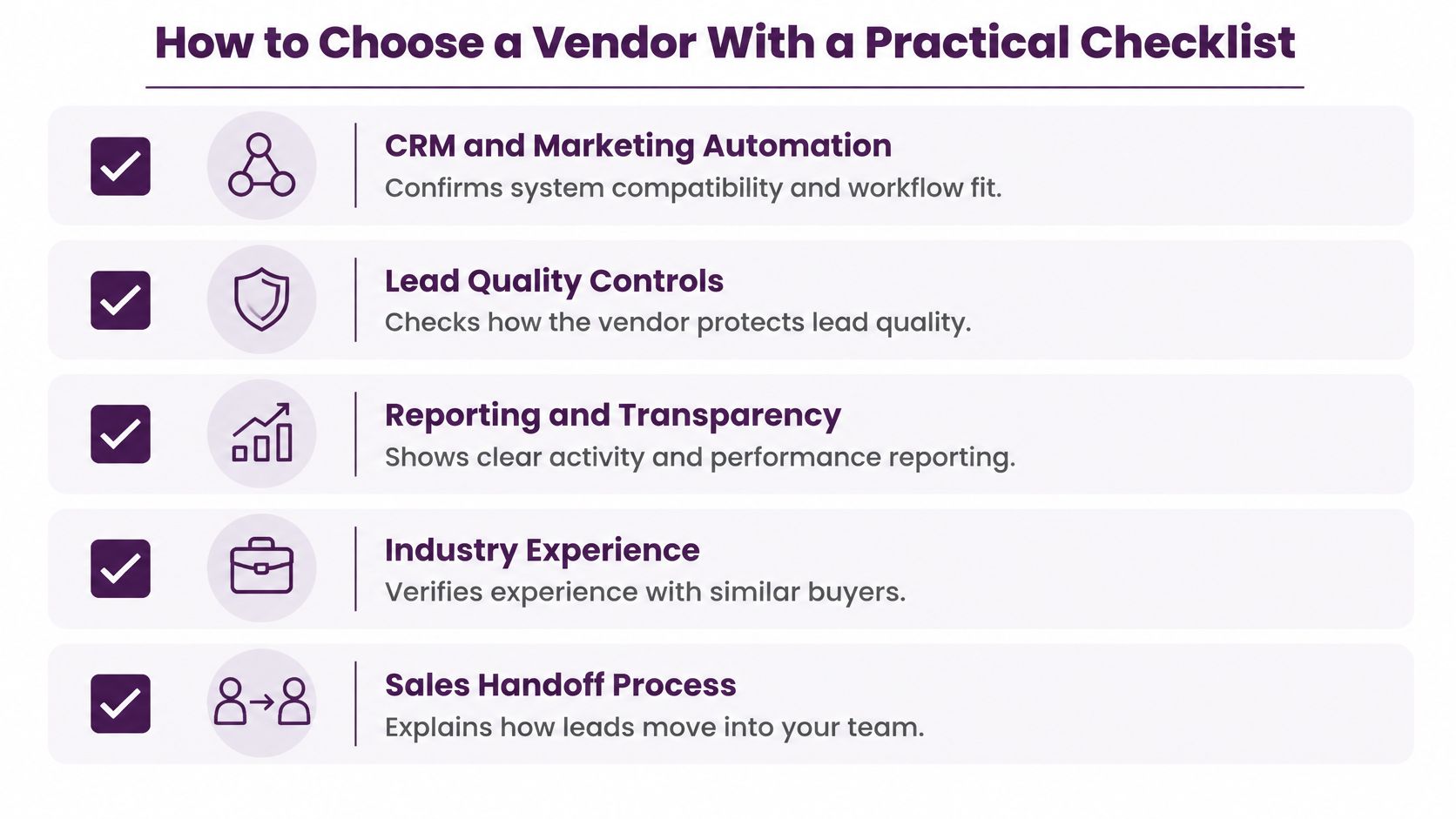
| CRM and marketing automation | Trace a web inquiry through assignment, outreach, and activity logging. |
| Language coverage | Handle the same objection in English and Spanish without changing its meaning. |
| Qualification discipline | Explain a disqualification and show the required CRM fields. |
| Industry experience | Respond to a realistic buyer question and identify when escalation is necessary. |
| Transparent reporting | Connect an activity record to sales acceptance and opportunity status. |
Ask when the provider starts its response-time clock. Ask what happens when an inquiry arrives after hours. Then ask where a rejected lead goes and who can inspect the rejection reason.
Those questions reveal whether the provider owns a process or merely supplies agents.
For bilingual campaigns, test conversational judgment rather than pronunciation alone. A prospect asking for written details shouldn’t be recorded as ready to buy because the agent secured permission to send an email.
Turn promises into yes-or-no checks
Use the same documented evaluation criteria to keep procurement, sales, and operations aligned. Record what evidence each provider supplied and which requirements remain unresolved.
- Industry references available: Can you speak with a relevant client, subject to confidentiality?
- Reviewed recordings available: Can you inspect permitted, appropriately protected examples and coaching notes?
- Data handling documented: Are access, retention, deletion, and incident responsibilities written down?
- Replacement terms defined: Does the agreement explain how inaccurate or improperly sourced contacts are handled?
- Paid pilot available: Can you test the operating model before committing to broader coverage, and what are its scope, price, and exit terms?
CallZent can discuss a bilingual nearshore program around your targeting, qualification, coverage, and CRM requirements. Compare the proposed scope with an internal team, a specialist agency, or temporary staffing using the same evidence requirements.
A vendor’s willingness to show rejected leads can tell you more than its presentation of successful meetings.
Keep the final decision tied to observable behavior. References provide context, but a working demonstration shows how the provider would handle your records and represent your company.
KPIs and Pricing Models That Measure Real Results
A booked meeting is an intermediate event. It doesn’t prove that the prospect fits your market, has a relevant problem, or belongs in an active sales process.
Define marketing-qualified leads, or MQLs, and sales-qualified leads, or SQLs, before comparing reports. Otherwise, providers can use identical labels for very different levels of buyer readiness.
Define funnel stages and their measurement rules
Use your own baseline rather than a generic conversion range. Define each stage, its eligible population, and the observation window. Compare similar sources and customer segments, and give longer buying cycles enough time to mature.
| Funnel stage | Evidence to require | Measurement rule |
|---|---|---|
| Lead to MQL | Target-market fit and completed screening fields. | Define eligible leads, duplicates, exclusions, and the qualification window. |
| MQL to sales acceptance | Sales confirms the handoff meets jointly approved criteria. | Track acceptance, rejection, pending review, and rejection reasons separately. |
| Accepted lead to opportunity | An internal seller verifies a business need and creates an opportunity. | Keep the stage definition and original source cohort consistent. |
| Opportunity to closed outcome | A recorded won, lost, or still-open status with a documented value where appropriate. | Report the observation period and attribution method; do not treat open deals as losses. |
Lowering qualification standards can fill more calendars while creating fewer useful opportunities. For example, a prospect who accepts a general information call shouldn’t automatically count as sales-qualified.
Require evidence of fit, buying role, need, timing, commercial pathway, channel eligibility and consent where required, and an agreed next step where relevant. Document unknowns rather than encouraging agents to invent qualification answers. Keep sales acceptance, opportunity creation, and closed revenue separate.
Pricing determines who carries the risk
- Per lead: The buyer carries more qualification risk unless acceptance requirements are explicit.
- Per qualified lead: The provider carries more screening responsibility, but definitions can become disputed.
- Per meeting: The provider is rewarded for bookings, so attendance and sales acceptance need separate controls.
- Hourly or seat-based: The buyer purchases capacity and retains more responsibility for productivity.
- Hybrid retainer with outcome bonuses: Both parties share incentives, provided outcomes are verifiable and within the provider’s influence.
The BPO pricing-model guide can help structure that commercial discussion.
Review weekly cohorts by source, industry, language, agent, campaign, and time to first contact. Keep later-stage outcomes attached to their original cohort so a long buying cycle doesn’t make recent outreach appear unsuccessful prematurely.
Ask which costs include research, training, management, technology, and rework. A lower headline price is not necessarily a lower cost per accepted opportunity. For a defined campaign cohort and cost boundary, divide the relevant program cost by the number of accepted opportunities produced by that cohort. Include agreed research, onboarding, management, technology, internal review, and rework costs. State which costs and outcomes are still pending; a zero-opportunity cohort has no finite cost-per-opportunity result.
Governance, Consent, and Quality Controls That Protect Your Pipeline
Outreach governance belongs in vendor selection. A provider should be able to explain where a contact came from, which permissions or other applicable grounds support the planned use, and how restrictions are enforced.
Do not accept a spreadsheet marked consent obtained as sufficient evidence when consent is required. Require the supporting record and a process for holding questionable contacts out of outreach.

Approve outreach by channel and campaign
A B2B label is not blanket permission to contact a person through any channel. Requirements depend on the communication method, technology, recipient, jurisdiction, and other campaign facts. Have the responsible compliance owner approve the actual workflow and keep that approval current.
The FTC CAN-SPAM guide states that commercial B2B email is covered. It describes accurate sender and subject information, a valid postal address, an opt-out method, and honoring opt-outs within 10 business days. Hiring another company does not remove the advertiser’s responsibility. Email authentication supports delivery and identity checks; it does not establish legal permission.
The FTC’s 2024 Telemarketing Sales Rule amendments address material misrepresentations in B2B telemarketing, among other changes. Do not assume all consumer-call provisions apply identically to every B2B program, or that a B2B exception resolves other federal or state requirements. Calling and texting need their own review, including applicable consent, do-not-call, revocation, recording, and technology rules.
Require an inspectable record
The service-level agreement should identify required documentation and who validates it.
- Source evidence: Record origin and acquisition date; retain the original form, disclosure, timestamp, and identified seller where consent or an inquiry supports outreach.
- Channel eligibility: Approved contact methods, supporting evidence, permissions where required, and any limitations.
- Suppression results: Applicable checks, opt-outs, and the process for preventing further outreach.
- Language records: The wording shown or spoken in the prospect’s preferred language.
- Accountability terms: Responsibilities for invalid lists, incident escalation, subcontractors, and legal review.
An illustrative financing inquiry submitted through a comparison form shouldn’t automatically trigger outreach from unrelated businesses. The compliance owner should validate the permitted use before agents receive the record.
Document compliance responsibilities alongside scripts, access controls, retention, suppression synchronization, and incident handling. Use call-review sampling to check whether agents honor refusals, avoid unsupported claims, and record outcomes accurately.
Operating standard: A contact record that can’t pass the agreed evidence check stays out of the calling queue.
Clients should be able to inspect the audit trail without waiting for a renewal discussion or a complaint.
A Practical Implementation Roadmap From Pilot to Scale
Launch readiness means more than having agents available. Your systems, internal sellers, and escalation owners must be ready to support the same operating process.
Use written decisions at each phase. That prevents an early activity spike from becoming an automatic expansion.
Connect systems and prove the response clock
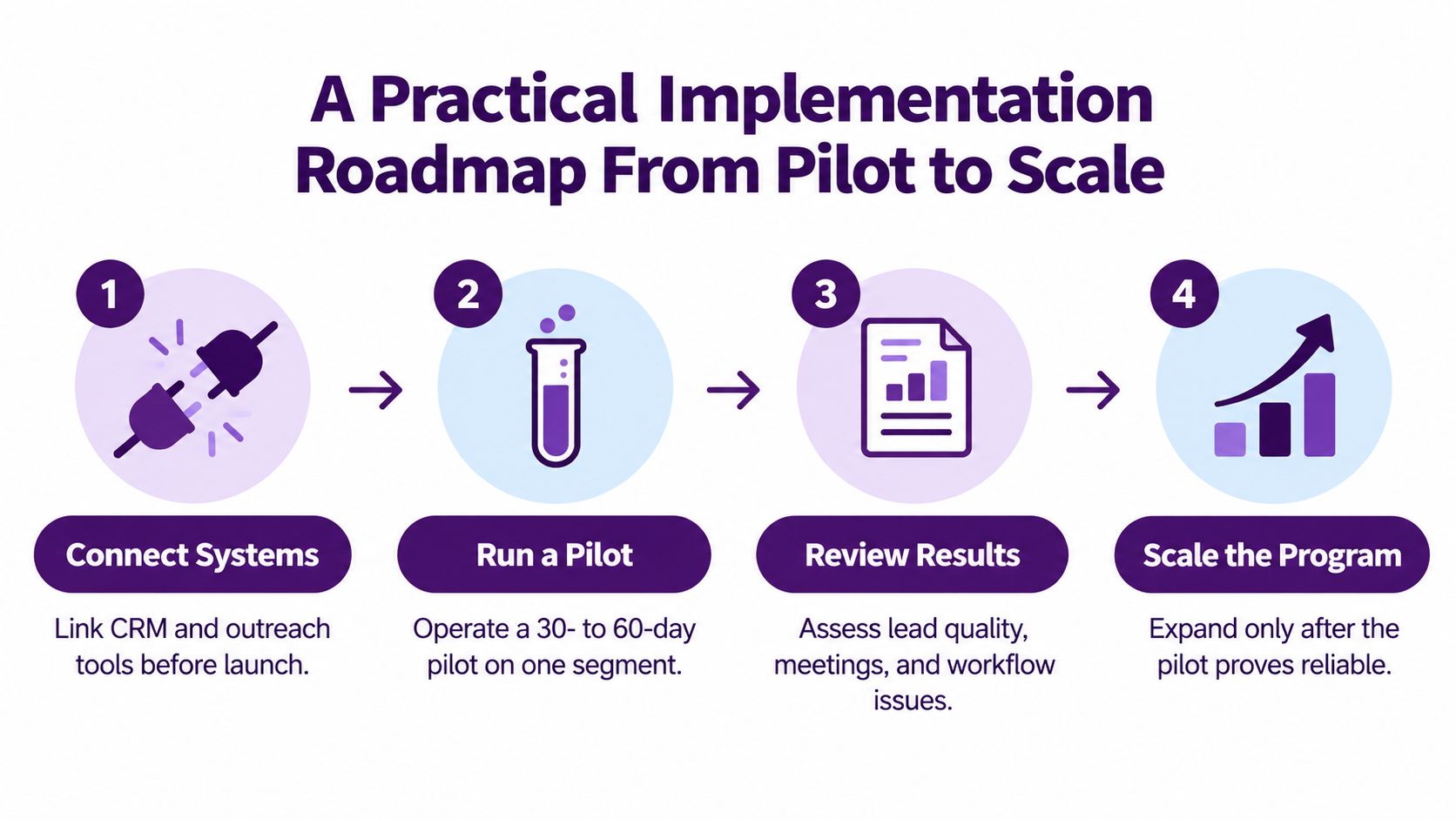
Connect web forms, the CRM, marketing automation, assignment rules, and outreach logging. Test duplicate handling, incomplete submissions, incorrect ownership, and failed notifications.
Set a first-attempt target that fits inquiry intent, staffed hours, lawful contact windows, and channel rules. For example, a five-minute target for eligible high-intent inbound requests during staffed hours can be a testable operating objective. It is an illustrative target, not a universal conversion benchmark or a CallZent guarantee.
Measure from original lead creation to the first documented eligible outreach attempt. Report elapsed time and, if used, a separate staffed-hours clock with clear rules. Do not restart the clock when an agent downloads a file, and do not equate an attempt or automated acknowledgment with a two-way contact.
Owner: Revenue operations.
Written decision: Approve launch only after test records complete the intended workflow.
Run a narrow B2B lead generation outsourcing pilot
Use a 30- to 60-day pilot as an illustrative planning window, with a narrow segment and jointly approved qualification criteria. Adjust duration to contact volume, setup dependencies, and the sales cycle; it is not a promise of closed revenue.
Specify retry intervals, channel sequencing, time-zone coverage, and escalation rules before agents begin. Route bilingual inquiries using declared language preference where available, and define what happens when the appropriate agent isn’t available.
For an illustrative demo request received outside staffed coverage, the system should preserve the original timestamp, assign ownership, and make the next action visible. It shouldn’t hide the delay in an unmonitored export.
Owner: Campaign manager.
Written decision: Confirm whether initial execution meets the agreed operating standards.
Review results at a go-or-no-go gate
Inspect permitted call samples, CRM completeness, sales rejection reasons, and lead-to-opportunity progression. Compare what agents recorded with what sellers learned during follow-up.
- Continue: The workflow is reliable and sales accepts the prospects.
- Revise: A specific targeting, messaging, or routing issue is correctable.
- Stop: Evidence gaps, repeated misrepresentation, or unresolved quality failures make expansion inappropriate.
Owner: Sales leader.
Written decision: Continue, revise, or stop with documented reasons.
Scale by segment
Expand coverage only after the pilot passes its review. Add segments with their own training requirements and performance views rather than combining everything into an aggregate report.
Apply disciplined outsourcing project management so changes have owners, approvals, and rollback conditions.
Owner: Client operations sponsor.
Written decision: Approve the next segment and its capacity limits.
Industry Examples and Your Next Step With CallZent
These scenarios are illustrative, not client case studies. Some involve customer inquiries rather than strictly B2B prospecting, but the same operating controls apply: identify the risk, assign the control, and measure the result that matters.
Healthcare and financial services
A healthcare organization asks an external team to follow up on inquiries about employer services. The risk is collecting or exposing unnecessary sensitive information during initial screening.
Limit the script to approved administrative questions, restrict record access, and escalate clinical questions. Track appropriately routed, accepted inquiries alongside documentation exceptions.
An insurance broker receives business quote requests while its internal producers are occupied. The risk is an inaccurate coverage promise or an incomplete disclosure during the initial conversation.
Use approved language and transfer product-specific advice to authorized staff. Track accepted quote conversations, disclosure completion, and the time between inquiry and documented response.
E-commerce and telecommunications
A retailer’s wholesale team receives high-intent purchasing forms and questions about unfinished business orders. The risk is treating a service request as permission for unrelated marketing or repeating information the buyer already provided.
Preserve order context and distinguish requested assistance from a new sales campaign. Track qualified wholesale opportunities and completed handoffs, not just outbound attempts.
A telecommunications provider runs campaigns across business accounts with multiple lines. The risk is applying an account-level permission too broadly or missing a contact’s opt-out.
Validate the campaign’s permitted scope, maintain appropriate suppression records, and give agents a clear stop-contact process. Track compliant conversations, suppression exceptions, and sales-accepted opportunities.
Make the next step concrete
Bring a target segment, sample inquiry records, an approved offer, and your current rejection reasons to a scoping discussion. Discuss a focused pilot with a shared scorecard, suitable observation window, and scheduled review, using the same evaluation gates described above. Confirm availability, price, staffing, and timing in the proposal.
The Tijuana call center team can discuss the coverage, language, and workflow requirements. Agree on who owns each handoff before agreeing on additional volume.
Frequently Asked Questions
What is B2B lead generation outsourcing?
It means assigning defined prospecting, initial outreach, qualification, or appointment-setting work to an external team. The provider and internal sales team agree on targeting, approved channels, qualification evidence, reporting, and when ownership transfers.
When should a business outsource lead generation?
Outsourcing may fit when response coverage, research capacity, or qualification work is a clear bottleneck and the sales team can explain which prospects it accepts. Clarify the offer, target market, and closing capacity before adding outreach volume.
Is outsourced lead generation the same as buying a contact list?
No. A list supplies records. An outsourced program adds defined work such as record validation, approved outreach, qualification, documentation, and handoff. The contract should state who supplies the data and who checks its suitability for each channel.
What should count as a qualified B2B lead?
Use jointly approved criteria relevant to the campaign, such as organization fit, contact role, business need, timing, and an agreed next step. Require supporting notes and document unknowns. A meeting booking alone does not establish qualification.
How should sales evaluate outsourced appointments?
Track whether the meeting was appropriately qualified, accepted by sales, attended, and progressed to an opportunity. Keep these events separate, record rejection and no-show reasons, and agree how disputes or replacements are handled.
Which KPIs matter most for outsourced lead generation?
Review time to eligible outreach, two-way contact rate, qualification, sales acceptance, meeting attendance, opportunity creation, and later closed outcomes. Define denominators, observation windows, campaign cohorts, and cost boundaries before comparing results.
How much does B2B lead generation outsourcing cost?
Cost depends on research, staffing, language coverage, technology, supervision, outreach scope, and the pricing model. Compare written proposals using the same assumptions and include onboarding, internal oversight, and rework rather than relying on a headline rate.
Does B2B outreach always require consent?
Requirements vary by channel, technology, recipient, jurisdiction, and campaign facts. Do not assume that every B2B contact needs the same consent or that a business contact is unrestricted. Have the responsible compliance owner approve the actual workflow and evidence requirements.
How long should a lead generation pilot run?
Choose a duration and sample that can test execution and handoff quality. A 30- to 60-day window is an illustrative planning option, not a standard or revenue guarantee. Longer sales cycles may require continued outcome tracking after the pilot.
Can a nearshore team support bilingual B2B lead generation?
A nearshore team can support English-Spanish outreach when proficiency, industry training, coverage hours, system access, and qualification standards fit the program. Test both languages and confirm staffing and escalation commitments in the proposal.
Bilingual Nearshore Support in Mexico
Build a Lead Generation Program Your Sales Team Can Use
Bring your target market, offer, coverage needs, and qualification criteria to CallZent. Discuss a bilingual nearshore program with defined handoffs, shared reporting, and a focused pilot scope.