

B2B Customer Care & Nearshore Support
B2B Customer Care: Build Support That Protects Business Relationships
Create a B2B support operation with clear ownership, connected account context, useful KPIs, and reliable English-Spanish coverage.
TL;DR — Quick Takeaways
- B2B customer care helps business customers resolve post-sale issues and keep operations moving.
- Prioritize severity, permissions, contract commitments, and accountable handoffs.
- Measure response and resolution separately, alongside quality, effort, and open-case age.
- Use AI within tested boundaries and preserve context when a person takes over.
- Compare delivery models using actual scope, language coverage, controls, and total cost.
A billing correction that never arrives, an outage without an owner, or an order change that disappears between departments can weaken a business relationship long before renewal. B2B customer care is the ongoing support a company provides to its business customers after the sale. It helps customers keep their operations moving while protecting confidence in the relationship.
That work deserves more attention than a ticket count. An agent may be helping an end user, a finance manager, and an account owner with different parts of the same problem. A dependable operation preserves context, defines decision authority, and makes the next step clear—even when several teams contribute to the answer.
What B2B Customer Care Includes
B2B customer care covers onboarding questions, technical assistance, billing disputes, order changes, service updates, and coordination with account teams. Customer care and customer success may share information, but their responsibilities should remain explicit. A support agent can resolve a case and surface renewal risk without owning the commercial renewal or having authority to change a contract.
A customer care orientation helps establish consistent habits: understand the business impact, take ownership, communicate accurately, and follow through. The practical goal is to prevent a customer from becoming the coordinator of your internal departments.

Connect Service Performance With Account Outcomes
Review service history alongside retention and account health. Repeated billing contacts, unresolved escalations, or missed commitments can identify relationships that need attention. They are risk signals, not proof that a support issue caused a cancellation. Pricing, product fit, procurement changes, and the customer’s own business conditions also affect renewals.
Compare similar account groups over time and ask account owners to validate what the signals mean. A delayed payment may reflect a disputed invoice, a cash-flow issue, or a normal procurement cycle. Good customer care investigates before applying a label.
How B2B Care Differs From Consumer Support
B2B cases often involve several stakeholders, negotiated service terms, and dependencies across customer operations. Consumer support can also involve complex, high-impact issues and long relationships. The distinction is useful for designing workflows, rather than ranking one type of customer as more important.
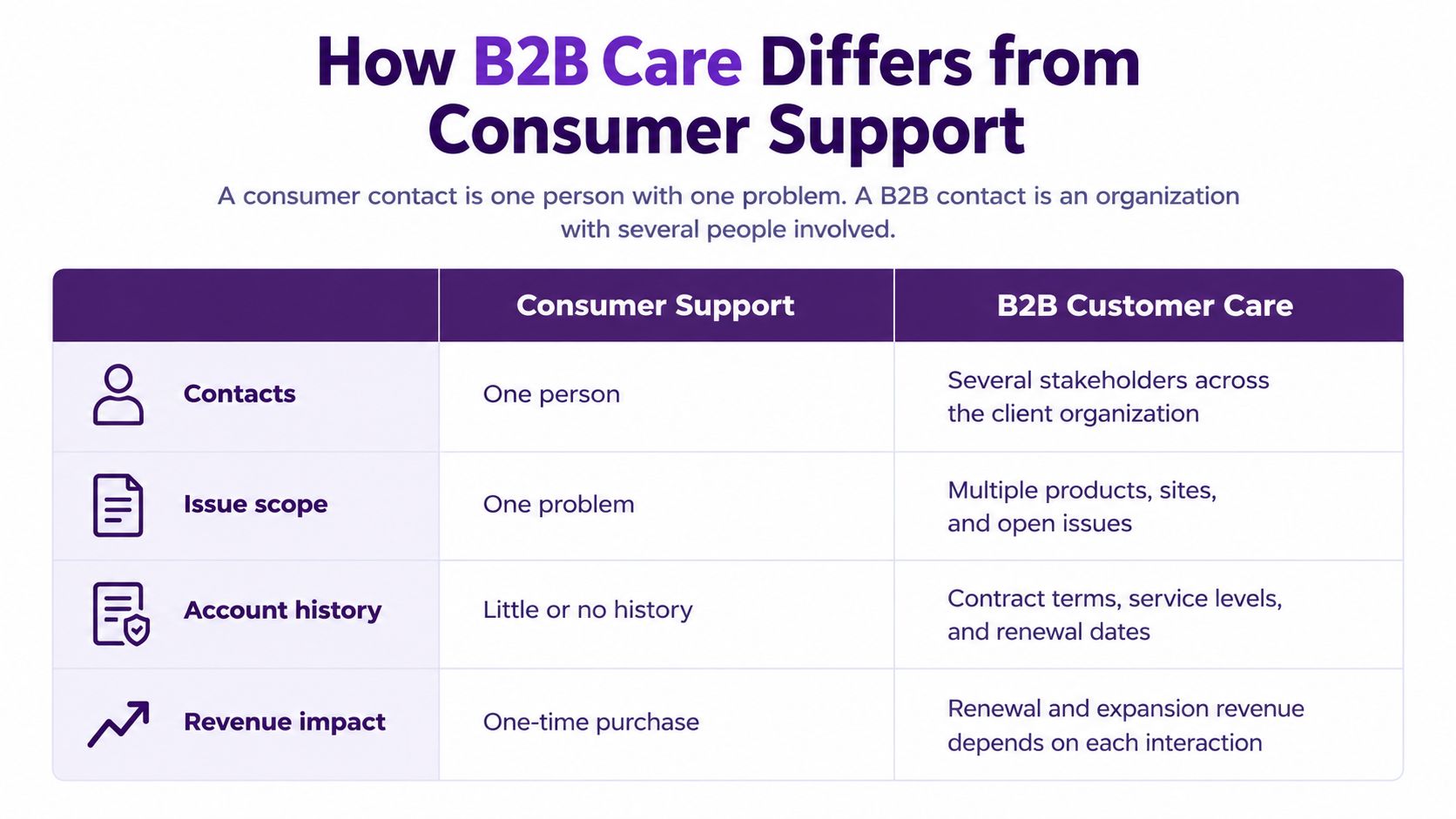
| Dimension | Common B2B considerations | Common consumer considerations |
|---|---|---|
| People involved | Users, administrators, procurement, finance, and account owners may share a case. | An individual or household often initiates the request; other parties may still be involved. |
| Service terms | Negotiated contracts, account permissions, and service commitments may shape the response. | Published policies and product terms often guide the interaction. |
| Context required | Account hierarchy, integrations, contract scope, and related incidents. | Identity, product or order history, preferences, and prior contacts. |
| Escalation | Technical, finance, operations, and commercial teams may need to coordinate. | Specialist or multi-team escalation may be needed depending on the issue. |
| Success measures | Resolution, effort, satisfaction, and account outcomes. | Resolution, effort, satisfaction, and customer retention. |
A clinic reporting a scheduling-system outage, for example, needs an agent who can recognize operational impact and activate the approved technical escalation. The agent should understand the account, communicate the next update, and avoid promising a repair time the technical team has not confirmed.
Core Strategies for Stronger Business Relationships
1. Prioritize Severity and Contract Commitments
Separate critical service interruptions from routine questions. Define severity using impact, urgency, available workarounds, and affected users. Account tiers may determine agreed coverage or dedicated resources, but safety, security, and major operational incidents need appropriate escalation regardless of account size.
Document acknowledgment targets, escalation ownership, update frequency, and restoration or resolution objectives separately. Acknowledging a case does not mean the problem is fixed. Use service commitments that your staffing, specialist availability, and dependencies can support.
2. Reduce Repetition and Customer Effort
Carry useful context through authorized handoffs: the issue, account details, troubleshooting already completed, commitments made, and next action. Preserve verification status when policy permits; require additional verification when a sensitive action or access change calls for it.
Agents should know which information they may share and who can approve credits, configuration changes, or contract exceptions. Convenience should not bypass authorization. A concise written recap helps the customer and the next team work from the same understanding.
3. Keep One Case History Across Channels
A customer may begin in a portal, send a document by email, and call for an update. Link those interactions to the right account and case, with role-based access to the information required. A channel change should not erase ownership or restart an existing service clock without a documented reason.
For English-Spanish programs, maintain terminology, knowledge articles, and handoff notes that support both languages. Staff the actual language demand by shift rather than assuming that a bilingual roster guarantees bilingual availability at every moment.
4. Act on Recurring Account Friction
Review repeated contacts and aging cases with account leaders. If three billing cases share the same underlying error, correcting each invoice independently leaves the cause in place. Assign an owner to investigate the pattern, fix the workflow, and explain the outcome to the customer.
Train agents to recognize these patterns and surface them. Effective agent training should cover account context, communication, permissions, knowledge use, and practical escalation decisions—not just a script.
B2B Customer Care KPIs That Support Better Decisions
Use a balanced scorecard. An average response time can conceal a critical case that waited too long, and a high closure count can hide premature closures. Segment results by severity, channel, customer group, and issue type before drawing conclusions.
| Metric | Definition to document | Decision it supports |
|---|---|---|
| First response time | Time from eligible receipt to the first substantive human response; define calendar or business hours. | Identify access and staffing gaps; distinguish automated acknowledgments. |
| Priority acknowledgment | Share of eligible priority cases acknowledged within the agreed threshold. | Check whether urgent cases reach an accountable owner. |
| Resolution time | Elapsed or business time to the defined resolution event; document permitted pauses. | Review both the median and 90th percentile to expose long waits. |
| First-contact resolution | Eligible issues resolved in the first contact, with a defined repeat-contact window and transfer rules. | Assess completion alongside quality and case complexity. |
| Reopen and transfer rates | Define eligible cases, observation windows, planned specialist transfers, and unplanned rework. | Investigate incomplete answers, routing problems, or missing permissions. |
| Escalation age | Time an escalated case remains open, grouped by priority and current owner. | Find stalled dependencies and specialist capacity gaps. |
| CSAT and customer effort | Document the survey question, scale, response rate, and sampling approach. | Understand the reported experience without assuming every customer responded. |
| Account outcomes | Retention, renewal, or expansion using consistent account cohorts and time periods. | Explore relationships with service history without assuming causation. |
The 90th percentile is the time at or below which approximately 90% of measured cases fall; it is not the average time for the slowest 10%. Review open-case age as well, because a report limited to resolved cases can omit the customers still waiting.
Set targets from customer impact, contractual obligations, operational capability, and reliable history. An illustrative 60–90-day baseline may help when data is limited, but it is not a reason to postpone urgent controls or existing commitments. There is no single response-time benchmark suitable for every B2B queue.
Build a Workflow With Clear Ownership
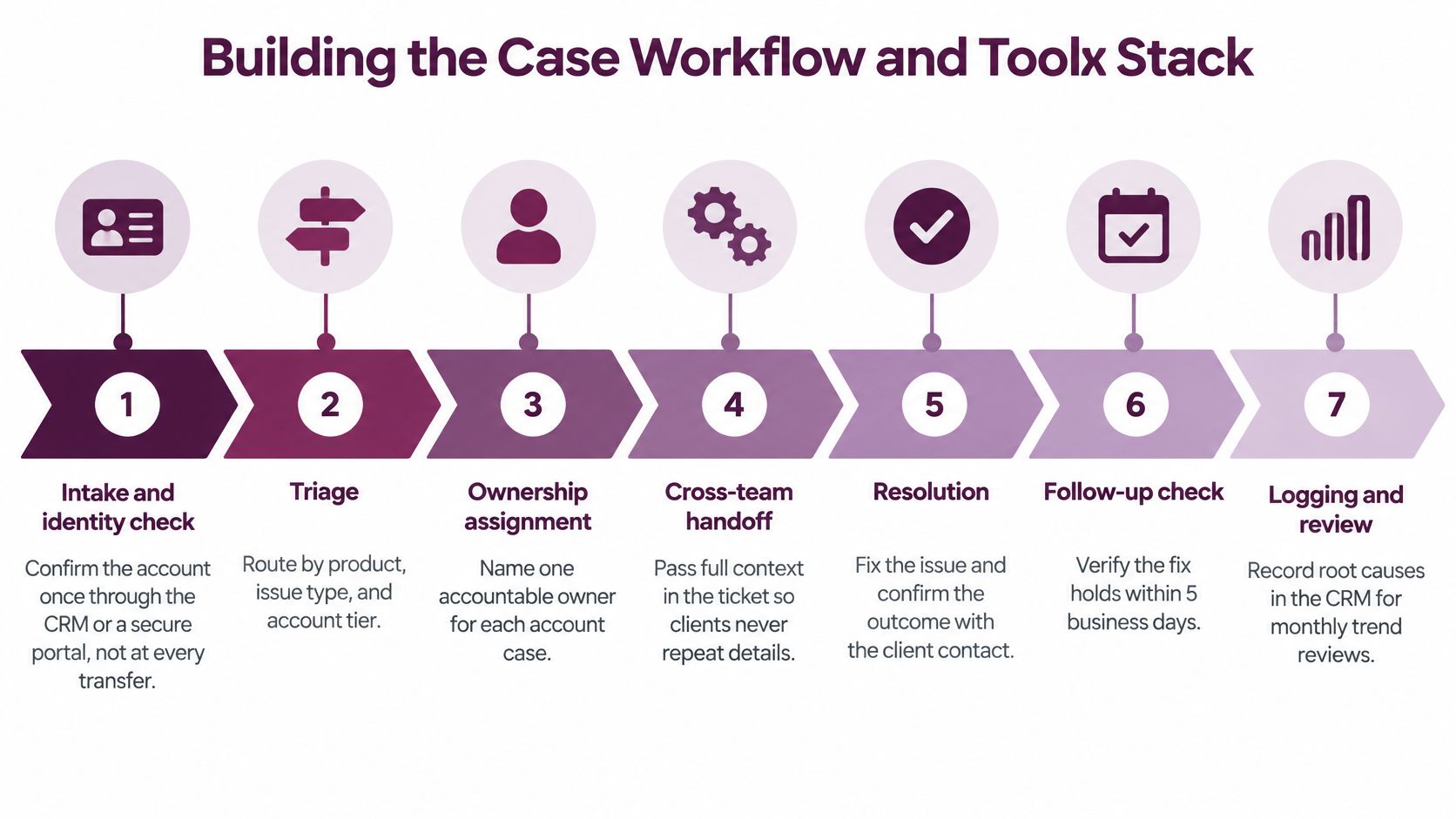
- Intake and verification: Identify the account, requester, permissions, issue, and business impact.
- Triage: Assign severity, language, skill requirements, and the appropriate queue.
- Context review: Retrieve relevant service terms, prior work, related cases, and approved knowledge.
- Resolution work: Complete authorized actions and record what was done.
- Escalation: Name the receiving owner, document acceptance, and tell the customer when to expect an update.
- Confirmation: Explain the outcome, verify it against the closure criteria, and provide a route back if the issue persists.
- Learning: Review repeat problems, update knowledge, and assign process improvements.
Handle privacy requests through a dedicated, linked process with an accountable privacy owner. Where GDPR applies, the European Data Protection Board’s guidance on individual rights describes the general one-month response period and a possible extension of two further months for complexity or request volume, with notice and reasons within the first month. Agents should capture requests promptly and follow approved verification and routing rules; they should not promise deletion or decide legal exceptions themselves.
The tool stack should support the workflow through connected case records, telephony, a controlled knowledge base, permissions, audit trails, and reporting. Establish access, retention, recording, and security requirements for the actual program before providing production access.
Use AI With a Clear Human Handoff
Automation can help categorize requests, retrieve approved knowledge, draft summaries, and send accurate status updates. Even routine actions such as password resets need appropriate identity and access controls. Use approved tools and data sources, and test the process before relying on it with customers.
Route disputed charges, security concerns, account-permission changes, complex failures, and requests outside approved automation boundaries to qualified people. At handoff, preserve context and make ownership visible. Provide clear instructions for reaching a person and explain coverage limits when live support is unavailable.
The NIST AI Risk Management Framework offers voluntary guidance for managing AI risk. It can help structure reviews of accuracy, privacy, monitoring, and accountability; it is not a certification or a guarantee that a particular tool is suitable.
Measure resolution, recontacts, erroneous actions, and failed handoffs alongside automation usage. A conversation kept inside a bot is not a successful outcome if the underlying issue remains open.
Compare In-House, Nearshore, and Offshore Delivery
Choose a delivery model around the work. Geography alone does not establish quality, language fluency, security, specialist capability, or total cost. A hybrid model can keep commercial authority internal while assigning defined support workflows to a trained external team.
| Model | Potential fit | What to verify |
|---|---|---|
| In-house | Work requiring close product access, strategic relationship ownership, or direct management. | Recruiting, training, coverage, supervision, technology, and fully loaded cost. |
| Nearshore | Programs that benefit from regional proximity, overlapping hours, or English-Spanish support. | Actual shift coverage, language proficiency, specialist access, controls, and total program cost. |
| Offshore | Programs whose required skills, coverage, and economics fit an overseas delivery team. | Working-hour overlap, language requirements, continuity, escalation arrangements, and management effort. |
Nearshore outsourcing can support real-time collaboration with U.S. teams when schedules align. Confirm operating hours and daylight-saving arrangements for each location. Bilingual proficiency and specialist training still need to be demonstrated, not inferred from an address.
Launch a Focused Pilot and Scale With Evidence
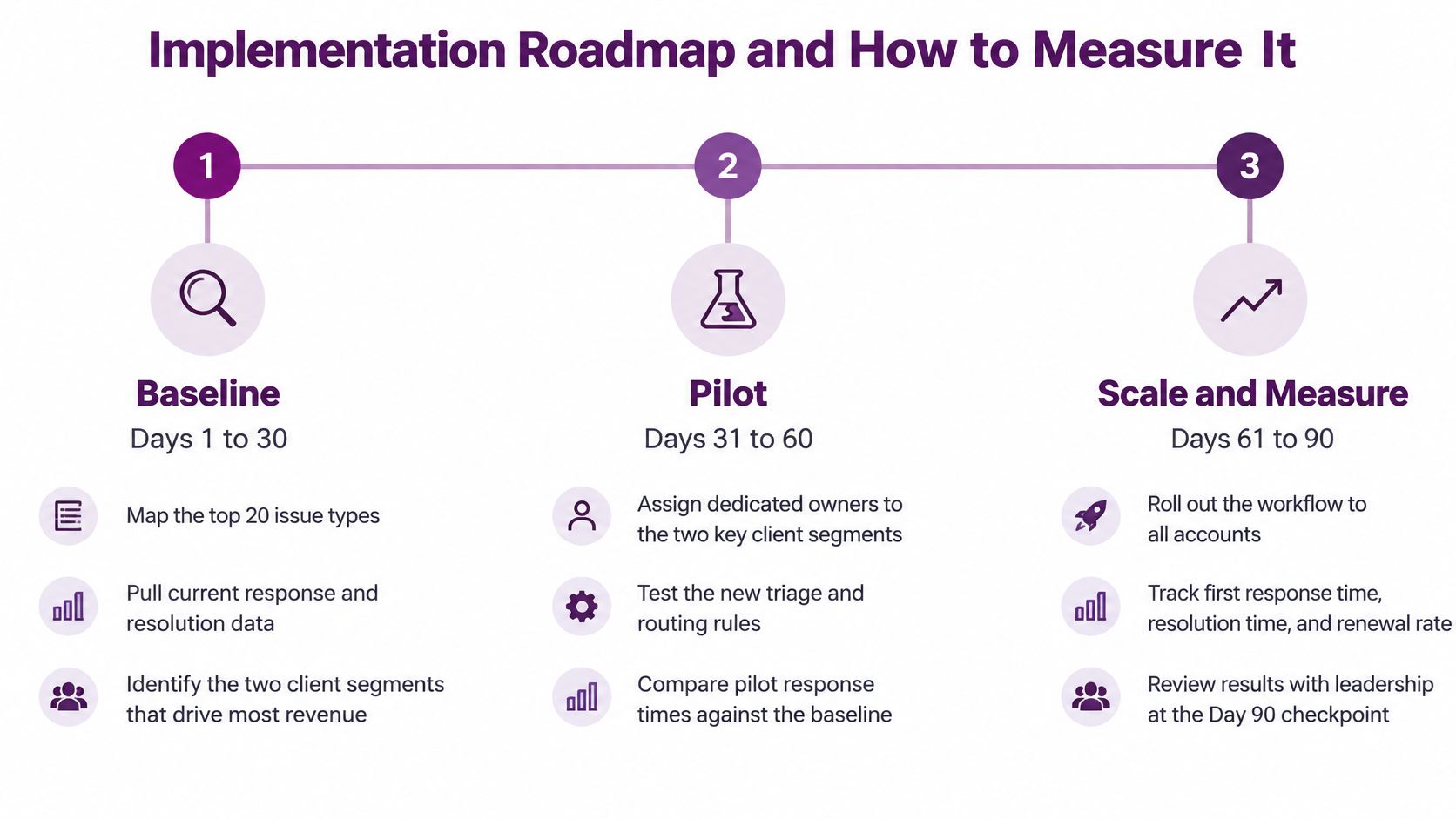
A 90-day roadmap can provide a planning structure, but launch timing depends on integrations, approvals, training, and risk. Do not treat the calendar as a promise or expand simply because a phase has ended.
- Baseline and design: Map recurring issues, clean measurement definitions, assign owners, and agree on scope and escalation.
- Controlled pilot: Test one queue or customer segment after access, training, security, and quality checks are ready.
- Review and scale: Compare results with a relevant baseline, account for demand changes, correct failures, and expand only when service and quality support the decision.
Review critical queues and aging cases daily, recurring quality and routing issues weekly, and customer and account outcomes at suitable monthly or quarterly intervals. A metric should lead to an investigation, rather than an automatic diagnosis: rising transfers may reflect routing gaps, more complex demand, or a legitimate specialist handoff.
Choose a Partner Around Your Operating Requirements
Ask each provider for evidence of relevant training, English-Spanish coverage, escalation ownership, quality calibration, reporting, access controls, and staffing continuity. Use the same scope when comparing written quotes, including onboarding, supervision, technology, coverage changes, and internal oversight.
CallZent can discuss a nearshore support program around your business needs. Define which customer contacts the team will own, which decisions remain with internal specialists, how account context will be shared, and what measures will determine success. The strongest starting point is a clearly scoped workflow with shared accountability.
Frequently Asked Questions
What is B2B customer care?
B2B customer care is the ongoing support a company provides to business customers after a sale. It can include onboarding assistance, technical questions, billing issues, order changes, and coordination with account teams.
How is B2B customer care different from B2C support?
B2B care often involves several stakeholders, negotiated contracts, account permissions, and operational dependencies. Consumer support can also be complex. Design workflows around the actual issue and customer impact rather than assuming one model is always simpler.
Is customer care the same as customer success?
The functions can overlap, but they need clear ownership. Customer care commonly handles requests and resolution, while customer success may focus on adoption, value realization, and account health. Define who owns renewals and commercial decisions.
Which KPIs should a B2B support team track?
Track first response, priority acknowledgment, resolution time, open-case age, first-contact resolution, reopens, transfers, quality, satisfaction, and customer effort. Review account outcomes separately and segment operational measures by issue type and severity.
What is a good response time for B2B customer care?
There is no universal target. Set acknowledgment, update, and resolution objectives using business impact, service commitments, coverage hours, and available capability. Document business-hour versus elapsed-time clocks and treatment of urgent cases.
How should teams prioritize B2B support cases?
Use impact, urgency, affected users, available workarounds, and agreed commitments to determine severity. Account tiers can shape resources and coverage, but serious safety, security, or operational incidents need appropriate escalation regardless of account size.
Can AI handle B2B customer service?
AI can assist with approved routine tasks such as categorization, knowledge retrieval, summaries, and status updates. Validate outputs, restrict access, monitor errors, and provide a human handoff for sensitive, complex, or out-of-scope requests.
Why does bilingual support matter in B2B customer care?
English-Spanish support can help customers communicate in their preferred language when the account population needs it. Plan proficiency, knowledge, staffing, and escalation coverage by shift; bilingual hiring alone does not guarantee continuous availability.
Can a company outsource B2B customer care?
Yes, when scope, access, training, service objectives, reporting, and escalation responsibilities are clear. Keep commercial authority and specialist decisions with the appropriate owners, and evaluate the partner through a controlled pilot.
How can a business start improving B2B customer care?
Choose a recurring issue that creates customer effort, map the workflow, assign an accountable owner, and establish reliable measurements. Pilot improvements in one queue, review quality and resolution, and expand based on evidence.
Bilingual Nearshore Support in Mexico
Build B2B Customer Care Around Your Accounts
Discuss your support workflows, English-Spanish coverage, service commitments, and escalation needs with CallZent. Define a program with clear responsibilities and measurable outcomes.