Skip to content

CALLZENT INSIGHTS / BUSINESS PROCESS OUTSOURCING
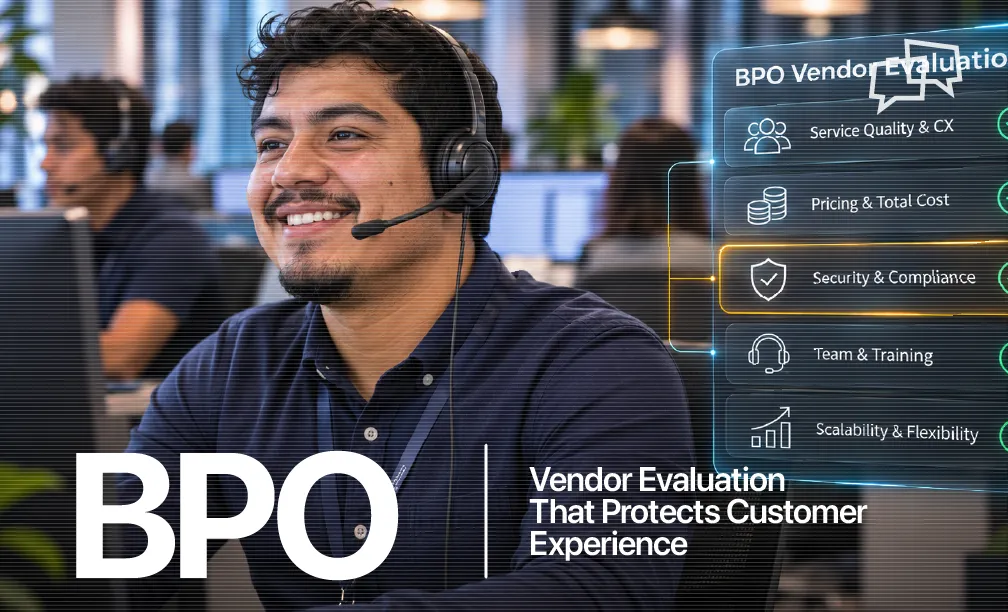
BPO Vendor Evaluation:
How to Choose the Right Outsourcing Partner.
A practical guide to evaluating BPO partners
through customer experience, pricing, recruitment,
quality management, security, and real-world performance.
Vendor Selection
CX & Quality
Nearshore BPO
Vendor Scorecard
BPO vendor evaluation should begin with one question:
will this partner protect the customer experience
you have worked hard to build?
Hourly rates matter, but they do not tell you
how agents will represent your brand during
a billing dispute, technical issue,
missed delivery, or urgent service request.
The right outsourcing partner can expand coverage,
control labor costs, and give your internal team
room to focus on growth. The wrong one can create
repeat contacts, inconsistent answers, frustrated
customers, and more management work than you had before.
A disciplined evaluation process helps you find
a provider that operates as an extension of your team,
not a distant transactional vendor.
SETTING THE FOUNDATION / 01
01
Start Your BPO Vendor Evaluation With Business Outcomes
Before comparing providers, define the problem
outsourcing needs to solve. A company that needs
bilingual order support during peak season should
evaluate vendors differently than a healthcare
organization that needs trained agents
to handle sensitive patient calls.
Clear goals keep the buying process focused
on outcomes instead of generic promises.
Document your expected call volume, channels,
service hours, languages, and seasonal changes.
Then identify the metrics that will define success.
These may include first-contact resolution,
customer satisfaction, speed to answer,
lead conversion, appointment completion,
order accuracy, or collection rates.
For back-office work, accuracy, turnaround time,
and exception handling may carry more weight.
Customer Experience
Resolution rates, satisfaction,
complaint handling, and quality of interaction.
Operational Performance
Answer speed, processing accuracy,
turnaround time, and escalation ownership.
Commercial Results
Lead conversion, appointment completion,
collections, and total program cost.
Flexibility
Seasonal staffing, ramp-up capability,
contract terms, and changing coverage needs.
Also decide where flexibility matters most.
A growing business may need the ability
to add agents quickly without committing
to a large long-term contract.
An established enterprise may prioritize
governance, reporting depth, and business continuity.
Neither priority is wrong, but each should
shape the vendor selection criteria.
For a useful measurement framework, review
CallZent’s guide to
KPIs in customer service
before requesting proposals.
The international standard
ISO 18295-2:2017
provides requirements for organizations using
customer contact centers, reinforcing the importance
of clearly defined responsibilities
between clients and providers.
Define what success looks like before
asking a vendor how much it costs.
COMMERCIAL EVALUATION / 02
02
Look Beyond Price to the True Cost of Service
A low quoted rate can be attractive,
especially when labor costs are rising.
But the cheapest provider is not always
the most affordable choice.
Poor quality creates hidden costs through
customer churn, escalations, rework, refunds,
training time, and internal oversight.
Understand What Is Included in the Rate
Ask vendors to explain exactly what their
pricing includes. Clarify whether the rate
covers recruiting, training, quality assurance,
supervision, technology, reporting, management,
and after-hours coverage.
Pricing Questions to Ask
- What are the minimum seat requirements?
- Are recruiting, onboarding, and training included?
- Are QA, supervision, and reporting included?
- Are there technology, telephony,
or integration charges? - What are the overtime and after-hours policies?
- How does pricing change as volume increases or decreases?
Transparent pricing is a meaningful sign of partnership.
You should be able to model costs under realistic
conditions, including a busy month, a slower quarter,
and an unexpected need for additional coverage.
Be cautious when a proposal looks simple because
major operational components are vague or excluded.
Compare alternative structures through CallZent’s
BPO pricing models
and its
international call center pricing comparison
.
Factor in the Delivery Location
Nearshore outsourcing
can offer a practical balance for U.S. companies.
Mexico-based teams often provide meaningful labor
savings while operating in compatible time zones
and with closer cultural familiarity than more
distant delivery locations.
That proximity can make training, collaboration,
and escalation management easier, particularly
for customer-facing programs where tone
and responsiveness affect retention.
Compare total operating cost, not just
the hourly price printed on a proposal.
THE HUMAN FACTOR / 03
03
Evaluate How the Vendor Builds and Supports Its Team
Customers remember the person who helped them,
not the outsourcing model behind the interaction.
That makes the vendor’s people practices
a core performance issue,
not a soft cultural detail.
Ask how the provider recruits for communication
skills, empathy, bilingual proficiency,
technical ability, and industry knowledge.
Request a clear view of the hiring process,
including language assessments,
background checks where applicable,
and role-specific screening.
Recruitment
Language proficiency, empathy, problem-solving,
screening, and role-specific qualifications.
Training
Product knowledge, simulations,
nesting, assessments, and monitored practice.
Coaching
Regular feedback, calibration,
quality reviews, and professional development.
Retention
Employee stability, career pathways,
engagement, and preservation of account knowledge.
A vendor should be able to explain how it identifies
agents who can do more than read from a script.
Training Must Be Continuous
Training deserves equal scrutiny.
Find out how long
initial agent training
lasts, who delivers it, how knowledge is tested,
and what happens when product details
or policies change.
Effective programs include nesting periods,
monitored live interactions, targeted coaching,
and regular calibration with the client team.
Retention Is an Operational Advantage
Agent retention
also matters. High turnover disrupts quality,
drives repeated training costs,
and makes it harder for agents to develop
confidence in your brand.
Look for a provider that treats agent empowerment,
recognition, coaching, and career growth
as operational investments.
Engaged agents tend to listen better,
solve problems more completely,
and create the human connections
customers expect.
At CallZent, that connection between agent
satisfaction and customer outcomes is central
to how outsourced support programs are designed.
It is a useful standard for any BPO relationship:
ask whether the vendor can show how its workplace
culture supports service consistency.
The people representing your brand
are part of your customer experience.
QUALITY & ACCOUNTABILITY / 04
04
Test Quality Management, Not Just Quality Claims
Almost every provider will say it delivers
excellent quality. Your evaluation should reveal
how that claim is measured and improved.
Request sample quality scorecards and ask which
behaviors are evaluated. A strong scorecard
goes beyond greeting and closing language.
What a Quality Scorecard Should Measure
Accuracy
Correct information and authorized actions.
Empathy
Listening and respectful customer communication.
Ownership
Clear next steps and appropriate resolution.
Compliance
Verification and required procedures.
Documentation
Complete records and accurate disposition.
Brand Standards
Appropriate tone and client-specific behavior.
Then ask how often interactions are reviewed,
who performs the reviews, and how coaching
is delivered. Quality assurance should
be a repeatable management system
with calibration sessions, root-cause analysis,
and action plans.
If customer satisfaction drops or handle times
climb, the provider should be able to identify
why and show what it will change.
Reports Should Explain Business Results
Reporting should give leaders enough visibility
to act. Review sample dashboards for daily operational
metrics and monthly trend analysis.
The best reports connect activity to business results.
For example, a lead-generation program should report
qualified opportunities and conversion outcomes,
not simply the number of calls completed.
The
ISO 18295-1:2017 standard
provides a framework for customer contact center
service requirements and performance indicators.
It can inform evaluation questions even when
a vendor does not claim certification.
Quality is a system for finding and fixing problems,
not a percentage on a dashboard.
RISK & BUSINESS RESILIENCE / 05
05
Confirm Security, Compliance, and Business Continuity
Security expectations vary by industry,
but every BPO vendor evaluation should examine
how customer data is protected.
This is especially critical for organizations
in healthcare, legal services, consumer finance,
and eCommerce.
Ask where data is stored, how systems are accessed,
whether access is role-based, and how the provider
monitors for inappropriate activity.
Discuss device policies, password controls,
data retention, incident response,
and employee confidentiality requirements.
If your program involves regulated data,
verify the vendor’s relevant compliance capabilities
and determine exactly which responsibilities
remain with your organization.
Verify the Controls, Not Just the Claims
The
NIST Cybersecurity Framework 2.0 supplier-risk guide
provides a useful reference for defining
supplier security requirements
and managing cybersecurity risk.
For healthcare programs involving protected health
information, review the
U.S. Department of Health and Human Services
guidance on HIPAA business associates
.
When a vendor qualifies as a business associate,
appropriate contractual safeguards,
including a business associate agreement,
are generally required.
CallZent’s
healthcare outsourcing compliance guide
offers additional considerations for
evaluating regulated support workflows.
Security Due-Diligence Checklist
- Role-based access to customer systems
- Documented identity and authentication controls
- Security incident response and escalation procedures
- Data storage, retention, and deletion rules
- Subcontractor visibility and oversight
- Evidence supporting applicable contractual
and regulatory obligations
Test Business Continuity
Business continuity deserves the same attention.
Ask how the provider handles power or internet
interruptions, staffing disruptions, natural events,
and sudden call-volume spikes.
A credible partner will have documented contingency
plans, alternative operating capacity,
and an escalation structure that does not depend
on one unavailable manager.
Ask what happens when normal operations fail,
before the first disruption occurs.
STRUCTURED VENDOR SELECTION / 06
06
Use a Scorecard and a Real-World Pilot
A structured scorecard prevents the selection
process from being driven by the most polished
presentation. Weight each category according
to your needs, then score each finalist
using evidence rather than impressions.
Useful categories include service quality,
recruiting, training, retention, security,
pricing, technology, reporting,
scalability, and cultural fit.
The example below is an illustrative
starting framework. Adjust the weights
to your business requirements before scoring.
Example BPO Vendor Evaluation Scorecard
| Evaluation Category | Example Weight | Evidence to Review |
|---|---|---|
| Service Quality & CX | 25% | QA scorecards, reporting samples, customer outcomes |
| Recruiting, Training & Retention | 20% | Hiring standards, nesting, coaching, retention measures |
| Security & Continuity | 20% | Access controls, risk documentation, recovery procedures |
| Pricing & Contract Flexibility | 15% | Complete proposal, exclusions, minimums, change terms |
| Technology & Reporting | 10% | Integration plan, dashboards, data ownership |
| Scalability & Cultural Fit | 10% | Ramp plans, leadership access, references, communication |
| Total | 100% | Score each vendor consistently against the same criteria |
How to Use the Scorecard
Give every finalist the same evaluation questions,
request comparable documentation,
and use a consistent rating scale,
such as 1 to 5.
Multiply each category rating by its assigned weight
to create a weighted result.
Keep critical compliance or security requirements
as mandatory gates rather than allowing a high
overall score to compensate for a serious gap.
Run a Pilot That Reflects Real Conditions
After narrowing the field, consider a pilot program.
A well-designed pilot is not a test of whether
agents can follow a basic script for two weeks.
It should measure the behaviors and outcomes
that matter in real operating conditions,
with defined targets, a shared scorecard,
and regular reviews.
01
Define a Manageable Scope
Select a specific call type, customer segment,
or limited hours of coverage.
02
Set Measurable Targets
Agree on quality, resolution, customer satisfaction,
reporting, and escalation performance.
03
Review, Adjust, and Decide
Refine training, workflows, knowledge resources,
and reporting before expanding the program.
A pilot can also reveal whether the vendor
communicates openly when something needs adjustment.
Define launch expectations and escalation ownership
through a documented
business process improvement
approach before scaling.
The best pilot tests how a vendor responds
when service is not going perfectly.
THE LONG-TERM DECISION / 07
07
Choose a Partner Your Team Can Work With
Capability matters, but the working relationship
determines whether that capability produces results
month after month.
During the evaluation, pay attention to how
a vendor responds to difficult questions.
Do leaders acknowledge trade-offs?
Do they ask thoughtful questions about
your customers and processes?
Are they clear about what they can improve
and what will require shared effort?
The right BPO partner will not promise
that outsourcing eliminates every operational
challenge. It should bring a practical plan
for improving performance, staying accountable,
and adapting as your business changes.
Final Partnership Questions
- Can we speak directly with the operational leadership team?
- Who owns unresolved customer issues?
- What happens when performance misses its target?
- How are changes to the program approved?
- What does the transition or exit process look like?
When a provider combines skilled people,
transparent operations, and genuine ownership
of your customer experience,
outsourcing becomes a growth decision
rather than a cost-cutting gamble.
Evaluate nearshore opportunities alongside
your operational requirements. CallZent’s
bilingual customer service
and
technical and customer support services
illustrate how a customer-facing program can
be built around specific responsibilities.
Choose the team you would trust with your most
valuable customer on their hardest day.
That standard leads to better vendor decisions
and stronger customer relationships
long after the contract is signed.
FREQUENTLY ASKED QUESTIONS
10 FAQs About BPO Vendor Evaluation
1. What is BPO vendor evaluation?
BPO vendor evaluation is the structured process
of assessing outsourcing providers based on
operational capability, service quality, pricing,
recruiting, training, technology, security,
and business fit. It helps organizations
choose a provider that can meet defined
performance and customer-experience requirements.
2. What criteria should be used to evaluate a BPO vendor?
Evaluate customer experience, relevant industry
experience, recruitment and training,
agent retention, quality assurance,
data security, business continuity,
pricing transparency, reporting,
scalability, and cultural compatibility.
Weight the criteria based on the actual
requirements of your outsourcing program.
3. How do you compare BPO vendor pricing?
Compare the total cost of delivering equivalent
services rather than hourly rates alone.
Confirm whether recruiting, training,
supervision, quality monitoring, reporting,
telephony, software, overtime, and setup
fees are included. Model expected costs
for normal, peak, and reduced volumes.
4. Why is agent retention important when choosing a BPO?
Agent retention helps preserve product knowledge,
service consistency, and customer familiarity.
Frequent turnover can increase recruitment
and training costs while disrupting quality.
Ask vendors for relevant retention data,
coaching practices, employee-development
initiatives, and staffing stability.
5. What KPIs should a BPO vendor report?
Important KPIs may include first-contact
resolution, customer satisfaction,
quality assurance scores, service level,
response time, repeat contacts,
order accuracy, conversion rates,
turnaround time, and escalation resolution.
Select measures that reflect the specific
outcomes the provider is responsible for delivering.
6. How can businesses verify a BPO vendor’s security?
Request documentation covering access controls,
authentication, data storage, retention,
incident response, confidentiality policies,
subcontractor oversight, and business continuity.
For regulated programs, review the specific
legal and contractual safeguards required,
along with evidence supporting the vendor’s claims.
7. Should you run a pilot before signing a long-term BPO contract?
A pilot is often useful when operational
complexity or vendor uncertainty is significant.
Define a limited scope, measurable targets,
review meetings, data-access rules,
and clear success criteria.
The pilot should test real customer interactions,
exception handling, escalation,
and the vendor’s ability to improve.
8. What are the benefits of choosing a nearshore BPO vendor?
Nearshore outsourcing can provide
compatible time zones, closer real-time
collaboration, access to bilingual talent,
and competitive operating costs.
For U.S. businesses, Mexico-based teams
may simplify training and escalation management.
Actual benefits depend on the provider,
program requirements, and delivery capabilities.
9. How do you know if a BPO vendor can scale with your business?
Ask for evidence of previous ramp-ups,
recruiting capacity, training timelines,
supervisor coverage, workstation availability,
and workforce planning. Evaluate how
service quality and pricing change as
agent counts or contact volumes increase.
A credible vendor should explain the limits
of its capacity as well as its growth plans.
10. What are the biggest red flags when selecting an outsourcing partner?
Warning signs include unclear pricing,
unsupported performance claims,
limited access to operational leadership,
weak security documentation,
vague escalation procedures,
inconsistent reporting,
high unexplained turnover,
and unwillingness to share references
or test a realistic pilot.
Be cautious when the vendor promises
perfect results without discussing
trade-offs and shared responsibilities.
THE RIGHT PARTNER MAKES THE DIFFERENCE
Your Customers Deserve
the Right Team.
CallZent provides bilingual nearshore customer support
and BPO services from Tijuana, Mexico.
Explore a program designed around your customers,
operational goals, service standards,
and performance requirements.