

VIRTUAL ASSISTANT SERVICES
Best Virtual Assistant Services for Growing Businesses in 2026
Compare the best virtual assistant services for founders, eCommerce brands, healthcare teams, and growing businesses. Learn how nearshore virtual assistant support improves scalability, customer experience, and operational efficiency.
TL;DR — Quick Takeaways
- The best virtual assistant service depends on workflow complexity, customer interaction, and operational scale.
- Founder-focused VA subscriptions work well for light admin support, but growing companies often need broader operational coverage.
- Nearshore bilingual support models improve timezone alignment, customer communication, and workflow continuity.
- Businesses should evaluate virtual assistant providers based on management burden, scalability, customer-facing capability, and process ownership — not just hourly pricing.
Are you still treating virtual assistant support like a glorified calendar service? That’s the gap that trips up a lot of teams. They compare hourly rates, skim feature lists, and miss the bigger decision: how much management work are they buying for themselves along with the assistant.
The best virtual assistant services free up time only when the model fits the business. A solo founder may need a single U.S.-based assistant who can keep the inbox under control. A growing e-commerce brand may need bilingual customer support, order follow-up, and back-office help that looks a lot more like a managed operations layer than a classic VA. If you’re also rethinking adjacent outsourced work, this guide to social media outsourcing is a useful companion read.
Summary of our findings: The best virtual assistant services usually fall into a few buckets. Time etc and Zirtual work well for founders who want a dedicated assistant and clear monthly structure. Prialto is strong when reliability and backup coverage matter more than bare-bones cost. Magic fits teams that want flexible staffing models. Wing Assistant stands out when you need broader role specialization. For companies that want cost efficiency, timezone alignment, bilingual coverage, and support that extends beyond admin tasks, CallZent is the strongest strategic fit.
1. CallZent
Need virtual assistant support that can handle customers, systems, and daily operations without creating another management job for your team?
CallZent stands out because it serves a different use case than the typical founder-focused VA subscription. It operates as a nearshore bilingual call center and BPO in Tijuana, so the model fits companies that need admin help plus customer-facing execution. That includes appointment setting, lead follow-up, back-office processing, customer service, and virtual assistant work that has to happen inside real business workflows.
That distinction matters. Grand View Research estimated the global virtual assistant market at $28.69 billion in 2024, which helps explain why more businesses now treat assistant support as an operating model choice, not a one-off hire. Separately, analysts at The Business Research Company valued the market at $8.17 billion in 2025, up from $6.37 billion in 2024. Adoption is broad at the small-business level too. According to the small-business usage figures cited in this virtual assistant statistics roundup, 41% of U.S. small businesses worked with at least one virtual assistant in 2025.
Why CallZent fits growing teams
CallZent makes the most sense for businesses that have outgrown the classic solo-assistant model. A founder with a light admin load usually does fine with one dedicated assistant. A multi-location clinic, e-commerce brand, or service business often needs more coverage, more process discipline, and Spanish-language support for part of the customer base.
Nearshore staffing changes the economics and the working rhythm. North American teams usually get better timezone overlap than they would with offshore providers, and the cultural alignment is often stronger for customer-facing work. That matters when agents are handling calls, booking appointments, updating a CRM, or responding to order issues in real time.
A practical example: an e-commerce company may start by outsourcing inbox management and order-status questions. Within a few months, the workload often expands to phone support, return coordination, post-purchase follow-up, and customer record updates. At that point, the limiting factor is no longer task delegation. It is operational consistency. CallZent is built for that step up.
If you want a clearer baseline on role scope before comparing providers, this guide on what a virtual assistant does for a business is a useful reference.
Practical rule: If the assistant will spend the day interacting with customers and core systems, a managed nearshore team is usually a better fit than a single freelance-style VA.
What stands out in practice
- Bilingual English-Spanish support: Useful for healthcare, retail, home services, and any business serving a mixed-language customer base.
- Nearshore coverage: Better for teams that need same-day coordination with U.S. and Canadian operating hours.
- Broader delivery model: CallZent supports inbound calls, outbound campaigns, scheduling, collections, technical support, and back-office assistance, which gives growing companies room to consolidate vendors.
- Flexible packaging: Custom plans make sense when support volume shifts between admin work and customer service from month to month.
The company also cites more than 20 years in business and operations in Tijuana and Hermosillo, plus a San Diego presence. For buyers, that signals maturity, but it does not remove the need for diligence. Ask early about onboarding ownership, QA process, supervisor coverage, compliance requirements, and how pricing changes as scope expands.
Best for: E-commerce brands, healthcare groups, finance and insurance teams, telecom, retail, and service businesses that need bilingual nearshore support with room to scale.
Watch-out: If you want a simple fixed-price VA with a narrow task list, CallZent may be more service capacity than you need. It is a stronger fit when the work touches customers, requires coverage across channels, or needs to grow into a broader support function.
2. Time etc
Time etc gets a lot right for founders and small teams. It offers dedicated U.S.-based assistants, flexible monthly hour bundles, transparent tracking, and easy plan changes. That combination works when you want structure without moving into a heavier managed-service model.
This is the kind of service that fits a consultant, agency owner, or founder who has a repeating list of tasks every week. Think inbox cleanup, calendar coordination, research, follow-ups, and document prep. If the work is steady but not overwhelming, a dedicated assistant with predictable hours is usually enough.
Where Time etc works best
The key advantage is simplicity. You don’t have to source talent yourself, and you still get a fairly direct relationship with the assistant. That makes it a strong middle ground between freelancing marketplaces and larger managed providers.
- Dedicated match: Better for ongoing trust and workflow consistency.
- Clear time tracking: Useful when you want visibility into exactly where hours go.
- Monthly bundles: Easier to budget than purely ad hoc models.
- Rollover on larger plans: Helpful if your workload varies month to month.
A good VA relationship usually fails for one of two reasons. The task list is too vague, or the owner keeps changing priorities every day.
Time etc won’t fix a messy operating style, but it does remove much of the hiring friction. If you’re still sorting out the basics, this short explainer on what a virtual assistant does helps clarify where admin support ends and operational support begins. You can review current plans directly on the Time etc website.
Best for: Solo founders, consultants, and small businesses that want a dedicated U.S.-based assistant with visible hours and low setup friction.
Trade-off: If your workload becomes specialized or customer-facing, you may outgrow this model faster than expected.
3. Prialto
Prialto is one of the strongest choices when the issue isn’t task volume. It’s management burden. The service pairs a dedicated assistant with an engagement manager and built-in backup coverage, which is exactly what busy executives and departments often need.
That structure matters more than most comparison lists admit. One of the biggest blind spots in this market is the hidden cost of supervision. Buyers focus on hourly pricing, but the harder question is how much internal oversight it takes to make the assistant productive. That issue becomes sharper in hybrid and remote teams, where communication cadence and process clarity matter as much as raw capability (analysis of VA management burden and oversight).
Why executives often prefer Prialto
Prialto’s value is continuity. If your primary assistant is out, there’s backup. If your workflows need to be documented, there’s a layer built for that. If security and consistency matter, the managed model is easier to defend internally than a loose contractor setup.
A financial advisor is a good example. The work may include meeting scheduling, CRM hygiene, follow-up coordination, and document handling. The assistant still matters, but the system around the assistant matters more. Firms exploring that use case can also compare workflow needs with this page on virtual assistant services for financial advisors. For service details, visit the Prialto website.
- Managed delivery: Good for leaders who don’t want to train and supervise heavily.
- Backup coverage: Reduces operational risk when someone is unavailable.
- Clear monthly capacity: Easier for department planning than loose hourly contracting.
- Security-oriented posture: Useful for companies with stricter process requirements.
Best for: Executives, departments, and firms that care about process continuity more than entry-level affordability.
Trade-off: It can be more structure than a very small business needs.
4. Zirtual
Zirtual is a straightforward option for buyers who want U.S.-based assistants, clear monthly plans, and a fast communication standard. It’s especially appealing to founders who don’t want to compare dozens of variables before making a decision.
The service is strongest when the work is classic executive or administrative support. Scheduling, inbox management, travel planning, research, and light project coordination fit well here. Zirtual also offers add-on paths for outbound calling and legal support, which gives it a bit more range than a pure admin-only provider.
When Zirtual is the right choice
If you value responsiveness and don’t want to overengineer the decision, Zirtual is easy to buy. It has a simple ladder of plans, dedicated contact through phone, SMS, and email, and a defined response expectation during business hours.
That simplicity is useful for small teams. Sometimes the best virtual assistant services aren’t the most feature-rich. They’re the ones you can implement fast and use. If you’re weighing whether to build support in-house or outsource it, CallZent’s perspective on outsourcing virtual assistants is worth comparing. You can review Zirtual directly on the Zirtual website.
The wrong VA service usually looks fine on paper. The problems show up two weeks later, when tasks fall between roles and nobody owns the workflow.
Best for: Founders and lean teams that want a U.S.-only assistant, simple monthly pricing, and quick turnaround for admin work.
Trade-off: Hours don’t roll over, so this isn’t ideal if your task load swings sharply month to month.
5. Delegated
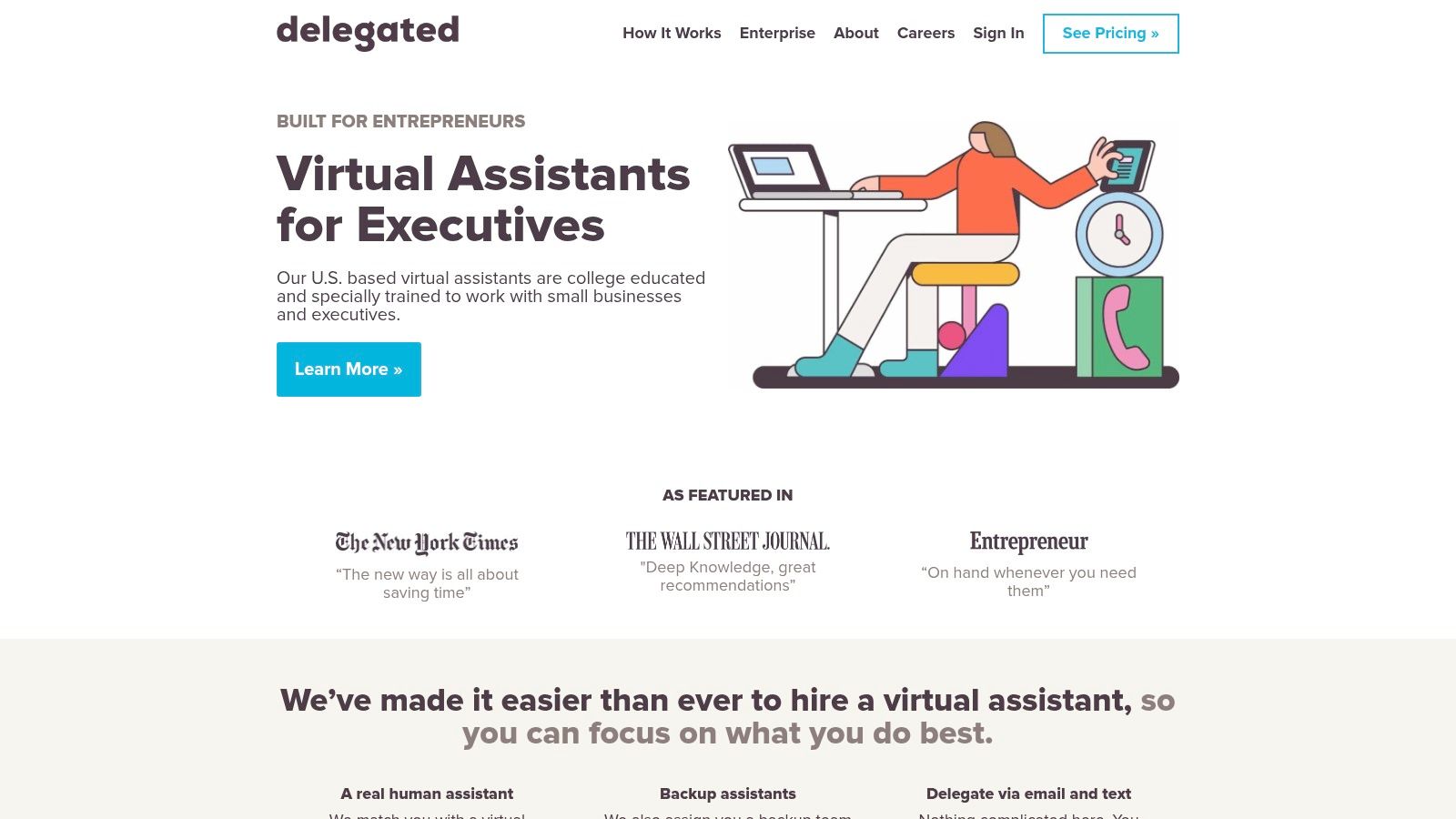
Delegated takes a different angle from many VA companies. Its assistants are U.S.-based W-2 employees, not contractors, and it also offers virtual receptionist support. For some buyers, that staffing model matters a lot.
This is often a better fit for owners who are cautious about consistency, professionalism, and worker classification issues. It can also appeal to businesses that want one vendor handling both executive support and front-desk style coverage.
The practical case for Delegated
A law office, insurance agency, or local service business may need appointment handling, message capture, follow-ups, and routine admin support. In that situation, the receptionist add-on can be more valuable than another generic VA feature.
- W-2 employment model: Some buyers prefer this for reliability and internal policy reasons.
- Public plan pricing: Easier to assess than custom-quote-only vendors.
- Receptionist option: Useful when the business needs both support and live coverage.
- Backup concept: Helpful for continuity.
For service leaders who care most about customer experience quality, it’s smart to compare the assistant model with the broader support requirements of your front line. CallZent’s overview of customer service solutions that improve support quality is a useful reference point. Delegated’s current offering is available on the Delegated website.
Best for: Owners and executives who want U.S.-based support with a more formal employment model and optional receptionist coverage.
Trade-off: It can be a heavier monthly commitment than lighter entry-level VA plans.
6. Magic
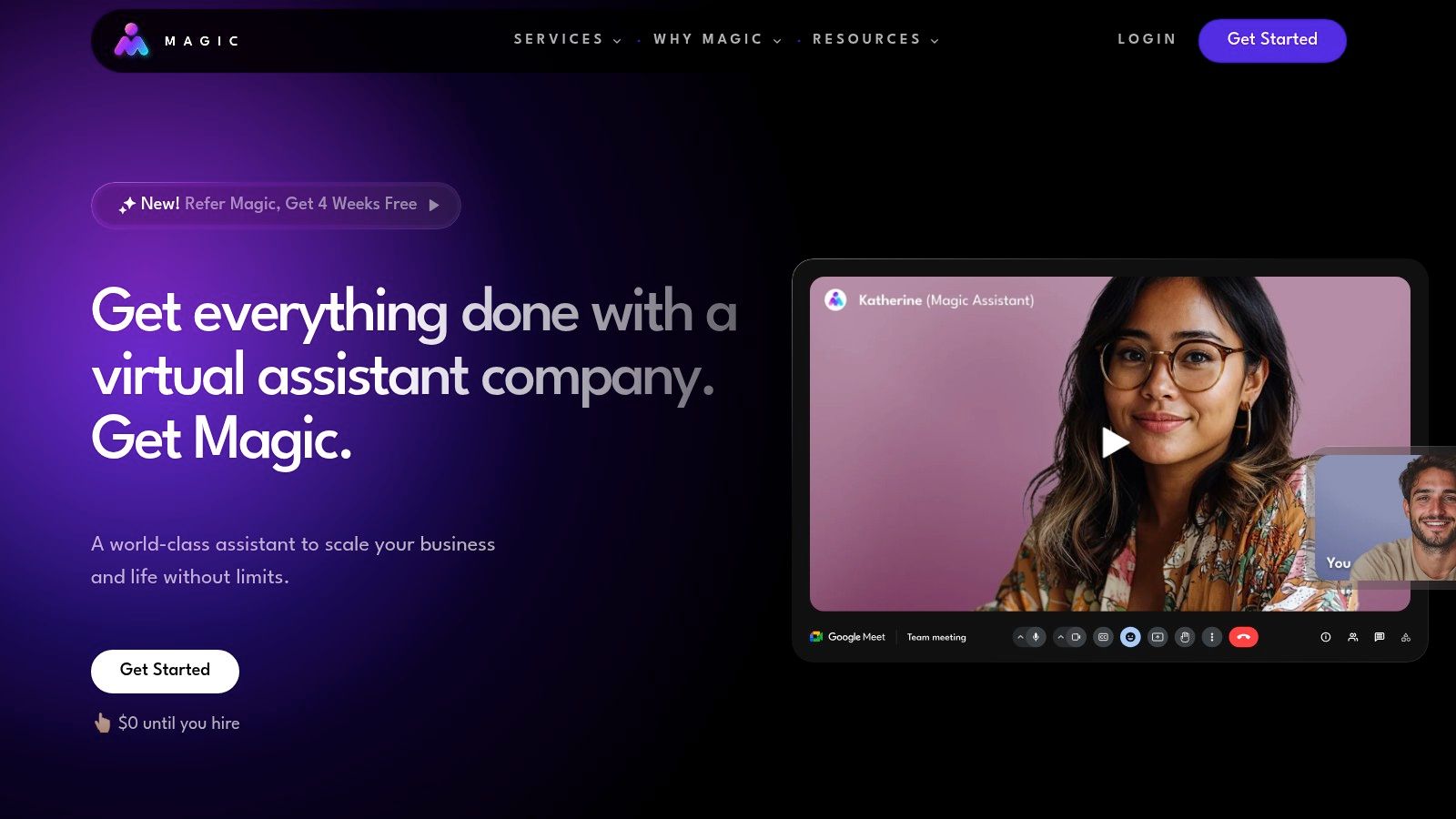
Magic is built for flexibility. You can choose a dedicated assistant for steady weekly support or tap into a shared on-demand pool for broader coverage. That makes it one of the more adaptable options on this list.
This model works well when the work is unpredictable. Maybe a startup has bursts of recruiting coordination one week, travel and scheduling the next, and inbox cleanup after that. A rigid monthly-hour plan can feel awkward in those conditions. Magic gives teams a more operational staffing model.
Where Magic makes sense
There’s also a bigger market signal behind this approach. Technavio projects the broader virtual assistant market will expand by USD 394.68 billion from 2026 to 2030 at an 87.2% CAGR, with North America accounting for 38.7% of forecast growth (Technavio virtual assistant market analysis). The practical takeaway is simple. Buyers increasingly need providers that can handle higher workflow volume across channels and use cases, not just one-off admin requests.
- Dedicated or on-demand options: Good for teams still figuring out workload patterns.
- Weekly billing visibility: Helpful if you want frequent usage tracking.
- 24/7 shared pool: Useful for companies that need responsiveness beyond standard hours.
- Purchase handling: Can save time for operational errands and procurement tasks.
Best for: Startups, fast-moving teams, and operators who value flexibility over a traditional dedicated-assistant relationship.
Trade-off: Weekly billing and a global talent mix won’t suit every company, especially those that want strict geography requirements.
7. Wing Assistant
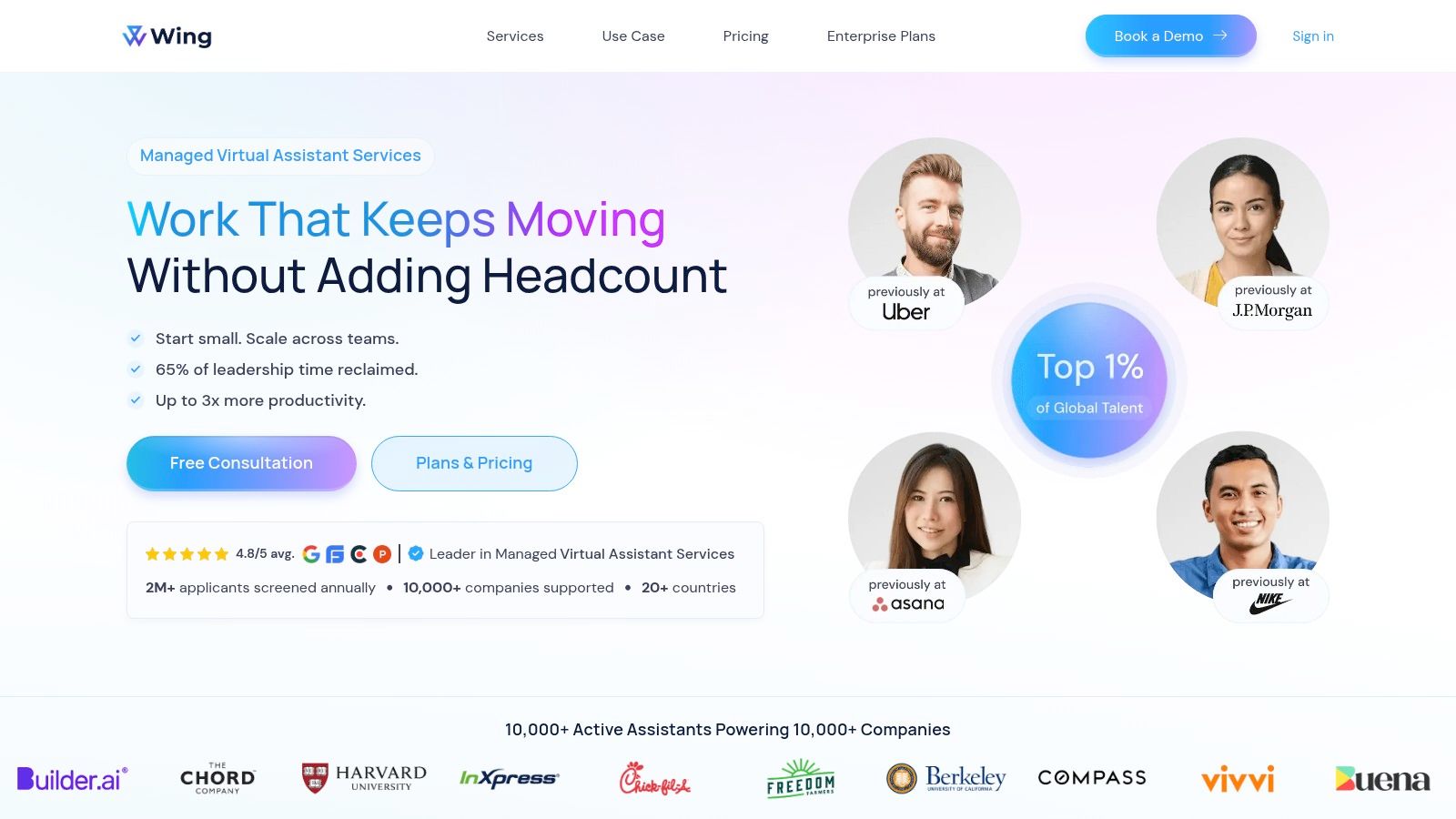
Wing Assistant is the strongest fit here if your needs go beyond general admin and into role specialization. It offers managed dedicated assistants across a wide catalog that includes e-commerce, bookkeeping, SDR work, marketing support, content, and design, plus some U.S.-based options.
That specialization matters because the market is moving away from generic assistant work. Independent research values the intelligent virtual assistant segment at USD 2.48 billion in 2022 and projects it could reach USD 14.10 billion by 2030, growing at a 24.3% CAGR. Another forecast cited in the same market discussion places the broader virtual assistant market at USD 5.62 billion in 2026 and projects growth to USD 42.08 billion by 2035, with North America holding more than 40% share (Grand View Research on intelligent virtual assistants). Buyers increasingly care about AI-assisted workflow capability and specialization, not just whether someone can manage a calendar.
Why Wing stands out
Wing’s managed setup, success manager support, and proprietary workspace make it easier to centralize work across different functions. That’s attractive for companies that don’t want separate vendors for admin, customer follow-up, lead generation, and content support.
There’s also a second reason Wing is relevant. Specialized industries now need more than a generic assistant. In healthcare, for example, buyers are being pushed to evaluate HIPAA alignment, EMR familiarity, billing support, scheduling, and timezone coverage, which is a very different buying process from hiring a VA for inbox management (industry perspective on specialized virtual assistant companies).
Bottom line: Once tasks touch regulated workflows, multilingual support, or high-volume customer operations, “best VA” often stops meaning “best admin assistant.”
Visit the Wing Assistant website to review role tracks and plan options.
Best for: Teams that want broader functional support under one vendor, especially in e-commerce, sales support, and specialized back-office roles.
Trade-off: The menu is broad enough that buyers need to choose carefully. If you don’t define the role well, you can end up paying for the wrong specialization.
Top 7 Virtual Assistant Services Comparison
| Service | 🔄 Implementation complexity | ⚡ Resource requirements | 📊 Expected outcomes | 💡 Ideal use cases | ⭐ Key advantages |
|---|---|---|---|---|---|
| CallZent | Moderate, custom onboarding and telephony/CRM integration. | Nearshore bilingual agents, training programs, scalable staffing; pricing via quote. | Higher CSAT and lower operating costs; 24/7 inbound/outbound capability. | Bilingual support for SMBs → enterprises (e‑commerce, healthcare, finance, telecom). | ⭐ Nearshore bilingual alignment, agent-centric culture, CRM/telephony integrations. |
| Time etc | Low, simple matching and quick start. | U.S.-based dedicated assistant, flexible monthly hours, time-tracking dashboard. | Predictable administrative support and single point of contact. | SMBs and founders needing part-time, predictable VA support. | ⭐ Transparent pricing, satisfaction guarantee, hour rollover on larger plans. |
| Prialto | Moderate–High, process design and managed-team onboarding. | Managed units (55 hrs), engagement manager, backup coverage, SOC 2–aligned practices. | Strong continuity, reduced client management overhead, secure operations. | Executives, departments, and regulated industries requiring documented processes. | ⭐ Managed team + engagement manager, continuity and security (SOC2 practices). |
| Zirtual | Low, straightforward plan ladder and fast setup. | U.S.-only, college-educated assistants; flat-rate monthly tiers. | Fast response times and consistent admin support. | Solo founders and small teams wanting U.S.-only assistants and simple pricing. | ⭐ Clear posted pricing, quick communication standard, legal/outbound add-ons. |
| Delegated | Low–Moderate, plan setup with W‑2 staffing model. | U.S.-based W‑2 employees, plan-based hours, optional receptionist minutes. | Reliable, compliant assistance with receptionist integration. | Owners/executives preferring W‑2 staff and integrated receptionist services. | ⭐ W‑2 staffing, predictable plans, combined assistant + receptionist offering. |
| Magic | Moderate, multiple engagement styles and weekly billing model. | Dedicated (20/40 hr) or 24/7 on‑demand pool, automatic time tracking, purchase handling. | Flexible coverage including 24/7 options; usage-based billing. | Teams needing flexible or round‑the‑clock support and enterprise workflows. | ⭐ Multiple engagement models (dedicated or on‑demand), purchase handling capability. |
| Wing Assistant | Moderate, onboarding for specialized tracks and app adoption. | Dedicated assistants, success manager, proprietary workspace, many specialized roles. | Broad functional coverage and centralized management with predictable pricing. | Teams needing specialized roles (SDR, bookkeeping, e‑comm, content) under one vendor. | ⭐ Wide catalog of specialized roles, flat‑rate plans, success manager + app. |
Your Next Step Take Action with a Strategic Partner
Which model fits the way your business runs today. A solo founder juggling calendar management has a different need than an e-commerce brand handling order issues in two languages, and both differ from an executive team that needs process discipline more than raw hours.
The smartest choice usually comes down to management load, coverage, and customer expectations. Time etc and Zirtual fit businesses that want a dedicated U.S.-based assistant for classic admin support. Prialto fits leaders who value a managed service with tighter process control. Magic works well when coverage needs change week to week. Wing Assistant is a practical option when one vendor needs to cover several specialized functions.
Growth changes the decision.
At a certain point, the issue is no longer task delegation. The issue is building a support function that can absorb customer service, scheduling, back-office work, and lead follow-up without forcing your internal team to supervise every handoff. That is the gap nearshore providers address especially well.
For North American companies, nearshore support often gives a better operating balance than either extreme. Onshore hiring can get expensive fast, especially once support needs extend beyond one assistant. Offshore teams can reduce cost, but timezone gaps, communication friction, and weaker cultural alignment often show up in customer-facing work. Nearshore teams sit in the middle. They keep collaboration easier while still improving unit economics.
That is why CallZent is a strong fit for businesses with bilingual customers, repeatable workflows, or support demand that spans more than one role. The practical advantage is not just lower labor cost. It is the combination of timezone alignment, English and Spanish coverage, and a structure that can support both assistant work and broader BPO functions under one partner.
🚀 Scale Smarter With CallZent
CallZent helps North American businesses improve customer support, appointment scheduling, lead generation, bilingual communication, and back-office operations through scalable nearshore virtual assistant services.
Talk to an ExpertUse that lens to make the decision. If you need one person for inbox and calendar support, choose a dedicated VA service. If you need managed executive support, choose a provider built around standardization and oversight. If you need scalable, nearshore coverage across customer service and operations, the model highlighted earlier is usually the better long-term bet.
Choose based on use case, not brand recognition. That is how you avoid paying for the wrong service twice.