Skip to content

REAL ESTATE VIRTUAL ASSISTANT SERVICES
A Real Estate 2026 Nearshore Guide
Learn how virtual assistant services for real estate help brokers and agents scale lead follow-up, listings, scheduling, and transaction support with a nearshore bilingual model.
TL;DR — Quick Takeaways
- Virtual assistant services for real estate create the best ROI when they handle repeatable operational workflows like lead routing, scheduling, CRM maintenance, listing coordination, and transaction support.
- Nearshore bilingual support improves response times and communication quality for English and Spanish-speaking clients across North American markets.
- Brokerages use VAs to protect selling time, reduce operational interruptions, and keep pipelines cleaner from inquiry through closing.
- The right provider matters as much as the role itself. Process management, QA oversight, security controls, and workflow familiarity directly affect performance.
- Success should be measured operationally through faster lead response, cleaner records, appointment conversion, and fewer missed handoffs.
Monday starts with three new listing appointments on the calendar, two price reduction conversations waiting for a response, and a weekend lead queue that still needs sorting. By noon, agents are buried in CRM cleanup, inbox triage, showing changes, and document follow-up. Revenue work gets pushed to the edge of the day.
That pattern is expensive.
Virtual assistant services for real estate solve an operating problem first. They give brokerages a way to move repeatable, non-licensed work off the agent desk and into a managed support layer. The strongest results usually come from nearshore, bilingual teams that can cover English and Spanish communication, stay close to U.S. business hours, and support growth in mixed-market service areas without the delays that often come with offshore handoffs.
For firms serving diverse markets, this is not just about lowering payroll pressure. It is about protecting response times, improving lead coverage, and building a back-office system that supports producers instead of interrupting them. Brokerages that understand the split between client-facing production and admin execution usually scale faster. This overview of real estate back office vs front office is a useful frame if your team is still blurring those roles.
If you are still defining the model, this guide to what a virtual assistant does in day-to-day operations gives the basic context. The primary decision for a brokerage is narrower. Which tasks should move first, what controls need to be in place, and whether your provider can support bilingual workflows without adding friction to the client experience.
TL;DR
- Virtual assistant services for real estate produce the best ROI when they take over repeatable processes such as inbox management, lead routing, scheduling, CRM updates, listing support, and transaction paperwork.
- A nearshore, bilingual model helps brokerages serve English and Spanish-speaking clients faster, with better call coverage and easier coordination during U.S. working hours.
- The value goes beyond labor savings. Brokerages use VAs to protect agent selling time, reduce dropped follow-up, and keep the pipeline cleaner from lead intake through closing.
- Provider quality matters. Access controls, supervision, QA, compliance habits, and real estate workflow familiarity directly affect performance.
- ROI should be measured against hours returned to agents, speed-to-lead, appointment conversion, transaction throughput, and fewer operational misses.
Practical takeaway: if a task does not require a license, local market judgment, or a trust-based negotiation, it should be reviewed for delegation to a trained support partner such as CallZent.
Are You Drowning in Real Estate Admin Work
Monday, 9:12 a.m. A new online lead comes in while one agent is in a showing, another is negotiating inspection repairs, and the broker is clearing compliance questions from Friday’s contracts. By noon, the lead still has no reply, two calendar changes are buried in email, and a listing status update is waiting on someone who is already over capacity.
That pattern is expensive.
 ss
ssMany brokerages are effectively running two operating tracks. One produces revenue: appointments, listings, negotiations, referrals, and closings. The other protects revenue: lead routing, inbox triage, document follow-up, CRM updates, scheduling, and transaction support. If agents are still carrying too much of that second load, selling time gets squeezed and service quality becomes inconsistent. For a useful way to separate those responsibilities, this breakdown of real estate back office vs front office is worth reading.
The strain rarely shows up as one dramatic failure. It shows up in small operational misses that keep repeating. A web lead waits three hours for a response. A showing confirmation goes out late. A file is missing one signature, so closing coordination stalls. A Spanish-speaking prospect asks a basic question and waits until someone bilingual is free. None of those issues look catastrophic on their own. Together, they slow conversion, frustrate clients, and create rework your agents should never be doing.
That is why brokerages are using virtual assistant services for real estate as part of operating design, not just as a way to trim payroll. The strongest setups shift repeatable work away from licensed producers and into a managed support function with clear service levels, documented processes, and coverage during U.S. business hours. A nearshore, bilingual team adds another advantage. It helps firms respond faster across English and Spanish conversations without creating time-zone delays or handoff gaps.
A three-agent team usually does not need to hire another in-house generalist first. It often needs tighter execution in a few areas that directly affect response time and pipeline control:
- Inbox ownership: sorting client messages, lender requests, vendor replies, and showing-related communication before they bottleneck an agent
- Calendar control: scheduling accurately, confirming appointments, and catching conflicts early
- CRM discipline: entering notes, tags, stages, and follow-up tasks while the interaction is still fresh
- Listing coordination: tracking media, status changes, platform updates, and outbound communication with fewer misses
- Bilingual client support: handling routine English and Spanish communication without waiting for an agent to translate or step in
The trade-off is straightforward. Delegating admin work does require process discipline, access controls, and tighter onboarding than many brokerages expect. But keeping high-volume back-office work on agent desks costs more than it looks like on paper. It reduces speed-to-lead, interrupts client-facing work, and turns skilled producers into part-time coordinators.
If you are still sorting out where a VA fits relative to a receptionist, ISA, or transaction coordinator, CallZent’s guide to what a virtual assistant does in day-to-day operations is a useful baseline.
What Tasks Can a Real Estate Virtual Assistant Handle
Monday at 9:15 a.m., three things hit at once. A new online lead wants a tour this week, a seller needs a listing update before noon, and a buyer texts in Spanish asking for financing options. If agents are the ones triaging all of that, production slows down fast. A real estate VA takes ownership of the repeatable work around those moments so agents stay focused on negotiations, appointments, and revenue.
The cleanest way to assign VA work is by workflow. Give the VA tasks that are high-frequency, process-driven, and tied to response time or record accuracy.
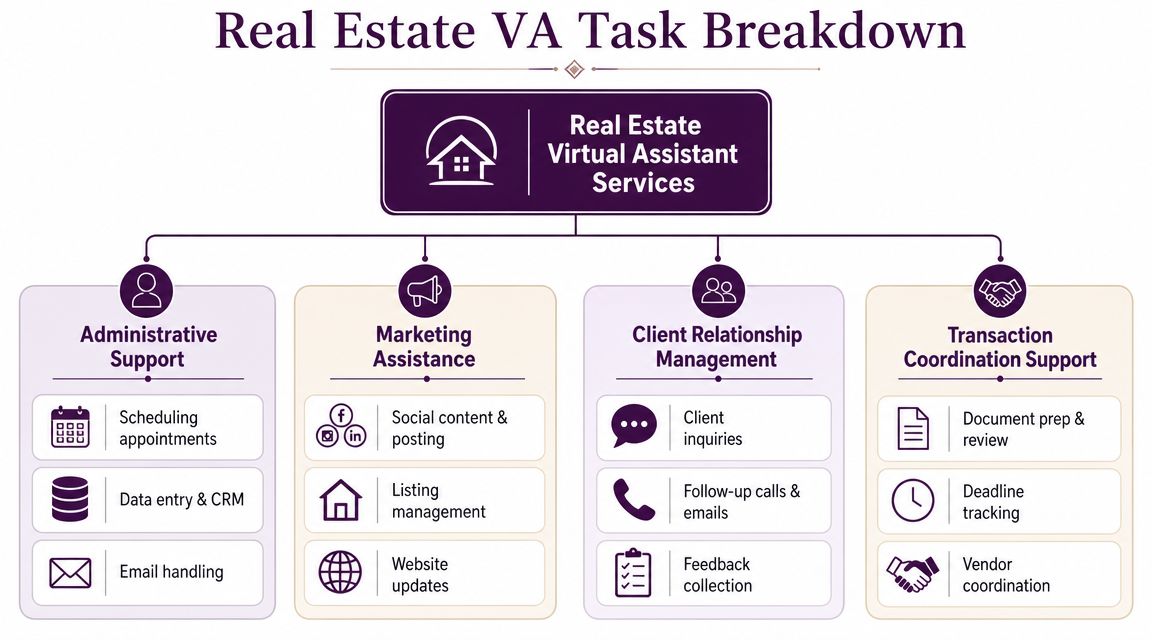
Lead management and follow-up
This is usually the first area to hand off because the ROI shows up quickly.
A VA can monitor inbound leads from your website, portals, social channels, and paid campaigns, then respond using your scripts and routing rules. That matters even more if you are already investing in digital marketing for real estate agents. More lead volume only helps if someone is consistently catching, qualifying, and scheduling those conversations.
Typical lead support includes:
- First-response handling: replying to new inquiries, asking intake questions, and pushing urgent prospects to the right agent
- CRM maintenance: logging notes, source details, tags, and next steps while the lead is still active
- Appointment coordination: confirming availability, booking tours or calls, and sending reminders
- Bilingual communication: handling English and Spanish outreach without waiting for an agent to translate or rewrite messages
For brokerages with steady showing volume, specialized real estate appointment scheduling support helps tighten the handoff between inquiry, confirmation, and attendance.
Listing and transaction support
This work protects consistency. It also protects margin, because small administrative misses turn into expensive agent interruptions.
A VA can keep listing files current, organize documents, update property information, and track deadlines across the transaction pipeline. The point is not to replace licensed judgment. The point is to keep the process moving so licensed staff only step in where they add real value.
Common assignments include:
- MLS entry and listing revisions
- Price, status, and remarks updates
- Document collection and file naming
- Form preparation for agent review
- Escrow and contingency deadline tracking
- Coordination with photographers, inspectors, stagers, and title contacts
The trade-off is straightforward. The more transaction support a VA handles, the tighter your SOPs and permissions need to be. Brokerages that document approval points clearly get far better results than teams that delegate informally.
Administrative and marketing support
Good VA support often starts with simple operational cleanup.
Inbox triage, calendar control, database hygiene, reporting prep, and follow-up list management are all strong fits. These tasks rarely look strategic on their own, but they affect response times, internal visibility, and how much context an agent has before every call.
A VA can also support light marketing execution, especially on repetitive tasks tied to listings and nurture campaigns:
- Scheduling social posts
- Uploading listing content
- Requesting brochure or flyer edits
- Cleaning contact lists
- Preparing simple email follow-up sequences
- Tracking responses from past clients and warm leads
Nearshore bilingual support adds a practical advantage here. Teams serving mixed English-Spanish markets can keep communication active across channels during normal U.S. business hours, with fewer handoff delays and fewer missed follow-ups.
The best task mix depends on where your brokerage is losing time today. If lead response is slow, start there. If listings and files are messy, assign coordination work first. If your agents are buried in inboxes and calendars, fix that before adding more lead volume.
The Strategic Benefits of Using Real Estate VA Services
Delegation saves time. That part is obvious. The bigger win is that it changes how the brokerage operates.
When a VA owns repeatable work, agents stop switching contexts every few minutes. They can stay in revenue-producing activity longer, which usually means better conversations, better preparation, and fewer dropped balls between appointments.
Better speed where it matters
Real estate is full of time-sensitive moments. A delayed follow-up after an inquiry. A missed showing confirmation. A listing update that doesn’t reach every channel cleanly. Those gaps hurt because they happen before the client sees the full quality of your service.
A disciplined VA function improves responsiveness in quiet but important ways:
- Leads hear back sooner
- Calendars stay current
- Client notes are visible to the team
- Documents move without unnecessary lag
- Agents walk into calls with better context
That matters even more when you’re also investing in digital marketing for real estate agents. Better marketing creates more inbound activity. It doesn’t solve the operational problem of handling that activity well.
Nearshore and bilingual support changes the equation
Many brokerages think too narrowly. They look at a VA only as a lower-cost admin resource. That’s incomplete.
A nearshore bilingual model gives you stronger real-time overlap with North American business hours, easier collaboration, and better coverage for English and Spanish communication. In many markets, that isn’t a nice extra. It’s a competitive requirement.
Here’s the practical difference:
- A lead inquiry in Spanish gets answered naturally
- A seller who prefers English still gets polished communication
- Managers can coach and monitor workflows in overlapping time zones
- Escalations happen quickly because the team is awake when your market is active
If you’re comparing support structures, CallZent’s page on outsourcing virtual assistants outlines how remote assistant support can be used across customer service, sales support, and operations.
A real estate VA is not just a labor decision. It’s a response-time decision, a coverage decision, and a client-experience decision.
Scalability without rushing headcount
A brokerage doesn’t always need to hire in-house the moment volume rises. Often it needs elasticity first. Virtual assistant services for real estate give you a way to add process capacity before you commit to a more fixed staffing model.
That’s useful during listing surges, new market expansion, seasonal demand shifts, or when a top producer suddenly starts generating more inbound volume than the current team can absorb cleanly.
Understanding Pricing Models and Calculating Your ROI
Most brokerage owners ask the wrong first question. They ask, “What does a VA cost?” The better question is, “What work am I buying back, and what does that let my team do instead?”
Pricing models matter, but only when tied to operating fit.
Comparing Real Estate VA Pricing Models
| Model | Best For | Pros | Cons |
|---|---|---|---|
| Hourly | Low or uneven task volume | Flexible, easy to test, useful for overflow work | Can become fragmented, harder to build deep process ownership |
| Dedicated assistant | Brokerages with recurring daily workflows | Stronger consistency, clearer accountability, easier training | Requires enough recurring volume to justify the setup |
| Project-based | One-time cleanup or launch work | Good for CRM cleanup, listing migration, or backlog reduction | Limited continuity, not ideal for live lead handling or ongoing support |
How to think about ROI without overcomplicating it
You don’t need a finance department to evaluate this.
Start with a simple internal exercise:
- List the tasks your agents handle that don’t require local judgment or licensed activity.
- Estimate the hours spent each week.
- Assign a realistic value to agent selling time.
- Compare that against the outsourcing cost.
- Add quality factors such as faster follow-up, fewer missed appointments, and cleaner records.
A simple example looks like this:
- Agent time recovered: 10 hours a week
- Value of that time: whatever your business assigns to productive agent hours
- VA cost: your monthly or weekly service cost
- Net operational gain: recovered value minus service cost
That framework isn’t perfect, but it’s practical. It also forces a better conversation than hourly rate shopping.
For owners who already think in investment terms, a rental-style tool like this calculator to assess rental profitability is a helpful reminder that ROI starts with inputs, assumptions, and discipline, not gut feel.
What to measure beyond cost
A VA that looks cheap can still underperform if the workflow is messy. Focus on outcomes such as:
- First-response consistency
- Appointment set rate
- Calendar accuracy
- Listing update turnaround
- CRM completeness
- Document cycle reliability
If you want a broader outsourcing lens, this guide on the ROI of outsourcing call centers is useful because it frames outsourced support around time and process value, not only payroll comparison.
How to Choose the Right Nearshore VA Provider
The provider decision matters more than most brokerages expect. A mediocre VA setup creates rework, confusion, and risk. A well-run provider creates clean handoffs, accountability, and visibility.
That difference usually comes down to structure.
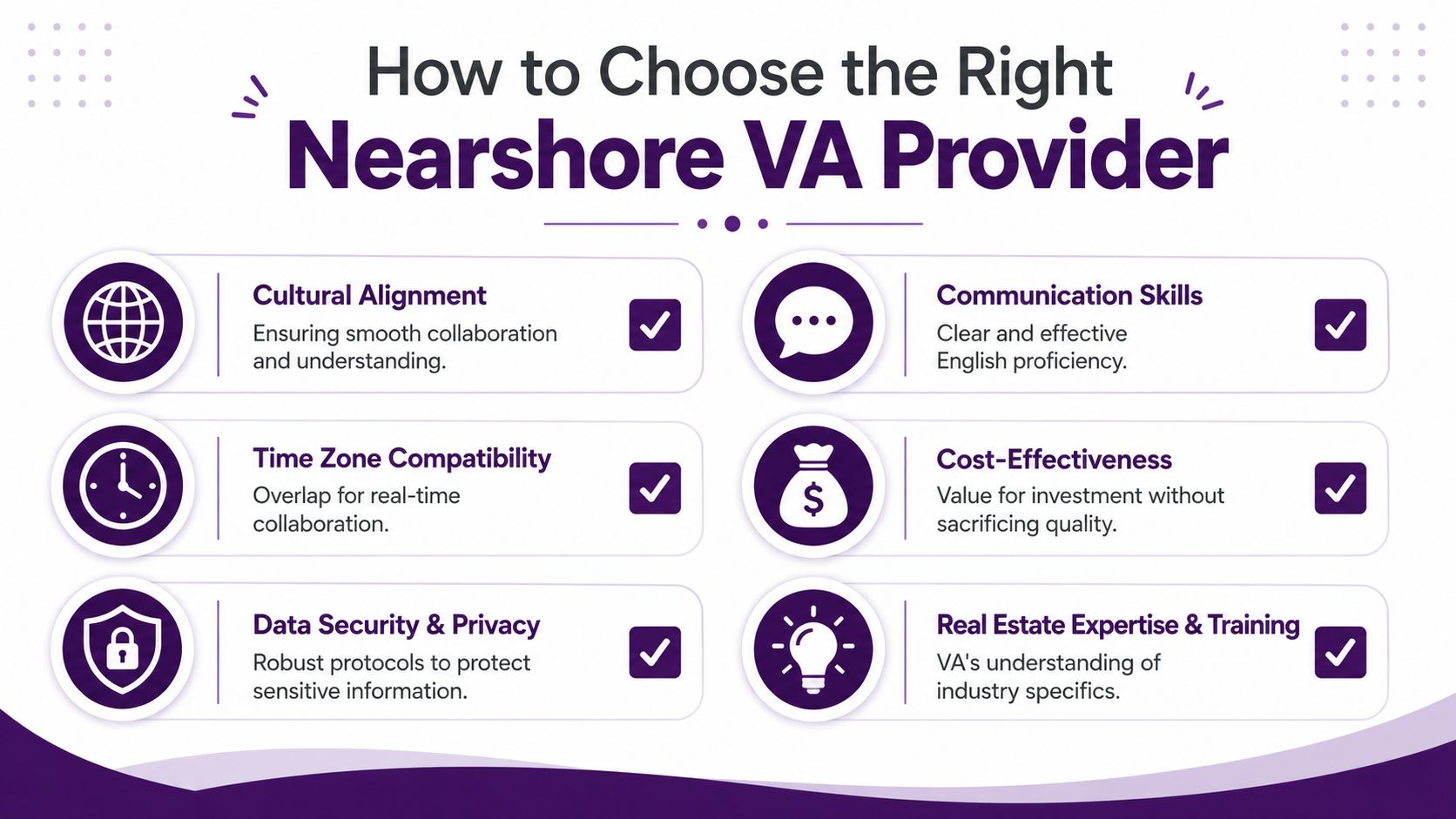
What to vet before you sign
Start with practical questions, not sales language.
- Time-zone overlap: Can the team work during your live market hours for inbound leads, showing coordination, and urgent changes?
- Bilingual fluency: Can they communicate comfortably in English and Spanish where your market demands it?
- Real estate familiarity: Do they understand CRM discipline, listing workflows, appointment routing, and document handling?
- Management layer: Is there supervision, QA, and escalation support, or are you managing a freelancer alone?
- Reporting: Will you get visibility into completed work, open items, and performance patterns?
- Training model: Can the provider onboard around your SOPs, tools, and scripts?
A nearshore partner in Mexico can make sense when you need close collaboration, easier communication, and service coverage aligned with North American operations. If that’s the route you’re evaluating, this overview of nearshore outsourcing to Mexico covers the operating logic.
Compliance is not a small print issue
It is common for many firms to get careless. Real estate VAs often handle personal contact details, financial conversations, identity-related documents, and message histories across several systems.
A useful industry warning from The Boutique COO is that compliance risk rises when VAs handle sensitive client data without structured permissions, retention rules, and supervision. A professional BPO provider mitigates that risk far better than an unmanaged freelancer setup.
If a VA touches your CRM, inbox, or transaction files, access control and supervision need to be designed up front.
Freelance help versus managed BPO support
Freelancers can work well for isolated tasks. But brokerages usually need more than task completion. They need continuity.
Managed support tends to be stronger when you need:
- Backup coverage
- QA oversight
- Role-based access handling
- Training refreshers
- Escalation paths
- Consistent reporting
This is one place where a provider like CallZent can fit. It offers bilingual nearshore BPO and virtual assistant support from Tijuana for North American businesses that need operational help across customer communication and back-office workflows.
Your Onboarding and Integration Checklist
A good VA can still fail inside a bad onboarding process. Most problems blamed on the assistant are setup problems. No SOPs. No clear ownership. No rules for escalation. No decision on what should stay with the agent.
The fix is straightforward. Build the operating lane before the VA starts driving in it.
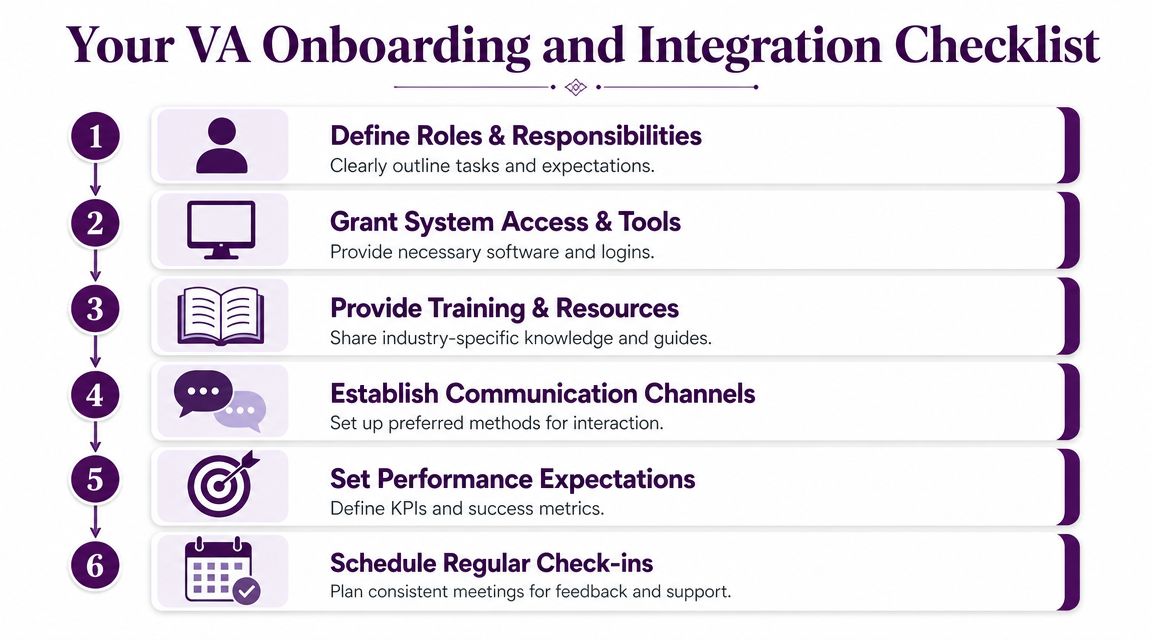
What to set up on day one
Use a practical checklist, not a vague handoff.
-
Define task ownership clearly
Separate what the VA owns, what they prepare, and what only the agent approves. For example, a VA can schedule, update, remind, log, and organize. The agent handles pricing strategy, negotiation posture, and sensitive relationship calls. -
Grant only the access they need
Set permissions for CRM, email, calendar, MLS-related tools, file storage, and phone systems based on the role. Don’t share full access by default. -
Document recurring workflows
Build simple SOPs for lead intake, showing coordination, listing changes, document naming, follow-up timing, and escalation triggers. A one-page checklist beats a verbal explanation every time. -
Set communication rules
Decide what belongs in Slack, email, your CRM, or a task board like Asana or ClickUp. Define response windows and what counts as urgent.
What should stay with the agent
Mature delegation beats lazy delegation.
Industry guidance highlighted by VA Talks makes an important distinction. While VAs can handle most admin, high-trust moments should stay in-house. Work requiring deep local market knowledge, nuanced negotiation, or critical relationship-building should remain with the agent.
That means the VA can prepare the field, but the agent still owns moments like:
- Final pricing discussions
- Negotiation strategy
- Delicate objection handling
- High-stakes seller confidence calls
- Conversations where local reputation and trust matter most
Don’t delegate the moment that wins the client. Delegate the work that makes that moment possible.
The KPIs to define early
Once the lane is clear, measure execution. Keep it simple at first.
- Lead follow-up completion
- Calendar accuracy
- CRM update consistency
- Listing change turnaround
- Document organization quality
- Escalation accuracy
A VA should never be judged only by “hours worked.” In a healthy setup, they’re judged by workflow reliability.
Frequently Asked Questions About Real Estate VAs
Do real estate VAs need to be licensed
Licensing depends on the task, not the job title. A VA can usually handle scheduling, CRM updates, listing coordination, inbox management, document prep, and database cleanup. Work tied to legal advice, licensed representation, contract interpretation, or negotiation authority should stay with licensed staff and the agent of record.
Brokerages should confirm state rules before assigning anything client-facing. The safest model is simple. Let the VA run the process. Let licensed agents own the decisions.
How do I know if my VA is actually performing well
Judge performance by output and consistency.
A real estate VA is doing the job well when leads get routed on time, appointments are accurate, CRM records stay current, and files are easy to audit. If agents still spend half the day fixing missed follow-ups or hunting for documents, the support model is not working, even if tasks look busy on paper.
For brokerages using a nearshore partner, I also look at communication quality. Can the VA handle English and Spanish interactions clearly, document both correctly, and escalate the right issues without delay? In diverse markets, bilingual execution is not a bonus. It directly affects lead response, client trust, and handoff quality.
Can a VA understand my local market well enough
A good VA does not need to replace local market judgment. They need to support it with clean execution.
That means they should understand your service area, property types, common transaction stages, and the terminology your team uses. They do not need to set pricing strategy, advise on neighborhood positioning, or lead sensitive seller conversations. Those remain agent responsibilities.
Nearshore teams can be especially useful here because time-zone overlap makes it easier to coach in real time. If the provider is bilingual, they can also support buyers and sellers who are more comfortable communicating in Spanish while your agents keep control of the relationship.
What’s the biggest mistake brokerages make with virtual assistant services for real estate
They hire before they define the lane.
A VA gets pulled into inbox triage, listing input, social posting, and cold outreach with no written priorities, no SOPs, and no owner for quality control. The result is predictable. Turnaround slips, handoffs break, and the agent starts taking work back.
The better approach is narrower at the start. Assign two or three repeatable workflows, document the standard, and measure turnaround and error rates for 30 days. After that, expand based on what the team can absorb.
Is nearshore really better than hiring a single freelancer
For many brokerages, yes. The difference is operating stability.
A single freelancer may work well for one agent with light admin needs. A nearshore managed team is usually the better fit when you need bilingual coverage, overlap with North American business hours, supervision, backup coverage, and room to scale across sales and operations. You are not just buying labor. You are buying continuity, management, and process discipline.
That trade-off matters when one absence can stall lead follow-up or transaction support.
How quickly should a brokerage expect value
Brokerages usually see the first return once the VA takes over high-frequency work that is easy to measure. Lead routing, appointment setting, CRM maintenance, inbox organization, and listing support often produce the earliest gains because they remove daily friction from agents and coordinators.
The bigger return takes longer. It comes after the brokerage builds a repeatable system with clear service levels, QA checks, and reporting. That is where a nearshore partner can outperform ad hoc hiring, especially if your team serves both English-speaking and Spanish-speaking clients.
🏡 Scale Real Estate Operations Smarter With CallZent
CallZent helps North American brokerages improve lead follow-up, appointment scheduling, bilingual communication, transaction coordination, and back-office workflows through scalable nearshore virtual assistant services from Tijuana, Mexico.
Talk to an ExpertIf your brokerage needs tighter lead follow-up, bilingual client communication, and cleaner back-office execution, CallZent is one option to evaluate. Their nearshore BPO model supports North American teams that need virtual assistant, scheduling, and customer support capacity without building every function in-house.