

Call Center for Startups
Call Center for Startups Guide for 2026 Nearshore BPO Playbook
Learn how startups should choose a call center partner, compare build vs buy, vet nearshore BPOs in Tijuana, negotiate AI and shrinkage terms, and set KPIs that improve support.
TL;DR — Quick Takeaways
- A call center for startups becomes necessary when support volume starts pulling founders, product managers, or account teams away from core work.
- Building in-house gives you control, but it also brings hiring, training, scheduling, QA, and software overhead.
- Nearshore teams in Tijuana offer a strong middle ground for North American startups because they combine bilingual talent, close collaboration, and better cost structure.
- The biggest rookie mistake is signing a BPO contract based on a sales demo instead of documented operating terms.
- Ask for proof that AI tools are production-active, not optional add-ons.
- Ask for documented shrinkage assumptions before you approve the statement of work.
- Measure success with First Call Resolution, not just speed.
- Your first 90 days should focus on training, calibration, and clean reporting, not aggressive scaling on day one.
You’re probably in one of two situations right now.
Either your founders, ops lead, or product team are still answering support calls between meetings, or you’ve already felt the first serious crack: missed callbacks, slow responses, confused customers, and a support process that depends too much on a few internal people who should be building the business.
That’s when a call center for startups stops being a “later” problem. It becomes an operating decision.
Key takeaway: The best startup support partner isn’t the one with the best pitch. It’s the one that can show exactly how the team will perform, scale, and report once real customers start calling.
Your Customer Support Is a Ticking Time Bomb
A familiar startup pattern looks efficient at first.
One founder handles angry customers because they know the product best. A customer success manager jumps in during peak hours. An engineer takes edge cases. Sales covers overflow when someone important complains loudly enough. For a while, that feels lean and practical.
Then the cracks spread. Customers hear different answers. Follow-ups slip. The product team starts prioritizing whoever shouts the loudest instead of what matters most. Support becomes reactive, inconsistent, and expensive in a way that rarely shows up cleanly on a budget line.
The scrappy phase doesn’t scale
The danger isn’t just volume. It’s dependency.
When customer support lives in Slack threads, personal inboxes, and tribal knowledge, every new hire adds more variation. The business starts teaching customers that service quality depends on who picks up the phone. That’s not a support model. That’s luck.
I’ve seen this inflection point hit startups right after a launch, after a new retail partnership, or when one product update creates a wave of basic questions. The same issue appears every time: support was treated like a side task until it became a bottleneck.
Support is an operating system
A real call center for startups does more than answer complaints. It creates structure.
You need clear routing, documented answers, escalation rules, and a team that can absorb spikes without dragging leadership into daily ticket cleanup. That’s why outsourced support isn’t some fringe tactic. The contact center industry is already enormous. The global contact center market is valued at $339.40 billion and is projected to expand to $496 billion by 2027, which shows how standard outsourced support infrastructure has become for growing companies (contact center market data).
That matters because founders often think outsourcing is a sign they’re losing touch with customers. Usually the opposite is true. Once the right team handles frontline interactions consistently, leadership finally gets cleaner feedback.
A good support operation gives you three things at once:
- Retention protection: Customers get faster, clearer answers.
- Operational relief: Internal teams stop firefighting all day.
- Product insight: Patterns become visible instead of anecdotal.
If you’re already seeing support spill into nights, weekends, or executive calendars, you’re past the point of “we’ll fix it later.” You need a system. A helpful place to pressure-test that transition is this guide on scaling customer support without chaos.
The First Big Decision Build vs Buy
Most founders frame this question too narrowly. They ask, “Should we hire support agents or outsource?”
That’s not the question.
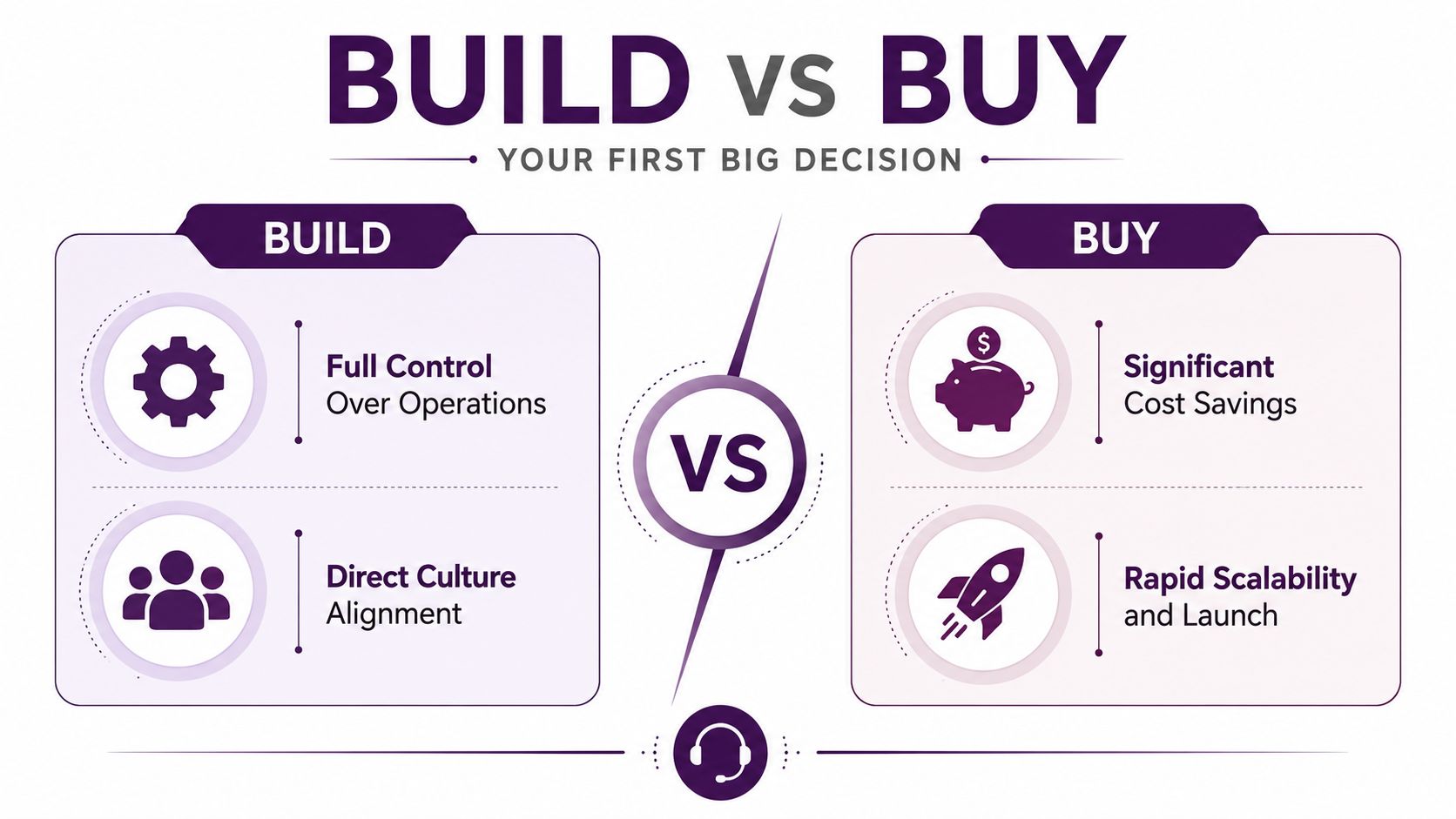
The question is whether your startup should spend time building a support operation from scratch, or buy an operating system that already includes hiring, scheduling, training, QA, and management discipline.
What founders underestimate about building
Building in-house sounds straightforward until you list every moving part.
You need to recruit agents, train them, document workflows, choose a phone platform, connect it to your CRM, monitor coverage, review quality, handle absences, and manage supervisors. You also need someone internally who owns the operation every day, not just during hiring.
There’s also a technical trap. The better approach for most startups is to start with a cloud phone system, budget $30 to $60 per agent monthly, set it up in about one week, and reevaluate once you reach 25 agents. The same guidance warns against custom in-house builds unless you’re handling 1,000+ daily calls with no staffing team, because that creates premature technical debt. It also notes that 80% of early-stage startups fail due to scaling infrastructure before establishing consistent demand (startup call center setup guidance).
That point gets missed all the time. Founders overbuild support infrastructure long before they’ve stabilized demand, workflows, or staffing.
What buying gets you immediately
Buying doesn’t mean giving up standards. It means buying speed and maturity.
A capable partner already has the basics in place:
- Recruiting muscle: They can staff faster than an early-stage startup.
- Operational coverage: Scheduling, absentee management, and overflow handling are already built into the model.
- Tool familiarity: Agents and managers already know common support systems and reporting workflows.
- Management structure: You aren’t inventing QA and coaching from zero.
Buy when support is important but not your core product advantage. Build only when support operations themselves are a strategic differentiator and you have the leadership bandwidth to run them well.
A practical decision test
Choose build if all three are true:
- You need unusually tight internal control.
- You already have experienced support leadership.
- You can absorb slower ramp time without hurting customers.
Choose buy if any of these are true:
- Your team is distracted: Founders or product staff are covering frontline support.
- Demand is lumpy: You need to scale up without rebuilding headcount plans every month.
- You need launch speed: You can’t wait for recruiting and training cycles to settle.
- You want less execution risk: The partner already knows how to run support at volume.
For most startups, buying first is the safer move. Then you decide later which functions should stay external and which should move in-house. If you’re weighing that trade-off, this comparison of in-house vs outsourced support is worth reviewing.
Why Nearshore in Tijuana Is Your Secret Weapon
Once a startup decides to outsource, the next mistake is treating every outsourced model as interchangeable.
They’re not.
Onshore gives you proximity but usually at a higher cost base. Offshore can reduce spend, but time zones, communication gaps, and slower collaboration can create drag exactly where startups can least afford it. Nearshore often lands in the sweet spot.
The Tijuana advantage is practical, not theoretical
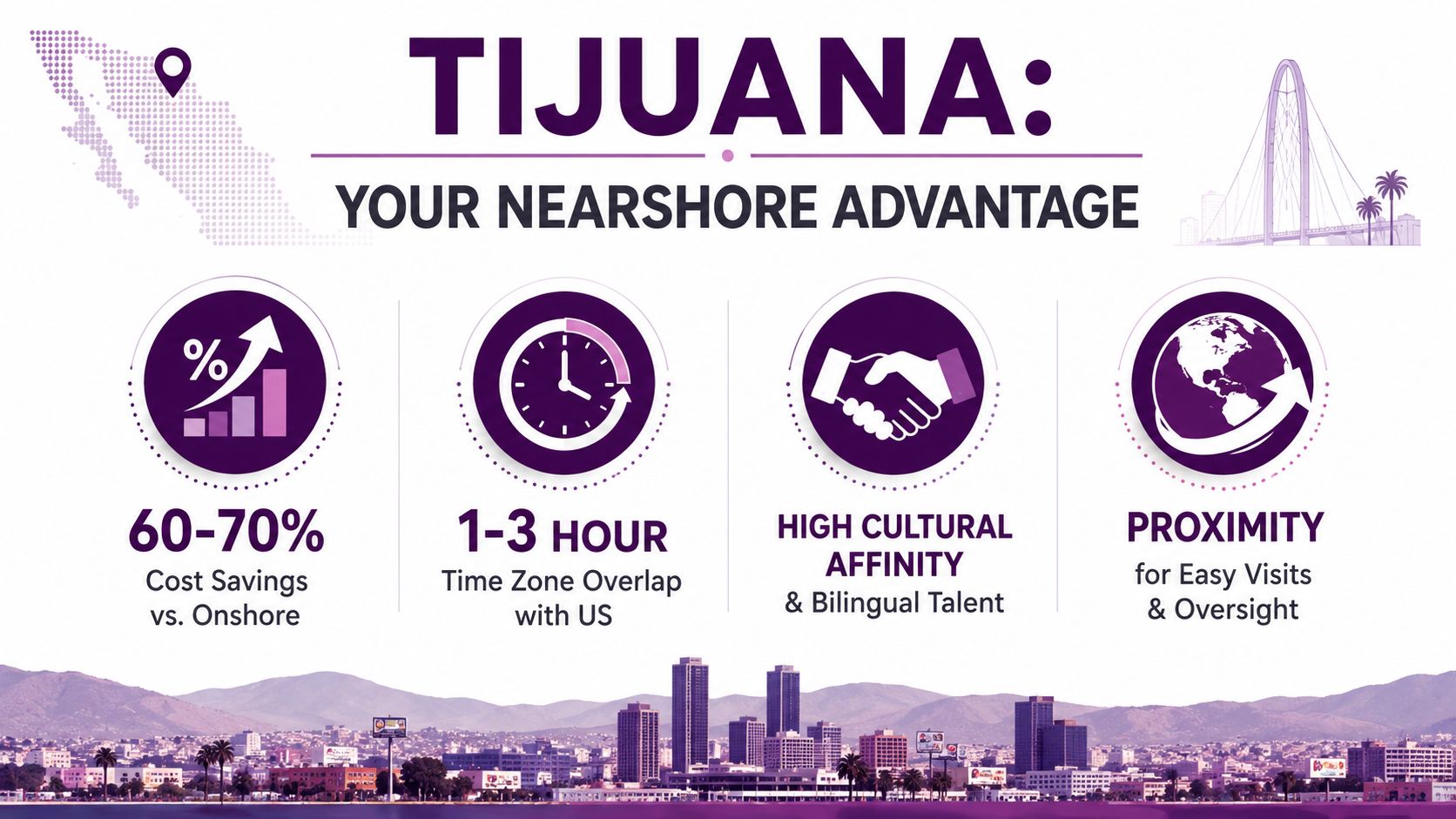
Tijuana works well for North American startups because the benefits show up in daily operations.
You get shared or closely aligned working hours. You can run training, calibration, and escalation reviews without waiting overnight for answers. Leadership can visit the site without planning an international expedition. If your brand serves both English and Spanish speaking customers, bilingual hiring is much easier.
There’s also a hard cost case. Nearshore call center pricing in Tijuana typically ranges from $10 to $20 per hour. Specifically, inbound customer service is priced at $10 to $14 per hour and technical support at $14 to $20 per hour, delivering a 40 to 60 percent cost savings compared to hiring and managing an equivalent in-house team in the U.S. (Tijuana nearshore pricing).
That’s the kind of difference that changes hiring plans, not just procurement spreadsheets.
Why startups feel the difference fast
The savings matter, but the operating rhythm matters more.
A startup support program usually needs fast changes in scripts, workflows, promotions, return rules, or escalation handling. When the team is nearshore, changes move faster because your managers and the vendor’s managers can work in near real time. That’s hard to replicate with teams several time zones away.
A few common examples:
- E-commerce brands: Need same-day updates when promotions or shipping exceptions change.
- Healthcare support teams: Need clearer communication and reliable escalation discipline.
- SaaS startups: Need agents who can route issues correctly and preserve context for technical teams.
- Financial services and insurance teams: Need bilingual support with tighter process consistency.
Tijuana also gives founders a useful middle ground between distance and control. You aren’t trying to micromanage every conversation, but you can still stay close enough to the operation to shape it.
Nearshore is strongest when partnership matters
If your goal is to maximize savings only, you’ll focus on hourly rates.
If your goal is to scale support without creating a management burden, you’ll care more about access, oversight, communication, and speed of correction. That’s where nearshore tends to outperform cheaper but more distant models. This is one reason many operators look to maximize business growth with nearshore instead of treating outsourcing as a simple labor arbitrage play.
For startups evaluating this route, it helps to understand the local model in detail. This overview of call center outsourcing in Tijuana, Mexico gives a practical baseline.
The Ultimate Vendor Selection Checklist
Most startup founders ask weak vendor questions.
They ask whether the BPO supports voice, chat, or email. They ask if agents are bilingual. They ask if the provider “uses AI.” Those aren’t useless questions, but they won’t protect you from a bad contract or a bad launch.
The right questions expose how the operation runs.
Start with what the contract must prove
Here’s the trap. A vendor can sound impressive in a pitch and still leave you with a vague statement of work.
That’s where startups get burned.
A critical pitfall for startups is failing to contractually negotiate AI integration and shrinkage assumptions. Founders must demand proof of production-active AI tools, documented weekly QA review cycles, and explicit ramp timelines to avoid partnering with providers who over-promise on technology and under-deliver on execution (BPO contracting pitfalls for startups).
That means you shouldn’t accept phrases like “AI-enabled environment” or “scalable staffing support” without specifics.
If a feature matters to operations, it belongs in the contract. Not in a slide deck, not in a demo, and not in a verbal promise.
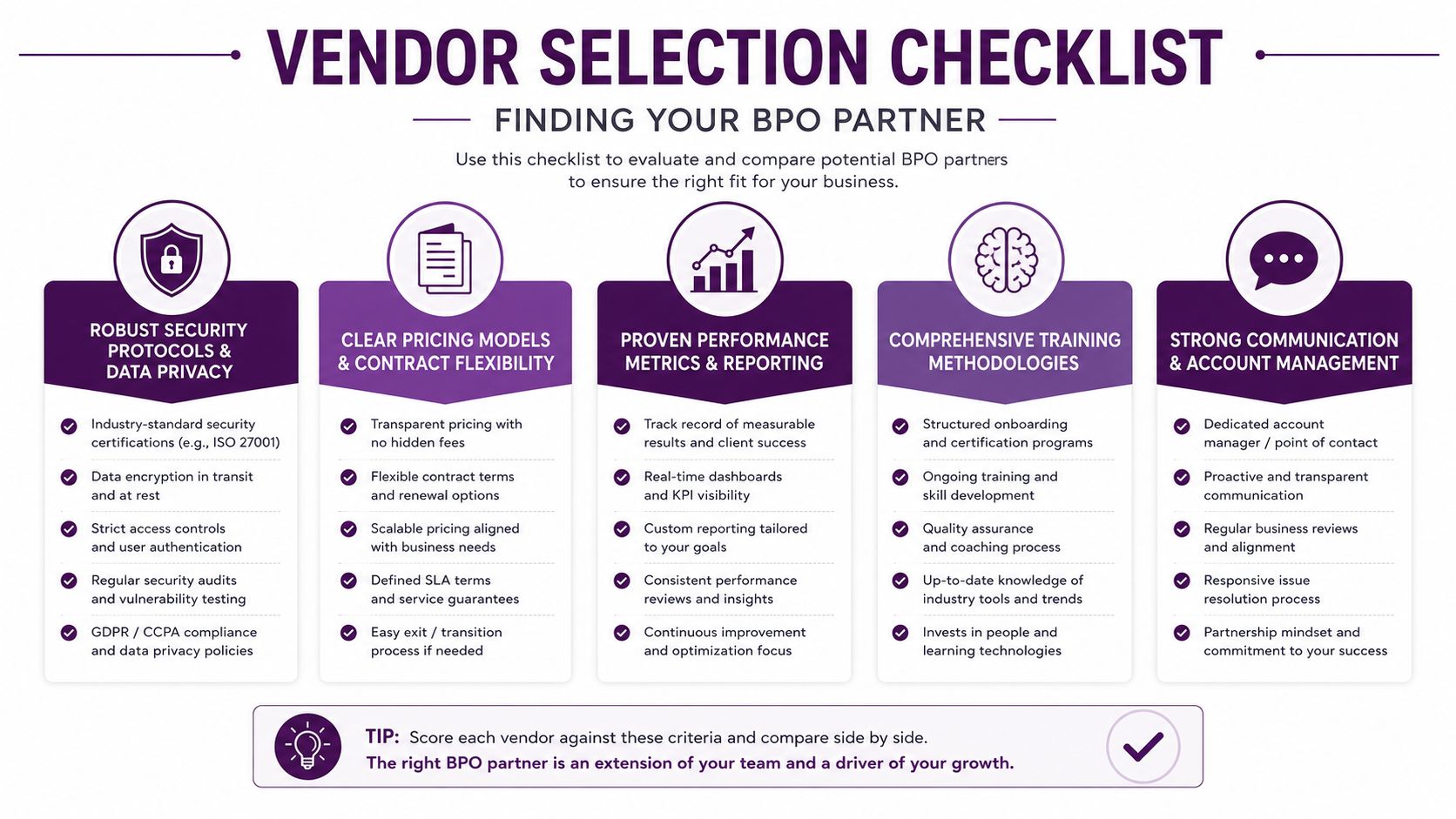
The five areas that matter most
Technology and AI
Ask whether the provider’s AI tools are live in production today.
You want examples such as real-time sentiment analysis, auto-summary, QA assistance, or workflow support that are already active in the operation you’ll receive. If a feature is optional, ask when it activates, how it is priced, and who owns setup.
Questions to ask:
- Production status: Is this AI tool active in the live environment or only available for pilot programs?
- Workflow impact: Which specific agent or QA workflows use it?
- Reporting: How will we see proof that the tool is being used consistently?
Staffing and shrinkage
Shrinkage catches inexperienced buyers off guard. You may think you’re paying for a certain number of agents, but actual coverage can be lower depending on how absenteeism, breaks, meetings, coaching, and training are modeled.
Ask for documented assumptions in writing.
- Coverage math: What shrinkage assumptions are built into the staffing model?
- Peak handling: How do you cover call spikes, unplanned absences, and training time?
- Ramp commitments: How quickly can the team add agents when volume increases?
QA and coaching discipline
A vendor can’t improve what it barely reviews.
You want to know how feedback is delivered, how often calls are reviewed, and what happens after quality issues surface. Weekly review cycles are far more useful than vague monthly summaries.
Training and knowledge management
Startups change fast. Your provider has to keep up.
Ask how new product information is rolled out, who updates the knowledge base, and how agents confirm they understood the update before taking live contacts.
Communication and governance
Strong account management prevents small issues from turning into recurring failures.
Clarify who attends weekly reviews, what reports you receive, how escalations work, and when leadership steps in.
Sample RFP questions for your BPO partner
| Category | Sample Question |
|---|---|
| Technology | Which AI features are production-active for the exact team model we would buy? |
| Technology | How do agents use auto-summary, sentiment analysis, or QA tools during live operations? |
| Staffing | What shrinkage assumptions are included in your staffing plan, and where are they documented? |
| Staffing | What is the process for adding agents when contact volume rises unexpectedly? |
| QA | How often are interactions reviewed, and how quickly do agents receive coaching feedback? |
| Training | How do you roll out product updates and verify agent readiness before launch? |
| Reporting | What reports will we receive weekly, and who explains variances? |
| Contract | Which items are guaranteed in the statement of work versus offered as optional services? |
A practical framework for this due diligence is this checklist on vendor evaluation criteria.
Defining Success with the Right SLAs and KPIs
A startup can ruin a good support partnership by measuring the wrong things.
The most common mistake is obsessing over speed in a way that punishes quality. If you push agents to end calls faster, they will. Customers will then call back, repeat themselves, and lose trust.
Stop worshipping handle time
Average Handle Time has value as an operational reference point, but it should not be the north star for a startup support team. Shorter isn’t always better. Sometimes it just means the agent rushed the customer off the line or escalated too quickly.
The better primary metric is First Call Resolution.
Startups should prioritize First Call Resolution over Average Handle Time. The most reliable drivers for FCR are agent authority, a searchable knowledge base, and CRM integration. Obsessing over handle time increases customer effort and churn, while focusing on FCR correlates with a 20 percent improvement in customer satisfaction scores (call center best practices for FCR).
That gives founders a cleaner principle: reward solved issues, not short conversations.
What a balanced scorecard looks like
A useful scorecard for a call center for startups usually includes a mix of service levels, quality signals, and operational health.
Focus on metrics that answer these questions:
- Did the customer get the issue resolved?
- Did the agent follow the right process?
- Did the team respond within the agreed window?
- Are repeat contacts increasing or decreasing?
- Are escalations happening for the right reasons?
Here’s a practical structure.
Service level metrics
These tell you whether the team is reachable and responsive.
- Response and queue performance: Are customers waiting too long before reaching an agent?
- Abandonment trends: Are customers giving up before the team answers?
- Coverage adherence: Is staffing lined up with actual demand?
Resolution metrics
These tell you whether support is working.
- First Call Resolution: The clearest signal of frontline effectiveness.
- Repeat contact rate: A useful check on whether “resolved” issues are resolved.
- Escalation quality: Track not just volume, but whether escalation was necessary.
Quality metrics
These tell you whether the team protects your brand.
- QA scores: Measure accuracy, empathy, compliance, and documentation quality.
- Knowledge usage: Confirm agents use the approved answers and workflows.
- CRM completeness: Make sure case notes and customer history are captured correctly.
Practical rule: If a KPI drives the wrong behavior, remove it or rebalance it. Startups need support teams that solve problems cleanly, not teams that game a dashboard.
Write SLAs that reflect customer reality
An SLA should define customer expectations and vendor accountability in plain language.
Good startup SLAs usually cover:
- Hours of operation: Which channels and time windows are in scope.
- Response commitments: What “timely” means by channel.
- Escalation windows: When unresolved issues move to your internal team.
- Reporting cadence: What gets reviewed weekly and monthly.
- Change management: How scripts, policies, and product updates are approved.
If the SLA is vague, your weekly reviews will become debates instead of decisions. This resource on call center service level agreements is a useful reference when drafting practical terms.
Your First 90 Days Onboarding a New Partner
A signed contract doesn’t create a working support operation. The first three months do.
Most early failures happen because the startup wants the vendor to “just start taking calls” before the knowledge base, escalation rules, and calibration rhythm are ready. That creates a messy launch, and then both sides spend weeks cleaning up avoidable issues.
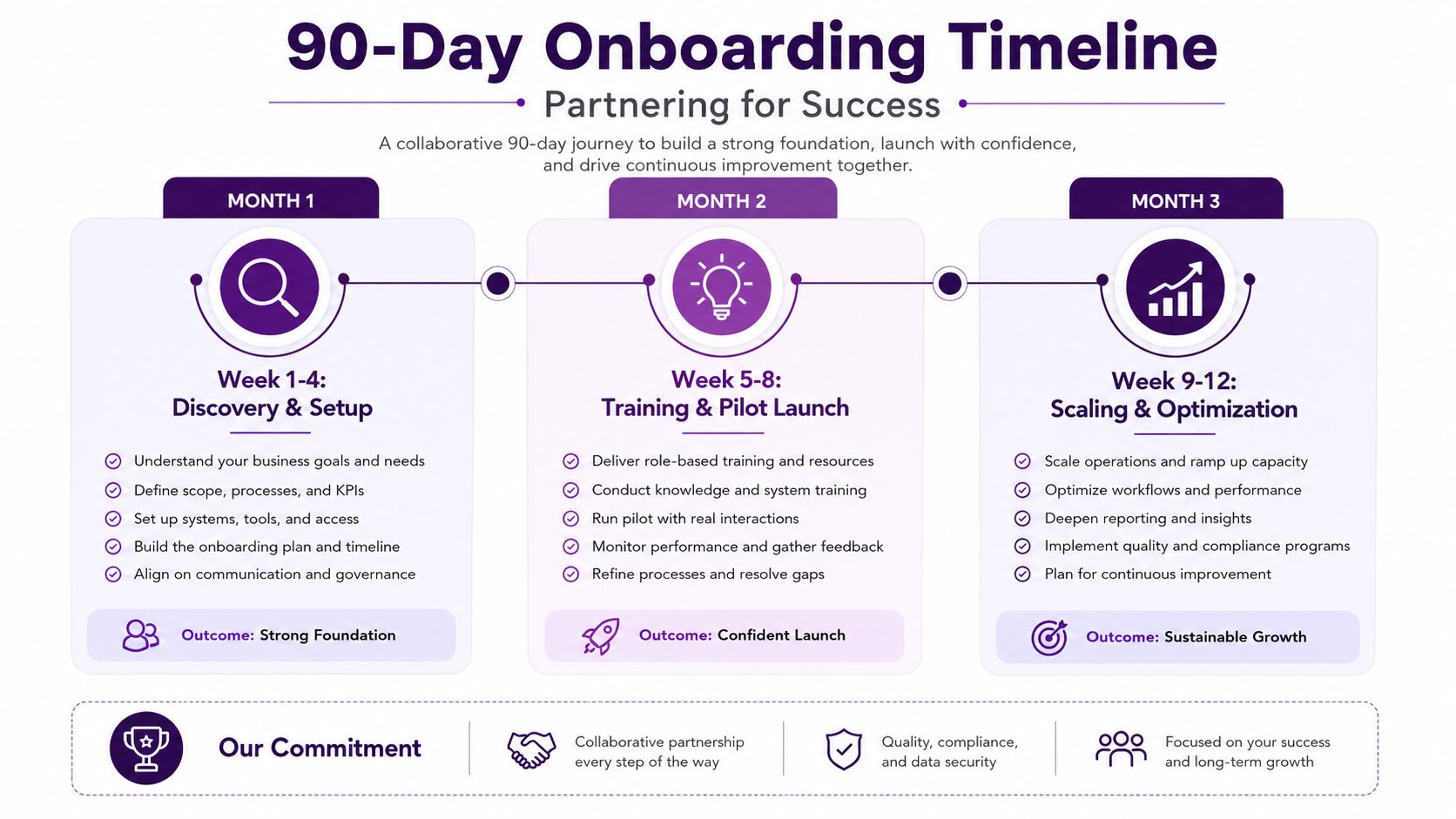
Month one focuses on clarity
In the first month, the startup has to provide the raw material.
That includes policies, common issues, refunds or exception rules, escalation contacts, CRM access, and examples of what “good” sounds like with customers. The vendor turns that into scripts, call flows, training materials, QA forms, and reporting logic.
This is also the right time to align on the basics behind performance language. If your internal team hasn’t worked with service metrics before, a simple explainer on what are service level agreements can help frame the conversation before you lock final accountability terms.
Month two is for controlled launch
Weeks five through eight should not feel like a full-speed rollout.
This phase works best when the new team starts with a controlled subset of contacts, then expands as the startup and provider calibrate answers, documentation quality, and escalation behavior. If you launch every queue at once, you won’t know whether issues are caused by training gaps, poor routing, or bad source material.
A realistic pilot phase usually includes:
- Limited scope: Start with a defined queue, issue type, or customer segment.
- Daily feedback: Review sample interactions and fix patterns fast.
- Live calibration: Compare how internal staff and outsourced agents handle the same scenarios.
- Knowledge updates: Tighten scripts and FAQs based on real contacts.
Month three is where the model proves itself
By weeks nine through twelve, the operation should look less like a pilot and more like a managed program.
You should have stable reporting, clearer staffing patterns, and fewer avoidable escalations. This is also the right time for a formal business review. Not a ceremonial meeting. A working review that asks whether the current staffing plan, QA process, and escalation map still match reality.
A strong first-quarter review should answer:
- Are customers getting consistent answers?
- Which contact types should stay with the vendor?
- Which issues still require internal handling?
- Where is the knowledge base still too thin?
- What has to change before the next volume increase?
The first 90 days are not about proving the vendor can answer calls. They’re about proving both teams can run one operation together.
Startup Call Center FAQs
When should a startup outsource support?
Outsource when support work starts pulling leadership or specialist teams away from their core jobs, or when response quality becomes inconsistent. If your product, ops, or sales teams are acting as an informal help desk, it’s time to formalize.
Is a call center for startups only for high-volume companies?
No. It’s also useful for startups with moderate volume but complex support needs, bilingual customers, or unpredictable spikes. The trigger isn’t just volume. It’s operational strain.
What should founders ask before signing with a BPO?
Ask how the team will be staffed, trained, quality-checked, and managed. Then ask what is guaranteed in the contract. AI features, QA cadence, ramp timelines, and shrinkage assumptions should be documented, not implied.
Should we prioritize low cost or flexibility?
Flexibility usually matters more early on. Startups change quickly. A slightly cheaper vendor can become expensive if they can’t adapt to product updates, policy changes, or volume swings.
What metric matters most?
For most startup support environments, First Call Resolution is the clearest operating signal because it ties directly to customer effort and repeat contact risk.
🚀 Build Startup Support Without the Chaos
If you’re evaluating your first outsourcing partner and want a team that understands startup speed, bilingual support, and nearshore execution in Tijuana, CallZent can help you build a support model that scales without pulling your internal team away from growth.
Talk to an ExpertIf you’re evaluating your first outsourcing partner and want a team that understands startup speed, bilingual support, and nearshore execution in Tijuana, explore CallZent.