
Contact Center Operations
Contact Center Management: A Practical Guide to People, Performance, and Technology
Build a practical operating model for workforce planning, measurable service targets, accountable leadership, AI oversight, and bilingual delivery.
TL;DR — Quick Takeaways
- Forecast demand and available coverage by interval, skill, channel, and language.
- Name owners for staffing, quality, coaching, technology changes, and escalations.
- Pair speed measures with resolution, repeat contacts, customer feedback, and cost.
- Define AI access, human review, escalation, monitoring, and rollback before launch.
- Evaluate nearshore support through actual coverage, language capability, and shared QA.
Buying better software won’t fix a queue if you don’t have enough trained people scheduled to answer it. That’s the uncomfortable starting point for honest contact center management. Technology routes, records, and reports the work. People still absorb the volume, handle the angry customer, notice the billing pattern, and decide when an exception needs a human override.
Contact center management is a workforce and control system. Software only helps when staffing, accountability, and guardrails are already clear.
Why Contact Center Management Is Really a Workforce Problem
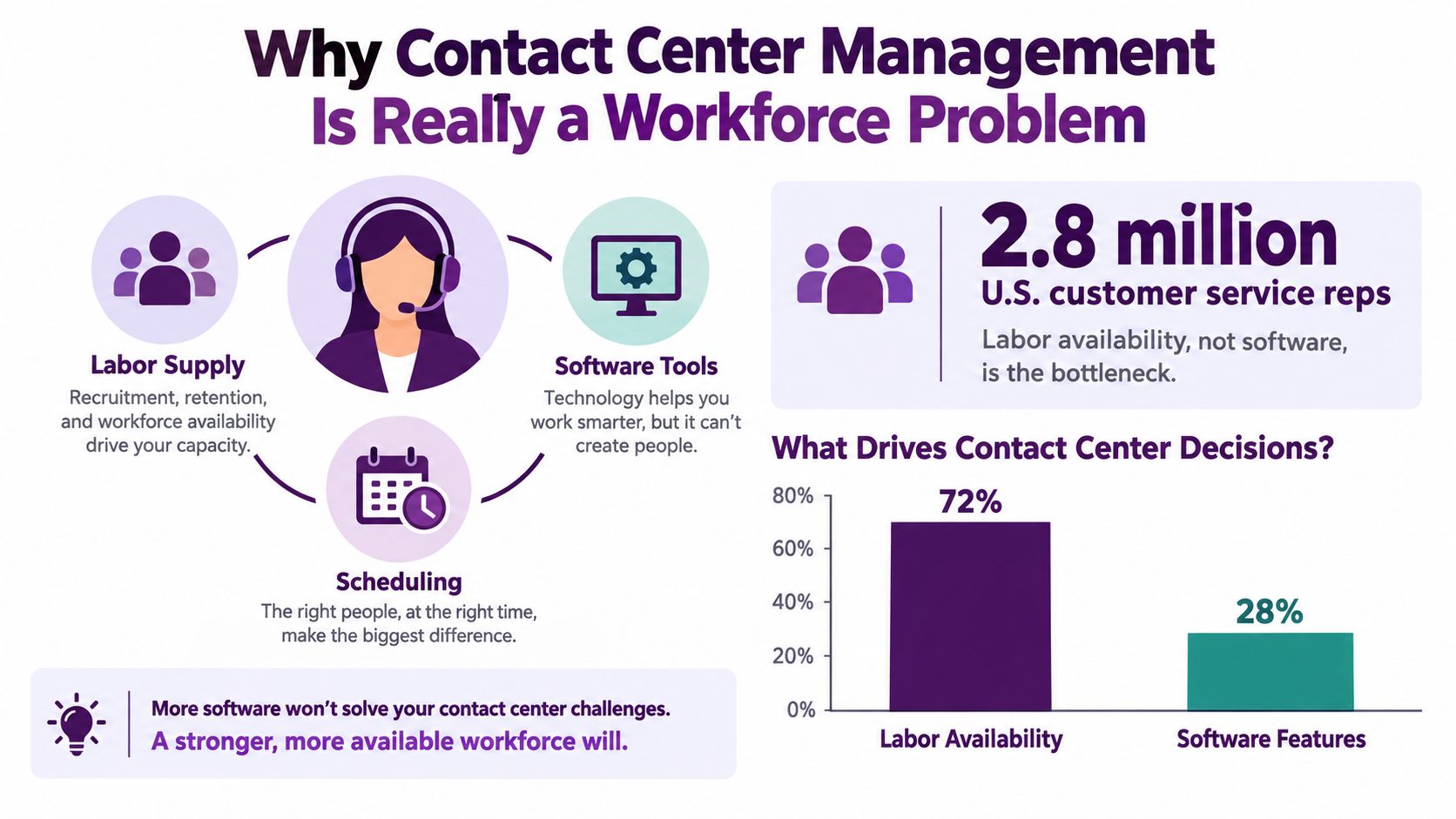
A manager can buy routing, dashboards, and speech analytics in a quarter. Recruiting, training, scheduling, and keeping enough capable agents takes disciplined work every week. That’s why contact center management starts with labor availability, not a feature comparison.
Turnover and unavailable time change the staffing requirement before the first contact arrives. Track attrition by role and tenure, and measure shrinkage from your own schedules rather than relying on a general industry percentage. Recruiting capacity, training seats, nesting support, and supervisor availability all belong in the operating plan.
The Four Systems in Contact Center Management
Every operating decision connects four things:
- Demand forecasts: Expected contacts by channel, language, skill, and interval.
- Employee availability: Scheduled hours after breaks, training, meetings, absence, and leave.
- Service targets: How quickly each customer segment must reach help, and what outcome counts as resolved.
- Labor budgets: The cost you’re willing to carry for coverage, overtime, idle time, and rework.
Change one and the others move. A tighter voice target may require additional coverage; changing the target alone does not change demand or create staffed capacity. Add chat concurrency without redesigning workload and quality can slip even while productivity dashboards look better. Cut training to protect today’s queue and you borrow capacity from next month’s new hires.
Good managers therefore don’t ask only, “How many contacts are coming?” They ask, “Who’s available, with which skills, in which language, and under what limits?” A structured approach to contact center workforce management turns those questions into forecasts, schedules, adherence checks, and corrective action. If that foundation is weak, every later choice about AI, outsourcing, or quality becomes harder to control.
Building the Operating Org and Leadership Accountability
An org chart tells you who reports to whom. It doesn’t tell you who can change a forecast at 9 a.m., pull an agent into coaching, approve an IVR change, or accept a missed service target. Those decision rights are where contact center management either runs cleanly or turns into group chat management.
Start by assigning ownership. Smaller teams may combine roles, but each decision still needs a named accountable person. The VP of Customer Experience owns business outcomes and trade-offs between cost, access, and quality. The Director of Operations owns daily execution across queues and sites. The WFM lead owns forecasts, schedules, and intraday staffing calls. The QA lead owns scorecard design and calibration, while supervisors own coaching and follow-through. IT owns platform reliability, integrations, access, and change control, not frontline performance targets.
Accountability in Contact Center Management
A simple RACI model prevents familiar failures. WFM recommends overtime, operations approves it, supervisors communicate it, and finance is informed before the spend lands. QA flags a compliance error, the supervisor coaches it, training fixes the knowledge gap, and operations verifies whether the behavior changed. When a CRM field breaks, IT fixes the integration, but operations decides the temporary workaround agents should use.
Startup teams often skip this structure because the founder or one strong manager can personally absorb ambiguity. That works until volume doubles, a second language queue opens, or a client demands evidence for an escalation. Then everyone discovers that knowledge lived in one person’s head. Documenting escalation tiers, approval limits, and meeting owners feels bureaucratic only until the first serious outage or compliance complaint.
Nearshore delivery needs the same clarity across company boundaries. Shared SLAs should specify who owns hiring profiles, training sign-off, schedule changes, QA calibration, and customer-facing exceptions. Tijuana teams can join live operating reviews during North American business hours, but proximity doesn’t replace a named owner on each side.
Make ownership reviewable. For every recurring decision, record the accountable owner, the person who executes it, the approval limit, and the escalation route. Test the model with an absence spike, a failed integration, and a customer complaint before relying on it during a live disruption.
The Technology Stack That Supports Real Decisions
Treat each platform as an answer to a management question. If a tool can’t improve a staffing, routing, coaching, quality, or customer decision, it’s shelfware with a login screen.
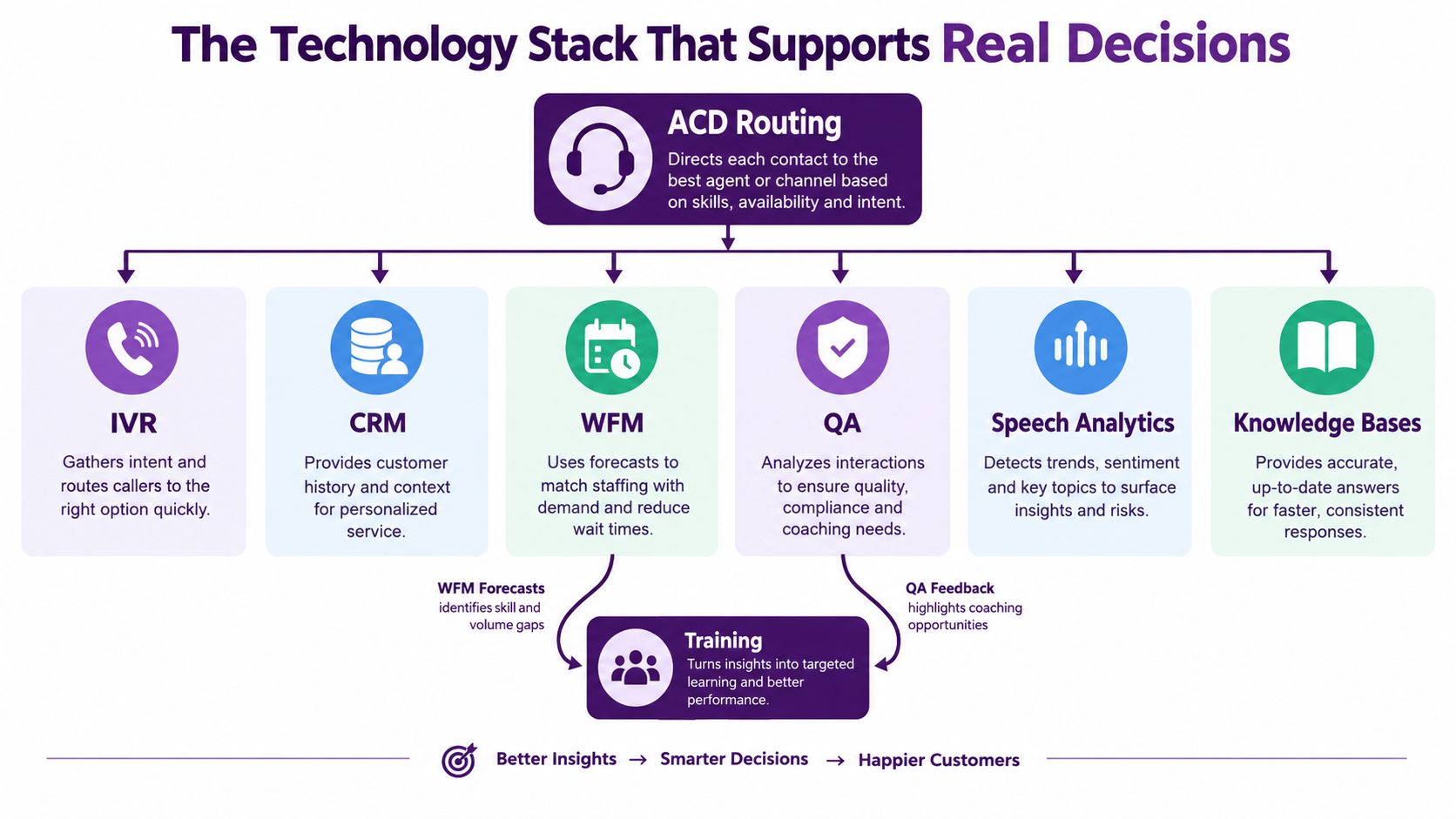
The ACD decides who gets the contact. Skills-based routing should reflect language, product knowledge, licensing, customer value, and urgency, with appropriate availability and load balancing among eligible agents. The IVR should identify intent and authenticate safely, then get out of the way. Long menus that exist to make containment look good usually push frustrated customers into queues with less context.
How the Stack Supports Contact Center Management
- CRM: Gives agents customer history, open cases, entitlements, and next actions in one workflow.
- WFM: Converts forecast volume and handle time into schedules, then exposes adherence and intraday gaps.
- QA and speech analytics: Show where behavior, wording, or process design creates repeat contacts and compliance risk.
- Knowledge base: Provides the approved answer agents should use, with ownership and review dates.
- Reporting layer: Connects queue data to outcomes so managers don’t reconcile five exports before acting.
The connections matter more than the boxes. ACD intent data should improve WFM forecasts. CRM disposition quality should shape coaching plans. QA findings should change knowledge articles and training, not sit in a monthly spreadsheet. Speech analytics can flag long silence, repeated authentication, or payment risk, but a supervisor still has to decide whether the cause is agent skill, a broken process, or a product defect.
Sequence purchases around the operation’s actual needs. Stabilize routing, customer context, scheduling, and QA before layering advanced analytics over unreliable data. A practical review of your contact center technology stack should map each system to its owner, source of truth, integration, and decision cadence.
Don’t buy for a future operating model you haven’t staffed. A small team needs clean queues, dependable CRM notes, schedules people can see, and QA feedback that arrives quickly. That’s less exciting than an AI demo. It’s also what keeps tomorrow’s queue covered.
KPIs, SLAs, and the Shrinkage Math Managers Actually Use
A KPI is useful only if it changes a decision. Faster answers don’t help if customers call back tomorrow, and low handle time isn’t efficiency if agents rush authentication or skip documentation. Read the measures as one system.
Core KPIs and What They Actually Tell a Manager
| KPI | What it measures | Management decision it supports |
|---|---|---|
| Service level | Eligible contacts answered within a defined threshold; document the denominator and abandon treatment | Staffing level and queue priority |
| Average speed of answer | Mean queue wait for answered calls; excludes abandoned callers unless separately defined | Intraday coverage and callback offers |
| Abandonment rate | Abandoned eligible contacts divided by offered eligible contacts, with exclusions disclosed | Access design and channel alternatives |
| Average handle time | Talk, hold, and after-contact work | Process, training, and capacity planning |
| First contact resolution | Eligible issues resolved on the first contact under a defined issue-matching rule and repeat-contact window | Knowledge, authority, and escalation design |
| CSAT and repeat contacts | Survey satisfaction and same-issue repeat demand; track response coverage and repeat-contact window | Coaching, product fixes, and policy review |
| Occupancy and adherence | Separate measures: contact-handling share of available handling time, and time in the scheduled activity | Break planning, flexibility, and burnout risk |
Define each KPI before comparing teams. Document the data source, calculation, exclusions, owner, review interval, and action threshold. Segment results by language, channel, and contact type; changes in the work mix can move a headline average even when agent performance is unchanged.
Now do the shrinkage math. Shrinkage is the share of scheduled time unavailable for contact handling under your agreed definition. Separate planned activities such as breaks, training, and meetings from unplanned absence. Use your own measured categories and avoid counting the same unavailable hour twice. CallZent’s shrinkage factor calculation guide provides a starting point for organizing the inputs.
Treat 80/20 as a chosen service objective: answer 80% of eligible calls within 20 seconds under the agreed formula. Define when the queue timer starts, whether short abandons are excluded, how callbacks are treated, and the review interval. A monthly result can hide severe gaps during peak periods. Choose targets around customer needs and available capacity, then assess abandonment, resolution, and cost alongside them.
A Worked Shrinkage Example
Illustrative calculation: If the coverage plan requires 650 available agent hours and expected shrinkage is 35%, schedule 650 ÷ (1 − 0.35) = 1,000 hours. Scheduling only 650 hours would leave 422.5 available hours under the same assumption, a shortfall of 227.5 hours. The 35% figure is a hypothetical input, not a recommended benchmark.
Establish the 650-hour requirement first through an appropriate coverage model. If it represents contact workload alone, queueing, occupancy allowance, skills, and service targets still need to be considered before applying shrinkage. Weekly totals also do not establish that enough qualified agents are present in each interval.
Average speed of answer is a mean for answered calls, so read it with abandonment and the wait-time distribution. Define occupancy separately from schedule adherence. Neither measure establishes whether a difficult interaction was resolved accurately or whether the workload is sustainable.
How Nearshore Bilingual Teams Can Support Continuity
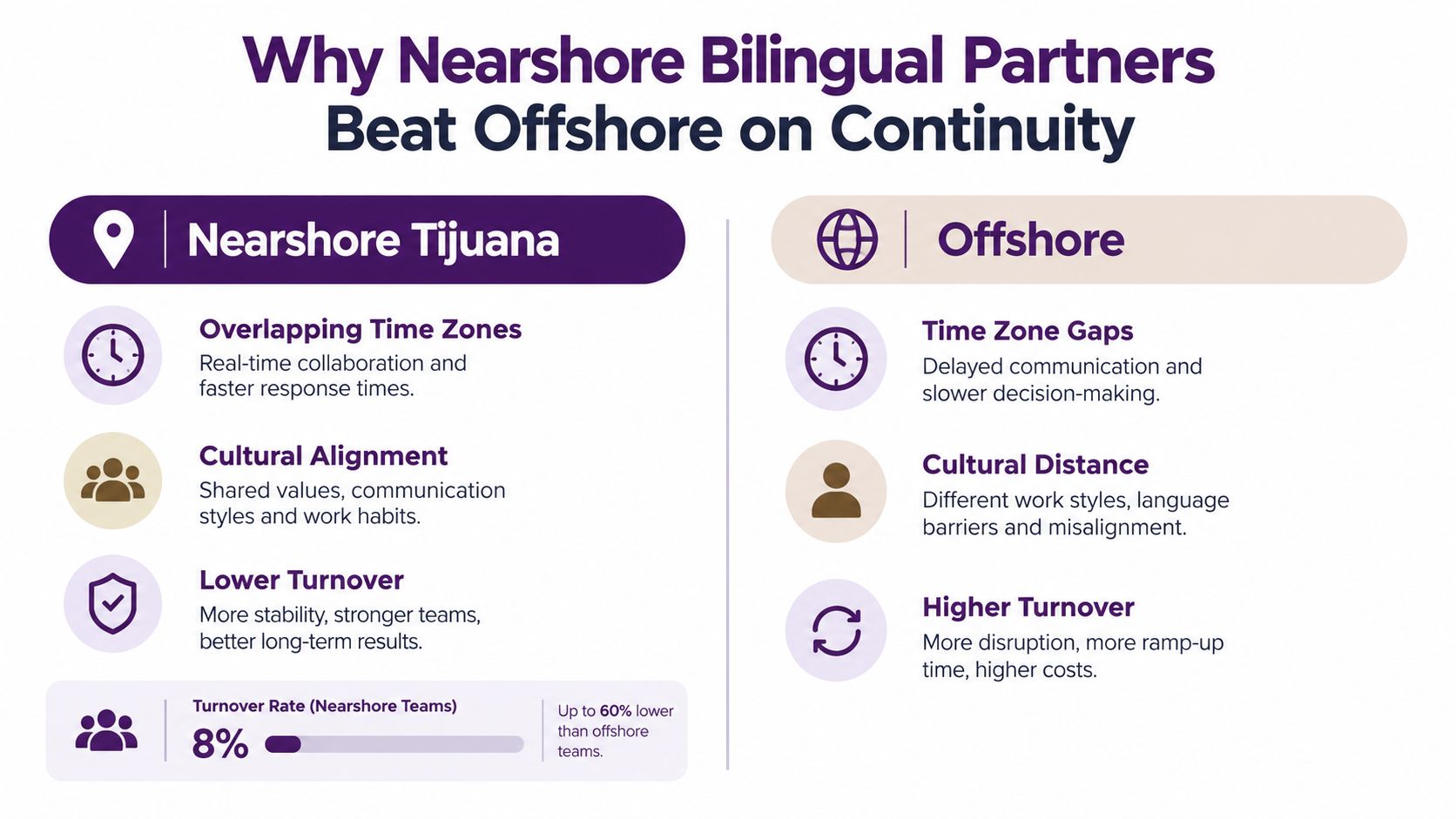
Hourly rate is the easiest outsourcing number to compare and often the least useful. Continuity determines whether the same trained agents stay long enough to learn your products, recognize repeat issues, and build judgment. Contact center management improves when your partner can join the operating rhythm in real time, with clearly defined coverage and escalation arrangements.
Evaluate continuity through evidence: agent and supervisor tenure, replacement procedures, training records, absence coverage, and the time it takes to resolve an operational issue. Location alone does not establish retention or service quality.
What Continuity Looks Like in Contact Center Management
A Tijuana bilingual team with an aligned shift can attend the same morning huddle as a U.S. operations lead, calibrate QA that afternoon, and retrain agents before the next peak. A supervisor can pull a call, discuss the wording with the client, update the knowledge article, and coach the team during the same business day. That speed matters in healthcare scheduling, financial servicing, insurance claims, and e-commerce exceptions where policy details and tone carry risk.
Language fit is also operational, not cosmetic. Bilingual agents need enough fluency to manage emotion, explain conditions, and document accurately in both languages. Test that ability with real scenarios, including interruptions, unclear requests, and compliance disclosures. Don’t rely on a polished sales call with the provider’s strongest speakers.
When evaluating a partner, ask about recruiting, trainer capacity, supervisor tenure, schedule flexibility, QA access, security controls, and replacement approvals. Compare turnover, retraining, rework, coordination, and travel within the full operating cost. CallZent’s nearshore versus offshore bilingual call center guide outlines considerations to include in that review.
Offshore and nearshore models can both support effective operations when skills, shifts, supervision, and controls fit the program. Mexico’s proximity can make shared working hours and visits practical for U.S. teams. Verify the actual delivery schedule, language performance, and incident response rather than treating geography as a quality guarantee.
AI, Automation, and the Governance Questions That Decide Success
Consider a hypothetical bilingual operation that launches a chatbot for order status, password help, and appointment changes. Containment rises in the vendor dashboard. Two weeks later, supervisors notice something else. Agents receive fewer easy contacts and more customers who are already frustrated, partially authenticated, or stuck between channels. Handle time climbs, QA scores vary, and the team starts blaming the bot for problems it didn’t create but also didn’t solve.
In this example, reduced simple-contact volume changes the work reaching agents. A higher average handle time could reflect a more complex remaining case mix rather than weaker performance. Review complexity, transfer quality, repeat contacts, and outcomes before concluding that automation improved or reduced productivity.
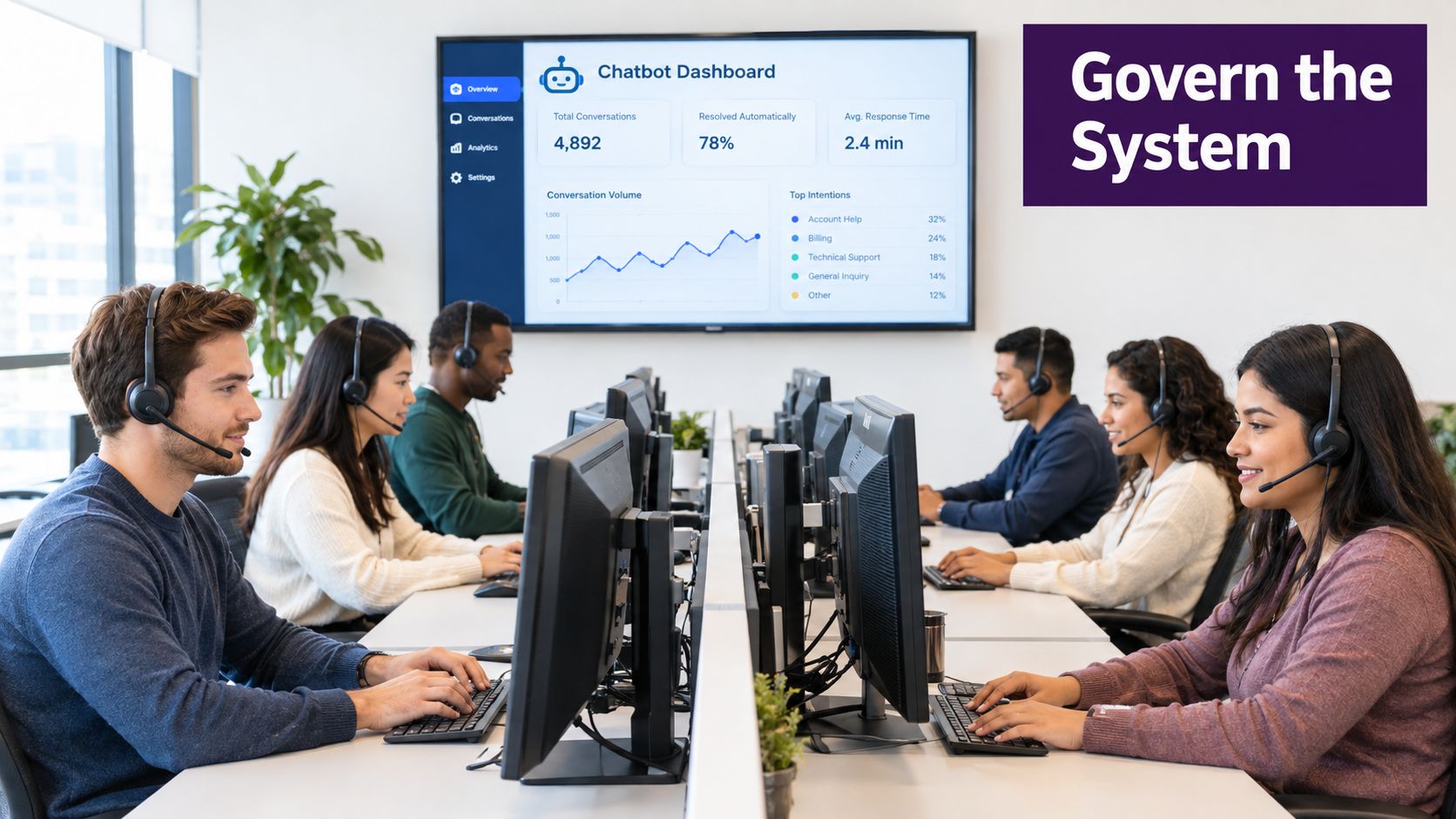
The NIST Generative AI Profile is a voluntary companion to the AI Risk Management Framework. Use it as a reference when developing governance for generative AI; adapt controls to your use case rather than treating a framework as a certification.
AI Governance in Contact Center Management
Before launch, write down the control rules:
- Escalation triggers: Vulnerability, threats, legal or medical risk, repeated failure, high value, and customer request for a person.
- Human override: Authorized staff can correct generated summaries and next actions, with changes traceable and sensitive decisions routed to the right owner.
- Error monitoring: Sample transcripts by intent and language, including cases the bot claims it resolved.
- Data retention: Define what enters prompts, transcripts, analytics, recordings, and backups, plus who can access each.
- Fallback behavior: Customers get an approved path to help when identity, payment, or system checks fail; a failed check must not bypass required authentication.
AI doesn’t remove management work. It moves management work into intent design, exception handling, monitoring, and accountability.
Measure more than containment and average handle time. Track transfer rate, repeat contacts, unresolved intent, quality variance between languages, and agent cognitive load. Review conversations where customers rephrase the same request or abandon after automation. Those cases tell you whether the system reduced effort or filtered out easy work.
The contrarian point is straightforward. AI can increase complexity before it reduces cost because someone must maintain intents, test releases, watch errors, retrain agents, and own customer harm when the answer is wrong. Assign release approval, rollback authority, and incident ownership, and fund that operating work from the start. If governance is an afterthought, automation will amplify the process failures you already have.
Coaching, QA, and Continuous Improvement Cadence
Quality culture sounds soft until you put it on a calendar. Agents improve when they receive specific feedback close to the interaction, understand the expected behavior, practice it, and see whether the next contact improved. Make scorecard expectations clear before evaluation, and provide a review path when an agent disputes a finding.
Run a weekly cadence with separate jobs. QA calibration aligns evaluators on what good sounds like. Supervisor one-to-ones turn one or two findings into practice, not a list of every flaw. A repeat-contact review looks for root causes across policy, knowledge, routing, and product defects. A short experiment log records one change, the expected effect, the owner, and the date you’ll decide whether to keep it.
Link each coaching action to approved knowledge and a follow-up interaction sample. CallZent’s agent training guide can help frame that connection between onboarding, practice, and ongoing feedback.
Coaching Load in Modern Contact Center Management
Protect coaching capacity when agents work across channels. Simultaneous conversations create different demands from switching between channels during a shift. Establish concurrency limits through observed quality, handling effort, customer risk, and agent proficiency rather than a single team-wide maximum.
Distinguish channel count from true complexity. Three password chats aren’t equal to one bereavement call, one disputed charge, and one Spanish language technical chat. Set concurrency by intent, customer risk, documentation burden, and agent proficiency. New hires need narrower work until their quality is stable. Experienced agents can handle more variety, but they still need recovery time after difficult contacts.
Flexible scheduling can support retention if you design it fairly. Publish core coverage needs, bidding rules, swap limits, and security requirements. Test changes against first contact resolution, QA, absenteeism, wait time, and schedule adherence. Healthcare, finance, and other regulated queues may need tighter continuity, while some e-commerce work can tolerate more variation.
Push back when the proposed fix for disengagement is only more monitoring. Monitoring can reveal behavior, but it can’t repair unclear authority, broken tools, unrealistic concurrency, or schedules that ignore people’s lives. A structured contact center QA program should connect scorecards to coaching, knowledge fixes, and process experiments. If the same defect appears across strong agents, investigate and correct the shared process while providing any individual support still needed.
A Practical Operating Checklist for the Next 90 Days
Start with the controls that protect capacity and customers:
- Days 1 to 30: Recalculate shrinkage by category, confirm forecast owners, and audit service targets by channel and segment.
- Days 31 to 60: Fix routing, CRM, WFM, and QA handoffs. Align nearshore SLAs, escalation rights, and calibration sessions.
- Days 61 to 90: Formalize AI escalation, override, transcript review, and retention rules. Lock the weekly coaching cadence.
For payment workflows in PCI DSS scope, the PCI Security Standards Council explains that card verification codes must not be stored after authorization, including in encrypted form. Prevent these values from entering retained recordings, transcripts, CRM notes, or AI inputs. Test the payment workflow and recording controls end to end; a recording-pause button alone does not establish compliance.
Frequently Asked Questions
What is contact center management?
Contact center management coordinates people, forecasts, schedules, technology, quality, and escalation so customers receive appropriate support across the agreed channels. It connects service objectives with staffing capacity, decision ownership, and measurable outcomes.
How is contact center management different from workforce management?
Workforce management focuses on demand forecasts, staffing requirements, schedules, adherence, and intraday adjustments. Contact center management includes those responsibilities as well as quality, coaching, customer outcomes, technology ownership, security, and partner oversight.
Which KPIs should contact center managers track?
Track service level, answer speed, abandonment, handle time, first-contact resolution, repeat contacts, customer satisfaction, occupancy, and adherence as appropriate to the channel. Define calculations and exclusions, and review results by language and contact type rather than relying on a single average.
How do you calculate staffing with shrinkage?
Divide the required available coverage hours by one minus the expected shrinkage rate. With a hypothetical requirement of 650 available hours and 35% shrinkage, the result is 1,000 scheduled hours. Establish the coverage requirement first and validate staffing by interval; this formula alone does not determine queue capacity.
How should managers govern AI in a contact center?
Define approved use cases, data access, human review, escalation triggers, error monitoring, release approval, and rollback authority. Review outcomes by language and intent, including interactions automation marks as resolved. Required authentication and professional decision boundaries must remain in place.
When can nearshore bilingual support be useful?
Nearshore support can be useful when a program needs English-Spanish coverage, overlapping working hours, and frequent collaboration with U.S. teams. Confirm language proficiency, actual shifts, supervision, security responsibilities, and shared quality standards before selecting a delivery model.
Bilingual Nearshore Support
Build a Contact Center Your Customers Can Count On
Talk with CallZent about English-Spanish support, coverage needs, training, and shared quality standards. Define a nearshore program around your customer journey, service targets, and operating requirements.