
KPI
AI-ENABLED CUSTOMER SUPPORT
Conversational AI for Customer Support: A Practical 2026 Guide
Conversational AI for customer support combines automation, grounded knowledge, bilingual agents, and human handoffs to reduce costs and improve service quality.
TL;DR — Quick Takeaways
- Conversational AI works best as part of a hybrid operating model in which automation handles routine work and human agents manage exceptions, emotion, policy, and judgment.
- The AI should answer from approved company knowledge, preserve context across the conversation, and transfer the full interaction history during escalation.
- Success should be measured through resolution quality, containment, first contact resolution, repeat contacts, customer satisfaction, and cost per resolved interaction.
- Bilingual nearshore teams help protect the customer experience when English- or Spanish-language conversations become too complex for automation.
Conversational AI for customer support stopped being a novelty the moment support leaders realized the economics were different. In industry reporting summarized for 2026, more than 70% of customer service organizations have already deployed AI or are actively piloting it, up from roughly 45% in 2023, and the same source projects AI-powered customer service will handle 85% of customer interactions without human agents by 2028 (2026 customer service AI statistics). That isn’t a chatbot fad. It’s a shift in how support queues get worked, how handoffs happen, and how bilingual teams like the ones in Tijuana keep the customer experience intact.
Practical rule: if the AI can’t answer from approved content and pass the full context to a human, it’s not support automation, it’s a deflection script.
What Conversational AI for Customer Support Is
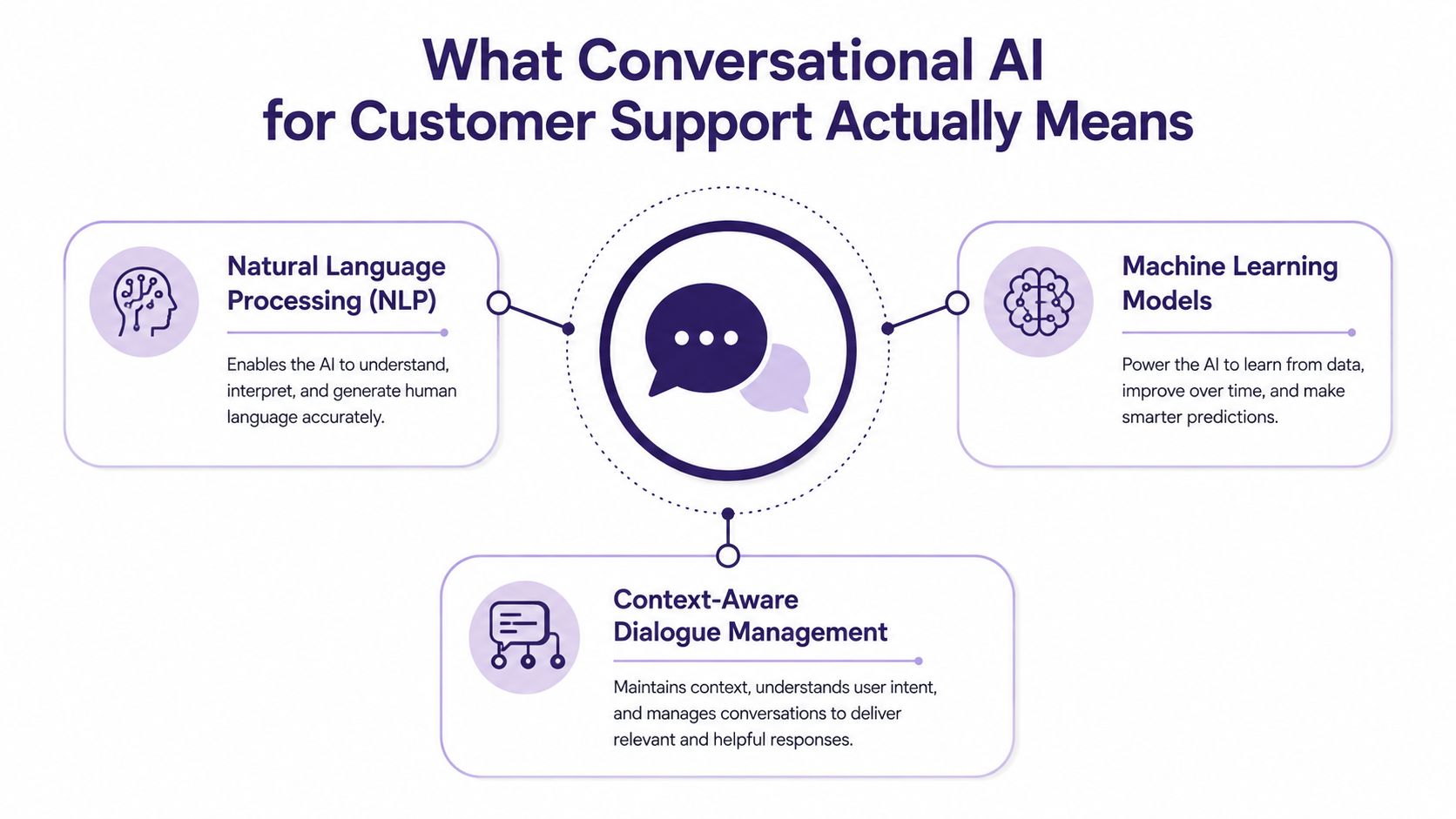
The first mistake many teams make is calling every chat widget “AI.” In customer support, conversational AI means software that uses natural language processing and machine learning to understand intent, carry context across turns, and resolve routine issues across chat, voice, and messaging channels (Helpdesk on conversational AI for customer service). That is a different tool from the old keyword-driven bot that waited for a trigger phrase and then returned a canned answer.
The operational value shows up in the queue. When support volume moves through a real contact center, the system has to do more than greet the customer. It has to identify the problem, decide whether it can solve it from verified material, and pass the case to a person when the issue needs judgment, policy interpretation, or a bilingual voice on the other end. That is where a hybrid model starts to matter more than the software label.
What it does in a live queue
A retailer can use it for order-status questions, payment updates, or basic policy lookup, then hand a billing dispute or a special exception to a human agent with the transcript intact. That pattern, automate simple work and escalate complex work, is the operating model that survives contact with real volumes and real customers.
For a nearshore team in Tijuana, the AI is part of queue design, not a replacement for the queue. It sorts requests by language, intent, and confidence, so a Spanish-speaking customer can get an immediate answer from the system and then reach a bilingual agent without repeating the story twice. That handoff only works if the routing logic preserves context and the knowledge base stays current enough for front-line use.
The support stack works best when the AI is anchored to the company’s own verified materials and includes a human fallback. One implementation guide recommends sourcing responses from approved content so the system stays tied to verifiable facts, and it also says customers should be able to reach a human if they want one (Intercom learning center on conversational AI for customer service). A related explanation of conversational intelligence also makes the same operational point from a different angle, the conversation has to stay readable for both automation and agents. That is the difference between automation that helps and automation that creates rework.
The bottom line: conversational AI for support is a routing and resolution layer that should improve speed, preserve context, and keep the human team focused on work that needs judgment. In practice, the payback depends on handoff economics, bilingual coverage, and how disciplined the team is about content governance.
Core Technologies and Architecture Behind Modern Support AI
A support bot that sounds confident but cannot ground its answers fails quickly in production. The architecture that holds up is a retrieval-augmented pipeline, where the system parses the message with NLP, classifies intent, keeps multi-turn context, retrieves grounded answers from a knowledge base, and then generates a response. That sequence keeps the model tied to enterprise data instead of improvising (Inkeep on conversational AI for customer support).
The floor-level version is straightforward. A customer sends a message. NLP extracts the intent and key entities. The system retrieves the approved answer or workflow from the knowledge base. The AI responds, or hands off with full context if the issue exceeds scope.
That sounds simple because the design is simple on paper. In practice, the problems start when teams skip retrieval and let the model answer from memory alone. Grounding the response reduces hallucination risk because the answer is constrained by enterprise content, and it also supports account updates, order status checks, and workflow actions through CRM or backend integrations. Teams that want the routing, queue visibility, and agent context to stay aligned usually need the support stack itself to expose those touchpoints cleanly, which is why call center software features matter as much as the model.
A bot is only as reliable as the data and workflows it can access.
The operational benchmark that separates a working system from a demo is intent recognition accuracy above 90%, because below that threshold routing errors and unnecessary handoffs start to pile up (Dashly on conversational AI customer service). The same source calls out three other requirements, native CRM integration, structured human handoff with full context transfer, and a self-improving training pipeline so conversation outcomes feed retraining instead of staying static.
Where deployments usually break
The broken version is easy to spot in a live queue. The AI answers from stale help-center content, the CRM is not connected, the human agent gets a vague summary, and no one closes the loop after the ticket is resolved. That is not an AI problem alone, it is an operating-model problem.
For teams running support in a BPO environment, the lesson is blunt. Build the retrieval path first, wire the CRM second, and only then work on more conversational polish. If the model cannot see the right content and cannot hand off cleanly, it will create more work than it removes.
Measurable Benefits and the KPIs That Prove AI Is Working
The business case becomes real when the queue starts changing. Analysts at NextPhone AI customer service statistics report that AI customer service can reduce cost per interaction from $4.60 to $1.45, a 68% drop, and they also cite a forecast that conversational AI could save contact centers $80 billion in labor costs in 2026. Those figures are useful, but finance teams still need proof at the KPI level, and operations teams need to see whether the hybrid model is holding together.
What to watch after rollout
The metrics that matter most are cost per interaction, containment rate, average handling time, first-contact resolution, and customer satisfaction. If the AI only deflects contacts away from agents while leaving customers stuck, containment is just deflection with a dashboard.
For teams that want a cleaner operating readout, call center KPIs should sit next to the AI metrics, not after them. That gives leaders a way to compare automation gains against the work still landing with bilingual agents, escalations, and repeat contacts.
| Metric | AI-Only | Hybrid Human Plus AI |
|---|---|---|
| Cost per interaction | Lower on simple questions, but can rise fast when escalation is messy | Lower overall because simple work is automated and complex work is routed correctly |
| Containment | Looks high if the bot traps customers in loops | Looks slightly lower, but the cases that stay in bot flow are more likely to be resolved |
| Average handling time | Can be fast on paper, but may hide repeated handoffs | Usually drops for agents because context is prefilled before they take over |
| First-contact resolution | Weak when the system can’t ground answers or hand off well | Stronger when the bot handles routine issues and agents get the hard ones with context |
| Customer satisfaction | Can fall when the bot blocks access to a person | Holds up better when customers can switch to a human without friction |
Hybrid beats AI-only in live support. The AI should absorb repeatable volume so agents can spend time on empathy, exceptions, billing disputes, and retention-sensitive conversations. That is how support capacity grows without proportional headcount growth, and it is also how nearshore bilingual teams keep pace without turning every issue into a manual escalation.
When leaders ask what “good containment” means, the answer should be fully resolved cases, not just conversations the bot kept for itself. A high containment number that leaves customers reopening tickets or trying another channel is a false win, and it usually shows up later as queue churn, longer resolution times, or more supervisor interventions.
The internal metric conversation should stay honest. If agents are spending less time on password resets and more time on loyalty-saving calls, the system is working. If the queue looks quieter but the backlog of unresolved cases is larger, the automation is only moving pain around.
Bilingual and Nearshore Integration Best Practices
A Spanish-speaking customer doesn’t care whether the first reply came from AI or a person. The customer cares that the answer is fast, accurate, and doesn’t force a repeat. In a Tijuana-based operation, the strongest setup is a bilingual queue where the AI detects language, resolves routine questions in that language, and then passes the same transcript to a human agent when the issue needs a live touch.
That handoff works because the agent sees the context before speaking. A customer who starts in Spanish can get an order-status answer immediately, then reach a bilingual agent who can continue in English or Spanish without resetting the conversation. That’s cleaner than translation-only routing, because the human still reads the nuance in the original transcript.
What helps in practice
- Language detection first: The system should route based on the customer’s language, not force a generic translation layer for every exchange.
- Native bilingual handling: A real bilingual agent in Tijuana is better than a translated script when the issue turns emotional or policy-heavy.
- Context transfer intact: The transcript, intent, and account details need to follow the handoff so the customer doesn’t repeat the story.
- Business-hours overlap: Nearshore teams can tune prompts, refresh knowledge, and review failure cases while the customer base is still active.
One practical reason this model holds up is speed of iteration. When AI and human agents sit in the same operational rhythm, the team can fix broken content, adjust routing rules, and tune escalation thresholds without waiting for a distant offshore window. That short feedback loop matters more than most software demos admit.
CallZent’s bilingual nearshore setup in Tijuana fits this pattern naturally, because the human side of the queue can take over when AI should stop. Used well, that’s not a cost-cutting story alone. It’s a service-quality story, especially when customers expect the answer in the language they started with.
Implementation Roadmap and Hybrid Human-AI Flow Design
Most rollouts fail because teams try to automate the whole contact center on day one. The safer path starts with intent discovery and knowledge-base cleanup, then moves to a narrow pilot, then expands into hybrid flows where AI handles triage and routine resolution while humans own exceptions.
Phase by phase
The first phase is content work. Support leaders need to find the top intents, remove duplicates, resolve contradictions, and mark approved content only. That’s tedious, but it’s the cheapest way to improve accuracy before the model ever goes live.
The second phase is a scoped pilot on two or three high-volume scenarios. Password resets, order status, or appointment scheduling are good candidates because they’re repeatable and easy to measure. If the system performs well there, the team can widen the scope without guessing.
The strongest deployments usually improve the knowledge base before they upgrade the model.
The third phase is hybrid expansion. The AI should triage, answer routine questions, and collect the right details before transfer. Humans should get the cases with emotion, ambiguity, or regulatory risk, along with the full conversation history.
The fourth phase is continuous learning. Conversation outcomes need to feed back into content updates, routing rules, and retraining, or the system will drift. That’s where governance matters more than hype.
A useful outside comparison comes from Qaly’s review of ChatGPT’s ECG reader. The point isn’t healthcare alone. It’s that a system can look impressive until edge cases, missing context, and weak fallback behavior expose the gap between demo quality and operational quality.
What content hygiene really means
The contrarian lesson is simple. Better AI performance often comes from fixing the help center, routing rules, and escalation policy before buying a “smarter” bot. If the knowledge base is stale or contradictory, the model will amplify the mess. If the fallback path is clear, the queue stays workable.
That’s also why the handoff design matters. A customer should never feel trapped in a dead-end bot flow. Once the issue is outside scope, the transition to a person needs to be obvious, quick, and context-rich.
Vendor Selection Criteria and Compliance for Regulated Industries
Vendor selection gets easier when you stop comparing feature lists and start comparing operational truth. The first question is whether the system can hit intent accuracy on your own data, not just on a polished demo. The second is whether it can retrieve grounded answers from your own sources, because that’s what keeps the answers aligned with policy and product reality.
What to score before signing
- Intent accuracy on your data: Ask for performance against your actual ticket mix, not a generic benchmark.
- Retrieval grounding to your sources: The vendor should show how responses stay tied to approved materials.
- Explainability and audit trail: You need to know why the system answered the way it did.
- Data sovereignty and compliance: Data isolation matters more in healthcare and finance than in casual consumer support.
- Proven integration and support: CRM, ticketing, and human handoff need to work without friction.
The compliance bar changes by industry. In healthcare and finance, HIPAA, PCI-DSS, and regional data-residency expectations can narrow the shortlist fast. Those teams need stronger controls on transcripts, storage, access, and retraining rights. In e-commerce and telecom, speed of deployment and channel coverage often matter more, but integration quality still decides whether the rollout works.
A vendor that won’t let you own your training data is the wrong vendor, especially if the work is regulated. The model improves from conversation history, but only if your team can inspect, correct, and retrain against it.
For teams that want to compare a platform alongside human support operations, CallZent’s own customer support services are one option in the market, especially when bilingual escalation and operational coverage matter. The point is not to pick software in isolation. It’s to choose a system that fits the way your queue runs.
Security and support posture deserve the same attention as features. If the vendor can’t show how human fallback, context transfer, and transcript access work under real policy constraints, the deployment will age badly.
Metrics-Driven ROI Scenarios by Industry
The ROI question changes by business model. For an SMB, the gain is often straightforward, because a smaller team can absorb more volume without adding headcount. For healthcare and finance, the value leans more toward coverage, controlled escalation, and compliance-ready service. For telecom and e-commerce, the biggest wins usually come from routine question volume.
A practical way to sanity-check the math is to compare AI savings against the cost of keeping humans on the repetitive work. A support stack with a strong AI layer can hand off simple contacts, while a bilingual nearshore team resolves the exceptions that would otherwise clog the queue.
A few useful comparisons
- SMB: If most contacts are repetitive, a modest level of containment can already free meaningful agent time.
- E-commerce: Order tracking, returns, and account questions are a natural fit for automation, so the savings tend to show up quickly.
- Healthcare: The ROI is often steadier than flashy, because customers need clarity, policy accuracy, and a human fallback.
- Telecom: Large queues and repetitive troubleshooting make automation especially useful for deflection plus triage.
- Finance: Strong controls matter most, so the win is often in faster service with fewer compliance risks.
For readers who want a consumer-facing contrast, the way 1Chat presents a ChatGPT alternative for families is a good reminder that people care less about model hype than about whether the conversation solves the problem. That same expectation drives customer support. Customers want the right answer, fast, in the right language.
The best ROI model is hybrid. AI should handle the cheap, repeatable work. The nearshore bilingual team in Tijuana should handle the conversations that preserve revenue, protect trust, and keep customers from churning when the issue is too messy for automation.
🚀 Build Conversational AI Without Breaking the Customer Journey
CallZent helps North American businesses combine AI automation with bilingual nearshore agents, clear escalation paths, and customer support workflows built for real production environments.
Talk to an ExpertIf you want to build conversational AI for customer support without breaking your queue, CallZent can help you design the human handoff, bilingual coverage, and support workflow around it. Visit CallZent to see how nearshore customer support and AI-enabled operations can work together in a real production environment.