
CUSTOMER EXPERIENCE & RETENTION
Customer Retention Services: A Revenue Growth Guide for 2026
Customer retention services reduce churn, protect recurring revenue, and improve loyalty through proactive support, bilingual care, analytics, and win-back programs.
TL;DR — Quick Takeaways
- Customer retention services protect existing revenue by resolving friction before it becomes a cancellation, downgrade, or inactive account.
- The strongest programs combine proactive outreach, loyalty support, win-back campaigns, clear escalations, bilingual service, and cohort-based analytics.
- Retention should be measured through customer retention rate, churn, customer lifetime value, Gross Revenue Retention, Net Revenue Retention, and cost per saved account.
- Nearshore bilingual teams can improve retention for North American businesses by providing English-Spanish support, cultural alignment, and real-time collaboration.
Customer retention services are no longer a soft-function add-on. Retaining an existing customer is widely treated as a high-impact growth move because acquisition costs are about 5x higher than retention costs, and some HBR-linked summaries put that gap at 5–25x Rivo’s retention statistics. A modest 5% increase in retention is associated with a 25% to 95% increase in profits, which is why serious operators now treat retention as a revenue discipline, not just a support queue.
A lot of companies still talk about retention as if it were a loyalty slogan. In a contact center or BPO environment, it’s more concrete than that. The work happens after the sale, when agents resolve friction, product teams learn where customers are getting stuck, and account owners decide whether an account is worth a human save attempt or a scaled automation path. Existing customers are also far more likely to buy again, with the probability of selling to an existing customer commonly cited at 60–70% versus 5–20% for a new prospect Rivo’s retention statistics. That gap is exactly why post-sale service quality moves revenue.
For North American businesses, especially those with bilingual customer bases, retention is also a delivery problem. If the support model doesn’t match the customer’s language, channel preference, or urgency level, churn often shows up as a service issue long before it shows up in finance reports. CallZent’s nearshore operating model in Tijuana fits this reality because retention work needs speed, continuity, and culturally aligned communication, not just ticket handling.
Why Customer Retention Services Drive Revenue Growth
A retention program pays for itself when it keeps revenue from leaking after the first sale. Customer retention services protect margin, lower pressure on paid acquisition, and create more room for renewals, upsell, and cross-sell. For operations teams, that makes retention a revenue function, not a side task inside support.
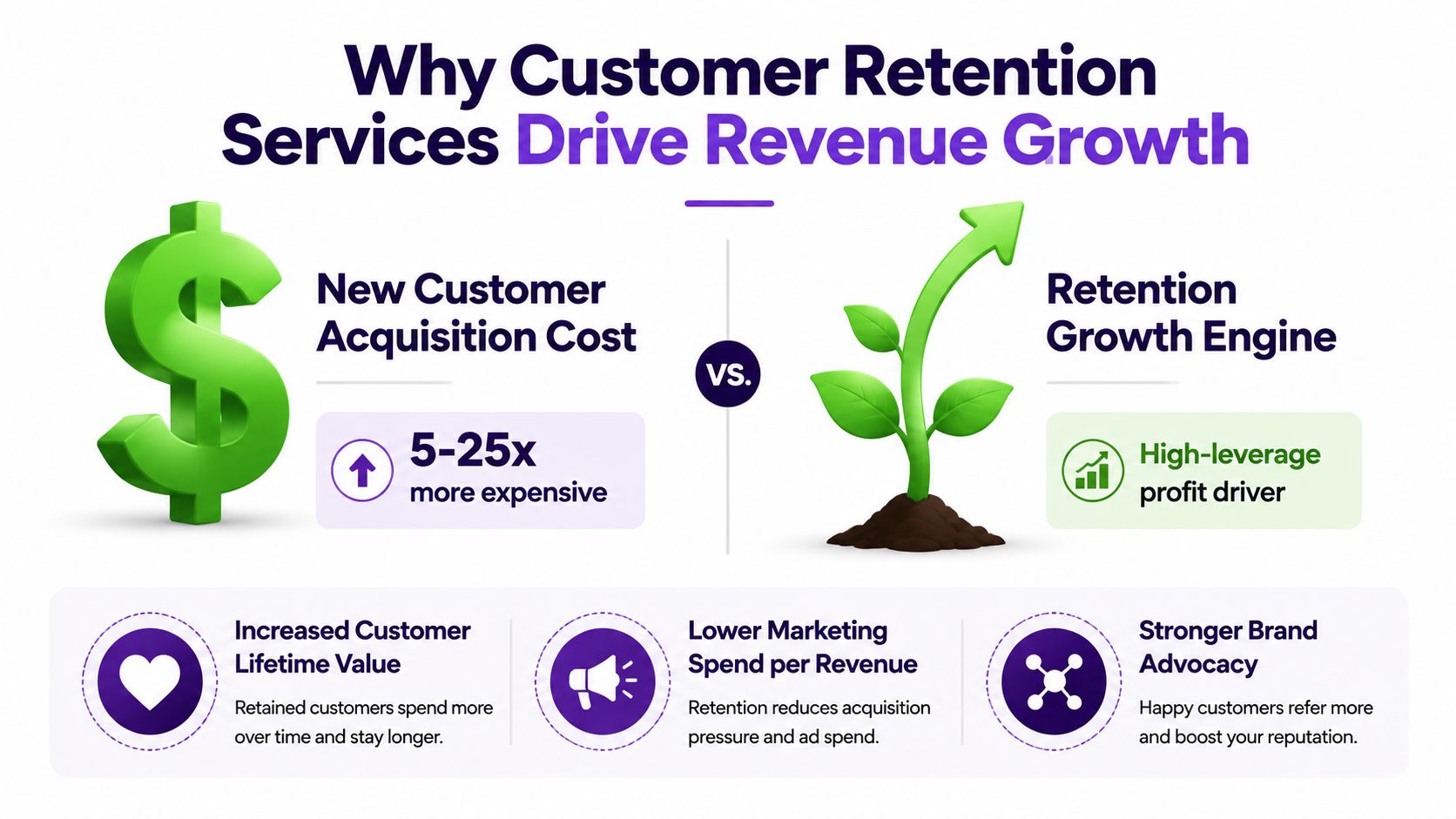
The economics are straightforward. Research summaries linked to Harvard Business Review have long shown that acquiring a new customer costs several times more than keeping an existing one, and that a small lift in retention can produce a large profit gain. In practical terms, that means retention work should be measured by how much revenue it saves and extends, not by how friendly the interaction sounded. Analysts at Rivo’s retention statistics have also reported that existing customers are often much more likely to buy again than new prospects, which is why post-sale service deserves a seat in revenue planning.
Existing customers are the fastest path to revenue
Existing customers already know the product, the brand, and the service team. That context shortens sales cycles and raises the odds of a repeat purchase. A retention operation should spend less time chasing uncertain leads and more time protecting accounts that are already in motion, especially when renewals, usage expansion, or save offers are on the table.
Practical rule: If the team only reacts after a cancellation request, it is running support, not retention.
That difference shows up fast in e-commerce, telecom, and financial services, where small service failures can turn into churn. Effective retention work usually combines proactive outreach, issue resolution, loyalty program support, and win-back campaigns. The goal is not more contact for its own sake. It is the right intervention at the moment it can still protect revenue.
Nearshore delivery matters here because language coverage and response speed change the economics of a save. A bilingual team in North American time zones can handle underserved customer segments without pushing them into slower queues or scripted handoffs. That matters in sectors with stricter service expectations, including customer service expectations in wealth management, where a delayed or awkward exchange can cost more than the account issue itself.
For BPO leaders, the test is whether the retention motion is visible in forecasting. A save interaction that keeps a high-value account active is a revenue event, not a courtesy. Teams that connect customer success, revenue operations, QA, and frontline service can see those events more clearly and act on the patterns that repeat.
If you want a more tactical view of where churn prevention usually starts, how to reduce customer churn with practical service moves breaks down the operational side in plain terms.
Core Components of Effective Customer Retention Services
A serious retention program usually breaks into five working parts. If one of them is weak, the rest tend to leak value. The best teams build these components into one operating model instead of treating them as disconnected projects.
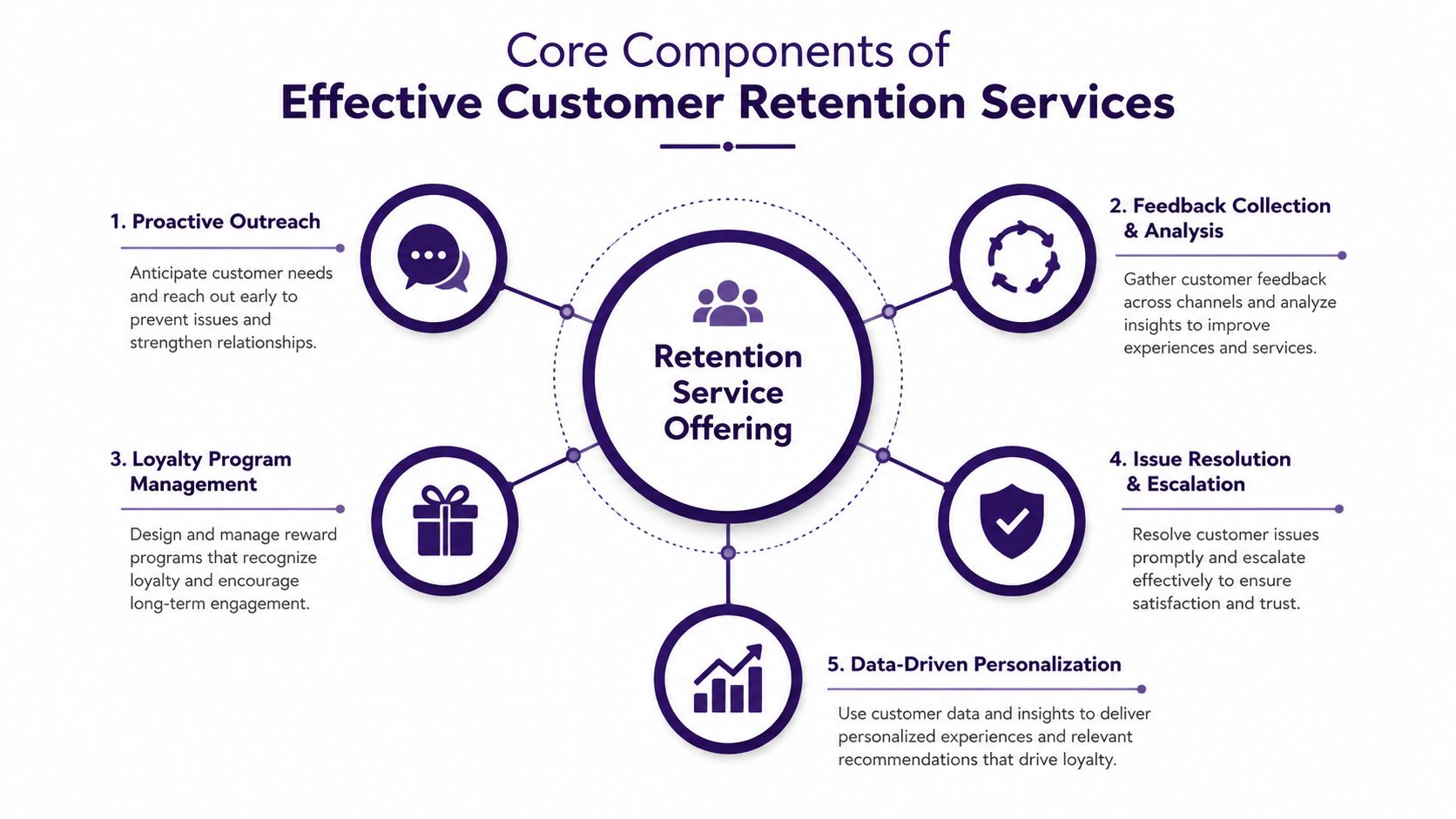
Proactive support and escalation paths
First-contact resolution still matters, but it’s not enough by itself. Retention-focused support teams also need omnichannel availability, clean escalation paths, and agents who can spot friction before a cancellation request appears. In a nearshore Tijuana team, that usually means voice, chat, and email coverage that lets customers move between channels without re-explaining the problem.
Retention campaigns that trigger on behavior
The most useful campaigns aren’t generic email blasts. They’re triggered by usage drops, renewal milestones, failed payments, or repeated service contacts. A telecom customer who stops using a premium feature needs a different outreach sequence than a subscriber who’s already called twice about billing. The trigger matters because it tells the agent whether the issue is product fit, confusion, or frustration.
Loyalty management that feels earned
Points, tiers, and personalized offers work when they’re easy to understand and tied to real behavior. A bilingual agent handling loyalty inquiries can often prevent a cancellation just by explaining how to redeem value the customer already has. That’s especially useful in consumer services where customers don’t leave because the offer is weak, they leave because the benefit is buried.
Win-back and recovery
Dormant customers need a different tone than active customers. Win-back outreach should sound informed, not desperate. The strongest recovery scripts refer to prior behavior, acknowledge the reason for inactivity, and offer a path back that doesn’t feel like a bait-and-switch.
Analytics that can be acted on
Retention teams need dashboards, but dashboards aren’t the point. The point is to know which cohorts are slipping, which agents are resolving the right problems, and which accounts deserve human intervention. That’s where customer service expectations in wealth management becomes a useful reference point, because high-trust sectors show how much consistency, clarity, and responsiveness shape loyalty.
For teams building the voice-of-customer layer, CallZent’s voice of customer programs can help connect agent feedback, customer feedback, and service trends into one retention workflow.
Customer Retention Benchmarks Across Major Industries
Retention targets only make sense when they match the business model. A subscription-heavy company cannot judge itself against a low-frequency transaction business and expect the benchmark to mean much. The market structure changes what healthy retention looks like, and the service model has to fit that reality.
| Industry | Average Retention Rate | Key Churn Driver |
|---|---|---|
| Media | 84% | Content fatigue and switching to other platforms |
| Professional services | 84% | Relationship continuity and perceived expertise |
| Telecom | 78% | Billing friction and service interruptions |
| Healthcare | 77% | Access issues and care coordination gaps |
| Banking | 75% | Trust, fee sensitivity, and switching ease |
| E-commerce | 38% | Low switching cost and inconsistent post-purchase experience |
These benchmark figures show a wide spread by sector. Another market-wide estimate puts the average retention rate at roughly 75% across ten major industries, with the range spanning from 55% in hospitality and travel to 84% in the strongest segments G2’s customer retention statistics. That gap is why retention programs should be built around customer behavior, not generic best practices. For a practical view of how retention ties back to account value, see how to measure customer lifetime value.
Why some industries hold customers better than others
Media and professional services often hold up better because the relationship is ongoing. Customers keep coming back for fresh content, advice, or expertise, and that repeat contact gives service teams more chances to correct friction before it turns into churn. Telecom and banking sit in the middle because switching is possible, but trust and billing experience still shape the decision.
E-commerce has a harder path. A customer can leave after one bad delivery, a return issue, or a support interaction that feels slow or indifferent.
Retention is easier when the relationship is continuous and harder when the purchase is occasional.
That difference changes the work on the floor. E-commerce retention programs need strong post-purchase onboarding, clear order-status communication, and issue resolution before the customer gets annoyed. In healthcare, proactive care coordination calls often matter more than promotional outreach. In telecom, billing clarity and escalation discipline usually prevent more churn than a discount email.
The nearshore bilingual angle matters here too, especially for underserved multilingual customer segments. In markets where language friction is part of the churn driver, a bilingual agent can lower repeat contacts, explain policy without confusion, and keep a customer from leaving over a problem that was fixable in one call. That is not a soft benefit. It changes revenue retention in cohorts where service comprehension is part of the purchase experience.
For teams comparing peers, the main lesson is simple. Do not chase the wrong benchmark. Build the service model that fits the churn pattern, then measure cohort behavior closely enough to see which intervention changed revenue, which one only reduced complaints, and which accounts needed a human touch before they slipped away.
Measuring Retention Services by Revenue Impact
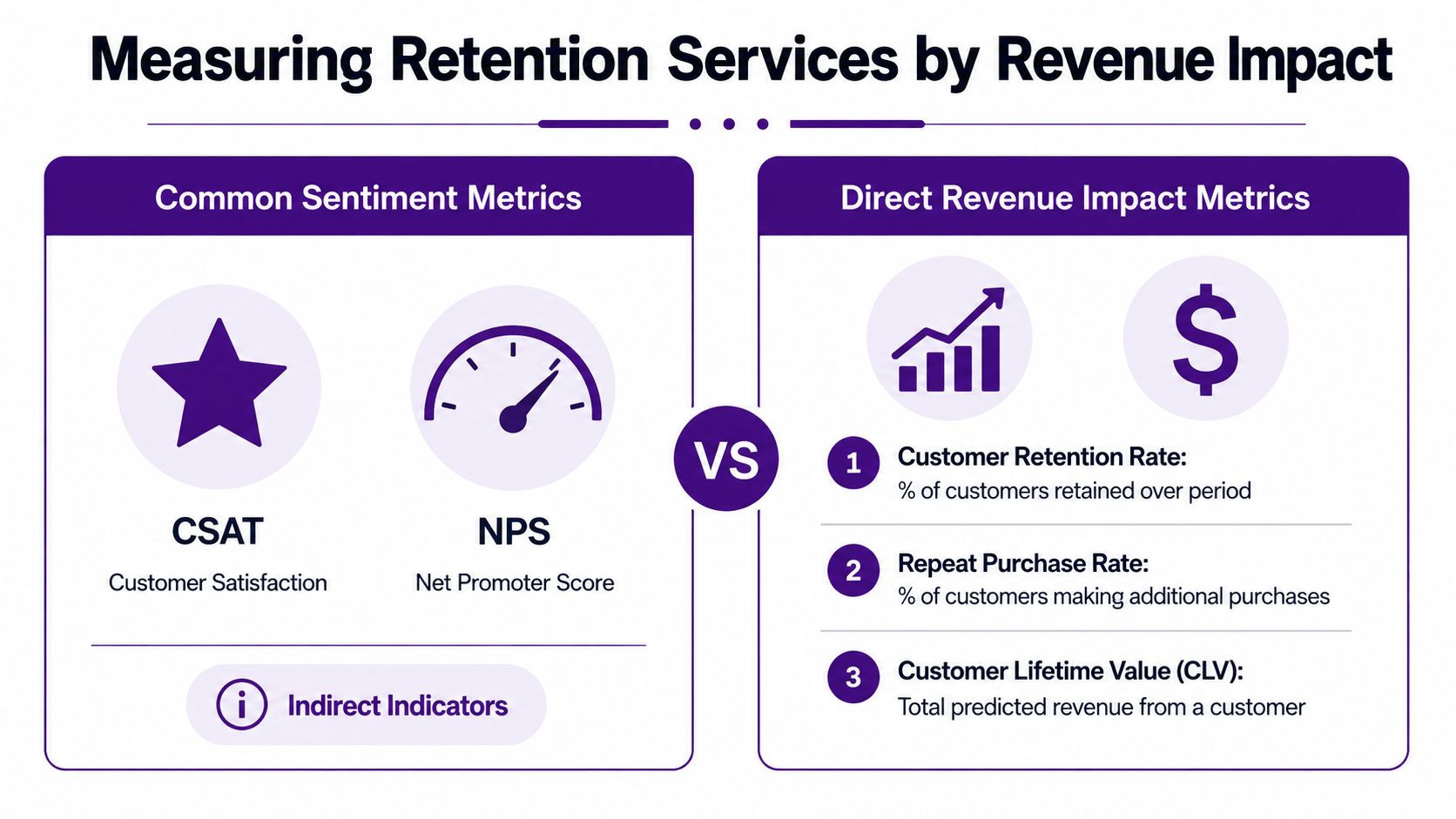
Most retention teams say they care about keeping customers. Better teams prove that retention in revenue, renewals, and expansion. That requires separating sentiment from financial impact and reading the customer base as cohorts, not as one blended average.
GRR and NRR tell different stories
For revenue-driven businesses, Gross Revenue Retention (GRR) and Net Revenue Retention (NRR) need to live on the same dashboard. Independent retention benchmarks published by Rework indicate annual targets of >90% for GRR and >110% for NRR, while customer retention rate benchmarks are listed at 85–95% annually Rework retention metrics. If GRR is weak, the base is eroding. If GRR is healthy but NRR lags, the team is not expanding existing accounts well enough.
That difference changes how leaders review performance. A support team can reduce complaints and still miss the problem if account value keeps shrinking. A customer success team can keep the base stable and still underperform if upsell and cross-sell do not move. Service quality, CSAT, and NPS matter, but only when they connect to churn and expansion outcomes.
Cohort analysis catches the churn that averages hide
A technically rigorous retention service should measure retention as a cohort-based metric, not just a single-period average. Retention rate is commonly calculated as ((customers at end of period − new customers) ÷ customers at start of period) × 100 Contentsquare retention metrics. Leading practice is to segment by acquisition cohort so teams can see whether customers acquired in different months or quarters retain differently over time Contentsquare retention metrics.
That matters because a flat blended number can hide early-life churn spikes. One cohort may be leaving during onboarding while another cohort holds steady after the first renewal. If you only look at the average, you miss the product-fit issue, the first-contact resolution gap, or the broken handoff that is driving loss.
How to measure customer lifetime value is a useful internal reference if you want to tie retention decisions to account value instead of anecdote.
Use payback logic, not generic best practices
A practical framework is straightforward. Human outreach makes sense when the customer’s lifetime value is high, the churn risk is real, and the save probability justifies the labor. Automation works better when the issue is repetitive, low-risk, and easy to resolve at scale. Hybrid service works when a digital prompt narrows the problem and an agent closes the loop.
Strong retention programs do not ask whether automation or people are better. They ask which one protects revenue fastest for this segment.
That is the level of discipline retention services need in 2026. Clearer revenue attribution matters more than more sentiment scoring.
The Bilingual Advantage in Customer Retention Services
Language access is one of the most overlooked churn drivers in North American service operations. A customer can like the product, pay the bill on time, and still leave because the service model doesn’t fit their language or cultural context. That problem shows up fast in healthcare, telecom, retail, and financial services, where a confusing interaction can feel like a dead end.
Why bilingual support changes the retention math
Nearshore bilingual teams in Tijuana have a structural advantage here because they can move between English and Spanish without the awkward handoff that breaks momentum. That matters when a customer is calling to dispute a charge, confirm benefits, or ask for help after a product failure. A monolingual or script-heavy interaction can turn a solvable issue into a cancellation.
The retention value is not just language fluency. It’s the ability to deliver culturally matched communication, cleaner escalation paths, and consistent follow-through. When customers feel understood on the first interaction, they’re less likely to interpret friction as disrespect or indifference.
Real service failures often look small from the inside
A Spanish-speaking patient may drop a healthcare plan after struggling through an IVR that doesn’t guide them clearly in their language. A telecom subscriber may switch providers after repeated miscommunication with agents who can answer the ticket but not explain the fix. In financial services, a customer can lose trust after a fee explanation sounds evasive instead of clear.
Those are not branding problems. They’re retention problems. The fix usually isn’t a new incentive. It’s a better support model that gives customers a straight path to resolution in the language they use.
How bilingual support improves retention is a useful read for teams building that model intentionally.
Practical rule: If the customer has to translate the problem before they can solve it, your retention process is already too expensive.
For North American businesses, that’s where nearshore delivery often outperforms generic offshore staffing. Time zone alignment, bilingual coverage, and faster collaboration with client teams create fewer gaps between issue detection and issue resolution. In retention work, those gaps are where churn tends to start.
How to Select the Right Customer Retention Service Provider
A retention provider should be judged on operating fit, not just labor cost. The cheapest team on paper can become the most expensive one if it misses saves, weakens brand trust, or creates escalation churn. A better selection process looks at delivery model, industry experience, technology, and contract flexibility together.
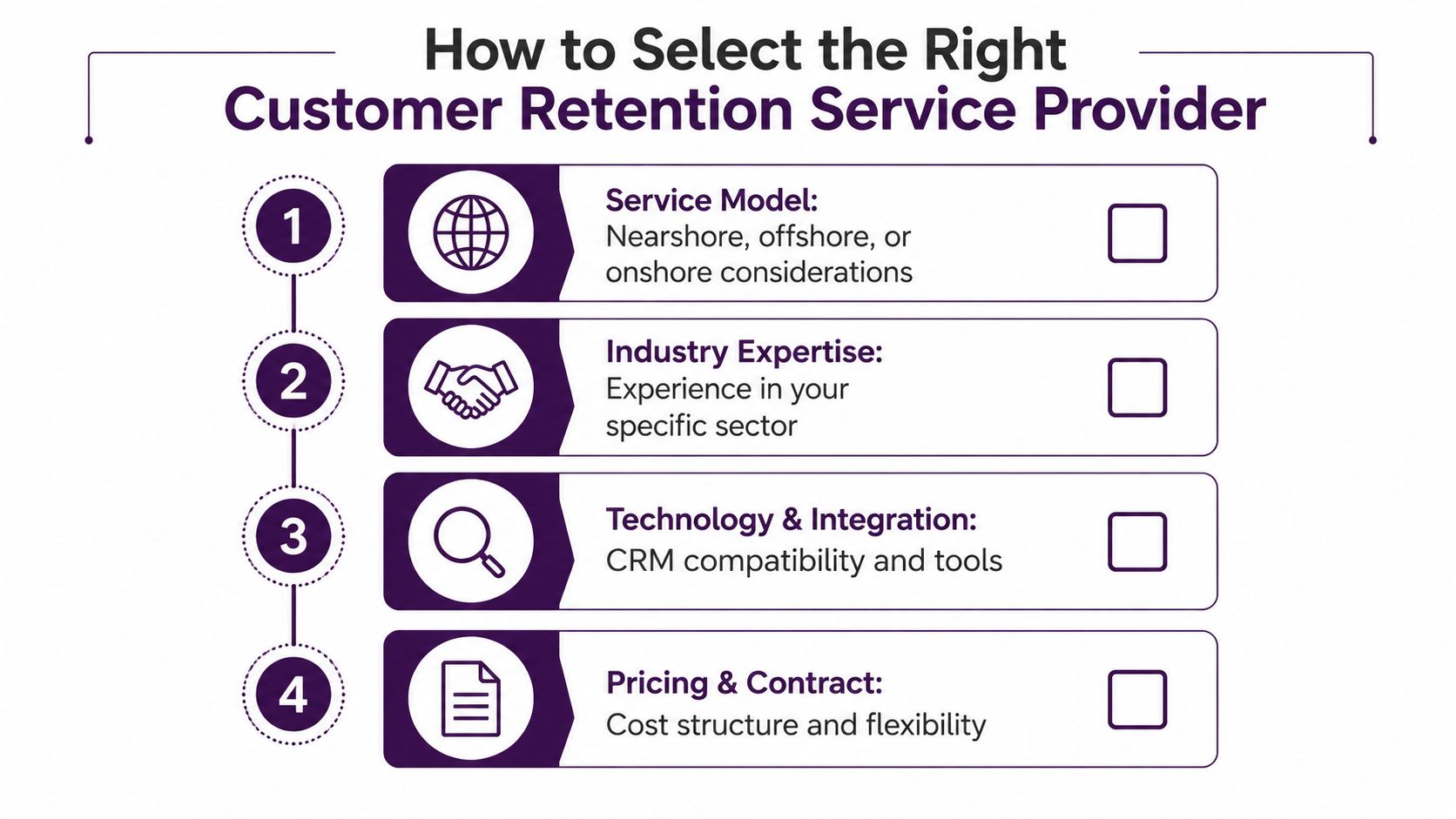
Start with delivery model and service fit
Nearshore, offshore, and onshore all solve different problems. Nearshore usually wins when a team needs better time zone alignment, easier management access, and stronger cultural fit for North American customers. Offshore can work for lower-complexity tasks, but retention work often depends on nuance, especially when there’s billing friction, account history, or bilingual support involved.
Ask for proof in the sector you care about
A provider should be able to describe how they handle your exact retention motion, not just talk about “customer service” in general. Healthcare teams need clear escalation discipline and privacy-aware workflows. Telecom teams need billing fluency and outage handling. E-commerce teams need post-purchase support, returns handling, and save offers that don’t feel random.
The evaluation lens at vendor evaluation criteria is a practical place to start if you’re building a shortlist.
Check the operating stack, not just the pitch deck
A real retention operation needs CRM integration, omnichannel tools, real-time dashboards, and reporting that lets your team see cohort performance. Ask how the provider handles QA, staffing continuity, bilingual coverage, and performance reviews. If reporting only shows volume and handle time, the provider isn’t built for retention outcomes.
Use this checklist during selection:
- Service model: Confirm whether nearshore, offshore, or onshore delivery fits your customer base and escalation needs.
- Industry expertise: Ask for examples from your sector, not vague cross-industry promises.
- Technology and integration: Verify CRM compatibility, omnichannel capability, and dashboard visibility.
- Pricing and contract structure: Make sure flexibility exists for volume shifts, pilot phases, and scale-up periods.
- Bilingual readiness: Test actual English and Spanish handling, not just résumé claims.
For North American buyers, CallZent is one option to assess because it provides bilingual inbound and outbound support from Tijuana, along with customer service, technical support, lead generation, debt collection, virtual assistance, and reservation management.
Real-World Retention Outcomes and Implementation Roadmap
A mid-market e-commerce brand came to a BPO partner with the same problem many teams have. Support volume was high, repeat purchases were uneven, and the company couldn’t tell which customers were leaving because of service friction versus product fit. The first move was not a loyalty campaign. It was a cohort review.
The team identified early-life churn patterns, then redesigned the service package around proactive outbound calls to at-risk accounts, bilingual support for Spanish-speaking customers, and a cleaner escalation path for order issues. Agents were trained to spot repeat-contact patterns and route customers into save workflows before frustration turned into cancellation. Loyalty program questions were handled in both English and Spanish, which helped re-engage a segment that had been under-supported.
The roadmap was simple. Assess the churn source, pilot a focused retention queue, integrate the reporting layer, and expand only after the team could show stable results by cohort. That sequence kept the work grounded in revenue impact instead of sentiment alone.
The key takeaway is direct. Customer retention services work when they’re measured as a revenue discipline, staffed with people who can resolve problems, and tuned to the language and behavior of the customers you’re trying to keep.
🚀 Turn Customer Retention Into a Revenue Discipline
CallZent helps North American businesses reduce churn through bilingual nearshore support, proactive outreach, customer recovery, and measurable retention workflows.
Talk to an ExpertIf retention is a priority in your business, start with the service gaps that are costing revenue and build a plan around them. Visit CallZent to explore bilingual nearshore support, retention-focused call center operations, and a delivery model built for North American customer relationships.