

Flexible Staffing Models
Flexible Staffing Models for 2026: Nearshore vs Offshore Guide for COOs
Learn how flexible staffing models work, when to use nearshore support, and how to balance cost, speed, and customer experience in e-commerce, healthcare, and finance.
TL;DR — Quick Takeaways
- Flexible staffing models help teams scale support capacity without overbuilding fixed headcount.
- The right model depends on the work. Some roles need a stable core team. Others are better handled through part-time, contingent, or on-demand coverage.
- For North American customer-facing operations, nearshore staffing often beats offshore when response speed, language fluency, and real-time collaboration matter most.
- The biggest mistake isn’t choosing flexible labor. It’s failing to integrate it well.
- A resilient support organization usually blends a core internal team with a flexible external layer, then manages both with clear workflows, onboarding, and accountability.
Is your current staffing plan built for stable demand in a market that no longer behaves that way?
That’s the gap many COOs are dealing with right now. Support volumes swing. Labor costs stay stubborn. Customer expectations don’t wait. Meanwhile, hiring full-time for every workload spike creates fixed cost you may regret a quarter later.
Flexible staffing models solve a real operating problem. They give leaders a way to add capacity without locking every role into a permanent seat. They also create room to protect service levels when the business gets hit with seasonal spikes, launch cycles, staffing shortages, or back-office overflow.
If your operation needs bilingual support, longer service hours, or a better way to absorb demand swings, it helps to study how U.S. call center operations are evolving alongside flexible delivery models.
Is Your Staffing Model Ready for 2026
The market already moved
A rigid staffing model is harder to defend than it used to be. As of 2026, over 55 million workers in the United States alone participate in some form of contingent or gig-based work arrangement, which signals a structural shift in how businesses build teams, not a temporary hiring tactic, according to DataIntelo’s on-demand staffing market report.
That matters because customer support, back-office processing, appointment handling, retention work, and sales support rarely rise in a straight line. A retailer can face a surge from a promotion. A healthcare group can see volume jump after open enrollment, seasonal illness, or provider schedule changes. A financial services team can hit a wall during tax season or policy renewal periods.
Traditional hiring doesn’t absorb that volatility well. By the time a full-time hire is approved, recruited, onboarded, and trained, the need may have shifted.
Key takeaway: The real advantage of flexible staffing models isn’t cheaper labor alone. It’s operational control when demand becomes unpredictable.
Why fixed headcount breaks under variable demand
COOs usually feel the same friction points first:
- Demand changes faster than HR cycles. Support leaders need coverage now, not after a long hiring loop.
- Overstaffing hurts margins. When volumes normalize, excess permanent headcount becomes expensive.
- Understaffing hurts customer experience. Slow answer times, abandoned contacts, and rushed agents create preventable churn.
- Managers burn out the core team. Overtime and queue pressure may solve today’s gap while damaging next quarter’s retention.
Flexible staffing models work best when leaders stop treating staffing as a one-time hiring decision and start treating it as capacity design. That shift changes the conversation from “How many people do we need?” to “Which work should stay core, and which work should flex?”
What readiness looks like
A staffing model is ready for 2026 if it can do three things well:
- Protect service quality during spikes
- Scale down cleanly when demand softens
- Keep critical customer interactions close to the business
That third point is where many companies make the wrong move. They compare options only on hourly rate, then discover too late that communication lag, weak cultural fit, or poor integration costs more than expected. In support environments, staffing isn’t only a labor decision. It’s a customer experience decision.
Understanding the Core Types of Flexible Staffing
Flexible staffing models aren’t one thing. They’re a set of operating choices. The easiest way to think about them is as a toolbox. You don’t use the same tool for a broken pipe, a seasonal rush, and a long-term expansion.
Temporary and contract staffing
Temporary or contract staffing fits work with a defined window or a clear overflow problem. Think of a retailer that needs extra agents for returns after holiday campaigns, or a healthcare billing team that needs short-term help with eligibility checks and document follow-up.
This model works when the work is real, but the duration is uncertain. It gives operations leaders room to respond without committing every demand spike to permanent payroll.
Good use cases include:
- Project-based support for a system migration, product launch, or backlog cleanup
- Seasonal coverage for e-commerce promotions, renewals, or intake surges
- Skill-specific work when internal teams don’t have the language or process expertise in-house
Part-time staffing
Part-time staffing is often underrated. It’s useful when demand is predictable, just not full-day or full-week predictable. A contact center may need more coverage in late afternoons, weekends, or specific billing cycles, but not enough to justify additional full-time seats.
A practical example is a clinic that gets the heaviest call volume when patients are off work. Another is an online seller with chat peaks tied to campaign drops and post-purchase questions.
Part-time staffing is often the cleanest fix for schedule mismatch. The workload exists. It just doesn’t fill a full-time shift.
On-demand staffing
On-demand staffing is your shock absorber. It’s built for unpredictable spikes where waiting to hire makes no sense. This is common in customer service queues, order support, insurance intake, and after-hours overflow.
The point isn’t elegance. It’s response capacity.
This model works best when processes are standardized, scripts are clear, and training can be delivered fast. If your workflows are messy, on-demand labor won’t rescue them. It will expose them.
Blended teams
Blended teams combine a stable internal core with a flexible external layer. In practice, this is how mature operations run. They keep brand-sensitive or high-judgment work close to the business, then flex other queues around it.
For contact centers, that often looks like this:
- Core team owns escalations, quality-sensitive interactions, and process feedback
- Flexible layer handles overflow, after-hours support, routine inbound contacts, outbound reminders, or bilingual coverage
- Specialist support steps in for short-term campaigns or language-specific work
Many companies also pair this with hybrid work schedules so they can support employee flexibility without giving up operational discipline.
The common mistake
Leaders often choose a model based on labor category instead of workflow fit. That’s backwards. Start with the work itself.
Ask:
- Does the volume stay steady or swing hard?
- Does the task require judgment or repetition?
- Is the work customer-facing, back-office, or both?
- Do we need same-day collaboration with internal teams?
If the answer includes real-time coordination, bilingual service, and customer experience risk, the staffing model matters more than the cheapest rate card.
Why Nearshore Is the Smartest Flexible Staffing Model
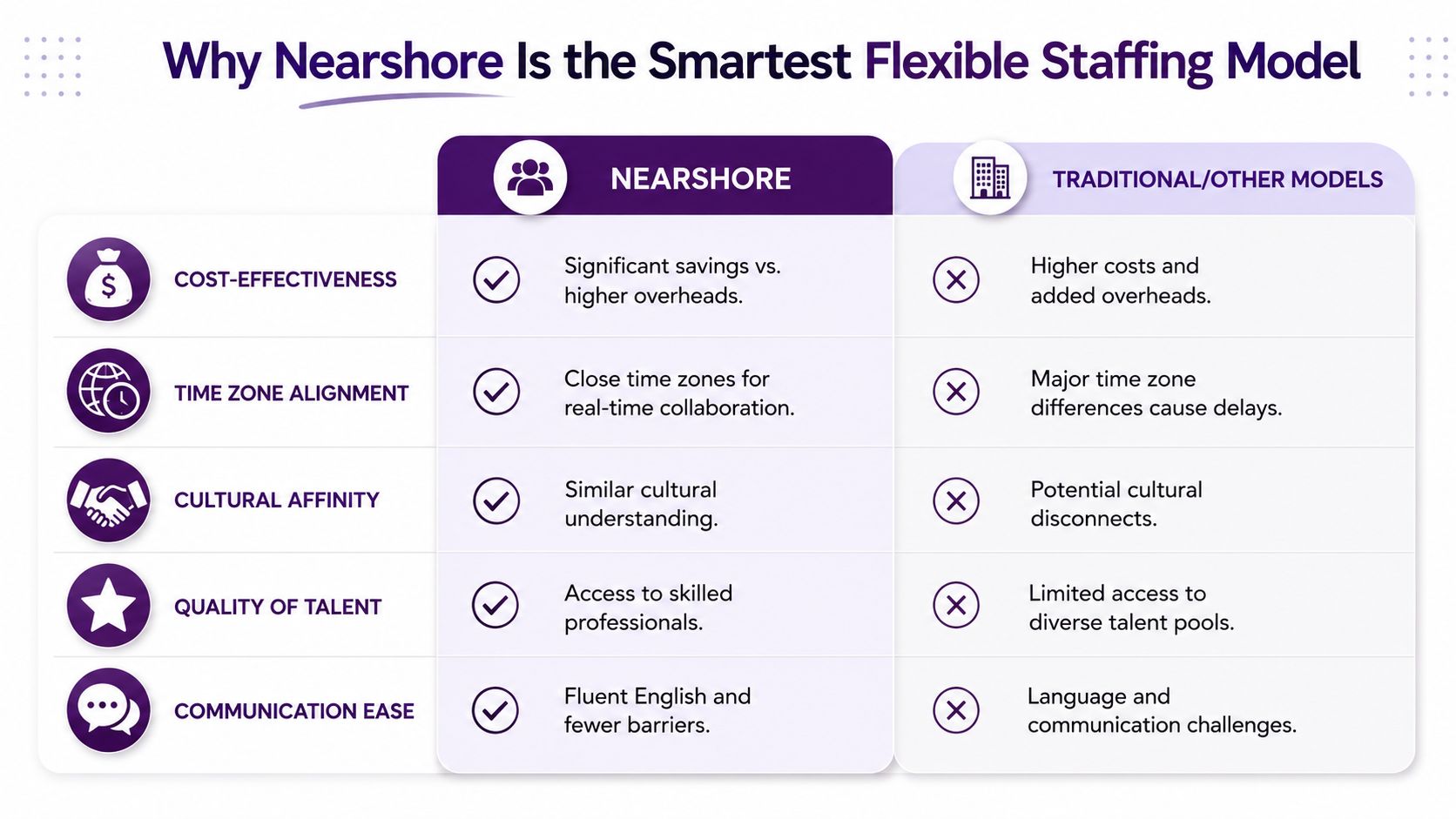
If your customers are in North America, your staffing design should respect North American operating reality. Customers call during your business day. Supervisors need same-day decisions. QA teams need live coaching. Escalations can’t sit overnight because a vendor is asleep twelve time zones away.
That’s why nearshore is often the strongest flexible staffing option for customer-facing work.
Nearshore beats offshore where speed matters
The biggest difference isn’t geography. It’s operating friction.
Recent 2024 to 2025 data shows that nearshore flexible models deliver 40% faster response times and 25% higher customer satisfaction scores for North American clients because of time-zone alignment and cultural fluency, while offshore models often suffer from 2 to 3 hour latency and language barriers that degrade service quality, according to Pace Staffing’s analysis of flexible staffing.
That shows up in real situations fast.
An e-commerce brand running a flash sale doesn’t need a vendor who can reply tomorrow. It needs agents who can jump into chat, voice, and order-status workflows during the same business window the campaign is live. A healthcare support team handling appointment reminders and insurance follow-up needs staff who can coordinate with U.S. office teams in real time, not pass issues across a long handoff chain.
Why Tijuana is a strategic fit
For bilingual support, Tijuana gives North American businesses a practical balance of proximity, language capability, and cost structure. Nearshore call centers in Mexico, including Tijuana, typically offer bilingual agents at $12 to $18 per hour, which is 30% to 40% lower than onshore U.S. rates while maintaining 90%+ English fluency and cultural alignment, according to CCSI’s guide to nearshore contact centers in Mexico.
That matters most in roles like:
- Customer care where tone and empathy shape retention
- Technical support where misunderstanding creates repeat contacts
- Collections and payment support where clarity affects compliance and outcomes
- Healthcare scheduling where bilingual communication reduces friction for patients
If you’re weighing this model at the strategy level, it helps to review the broader benefits of nearshore outsourcing through an operational lens, not just a procurement lens.
Nearshore isn’t always the answer
There are cases where offshore still makes sense. Low-touch back-office processing, overnight workflows, or highly repetitive tasks with limited live interaction can fit offshore models well.
But customer-facing support has different economics. A lower rate means less if the team creates slower handling, more rework, weaker first-contact resolution, or avoidable customer frustration.
You don’t optimize support by buying the cheapest labor. You optimize it by matching labor design to the cost of service failure.
For most North American businesses, nearshore flexible staffing is the better fit when the work requires speed, bilingual service, coaching access, and cultural familiarity. That combination is hard to fake, and expensive to recover once customer experience drops.
Balancing the Benefits and Risks of a Flexible Workforce
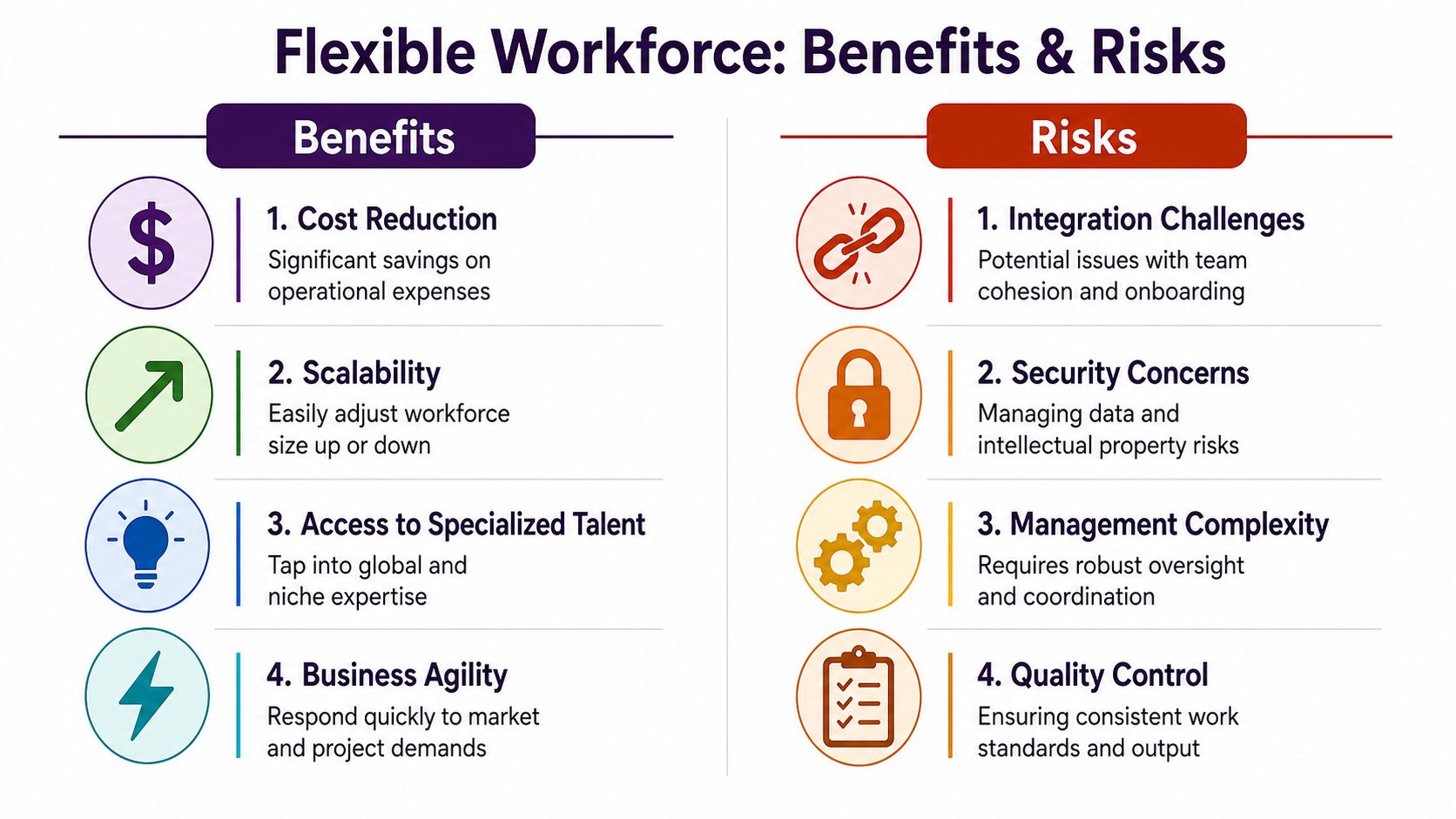
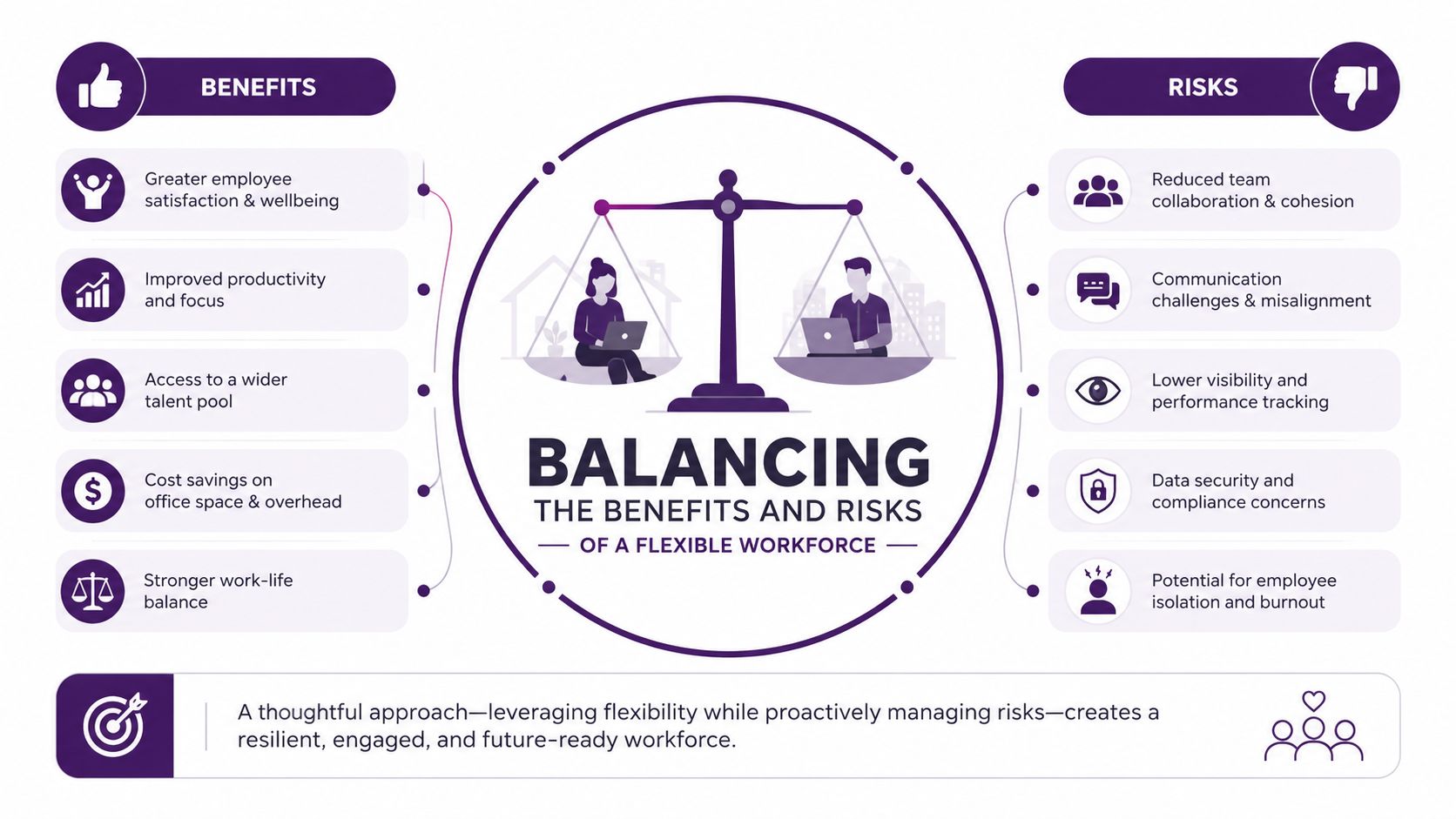
Flexible staffing models can improve operating range fast. They let leaders add coverage, expand hours, launch new support lines, and protect the internal team from burnout. But the upside only holds if the operating model is disciplined.
The risk isn’t flexibility itself. The risk is using it casually.
Where the benefits are real
The strongest benefits usually show up in three places.
First, leaders gain capacity control. They can scale support around campaigns, claims volume, appointment flow, or seasonal order swings without rebuilding the org chart each time.
Second, they improve cost structure. Variable support capacity is often easier to manage than carrying fixed headcount for peak demand that only appears part of the year. If you’re evaluating the economics, understanding labor arbitrage in operations proves useful, especially when comparing onshore, nearshore, and offshore options.
Third, they expand talent access. Bilingual support, extended-hour coverage, and specialized back-office work are easier to source when the labor model is flexible.
The hidden cost most teams miss
The biggest downside is integration failure.
Without deliberate integration protocols, flexible workers can reduce team cohesion and increase error rates by 15% to 20% in the first quarter, an “integration gap” that can overturn the perceived 30% cost advantage over permanent hires, according to CS Recruiters’ analysis of flexible staffing risks and benefits.
That finding matches what operations teams see on the ground. The problem usually isn’t that contingent workers can’t perform. It’s that companies drop them into weak systems.
Common failure points include:
- Fragmented onboarding where agents get tools but not context
- Unclear ownership between internal supervisors and external team leads
- Separate communication channels that isolate flexible staff from daily updates
- Inconsistent quality management across locations or labor types
Practical rule: If contingent staff attend training but not calibration, they won’t perform like part of the same operation.
What good integration looks like
A healthy flexible workforce doesn’t feel like two teams. It feels like one operation with different labor layers.
That requires a few basic disciplines:
- Standardized onboarding so every agent learns the same workflows, escalation paths, and brand standards
- Weekly manager check-ins to catch confusion before it turns into repeat errors
- Shared communication channels for policy changes, queue updates, and coaching notes
- Common scorecards so quality is measured the same way across internal and external teams
Small businesses often underestimate this work. They focus hard on staffing up and barely at all on operating rhythm. That’s when flexible staffing stops looking efficient and starts looking chaotic.
The reward is still worth it. But it only shows up when leaders manage integration with the same seriousness they bring to hiring.
A Practical Framework for Implementing Flexible Staffing
Most staffing strategies fail before launch because the company skips diagnosis. Leaders feel pressure, add people, and hope the added bodies solve the issue. Sometimes scheduling is the problem. Sometimes it’s training. Sometimes the queue should flex, but the escalation layer should not.
A good framework separates those decisions.
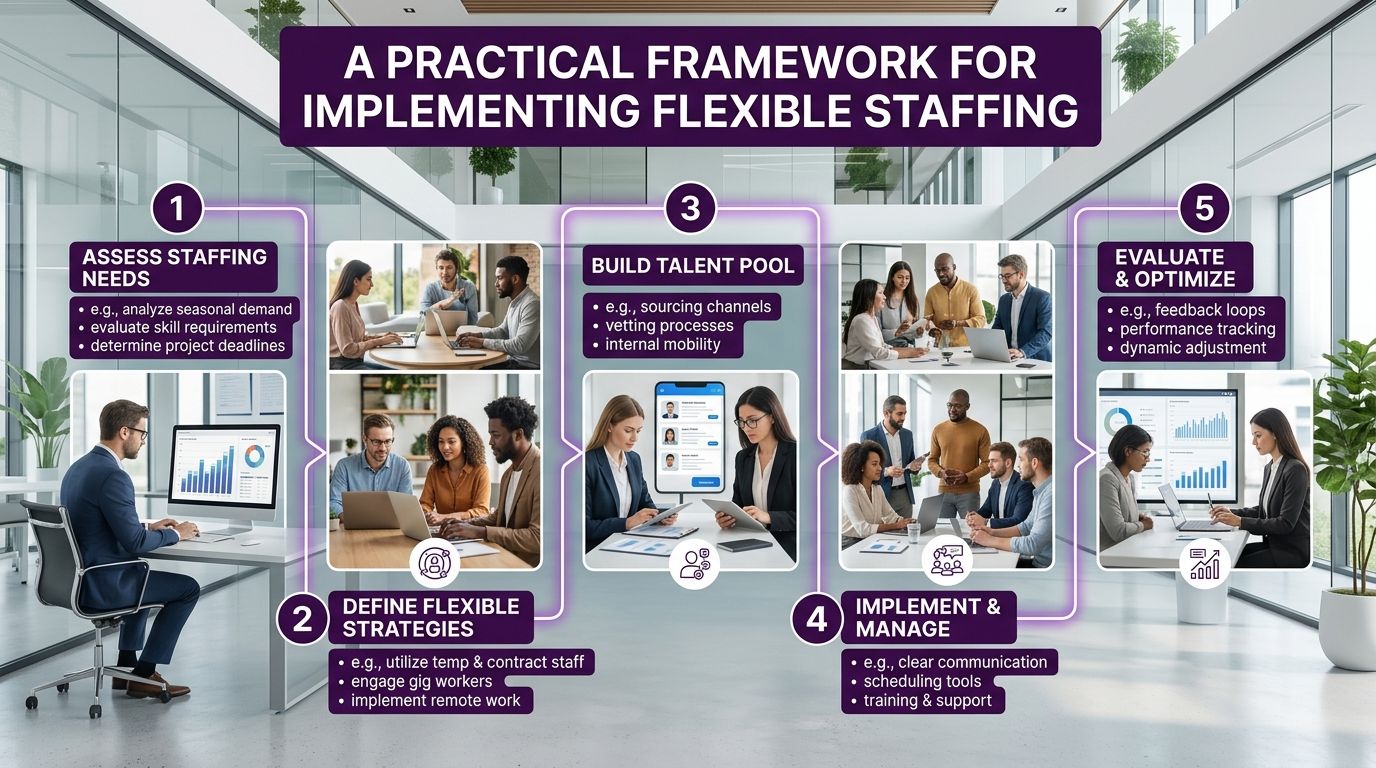
Step 1 Assess the work before the headcount
Start with contact patterns, ticket categories, backlog trends, service windows, and language needs. Don’t ask “How many agents do we need?” first. Ask which types of work need stable ownership and which can flex safely.
For engineering and technology teams, the optimal configuration is a core-to-flex ratio of 60% to 70% permanent employees and 30% to 40% contingent talent, with quarterly reassessment of utilization rates, according to Pendoah’s scaling guide for flexible staffing. Customer support teams can use the same logic even when the exact role mix differs. Protect the core. Flex around it.
Step 2 Define success in operating terms
If the model is working, you should see it in daily execution.
Track practical measures such as:
- Cost per resolution to understand whether staffing changes are improving unit economics
- Agent utilization to see whether labor is matched to actual workload
- CSAT and QA trends to catch service erosion early
- Escalation volume to identify training or authority gaps
- Schedule adherence and coverage by interval to judge planning accuracy
A flexible model without agreed metrics turns into opinion warfare between operations, finance, and vendor management.
Step 3 Build integration before go-live
Many teams encounter trouble. They contract capacity but don’t design how that capacity joins the operation.
A strong launch plan should include:
- Workflow documentation that reflects actual current-state processes
- Clear role boundaries for who handles exceptions, refunds, escalations, and policy calls
- Shared QA calibration between internal and external leads
- Ramp expectations by queue and task type
If your team needs help structuring the onboarding side, this guide on how to build a world-class remote onboarding program offers a useful framework for distributed teams.
Choosing Your Flexible Staffing Model
| Business Need | Best-Fit Model | Primary Benefit |
|---|---|---|
| Seasonal customer support spikes | Temporary or nearshore overflow team | Fast capacity without long-term fixed headcount |
| Evening or weekend coverage | Part-time staffing | Better schedule match |
| Unpredictable daily fluctuations | On-demand model | Elastic response to volume swings |
| Bilingual customer service | Nearshore blended team | Real-time communication and language alignment |
| Backlog cleanup or admin processing | Contract staffing | Focused execution for defined work |
| High-touch escalations and brand-sensitive contacts | Core in-house team with selective flex support | Quality control and institutional knowledge |
Step 4 Review vendors like operators do
Don’t buy on price sheet alone. Review ramp speed, quality controls, language strength, security discipline, reporting maturity, and management access. A good partner should be easy to evaluate against structured vendor evaluation criteria, not just sales promises.
Step 5 Rebalance quarterly
Flexible staffing models need maintenance. Queues change. Campaigns end. Some temporary work becomes permanent. Some “strategic” work turns out to be highly repeatable and safe to flex.
Review the model on a regular cadence. Keep what the business needs central. Flex what moves.
How Leading Industries Use Flexible Staffing Models
The best way to judge flexible staffing models is to look at where they solve real operating problems.
E-commerce uses flex capacity to survive demand spikes
An online retailer heading into Black Friday usually faces a familiar dilemma. If it hires too many permanent agents, post-peak labor becomes a drag on margin. If it hires too few, wait times rise right when purchase intent is highest.
A blended nearshore model solves that cleanly. The internal team keeps ownership of escalations, VIP issues, and policy exceptions. The flexible team handles order status, shipping questions, returns, chat overflow, and bilingual contacts. That gives the business more room to protect service without committing every seasonal need to year-round headcount.
Healthcare uses flexibility to protect clinical staff
Healthcare has already moved decisively in this direction. An overwhelming 97% of healthcare organizations plan to increase their use of flexible work options in the coming year, including float pools, gig-style roles, per diem, and contract staffing, according to StaffingHub’s healthcare workforce trends report.
In practice, that often means using flexible support teams for appointment reminders, intake calls, referral coordination, insurance verification, and follow-up outreach. The clinic keeps nurses, front-desk leaders, and providers focused on patient care while support workflows move through a structured external layer.
Healthcare organizations don’t use flexible staffing because it sounds modern. They use it because patient access work still has to get done when internal teams are stretched.
Financial services uses targeted flex teams for cyclical demand
A financial services firm may see sharp spikes around tax season, renewal windows, claims questions, or payment reminders. The right move usually isn’t to outsource every interaction. It’s to map the work by sensitivity.
Routine inbound questions, document status updates, outbound reminders, and bilingual assistance can be flexed safely when scripts, QA, and compliance controls are tight. Account-specific judgment calls and exception handling stay close to the core team.
That industry-by-industry approach is why flexible staffing works. It’s not one blanket model. It’s a staffing architecture. Businesses that want to compare where this approach fits best can review common industries that benefit from nearshore outsourcing and map those lessons to their own service environment.
🚀 Build a Flexible Staffing Model That Fits Real Demand
If your team is rethinking coverage, bilingual support, overflow management, or back-office scalability, CallZent can help you design a nearshore staffing model that fits the way your operation functions. The right setup protects service quality, gives you room to scale, and avoids the hidden friction that comes from forcing a rigid staffing model onto variable demand.
Talk to an ExpertIf your team is rethinking coverage, bilingual support, overflow management, or back-office scalability, CallZent can help you design a nearshore staffing model that fits the way your operation functions. The right setup protects service quality, gives you room to scale, and avoids the hidden friction that comes from forcing a rigid staffing model onto variable demand.