Healthcare Call Center Operations
Healthcare Call Center: Services, Compliance, KPIs, and Best Practices
Learn how healthcare call centers improve patient access, support HIPAA-compliant workflows, reduce administrative pressure, and provide dependable bilingual coverage.
TL;DR — Quick Takeaways
- A healthcare call center supports patient access, scheduling, referrals, billing questions, refill coordination, reminders, and after-hours intake.
- Healthcare programs must balance speed with identity verification, privacy, documentation, empathy, and safe escalation.
- HIPAA compliance requires more than signing a Business Associate Agreement. Safeguards must appear in everyday workflows, access controls, training, QA, and incident reporting.
- Healthcare KPIs should prioritize access, safe resolution, callback compliance, abandonment, and patient experience—not simply shorter handle times.
- Bilingual nearshore teams in Mexico can provide English and Spanish coverage with North American time-zone alignment.
- A controlled 90-day implementation helps document workflows, test handoffs, train agents, and establish reporting before full-scale operations.
- AI can support routing, intake, reminders, and summarization, but sensitive, clinical, complex, and emotionally difficult interactions still require qualified people.
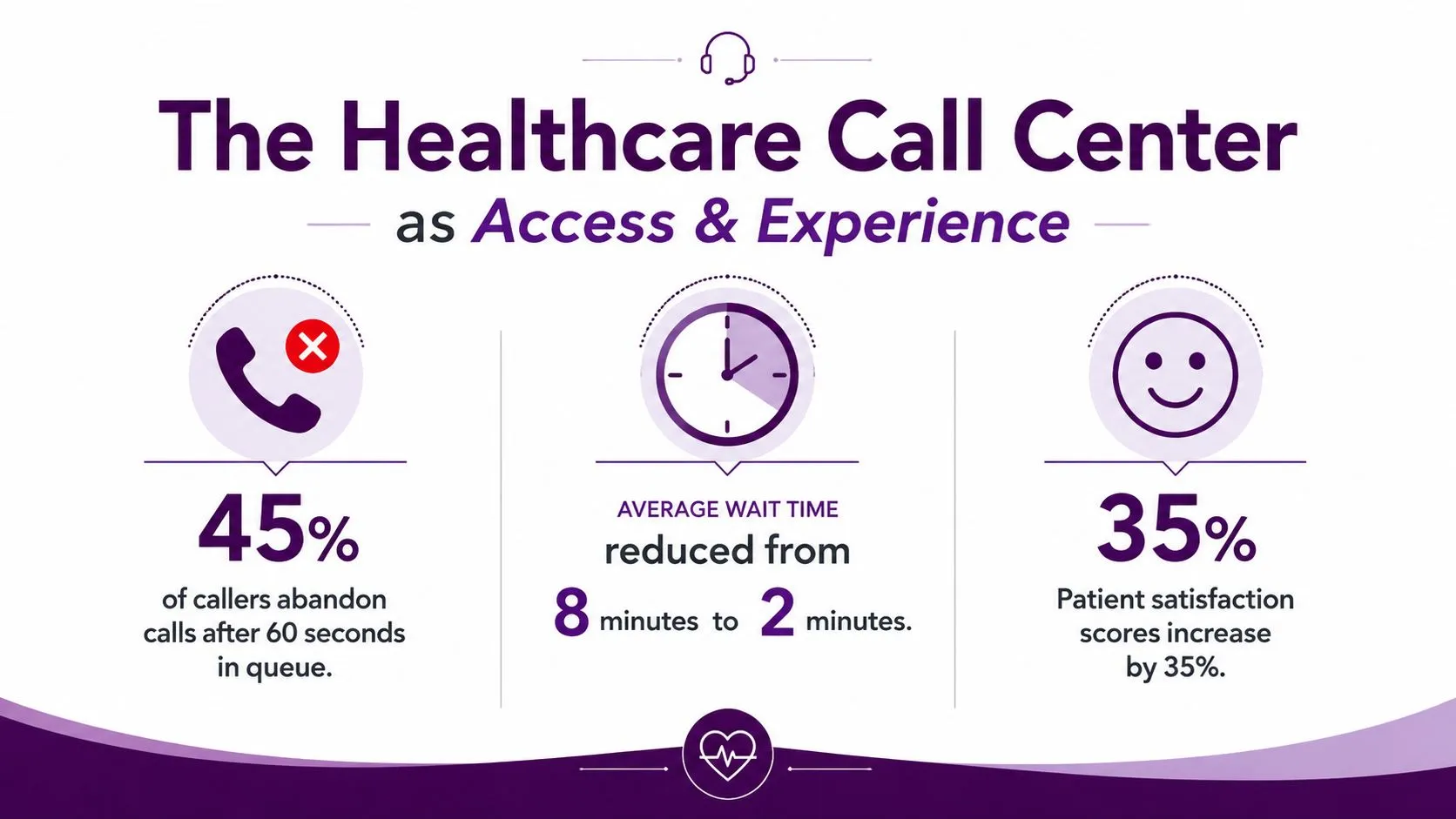
A healthcare call center handling roughly 2,000 calls a day can still fall short of the access standard patients experience. Peak staffing may cover only 60% of required capacity, creating a shortage of about 23 agents. Average hold time can reach 4.4 minutes, compared with the Healthcare Financial Management Association’s 50-second target. Only 1% of centers reportedly achieve a first-call resolution rate between 80% and 100%.
Those gaps affect the clinic’s daily workflow. A patient may abandon a scheduling call, a front-desk employee may leave an in-person patient to answer the phone, and a referral may go elsewhere because no one responded promptly. Nearshore bilingual teams can change the staffing equation by extending coverage and supporting more patients across languages and time zones.
A healthcare call center is an access, compliance, and patient-experience operation, not just an answering service.
What a Healthcare Call Center Does
Average hold times in healthcare can stretch to 4.4 minutes, while peak staffing may cover only 60% of required capacity. Those figures, noted earlier, show why a clinic can lose access even when its front desk is working continuously. Healthcare access guidance commonly treats an average hold time under 2 minutes and abandonment below 5% as important thresholds, while Veterans Health Administration access goals cite an average speed of answer at or below 30 seconds (healthcare access measurement research).
The work happens across several access points
A healthcare-specific team commonly manages:
- Inbound calls: Appointment requests, cancellations, prescription questions, insurance inquiries, and patient messages.
- Outbound calls: Appointment reminders, follow-up checks, referral outreach, and care-gap campaigns.
- After-hours coverage: Clear intake and escalation while the clinic is closed.
- Administrative coordination: Documentation, callback tracking, and outcome coding.
The operational difference from a generalist BPO is context. A trained healthcare agent understands medical terminology, follows an approved scheduling workflow, verifies identity before discussing protected information, and recognizes when a symptom description requires clinical escalation. The agent does not diagnose. Instead, the agent follows the path the provider has approved.
The same discipline matters for referral and life-sciences organizations. Teams reviewing specialized staffing options can consult LatoJobs healthcare life sciences for healthcare-focused talent categories.
Nearshore staffing changes the operating model by adding language coverage and time-zone overlap. A bilingual team in Tijuana can support English- and Spanish-speaking patients while working within the clinic’s business hours. Supervisors can watch live demand, adjust schedules, and refine scripts or escalation rules with the provider without relying on distant handoffs.
A call center is therefore more than a phone queue. It works like an access layer between patients and the clinic, keeping routine requests moving while directing sensitive or clinical matters to the right team.
Practical takeaway: A healthcare call center protects the patient relationship from the first call through follow-up by combining trained people, documented workflows, and reliable access coverage.
For clinics assessing service models, CallZent healthcare provider solutions outline patient-interaction and access support that a specialized partner may provide.
Core Services Every Healthcare Call Center Should Run
A healthcare call center should operate as one coordinated access layer, not a collection of disconnected queues. For a two-provider clinic with one shared front desk, that means routine requests move through documented workflows while clinical or sensitive matters reach the appropriate staff member.
Appointment scheduling and rescheduling
Scheduling is the front door. Agents confirm the visit reason, select the approved provider or appointment type, check availability, and record the outcome in the designated system. If the clinic has supplied the workflow, the same call can include new-patient intake and insurance verification.
A patient who needs to move a follow-up visit should not have to explain the situation repeatedly. The agent checks scheduling rules, verifies the patient’s details, offers approved options, and documents the change. Clinic staff can then spend more time on care than on recurring calendar work.
Prescription refill coordination
Refill requests need a defined route. The agent gathers the request, verifies the information required by policy, checks an existing request’s status, and sends the message through the approved channel. Clinical approval remains with the clinician or pharmacy, so the agent does not judge the request or promise an outcome.
This service is especially useful for status calls. A clear update can answer the patient’s question without creating another message for the clinical team.
Post-visit follow-up
After a visit, agents can confirm that the patient received instructions, address a scheduling need, and route questions requiring clinical review. They can also support appointment reminders and other follow-up workflows through CallZent’s patient appointment reminder service.
Outbound work depends on accurate lists and outcome codes. In one large healthcare outreach deployment, 548,089 call attempts produced 66,238 new appointments, with an adjusted booking rate of 14.6% after invalid or already-scheduled contacts were excluded. The program also confirmed existing follow-up care through 90,774 additional calls (published outreach results). The operational lesson is clear: a call can support continuity of care even when it does not create a new appointment.
Insurance and billing inquiries
Agents can explain statement processes, record payment-plan questions, check prior-authorization status, and route disputes to the correct billing or payer team. Scripts must define the boundary between explaining a process and interpreting a patient’s account. An incorrect answer can create confusion and weaken trust.
Clinic leaders evaluating this workflow can use guidance on reducing administrative costs in healthcare to assess process design, handoffs, and avoidable repeat work rather than treating staffing as the only cost variable.
After-hours triage support
After-hours agents follow a written intake and escalation protocol. They record the caller’s stated concern and required details, then route urgent situations to the designated clinical or emergency pathway. They do not diagnose or improvise.
These services should connect at the workflow level. A scheduling call may expose a billing barrier, a refill request may require a callback, and a post-visit call may show that the patient cannot access telehealth. Visible handoffs prevent the patient from starting over, while bilingual nearshore coverage can keep those routes accessible across the clinic’s language and time-zone needs.
HIPAA Compliance and How It Shapes Daily Operations
HIPAA becomes operational the moment a call center handles protected health information for a covered entity. The call center is treated as a business associate, and a written Business Associate Agreement must be in place before PHI is shared (HIPAA call center requirements). A vendor that avoids the BAA conversation should be removed from consideration before a sales demonstration becomes a procurement decision.
The agreement is only the starting point. The Security Rule applies directly to the call center, and identical violations can reach $2,190,294 per calendar year (business associate and Security Rule guidance).
What agents must do on every interaction
Daily safeguards should be visible in the workflow:
- Verify identity first: Agents confirm the required identifiers before discussing health information.
- Use minimum necessary access: Role-based permissions limit what each employee can view.
- Protect systems: Strong authentication, encryption in transit, audit logs, and access controls protect systems that store or transmit electronic PHI (HIPAA operational safeguards).
- Control the workspace: Screen-locking, clean-desk rules, and restrictions on personal devices reduce exposure.
- Secure recordings and messages: Recorded lines, voicemail transcription, retention rules, and callback channels must follow the provider’s approved policy.
A patient might ask an agent to send information to a family member. The agent shouldn’t rely on familiarity or urgency. The agent follows the verification and authorization process, records the interaction, and escalates when the situation falls outside the script.
Compliance is a habit, not a binder. It should appear in onboarding, call scripts, QA scorecards, access reviews, and audit logs that the client can request.
A provider should also ask how the vendor handles offboarding, incident reporting, recording access, and subcontractors. CallZent’s healthcare outsourcing compliance guide provides a useful reference point for organizing those questions before contract approval.
KPIs That Matter in Healthcare vs Generic Call Centers
A generic contact center may celebrate shorter handle time and higher occupancy. Those measures can be useful, but healthcare leaders should be careful when they become the main objective. An agent who rushes a symptom-related call, skips identity verification, or transfers a patient repeatedly may look efficient while creating a serious access problem.
Healthcare performance starts with whether patients reach the right support safely and promptly. Common healthcare benchmarks include abandonment under 5%, while some healthcare operations guidance describes 5% to 8% as acceptable and 2% to 3% as high-performing. One HFMA source cited in that guidance places average abandonment at 7%, with a goal below 5% (healthcare call abandonment guidance).
Compare the scorecards
| Metric | Generic Call Center | Healthcare Call Center |
|---|---|---|
| Speed to answer | Efficiency against internal service goals | Access measured against healthcare-specific thresholds |
| Abandonment | Often treated as a queue-management issue | A patient-access risk, commonly targeted below 5% |
| First-call resolution | Fast closure of a customer issue | Complete resolution without unsafe shortcuts or avoidable callbacks |
| Handle time | Lower is often preferred | Balanced against verification, empathy, documentation, and escalation |
| Quality review | Script and service adherence | Privacy, identity verification, triage routing, accuracy, and patient experience |
| Outbound success | Contact or conversion activity | Appointment capture plus confirmed follow-up and continuity outcomes |
A provider should also review patient satisfaction by call type. A billing call and a routine reminder shouldn’t be interpreted the same way. Triage callbacks need their own compliance measure, including whether the promised escalation occurred.
For managers building a dashboard, VoIP call center analytics offers useful background on the reporting capabilities commonly available in cloud calling environments. The technology matters, but the definitions matter more. Ask the vendor how it calculates abandonment, first-call resolution, callbacks, and escalations.
Use CallZent call center KPIs as a starting point for the scorecard conversation, then adapt the measures to the clinic’s access promises and clinical workflows.
Choosing the Right Vendor for Your Organization
Vendor selection shouldn’t begin with a polished demo. It should begin with a discovery worksheet that shows what the operation requires.
Start with the demand pattern
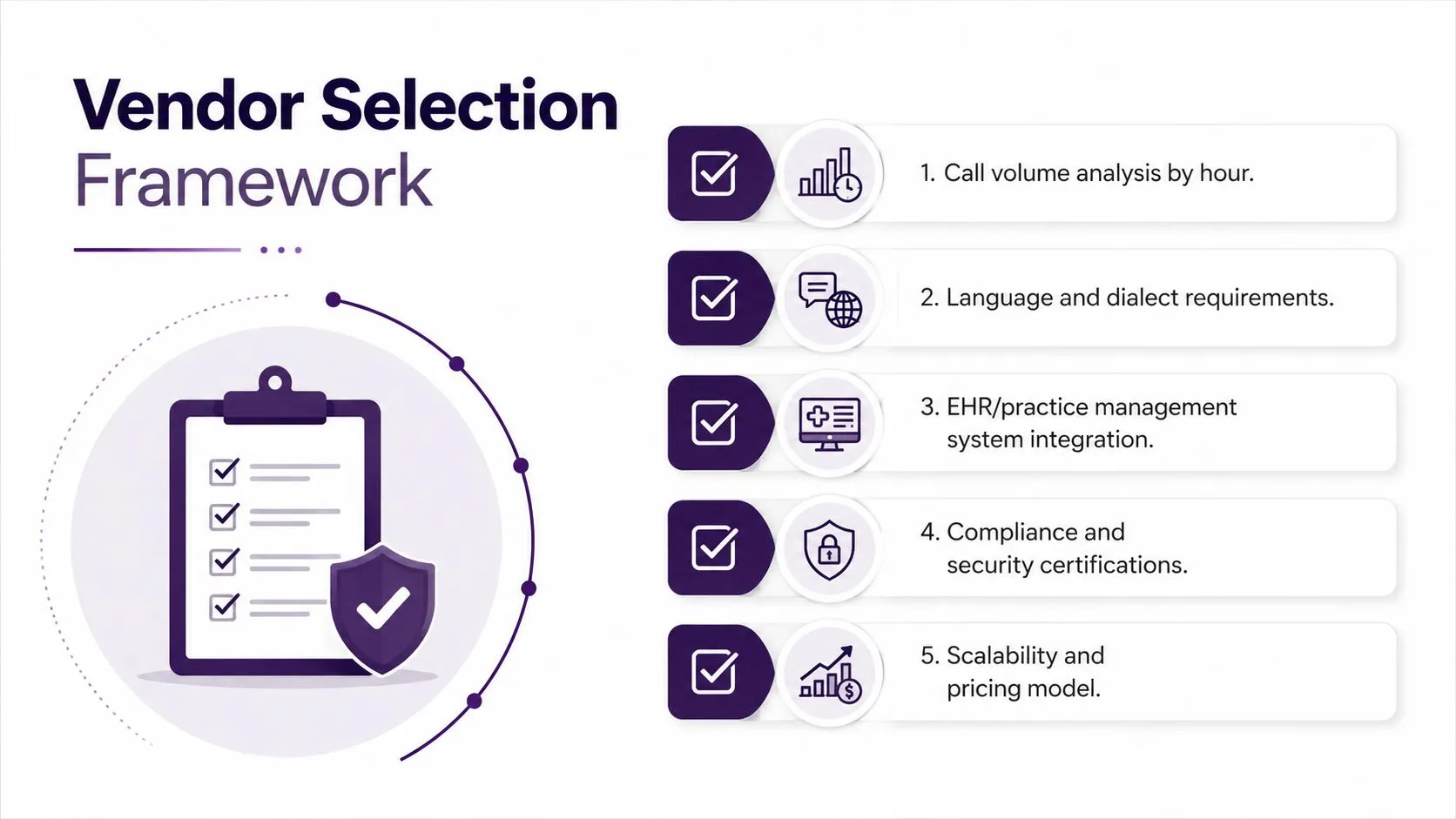
Record call volumes by hour, common call reasons, language needs, after-hours expectations, and seasonal pressure points. Then list every system the team must use, including the EHR, practice-management platform, CRM, telephony system, and secure messaging tools.
A vendor may sound capable until you ask how an agent will update an appointment, document a callback, or route an urgent concern without duplicating work. The answer should describe the actual workflow, not just an integration logo.
Test bilingual and nearshore capability
English and Spanish support can improve access for diverse patient populations, but “bilingual” shouldn’t remain a vague label. Ask how the vendor tests language proficiency, handles regional expressions, documents interpreter needs, and supervises calls in both languages.
A Tijuana-based nearshore team can offer time-zone alignment with U.S. operations and easier collaboration than a distant offshore model. That can help supervisors join calibration sessions, review live call patterns, and adjust coverage quickly. Treat language quality and operational proximity as measurable evaluation criteria, not marketing adjectives.
Inspect the technology and controls
Ask for a demonstration of the full agent workspace:
- Secure voice: Confirm how calls, recordings, and access are protected.
- Redaction: Review how sensitive information is masked in screen recordings.
- System connection: See how the EHR or practice-management system receives notes and outcomes.
- Ticketing: Verify that unresolved issues create visible ownership and deadlines.
- Reporting: Request sample views for answer speed, abandonment, escalations, and QA.
Pressure-test the commercial model
Pricing may be structured per seat, per call, per patient, or through a blended arrangement. Compare each model against your demand pattern. A per-seat model may feel predictable but leave unused capacity during quiet periods. A per-call model may fit variable demand but require careful definitions for transfers, callbacks, and repeat contacts.
Finally, review SLAs for answer time, abandonment, uptime, security incidents, and escalation handling. Ask for references from organizations with similar clinical workflows, then ask about audit history, transition ownership, and what happens when the account manager changes.
Implementation Best Practices From Day One to Steady State
A healthcare call center rollout works better as a 90-day operating build than as a single launch date. The provider and vendor need time to document the work, test the handoffs, and expose unclear instructions before patients experience them.
Days 1 to 30 build the operating map
The discovery phase should produce more than a volume estimate. Create call flows for each service lane, collect patient FAQs, define escalation rules, map EHR fields, and identify which information agents can access.
The clinic should approve scripts for scheduling, refill coordination, billing questions, telehealth support, and after-hours intake. If the provider can’t explain what happens when a patient’s request falls outside the standard path, the workflow isn’t ready for training.
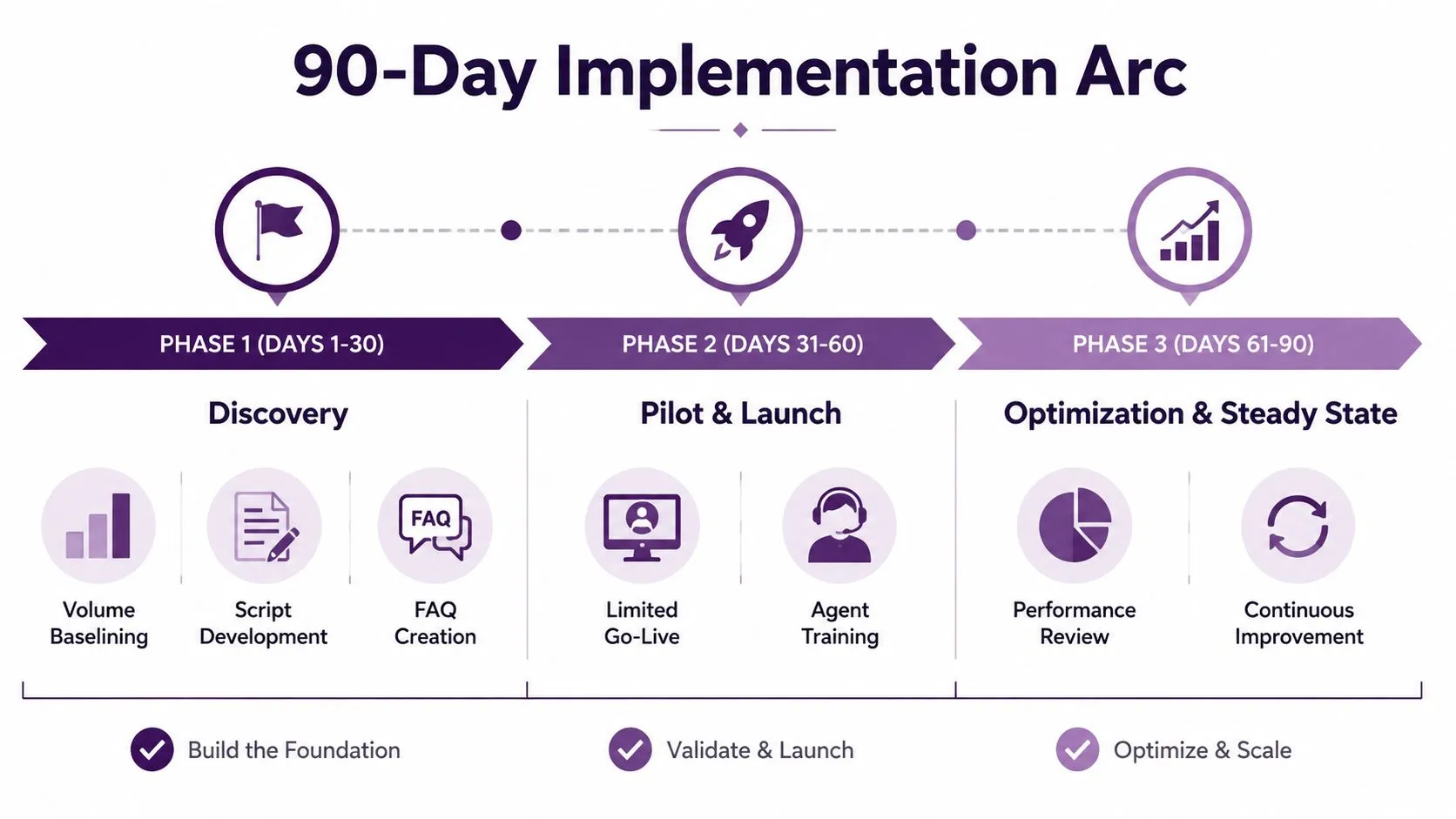
Days 31 to 60 test the handoffs
Use shadowing, side-by-side listening, call calibration, and a limited pilot. Supervisors should compare how different agents interpret the same patient scenario, especially for triage routing, billing disputes, and privacy verification.
A pilot should answer practical questions. Can an agent find the correct appointment type? Does the escalation reach the right clinical team? Does the patient receive a clear callback expectation? Does the note contain enough information for the next person to act without asking the patient to repeat everything?
A pilot should reveal ambiguity before it reveals volume.
Days 61 to 90 establish ownership
Steady state needs a reporting rhythm. Weekly QA sampling can identify errors while they’re still correctable, and monthly business reviews can address staffing, SLA performance, training needs, and workflow changes.
The provider should keep the operating artifacts:
- Call-flow diagrams
- Knowledge-base articles
- Escalation matrices
- Compliance checklists
- Approved scripts and revision history
- Reporting definitions and ownership rules
That documentation protects continuity when supervisors, account managers, or clinic employees change. It also gives the provider a clear basis for deciding whether the model is working.
Where AI Helps and Where Humans Must Stay
Healthcare calls demand more than a short training course. Agents need to understand clinical context, show empathy under stress, follow privacy rules, and recognize when a routine request may need a human or clinical response.
AI works well as a routing, intake, and summarization layer. Appropriate uses can include identity verification, eligibility checks, appointment reminders, prescription refill status, routine FAQs, and after-hours routing. These workflows are structured, repeatable, and easier to audit when the provider has defined the boundaries.
Human agents should remain involved when judgment, trust, or emotional sensitivity matters:
- Symptom descriptions that require clinical assessment
- Scheduling across multiple providers or complex care plans
- Billing disputes and authorization conflicts
- Distressed, confused, or vulnerable callers
- Any interaction where the approved workflow requires escalation
Recent healthcare industry coverage describes AI agents introduced in 2025 for frequent patient and member inquiries, while broader 2025 discussions emphasize omnichannel compliance, data security, and cloud scalability (healthcare AI agent coverage). The useful question isn’t whether AI sounds impressive. It’s whether the provider can define what the system may do, what it must record, and when it must transfer.
A generic chatbot attached to a HIPAA queue creates risk if the vendor can’t provide audit logs, appropriate security controls, or BAA coverage. It also creates a patient-experience failure when a caller asks about a medication and the bot keeps repeating a limited FAQ.
Providers evaluating conversational tools can review CallZent conversational AI for customer support while asking a direct question: Which calls will the system refuse to resolve on its own?
Key Takeaways for Providers and Small Businesses
A clinic director can make meaningful progress in the next thirty days without changing vendors immediately. Start by pulling three months of hold time, abandonment, and first-call resolution data. Those figures create a baseline for the discovery process and prevent a provider from accepting a generic “industry average” as an answer.
Next, put compliance before feature lists. Confirm the Business Associate Agreement, access controls, audit logging, encryption, recording policies, and escalation process. A bilingual nearshore team can also provide practical value when English- and Spanish-speaking patients need consistent support during the same operating window.
Use this checklist to organize the decision:
- Measure the current queue: Document access performance and unresolved call types.
- Define healthcare SLAs: Prioritize answer time, abandonment, callback compliance, and safe resolution over talk-time reduction.
- Map the first phase: Build scripts, FAQs, call flows, and EHR mappings during the first month.
- Supervise the launch: Use the second month for shadowing, calibration, and a controlled pilot.
- Stabilize reporting: Establish QA reviews, escalation ownership, and business reviews by the third month.
- Set escalation triggers: Review the vendor after missed SLAs for two consecutive months or any incident that risks patient data.
The right healthcare call center makes access measurable, compliance routine, and every patient interaction easier to own.
Bilingual Healthcare Support From Mexico
Build a Healthcare Call Center Around Your Patients
CallZent provides bilingual nearshore healthcare support from Mexico, including patient interactions, appointment scheduling and follow-up, after-hours coverage, intake, triage routing, and telehealth assistance.
Request a Custom QuoteCallZent provides bilingual nearshore healthcare support from Tijuana, including patient interactions, appointment booking and follow-up, 24/7 hotline coverage, triage routing, and telehealth assistance. Visit CallZent to discuss a healthcare call center model built around your workflows, systems, language needs, and access goals.