Skip to content

CUSTOMER SERVICE STRATEGY
How Improve Customer Service with a Practical BPO Playbook
Learn how improve customer service with a step-by-step playbook covering KPIs, staffing, omnichannel systems, AI support, and continuous improvement.
TL;DR — Quick Takeaways
- Diagnose before fixing. Customer service problems usually come from broken workflows, disconnected systems, or poor handoffs.
- Use customer-centered KPIs. Metrics like first-contact resolution, customer effort, and QA quality matter more than speed alone.
- Build an omnichannel foundation. CRM visibility, integrated systems, and clear workflows reduce customer frustration.
- Strategic staffing matters. Nearshore bilingual support improves coverage, flexibility, and consistency for North American operations.
Your team is answering tickets all day, customers are still frustrated, and managers keep asking why service quality isn’t improving. That usually means you don’t have a customer service problem in the abstract. You have a systems problem.
Most companies try to fix service by telling agents to be faster, friendlier, or more empathetic. Some of that matters. But in operations, better service usually comes from better design. Better routing. Better data. Better staffing. Better language coverage. Better handoffs across channels.
The companies that improve customer service consistently are the ones that treat it like an operating model, not a motivational campaign.
TL;DR
- Diagnose first. Pull complaints, calls, chats, emails, reviews, and survey feedback into one view so patterns are visible.
- Set customer-centered KPIs. Don’t let handle-time pressure push agents to rush customers off the line.
- Fix the foundation. Omnichannel consistency, CRM visibility, knowledge access, and clear workflows matter more than isolated scripts.
- Staff strategically. Bilingual nearshore support can improve coverage, consistency, and language access without splitting operations into disconnected teams.
- Reduce agent effort. Cleaner workflows and AI-assisted support often improve customer experience faster than more coaching alone.
- Run a continuous loop. Measure, review, coach, fix, and repeat.
Start by Diagnosing Your Customer Service Performance
A lot of service teams hit the same wall. Volume goes up. Response quality starts to slip. Customers repeat themselves across channels. Supervisors hear complaints, but nobody can say whether the root cause is staffing, process design, bad routing, or weak knowledge management.
That is where real improvement starts. Not with a training session. Not with a new slogan. With diagnosis.
Look at the whole operation, not one dashboard
The fastest way to misread service performance is to look at one metric in one system. Operations leaders need one combined view of what customers are experiencing.
DTiQ recommends building that view by collecting complaint and interaction data from surveys, social media posts, emails, calls, and other sources in one system, then analyzing trends and root causes instead of reacting to anecdotes in its guidance on using data to improve customer service. That matters because fragmented systems hide recurring defects.
If your phone system says one thing, your helpdesk says another, and your social inbox says something else, you are not measuring service. You’re sampling fragments.
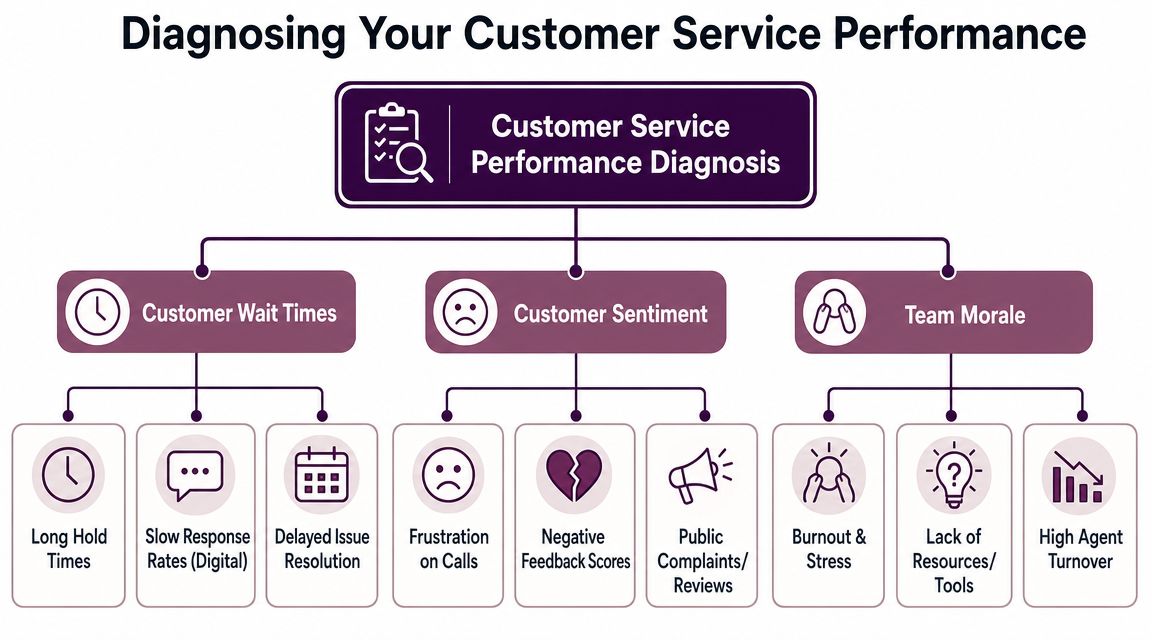
A practical diagnostic starts with three lenses:
- Customer wait and delay patterns. Check hold times, slow chat replies, unresolved cases, and tickets that bounce between teams.
- Customer sentiment signals. Review survey comments, escalations, complaint categories, review themes, and transcripts where frustration shows up early.
- Team strain indicators. Listen for signs that agents are struggling with tools, policy confusion, repeated transfers, or knowledge gaps.
Map friction across the journey
Customer service breaks most often at handoff points. A customer starts in chat, moves to email, then calls. The agent on the phone has no context. The customer restates the problem. Trust drops.
That is why journey mapping still matters in day-to-day operations. You don’t need a giant consulting exercise. You need a practical map of where issues enter, where they stall, and where they get transferred.
Use a simple audit like this:
- Pick the top contact reasons and follow each from first contact to resolution.
- Mark every handoff between channel, team, or system.
- Flag repeat effort such as duplicate verification, repeated account lookups, or asking customers to resend the same documents.
- Review failure points where customers abandon, escalate, or call back.
Practical rule: If a customer has to repeat the issue, the process is broken even if the ticket eventually closes.
The diagnostic also needs call listening and transcript review. Metrics tell you where the friction is. Actual interactions tell you why it happens.
A short example. If customers keep calling about order changes, the issue may not be agent behavior at all. It may be that the website, confirmation email, and IVR menu all describe the process differently. In that case, more coaching won’t fix it. Alignment will.
For teams that need a more disciplined review cadence, this kind of audit works well alongside a structured call center performance monitoring process. The important part is consistency. One-time reviews usually miss the recurring pattern.
Define What ‘Better’ Means with the Right KPIs
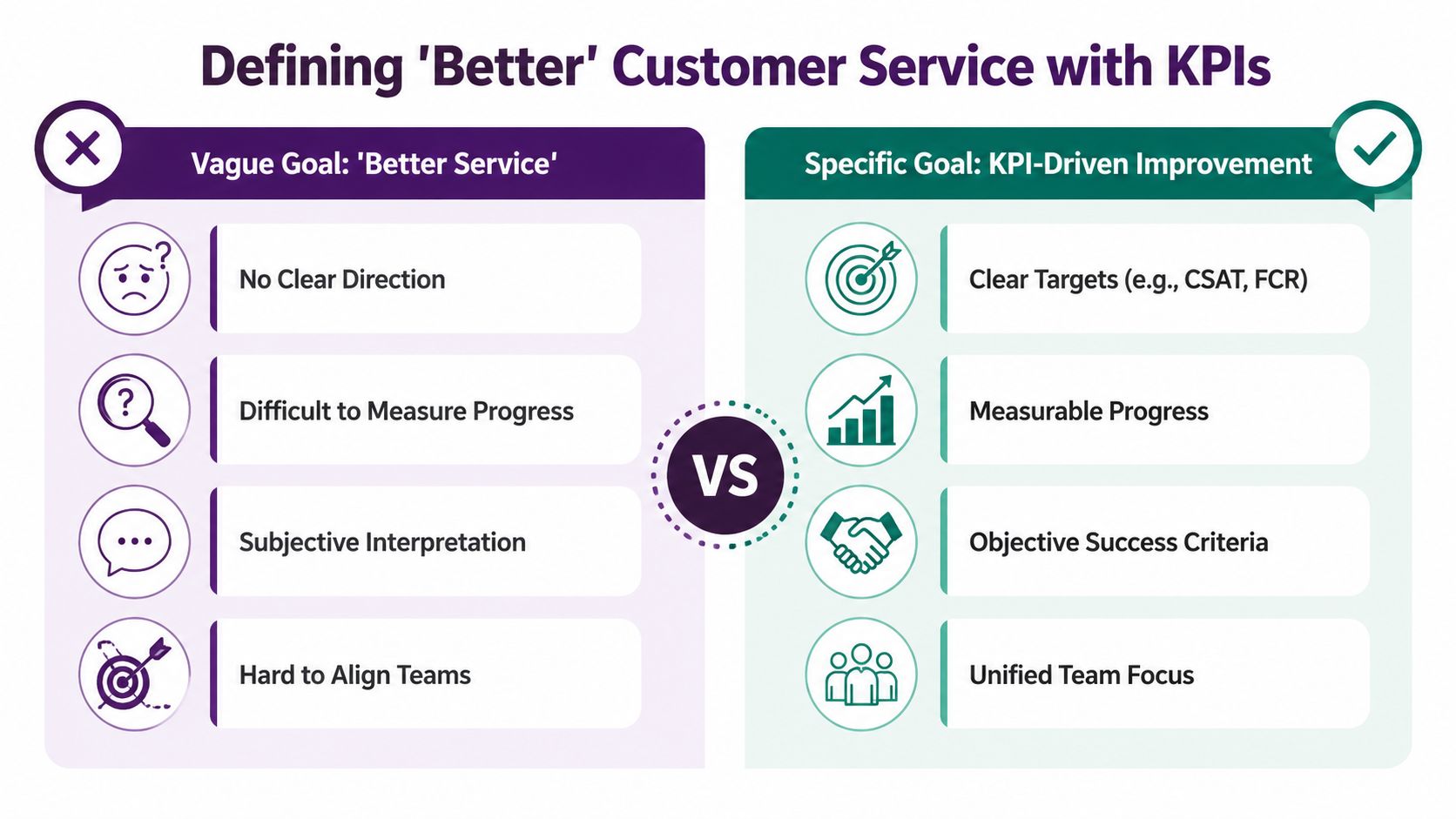
Most service scorecards are crowded with numbers and still fail to guide behavior. The reason is simple. They reward activity more than outcomes.
If your supervisors tell agents to reduce handle time at all costs, agents will rush, interrupt, transfer too early, or avoid fully solving the problem. The metric improves. The experience gets worse.
Stop rewarding speed when the issue needs resolution
Invoca advises prioritizing NPS over AHT because pushing average handle time down can degrade experience quality, in its article on customer service data analysis and KPI choices. The same source notes that 92% of contact centers have a QA program, but they usually sample only 2 to 5% of interactions, which means most conversations are never reviewed.
That combination creates a common failure pattern. Leaders optimize speed using a narrow slice of monitored calls, then assume the operation is under control.
A better scorecard answers four questions:
| Question | Better KPI direction |
|---|---|
| Did the customer get the issue resolved? | Focus on first-contact resolution and QA-confirmed resolution quality |
| Did the experience feel easy? | Track effort signals, repeat contacts, and friction comments |
| Would the customer stay with you or recommend you? | Prioritize NPS and satisfaction measures |
| Are agents following the right behaviors consistently? | Expand QA coverage and tie coaching to recurring defects |
Build a scorecard that changes behavior
Good KPI design has to connect frontline behavior to customer impact. That means each metric needs an operational use, not just a reporting function.
Use this split:
-
Outcome metrics
These reflect what the customer experienced. NPS, satisfaction, ease, repeat contact patterns, and complaint trends belong here. -
Behavior metrics
These show whether agents are doing the right things. Quality monitoring, correct documentation, process adherence, and escalation judgment fit here. -
Capacity metrics
Queue conditions still matter. Volume, backlog, schedule adherence, and response time belong in the model. They just shouldn’t dominate it.
Better service isn’t shorter calls by default. Better service is fewer avoidable follow-ups, cleaner resolution, and less customer effort.
A practical example from BPO operations: if an agent spends extra time clarifying a billing issue and prevents two future contacts, that is operationally better than a short call that creates a callback, a charge dispute, and a complaint. Leaders who only watch AHT miss that completely.
Expand QA beyond spot checks
Most centers still use QA as a compliance sample instead of an improvement engine. That is too narrow for modern support.
When you only review a tiny subset of interactions, you tend to coach individuals while missing broken scripts, weak workflows, and recurring knowledge errors. Broader review coverage gives you a cleaner picture of what customers hear every day.
If you’re rebuilding your measurement model, a focused guide to customer service KPIs that power real results can help you decide which metrics belong on the executive dashboard and which belong in team coaching.
The simplest test is this. If a KPI makes agents work against the customer, remove it or rebalance it.
Build Your Tech and Process Foundation for Success
Customer service quality is built in the workflow before it shows up in the conversation. When systems are disconnected, agents improvise. Customers feel every bit of that friction.
That is why service leaders need to design around continuity. Not channel by channel. End to end.
Omnichannel has to feel like one conversation
Salesforce reports that 78% of consumers expect consistent experiences wherever they engage in its article on customer service trends in financial services. The same source explains that customers want fluid, smooth support and increasingly want self-service options instead of getting pushed into long phone queues.
That expectation applies far beyond financial services. If a customer starts on chat and ends on phone, the experience should feel continuous. Same context. Same account history. Same answer.
In practical terms, that means connecting:
- CRM records so the full interaction history is visible
- IVR and telephony so routing reflects who the customer is and why they’re calling
- Email and chat platforms so digital contacts don’t sit outside the main record
- Knowledge bases so agents and customers use the same source of truth
- Self-service tools so routine tasks can be completed without escalation
A real-world example is simple. If your CRM is connected to your IVR and helpdesk, an agent can see the order number, recent chat transcript, and open case status before saying hello. If those tools are disconnected, the first two minutes of the call are spent rebuilding context.
Process discipline matters as much as software
New tools don’t fix bad workflows. They scale them.
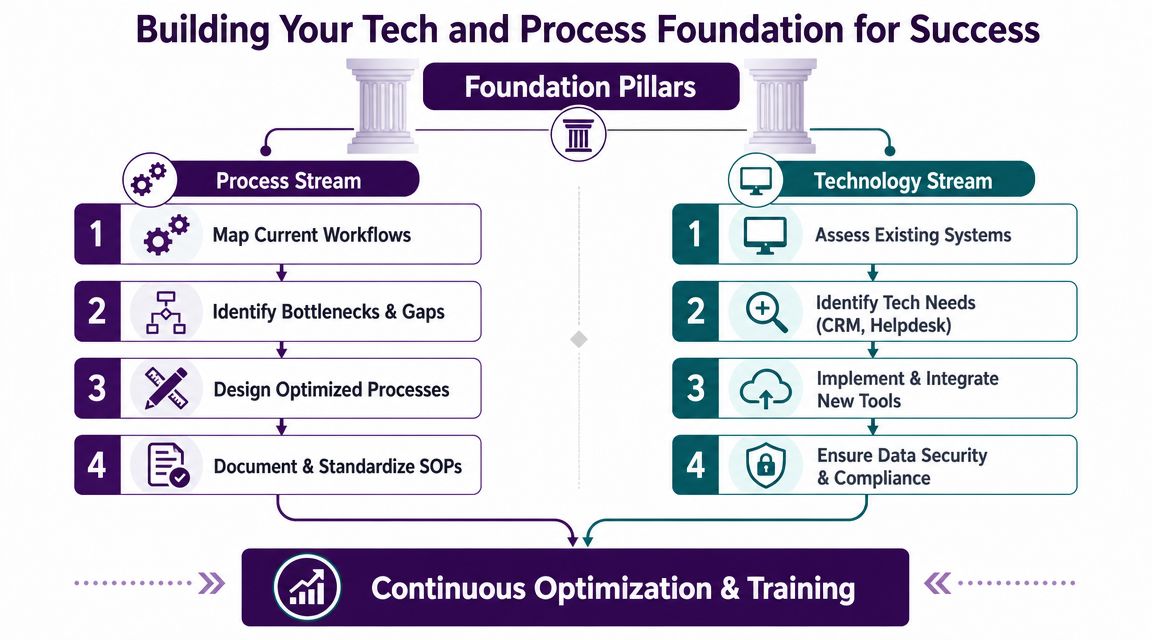
Before buying anything, map the current process and ask where customers and agents lose time. Common trouble spots include duplicate verification, unclear ownership between departments, and exceptions that only a few senior employees know how to handle.
A workable sequence looks like this:
- Map the current workflow from customer entry to final resolution.
- Find the repeat bottlenecks such as approval delays or channel handoff failures.
- Standardize the resolution path for the most common issues.
- Document what good looks like in SOPs, macros, and knowledge articles.
- Train and coach against the process, not just the script.
For teams building a stronger coaching layer around these workflows, a dedicated coaching platform can help managers turn QA observations into repeatable frontline development instead of one-off feedback.
Choose tools that reduce repeated effort
A service stack should make work easier for customers and agents at the same time. If it only helps reporting, it is incomplete.
Here is a practical screen to apply when evaluating tools:
| Capability | What to look for |
|---|---|
| Customer context | Unified history across phone, email, chat, and CRM |
| Agent usability | Fewer screen switches and faster access to answers |
| Process support | Routing, automation, templates, and escalation paths |
| Quality control | Searchable interactions, QA workflows, and coaching support |
| Compliance | Secure access, permissions, and documented handling steps |
If you’re comparing platforms or trying to close functional gaps, it helps to review the core call center software features that support a real omnichannel operation rather than a patchwork of tools.
How to Improve Customer Service with Strategic Staffing
A lot of service leaders spend months refining workflows, then undermine the whole plan with the wrong staffing model.
If your demand curve changes by season, your customers expect English and Spanish support, or your operation needs broader coverage without adding management drag, staffing becomes part of service design. Not just a recruiting task.
Training matters, but staffing shape matters too
Even strong agents struggle when teams are built around fragmentation. One group handles phone. Another handles chat. A separate team handles Spanish. Knowledge drifts. QA standards drift. Customers get uneven answers depending on who picks up.
A better model is centralized support with shared standards, shared QA, and shared knowledge, then flexible specialization where needed. That structure usually produces more consistent outcomes than building isolated micro-teams around every language or channel.
This is also where nearshore staffing becomes practical, not theoretical. For North American businesses, a nearshore team can support time-zone alignment, tighter communication with in-house managers, and easier operational oversight than a far-off model that feels detached from the business day.
Bilingual support is not a nice-to-have
Language access changes the customer experience in a direct way. CSA Research found that 76% of consumers prefer to buy products with information in their own language, and 40% won’t buy at all if content is only offered in another language in its research on language and buying behavior.
That has real implications for support teams in healthcare, telecom, insurance, retail, and e-commerce. If the sale or service issue becomes complicated, language mismatch adds effort fast. Verification gets harder. Explanations take longer. Errors increase.
The operational question isn’t whether bilingual support sounds good. It’s whether your current model can deliver the same quality standard in both languages.
A nearshore bilingual partner can help solve that without forcing you to run separate operations. In practice, that means one QA framework, one reporting structure, one knowledge base, and consistent handoff rules across English and Spanish interactions. CallZent is one example of that model through bilingual customer service team design and nearshore support structure.
Use staffing as a lever, not a patch
Businesses usually outsource too late. They wait until service levels slip, then scramble to add headcount. That turns outsourcing into a rescue move instead of a strategy.
A stronger approach is to decide where internal teams should stay closest to the business and where a partner can execute with more flexibility. Good candidates for nearshore support often include:
- High-volume customer service where schedule coverage and consistency matter
- Bilingual support queues that are hard to staff locally
- After-hours and overflow support when internal teams can’t stretch further
- Back-office tasks that delay frontline resolution if they stay stuck in the queue
Training still matters here. If you’re building internal trainers or supervisor coaches, resources on upskilling UK accounting and data roles are useful because the train-the-trainer model translates well to support operations. The same principle applies. Strong frontline performance depends on repeatable coaching capability, not only onboarding.
The best staffing decision is the one that protects quality while giving you room to scale.
Unlock Better Service by Reducing Agent Effort
A lot of customer service advice still assumes the main problem is agent attitude. Usually it isn’t.
Agents fail when the work is heavier than it needs to be. Too many tabs. Weak search. Duplicated steps. Manual wrap-up work. Poor routing. Knowledge articles that answer half the question.
Easier agent work usually creates better customer work
Zendesk reports that 67% of customer service leaders say AI has increased customer satisfaction, and 68% say it has increased agent satisfaction in its coverage of CX trends and AI impact. That is an important shift in how to think about service improvement.
The value of AI in support isn’t only automation for the customer side. It is support for the agent side. Better answer suggestions. Better next-step guidance. Better triage. Better summaries. Less repetitive admin.
When agent effort drops, several things tend to happen operationally:
- Answers become more consistent because agents can find the right information faster
- Resolution speeds up because fewer steps are manual
- Stress drops because the work is less chaotic
- Customers feel less friction because the interaction sounds more confident and complete
What to fix before asking agents to try harder
If you want a quick operational win, inspect the agent desktop before launching another soft-skills program.
Start with these questions:
- How many systems does an agent touch to resolve one common issue?
- How long does it take to find a trusted answer in the knowledge base?
- Which tasks are repetitive enough to automate or pre-fill?
- Where does routing send customers to the wrong queue and create avoidable transfers?
A simple example. If every billing call requires agents to copy details from one system into another before they can explain the issue, you have built delay into the call. AI-assisted summaries, better integrations, or workflow automation can remove that burden immediately.
Customers hear operational friction in the first minute of a call. So do agents.
Friendliness still matters. But once the basics are in place, the next big gains usually come from making it easier for agents to do accurate work at speed.
Create a Culture of Continuous Improvement
Customer service doesn’t stay fixed. Products change. Policies change. Channels change. Customer expectations change. If your operation only improves when a crisis forces it to, you are always behind.
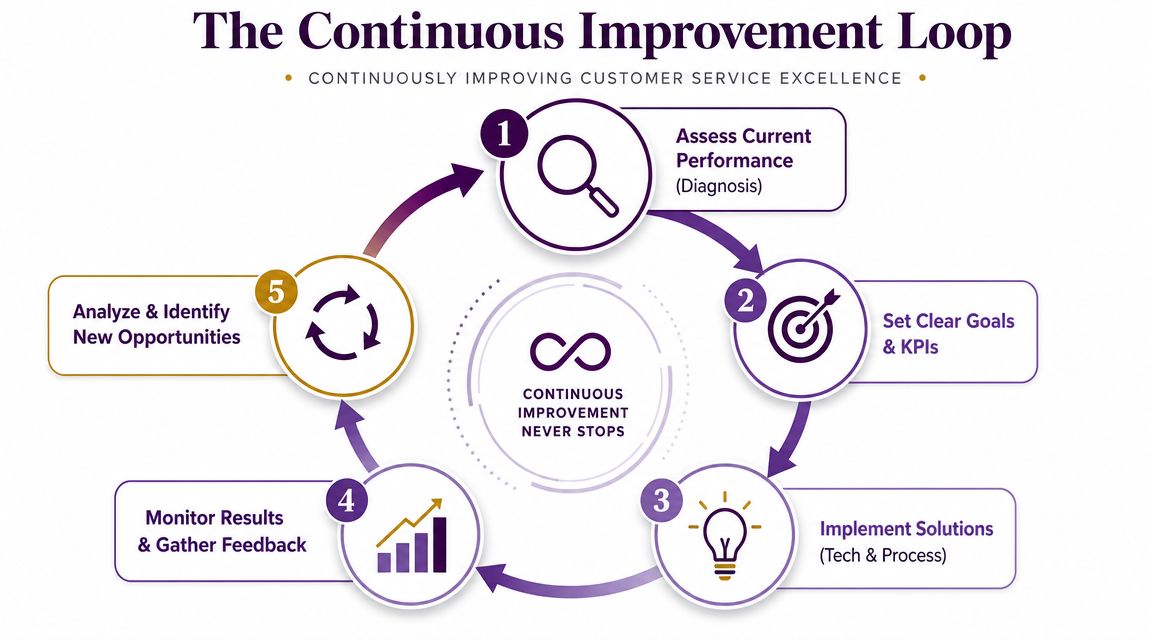
The better model is a standing loop. Measure, inspect, adjust, repeat.
Run a simple operating cadence
Smart Communications found that 85% of customers said communications are very important or somewhat important to the overall customer experience, and 67% are likely to abandon an interaction if the way information is collected is too difficult in its 2024 financial services communication survey. That reinforces a practical rule for service leaders. Improvement work should make interactions more accurate, easier to complete, and more trustworthy.
A working continuous improvement loop can be run every month or quarter:
-
Measure core results
Review the KPI set that reflects customer outcomes and operational quality. -
Inspect the interaction layer
Pull QA findings, complaint themes, and customer feedback into one review. -
Pick a few defects to fix
Don’t launch ten initiatives at once. Choose the friction points creating the most repeat effort. -
Deploy targeted changes
Update workflows, scripts, training, routing logic, or knowledge content. -
Check results and refine
Measure the shift, then decide whether the fix held or needs adjustment.
A practical 90-day pattern
You do not need a giant transformation program to get movement. A focused ninety-day cycle is enough to create discipline.
| Time window | Operational priority |
|---|---|
| First 30 days | Diagnose channels, review complaints, align KPI definitions |
| Days 31 to 60 | Fix top workflow defects, retrain on common failure points, tighten QA calibration |
| Days 61 to 90 | Review outcomes, expand what worked, remove changes that added complexity |
Service teams often overreact to noise. One loud complaint triggers a policy change. One bad week triggers a script rewrite. A formal cadence prevents that.
For leadership teams trying to make these changes stick across departments, a modern playbook for organizational change is useful because customer service improvement usually requires operations, IT, training, and management to move together.
Treat service as a growth system
The companies that get customer service right stop treating it like a cost line to contain. They run it as a signal system for the business.
Customer complaints show where product language is unclear. Repeat questions show where self-service is weak. Transfer patterns show where ownership is fuzzy. QA findings show where process design is failing the frontline.
That is why feedback loops matter. A structured process for collecting and acting on customer feedback for continuous improvement helps turn service from reactive firefighting into operational learning.
If you want to know how improve customer service in a way that lasts, the answer is straightforward. Diagnose thoroughly. Measure the right things. Fix the workflow. Staff for reality. Reduce agent effort. Repeat the cycle until good service is no longer accidental.
🚀 Improve Customer Service With CallZent
CallZent helps North American businesses improve customer service through bilingual nearshore support, omnichannel customer care, and scalable operational workflows built for measurable performance.
Schedule a CallIf you’re reworking your service operation and need bilingual nearshore execution for customer support or back-office workflows, CallZent can be part of the evaluation list. The team supports North American businesses with English and Spanish service coverage, 24/7 support models, and operational collaboration built around measurable service performance.