

CallZent Insights · Ecommerce Customer Support
How to Improve Ecommerce Customer Experience
Reduce checkout friction, strengthen bilingual support, and give shoppers a clearer path from the first question to the next purchase.
TL;DR — Quick Takeaways
- Make product details, total costs, delivery expectations, and return terms easy to find before payment.
- Offer guest checkout, remove nonessential fields, and give every error a useful next step.
- Connect English- and Spanish-speaking agents to accurate order context and clear escalation rules.
- Use self-service for routine tasks, with an easy path to a trained human.
- Track resolution, repeat contacts, payment success, and completed orders alongside response time.
- Match nearshore staffing and coverage to actual customer demand and the agreed service scope.
Baymard Institute’s collected studies place average online cart abandonment at around 70%, so roughly seven of every ten carts are left without a completed purchase (Baymard Institute). The uncomfortable part is that many of those lost orders aren’t caused by a weak product. They’re lost because a payment fails, delivery terms are unclear, a form feels excessive, or a customer can’t get a useful answer in the language they prefer.
Why 70% of Carts Never Become Orders
Cart abandonment can reveal operational friction, although many shoppers are simply browsing or comparing options. Separate those visits from customers blocked by a solvable checkout problem. Baymard reports that 65% of benchmarked sites perform at a mediocre level or worse, while only 2% achieve a good checkout rating (Baymard Institute). Retailers are asking customers to tolerate friction at the point when they have already decided to spend.
Treat CX as a measurable system
A useful improvement program follows the customer journey:
- Discovery: Make navigation, search, mobile browsing, and product information easy to use.
- Evaluation: Answer questions about fit, compatibility, stock, delivery, and returns before commitment.
- Checkout: Remove unnecessary fields, explain charges, support preferred payment methods, and preserve entered data after errors.
- Fulfillment: Set realistic delivery expectations and communicate exceptions before customers ask.
- Returns: Show eligibility, shipping responsibility, and refund steps before purchase.
- Support: Give agents access to order, payment, delivery, and account data, plus authority to resolve issues without unnecessary transfers.
Customer support operates throughout the buying journey. A shopper asking whether an order will arrive before a trip still has purchase intent. A customer with a declined card may also be ready to buy if an agent can identify the payment issue and offer a workable next step.
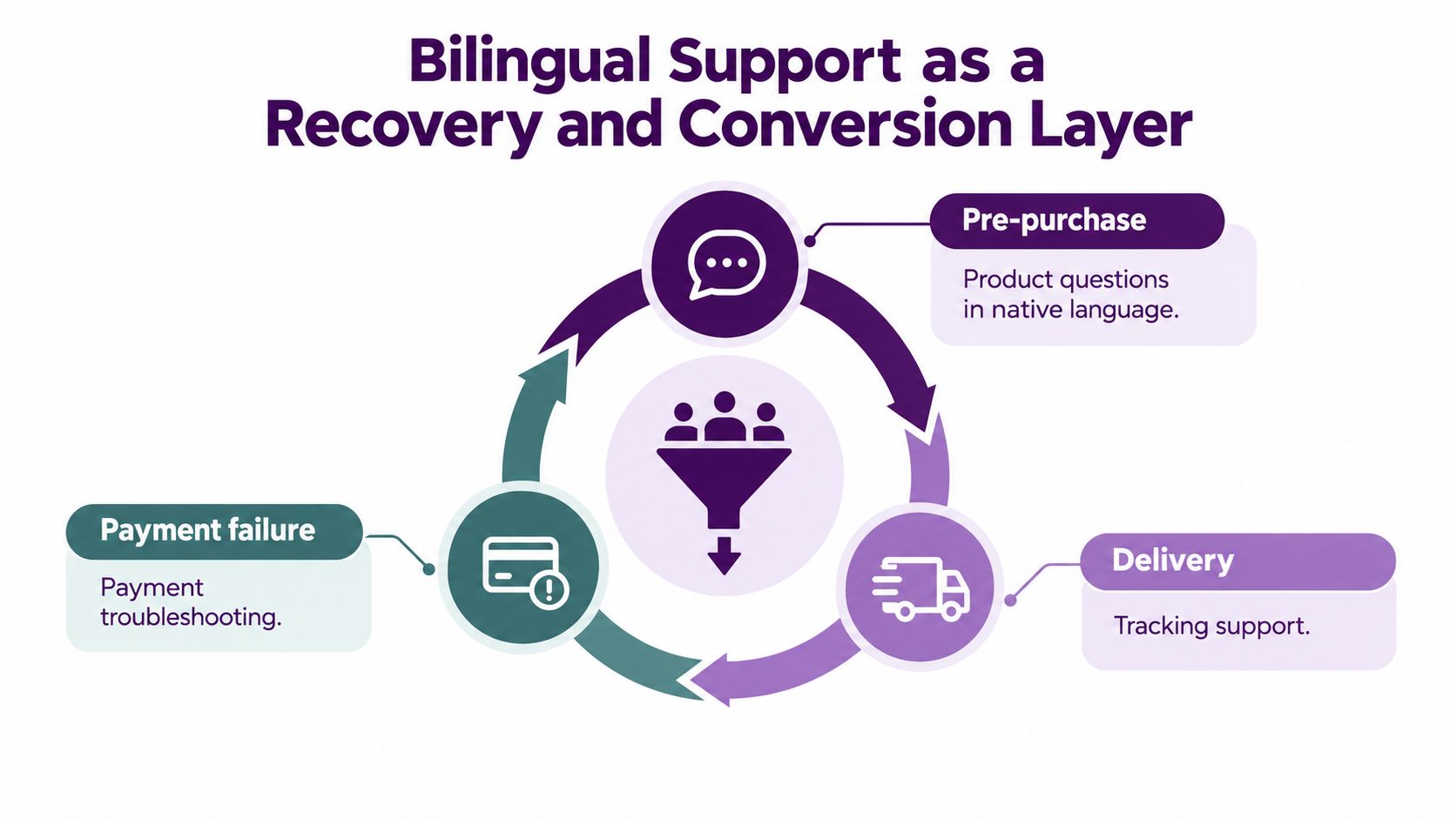
That makes bilingual, 24/7 coverage a recovery and conversion layer, particularly when a nearshore BPO can staff demand across time zones. The operating design matters: agents need reliable order context, clear escalation rules, and permission to resolve common failures. Automation can sort intent and answer repetitive questions, but a fast incorrect answer sends the customer away.
Pre-Purchase Experience From Landing to Add to Cart
A shopper can abandon before seeing a checkout field. Slow mobile pages, weak photography, missing dimensions, and search results that ignore intent all block the add-to-cart decision.
Run a phone-based walkthrough using customer language. Search for a product, apply a practical filter, open a product page, and answer the questions that commonly create support contacts. Check availability, delivery timing, compatibility, sizing, materials, and return conditions without sending the shopper to another tab. This exercise exposes gaps that page analytics alone often miss.

Give shoppers enough evidence to decide
Product pages should answer decision questions in plain language. Include clear images, dimensions, material details, compatibility notes, and care instructions. Place the delivery window and relevant shipping cost close to the purchase control. State whether the item is in stock, backordered, or available for preorder. Link directly to practical return conditions rather than sending customers only to a legal policy page.
Support should be reachable before the cart. Chat, phone, email, or SMS can resolve uncertainty, provided the first contact does not require a long form. For high-intent shoppers, an agent who confirms fit, stock, or delivery can protect a sale that a generic FAQ would lose.
Search quality requires the same operational attention. A shopper seeking a specific size or color should not receive an unfiltered category page. Review zero-result searches, repeated questions, and product-page exits together. They often reveal incomplete attributes, inconsistent naming, or missing compatibility information. Feed those findings back to merchandising and content teams.
Use live chat software for e-commerce to route pre-purchase conversations by product category, language, and urgency. Record the answer, not just the contact. That record shows which product-page gaps repeatedly consume agent time and where bilingual, round-the-clock coverage can recover intent before the shopper leaves. Measure add-to-cart activity, assisted conversions, and the questions that remain unresolved.
Checkout Optimization That Actually Moves the Needle
Checkout redesigns can look polished in a presentation and still lose orders in production. Start with the failure point, not the color palette. Identify whether customers leave after seeing delivery costs, encounter an address error, reject an unexpected fee, or fail payment authorization. Each issue needs a different owner and fix.
Offer guest checkout, remove fields that do not serve a clear fulfillment or service need, and preserve information after validation errors. Invite shoppers to create an account after completing the order. Evaluate field count alongside clarity, accessibility, and payment success.
Instrument the failure, then fix the element
Track the funnel by device, traffic source, country, payment method, error type, and checkout step. Separate a shopper who closes the page after seeing shipping costs from someone whose authorization fails. The first issue belongs to pricing and merchandising. The second may require payment operations, fraud review, or support intervention.
Use a friction-to-action matrix to assign ownership. The priorities below are practical starting points; validate them against your store’s own funnel and support data.
| Abandonment Reason | Operational Owner | Priority Fix |
|---|---|---|
| Extra costs were too high | Pricing & merchandising | Show shipping, taxes, and fees before payment |
| Delivery was too slow | Fulfillment | Publish realistic delivery dates |
| Site lacked credit-card trust | Payments & UX | Explain payment handling accurately and provide clear policies |
| Checkout was too long or complicated | Product & UX | Remove nonessential fields and clarify errors |
| Total cost wasn’t visible early | Pricing & checkout | Display the landed total before payment |
| Preferred payment method was missing | Payment operations | Add market-relevant payment choices |
Use moderated usability tests with a think-aloud protocol. Watch for hesitation, misunderstood errors, and searches for information that should already be visible. Test one change at a time where possible, measuring completed orders and revenue per visitor rather than clicks alone.
Payment recovery belongs inside the checkout operating model. Give agents controlled scripts for explaining charges, troubleshooting declines, and supporting English- and Spanish-speaking customers without making them repeat nonsensitive details already captured in the case. Never collect full card details or security codes through ordinary chat or email; direct customers to the approved payment flow. A failed payment can represent a recoverable sale, but only if the queue is monitored, the handoff is fast, and agents can see the relevant order context.
Order processing teams can also reduce avoidable errors through order processing services, provided the partner follows your inventory, payment, privacy, and escalation rules. Set ownership for each error type, record the resolution, and review recovery rate alongside conversion.
Bilingual Support as a Recovery and Conversion Layer
A payment decline is not automatically a lost order. It is often a customer who still wants the product but lacks a clear, immediate next step.
A typical recovery case starts when a shopper reaches payment, sees a generic decline message, retries, and leaves after the second failure. Where the customer has requested help or approved follow-up, a bilingual agent can respond promptly, confirm that the order remains incomplete, explain approved payment options, and stay available during another attempt. The agent records the issue code and language preference, so follow-up begins with context while retaining any identity verification required for the next action.
Checkout friction creates a queue of recoverable orders. A permission-based payment assistance program can help customers blocked by the interface, while preserving a clear boundary around payment security and customer consent.
Recovery depends on call-center visibility. Agents need controlled access to order status, payment error categories, inventory, shipment data, CRM history, and approved knowledge-base answers. They should not ask customers to repeat information already captured in the case record. The handoff between chat, phone, and back-office teams should carry the transcript, verification status, and next action.
Build recovery around contact type
Route contacts by pre-purchase questions, payment failures, delivery requests, returns, technical issues, and suspected fraud. Each queue requires its own service level, script boundaries, and escalation path.
- Payment failures: Explain safe next steps without exposing sensitive payment data.
- Delivery issues: Confirm the latest carrier status, set a realistic expectation, and escalate exceptions.
- Returns: State eligibility, label responsibility, and refund steps in plain language.
- Product questions: Capture recurring questions and send them to merchandising teams.
- Fraud concerns: Follow verification and privacy procedures instead of improvising.
For North American brands, a nearshore support program in Mexico can provide English- and Spanish-language coverage across the channels included in the agreement. Back-office staff can handle order updates and case documentation while agents focus on live recovery. The arrangement works when the partner is measured on resolution and assisted conversion, not only speed of answer. The guide to how bilingual support improves retention explores the operational point: language, context, and follow-through must work as one service experience. Connect that service plan to a defined order-processing workflow so agents and back-office staff use consistent records and escalation rules.
Fulfillment, Shipping, and Returns That Build Trust
A delivery promise can determine whether a shopper completes checkout. Customers judge a retailer by the stated arrival date, shipping charge, return conditions, and how quickly they can find each detail.
For U.S. online sales, the Federal Trade Commission’s consumer guidance explains that sellers must ship within the time promised in advertising. If no shipping time is promised, the order generally must ship within 30 days after the seller receives the customer’s identifying and payment information or permission to charge the account. Align product copy, checkout estimates, and support scripts with the actual shipping commitment. Shipping and delivery dates are different; if a shipping promise cannot be met, follow the applicable delay-consent and refund process.
Show the policy beside the purchase decision. Customers need clear answers on:
- Delivery date: When will the order ship, and when should it arrive?
- Exceptions: What happens when inventory, weather, or carrier disruption changes the estimate?
- Eligibility: Which products qualify for returns, exchanges, or refunds?
- Return shipping: Who pays for the label?
- Timing: How long does the customer have to start a return, and when should the refund arrive?
- Status: Where can the customer track an order, return, or refund?
The same FTC guidance advises shoppers to verify return eligibility, who pays return shipping, and how many days they have to make the return before buying. Put those details on product and checkout pages, not only in the footer.
Support operations need exception playbooks with decision points. For a delayed shipment, the agent should confirm the latest carrier status, explain the available remedy, and record when the next update is due. For a refund, the script should distinguish between a return still in transit, one received but awaiting approval, and one already released for payment.
The customer service issues in e-commerce process should feed root-cause reporting. Repeated contacts about stale tracking links, missing delivery scans, or failed return labels indicate work for logistics, systems, or product operations. They also reveal recovery opportunities. A trained bilingual agent can explain a delay in the customer’s preferred language, offer the permitted remedy, and protect the relationship when a shipment or payment process fails.
Customers accept exceptions more readily when the retailer explains what happened, states what comes next, and assigns ownership for the follow-up.
When Automation Helps and When It Backfires
Adding a chatbot to a store doesn’t create a customer experience strategy. It creates another queue, and customers quickly notice whether that queue can solve anything.
Use automation for low-risk certainty
Good automation handles requests with clear answers and limited consequences:
- Order status: Retrieve shipment and delivery information from the order system.
- Frequently asked questions: Explain products, delivery areas, and basic policy terms from an approved knowledge base.
- Contact intake: Collect order number, issue category, language preference, and callback details.
- Return initiation: Start a documented process while reserving exceptions for human review.
Provide a clearly available human escalation path for billing disputes, failed deliveries, accessibility needs, complaints, suspected fraud, and emotionally charged cases. The handoff must preserve the transcript, order context, language preference, and customer’s stated problem. Requiring the customer to start over is one of the fastest ways to turn a minor issue into a complaint.
A useful service dashboard tracks successful resolution, transfer friction, repeat contacts, CSAT, time to resolution, and assisted conversion. Chatbot containment can be included, but it can’t be the main success measure. A bot that prevents customers from reaching an agent may improve containment while damaging trust.
Give the customer an exit
Make the human option visible. Tell customers when an agent is available, offer a callback where appropriate, and route English and Spanish conversations to agents who can continue naturally in the chosen language. Automation should shorten the path to an answer, not make the customer prove that the issue is complicated enough to deserve help.
Personalization That Respects Customer Preferences
Personalization works when it reduces effort and respects the customer’s sense of control. It backfires when a retailer appears to know more than the customer expected, uses data without explanation, or presents an automated recommendation as if it were a neutral human judgment.
Personalize with a clear exchange
A customer should understand what the retailer is using and what benefit the customer receives. Recommendations based on recent browsing can be useful. A language preference that follows the customer from chat to email can remove repetition. Neither requires collecting every possible signal.
Use a restrained operating model:
- Explain relevance: Add plain-language copy such as “Recommended based on products you viewed,” where that is accurate.
- Minimize collection: Gather the information needed for the experience instead of collecting data only because a platform allows it.
- Offer control: Let customers change language, communication, personalization, and privacy preferences from a mobile-friendly location.
- Explain automated support: Make clear when customers are interacting with a bot and how to reach an agent.
- Protect sensitive moments: Use stronger human review for payments, disputes, accessibility requests, and complaints.
For bilingual shoppers, English and Spanish experiences must be equivalent in meaning and control. Translating a long privacy notice while leaving the opt-out button difficult to find in one language isn’t equivalent access. Agents should also know how to explain data use without making legal promises they aren’t authorized to make.
Measure Ecommerce CX Beyond Response Speed
The contact center dashboard should join operational and experience data. Track these measures by issue type, channel, device where relevant, and language:
- First-contact resolution: Whether the customer received a complete answer without another contact.
- Time to resolution: How long the issue remained open, not only how quickly an agent answered.
- Repeat-contact rate: Whether a short interaction created more work later.
- CSAT: The customer’s assessment after the interaction.
- Refund cycle time: The time from approved return to completed refund.
- Assisted conversion: The share of eligible supported shoppers who complete an order within a defined attribution window. This records an association; use controlled tests to estimate incremental revenue.
- Cost per resolved contact: The cost of achieving a complete resolution, segmented by issue and language.
Don’t optimize average handle time alone. Agents who end conversations quickly without resolving the issue can increase repeat contacts, escalations, and churn. Quality audits should examine whether the agent identified the root cause, used the correct policy, preserved language preference, and completed the promised follow-up.
A 90-Day Plan to Improve Ecommerce Customer Experience
Days 1 to 30, diagnose. Instrument add-to-cart, checkout initiation, payment authorization, completion, and abandonment. Segment exits by device, country, traffic source, payment method, and error type. Review transcripts and run moderated usability tests to identify the specific moments customers misunderstand.
Days 31 to 60, fix and test. Remove nonessential fields, enable guest checkout, add address autocomplete and inline validation, preserve entered data after errors, and expose delivery, returns, and total cost earlier. Test changes against completed orders and revenue per visitor, while reviewing payment declines separately from usability exits.
Days 61 to 90, operationalize. Add bilingual coverage for priority hours and issue types, establish human escalation rules, connect agents to order and shipment data, and create recovery queues for payment and delivery failures. A nearshore BPO can extend coverage and handle back-office processing when internal teams lack the capacity to monitor these queues continuously.
The strongest CX program doesn’t chase a prettier funnel. It removes the reasons customers need rescue, then makes rescue fast and human when prevention fails.
A CX lead can turn this into a working checklist:
- Can customers see total cost and delivery expectations before payment?
- Can they complete checkout without creating an account?
- Does every payment error have a customer-readable next step?
- Can agents see order, shipment, inventory, and prior-contact context?
- Can customers move from self-service to an English- or Spanish-speaking human without repeating themselves?
- Are return rules, refund timing, and shipping responsibility visible before purchase?
- Are recommendation logic, communication preferences, and privacy controls clear in both languages?
- Does the dashboard measure completed resolutions and assisted revenue, not only response speed?
Improving ecommerce customer experience is a compounding trust strategy. A shorter checkout protects conversion, accurate delivery communication reduces anxiety, a fair return process protects the second purchase, and a capable bilingual agent can recover the moment when technology or logistics falls short. The stores that execute these details consistently won’t need to choose between efficiency and empathy. They’ll assign each task to the system, team, or partner best equipped to complete it.
Frequently Asked Questions
How can I improve ecommerce customer experience?
Start with the points where shoppers lose confidence: incomplete product information, unexpected costs, difficult checkout, unclear delivery promises, and slow support. Fix those issues, connect agents to accurate order data, and measure completed purchases and resolved contacts.
How does bilingual support help ecommerce shoppers?
English and Spanish support can make product, payment, delivery, and return explanations easier to understand. Preserve the preferred language and case context across channels, and verify performance through resolution and satisfaction data.
What should ecommerce agents do when a payment fails?
Explain the approved next step and direct the customer to a secure payment flow. Agents should not collect full card details or security codes through ordinary chat or email, promise authorization, or bypass fraud controls.
Which ecommerce customer experience metrics matter most?
Track checkout completion, payment success, first-contact resolution, repeat contacts, time to resolution, CSAT, refund cycle time, and cost per resolved contact. Define the attribution window for assisted conversions and use tests to estimate incremental impact.
Should ecommerce support be available 24/7?
Base coverage on customer time zones, contact volume, order patterns, and the cost of delayed help. Extended or 24/7 coverage may be appropriate, but staffing levels and escalation availability should be agreed before launch.
How can a nearshore BPO support ecommerce operations?
A nearshore team can support customer conversations and order-related tasks under an agreed scope. Define channels, languages, schedules, system permissions, quality standards, and escalation ownership with the provider.
Bilingual Nearshore Ecommerce Support
Give Every Shopper a Clear Next Step
Build an English- and Spanish-language support program around your products, orders, delivery questions, and return workflows. Talk with CallZent about dedicated nearshore teams in Mexico, coverage needs, and the service goals that matter to your store.