
Inbound and Outbound Operations
Compare operating models, KPIs, compliance controls, AI readiness, industry use cases, and bilingual nearshore delivery before choosing the right call center structure.
TL;DR — Quick Takeaways
- Choose inbound when customers need fast access, reliable resolution, and strong first-contact outcomes.
- Choose outbound for controlled outreach, qualified conversations, renewals, collections, and proactive retention.
- Use a hybrid model when service protection and revenue generation both matter.
- Give inbound and outbound teams separate staffing logic, workflows, QA forms, and scorecards.
- Place consent, suppression, calling-hour, disclosure, and abandoned-call controls inside the outbound workflow.
- Use AI for repeatable work, routing, summaries, and agent assistance; preserve human ownership for ambiguity, emotion, and regulated interactions.
- Nearshore bilingual delivery works best when language capacity is forecast by interval and managers share customer context without combining unlike KPIs.
Your support queue is climbing, sales follow-up is inconsistent, and the same agents are expected to answer urgent customer calls while chasing prospects. That setup doesn’t create flexibility. It creates slow responses, uneven coaching, and unclear accountability.
The right inbound and outbound call center model depends on who starts the conversation, what the agent must accomplish, and which rules govern the interaction. A nearshore bilingual operation can support both, but only when the staffing plan, technology, quality program, and compliance controls are designed separately.
Why Your Business Needs the Right Call Center Model in 2026
A director often inherits the same operational problem: customer questions arrive through voice, chat, and email, while sales representatives are still expected to follow up on leads and renewals. The support queue grows, agents switch between service and sales scripts, and managers can’t tell whether weak results come from staffing, routing, list quality, or coaching.
The answer isn’t another feature inside the contact-center platform. Inbound and outbound call center programs solve different operating problems. Inbound teams absorb demand that customers create. Outbound teams create contact opportunities through planned campaigns. Combining the teams without separating their workflows usually produces mediocre service and unfocused outreach.
The scale of the workforce shows why this is an operating discipline, not a minor administrative function. The U.S. Bureau of Labor Statistics reported approximately 2.7 million customer service representative jobs in 2025, with representatives serving customers by phone, email, text, live chat, social media, and in person. Review the official BLS Occupational Outlook Handbook for current employment and role data. That labor base supports healthcare, financial services, telecommunications, retail, insurance, and e-commerce.
Answer three questions before choosing a provider
-
Who initiates the contact? A customer calling about a failed payment needs access, authentication, diagnosis, and resolution. A representative calling a prospect needs permission, a relevant opening, discovery skill, and a defined next step.
-
What outcome matters? Inbound management focuses on queue access, resolution, customer effort, and quality. Outbound management focuses on contact yield, qualified conversations, conversion, recovery, or renewal.
-
What exposure applies? Inbound programs still require privacy, authentication, recording, and escalation controls. Outbound programs add consent, do-not-call, calling-hour, disclosure, and abandoned-call requirements.
Practical rule: Don’t sign a contract until the provider shows separate staffing logic, QA forms, dashboards, and escalation procedures for inbound and outbound work.
A buyer should also review the broader communication journey, not only the phone channel. Guidance on how to assess and improve communication can help identify where customers lose context between voice, email, chat, and follow-up.
The best model is the one that matches the operating intent. Nearshore delivery from Tijuana can add bilingual capacity, overlapping business hours, and direct collaboration with North American managers, but geography won’t repair a poorly defined workflow. Define the work first, then select the delivery structure.
Inbound vs Outbound Call Centers Defined by Operating Intent
An inbound call center responds to contact initiated by a customer, patient, subscriber, policyholder, or buyer. The caller already has a reason to engage, so the agent’s job is to understand the intent quickly, access the right account or knowledge, and resolve the issue without unnecessary transfers.
Typical inbound work includes:
- Customer service: Answer account questions, complaints, billing requests, and policy inquiries.
- Technical support: Guide troubleshooting, authenticate the user, and escalate cases that require specialist intervention.
- Order assistance: Handle order status, returns, exchanges, delivery questions, and product information.
- Appointment handling: Schedule, reschedule, confirm, or cancel appointments.
- Overflow and after-hours support: Protect accessibility when internal teams face peaks or operate limited hours.
The primary management challenge is variable demand. A customer doesn’t wait for a convenient staffing interval before reporting a failed transaction or service outage. Inbound leaders therefore plan around queues, service level, answer speed, abandonment, occupancy, and resolution quality. A low average handle time isn’t valuable if agents rush customers into repeat calls.
An outbound call center starts the conversation. The business may call a prospect, existing customer, patient, account holder, or former buyer to create an opportunity or complete a planned action. The purpose could be lead qualification, appointment setting, renewals, collections, surveys, win-back, payment reminders, or proactive notifications.
Outbound success depends on a funnel:
Dials → live connections → right-party contacts → qualified conversations → desired outcomes
A large number of dials can conceal weak data, poor caller identification, inconvenient calling windows, or an ineffective opening. Outbound managers need campaign-level visibility rather than a single activity total.
| Dimension | Inbound Call Center | Outbound Call Center |
|---|---|---|
| Contact direction | The customer or user initiates | The business, agent, or approved system initiates |
| Operating intent | Resolve a need that already exists | Create, recover, confirm, or advance an opportunity |
| Common services | Support, technical assistance, billing, orders, appointments, overflow | Lead generation, collections, renewals, surveys, win-back, notifications |
| Primary staffing challenge | Match variable arrival patterns to service demand | Maintain productive campaign capacity and compliant contact pacing |
| Core performance question | Did the customer reach the right resource and get the issue resolved? | Did the campaign reach the right person and produce the intended outcome? |
| Main risk | Long waits, transfers, repeat contacts, inconsistent answers | Invalid consent, suppression failures, poor list quality, excessive contact, abandoned calls |
| QA emphasis | Diagnosis, accuracy, empathy, resolution, documentation | Disclosure, permission, discovery, objection handling, disposition accuracy |
| Best technology fit | Skill routing, CRM context, knowledge assistance, callback queues | Campaign orchestration, consent management, dialer controls, disposition tracking |
A bilingual provider can operate both functions, but the playbooks shouldn’t be identical. The same English-Spanish capability can support a service queue in the morning and a renewal campaign later, provided leaders protect role clarity, campaign permissions, coaching time, and quality standards. Businesses evaluating inbound delivery can review inbound call center services for FCR, CSAT, and loyalty as part of that decision.
The practical distinction is simple: inbound protects the relationship when the customer reaches out, while outbound deliberately creates the next interaction.
KPI Differences That Separate Inbound and Outbound Performance
A single blended dashboard can hide the constraint that is costing the operation money. Inbound and outbound work follow different stages, so managers need separate scorecards, shared controls, and an executive view that connects performance to business outcomes.
Inbound measurement starts with service level, average speed of answer, abandonment rate, average handle time, first-contact resolution, customer satisfaction, and transfer rate. Service level records the percentage of offered calls answered within a defined threshold. A common baseline is 80/20, meaning 80% answered within 20 seconds, as described in call center service-level benchmarks.
Treat 80/20 as a staffing reference, not a complete service judgment. A queue can meet the target while a smaller group waits several minutes. Pair service level with average speed of answer and abandonment rate, then document whether abandoned calls enter the denominator. Without that definition, two providers can report different results from similar call behavior.
Outbound requires a funnel scorecard. Connect rate equals answered calls divided by total dials. Conversion rate measures the share of conversations that produce the defined result. Keep these measures separate. A weak result may come from poor list quality, unreliable caller identification, agent execution, offer positioning, or weak follow-up.
Verified benchmark reporting places cold-outbound connect rates broadly around 3% to 10% in the United States, with one large-dataset estimate near 5%, and describes cold-call success at approximately 2.3% of all attempts in 2025. These figures appear in outbound calling benchmark research. Use them for planning, not forecasting a guaranteed result. List source, market, language, offer, campaign purpose, and contact restrictions will change performance.
Build separate scorecards with one shared control layer
| KPI | Inbound Focus | Outbound Focus |
|---|---|---|
| Service level | Answer the required share of calls within the target threshold | Not a primary campaign measure |
| Average speed of answer | Control queue delay for answered calls | Use for internal campaign staffing, not outreach success |
| Average handle time | Balance efficient resolution with complete diagnosis | Do not use as the main productivity measure |
| First-contact resolution | Resolve the issue without repeat contact or unnecessary transfer | Track only when the campaign includes service resolution |
| Connect rate | Not a primary measure | Compare answered calls with total dials |
| Right-party contact rate | Not a primary measure | Confirm that the intended person was reached |
| Qualified conversation rate | Not a primary measure | Measure conversations that meet campaign criteria |
| Conversion or recovery | Track relevant sales or save opportunities | Measure appointments, payments, renewals, sales, or another defined outcome |
| Customer satisfaction | Assess the service experience | Measure outreach quality when the interaction affects the relationship |
| Compliance defects | Check authentication, privacy, disclosure, and documentation | Check consent, opt-out, calling time, disclosure, suppression, and recording controls |
Average handle time cannot govern both teams in the same way. Pressure an outbound agent to end a productive discovery call quickly, and qualification suffers. Reward an inbound agent for shortening every call, and customers may leave without a resolution.
Set separate operational scorecards, then apply shared quality, compliance, and data-governance controls. Give executives one view of service cost, customer outcomes, campaign outcomes, and operating risk. A broader framework is available in CallZent’s call center KPI guidance.
The KPI should describe the decision the agent is making. Inbound agents decide how to resolve the customer’s need. Outbound agents decide how to advance a conversation responsibly.
AI readiness depends on clean definitions and consistent dispositions. A bilingual nearshore team should report English and Spanish results separately by queue, campaign, hour, channel, and agent group. Those segments give workforce managers usable training and staffing signals, while structured outcomes give AI systems cleaner data for forecasting, quality review, and next-best-action support. A daily average can hide an interval-level shortage in one language, so review performance at the level where managers can still correct it.
Compliance and Legal Obligations Unique to Outbound Calling
Outbound calling carries obligations that inbound service teams usually don’t face in the same combination. The business chooses whom to contact, when to contact them, how often to retry, what the agent says, and whether an automated system is involved. That control creates responsibility.
The Telephone Consumer Protection Act became law in 1991, establishing restrictions involving automated telephone equipment, prerecorded voice messages, unsolicited advertisements, and related calling practices. The law remains a foundation for outbound governance, especially for lead generation, collections, insurance, telecommunications, financial services, and retention campaigns. Review the TCPA statute and related FCC rules.
For calls to U.S. consumers, the FCC explains that non-emergency autodialed or prerecorded calls to wireless phones generally require prior express consent. Advertising calls require written consent, and prerecorded telemarketing calls to home or wireless numbers require prior written consent. The FCC also treats text messages as a type of telephone call under relevant TCPA requirements, so a voice campaign that moves into SMS still needs consent and opt-out governance. See the FCC guidance on unwanted communications.
Operate outbound controls before the first dial
The National Do Not Call framework requires covered sellers and telemarketers to scrub applicable calling lists against the registry at least every 31 days, according to the FTC rule amendment. That process doesn’t replace an internal suppression list. A consumer’s direct request to a company must also be honored.
A responsible campaign workflow should include:
- List freeze: Lock the campaign audience before launch and record the latest registry scrub date.
- Consent record: Store the source, date, phone number, disclosure language, and permitted channel.
- Internal suppression: Prevent future calls and messages after a direct opt-out.
- Time-zone rules: Restrict contact windows based on the recipient’s location.
- Caller transparency: Use accurate identification and train agents to disclose the seller and campaign purpose.
- Script approval: Obtain legal and operational sign-off before agents use a new offer or call topic.
- Audit storage: Retain recordings, dispositions, consent evidence, and suppression events in an accessible system.
The FTC’s Telemarketing Sales Rule adds a specific abandonment standard. A call is abandoned when a person answers, finishes their greeting, and the telemarketer doesn’t connect them with a sales representative within two seconds. The safe harbor requires abandonment of no more than 3% of live-answered calls, measured over a campaign lasting fewer than 30 days or over each successive 30-day period of a longer campaign. It also requires the phone to ring for at least 15 seconds or four rings and a recorded seller-identification message when no agent is available. These thresholds are explained in the FTC Telemarketing Sales Rule compliance guidance.
| Regulation | Core Obligation | Operational Control |
|---|---|---|
| TCPA | Manage consent for covered autodialed, prerecorded, advertising, and wireless calls | Consent database, approved scripts, channel permissions, opt-out handling |
| FCC requirements | Apply written-consent rules to covered advertising and prerecorded telemarketing calls | Store disclosure language and consent evidence before automation |
| National Do Not Call framework | Scrub applicable lists at least every 31 days and honor consumer requests | Registry process, internal suppression, campaign audit trail |
| Telemarketing Sales Rule | Control abandoned-call behavior and provide required identification | Dialer pacing, staffing checks, recorded message, campaign reporting |
| Internal privacy policy | Protect account information and restrict sensitive disclosures | Authentication, role-based access, recording governance, escalation |
| State requirements | Review additional rules that may apply to the consumer, industry, or campaign | Counsel review, state-aware workflows, documented training |
Don’t treat compliance as a legal document stored outside operations. It belongs in the dialer, CRM, QA form, training program, and supervisor dashboard. Teams that also use email outreach should apply the same permission-first discipline and can consult this practical resource on cold email compliance.
A nearshore partner can own the infrastructure, but the brand still needs to approve campaign purpose, audience, offer, and permissions. A provider’s call center compliance services should make evidence easy to retrieve, not merely promise that agents received training.
Where AI Helps and Where a Bilingual Human Team Wins
AI is useful in contact centers, but AI adoption isn’t the same as AI readiness. Research on contact-center maturity reports that 82% of organizations remain in limited pilots or early adoption, while 53% say their data isn’t sufficiently organized or centralized for AI and 67% still rely on manual processes or limited workflow automation, according to the contact-center AI maturity findings.
Those conditions matter more than a vendor demonstration. A conversational system can’t reliably route, summarize, authenticate, or escalate if the CRM contains conflicting customer records, the knowledge base is outdated, or supervisors haven’t defined what happens when confidence falls.
Give automation the predictable work
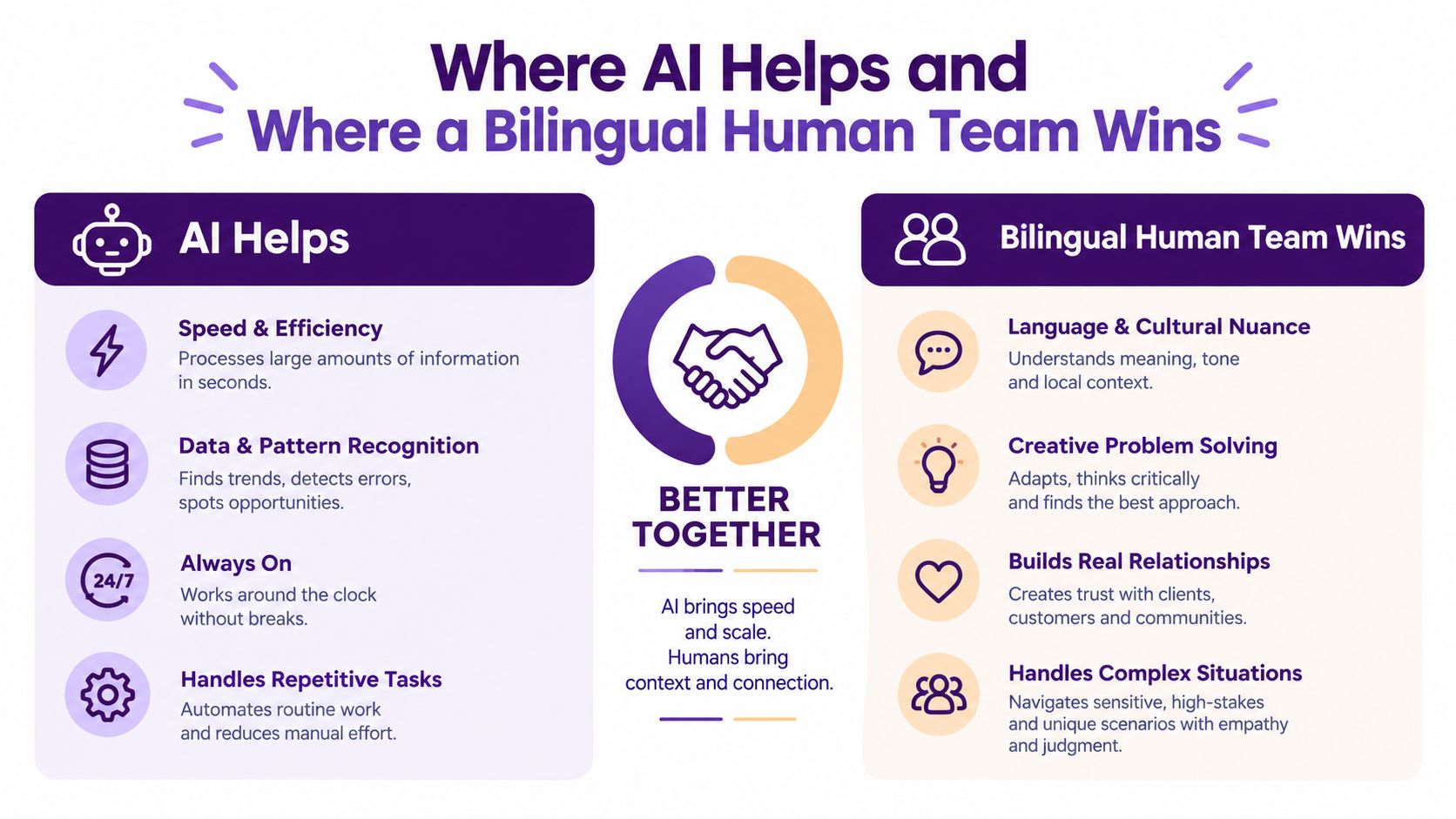
AI can handle structured interactions such as password-reset guidance, order-status lookups, appointment confirmations, eligibility checks, and initial pre-qualification. It can also summarize calls, suggest knowledge articles, classify intent, prepare CRM notes, and route a contact to the right queue.
The handoff must be designed before launch. Define the confidence threshold, escalation reason, transcript transfer, authentication state, and agent responsibility. If the customer has to repeat the entire story after an automated transfer, the system has reduced convenience rather than improved it.
Keep people in conversations with ambiguity and consequence
Human agents should own emotionally charged complaints, complex troubleshooting, regulated disclosures, disputed charges, sensitive healthcare conversations, and interactions where trust determines whether the customer continues. Language switching adds another layer. A bilingual English-Spanish agent can clarify meaning, recognize hesitation, and adapt the explanation when a literal automated response would sound confusing or dismissive.
For hiring and workflow teams exploring automation in talent discovery, AI lead discovery for recruiters offers a useful comparison point. The same principle applies to contact centers: AI can organize and prioritize work, but managers still need a clear definition of a qualified interaction and a human owner for exceptions.
A practical hybrid model looks like this:
- Inbound triage: AI identifies intent and retrieves account context before routing.
- Routine completion: Automation handles low-risk, repeatable transactions with a clear exit path.
- Human resolution: Bilingual agents take complex, emotional, revenue-sensitive, or regulated conversations.
- Outbound preparation: AI can organize records, surface relevant history, and assist with compliant scripting.
- Quality monitoring: Supervisors review outcomes, transfers, complaints, conversion, and compliance defects rather than only automation volume.
Review conversational AI for customer support with one question in mind: which interactions should remain human-led, and how will the system prove that it handed them off correctly?
Use AI to remove repetition, not responsibility. The more a call involves ambiguity, emotion, regulated information, or language nuance, the stronger the case for a bilingual human owner.
Which Model Fits Healthcare, E-Commerce, Finance, and Telecom
Industry context changes the answer. A healthcare provider shouldn’t copy an e-commerce campaign structure, and a telecom operator shouldn’t measure technical support like a collections program. The same organization may need inbound, outbound, and hybrid queues for different customer moments.
| Industry | Inbound Demand | Outbound Demand | Primary Use Cases |
|---|---|---|---|
| Healthcare | High | Targeted | Patient scheduling, insurance verification, nurse triage, multilingual support, reminders, care-gap outreach |
| E-commerce | High and transaction-driven | Targeted growth activity | Order status, returns, product support, win-back, post-purchase reviews, high-value customer development |
| Financial services | High and authentication-heavy | Tightly controlled | Account service, fraud alerts, collections, renewals, retention, consent-based cross-sell |
| Telecom | High during service issues | Consistent revenue and retention activity | Technical support, billing, retention, win-back, upgrades, churn prevention |
Healthcare needs access first
A patient line should usually be inbound-dominant because the customer initiates contact around a real need. The provider must protect authentication, privacy, escalation, and language access. Outbound reminders and care-gap outreach can reduce missed steps, but the program needs approved scripts, reliable consent handling, and escalation for clinical questions.
A bilingual nearshore team can provide scheduled and after-hours coverage, but it shouldn’t answer clinical questions beyond its authority. The operating design must identify exactly when an agent transfers to a licensed or designated professional.
E-commerce benefits from a deliberate blend
An online retailer receives inbound requests about delivery, returns, refunds, product compatibility, and account access. These contacts often reveal friction in the buying journey. Supervisors should feed recurring reasons back to fulfillment, merchandising, and product teams.
Outbound activity can focus on win-back, review requests, post-purchase education, and selected customer-development campaigns. The agent should see order history and campaign purpose before calling. A generic sales script is the wrong tool for a customer whose previous order arrived damaged.
Finance and telecom need discipline on both sides
Financial services rely heavily on inbound support because authentication and account accuracy come first. Outbound collections, fraud notifications, renewals, and cross-sell campaigns need strict permission and disclosure controls. A nearshore team can support the work, but it must follow the client’s authentication policy and escalation boundaries.
Telecom combines both models naturally. Customers call about outages, devices, billing, and connectivity. The company calls about upgrades, retention offers, win-back, and churn prevention. The two functions can share customer context, but they need separate coaching, permissions, and performance goals.
For a broader view of regulated and specialized operating needs, review industry-specific call center solutions. The right decision isn’t based on industry label alone. It depends on whether the interaction is urgent, sensitive, repetitive, revenue-linked, or permission-dependent.
Choosing Between Inbound, Outbound, and a Hybrid Nearshore Partner
Choose the operating model from the work your customers and campaigns require. Nearshore providers in Mexico, Colombia, and Central America can support North American programs with overlapping time zones, same-day escalation, and English-Spanish coverage. Those advantages matter only when staffing, supervision, technology, and compliance controls match the interaction type.
Use this matrix to narrow the decision:
| Business Profile | Primary Need | Language Requirement | Recommended Model | Nearshore Fit |
|---|---|---|---|---|
| Healthcare patient line | Fast, careful access and escalation | English-Spanish, with qualified escalation paths | Inbound-heavy with targeted outbound reminders | Strong for bilingual access and extended coverage |
| SaaS support operation | Resolution, technical diagnosis, retention | English, Spanish, or both by market | Inbound with proactive renewal and adoption outreach | Strong when CRM context and technical training are mature |
| Retail or e-commerce brand | Customer service plus repeat revenue | English-Spanish for North American buyers | Hybrid | Strong for shared customer context and seasonal flexibility |
| Collections program | Right-party contact, payment recovery, compliance | Language matched to the customer base | Outbound-led | Strong only with consent, suppression, and trained agents |
| Insurance broker or carrier | Claims and policy service plus lead follow-up | English-Spanish, with regulated scripting | Inbound-heavy hybrid | Strong when scripts, disclosures, and escalation are controlled |
| Telecom provider | Technical support, retention, and win-back | English-Spanish | Hybrid with distinct queues | Strong for real-time coordination and language coverage |
| Small business testing a new channel | Validate demand before scaling | Based on target market | Focused pilot, then hybrid if evidence supports it | Useful when the partner can provide transparent reporting |
Choose inbound-heavy when service failure is the main risk
Utilities, healthcare lines, SaaS support, and technical service teams should prioritize queue engineering, service-level adherence, knowledge management, and first-contact resolution. Customers call these teams because something is urgent, broken, confusing, or difficult to access. Agents need the authority and training to address the immediate issue, not an outbound sales quota that competes with service quality.
Measure the operation through response time, abandonment, resolution, escalation accuracy, and customer outcomes. Give supervisors access to recurring failure patterns so they can correct training, documentation, and escalation rules.
Choose outbound-led when the funnel is the business case
Collections, lead qualification, appointment setting, renewals, and win-back programs require campaign discipline. A qualified partner should show working dialer controls, clean list management, consent records, suppression handling, call recording, disposition governance, and coaching tied to qualified outcomes.
Separate every stage of the funnel in reporting: dials, live connections, right-party contacts, conversations, and completed outcomes. Cold-outbound connect rates commonly fall within a broad low range, and reported cold-call success remains a small share of total attempts, as detailed in outbound performance reporting. Use that reality to challenge optimistic forecasts, then establish a baseline from your own audience, offer, list quality, and agent performance.
Compliance must sit inside the workflow. The partner should document who approves data sources and scripts, who manages opt-outs, and how exceptions reach the client. Outbound volume without those controls creates operational and legal exposure.
Choose hybrid when customer value depends on continuity
A retailer may need inbound support for delivery and returns, followed by outbound follow-up after a successful purchase. A fintech may require inbound account service alongside permission-based renewal or payment-recovery outreach. A telecom provider may combine technical support with a separate retention campaign.
The hybrid model succeeds when customer context is shared while accountability remains separate. Build distinct queues, scripts, QA forms, and KPIs for service and campaign work. Supervisors should see the full customer journey, but agents do not need to perform every task. Bilingual nearshore delivery can connect the two models by giving North American businesses shared language coverage, overlapping management hours, and a practical path to human review when automation reaches its limit.
Before selecting a delivery partner, request evidence on these points:
- Workflow maturity: Can the team show documented escalation paths, dispositions, and exception handling?
- AI readiness: Are customer records organized, CRM integrations reliable, and human handoffs measurable?
- Language coverage: Can staffing forecasts show English and Spanish capacity by interval rather than only by daily total?
- Compliance ownership: Who scrubs lists, stores consent, honors opt-outs, and approves scripts?
- Quality governance: Are QA forms different for service, sales, collections, and technical support?
- Reporting discipline: Can executives review cost, customer outcomes, campaign outcomes, and risk without combining unlike KPIs?
- Scalability: Can the operation add coverage without weakening training, supervision, or documentation?
- Nearshore collaboration: Can managers work during overlapping hours with the people responsible for daily performance?
AI readiness should be part of the selection decision from the start. A provider needs organized customer data, dependable integrations, clear permission rules, and measurable handoffs before automation can improve the operation. Use AI for routing, agent assistance, summaries, and repetitive interactions. Keep bilingual human agents responsible for sensitive decisions, exceptions, regulated conversations, and cases where tone or judgment affects the outcome.
CallZent provides bilingual nearshore inbound and outbound call center and BPO services from Tijuana, including customer support, technical support, lead generation, collections, appointment scheduling, virtual assistance, and reservation management. Evaluate its fit, like any provider, through language capability, reporting, compliance, technology integration, staffing quality, and the outcomes your program requires.
The best choice is the model that gives each interaction the right owner, metric, and control. Select inbound-heavy delivery for urgent service, outbound-led delivery for measurable campaigns, and hybrid delivery when continuity across both functions affects customer value.
Visit CallZent to discuss a bilingual nearshore program for inbound support, outbound campaigns, or a hybrid operation built around your customer journey. Bring current volumes, language requirements, KPIs, and compliance needs, then ask the team to map them to a practical delivery model.
Bilingual Nearshore Support
Build the Right Inbound, Outbound, or Hybrid Team
CallZent helps U.S. companies design bilingual call center programs from Mexico with the staffing, quality controls, reporting, and workflows each interaction requires.
Talk to a CallZent Expert