

Contact Center Technology & Strategy
Industry-Specific Solutions: A Practical Guide for Contact Centers
Discover how industry-specific solutions improve contact center workflows, compliance, integrations, agent performance, and customer outcomes.
TL;DR — Quick Takeaways
- Industry-specific solutions generate value by incorporating sector workflows, compliance controls, integrations, training requirements, and relevant KPIs into daily operations.
- Generic platforms may work for simple, low-risk customer interactions but often require substantial customization in healthcare, financial services, insurance, telecom, and other complex environments.
- A long feature list does not guarantee better performance. Integration architecture, data quality, agent readiness, and workflow design frequently matter more.
- Contact center benchmarks should reflect the complexity and risk of each industry instead of forcing every queue to meet identical handle-time or resolution targets.
- Before selecting a platform or BPO partner, test exception paths, integration failures, escalation procedures, reporting definitions, and agent decision boundaries.
A counterintuitive shift is reshaping contact centers: the software with the longest feature list often creates less value than a narrower platform built around one industry’s rules. The reason is operational. Healthcare verification, banking authentication, insurance claims, and e-commerce returns don’t follow the same sequence, require the same controls, or justify the same handling time.
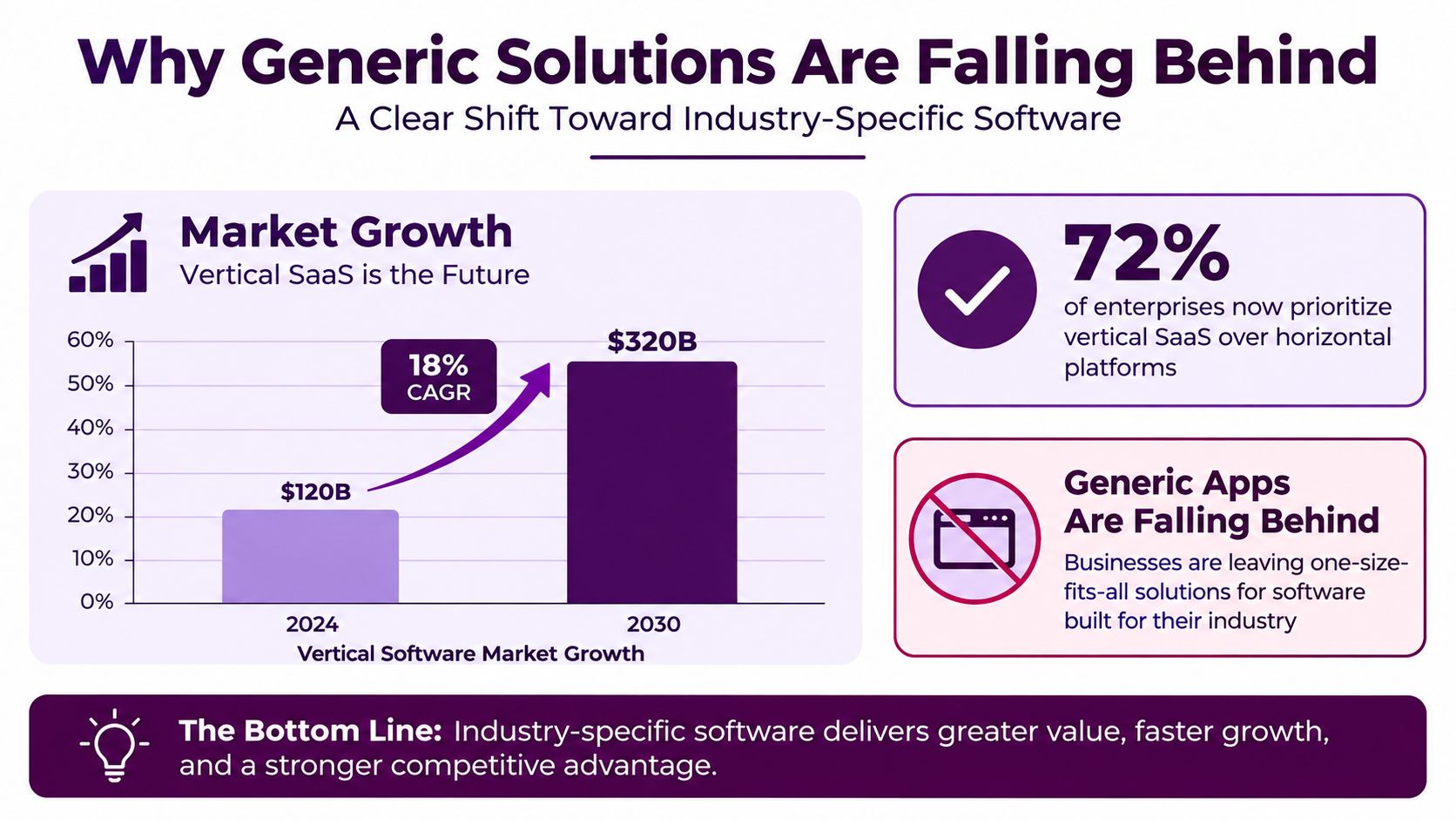
The market reflects that change. Vertical software reached an estimated USD 150.25 billion in 2024 and is projected to reach USD 430.12 billion by 2033, at a 12.5% compound annual growth rate from 2025 to 2033, according to Grand View Research’s vertical software market analysis. For contact center leaders, the important question isn’t whether industry specific solutions sound attractive. It’s whether the deployment architecture can connect them to the systems, people, and performance measures already running the operation.
Why Generic Solutions Are Falling Behind
Generic platforms remain useful for basic customer records, tickets, and communications. Their limits appear when agents must follow regulated scripts, verify identity through defined steps, document each interaction, and move information across specialized systems. At that point, the platform’s flexibility often shifts work onto supervisors, agents, and integration teams.
Market demand reflects that operational pressure. North America held the largest regional revenue share at 30.6%, while large enterprises represented 57.9% of demand, according to Grand View Research. The analysis links adoption to software that supports operational efficiency, regulatory compliance, and customer engagement across healthcare, banking and financial services, retail, and manufacturing.
A separate forecast estimated the vertical-specific software market at USD 293.36 billion in 2024, rising to USD 318.16 billion in 2025 and USD 474.5 billion by 2029. These figures use different market definitions, so they should not be combined into one measurement. They do, however, indicate sustained demand for systems designed around industry workflows rather than broad feature coverage.
Why contact centers feel the pressure first
A generic CRM can record that a customer called. It rarely determines what the agent must verify, which disclosure applies, or when the case requires escalation. A healthcare workflow can guide scheduling, patient verification, authorization questions, and documentation. A financial services workflow can separate authentication, account servicing, fraud escalation, and restricted disclosures.
The difference reaches beyond the agent desktop. It affects quality assurance, staffing, reporting, escalation design, and the handoff between a BPO and the client’s internal teams. If the platform lacks industry logic, agents create workarounds, training takes longer, and supervisors spend more time correcting inconsistent execution. Integration quality matters just as much. A workflow designed for the specific industry that cannot exchange reliable data with the CRM, claims system, scheduling tool, or identity service will not produce the expected return.
Organizations assessing process maturity alongside software selection can consult the Synopsix digital transformation guide. That review should include data ownership, migration effort, agent readiness, and the controls required after launch.
Specialization becomes necessary when an error, missed compliance step, or poor customer handoff carries a high cost. Generic tools still fit straightforward, low-risk work. They lose ground when agents need sector-specific judgment supported by repeatable controls. Businesses comparing service models can review CallZent’s industry expertise to see how vertical requirements translate into contact center delivery.
Core Components of Industry Specific Solutions
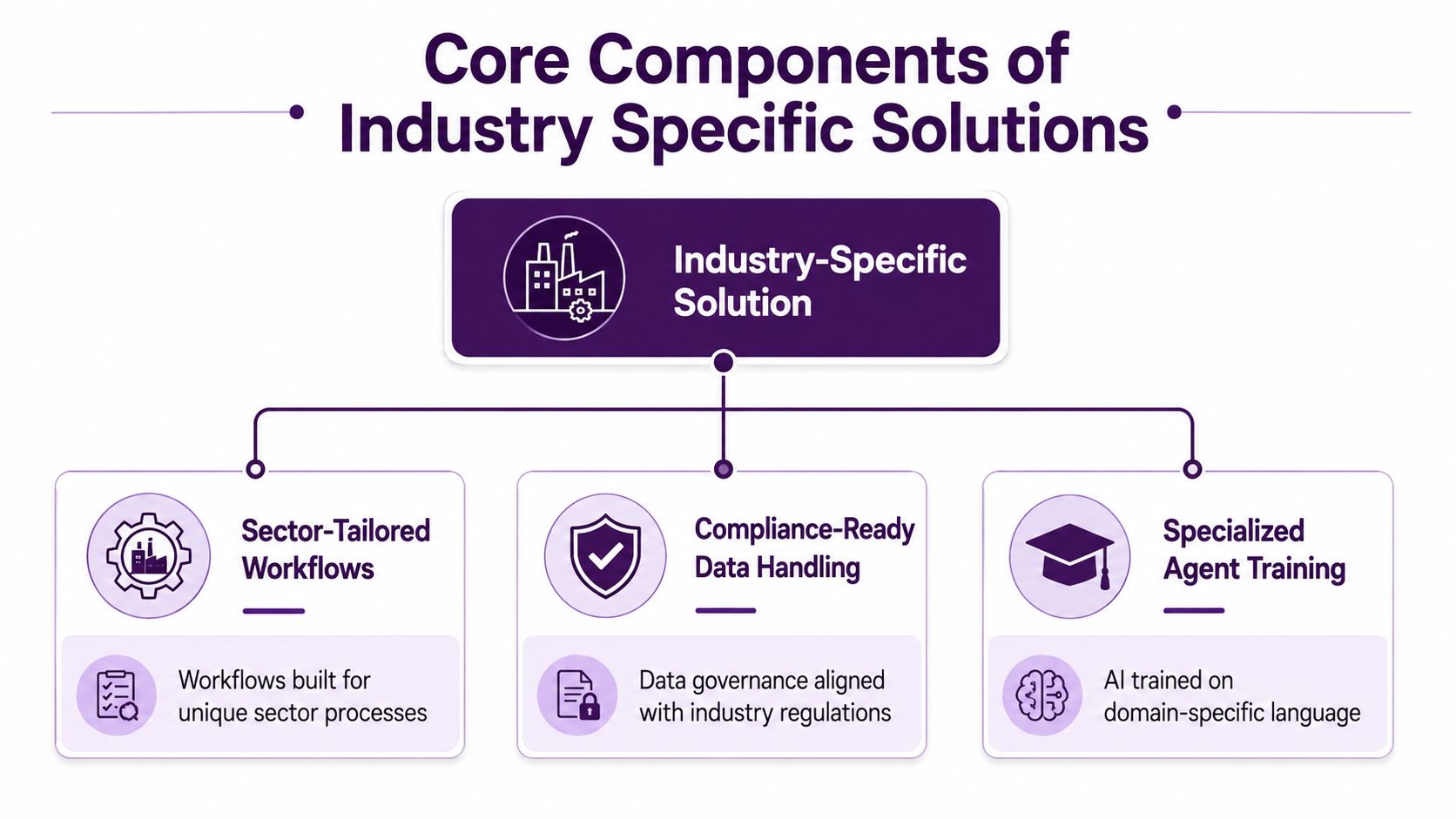
A product isn’t industry-specific because its homepage names a sector. It earns that description when the operating model is built into the workflow, data structure, agent enablement, and reporting layer.
Consider a generic CRM configured for a healthcare provider. It may store a caller’s name, contact details, and case notes. A more credible healthcare solution can guide the agent through patient identification, appointment rules, insurance verification, escalation boundaries, and documentation requirements. The difference is similar to giving a receptionist a blank notebook versus giving that receptionist a controlled intake process designed for a clinic.
What to inspect before accepting the label
-
Sector-specific workflows: Ask the vendor to demonstrate a real interaction from opening greeting through disposition. In finance, the flow should distinguish authentication from account support and fraud escalation. In healthcare, it should show how the agent handles verification, scheduling, and sensitive information without relying on memory.
-
Compliance-ready data handling: Look for role-based access, controlled fields, audit trails, retention rules, and escalation controls. Compliance isn’t a PDF attached to a proposal. It must appear in what agents can see, what they can enter, and what supervisors can review.
-
Specialized agent training: Training should cover terminology, decision boundaries, documentation, empathy expectations, and practice scenarios. A financial services agent needs more than general customer service skills. They need to understand when a request requires verification, escalation, or a restricted response.
The KPI layer matters too
Verticalization should reach reporting. A retail operation may care about speed during order tracking and returns. A healthcare operation may accept longer interactions when verification and documentation protect the patient and the provider. A finance operation may prioritize accurate resolution over rapid closure.
Integration is another test. Ask whether the solution connects with an EHR, core banking platform, policy administration system, order management system, or CRM without forcing agents to duplicate records. If the vendor only shows a polished dashboard, you’re seeing presentation, not necessarily vertical capability.
Practical rule: Ask the vendor to show the exception path, not just the happy path. Industry knowledge becomes visible when the customer record is incomplete, the system rejects a request, or the agent must escalate.
How Performance Benchmarks Vary Across Industries
A contact center target has meaning only within its operating context. Treating every queue as though it should deliver the same first-call resolution or average handle time encourages the wrong behavior. Agents may rush complex work, transfer difficult contacts, or close interactions before the underlying issue is resolved.
APQC’s contact center KPI benchmarks are useful because they frame metrics such as first-call resolution, average handle time, service level, and abandonment against peer groups. Sector-focused benchmarking also recognizes that healthcare and financial services often carry higher resolution expectations than telecom because errors and rework can create greater operational and compliance costs.
| Industry | First-Call Resolution | Average Handle Time | Key Driver |
|---|---|---|---|
| Financial services | About 75% | About 9 minutes | Authentication, risk controls, and account complexity |
| Retail and e-commerce | About 70% | About 5 minutes | Order status, returns, and transaction speed |
| Healthcare | About 80% | Materially longer handling times | Verification, clinical context, compliance, and documentation |
| Telecom | Typically lower resolution expectations than healthcare and financial services | Varies by issue type | Troubleshooting, plan changes, and network dependencies |
The industry examples above come from Nextiva’s contact center benchmark discussion, which also describes a commonly used service-level target around 80/20. That target isn’t a universal standard. A healthcare queue may need time for accurate documentation, while a retail queue may be designed around fast order questions.
Use benchmarks as operating boundaries
A BPO partner should explain why a target fits your workflow. Ask what counts as a resolved contact, which dispositions are excluded, how repeat contacts are tracked, and whether transfers are treated as failures or appropriate escalations.
The right benchmark balances customer effort, quality, compliance, staffing, and cost. For a healthcare provider, an agent who spends longer verifying information may protect the patient experience. For e-commerce, unnecessary handling time can make a simple return expensive. You can use CallZent’s performance benchmarking resource to structure that conversation around your actual queue mix rather than an abstract industry average.
The useful benchmark isn’t the lowest handle time. It’s the target that produces reliable resolution without shifting work into callbacks, complaints, or back-office rework.
Real-World Applications Across Key Industries
Industry specific solutions become easier to evaluate when the use case is concrete. The same contact center can support multiple sectors, but the operating logic changes with the customer’s need and the consequences of an incorrect response.
Healthcare
A healthcare provider may receive calls for appointment reminders, rescheduling, insurance verification, referral questions, and coverage-related follow-up. A customized workflow presents the correct verification sequence, limits what the agent can disclose, and routes clinical questions to an appropriate team.
The practical outcome isn’t just faster answering. It is more consistent execution, fewer avoidable handoffs, and cleaner documentation for the provider’s internal staff. A BPO supporting these processes should demonstrate how it handles patient identity, scheduling rules, escalation, and after-call notes. CallZent’s healthcare provider solutions provide a relevant example of how contact center delivery can be aligned to provider workflows.
Financial services and insurance
Financial services teams commonly manage account support, fraud alerts, payment questions, and identity verification. Insurance operations add claims intake, policy servicing, coverage questions, and documentation. In both cases, agents need decision trees that distinguish routine support from risk-sensitive activity.
A useful deployment connects the agent desktop to the systems that contain account, policy, or claim information. It also records the reason for escalation and gives supervisors a way to review adherence to the workflow. The expected benefit is qualitative but important, fewer improvised responses and a clearer audit trail.
E-commerce and retail
E-commerce customers usually want order tracking, delivery updates, returns, exchanges, refunds, or product information. The solution should connect the agent to order management and inventory data, then make the next action obvious.
Retail loyalty programs add another layer. Agents may need to identify a customer, explain points or rewards, correct an account issue, and protect the relationship without creating unauthorized adjustments. A custom operation separates these paths instead of forcing every request into a generic ticket form.
Telecom, travel, and other service operations
Telecom troubleshooting depends on device details, service status, plan rules, and technical escalation. Plan upgrades require a different flow from outage support. Travel and hospitality teams handle reservations, changes, cancellations, and time-sensitive exceptions, while automotive and consumer lending operations bring their own documentation and approval requirements.
For each vertical, the measurable outcome should be defined before launch. That may mean higher reliable resolution, fewer transfers, better documentation, lower rework, or improved visibility into why customers contact the business. A vendor that promises one universal result without asking about queue design, system access, and escalation rules isn’t evaluating the operation carefully enough.
The Integration Challenge Most Vendors Ignore
The most expensive failure usually happens after the sale. The software works in a demonstration, but agents still switch between the CRM, ERP, legacy database, knowledge base, and industry platform because the integration plan was treated as a technical detail.
Recent research reported that 82% of respondents found integrating AI with core systems harder than the AI technology itself, while KPMG found that 76% of industrial leaders cited unreliable data as a top AI risk, despite 83% believing they had strong AI data foundations. These findings are summarized in Aptean’s research coverage on AI and core-system integration.
Where implementations break
Data silos create conflicting customer records. Incompatible APIs force manual exports or custom middleware. Legacy systems may lack modern interfaces but still contain the information agents need. Unreliable synchronization causes agents to work from outdated account, order, or policy data.
These aren’t minor inconveniences. They increase handle time, create duplicate documentation, and make performance reporting harder to trust. A specialized vertical product can underperform if the surrounding architecture prevents it from receiving complete, current information.
The practical priority is implementation architecture before feature depth. A vendor with fewer visible features but a clear integration model may deliver more value than a feature-rich platform that depends on fragile workarounds.
Questions to ask before signing
- System ownership: Which platform remains the system of record for customer, account, order, policy, or patient data?
- Data movement: What information moves between systems, when does it move, and what happens when synchronization fails?
- API reliability: Are the APIs documented, monitored, versioned, and supported during production incidents?
- Legacy compatibility: Can the workflow read from older systems without creating a parallel record that agents must maintain?
- Security controls: Which roles can view, edit, export, or delete sensitive information?
- Testing approach: Can the vendor test realistic exceptions with masked production-like data before launch?
- Rollback plan: How will the team restore service if an integration change disrupts the queue?
A useful contact center technology stack should support these questions rather than obscure them. The best deployment plans include data mapping, workflow ownership, failure handling, user acceptance testing, training, and a controlled migration path.
Evaluating and Selecting the Right BPO Partner
A BPO partner should prove vertical capability through operating evidence, not industry logos alone. Ask for sample workflows, training materials, quality forms, escalation maps, and reporting definitions that match your customer journeys.
Use a decision matrix with criteria such as:
- Vertical depth: Can the provider explain your regulations, terminology, exceptions, and customer expectations without reading from a sales deck?
- Agent readiness: Does training include role-play, nesting, knowledge checks, quality calibration, and continuing refreshers?
- Compliance controls: Can the provider document access controls, monitoring, data handling, and escalation procedures relevant to your work?
- Technology fit: Will agents work in your systems, the provider’s platform, or an integrated environment? Who owns configuration and support?
- Scalability: Can staffing expand or contract without weakening training, quality, or supervision?
- Location model: Nearshore delivery can offer time-zone alignment, geographic proximity, and bilingual collaboration. Offshore delivery may offer a different cost structure, but buyers should assess communication, travel, oversight, and operational continuity rather than compare hourly rates alone.
Questions that expose weak proposals
Ask the provider to walk through a difficult contact, show how a supervisor reviews it, and explain what happens when the client system is unavailable. Request a sample scorecard that separates compliance, accuracy, empathy, documentation, and resolution.
Red flags include identical scripts for different industries, generic onboarding, vague integration ownership, reporting that measures activity instead of outcomes, and promises of immediate readiness for complex queues. If the provider can’t define what agents may do without approval, the operation isn’t ready for production.
For specialized back-office work, HireAccountants’ accounting outsourcing guide offers a useful reminder that outsourcing decisions should account for process control, expertise, and data handling, not just labor capacity. Apply the same discipline to customer support.
A practical vendor evaluation framework helps turn these questions into comparable evidence. Choose the partner that can explain the full operating model, including implementation, governance, staffing, quality, and continuous improvement.
How CallZent Delivers Industry-Specific Nearshore Solutions
CallZent operates a bilingual nearshore call center and BPO in Tijuana, serving North American clients in English and Spanish. Proximity and aligned time zones can simplify launch coordination, escalations, and performance reviews, but they do not replace disciplined implementation. Clients still need clear ownership for systems, training, staffing, and quality control.
The operation supports 24/7 inbound and outbound services across customer service, technical support, lead generation, debt collection, virtual assistance, and reservation management. Delivery can be configured for healthcare, financial services, e-commerce, telecom, insurance, retail, and other sectors where scripts, permissions, workflows, and reporting must follow industry requirements. The practical test is whether those configurations work in production, not whether they appear in a proposal.
Cost belongs in a fully loaded operating model. One estimate places Mexico’s fully loaded call center seat cost at roughly $12 to $20 per hour, with the majority near $15, while estimated agent take-home pay ranges from $3.00 to $6.00 per hour, according to RethinkCX’s Mexico BPO cost index. A separate 2026 wage index reports a median loaded monthly cost of $2,950 in Mexico, compared with $2,750 in Colombia and $6,500 in the U.S. onshore market, as reported by CallForce’s nearshore wage index. These figures provide planning context, not a final business case.
CallZent involves clients in strategy development and performance tracking, with a culture focused on agent support and operational consistency. Before selecting a package, the discovery process should map workflows, integrations, staffing assumptions, escalation rules, and KPIs. That evidence shows whether the proposed service can deliver measurable improvement after launch.
Build a Contact Center Around Your Industry
CallZent can help you design a bilingual nearshore operation aligned with your workflows, customers, systems, compliance requirements, and performance goals.
Talk to an Expert