

OUTSOURCING & BPO STRATEGY
Labor Arbitrage Meaning in 2026 for Outsourcing and BPO
Learn labor arbitrage meaning, hidden outsourcing costs, and why nearshore BPO often delivers better value than offshore for North American businesses.
TL;DR — Quick Takeaways
- Labor arbitrage means moving work to lower-cost labor markets to reduce operational expenses.
- Nearshore outsourcing often creates better collaboration and customer experience than offshore models.
- The cheapest labor is not always the most cost-effective operational decision.
- Successful BPO partnerships depend on communication, QA, training, and process alignment.
Most companies ask the wrong question about outsourcing.
They ask, “Where can we find the cheapest labor?” The better question is, “Where can we get reliable talent, strong customer experience, and workable economics without creating new operational headaches?” That gap in thinking is where the real labor arbitrage meaning starts to matter.
Labor arbitrage sounds like an academic term, but in practice it’s a very simple business move. A company shifts work to a market where wages are lower than at home. That can apply to customer support, technical support, bookkeeping, claims processing, lead generation, or back-office admin. The logic is obvious. If labor costs less somewhere else, margins should improve.
Sometimes they do. Sometimes they don’t.
The difference usually comes down to whether a business evaluates hourly wage alone or the full operating reality behind it.
Are You Overpaying for Talent and Stifling Your Growth?
If your labor costs are climbing and your team is stretched, you’re probably already thinking about outsourcing, even if you haven’t labeled it that way.
Labor arbitrage means using wage differences between markets to get work done at a lower labor cost. The simplest analogy is manufacturing. If two facilities can assemble the same product, but one can do it with lower labor expense, a buyer will naturally compare both options. The same thing happens in service work. A business can staff customer support, finance ops, or admin workflows in another market instead of building every role domestically.
That sounds straightforward. It rarely stays that way for long.
A practical operator doesn’t just ask whether labor is cheaper. They ask whether the work will be managed well, whether customers will notice the difference, and whether the delivery model fits the business. The same thinking applies outside call centers too. For finance-heavy teams, firms exploring outsourced bookkeeping or controller support often look at specialist staffing options like Hire Accountants because labor arbitrage only works when the talent model matches the process complexity.
The cheapest team on paper can become the most expensive team to manage.
That’s why smart outsourcing decisions start with business fit, not wage tables.
The important part is this. Labor arbitrage is not just about lower wages. It only works when communication, oversight, training, quality control, and customer experience stay strong.
For North American businesses, nearshore often creates a better operating balance because teams can work in overlapping hours, collaborate faster, and reduce friction that slows offshore delivery. If you want a broader primer on how outsourcing fits into business operations, this overview of business process outsourcing is a useful starting point.
Bottom line: labor arbitrage can reduce costs, but the best decision usually comes from total value, not the lowest rate.
The Real Meaning of Labor Arbitrage Beyond a Definition
Labor arbitrage is often defined too narrowly. The textbook version says a company shifts work to a lower-cost labor market. True, but incomplete.
In practice, labor arbitrage is a decision about where work should live, how it should be managed, and what trade-offs the business is willing to accept. That makes it an operating model question, not just a procurement question.

The simple version most leaders start with
A retailer in the U.S. needs a larger customer support team. Hiring locally may strain payroll. So leadership looks at other markets where English-speaking agents or bilingual agents are available at lower wages. That is labor arbitrage in action.
The same pattern applies to:
- Customer service teams handling tickets, chats, and phone calls
- Back-office operations such as order processing and data entry
- Finance support like AP, AR, and reconciliations
- Technical support desks for troubleshooting and escalation routing
On the surface, it looks like a direct wage comparison. If the role costs less elsewhere, move it.
The real version operators deal with
The problem starts when buyers treat wages as the whole equation.
Labor cost differences can range from 20-70%, and some developing countries may offer labor at 70-80% below developed nation wages, but that headline number can mislead buyers. In U.S. manufacturing, variable labor costs often represent only 5-15% of total product costs, and a 20% labor arbitrage advantage can translate to just 1-3% overall profitability improvement. When total landed costs are included, about 25% of labor arbitrage decisions result in negative EBITDA impact according to the global labor arbitrage reference summary.
That’s the part many first-time buyers miss.
Practical rule: If you can’t explain your management overhead, QA burden, rework risk, and communication friction before signing, you don’t know your real outsourcing cost yet.
What total landed cost actually means
A lower hourly rate can be offset by problems like:
- Quality control gaps that force rework
- Management overhead from constant supervision
- Communication delays across time zones
- Process drift when documentation isn’t strong
- Customer dissatisfaction when conversations feel misaligned
A call center example makes this clear. A business may save on agent wages, but if supervisors spend extra hours correcting tickets, retraining teams, or handling escalations that should never have happened, the savings shrink fast.
That’s why labor arbitrage meaning, in real business terms, is not “hire cheaper people somewhere else.” It’s “relocate work only when the full delivery model improves the business.”
How Labor Arbitrage Powers the BPO Industry
The BPO industry is one of the clearest real-world expressions of labor arbitrage. Companies don’t just move jobs randomly. They outsource specific functions that can be standardized, measured, and managed through service delivery systems.
That’s why BPO became the vehicle for turning wage differences into operating strategy.
Where businesses use it most
Common outsourced functions include:
- Inbound customer support for order questions, account help, and service issues
- Outbound sales and lead generation for pipeline development
- Technical support for troubleshooting and tiered escalations
- Back-office processing such as claims intake, document review, and data handling
- Collections and payment support where process discipline matters
- Virtual assistance for admin-heavy workflows
A healthcare group might outsource appointment scheduling and patient follow-up. An e-commerce brand might outsource order support, returns, and live chat. An insurance firm might outsource intake and policy servicing workflows. The theory is the same in each case. Move repeatable work to a lower-cost talent market with a delivery partner that can run it well.
For a broader look at how business leaders evaluate these operating models, this guide to call centers and BPO for business leaders lays out the main functions clearly.
It’s no longer only about cheap labor
Historically, labor arbitrage was a basic cost-reduction play. Today, it has evolved into a more advanced strategy that also considers access to specialized talent, time zone alignment, and technology infrastructure, shifting attention from pure cost cutting to value creation, as outlined in this discussion of how labor arbitrage has evolved.
That change matters.
A company might choose a BPO partner because it needs:
- Bilingual English and Spanish support
- Coverage during North American business hours
- Faster collaboration with internal operations teams
- Better access to talent in a specific workflow
- Reliable systems for QA, training, and reporting
What works and what tends to fail
Strong BPO relationships usually share a few traits:
- Clear process ownership: The client knows what should be outsourced and what should stay in-house.
- Defined service levels: Everyone knows what “good” looks like.
- Frequent calibration: Managers review calls, tickets, and outcomes often.
- Training discipline: Product knowledge and customer standards are taught continuously.
Poor BPO outcomes usually come from the opposite pattern. The buyer outsources a messy process, expects the vendor to fix it by default, and focuses only on the rate card.
A BPO partner can improve execution. It can’t rescue a broken operating model by itself.
That’s the practical meaning of labor arbitrage inside outsourcing. The labor market difference creates the opportunity. Process design determines whether that opportunity becomes value.
Offshore vs Nearshore A Strategic Comparison
The most common mistake in outsourcing strategy is treating offshore and nearshore as if they’re interchangeable.
They’re not.
Both use labor arbitrage. Both can lower cost compared with building the same team domestically. But they produce very different day-to-day operating realities, especially for North American businesses that depend on fast communication, brand consistency, and real-time issue resolution.
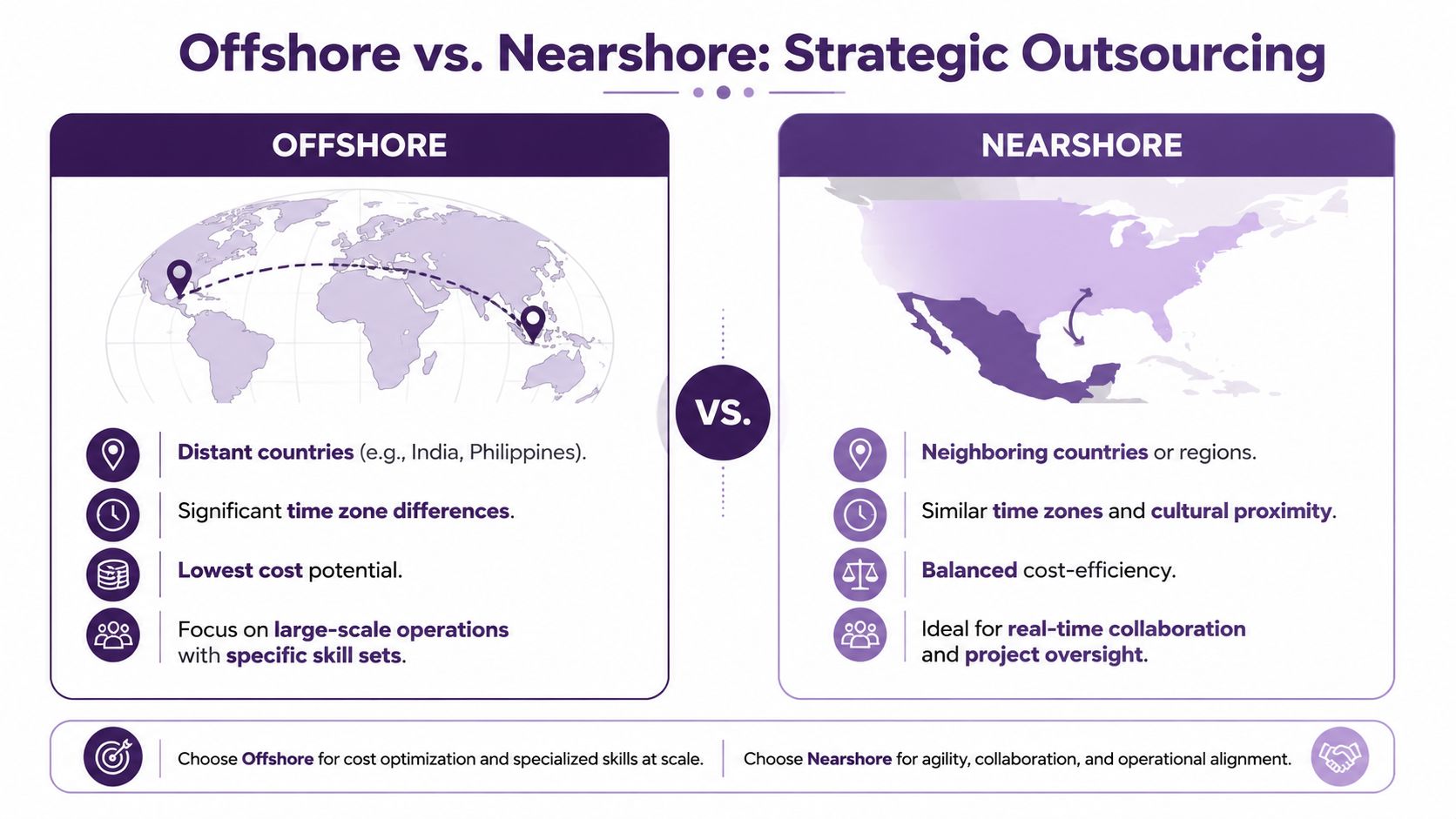
What offshore usually means
Offshore outsourcing typically places work in distant markets such as India or the Philippines. The attraction is obvious. Buyers often pursue offshore models for the lowest apparent labor cost and for access to large labor pools.
That model can work well when the business has mature processes, detailed SOPs, tolerance for asynchronous communication, and internal leaders who know how to manage distributed operations.
It becomes harder when the work depends on fast feedback loops.
A support manager in California who needs same-day changes to scripts, QA standards, or escalation rules may struggle if the vendor team works on the other side of the world. The work still gets done, but response cycles often slow down.
What nearshore usually means
Nearshore outsourcing places work in a nearby market, often one that shares similar time zones and closer cultural context with the client’s home market. For North American companies, Mexico is one of the clearest examples.
The cost may not always be the absolute lowest available globally. But the operating model is usually easier to manage. Leaders can meet during shared business hours, collaborate in real time, and visit sites without international travel complexity.
That difference matters most when customer experience is part of the equation.
Side-by-side decision criteria
| Model | Best fit | Common strength | Common friction |
|---|---|---|---|
| Offshore | High-volume, process-stable work | Lower headline labor cost | Time zone gaps, slower collaboration |
| Nearshore | Customer-facing, fast-moving operations | Better alignment with North American teams | May not be the lowest quoted rate |
Where nearshore gains strategic value
Nearshore is often stronger when the work requires:
- Real-time collaboration between client managers and outsourced teams
- Faster issue resolution during North American business hours
- Bilingual support for English and Spanish-speaking customers
- Closer cultural alignment in tone, service expectations, and communication style
- Easier oversight through simpler travel and tighter working relationships
This is especially relevant in sectors like healthcare, financial services, retail, telecom, and e-commerce, where service quality and compliance discipline matter just as much as labor cost.
For example, a medical practice group evaluating support models may compare offshore staffing with process tools that reduce documentation burden directly. Teams exploring modern solutions for physician charting burnout are often solving the same underlying problem from a different angle. They’re not only cutting cost. They’re trying to protect workflow quality while reducing operational strain.
Why offshore can look cheaper than it really is
Buyers can find themselves trapped. Offshore quotes can look excellent in procurement spreadsheets. But if team leads lose hours every week to delayed communication, retraining, or avoidable escalations, the spreadsheet stops reflecting reality.
A practical comparison includes:
- Meeting availability
- Ramp-up speed
- Supervisor burden
- Training revisions
- Escalation handling
- Customer experience consistency
For North American operators, those factors often shift the decision toward nearshore because the value equation is more balanced. Cost still matters. It just isn’t isolated from execution.
If you want a more detailed framework for evaluating these trade-offs, this comparison of nearshore vs offshore outsourcing costs, risks, and ROI is worth reviewing.
Nearshore often wins not because it is the cheapest model, but because it reduces the friction that erodes outsourced value.
Benefits vs Hidden Risks Weighing Your Options
Labor arbitrage can absolutely help a business grow. It can lower labor expense, expand capacity, and let internal teams focus on higher-value work. But it also creates exposure if leadership treats outsourcing like a pricing exercise instead of an operating decision.
That’s where many initiatives go sideways.

The upside when the model is right
A well-structured outsourcing strategy can deliver meaningful advantages.
- Cost flexibility: Businesses can often staff core support functions more efficiently than hiring every role domestically.
- Scalability: Teams can add seats faster during seasonal peaks, launches, or rapid growth periods.
- Talent access: Companies can hire for language coverage, specialized support roles, or hard-to-fill process positions.
- Operational focus: Internal leaders can spend less time on transactional work and more time on product, sales, or customer strategy.
An e-commerce company is a good example. During peak order periods, support volume rises fast. An outsourced team can absorb chat and email volume while the in-house team handles escalations, VIP cases, and process improvement.
The hidden risks buyers tend to underestimate
The biggest risks rarely appear in the first proposal.
- Management drag: Your internal team may spend more time supervising than expected.
- Communication breakdowns: Language nuance, tone, and timing affect customer interactions more than many buyers assume.
- Quality inconsistency: Even trained agents struggle if the process design is weak.
- Compliance exposure: Data handling, access controls, and customer privacy requirements add complexity.
- Brand damage: A bad outsourced interaction doesn’t feel outsourced to the customer. It feels like your company failed.
Reputational risk is one of the least measured costs in labor arbitrage. Companies that hire purely on cost grounds can run into supply chain controversy or labor-practice backlash that outweighs short-term savings, which is a growing concern in North American markets according to this overview of labor arbitrage risks and strategic concerns.
Focusing solely on the hourly rate is the most common mistake in labor arbitrage; the true cost is measured in customer satisfaction, efficiency, and brand integrity.
Risk control is operational, not theoretical
The strongest outsourcing programs use controls like:
- Structured QA reviews with weekly calibration
- Tight access policies for customer and account data
- Documented escalation paths so agents know when to hand off
- Regular retraining after product or policy changes
- Clear privacy standards for regulated workflows
If your business handles sensitive customer information, privacy practice becomes part of the labor arbitrage decision, not a separate checkbox. This overview of best practices for protecting customer privacy in BPO is a good reference point for evaluating that side of the model.
Cheap labor is easy to buy. Stable service quality is harder. That’s why governance matters more than the initial quote.
Your Checklist for Choosing the Right BPO Partner
A good partner evaluation process should make weak vendors uncomfortable.
If every provider sounds the same in the sales conversation, your questions probably aren’t sharp enough yet. The right checklist forces specifics on communication, training, oversight, performance management, and business fit.
BPO Partner Evaluation Checklist
| Evaluation Criteria | What to Ask/Verify |
|---|---|
| Time zone overlap | How many working hours overlap with our core operating day? |
| Communication quality | How do you assess spoken and written English, and if needed, Spanish? |
| Cultural fit | How do you train agents to match our brand tone and customer expectations? |
| Leadership access | Who manages the account day to day, and how often do we meet with them? |
| Training process | What does onboarding look like for new agents on our account? |
| QA discipline | How are calls, chats, or tickets reviewed and scored? |
| Scalability | How quickly can you ramp if our volume rises unexpectedly? |
| Data security | What controls protect customer information and access to systems? |
| Retention strategy | How do you reduce turnover and maintain program continuity? |
| Site visibility | Can we visit the operation, observe training, and meet the team? |
Questions that reveal the real partner
Some questions matter more than others.
- Ask about overlap, not just availability: A vendor may offer coverage, but that’s different from real collaboration during your business day.
- Ask how training changes after launch: Good partners don’t stop at onboarding. They update scripts, workflows, and coaching as your business changes.
- Ask who owns performance correction: If quality slips, someone needs authority to fix it quickly.
- Ask for examples of escalation handling: Not polished pitch language. Actual process.
A nearshore provider often performs well on these points because oversight is easier, communication cycles are shorter, and travel is simpler. Those aren’t abstract benefits. They affect how fast problems get solved.
What to verify before signing
Before you move forward, confirm these details in writing:
- Service scope: Which tasks are included and which are excluded
- Reporting cadence: Daily, weekly, and monthly performance visibility
- Training responsibilities: What the partner owns versus what you provide
- Security expectations: Access rules, authentication controls, and data handling
- Exit flexibility: What happens if the partnership needs to change
If you’re comparing vendors, this guide on how to find and vet the best call center outsourcing companies gives a useful framework for separating polished sales decks from strong operating partners.
A capable BPO partner should feel easy to work with before launch, not only after the contract is signed.
The Future of Outsourcing Is Smart Partnership
In 2026, the meaning of labor arbitrage has less to do with chasing the lowest wage and more to do with building a delivery model that holds up under pressure.
That’s the shift many companies are making now. They’re moving away from cost-only outsourcing decisions and toward partner models built around execution, responsiveness, and business fit. Some are also reviewing vendor relationships more closely as part of broader spend control efforts. If procurement teams are tightening software and service costs across the board, resources on reducing Zendesk spend creep reflect the same broader discipline. Cut waste, but protect the systems that keep operations stable.
For North American companies, nearshore often fits that direction better than traditional offshore. It supports cost efficiency, but it also supports faster collaboration, stronger oversight, and a better customer experience.
That’s where outsourcing decisions create long-term value. Not in the lowest rate. In the strongest operating partnership.
🚀 Build a Smarter Nearshore Support Operation
CallZent helps North American businesses scale customer support and back-office operations with high-performance nearshore BPO solutions.
Schedule a CallIf you’re evaluating whether a nearshore model makes sense for your support or back-office operation, CallZent can help you assess the practical trade-offs and design a delivery approach that fits your business goals.