

Nearshore Lead Generation
Lead Generation Process in BPO: A Practical Nearshore Guide
Learn how nearshore BPO teams define an ICP, verify data, coordinate outreach, qualify prospects, manage CRM handoffs, and measure sales-ready demand.
TL;DR — Quick Takeaways
- A reliable BPO lead generation process begins with an agreed ideal customer profile and a written definition of sales acceptance.
- Verified data and coordinated phone, email, and social outreach matter more than raw list size.
- Activity, expressed interest, qualification, and a sales-accepted opportunity are different funnel stages.
- CRM notes, dispositions, recordings, and meeting context should travel with every handoff.
- Track contact rate, qualification rate, cost per qualified lead, sales acceptance, and downstream conversion.
- Nearshore teams can add bilingual execution, overlapping workdays, and faster coaching cycles.
- Improve targeting and qualification before increasing outreach volume.
Published market estimates for lead generation services vary substantially because research firms use different definitions and scopes. The consistent signal is not one headline market value; it is the growing demand for measurable pipeline creation, verified data, qualification, and accountable sales handoffs.
A lot of companies in Tijuana, and across nearshore BPO, are still dealing with the same painful problem: the phone keeps ringing, the lead list keeps growing, and sales still says the pipeline is weak. The issue usually isn’t volume, it’s that the lead generation process in BPO was built to create activity, not qualified demand.
Lead generation only works when qualification and handoff are treated as part of the job, not an afterthought. That’s where nearshore teams can win, because proximity, bilingual execution, and tighter feedback loops make it easier to align the vendor’s output with the client’s sales expectations.
Why Your Lead Generation Process Keeps Failing
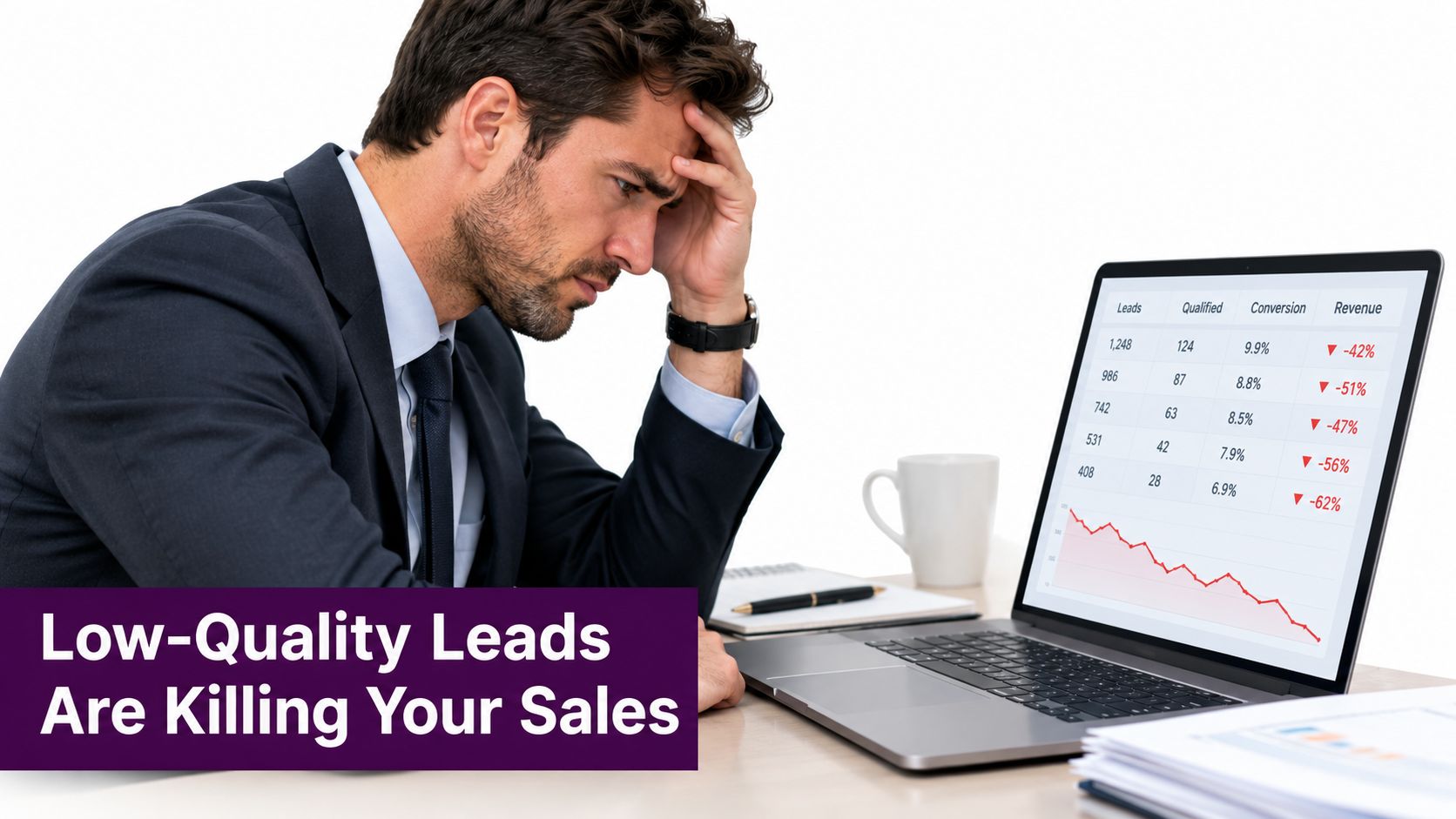
A common failure starts with a simple story. An e-commerce brand hires a low-cost offshore vendor, gets 500 leads a month, then learns that only a tiny share are worth a sales follow-up. The marketing team says the vendor delivered, the sales team says the leads are weak, and nobody agrees on where the breakdown happened.
That pattern usually comes from a bad definition of “qualified.” The vendor is judged on volume, while sales is judged on revenue, so the two sides optimize for different outcomes. A BPO can book a lot of activity and still miss the point if the contacts don’t match the client’s ICP, buying stage, or handoff rules.
The Real Break Point Is Usually Not Volume
Poor list quality, shallow scripts, and weak follow-up create a false sense of success. The campaign can look busy while the sales team stops trusting the leads. When that happens, even strong outreach teams start hearing the same complaint, “These names aren’t ready.”
That’s why structured qualification matters more than raw activity. A practical resource like B2B lead generation best practices helps frame the basics, but the operational difference comes from how a BPO applies those principles in the field.
In a nearshore setting like Tijuana, the advantage is simpler and more practical than people assume. Agents can work in the same business hours as North American buyers, they can pivot faster on script feedback, and they can pass context to the sales team without the lag that often kills momentum. If you want a benchmark for how a serious vendor frames this work, review CallZent’s outsourced lead generation review.
Practical rule: if sales wouldn’t accept the handoff in a live meeting, the lead wasn’t qualified enough.
The Complete Nearshore BPO Lead Generation Workflow
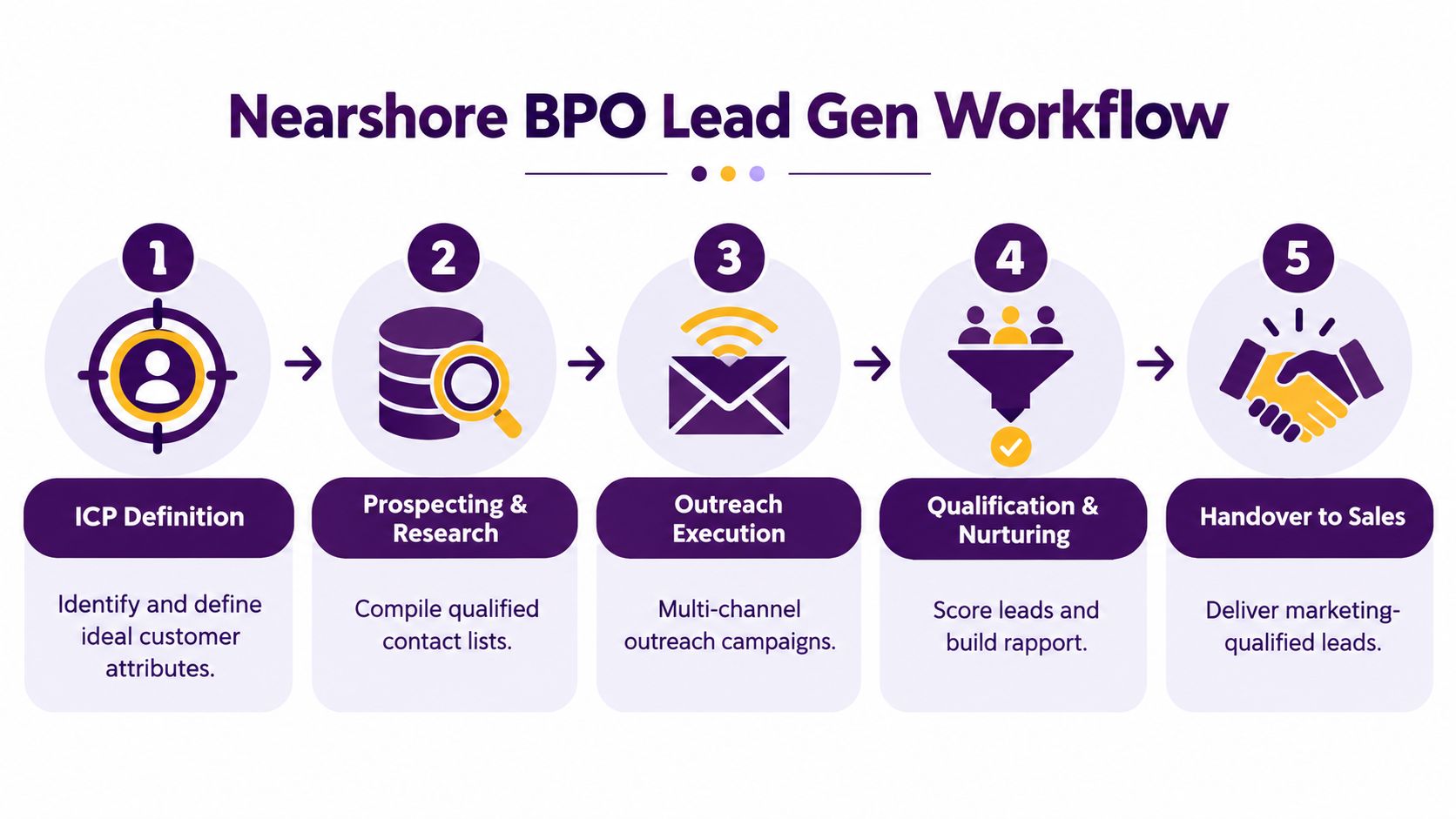
A good workflow starts before the first dial. The team defines the ideal customer profile, not just by industry, but by company size, job title, pain point, and buying trigger. Without that alignment, every later step becomes guesswork.
Steps 1 Through 3 Build the Pipeline
First comes ICP definition. A nearshore team should sit with the client and map target accounts, decision-makers, exclusions, and common objections before the campaign launch. That saves time later because the script and the list are built around the same buyer profile.
Second is list building and verification. Purchased lists may look cheap, but verified lists are what keep outreach relevant. One practical workflow is to match contacts to firmographic and role criteria, then verify them before outreach starts, which reduces the risk of wasting agent time on dead records.
Third is multichannel outreach. The strongest campaigns don’t rely on one channel. They combine phone, email, and social touchpoints in a coordinated sequence. If the buyer is active in email but slow to answer calls, the team can keep the conversation moving without forcing the same pitch everywhere.
Steps 4 and 5 Turn Activity Into Sales Readiness
The fourth stage is qualification and nurture. That means using explicit scoring, asking better questions, and knowing when a prospect is early-stage versus ready for a meeting. A useful framework for vendor evaluation is the guide to hiring SDRs, because it helps buyers compare sourcing models without confusing hustle for quality.
The final stage is handoff and quality assurance. Sales should receive the meeting context, call notes, and any recording or CRM update needed to continue the conversation cleanly. If the handoff is sloppy, the pipeline leaks right at the moment it should be converting.
For operational visibility, the most useful benchmarks stay simple: contact rate, qualification rate, and cost per qualified lead. A clean workflow also makes it easier to build a consistent outbound machine, which is why many buyers connect this stage to CallZent’s outbound lead generation services.
Overcoming the Funnel Friction Problem
The hard part of lead generation isn’t finding contacts; it is moving the right prospects through the funnel. Published MQL-to-SQL benchmarks vary by industry, channel, qualification definition, and sales model. That variability is exactly why a buyer should establish its own baseline and avoid treating a single cross-industry percentage as a universal target.
Where the Friction Usually Starts
Weak nurturing is one cause. Prospects get one or two touches, then disappear into a long follow-up cycle that never feels personal. In BPO operations, that usually means the lead got contacted, but not guided.
Poor ICP alignment is the second cause. If the list is too broad, agents spend time speaking to people who were never a fit. The team can still report activity, but the client experiences wasted sales motion.
The third cause is shallow qualification. A lead can answer the phone and still not be worth a sales representative’s calendar slot. Instead of relying on a generic conversion claim, define the evidence required for sales acceptance: account fit, role, business need, timing, decision process, and an agreed next step.
What Fixes the Leak
Scripts need to reflect real objections, not just polite discovery questions. Agents also need a tighter feedback loop with sales so they can see which conversations turned into real opportunities and which ones stalled. That’s where CallZent’s appointment-setting overview fits operationally, because appointment setting only works when the qualification bar is clear.
The quickest way to improve conversion is to reduce the number of “maybe” leads that reach sales.
Nearshore teams in Tijuana can improve this loop faster because they’re close enough to align on live calls, change language mid-campaign, and adjust qualification thresholds without a long offshore lag. The point isn’t just to create more meetings; it’s to create meetings your sales team will take seriously.
Choosing the Right Outreach Channels for Your Campaign
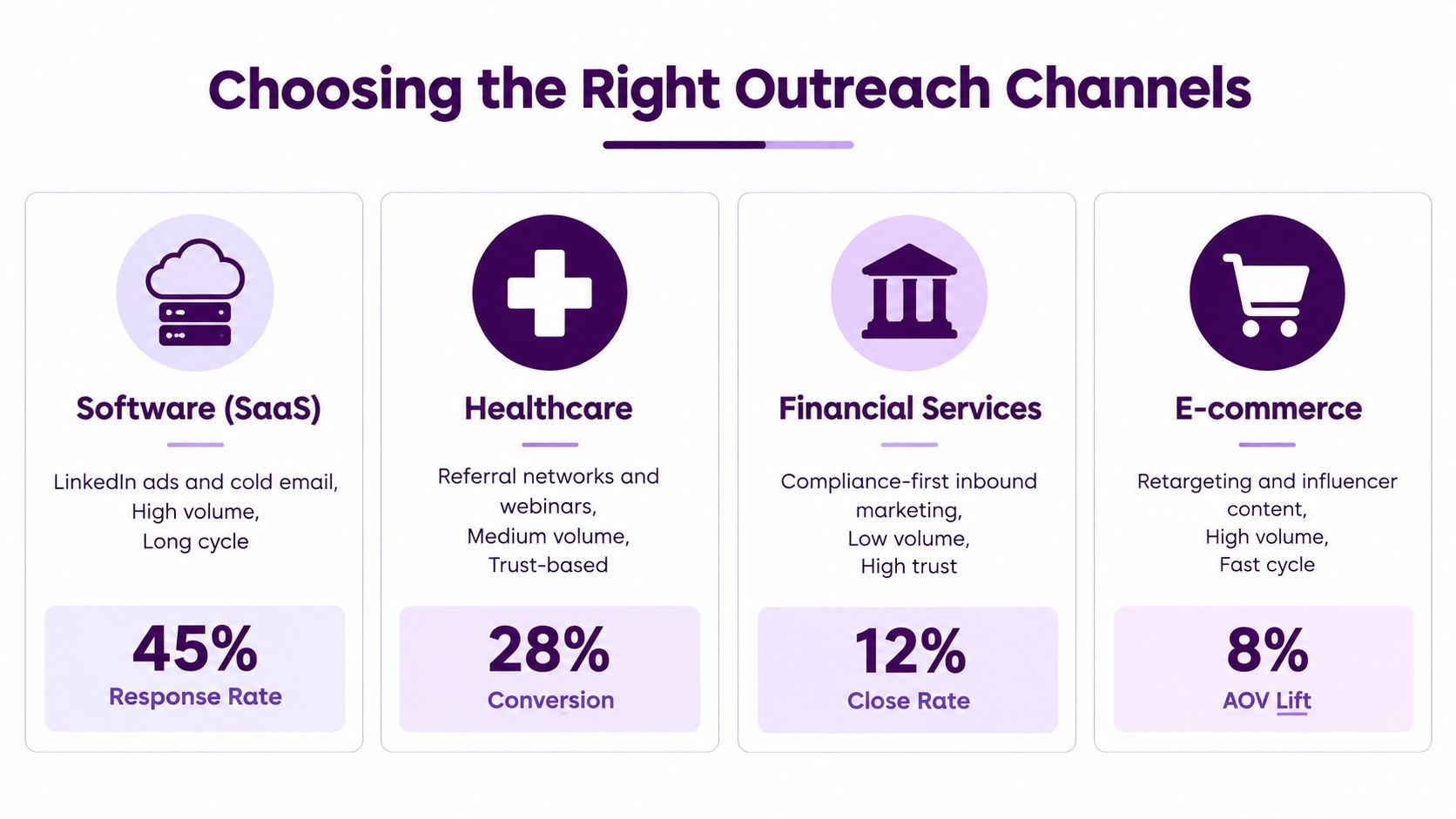
Not every channel deserves equal weight. A software buyer may respond to a different sequence than a healthcare administrator or an e-commerce operator, and a good BPO team adjusts the mix instead of forcing one playbook on every market.
Match the Channel to the Buying Behavior
Outbound calling still matters when the sales cycle needs human contact, rapid discovery, or quick disqualification. Email works well when the message needs documentation, compliance context, or a slower decision path. LinkedIn outreach and social selling help when the buyer is already active in professional networks and the relationship needs to warm up before the first meeting.
For a deeper tool comparison, many teams keep a reference list such as LeadBeast’s LinkedIn lead generation tool guide to understand which prospecting tools fit different workflows. The point isn’t to collect tools; it’s to choose the few that actually support your sales motion.
The Nearshore Angle Changes the Mix
Nearshore BPOs in Tijuana can run bilingual campaigns that switch between English and Spanish without losing message consistency. That matters when the audience includes U.S. decision-makers, cross-border operators, or bilingual teams that expect a smoother experience across touchpoints.
The smarter approach is to sequence channels around friction, not habit. A prospect who ignores cold calls might still respond to a short email with a clear value proposition, then engage on LinkedIn after the first touch. Another prospect may need a call first, then a follow-up email that includes the meeting context and next step.
The outreach map should also reflect first-party data and omnichannel coordination. Buyers notice when the same company sends disconnected messages from different people, or when the content changes from one channel to the next. That inconsistency kills trust quickly.
Building a Technology Stack That Scales With Your Team
A strong campaign can still fail if the tools don’t talk to each other. Agents end up copying notes manually, managers lose visibility, and the client gets delayed reporting that doesn’t help them steer the funnel.
The Stack Has to Support the Workflow
A predictive dialer can help with volume, but only if compliance settings and calling rules are configured properly. CRM integration matters just as much, because the moment a lead is qualified, the notes, tags, and meeting details need to flow into the client’s system without extra administrative work.
Lead scoring platforms are useful when they’re tied to real qualification behavior, not vanity points. Dashboards matter because managers need to see which campaign, script, or agent is creating actual sales-ready opportunities.
For a more specific view of how tools and systems fit together in a service environment, CallZent’s contact center technology stack shows the kind of operational backbone buyers should ask about before signing a contract.
What to Ask Before You Buy
If you’re evaluating a provider, ask these questions:
- How does your CRM handoff work? If the answer is “we email the notes,” the process is too manual.
- How do you separate qualified leads from booked activity? If the vendor can’t explain the difference, reporting will be noisy.
- How do agents update prospect status in real time? Slow updates create duplicate work and weak follow-up.
- How do you protect QA across languages? This matters in bilingual nearshore operations more than most clients expect.
A call center team can have great agents and still underperform if the stack is fragmented. The best setups reduce manual work, speed up response time, and make coaching easier because managers can see exactly where the campaign is drifting. That is the difference between a busy team and a scalable one.
Measuring Success and Optimizing Your Lead Generation Process
The right metrics tell you whether the campaign is producing revenue-ready demand or just noise. A BPO should never stop at “we made the calls,” because call activity alone doesn’t tell the client whether the pipeline moved.
Track the Numbers That Reflect Real Progress
The first layer is operational. Contact rate, qualification rate, and response rate show whether the list, timing, and messaging are working. If contact is low, the problem may be data quality or channel choice. If contact is fine but qualification is weak, the script or ICP definition is probably off.
The second layer is commercial. Cost per qualified lead tells you whether the campaign is efficient, and sales conversion rate tells you whether the leads are useful after handoff. Those two metrics should always be read together, because a cheap lead that never converts is still expensive.
For a dashboard structure that supports this level of review, CallZent’s reporting and metrics dashboard guide helps buyers ask better questions. It’s easier to improve a campaign when everyone is looking at the same numbers.
Optimization Works Through Feedback, Not Guesswork
The team should review call notes, objections, and lost opportunities on a regular cycle. If sales keeps rejecting a certain lead type, the qualification bar needs to change. If one script consistently reaches better prospects, it should become the new baseline.
A simple optimization rhythm looks like this:
- Review lead quality weekly: Check which sources created meetings that sales accepted.
- Refine scripts from live objections: Use real call outcomes, not assumptions.
- Adjust targeting before increasing volume: Bigger lists only help when the fit is right.
- Coach agents on the handoff: The prospect should never feel like the conversation restarted from zero.
If the sales team keeps asking for “better leads,” the BPO needs clearer acceptance criteria, not just more activity.
Nearshore operations work well here because the feedback loop is shorter. Managers, agents, and client stakeholders can review outcomes quickly, adjust the message, and keep the campaign aligned with changing market conditions. That’s how the lead generation process in BPO becomes a revenue engine instead of a reporting exercise.
Bilingual Nearshore Lead Generation
Turn Outreach Activity Into Sales-Ready Opportunities
CallZent helps North American teams build bilingual lead generation, appointment-setting, qualification, CRM handoff, and reporting workflows from Mexico.