
Loyalty Programs
Loyalty Programs Guide for Retention Growth and Better Customer Support
Learn how loyalty programs drive retention, which model fits your business, which metrics matter, and why bilingual BPO support is the missing link behind stronger program ROI.
TL;DR — Quick Takeaways
- Loyalty programs create an ongoing value exchange between a business and its customers.
- They help increase repeat purchases, retention, customer lifetime value, and first-party data quality.
- The best loyalty programs are designed around customer behavior, not just points, badges, or app features.
- Technology handles tracking and offers, but people determine whether members enroll, stay active, and trust the program.
- Bilingual BPO support can improve loyalty program ROI by helping customers enroll, redeem rewards, resolve issues, and stay engaged.
Customers keep leaving, so the team buys more ads, runs more promotions, and pushes harder on acquisition. Then the same cycle repeats.
That’s the gap many companies miss. If customers leave as fast as you find them, growth gets expensive fast. Loyalty programs help fix that, but only when they’re designed around real customer behavior, not just points, badges, or a mobile app screen.
A useful loyalty program does three things at once. It gives customers a reason to stay, gives the business cleaner first-party data, and gives service teams a better way to keep relationships from breaking down. That last part matters more than most brands admit. A rewards structure can look polished on paper and still fail in practice if customers can’t enroll easily, redeem confidently, or get help when something goes wrong.
Introduction Are Your Customers Leaving as Fast as You Find Them
Are you spending money to acquire customers only to watch them disappear after one or two purchases?
That’s not just a marketing problem. It’s an operating model problem. Businesses that rely on one-time transactions usually end up overpaying for growth, underusing their customer data, and putting too much pressure on sales to replace avoidable churn. A strong loyalty strategy changes that equation by giving customers a practical reason to come back and a clear sense that staying is worth it.
Many loyalty programs falter at this critical juncture. Companies focus on the reward catalog, the app interface, or the launch campaign. They spend less time on the harder questions. What behavior are we trying to reinforce? Which customers should get a different experience? What happens when a member calls because their points are missing, a reward won’t apply, or the sign-up process fails?
The businesses that get this right treat loyalty as part of customer retention, not as a side promotion. That thinking is also central to any serious effort to reduce customer churn. The reward matters, but so does the support model behind it.
Loyalty programs work best when the customer never has to wonder what they earned, how to use it, or who can fix an issue fast.
Some models are simple. Some are advanced. Some are ideal for e-commerce, while others fit healthcare networks, retailers, financial services firms, or subscription businesses better. The right choice depends on margins, purchase frequency, customer expectations, and service capacity. The companies that retain well build around all four.
What Loyalty Programs Are and Why They Matter Now
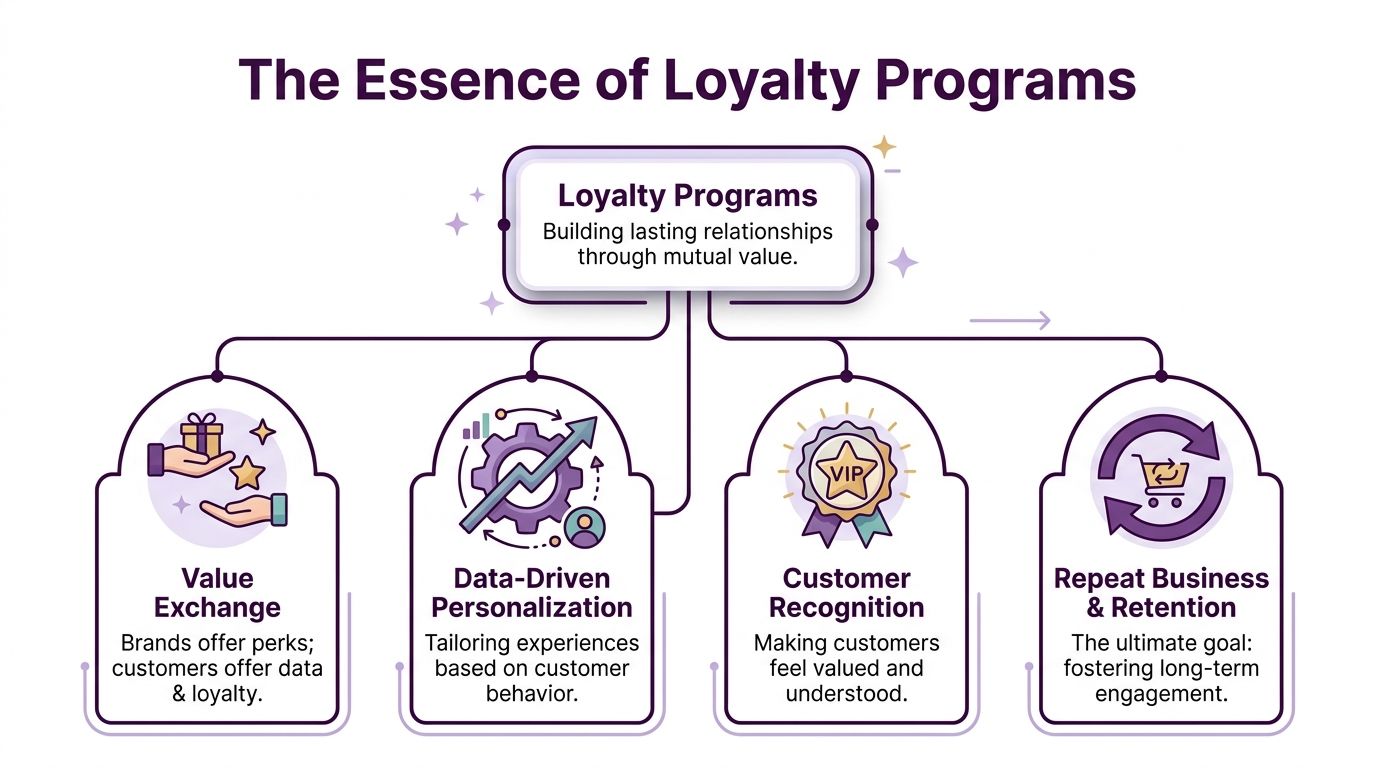
A loyalty program is a structured exchange that gives customers a reason to stay engaged after the first purchase. The business offers rewards, recognition, access, convenience, or personalized service. The customer responds with repeat purchases, preference, feedback, and permission-based data that can be used to improve future interactions.
That is why loyalty should sit inside a broader customer experience management strategy, not in a stand-alone promotion plan. If enrollment is confusing, rewards are hard to use, or support cannot resolve issues quickly, the program loses credibility fast.
Retention matters because it changes growth economics. Analysts cited in Emarsys customer loyalty statistics note that small gains in retention can produce outsized profit impact, while returning customers tend to spend more and cost less to serve than newly acquired ones. For operators, that makes loyalty less of a marketing add-on and more of a margin protection tool.
It also gives brands a better way to use their own customer data. Paid media costs rise. Third-party targeting gets weaker. A loyalty program creates direct signals about purchase frequency, category interest, service issues, and drop-off points. Those signals become useful only if the business can act on them across marketing, support, and retention teams.
Strong programs usually deliver value in four ways:
- Behavior shaping: They reinforce the actions that matter, such as repeat purchases, larger baskets, referrals, or renewals.
- Recognition: They make good customers feel known, especially when benefits reflect their history and preferences.
- Data quality: They produce first-party insights the business can use for segmentation and better service.
- Operational visibility: They expose friction points such as failed enrollments, missing points, reward confusion, and redemption errors.
That last point is where many loyalty strategies break down. A program can have strong app logic and still underperform if members cannot get help from a trained support team. In practice, BPO agents often determine whether a customer completes enrollment, understands the offer, or gives up after one frustrating interaction. That is one reason companies working with partners like CallZent often get more return from the same loyalty technology stack. Human support closes the gaps the platform cannot handle on its own.
Some brands also use loyalty to reflect what they stand for, not just what they sell. Programs built around community perks, local partnerships, or experiences can work well for businesses that want to support local brands and artisans and give customers a reason to stay beyond discounts alone.
A useful rule is simple. If the customer cannot easily understand what they earned, how to redeem it, or who will fix a problem, the program will struggle to retain anyone.
Choosing Your Model A Breakdown of Common Loyalty Programs
Not all loyalty programs solve the same problem. A coffee chain with high purchase frequency needs a different structure than a healthcare provider, online retailer, or financial services brand.
The model should fit customer behavior first. If the structure clashes with how people buy, the program becomes a burden instead of an advantage.
Four common loyalty programs
Here’s the short version of the main models most businesses consider:
| Program Type | How It Works | Best For | Key Benefit |
|---|---|---|---|
| Points-Based | Customers earn points for purchases or actions, then redeem them for rewards | Retail, food service, e-commerce, repeat purchase businesses | Easy to understand and easy to launch |
| Tiered | Members unlock higher status and perks as spend or engagement increases | Beauty, travel, premium retail, finance | Encourages progression and stronger emotional commitment |
| Subscription or Paid | Customers pay for access to ongoing benefits such as shipping, discounts, or exclusive perks | E-commerce, membership businesses, service brands | Creates recurring commitment and high perceived value |
| Coalition | Customers earn and redeem across multiple participating brands | Healthcare groups, regional business networks, shopping centers | Broadens value without each brand funding everything alone |
For teams evaluating long-term value, measuring customer lifetime value should shape the choice. A program that looks popular but attracts low-value, discount-only behavior can still hurt margins.
Where each model works and where it fails
Points-based loyalty programs
These are the most familiar. Customers buy, earn, and redeem. They work well when purchases happen often and rewards can be reached without confusion.
They tend to fail when the math is hard to follow or the reward feels too far away. If customers can’t quickly answer “What do I get?” they stop caring.
A simple retail example is a neighborhood café. Buy regularly, collect points, get a free item or a small upgrade. The appeal is immediate and transactional.
Tiered loyalty programs
Tiered structures tap into status, exclusivity, and progression. They’re often stronger when customers spend at different levels and some segments deserve a more enhanced experience.
That’s why this model matters in beauty, hospitality, finance, and premium e-commerce. Customers in the top tier of a well-structured program contribute 40% of total revenue, despite representing only 10–15% of the user base, according to Hightouch’s review of tiered loyalty program design.
That doesn’t mean every business needs tiers. It means tiers work when there’s a real difference between occasional buyers and high-value members, and the benefits feel aspirational rather than cosmetic.
Subscription or paid programs
These work when the benefit is obvious from day one. Think shipping advantages, service access, member pricing, or bundled convenience.
The mistake here is charging before the value is visible. Customers won’t stay in a paid loyalty program that feels like a disguised fee.
Coalition programs
Coalition models are underrated for regional ecosystems and complex service environments. A healthcare network, for example, could connect wellness check-ins, pharmacy engagement, and partner services inside one member structure. A local retail group could let shoppers earn value across several businesses instead of forcing each store to carry the full burden alone.
The right loyalty model should reward the behavior you want more of, not just the behavior that’s easiest to track.
Loyalty Programs in Action Real-World Examples and Best Practices
Examples make this clearer because structure matters less than fit.

Sephora Beauty Insider and why tiering works
Sephora’s Beauty Insider is a strong example of a tiered program because it blends transactional rewards with status. Members don’t just collect value. They move upward, gain access, and feel recognized differently as their relationship deepens.
That’s the key lesson. A tiered program works when the higher level feels meaningfully different, not when it just offers slightly better coupons.
Amazon Prime and why paid loyalty programs can stick
Amazon Prime shows the logic of a subscription-based program. The member pays upfront, but the daily value is easy to understand. Shipping convenience, bundled benefits, and a consistent experience reduce purchase friction.
This model is powerful when customers use the service often enough to justify the commitment. If the customer has to think too hard about whether they’re getting value, churn follows.
A healthcare coalition example that fits real operations
A healthcare network can use a coalition-style model in a practical way. A patient could earn benefits for appointment adherence, pharmacy engagement, preventive care participation, and partner wellness services. The point isn’t gimmicks. The point is reinforcing behaviors that improve continuity and reduce drop-off.
That kind of program works best when support teams can explain the rules clearly and help members work with them across channels.
What the best loyalty programs do consistently
Forrester and EY analysis highlights that long-term returns often create the biggest business impact, with 66% of consumers adjusting their spend to maximize loyalty benefits and 75% being more likely to make a purchase after receiving a targeted offer, as summarized by Tremendous.
That supports a few clear best practices:
- Mix transactional and experiential rewards: Discounts help, but access, convenience, recognition, and exclusive treatment often deepen the relationship.
- Keep redemption simple: If customers need a manual explanation every time, the program is too complicated.
- Use customer data responsibly: Targeted offers work when they’re timely and relevant, not constant.
- Support omnichannel use: Customers should be able to understand and use benefits whether they engage online, by phone, or through a store or service desk.
- Design for service recovery: Missing points, delayed rewards, and disputed redemptions are part of reality. Plan for them before launch.
A café example makes this simple. If a customer orders through an app, earns rewards in-store, and calls with a balance issue, the program needs one consistent answer across all three interactions. That’s where many brands fall short.
Building Your Program Key Metrics and Implementation Steps
A loyalty program shouldn’t start with software. It should start with a business decision.
What behavior do you want to increase? More repeat orders? Better retention after onboarding? Higher engagement from dormant members? Stronger cross-sell in a healthcare or financial services relationship? Until that’s clear, the platform choice is premature.
Build the operating plan before the launch plan
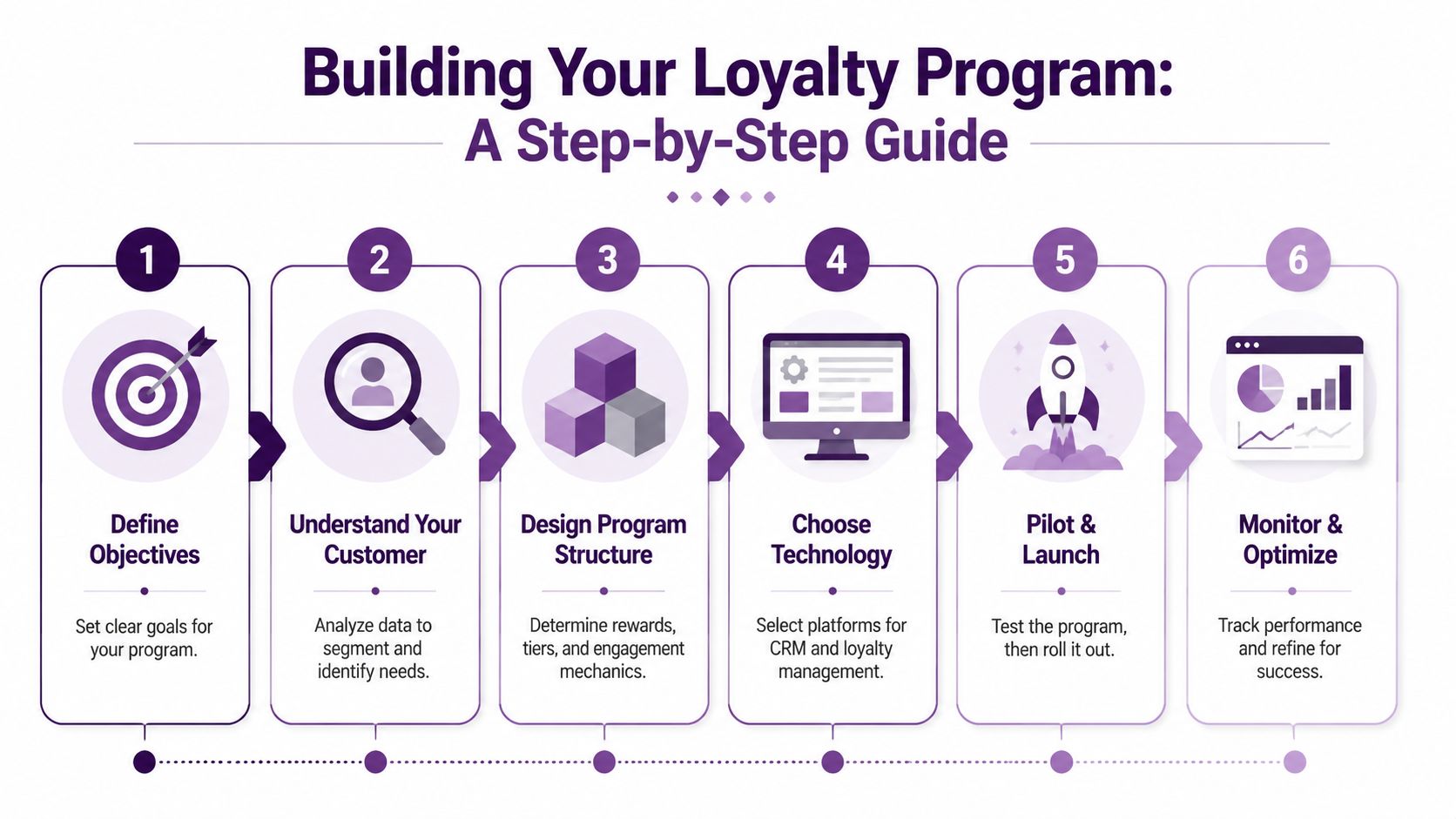
A practical rollout usually follows six steps:
-
Define the goal
Pick one or two business outcomes. Don’t launch a program that tries to solve everything at once. -
Map customer behavior
Look at buying cadence, support contacts, lapsing patterns, and customer segments. CRM data earns its keep in this analysis. -
Choose the structure
Match the model to purchase frequency, margin profile, and customer expectations. -
Select the systems
The CRM, rewards engine, service desk, and reporting layer need to work together. In restaurant and hospitality contexts, the principles behind enhancing guest recognition with CRM also apply to loyalty design more broadly. Recognition is much easier when service teams can see context, history, and preferences in one place. -
Pilot before broad launch
A smaller segment exposes friction early. That’s where you find weak enrollment language, confusing reward logic, or service gaps. -
Measure and adjust
Loyalty programs need regular tuning. Thresholds, messages, and reward mixes often need refinement after launch.
Track the metrics that prove loyalty programs work
Operations teams need more than enrollment totals. The useful metrics are the ones that show whether the program is changing customer behavior and supporting profit.
Use a KPI framework that includes:
- Customer Retention Rate: Are members staying longer than non-members?
- Redemption Rate: Are rewards being used, or just accumulating without impact?
- Average Order Value: Do members spend more per transaction?
- Customer Lifetime Value: Does the program improve long-term customer value?
- Service friction indicators: What issues appear repeatedly in support contacts?
A formal approach to customer service KPIs helps here because loyalty success is often tied to service quality, not just campaign response.
Technology matters, but only if it acts in real time
High-performance loyalty programs rely on first-party data that moves the experience. Real-time first-party data integration correlates with a 15–20% increase in customer retention and a 30% lift in average order value, while programs using behavioral data for context-aware rewards generate customer lifetime value that is 4.5x higher than non-personalized initiatives, according to Yotpo.
That’s why delayed systems create so many problems. If the CRM, ecommerce platform, and rewards engine don’t update quickly, customers see the gap immediately. They call because points didn’t post. They abandon a cart because a benefit didn’t apply. They lose trust because the experience feels unreliable.
One option some businesses evaluate in this area is CallZent’s customer loyalty program solution, which supports points accumulation, tiered rewards, personalized offers, and gamified engagement using CRM data. That kind of tool is most useful when paired with clear business rules and strong support workflows.
Operator’s view: The launch isn’t the finish line. The first month of member questions tells you whether your program is clear, usable, and worth scaling.
The Human Touch How BPO Support Elevates Loyalty Programs
Most conversations about loyalty programs stay focused on app mechanics, automation, and reward logic. Those matter. They just aren’t enough.

Where loyalty programs usually break down
Programs often fail in the messy moments. A customer can’t enroll. Points are missing. A reward expired unexpectedly. A high-value member feels like the company doesn’t recognize their history. Technology logs the event, but a person usually has to save the relationship.
That’s why the support function is so important. Most content on loyalty programs focuses on app mechanics but ignores the critical role of human support. Poorly designed programs often fail not due to a lack of features, but because they cannot generate the engagement needed for ROI. For businesses where a significant portion of customer service occurs via phone, the human element remains the biggest underserved variable in loyalty strategy, especially in healthcare and e-commerce, as noted in this discussion on loyalty support gaps.
What a BPO team does that software cannot
A nearshore BPO partner adds value at the exact points where loyalty becomes human:
- Enrollment support: Agents help customers sign up, explain the value clearly, and remove early hesitation.
- Reward clarification: Members need fast answers about balances, eligibility, and redemption steps.
- Issue resolution: Missing points and disputed rewards are churn moments if they’re handled poorly.
- Proactive outreach: High-value members often respond well when a person reaches out with context, not a generic blast.
- Feedback capture: Agents hear the friction directly and can surface patterns product teams miss.
This is especially relevant in bilingual North American markets. A customer who shops in English but wants support in Spanish shouldn’t have to struggle through a loyalty issue just because the program was designed for one language path.
For businesses serving diverse customer bases, outsourcing bilingual customer support can strengthen the loyalty experience where technology alone falls short. The goal isn’t adding more agents for the sake of it. The goal is protecting the relationship at the exact moments when trust is most fragile.
Why this matters in healthcare and e-commerce
Healthcare and e-commerce both depend on continuity. In healthcare, clarity and reassurance often matter as much as the incentive itself. In e-commerce, speed and confidence usually determine whether the next purchase happens.
A loyalty program in either sector needs someone who can explain, solve, reassure, and escalate. That’s not a software feature. That’s an operating capability.
When customers call about loyalty, they’re usually asking a larger question. “Can I trust this brand to keep its promise?”
Conclusion Turning Customers into Lifelong Advocates
Loyalty programs work when they’re built as retention systems, not just reward systems.
The model matters. Points, tiers, subscriptions, and coalition structures each fit different customer behaviors and business goals. The technology matters too. Real-time data, CRM integration, and personalized rewards all shape whether the program feels useful or forgettable.
But the strongest programs still depend on something more basic. Customers need clear answers, quick problem resolution, and consistent support when the experience breaks. That’s where many brands lose the return they expected from their loyalty investment. The platform is live, the campaign launches, and then support friction erodes trust one interaction at a time.
A well-run loyalty program turns repeat buyers into long-term advocates because it combines smart design with reliable human help. That’s the formula that keeps members engaged, protects margin, and gives businesses a stronger base for growth.
🚀 Ready to Strengthen Your Loyalty Program Support?
CallZent helps businesses support loyalty programs with bilingual nearshore customer service, enrollment assistance, reward issue resolution, proactive outreach, and retention-focused BPO workflows.
Talk to an ExpertFAQs About Loyalty Programs
What are loyalty programs?
Loyalty programs are structured customer retention systems that reward repeat engagement, purchases, referrals, renewals, or other valuable behaviors with points, perks, recognition, access, or personalized benefits.
Why do loyalty programs matter for retention?
Loyalty programs matter because they give customers a reason to return, help businesses collect first-party data, increase customer lifetime value, and create more opportunities for service recovery and personalized engagement.
What are the main types of loyalty programs?
The main types of loyalty programs include points-based programs, tiered programs, subscription or paid programs, and coalition programs where customers earn and redeem value across multiple brands.
Which loyalty program model is best?
The best loyalty program model depends on purchase frequency, margins, customer behavior, service capacity, and business goals. A coffee shop may benefit from a points program, while a premium retailer may benefit more from tiers.
What metrics should loyalty programs track?
Important loyalty program metrics include customer retention rate, redemption rate, average order value, customer lifetime value, repeat purchase rate, enrollment rate, active member rate, and service friction indicators.
Why do loyalty programs fail?
Loyalty programs often fail because rewards are confusing, redemption is difficult, enrollment is unclear, customer data is disconnected, support teams are unprepared, or customers do not understand the value of staying engaged.
How does customer support improve loyalty program ROI?
Customer support improves loyalty program ROI by helping members enroll, understand benefits, resolve missing points, redeem rewards, fix account issues, and stay confident that the brand will keep its promises.
Why is bilingual support important for loyalty programs?
Bilingual support is important because customers should be able to understand, use, and resolve loyalty program issues in the language they are most comfortable with, especially in diverse North American markets.
How can a BPO partner support loyalty programs?
A BPO partner can support loyalty programs through enrollment assistance, reward clarification, issue resolution, proactive outreach, feedback capture, service recovery, and bilingual customer support across channels.
How can CallZent help with loyalty programs?
CallZent helps businesses support loyalty programs with bilingual nearshore customer service, BPO workflows, enrollment support, reward issue resolution, proactive outreach, and member experience support across North America.
If you’re building or fixing a loyalty strategy, CallZent can help you support it operationally with bilingual nearshore customer service and BPO workflows that improve enrollment, issue resolution, and member experience across North America.