

Outsourcing Management and BPO Governance
Managing Outsourcing Projects: A Practical Nearshore BPO Playbook
Learn how to control scope, select the right provider, build measurable SLAs, establish effective governance, and manage an outsourced operation from launch through transition.
TL;DR — Quick Takeaways
- Define the process, exclusions, assumptions, dependencies, and decision rights before selecting a vendor.
- Translate each business objective into operational, quality, and business metrics with an owner and measurement method.
- Choose a BPO partner based on operational fit, time-zone overlap, language, compliance, and total cost—not rate alone.
- Make SLAs measurable, test onboarding in controlled stages, and validate bilingual handoffs before full launch.
- Run weekly operational, monthly business, and quarterly strategic governance forums.
- Align fees, incentives, change control, audit rights, and exit obligations with the business outcomes you need.
- Use the first 90 days to establish baselines, test escalation, and identify transition risks early.
A new operations lead inherits an outsourced call center program that looks healthy in the dashboard. Service levels are green, reports arrive on schedule, and the vendor says the script needs work. Yet customer satisfaction is falling, agent attrition is rising, and change requests keep appearing after the contract was signed. Managing outsourcing projects successfully means controlling the operating model, not just choosing a vendor and reviewing a monthly report.
This playbook focuses on the points where nearshore BPO engagements drift: unclear scope, activity-based SLAs, inactive governance forums, and contracts that reward the wrong behavior. It applies to customer service, technical support, appointment scheduling, back-office processing, and other outsourced operations where quality and business outcomes matter as much as volume.
TL;DR
- Define the process, exclusions, assumptions, dependencies, and decision rights before vendor selection.
- Translate each business objective into operational, quality, and business metrics with an owner and measurement method.
- Choose a BPO partner based on fit, overlap, language, compliance, and total cost, not rate alone.
- Make SLAs measurable, test onboarding in stages, and validate bilingual handoffs before launch.
- Run weekly operational, monthly business, and quarterly strategic governance forums.
- Align fees, incentives, change control, audit rights, and exit obligations with business outcomes.
- Use the first 90 days to establish baselines, test escalation, and identify transition risks early.
Why Most Outsourcing Projects Drift Off Course
The first warning usually isn’t a missed report. It’s a mismatch between what the dashboard says and what customers experience. In week one, an experienced manager looks for repeated ad hoc requests, unexplained staffing exceptions, leadership no-shows on review calls, and a vendor that treats every quality issue as a script problem.
The historical risk is substantial. A widely cited benchmark covering more than 8,000 outsourced software projects found that 31% were cancelled outright, while 68% experienced at least one major failure dimension, including schedule overruns above 180% of plan, budget overruns above 160% of estimate, or functionality delivery below 70% of target. Only 16% were completed as expected, on time, and on budget, as summarized by CIO Insight’s overview of outsourcing risks. Call center programs have different deliverables, but the warning applies: a contract doesn’t replace active control over scope, cost, schedule, or quality.
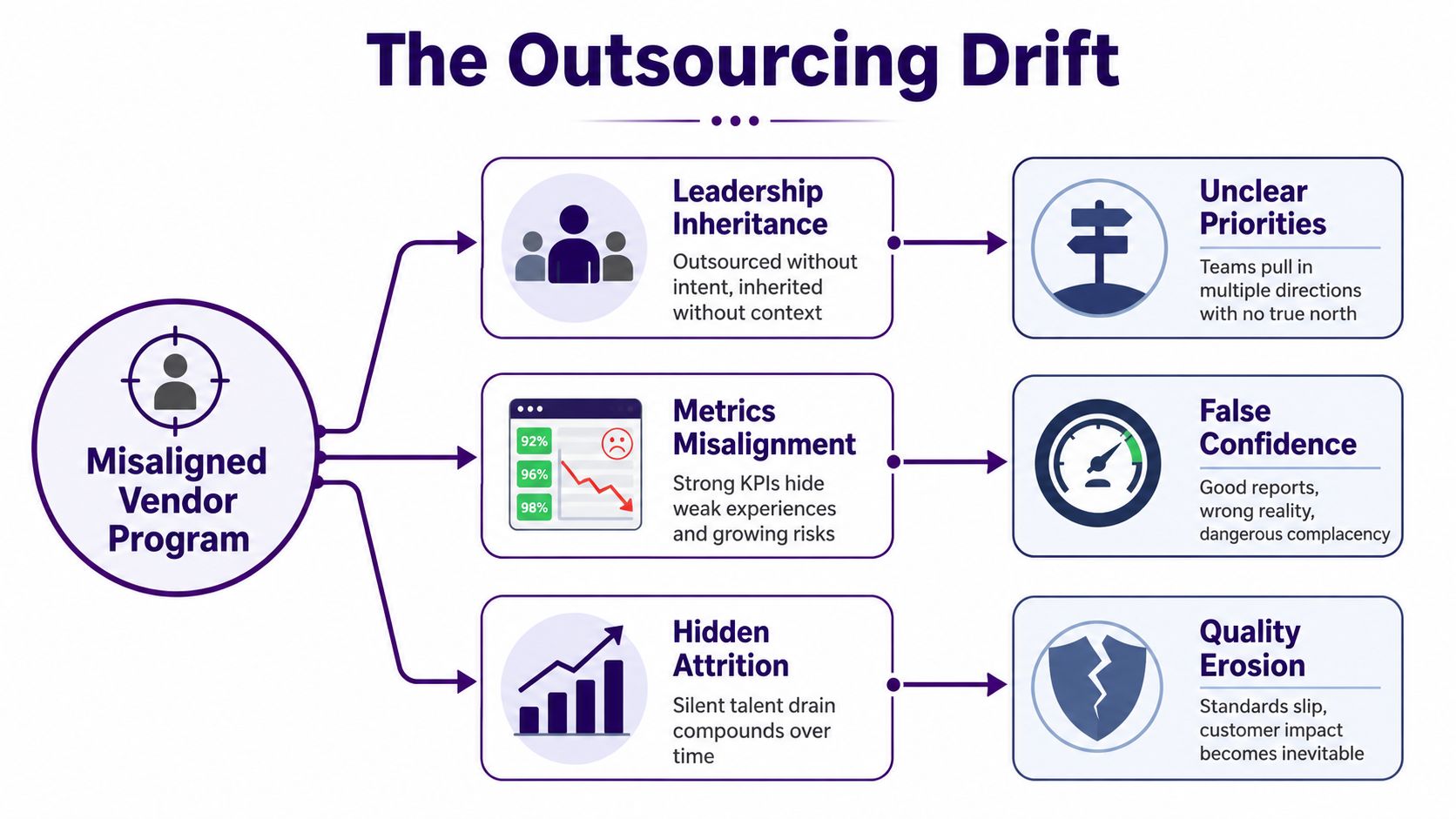
The four signals of outsourcing drift
-
Scope expands without contract change. The client adds channels, languages, reporting, or exception handling through casual messages. The vendor accepts the work, then later submits escalating change orders or reduces attention to contracted services.
-
SLAs measure activity instead of outcomes. A vendor reports calls answered, tickets closed, or schedules filled, but nobody connects those figures to resolution quality, customer effort, retention, or revenue protection.
-
Governance exists on paper only. Meetings remain scheduled, yet decision-makers don’t attend, action items have no owner, and the same unresolved issue appears in consecutive reports.
-
Incentives reward the wrong behavior. A price-only model can encourage low staffing, short interactions, or task completion even when those choices increase repeat contacts and customer frustration.
Practical rule: Treat constant exceptions, missing decision-makers, and unexplained metric conflicts as control failures, not isolated annoyances.
A useful companion for controlling scope is The OKR Hub’s guide to scope creep management, especially when teams need to connect changing requests to approved objectives. The sections that follow address each failure point directly, from pre-signature scoping through transition and exit.
Setting Scope and Success Metrics Before You Sign Anything
A vendor can’t manage an undefined operation. Before outreach begins, map the customer journey from contact initiation to resolution, escalation, closure, and follow-up. Separate predictable volume work from judgment work, then flag moments involving regulatory obligations, sensitive data, brand reputation, revenue protection, or customer retention.
Write the scope on one page. Include:
- Included work: Channels, queues, hours, languages, customer types, systems, and transaction categories.
- Excluded work: Requests the provider won’t handle, such as complex approvals or regulated decisions.
- Assumptions: Forecast quality, client response times, system availability, training inputs, and staffing conditions.
- Dependencies: Knowledge-base ownership, CRM access, product updates, marketing calendars, and internal escalation support.
- Decision rights: The person who can approve a process change, policy exception, staffing adjustment, or customer remedy.
Then translate each objective into three kinds of measures. An operational KPI shows whether work moves efficiently. A quality KPI shows whether agents perform correctly and consistently. A business KPI shows whether the program supports the P&L rather than merely producing activity.
| Objective | Operational KPI | Quality KPI | Business KPI |
|---|---|---|---|
| Resolve customer issues efficiently | First contact resolution | Calibrated QA score | Customer satisfaction impact |
| Protect peak-hour coverage | Schedule adherence | Interaction quality during peaks | Reduced abandoned demand |
| Improve appointment handling | Booking completion rate | Booking accuracy | Kept appointment contribution |
| Support revenue-critical inquiries | Response and queue performance | Compliance and sales-quality score | Retention or revenue contribution |
For every metric, document the target, baseline, measurement window, data source, calculation method, and owner. If the client system and vendor system produce different results, identify which record controls and how disputes are resolved.
The financial case also needs more than an hourly rate. A structured outsourcing cost-benefit analysis should account for transition effort, training, management time, technology, quality assurance, rework, and the cost of poor customer outcomes. This discipline prevents an apparently cheap program from becoming expensive through hidden operational work.
Choosing the Right Vendor for the Right Job
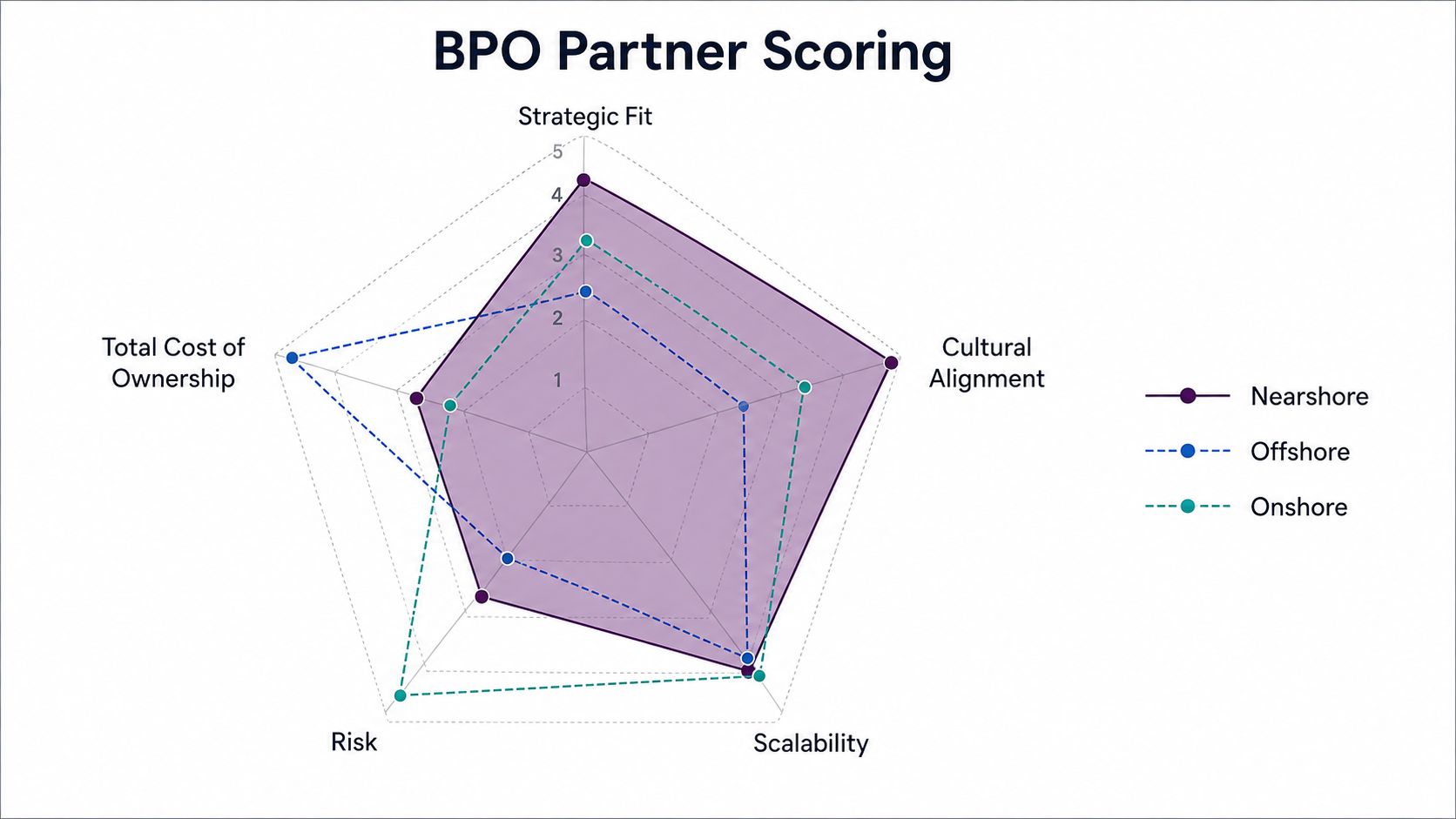
Lowest price is a procurement result, not a delivery strategy. A nearshore, offshore, or onshore provider can work well, but the right choice depends on the job’s complexity, language needs, customer expectations, compliance exposure, and required collaboration.
Score each candidate across five dimensions, then assign weights based on the program:
- Domain fit: Has the provider handled similar products, customer types, systems, and escalation patterns?
- Geographic and time-zone overlap: Can client and vendor leaders make decisions during shared working hours?
- Language and accent quality: Can agents handle the customer’s language naturally, including bilingual handoffs and difficult conversations?
- Security and compliance maturity: Are access controls, training, monitoring, incident response, and audit practices documented?
- Total cost of ownership: Does the proposal include transition, ramp, management, quality staffing, technology, attrition risk, and rework?
A Tier 1 customer support program may place heavier weight on language, cultural alignment, quality, and real-time collaboration. A back-office process requiring overnight turnaround may place more weight on cost, scale, process controls, and asynchronous handoffs. Geographic spread matters because outsourced-services revenue reached $95.2 billion in 2019, with business process outsourcing representing $26 billion, and the Americas generating the largest regional share, according to Statista’s global outsourcing market data. Distributed delivery is now a normal operating condition, not an unusual exception.
A practical shortlist screen
Before issuing an RFP, ask each candidate to provide:
- Delivery ownership: Named operations, workforce, training, and quality leaders.
- Subcontracting disclosure: A clear statement of who performs the work and where.
- Attrition visibility: Role-level staffing history and replacement process.
- Quality evidence: Calibration method, sampling approach, coaching workflow, and reporting examples.
- Handoff design: Sample English and Spanish scripts, escalation paths, and overlap windows.
- Commercial clarity: A full cost model, assumptions, exclusions, and change-order rules.
Use a weighted scorecard rather than debating impressions. The vendor evaluation criteria used by CallZent offers a practical starting point for organizing that comparison. A vendor that scores well on rate but poorly on ownership, QA staffing, or handoff discipline isn’t low risk. It may be underpricing the work you’ll later have to manage.
Building SLAs and Onboarding That Hold Up
An SLA should run the engagement, not sit in a contract folder. Define the service, performance standard, measurement method, responsibilities, reporting, escalation path, remedies, and review process, as outlined in CIO’s guide to outsourcing SLAs.
Tie each important outcome to one measurable KPI. Connect average handle time with cost per call, first contact resolution with customer satisfaction, schedule adherence with peak coverage, and quality with calibrated evaluations and customer feedback. If the team cannot explain the action triggered by a missed range, the metric is not ready for the SLA. A call center SLA framework can help organize those components and their measurement rules.
| KPI | Baseline | Target | Measurement Window | Escalation Owner |
|---|---|---|---|---|
| First contact resolution | Approved pre-launch baseline | Contracted improvement or threshold | Weekly, with monthly trend | Operations lead |
| Quality score | Calibration baseline | Agreed quality threshold | Weekly sampling | Quality manager |
| Schedule adherence | Workforce baseline | Coverage requirement by interval | Daily and weekly | Workforce manager |
| Customer satisfaction | Survey baseline | Contracted satisfaction threshold | Weekly trend, monthly review | Client experience owner |
| Response performance | Historical queue baseline | SLA by channel and priority | Daily dashboard | Service delivery lead |
Specify the escalation owner, response time, resolution window, backup contact, and communication channel. For nearshore teams, state how time-zone overlap and bilingual handoffs affect coverage and escalation. Practical examples include acknowledging a Slack message within 4 hours during business days, responding to Jira comments within 1 business day, answering an escalation-channel message within 2 hours regardless of time zone, and responding to email within 24 hours, based on Shift Asia’s software outsourcing project guidance.
Onboarding in controlled stages
Use three phases:
- Knowledge transfer: Product training, policy review, system access, shadow shifts, call listening, and bilingual script validation.
- Controlled go-live: Reduced volume, enhanced quality sampling, daily issue review, and rapid client decisions.
- Steady-state ramp: Increase volume only after KPI trends remain stable for at least four consecutive weeks.
Set acceptance criteria for every handoff. Include agent credentials, CRM access, knowledge-base permissions, reporting files, escalation rosters, approved scripts, and confirmation that the receiving team can use them under live conditions. SLA management with Intelligent Contacts offers guidance on managing the operating layer beyond contract wording.
Onboarding ends when trained agents can deliver reliably during real customer interactions, including time-zone changes, bilingual transfers, and escalation pressure. Training completion alone does not prove operational readiness.
Running a Governance Cadence That Actually Works
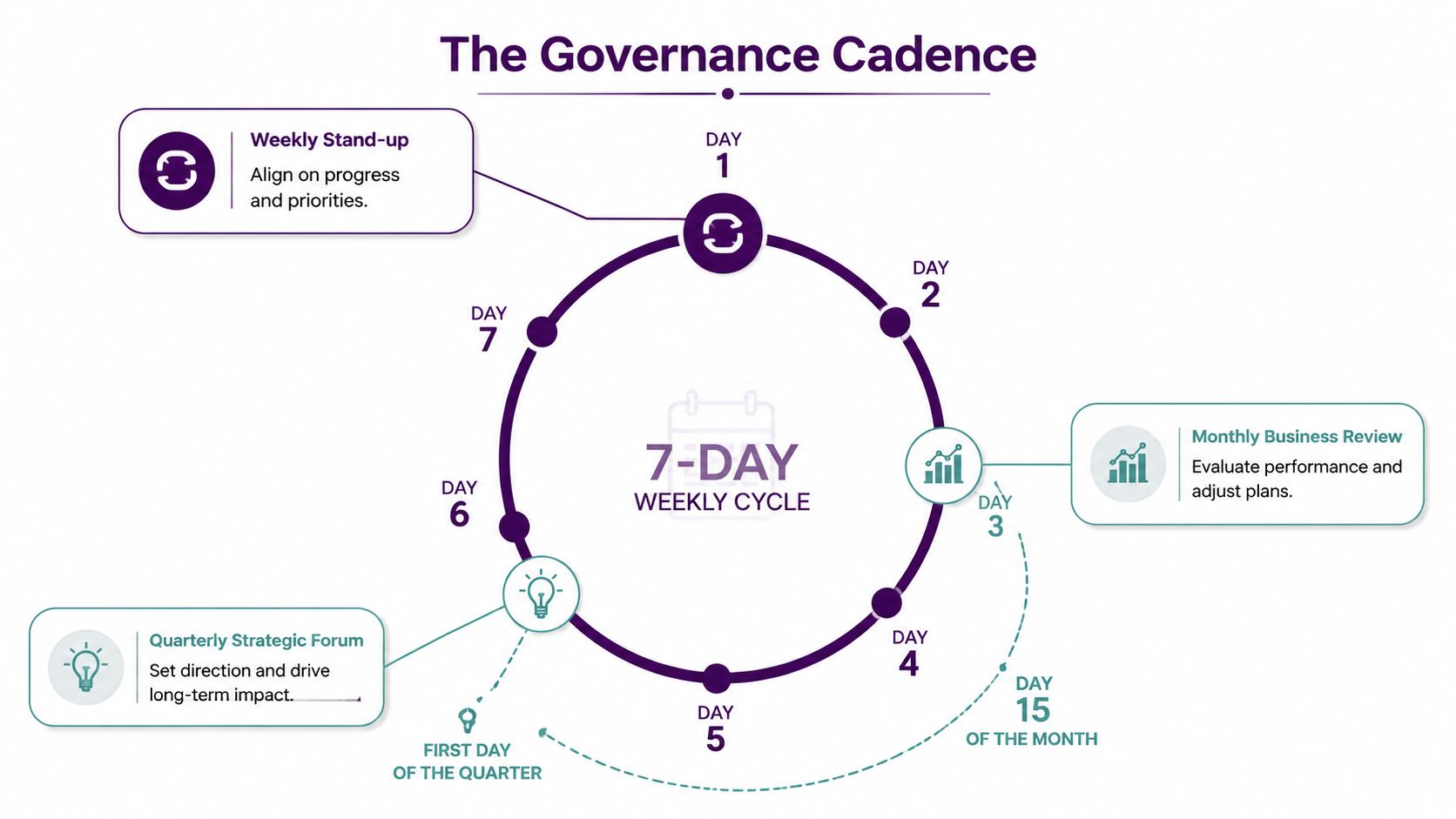
A monthly status call can’t carry every operational, commercial, and strategic decision. Effective governance uses separate forums because each meeting needs a different level of authority and evidence.
Weekly operational control
The weekly stand-up should focus on live conditions:
- SLA performance and queue health
- Staffing gaps, attendance, and forecast exceptions
- Open incidents and customer-impacting defects
- Quality trends and coaching completion
- Scope changes awaiting approval
- Decisions required from the client
Each agenda item needs one decision-maker, one owner, and one due date. The vendor should bring the current scorecard and risk register, not a polished narrative that hides variance.
Monthly business review
The monthly forum should examine trends against contracted targets, validate invoices, review approved and pending change requests, reconcile staffing and volume assumptions, and decide whether the roadmap still matches business priorities. Include delivery and program leadership from both sides. If the client owner can’t attend, reschedule or delegate authority. A meeting without decision rights creates the appearance of governance without the function.
Quarterly strategic forum
Executives should use the quarterly forum for commercial levers, strategic changes, security concerns, investment decisions, renewal positioning, and exit risk. Formal outsourcing governance commonly uses a weekly or fortnightly operational forum, a monthly management forum, and a quarterly strategic forum, with scorecards, financial reconciliation, risk registers, and independent checks of vendor SLA data against ticket-level records, as outlined by Aventario’s IT outsourcing governance framework.
For nearshore work, schedule forums inside the shared overlap window and rotate chair responsibility quarterly. That small discipline prevents the client from becoming the permanent meeting administrator and keeps accountability distributed.
Designing Contracts and Incentives for Real Accountability
Many operational failures are contract failures wearing an operational mask. If the agreement rewards the vendor for handling volume at the lowest possible cost, the vendor has little commercial reason to protect resolution quality, customer loyalty, or long-term process health.
A balanced structure connects a defined portion of fees to outcomes the client can verify. Operational measures might include SLA adherence and schedule coverage. Quality measures can include QA and customer satisfaction. Business measures may include retention or revenue contribution where the provider has a legitimate influence over those results.
| Contract Element | Weak Version | Strong Version |
|---|---|---|
| Pricing | Fixed rate focused on volume | Base fee with balanced performance measures |
| Scope | General service description | Included work, exclusions, assumptions, and dependencies |
| Change control | Informal requests by email | Written impact assessment and approval rights |
| Performance remedy | Discussion after failure | Defined remedy, recovery plan, and escalation |
| Data and security | Broad compliance language | Specific controls, audit rights, and incident duties |
| Exit | Notice period only | Transition assistance, artifacts, data return, and asset handover |
Use gain-share for sustained outperformance only when the measurement method is auditable. Add a clawback or service-credit mechanism when critical metrics miss for two consecutive periods, but avoid incentives that encourage agents to rush interactions, reject complex customers, or manipulate classifications.
Contract language should also cover subcontracting, data handling, audit rights, knowledge ownership, system access, and client responsibilities. A general software development agreement resource for founders can help teams think through ownership, deliverables, acceptance, and termination concepts, even though call center agreements require service-specific provisions.
Change and exit are part of launch design
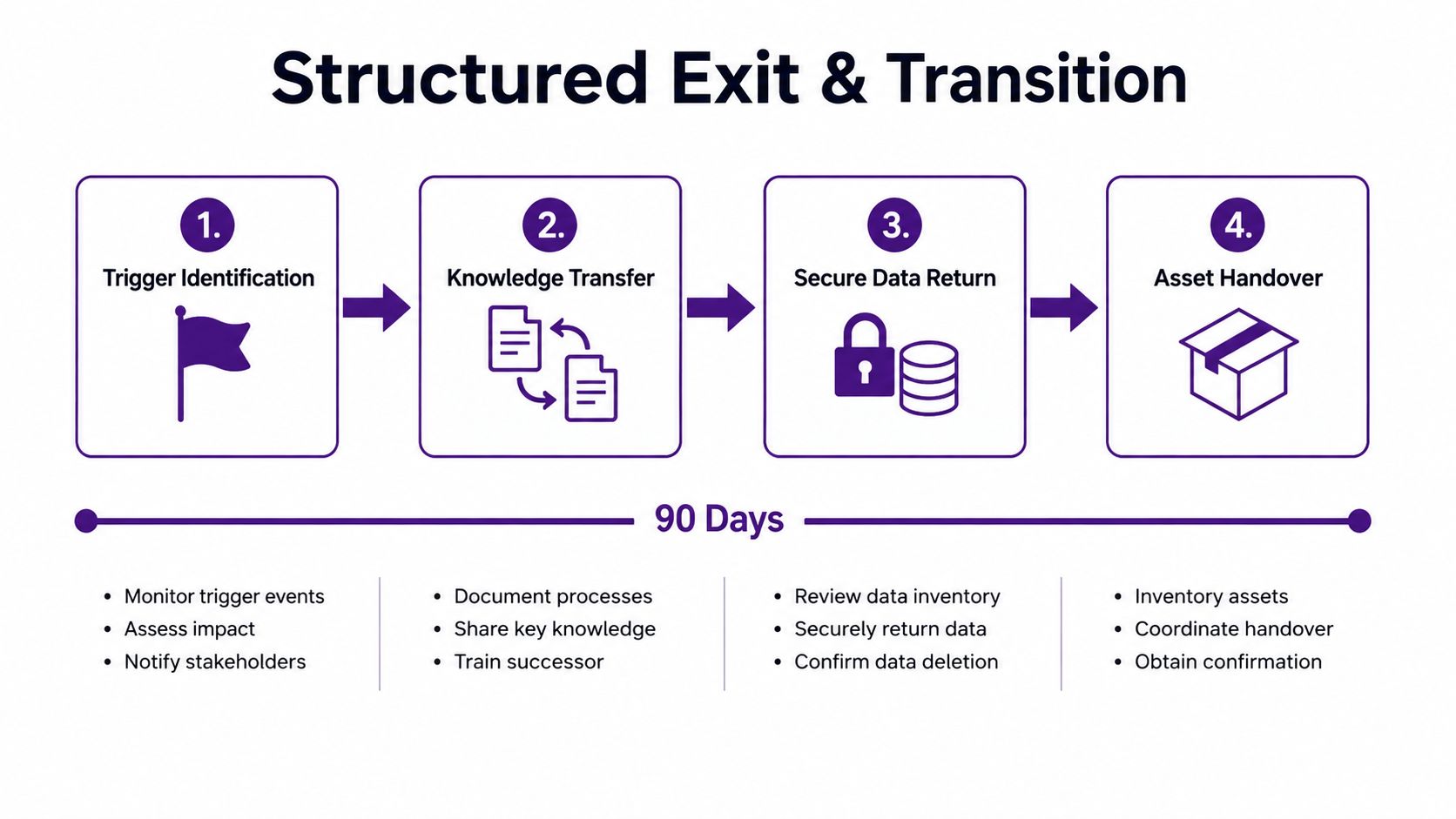
Every change request should show scope impact, cost impact, timeline impact, staffing impact, and approval authority. The agreement should include transition and exit terms triggered by performance, convenience, or strategic change. Specify transition assistance length, knowledge-transfer artifacts, data return, access removal, asset ownership, and rehire rights for tenured agents where appropriate.
A call center contracts framework from CallZent can serve as a reference point when organizing these commercial and operational provisions. A vendor should be rewarded for delivering the outcome the business needs, not merely for completing the task that was easiest to count.
Transition, Exit and Your First 90 Days of Action
Exit planning belongs in the contract before go-live. Define the triggers, notice process, knowledge-transfer protocol, data return, system deprovisioning, equipment handover, open-case ownership, and customer communication responsibilities while both parties still have goodwill.
The first 90 days
Days 1 through 30: Establish KPI baselines, confirm scope, validate access, publish the governance calendar, and review the escalation matrix with named backups.
Days 31 through 60: Validate the first month of SLA reporting against source records, inspect invoice assumptions, review quality calibration, and test bilingual handoffs across the agreed time-zone overlap.
Days 61 through 90: Run a contract health review, pressure-test escalation with a live incident or controlled exercise, confirm change-control behavior, and document the transition plan even if renewal appears likely.
A nearshore operating model can support real-time collaboration and bilingual customer handling when responsibilities are explicit. Review the capabilities and operating considerations described on CallZent’s nearshore call center services page before deciding which activities require local overlap, language fluency, or faster client access.
Questions operators still ask
How should seat counts scale? Tie increases and reductions to forecast assumptions, notice periods, training capacity, and service impact. Don’t treat seats as a simple volume switch if ramp time or quality coverage will change.
How do we preserve cross-border visibility? Use shared dashboards, common definitions, ticket-level verification, documented handoffs, and meeting times that respect the overlap window.
What signals point toward transition? Repeated missed deliverables, disputed reports, unresolved incidents, unexplained staffing changes, unauthorized scope expansion, and leadership disengagement are stronger warnings than a single poor week.
The first quarter should produce evidence, not optimism. You want a verified baseline, functioning governance, auditable SLAs, tested escalation, and a contract that still reflects the work the operation is performing.
Managed Nearshore BPO Services in Mexico
Build an Outsourcing Program With Clear Accountability
CallZent provides bilingual nearshore call center and BPO services from Mexico for customer support, technical support, appointment scheduling, and back-office operations. Build your program around measurable SLAs, practical governance, transparent reporting, and a transition plan aligned with your business.
Request a Custom QuoteCallZent provides bilingual nearshore call center and BPO services from Tijuana, including customer support, technical support, appointment scheduling, back-office operations, and CRM-integrated agent onboarding. Visit CallZent to discuss a managed outsourcing program with clear SLAs, practical governance, and a transition plan built around your customer and business requirements.