
Nearshore BPO Strategy
Nearshore Outsourcing Solutions: A Practical Guide for 2026
Compare nearshore outsourcing solutions by cost, collaboration, bilingual talent, compliance, technology, AI readiness, partner quality, and measurable ROI.
TL;DR — Quick Takeaways
- The best nearshore outsourcing solutions are rarely selected on hourly rates alone.
- Time-zone alignment enables faster decisions, escalations, coaching, approvals, and process changes.
- Mexico can offer U.S. companies bilingual talent, cultural proximity, compatible business hours, and easier collaboration.
- Evaluate compliance, security, quality assurance, training, technology, retention, and management accountability.
- Use a controlled pilot to test integrations, language quality, reporting, and operational performance.
- Measure total value through customer outcomes, productivity, escalation speed, retention, and cost—not labor savings alone.
- AI should automate appropriate routine work while trained people remain responsible for complex and sensitive decisions.
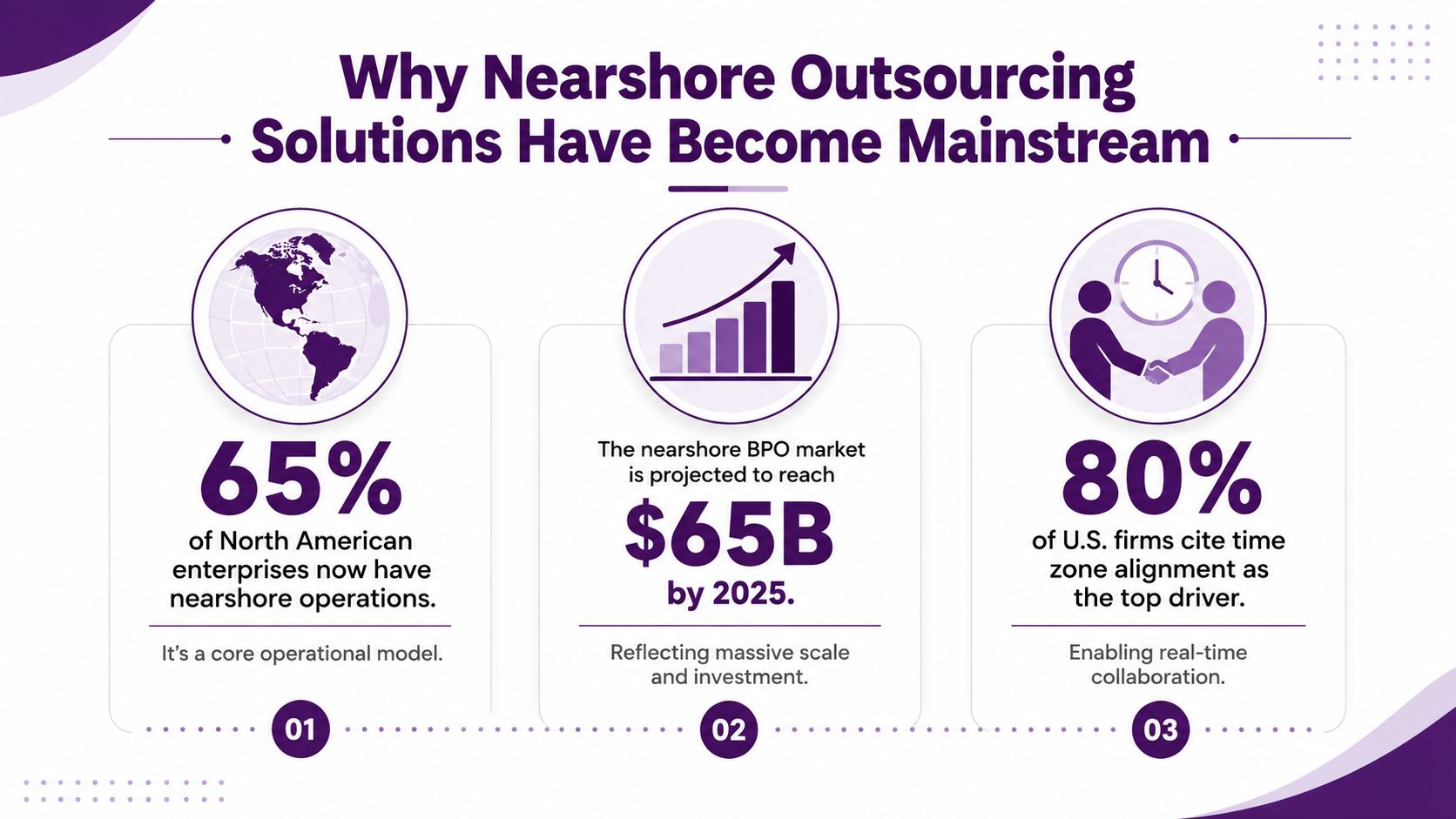
Nearshore outsourcing solutions have gone mainstream for a simple reason, they solve more than cost. When the global nearshore BPO market is already valued at US$61.57 billion in 2025 and projected to reach US$120.11 billion by 2033, with North America as the largest revenue-generating region in 2025, it’s no longer smart to treat nearshore as a fallback option. It’s now a core operating model for companies that need bilingual coverage, faster coordination, and tighter control over quality and compliance. The broader market picture from Grand View Research makes the shift clear, nearshore is not a niche cost play anymore.
A lot of buyers still ask the wrong question. They compare nearshore outsourcing solutions to offshore vendors only on labor cost, then get surprised when the cheaper option creates more rework, more waiting, and more management overhead. The better question is whether a partner can operate in real time, protect sensitive information, and integrate into your own operating rhythm without slowing your team down. For a useful primer on the basic model, SaaS nearshoring strategy by Rite NRG explains the working logic behind proximity-based delivery.
Key takeaway: nearshore is strongest when speed, quality, and coordination matter at the same time.
Why Nearshore Outsourcing Solutions Have Become Mainstream
Nearshore outsourcing solutions became mainstream because buyers found that proximity is an operational advantage, not just a convenience. The market data points in the same direction, but the key shift is that companies now use nearshore teams to run core parts of the business, not only to cut labor spend. A market projected to grow from US$61.57 billion in 2025 to US$120.11 billion by 2033, at an 8.8% CAGR, points to durable demand rather than a passing test case. The fact that North America was the largest revenue-generating region in 2025 shows how strongly U.S. and Canadian buyers have adopted the model. Grand View Research’s nearshore market data captures that scale.
The practical reason is simple. Companies do not want to wait overnight for answers when a customer issue is active, a campaign is live, or a production incident needs attention. Nearshore outsourcing solutions keep work moving during the same business day, which changes how quickly teams can review, approve, fix, and escalate.
Cost matters, but it’s not the whole story
Budget pressure still drives many decisions. Independent sources commonly place nearshore savings at 40% to 60% versus onshore U.S. equivalents, and one analysis says average nearshore software development rates are 46% lower than onshore rates. A separate industry view estimates 20% to 40% lower hourly rates than onshore providers, with U.S.-focused analyses reporting 30% to 50% labor cost savings for nearshore teams. The Stealth Agents nearshore statistics roundup and GigaBPO’s cost discussion both explain why buyers keep returning to the model.
The larger gain comes from lower coordination friction. Same-day collaboration means fewer handoff delays, fewer clarifying messages, and less rework caused by misunderstood requirements. That is why nearshore has moved from a cheaper alternative to a better execution model for many North American companies.
Why the model feels different in practice
The strongest nearshore relationships act less like vendor relationships and more like extensions of the internal team. Shared work hours let managers run daily stand-ups, make architectural calls, and handle incidents without waiting for the next shift. That is a very different operating rhythm from offshore models, where even a simple clarification can sit unresolved until the next day.
Nearshore outsourcing solutions fit customer support, BPO, back-office operations, and technical work well because the model supports real-time coordination, bilingual coverage, and tighter oversight. A team in Tijuana, for example, can work U.S.-aligned hours, support English and Spanish conversations, and stay close enough for easier governance. For companies that also need to evaluate collaboration setup, compliance readiness, and AI workflow maturity, the model is stronger when those pieces are in place. SaaS nearshoring strategy by Rite NRG explains the working logic behind proximity-based delivery, and CallZent’s overview of nearshore outsourcing benefits adds a useful practical view of the advantages.
Nearshore Vs Offshore Vs Onshore Making the Right Choice
The wrong model usually looks cheap at first and expensive later. That’s why the comparison has to go beyond headline rates and look at how each option affects communication, compliance, and total cost of ownership. A healthcare company that handles protected information, for example, can’t treat delayed handoffs and weak oversight as minor inconveniences. A simple ecommerce support queue may tolerate more delay, but a live patient issue or payment exception usually can’t.
Where each model fits best
Onshore works best when the work is tightly tied to local regulation, executive visibility, or highly sensitive customer relationships. It usually gives you the shortest cultural distance and simplest compliance discussions, but it also carries the highest labor cost.
Nearshore is the middle path when the work needs real-time collaboration, bilingual capability, and better cost control. It’s especially useful when the team must work inside the same business day as your internal staff.
Offshore makes sense when the work is highly standardized, less time-sensitive, and easier to package into asynchronous handoffs. It can still be effective, but the management model has to absorb the lag.
| Factor | Onshore (US) | Nearshore (Mexico/LatAm) | Offshore (Asia) |
|---|---|---|---|
| Cost profile | Highest | Lower than onshore, but not the cheapest | Usually lowest headline cost |
| Time-zone overlap | Full or near-full | Strong overlap with U.S. hours | Limited or minimal overlap |
| Collaboration style | Real-time, easiest | Real-time, efficient | More asynchronous |
| Compliance complexity | Often simpler for U.S. rules | Moderate, partner-dependent | Often highest coordination burden |
| Typical use cases | Regulated work, executive-facing work | Bilingual support, back office, tech support, shared operations | High-volume transactional work |
A practical scenario beats a generic rule
A healthcare provider that needs live patient callbacks, secure data handling, and escalation discipline should lean toward a nearshore or onshore model, because the operational risk sits in delay and miscommunication, not just labor cost. An ecommerce retailer that needs seasonal order support and can process some issues asynchronously may accept offshore for certain queues, but even there, nearshore often wins if the brand cares about same-day resolution and bilingual service.
If you’re comparing models for a specific business line, CallZent’s nearshore versus offshore comparison is a helpful reference point.
Practical rule: choose the model that reduces management friction, not just the one that lowers invoice rates.
Industries and Use Cases That Benefit Most from Nearshore
Nearshore creates disproportionate value where the work is customer-facing, exception-heavy, or sensitive to timing. That’s why bilingual contact centers, technical support teams, and regulated services tend to see the strongest fit. The common thread isn’t just geography, it’s the need for fast human coordination inside the same business day.
A good example is a contact center serving U.S. customers in both English and Spanish. That operation needs agents who can shift tone, resolve issues live, and escalate cleanly when the customer gets frustrated. Nearshore staffing in Tijuana is naturally suited to that environment because the team can work aligned hours and stay close to the client’s operating rhythm. For a deeper breakdown of where the model tends to fit, CallZent’s industry guide to nearshore outsourcing is worth reviewing.
Use cases where proximity matters more than cheap labor
Customer support and contact centers benefit when live calls, chat, and email cases need fast handoffs. If an agent has to wait until the next day for a supervisor answer, customer experience drops quickly.
Back-office operations work well in nearshore setups when teams need ongoing clarification from finance, operations, or sales leaders. Shared hours cut down on stalled approvals.
Technical support gains value from short escalation paths. A Tier 2 or Tier 3 agent can loop in engineering during the same shift instead of carrying a ticket overnight.
Healthcare services need a partner that can sustain sensitive conversations and handle PHI with discipline. That’s where compliance readiness matters as much as language and cost.
Financial services often need secure data handling, careful documentation, and consistent quality controls. A partner that can’t keep clean escalation records will create more risk than value.
Ecommerce is a strong nearshore use case when demand spikes seasonally. The right model lets teams absorb volume without losing service consistency.
One operational lesson has held up across dozens of transitions. If the work includes exceptions, escalations, or trust-sensitive conversations, nearshore usually creates more value than a purely transactional model.
Bilingual support and revenue-adjacent work
Nearshore is also useful for sales development and lead qualification, especially when teams need real-time coordination with marketing and account executives. If your team is building outbound coverage or appointment-setting capacity, Hire BDRs is a useful example of how proximity-based staffing can support revenue workflows, not just support queues.
The point is simple. The more your process depends on live judgment, the more value proximity brings.
How to Evaluate Nearshore Partners Beyond Cost
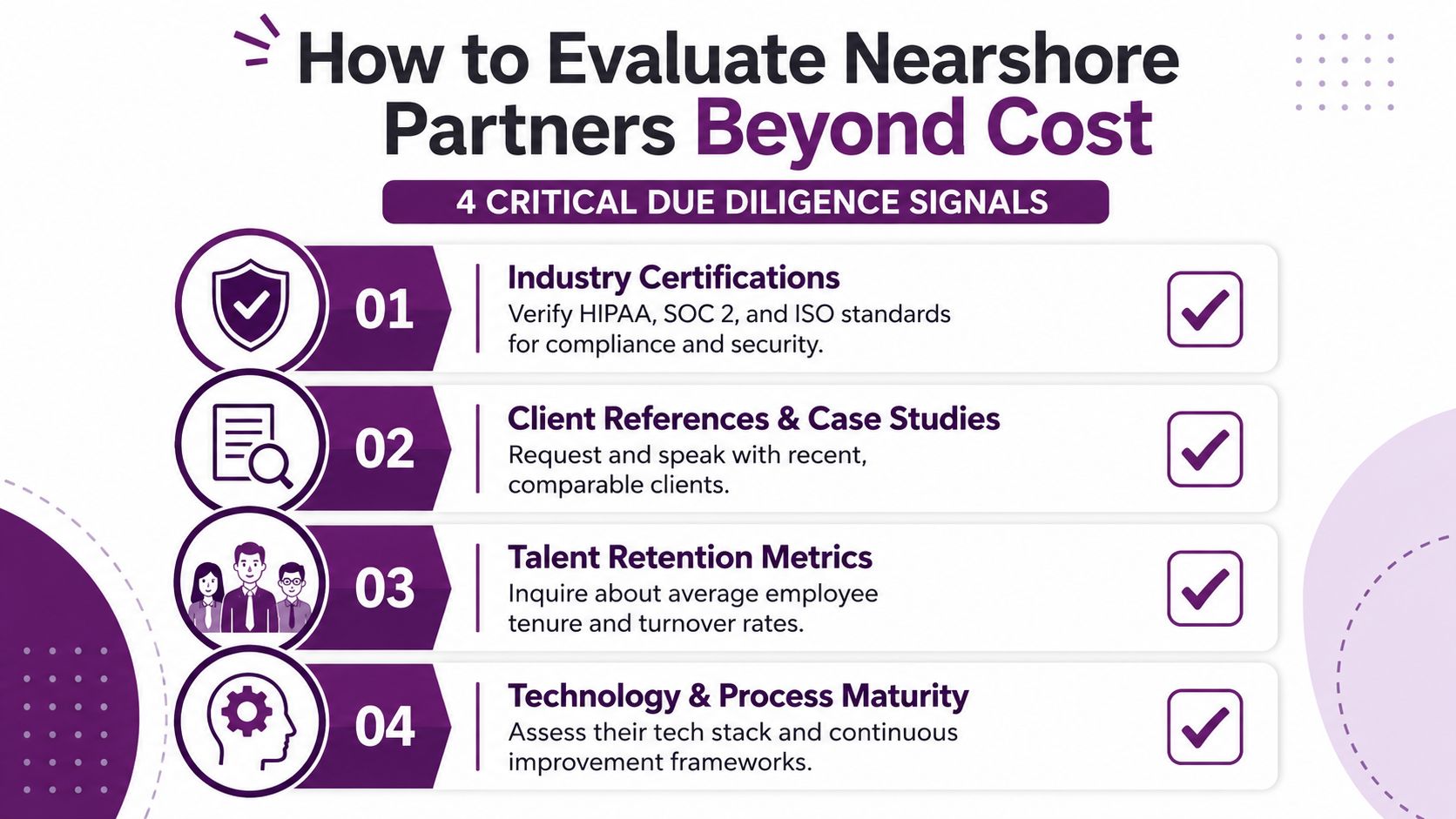
The best nearshore partner is rarely the cheapest one, and the cheapest one is rarely the easiest to manage. A strong evaluation starts with the basics, then goes deeper into how the partner handles compliance, training, escalation, and technology. Nearshore is not a quality guarantee on its own. It only becomes one when the provider can prove that the operating model will hold under real complexity.
Start with certifications if your work touches regulated data. Ask directly whether the team has HIPAA, SOC 2, or ISO coverage when the use case requires it. Then ask for evidence, not promises. If the provider can’t explain how compliance is maintained day to day, the certificate is just wall decor.
Questions that expose execution quality
Use questions that reveal how the operation really works:
- How do you train agents? Ask how onboarding is structured, how knowledge is tested, and how refresh training is handled when policies change.
- What comparable work have you done? A generic “we’ve supported many clients” answer is weak. Ask for recent examples from the same industry or similar channel mix.
- How do you handle escalation? Find out who owns urgent issues, how quickly they move, and how often the client is involved.
- What does your stack look like? A mature provider can explain its CRM, QA, workforce management, reporting, and security controls without sounding vague.
- How do pilots work? A real pilot should show you how the team responds under limited scope before you expand.
If you want a structured way to compare vendors, dreach’s AI staffing resources offer a useful lens on how AI-enabled service delivery changes the vendor conversation.
Red flags that matter
Watch for weak references, overly polished sales talk, and a lack of process detail. If a vendor avoids discussing turnover, coaching, or quality assurance, that usually means the operating system is fragile. The same goes for partners that say yes to every scope change without explaining how they’ll protect service levels.
A stronger partner will talk candidly about trade-offs. They’ll explain where automation helps, where humans stay in the loop, and how they preserve consistency when volume rises.
A solid nearshore partner should be able to explain its failure modes. If they can’t tell you where things break, they probably haven’t managed enough complexity.
Measuring True ROI Cost Savings Vs Operational Value
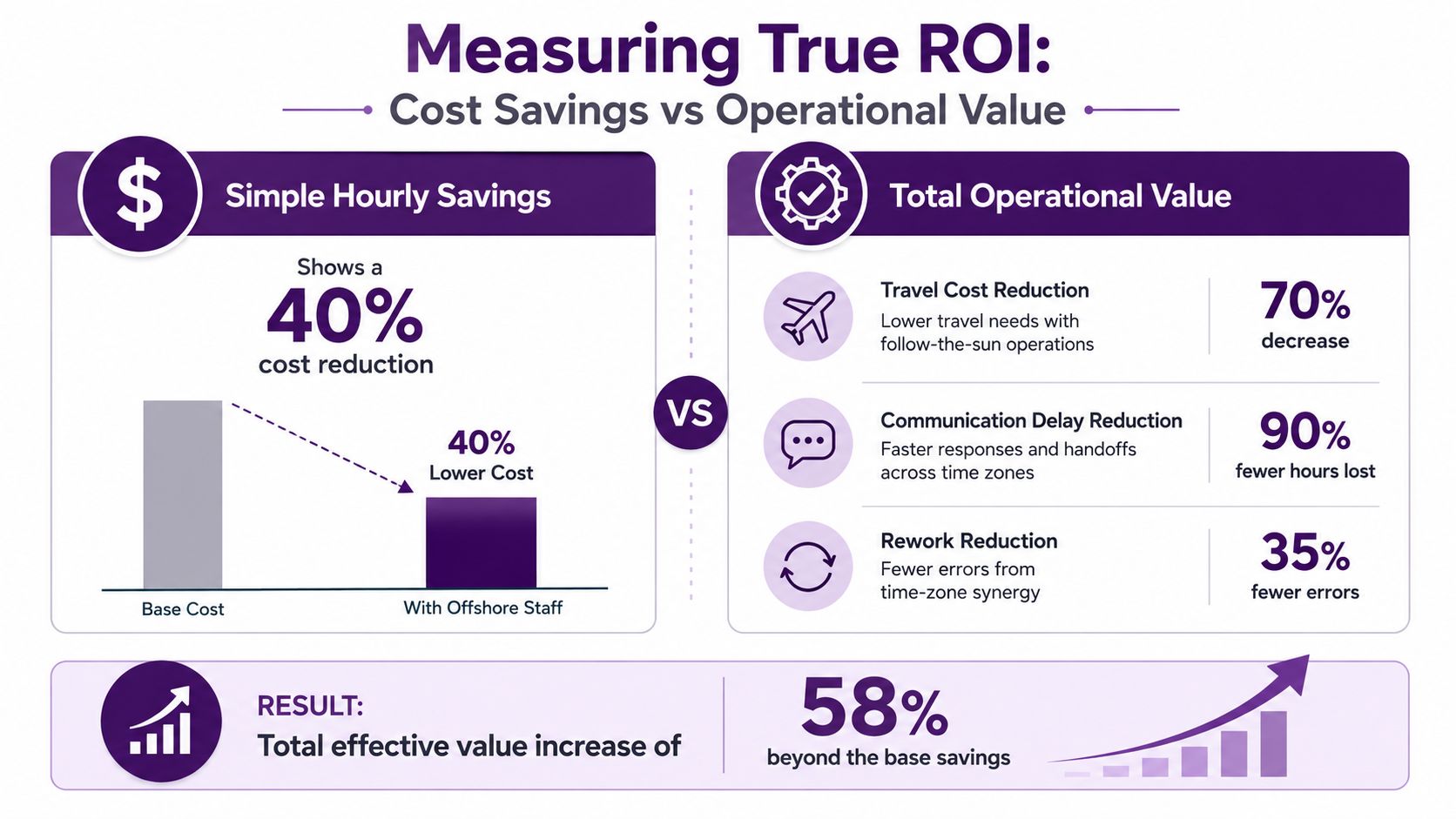
Hourly rate comparisons are too shallow to guide a serious outsourcing decision. Real ROI includes labor savings, but it also includes the operating costs that disappear when teams communicate faster and rework less. The smartest buyers build a business case around both sides of the ledger, then track the results with the same discipline they’d apply to an internal team.
The savings side is usually obvious. Nearshore providers often reduce direct labor costs compared with onshore hiring, and they can also lower travel, training, and management overhead. The less obvious gain is that the team wastes less time waiting for answers, which improves throughput and often improves customer outcomes.
What to measure beyond labor cost
Track metrics that show whether the model is improving operations:
- First-call resolution, because faster resolution usually means fewer handoffs and less friction.
- Average handle time, because it reveals whether agents have the tools and authority to close issues efficiently.
- Customer satisfaction, because better collaboration should translate into a better customer experience.
- Agent retention, because turnover drives hidden replacement and training costs.
- Escalation speed, because a nearshore model should shorten the path from issue to action.
A useful internal rule is to separate hard savings from soft savings. Hard savings are easier to present to finance, things like lower labor and infrastructure costs. Soft savings are just as real, but they show up as less rework, faster resolution, and better service quality.
How to build the business case
The cleanest business case compares the current operating model against the nearshore design, then quantifies what changes if the team gets same-day coverage, closer management, and cleaner handoffs. That usually resonates better with stakeholders than a simple “we’ll save on labor” pitch.
For a framework you can adapt to your own numbers, CallZent’s outsourcing cost benefit analysis is a practical place to start. The strongest internal case is the one that connects cost with customer experience, not one or the other.
The AI Shift What Work Should Remain Human Led
AI is changing nearshore economics, but not in the simplistic way a lot of vendors describe. The core question isn’t whether automation should exist. It’s which parts of the workflow should stay human-led because the stakes are too high, the nuance is too important, or the exception handling is too messy for a bot alone.
Routine tasks are the easiest place to automate. Data entry, simple FAQs, ticket triage, and repeatable status updates can all be supported by AI or automation tools. That frees agents to focus on the conversations where tone, judgment, and trust matter.
Human work still matters most in the hard moments
Sensitive customer conversations belong with trained people. So do complex escalations, complaints, exception handling, and quality control. When a customer is angry, confused, or worried about a regulated issue, a scripted response can make the problem worse.
Nearshore creates extra value here because bilingual agents working in overlapping hours can collaborate with internal teams in real time. That matters more when AI is absorbing routine volume, because the human team is left with the work that needs context, empathy, and judgment. In that setup, nearshore isn’t just a labor pool. It’s a coordination layer.
What strong providers are doing now
The better providers are blending AI into the workflow without pretending it can replace people. They use tools for agent assist, knowledge lookup, and quality monitoring, then keep a human in the loop for decisions that affect the customer relationship. That combination works especially well in customer support and back-office operations, where speed matters but so does accuracy.
One of the clearest shifts is this. Nearshore outsourcing solutions create more value for complex, customer-facing work than for simple transactional work, because the advantage is not just labor savings, it’s collaboration under pressure. As AI handles routine volume, the human side becomes more strategic, not less.
Your Implementation Roadmap and Partner Selection Checklist
A clean rollout beats a rushed one every time. Start by defining the work, the risk, and the service outcomes you want. Then shortlist providers that match your compliance needs, language needs, and operating style, not just your budget.
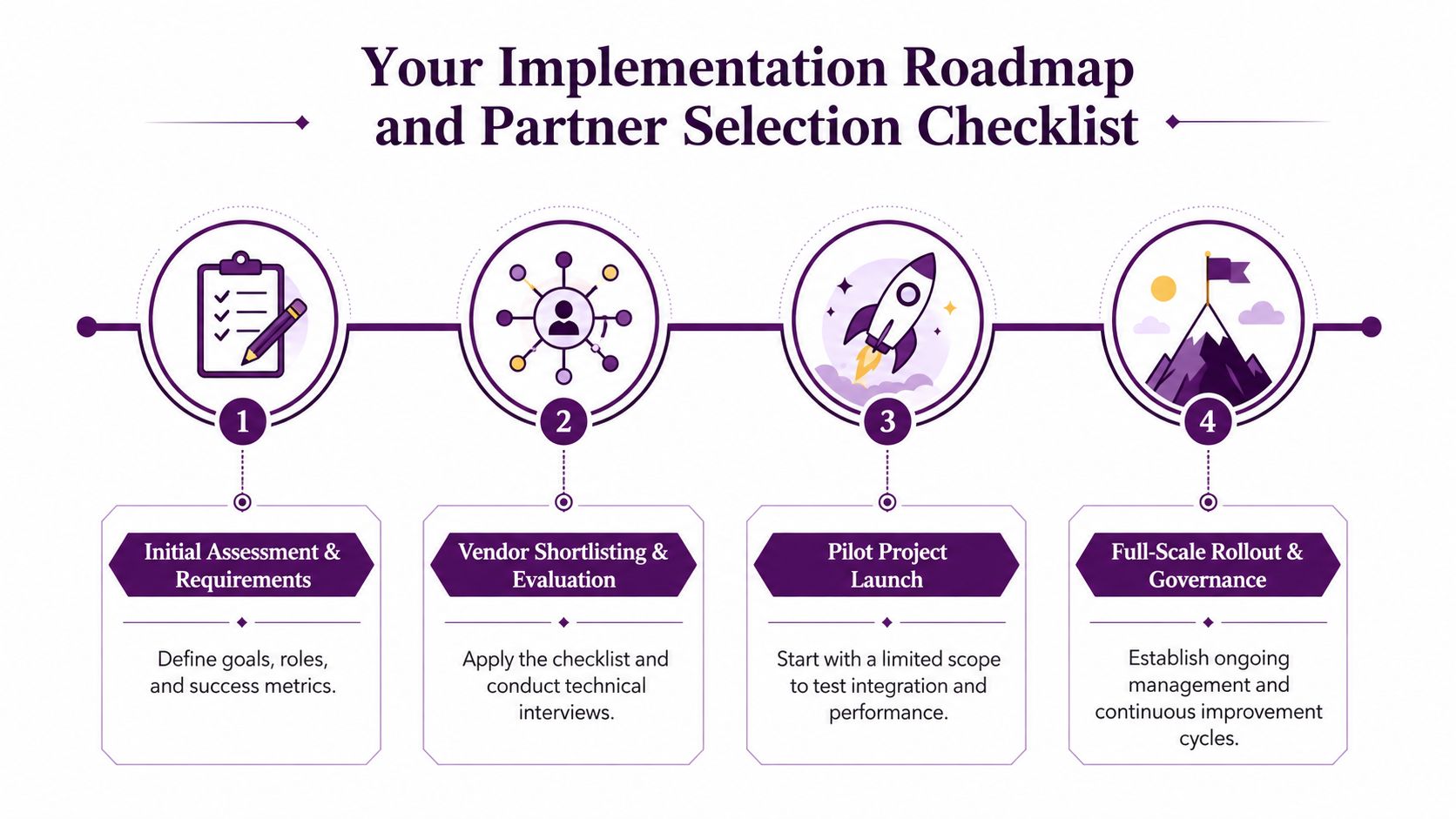
A practical rollout path
- Initial assessment. Define the customer journeys, back-office processes, or support queues that belong in scope.
- Vendor shortlisting. Review certifications, references, tooling, training, and escalation discipline.
- Pilot launch. Keep the pilot narrow enough to test integration, reporting, and quality under real conditions.
- Full rollout and governance. Lock in review cadences, service metrics, and improvement cycles.
Use CallZent’s vendor evaluation criteria to pressure-test fit before you sign. The key checklist items are straightforward, but they’re often skipped.
- Compliance readiness for the data and industries you serve.
- Technology maturity across CRM, QA, reporting, and workforce tools.
- Cultural fit that supports clear communication.
- Scalability that won’t collapse when volume spikes.
- Exit provisions so you’re not trapped if the arrangement underperforms.
The strongest implementations also involve the client from day one. If your team isn’t helping define strategy and performance tracking, the partner will optimize for convenience instead of outcomes.
If you’re comparing nearshore outsourcing solutions for customer support, bilingual service, or back-office operations, CallZent can help you map the right operating model in Tijuana and translate it into a workable rollout plan. Visit CallZent to review the service options, see how the team handles cross-border collaboration, and start a conversation about what your operation needs next.
Build Your Dedicated Nearshore Team in Mexico
CallZent can help you design a bilingual nearshore program around your customer experience, back-office workflows, service standards, and growth plans.
Talk to an ExpertFrequently Asked Questions
1. What are nearshore outsourcing solutions?
Nearshore outsourcing solutions transfer business processes to a provider in a nearby country. For U.S. companies, this often means working with teams in Mexico or Latin America that offer compatible time zones and closer collaboration.
2. How is nearshore outsourcing different from offshore outsourcing?
Nearshore providers operate in nearby countries and generally offer greater time-zone overlap and geographic proximity. Offshore providers may offer lower headline costs but can require more asynchronous communication and management coordination.
3. What services can a nearshore BPO provide?
Services may include customer support, technical assistance, sales development, appointment setting, healthcare support, order processing, finance administration, data processing, virtual assistance, and other back-office workflows.
4. Why do U.S. companies outsource to Mexico?
Mexico offers proximity to the United States, compatible working hours, access to English-Spanish talent, cultural familiarity, easier travel, and a potentially lower operating cost than equivalent onshore delivery.
5. Is nearshore outsourcing less expensive than onshore outsourcing?
It can be, but pricing depends on skills, services, hours, location, technology, security, management, and staffing requirements. Buyers should evaluate total operating value instead of comparing hourly rates alone.
6. Which industries benefit most from nearshore outsourcing?
Nearshore can be valuable for healthcare, financial services, SaaS, technology, e-commerce, retail, hospitality, legal services, telecommunications, and other industries requiring timely coordination or bilingual support.
7. How should a company evaluate a nearshore provider?
Review comparable experience, language proficiency, recruitment, training, retention, security, compliance, quality assurance, technology, reporting, management, escalation, pricing, scalability, and contractual terms.
8. Should a company run a nearshore pilot?
Yes. A focused pilot lets both parties test training, integrations, reporting, language quality, customer outcomes, and management collaboration before expanding the engagement.
9. How does AI affect nearshore outsourcing?
AI can support routine tasks, knowledge retrieval, summaries, routing, quality monitoring, and administrative automation. Human agents remain important for complex, sensitive, high-value, or exception-heavy work.
10. How long does it take to launch a nearshore team?
The timeline depends on recruitment, training, technology, integrations, security, workflow complexity, and team size. A controlled pilot can often launch more quickly than a large multi-process operation.