
Data Operations & Back-Office Support
Outsource Data Management: What to Delegate, Control, and Measure
Define processing boundaries, evaluate providers, protect sensitive records, and measure accepted output before expanding an outsourced data workflow.
TL;DR — Quick Takeaways
- Separate administrative processing from specialist engineering, infrastructure, and security services.
- Retain accountable ownership of policy, authorization, acceptance, and provider oversight.
- Map records, access paths, subprocessors, exports, and backups before transfer.
- Pilot representative work and verify field-level results, recovery, and exception handling.
- Compare total cost per accepted record and approve AI use explicitly.
Outsourcing more data work does not have to mean losing control. It does require a clear answer to three questions: what may the provider do, who approves exceptions, and how will your team verify the result? Without those boundaries, a small mapping error or an unclear handoff can affect thousands of records before anyone notices.
When you outsource data management, the objective should be dependable, usable information. A faster queue is helpful only if records reach the next system accurately, sensitive information stays within approved access boundaries, and someone owns corrections, recovery, and deletion.
Which Data Tasks to Outsource and Which to Retain
Data management covers several different services. A back-office processing team may handle record entry, document indexing, CRM cleanup, and validation. Storage administration, security monitoring, database engineering, and incident response require different skills and controls. Do not assume a provider offering one category can deliver the others.
A hybrid arrangement can separate execution from approval. Specialists may help design classification, access, or retention rules, but your organization still needs an accountable owner who approves the operating policy, understands the applicable obligations, and evaluates provider performance.
| Workflow | Potential provider role | Owner approval to retain |
|---|---|---|
| Entry and migration | Enter records, map approved fields, and reconcile batches | Source definitions, acceptance rules, release, and exception decisions |
| Cleanup and deduplication | Apply matching rules and flag uncertain matches | Merge thresholds, authoritative records, and disputed matches |
| Classification and retention | Recommend categories and execute approved tagging or disposal | Policy, retention obligations, holds, and authorized exceptions |
| Access administration | Provision and revoke permissions under approved procedures | Authorization, role design, and periodic access review |
| Storage, backup, and monitoring | Specialist infrastructure or security services, if separately qualified | Architecture, recovery goals, escalation, and evidence requirements |
| AI-assisted processing | Use specifically approved tools for defined tasks | Permitted data, model use, validation, retention, and approval boundaries |
Define the boundary around the real workflow
Consider a hypothetical retailer delegating catalog cleanup. The outside team standardizes descriptions and flags duplicate SKUs. The retailer approves category definitions, pricing authority, and disputed matches. Uncertain records enter an exception queue instead of being merged automatically into the live catalog.
A healthcare organization may similarly delegate indexing while retaining clinical interpretation and approval of access roles. Coding, infrastructure administration, and clinical decisions are separate scopes. Before transferring records, identify their sensitivity, the obligations that apply, and the person qualified to accept the work.
Evaluate Providers With Evidence, Not General Assurances
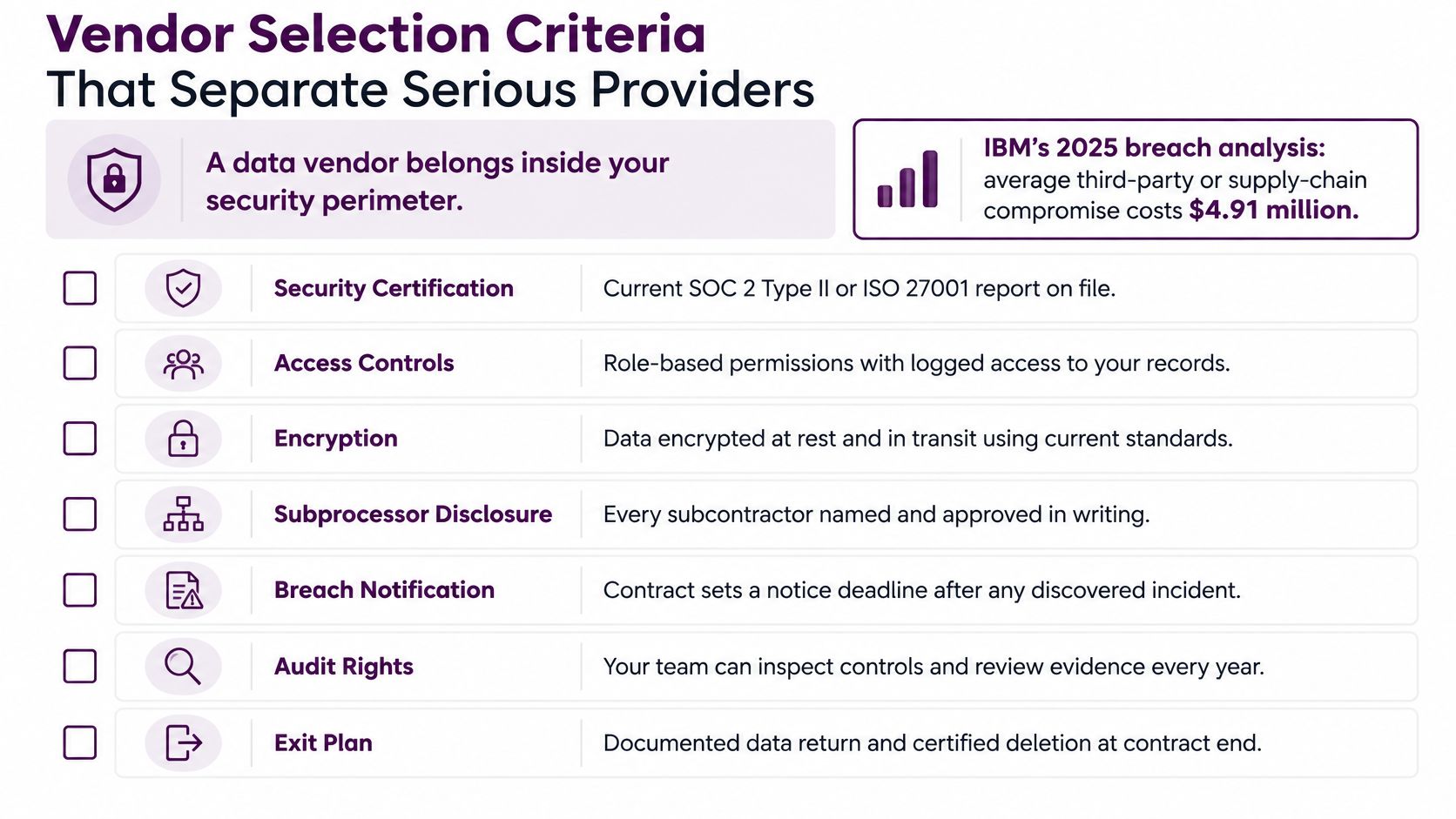
A data provider becomes part of your processing chain and can introduce new access paths, copies, and dependencies. That makes vendor selection an operating decision as well as a purchasing decision.
- Control evidence: Review relevant audit or assurance reports, scope, dates, exceptions, and remediation. A certificate logo does not establish that your workflow was assessed.
- Subcontractors and platforms: Identify external processors, permitted locations, and the process for approving or notifying changes.
- Data flows: Map sources, destinations, transfers, exports, local downloads, and backups.
- Quality measurement: Request field-level error reports, sampling rules, rejected-record examples, and corrective-action evidence.
- Staffing and training: Confirm required skills, supervision, replacement training, access approval, and language coverage.
- Continuity and exit: Specify usable return formats, access to necessary records, deletion handling, and transition assistance.
Test difficult records during a bounded pilot
A pilot should include representative data, ambiguous records, and escalation scenarios. Use approved synthetic or de-identified records where practical during early testing. If production information is necessary, complete the required agreements and access controls first.
Agree on what the provider may complete, what it may recommend, and what requires internal approval. A two-to-four-week pilot can be a planning example, but the appropriate duration depends on volume, complexity, and the time needed to observe exceptions. Price, scope, and acceptance criteria should be explicit.
References are most useful when they can explain how the team handled a disputed record, an urgent correction, or an unexpected staffing gap. Ask for the operating evidence behind the story.
Match Security and Privacy Requirements to the Activity
Start with the data, the entities involved, and what the provider actually does. HIPAA, GDPR, California privacy requirements, and PCI DSS have different scopes. An agreement or assessment for one service does not automatically cover recordings, exports, support tickets, or a separate processing environment.
| Requirement | Scope question | What to verify |
|---|---|---|
| HIPAA | Is the provider acting as a business associate in a HIPAA-regulated arrangement? | Required business associate agreement, permitted uses, safeguards, reporting, and subcontractor handling |
| GDPR | Does GDPR apply, and what controller or processor role does each party perform? | Article 28 terms, instructions, subprocessors, security, and any international-transfer requirements |
| PCI DSS | Does the service handle payment account data or affect the security of the cardholder-data environment? | Assessment scope, applicable responsibilities, and the provider’s relevant compliance evidence |
| CCPA, as amended | Does the arrangement fall within California requirements for the relevant entities and information? | Specified purposes, use restrictions, assistance, oversight rights, and required contract terms |
Healthcare records and business associate agreements
HHS guidance on business associate contracts explains the role of agreements in applicable HIPAA relationships. A scheduling or indexing arrangement involving protected health information needs review of the actual services and parties. Where required, complete the agreement before the provider receives access, and address recordings, transcripts, exports, and subcontractors as relevant.
Processor contracts and international transfers
When GDPR applies to processing on a controller’s behalf, document the required processor terms and instructions. Identify subprocessors and the applicable authorization process. Review cross-border access and transfers separately: an Article 28 agreement alone is not automatically a complete international-transfer solution. The European Commission’s standard contractual clauses guidance explains how the clauses relate to processing roles and transfer arrangements.
Payment security and California contract terms
PCI DSS scope can extend to providers that affect payment-data security even if they do not directly store, process, or transmit account data. Review the PCI Security Standards Council’s service-provider scope guidance, then confirm the specific service, responsibility allocation, and relevant assessment evidence. A provider’s Attestation of Compliance should be checked for scope rather than treated as approval of every workflow.
For California-covered service-provider or contractor arrangements, use the California Privacy Protection Agency’s current laws and regulations to review required contractual purposes, restrictions, and oversight provisions. A generic promise to follow instructions is not a substitute for all applicable terms.
Your legal, privacy, and security owners should confirm applicability and the final agreement. Contracts also need an operational counterpart: approved tools, named accounts, controlled exports, clear incident escalation, and evidence that the controls work.
Transition Data Work Through Six Acceptance Gates
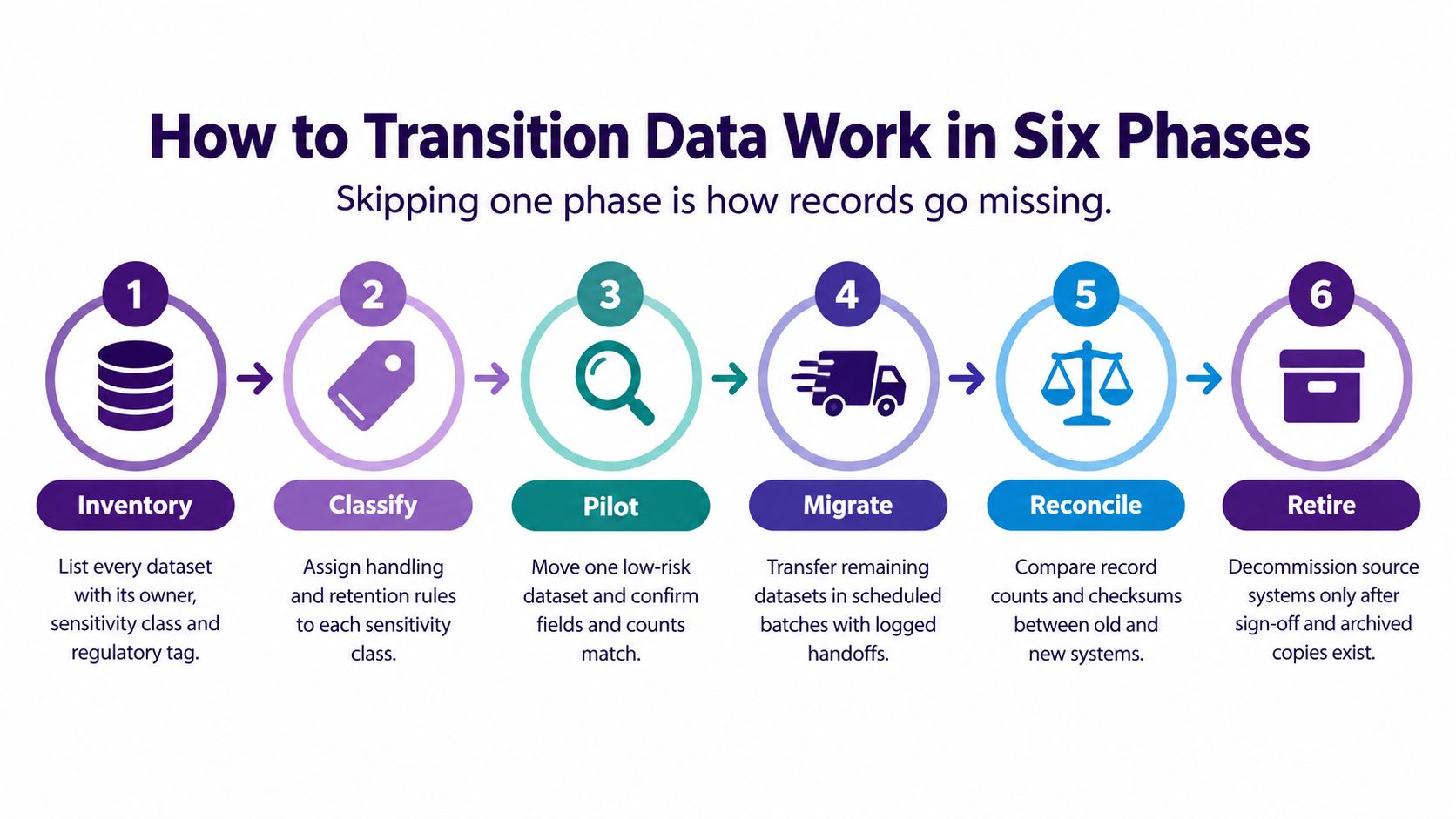
A controlled transition lets your team identify gaps before retiring the source workflow. Each phase needs an owner, evidence, and a decision about whether the next step may proceed.
- Inventory and classify: List datasets, fields, owners, sensitivity, source systems, and existing copies. Inspect actual fields rather than relying on filenames.
- Agree before transferring: Define permitted processing, data rights, retention, deletion, subprocessors, notification, acceptance, and exit support.
- Configure access: Use named accounts, least-privilege roles, appropriate authentication, separate test access, and suitable protection for storage and transfers.
- Pilot and reconcile: Compare record identifiers, mapped fields, rejected items, approved transformations, and accepted output.
- Test recovery and escalation: Demonstrate usable restoration and incident routing. Record elapsed recovery time, the recoverable data point, and escalation timestamps.
- Cut over in stages: Define rollback triggers, protect against conflicting writes or duplicate processing, and expand only after approval.
Reconcile fields as well as record counts
In a hypothetical pilot, the source and output contain identical record counts, but the export omits postal codes. A field-completeness check catches the omission before launch. Counting rows alone would have missed it.
Maintain a handoff register with batch IDs, source and output counts, rejected items, approved changes, and the accountable reviewer. Practical outsourcing project management makes those decisions visible to both teams.
A backup is not verified simply because a job reports success. Test that authorized staff can restore usable records and resume the workflow. Define recovery time objectives and recovery point objectives separately: one concerns restoration time, the other the acceptable data-loss window.
Use SLAs That Measure Accepted Output
An outside team can finish a queue early and still deliver unusable records. Select quality dimensions that affect the next business action, such as accuracy, completeness, validity, uniqueness, timeliness, and traceability. Define how each is tested instead of relying on one broad accuracy score.
- First-pass yield: Records accepted without rework divided by the defined records evaluated, with queue and acceptance rules disclosed.
- Field-level error rate: Errors among inspected eligible field values, separated by criticality and field.
- Deduplication quality: Precision measures how many flagged matches are true matches; recall measures how many true matches are detected, using a labeled evaluation set.
- Exception aging: Time unresolved items remain open, with urgency, ownership, and waiting-state rules defined.
- Reconciliation exceptions: Missing, extra, or mismatched records, with release-blocking conditions stated.
- Recovery performance: Tested restoration time and recoverable data against the agreed objectives.
- Deletion and access removal: Completion time, exceptions, retained-copy treatment, and overdue actions.
For example, an insurer may need policy numbers and loss dates to route claims. A high overall score can hide repeated errors in those critical fields. Report them separately and block affected records from release when the agreed acceptance rules require it.
A useful BPO SLA management process assigns calculation rules, a metric owner, review coverage, reporting windows, and a dispute process. Independently sample accepted work as well as rejected work; reviewing only failures does not reveal records accepted incorrectly.
Link throughput goals to quality thresholds and corrective action. Keep inspected results separate from estimates for the full population so a sample does not appear to prove that every delivered record is correct.
Compare Total Cost Across Delivery Models
Hourly rates do not capture the full cost of data processing. Compare equivalent scope, volume, service targets, retained oversight, and acceptance requirements across in-house, hybrid, and outsourced options.
| Cost category | Include in the comparison | Question to resolve |
|---|---|---|
| Staffing | Labor, supervision, training, absence coverage, and QA | Which activities and available hours are billable? |
| Tools and infrastructure | Licenses, storage, integrations, backup, transfer, and export costs | What is bundled, passed through, or billed separately? |
| Oversight and controls | Internal owner time, assurance review, monitoring, and remediation | Who reviews evidence and handles exceptions? |
| Quality and rework | Validation, correction, duplicate handling, and downstream repair | Who pays when work fails acceptance? |
| Transition and exit | Mapping, parallel operation, setup, offboarding, and usable data return | What does migration or termination require? |
Measure cost per accepted record carefully
Hypothetical example: A program costs $12,000 for the reporting period, including processing, QA, retained oversight, and rework. Of 10,000 submitted records, 9,500 are accepted by the cutoff. Cost per accepted record is $12,000 ÷ 9,500, or approximately $1.26. Report the remaining 500 records and their status rather than hiding them behind the unit cost.
These numbers illustrate a method, not a CallZent rate or expected result. Keep cost scope and outcome windows consistent, and avoid counting the same accepted record again after correction. Our outsourcing cost-benefit analysis guide provides a broader framework for comparing delivery options.
Price the architecture too. A controlled workspace may reduce copying, but it still needs mapped access, storage, backup, export, and exit arrangements. Neither cloud nor on-premises delivery is inherently the right answer for every dataset.
Establish Oversight and Approved AI Use

Assign a named internal owner to each data domain and give that owner authority to reject work, approve exceptions, and escalate unresolved issues. The provider’s service manager coordinates delivery; that role does not replace your accountable decision-maker.
Set a review cadence that matches risk. Operational meetings should examine open exceptions and quality trends. Control reviews should examine access, changes, incidents, recovery, and remediation. Periodically revalidate subprocessors, data flows, contract scope, and exit readiness.
Control AI tools before records reach them
Approve the tools, data categories, purposes, and validation rules for AI-assisted processing. Address model training, provider retention, browser extensions, and any subprocessors. Redaction and de-identification need verification; removing a name does not necessarily make a record anonymous.
Keep only the audit evidence needed for the task under defined access and retention rules. Logging every full prompt and output can create unnecessary copies of sensitive records. Specify how corrections, deletion requests, and incident investigations reach those copies.
The NIST Privacy Framework provides a voluntary structure for managing privacy risk. Use it to organize responsibilities across collection, processing, sharing, retention, and disposal; it is not a certification of the provider or a substitute for applicable obligations.
Start with a bounded program
Inventory the records, write acceptance and escalation rules, and choose a representative pilot before committing to full volume. Confirm that your team has enough time and expertise to review output, not just enough budget to purchase processing capacity.
If English-Spanish coordination and overlapping working hours fit the workflow, evaluate a Tijuana-based nearshore team alongside internal and specialist options. Discuss administrative record handling separately from engineering, hosting, cybersecurity, or other specialized services, and confirm the exact scope before selecting a provider.
Frequently Asked Questions
What does it mean to outsource data management?
It means delegating defined data workflows to an external provider under agreed instructions, controls, and acceptance rules. Scope may include entry, indexing, validation, or cleanup. Infrastructure, engineering, and security services require separate capability and scope checks.
Which data tasks are suitable for outsourcing?
Repeatable tasks with defined inputs and verifiable outcomes can be suitable, including record entry, document indexing, approved field mapping, and rule-based cleanup. Assess sensitivity, complexity, permissions, and your ability to verify results before delegating.
Which responsibilities should remain with an internal owner?
Retain an accountable owner for policy approval, access authorization, acceptance criteria, exception decisions, and provider oversight. Specialists can advise or execute approved procedures, but your organization still needs someone able to judge the work and applicable responsibilities.
How should a business evaluate a data-processing provider?
Review relevant control evidence, data flows, subcontractors, access management, training, quality measurement, recovery, and exit support. Test difficult records and exceptions in a bounded pilot rather than relying only on demonstrations or certificate logos.
Does outsourcing data processing require a HIPAA business associate agreement?
A required agreement depends on the parties and activity in a HIPAA-regulated arrangement. Where the provider acts as a business associate, address the applicable agreement and safeguards before access. Review recordings, exports, and subcontractor handling as part of the actual service.
Is a GDPR processor agreement enough for an international transfer?
Not automatically. Review the required processing terms and the international-transfer arrangements applicable to the parties, locations, and data flows. A processing agreement should not be assumed to resolve every cross-border access or onward-transfer requirement.
Which KPIs show whether outsourced data work is usable?
Useful measures include first-pass yield, field-level error rate, reconciliation exceptions, deduplication precision and recall, exception aging, and tested recovery performance. Define denominators, review coverage, acceptance rules, and severity before comparing results.
How should cost per accepted record be calculated?
Divide the relevant program costs by the defined records accepted within the agreed reporting rules. Include processing, quality review, retained oversight, and correction costs within scope. Disclose pending and rejected work and avoid counting the same accepted record more than once.
Can an outsourced team use AI with customer records?
Only within approved tools, purposes, access, and data-handling rules. Review retention, model training, subprocessors, validation, and human escalation. Limit audit copies and define how corrections, deletion, and incident investigation apply to prompts and outputs.
How should a data-management outsourcing pilot begin?
Inventory the records, name decision owners, resolve agreements and permissions, and set acceptance and rollback rules. Use representative records, test exceptions and recovery, reconcile fields as well as counts, and expand only after the responsible owner approves the results.
Bilingual Nearshore Support in Mexico
Build a More Reliable Back-Office Data Workflow
Bring your record types, expected volumes, systems, and acceptance requirements to CallZent. Discuss a bilingual nearshore back-office program with defined permissions, review responsibilities, and pilot goals.