Quality Monitoring
Quality Monitoring Guide for Contact Centers in 2026: Build a Smarter QA Program
Learn how to build a modern quality monitoring program for your contact center with practical QA frameworks, scorecards, AI tools, and nearshore BPO insights from Tijuana.
TL;DR — Quick Takeaways
- Quality monitoring is not just call listening. It is a structured way to improve service consistency.
- Sampling alone usually misses the underlying problem. You need a system that connects evaluation, coaching, and process fixes.
- Good QA protects more than compliance. It supports customer satisfaction, agent confidence, and better business decisions.
- The goal is not to punish agents. The goal is to remove guesswork and help them succeed more often.
- Modern quality monitoring combines people, process, and technology so leaders can coach faster, catch risk earlier, and improve customer outcomes.
Your agents sound capable. Your supervisors are busy. Customers still get uneven experiences.
That’s the situation many contact center leaders are in right now. A few calls get reviewed each week, some feedback gets shared, and everyone hopes service quality improves. Usually, it doesn’t. Not in a consistent way. Not in a way that moves customer satisfaction, retention, or margin.
Real quality monitoring isn’t just listening to calls and scoring agents. It’s an operating system for service performance. Done well, it shows you where conversations break down, where processes create repeat contacts, where compliance risk is hiding, and where good agents need better support instead of more pressure.
For a nearshore call center and BPO in Tijuana, this matters even more. Clients don’t hire an external team to get “good enough” service. They expect visibility, consistency, and ROI. That means quality monitoring has to connect directly to coaching, workflow design, reporting, and customer outcomes.
Introduction Beyond Just Listening to Calls
If your customer service results feel flat even though your team is working hard, the problem often isn’t effort. It’s the system behind the effort.
A lot of companies still treat quality monitoring like a side task. A supervisor grabs a few recordings, fills out a form, points out mistakes, and moves on. That approach creates noise, not improvement. It catches isolated errors, but it rarely shows why customers are calling back, why agents sound inconsistent, or why one shift performs differently from another.
The better view is simple. Quality monitoring is a business intelligence function inside the contact center. It helps leaders see patterns early, coach with evidence, protect brand standards, and make better operational decisions. That’s why it belongs next to workforce planning, training, and reporting, not buried inside a compliance checklist.
Teams that want a stronger service model usually also need a stronger understanding of the full contact center experience, because quality doesn’t live in one call. It shows up across the customer journey.
Great quality monitoring isn’t about catching agents doing things wrong; it’s about systematically creating an environment where they can succeed.
Here’s a practical example. An e-commerce support team may think it has an agent issue because refund calls are scoring poorly. After closer review, the underlying problem may be that agents are using three different policy explanations because the knowledge base is outdated. Without a proper quality monitoring program, management blames the rep. With a proper program, management fixes the source.
That’s the shift that matters. Reactive QA looks backward. Modern quality monitoring helps you run the operation forward.
What Quality Monitoring Really Means in a Modern BPO
In a modern BPO, quality monitoring means reviewing conversations the way a coaching staff reviews game film. You’re not only looking at whether one player missed a move. You’re studying execution, decision-making, consistency, and whether the system itself gave the team a fair chance to succeed.
That’s the difference between old QA and modern QA. Old QA asks, “Did the agent follow the script?” Modern QA asks, “Did the customer get the right outcome, was the process followed, was risk controlled, and what should we improve next?”
A broader view becomes even more useful when you’re managing multiple service lines, channels, and client requirements. That’s where tools such as conversational intelligence start to matter, because they help teams analyze patterns at scale instead of relying only on human spot checks.
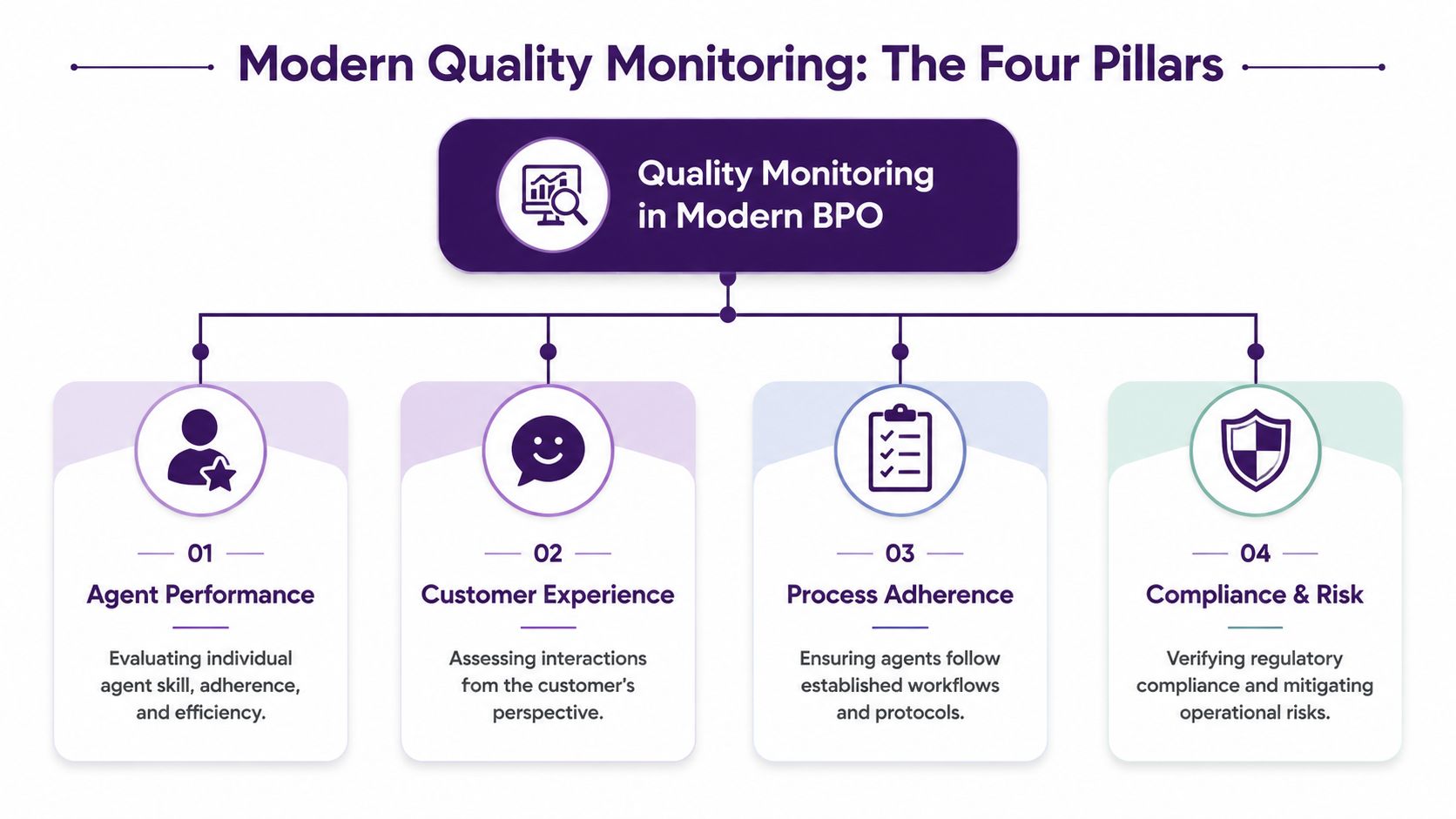
The four pillars of quality monitoring
Agent performance
This is the part often initially addressed. You evaluate communication skill, professionalism, product knowledge, listening, de-escalation, and call control.
But strong programs don’t stop at “agent did well” or “agent missed a step.” They separate skill gaps from process gaps. If an agent struggles to explain a billing rule, that may be a training issue. If five skilled agents struggle with the same billing rule, that’s probably a process issue.
Customer experience
A conversation can be compliant and still feel frustrating. That’s why quality monitoring has to include the customer’s side of the interaction.
Did the rep sound engaged? Did they explain next steps clearly? Did the customer leave with confidence, or just with a ticket number? In practice, this pillar often reveals the difference between a technically correct interaction and a brand-building one.
Process adherence
This pillar checks whether agents followed the right workflow, not just whether they were polite. Did they verify identity correctly? Did they document the case in the CRM? Did they route the issue to the proper queue?
A lot of repeat contact volume starts here. When process adherence is weak, the next team inherits incomplete work, and the customer has to start over.
Compliance and risk
In healthcare, finance, insurance, and collections, this pillar can’t be optional. Agents need to follow required language, security procedures, and disclosure standards. Misses here can create client risk fast.
A mature QA team doesn’t only score conversations. It protects the operation from silent failure.
A practical example from bilingual support makes this clear. An agent may deliver warm service in Spanish and still miss a required verification step. Another may follow every compliance line in English but rush the explanation so badly that the customer remains confused. Modern quality monitoring catches both kinds of problems because it looks at the entire interaction, not one narrow slice.
The Business Case for Effective Quality Monitoring
Quality monitoring has to earn its place like any other operational investment. If it doesn’t improve outcomes, it becomes administrative overhead. If it does improve outcomes, it becomes one of the most valuable management systems in the contact center.
The business case gets stronger when QA is tied to the metrics leaders already care about. That includes customer satisfaction, first contact resolution, customer complaints, handle time, repeat contacts, and team stability. It also includes revenue and margin, because customer experience problems eventually show up in both.
Organizations that implement quality management practices effectively see an average 9% increase in sales, a 26% increase in profitability, and a 40% reduction in customer complaints, according to data summarized by Steelhead’s quality statistics review citing ASQ findings. That’s why quality monitoring should be treated as a performance driver, not a support function that only audits agents.
A disciplined QA operation also gives managers better visibility into what to fix first. When leaders can monitor call center performance with quality data tied to operational KPIs, they stop making decisions based on anecdotes.
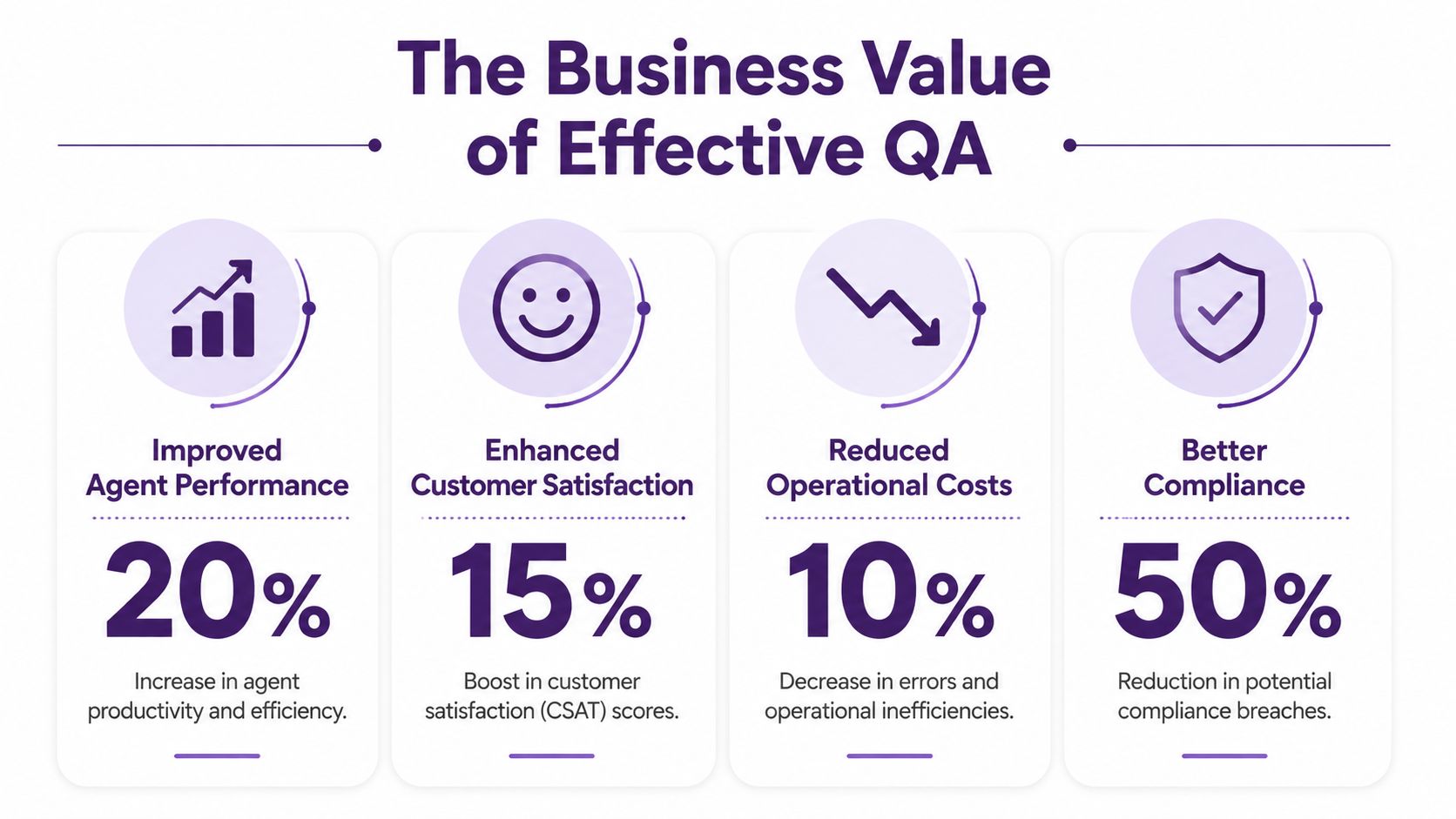
The KPIs that quality monitoring should move
-
Customer Satisfaction
QA improves CSAT when agents communicate clearly, set expectations well, and resolve issues without friction. -
First Contact Resolution
Better evaluations reveal where calls fail to resolve the true issue. That lets managers coach for better probing, cleaner documentation, and stronger ownership. -
Average Handle Time
Good QA doesn’t mean rushing calls. It means removing wasted steps, call repeats, and unclear explanations that prolong work. -
Customer complaints
Complaint volume often reflects inconsistency. Strong quality monitoring reduces the variation between agents, shifts, and queues. -
Agent retention
Teams stay longer when feedback feels fair, useful, and connected to real development instead of random criticism.
What ROI actually looks like in practice
Consider two support teams handling the same product. One reviews a handful of calls and gives broad feedback like “show more empathy” or “be more confident.” The other uses a structured scorecard, tracks issue trends, and coaches against specific behaviors like missed discovery questions or unclear ownership statements.
The second team usually improves faster because managers can connect behavior to outcomes. If repeat contacts are rising, QA can isolate whether agents are skipping troubleshooting steps, misunderstanding policy, or ending calls before confirming resolution. That makes corrective action faster and cheaper.
If your quality program can’t explain why customer metrics are moving, it’s not a quality program yet. It’s a grading exercise.
The strongest business case for quality monitoring is that it cuts waste on both sides of the equation. Customers spend less time repeating themselves. Managers spend less time guessing. Agents spend less time recovering from broken processes. That’s where ROI shows up.
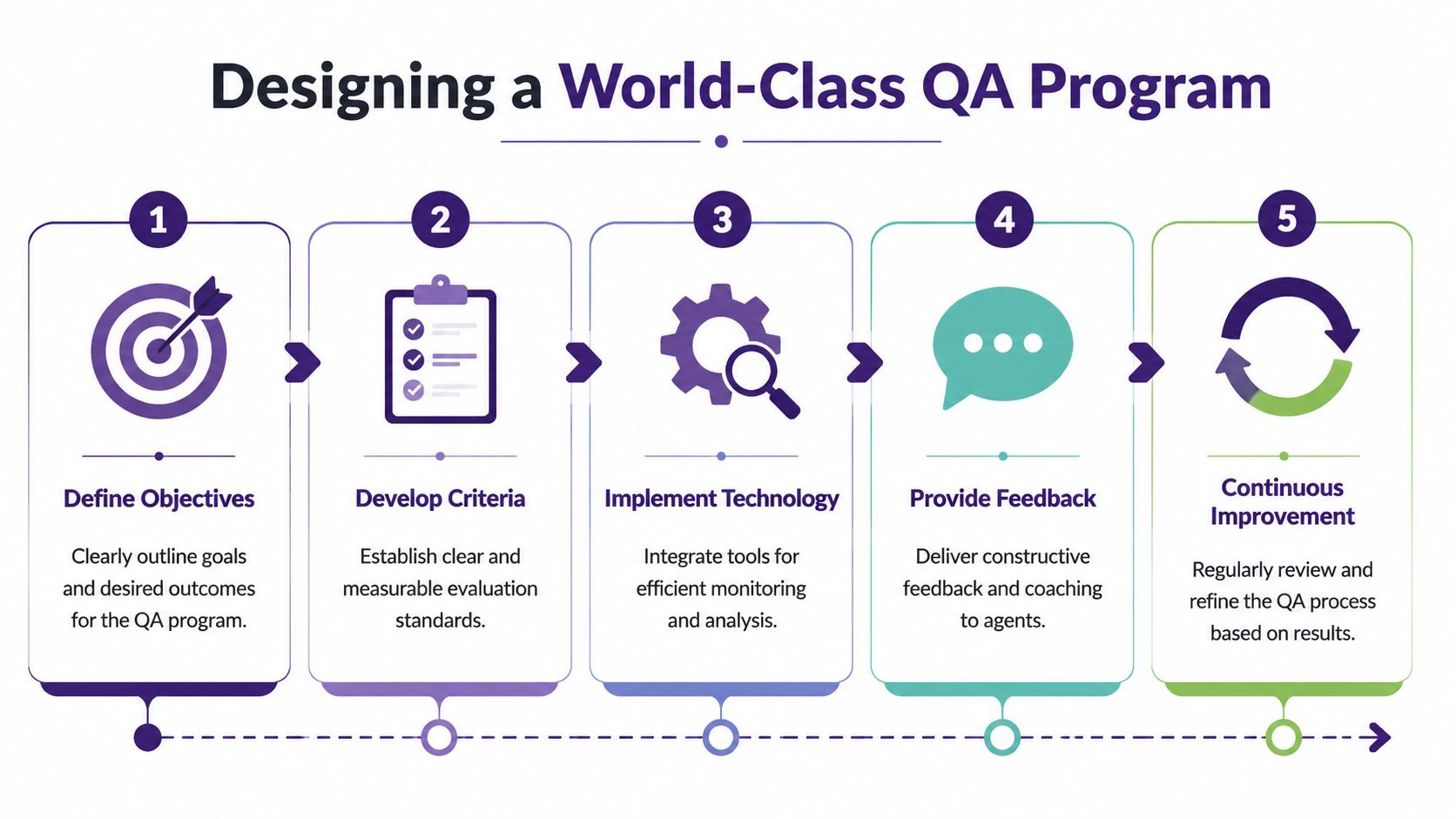
How to Design a World-Class QA Program
Most weak QA programs fail for predictable reasons. The scorecard is vague. Sampling is random. Coaching happens too late. Agents don’t trust the scoring. Supervisors use the form as a compliance sheet instead of a development tool.
A world-class program fixes those basics first.
Build the scorecard before you build the review process
Your scorecard is the backbone of quality monitoring. If the criteria are unclear, every downstream decision gets weaker. Agents feel judged inconsistently, supervisors coach based on opinion, and clients lose trust in the reports.
The best scorecards focus on behaviors that matter to the customer and the business. Ringover notes that when QA scorecard criteria are explicitly defined, objectively measured, and consistently communicated, team-level QA scores rise by 18% within 3–6 months, and targeted coaching tied to real-time analytics correlates with a 25% reduction in repeat contacts in its review of quality monitoring in call centers.
A balanced scorecard usually includes service quality, process execution, and risk controls. It should also be simple enough that two evaluators reviewing the same call arrive at nearly the same result.
Sample QA Scorecard Template
| Category | Criteria | Weight |
|---|---|---|
| Greeting and opening | Proper greeting, tone, verification, professional start | |
| Discovery | Asked relevant questions, identified root issue, active listening | |
| Accuracy | Shared correct information, followed policy, no misleading statements | |
| Empathy and communication | Clear language, ownership, appropriate empathy, confidence | |
| Process adherence | Followed workflow, documented correctly, routed properly | |
| Compliance | Required disclosures, verification steps, security procedures | |
| Resolution | Solved issue or advanced it correctly, set next steps clearly | |
| Closing | Confirmed understanding, summarized outcome, ended professionally |
The exact weighting should match the account. A healthcare line may prioritize compliance and accuracy. A retail support team may put more weight on resolution and brand voice. The mistake is using one generic form for every queue.
Choose a sampling strategy that reflects risk
Random sampling sounds fair, but it often misses what matters. A better approach mixes coverage based on customer impact and operational risk.
Use a sampling plan that includes:
-
New hires and nesting agents
Review more interactions early, because habits form fast. -
High-risk transactions
Pull calls involving payments, cancellations, complaints, escalations, or disclosures. -
Trend-based reviews
If one contact reason is driving repeats, sample that reason heavily for a period. -
Balanced channel coverage
Review calls, chats, emails, and bilingual interactions if the account uses them.
A simple example: if a telecom team sees a spike in billing disputes, don’t keep reviewing mostly password reset calls because they’re easier to score. Shift QA attention to the issue creating operational pain.
Make coaching fast and specific
Coaching is where quality monitoring either creates improvement or dies in a spreadsheet.
Agents improve when feedback is timely, narrow, and tied to examples. “You need to improve your soft skills” is too vague to change behavior. “You solved the issue, but you skipped the ownership statement before placing the customer on hold” is coachable.
Use a repeatable coaching cycle:
- Review the interaction and isolate the few moments that mattered most.
- Tie feedback to the scorecard so the agent sees the standard, not just the opinion.
- Practice the correction with a short roleplay or call opening rewrite.
- Recheck quickly in the next set of monitored interactions.
Practical rule: If feedback arrives too late, it becomes commentary. If it arrives quickly, it becomes performance management.
One operational note matters here. QA and operations should calibrate together. If evaluators, trainers, and team leads don’t agree on what good looks like, the scorecard won’t save you. Consistency across reviewers is just as important as consistency across agents.
Leveraging Technology for Smarter Quality Monitoring
Manual QA still has value, but it breaks down fast at scale. If your team reviews a tiny slice of interactions, you’re making decisions from an incomplete picture. That creates blind spots in coaching, compliance, and customer trend analysis.
Qualtrics argues that modern call centers need to evaluate 100% of customer interactions rather than relying on small manual samples, and reports that organizations using AI-powered full interaction monitoring achieve 20 to 30% higher First Contact Resolution rates and a 15% improvement in Customer Satisfaction scores compared with manual sampling in its article on call center monitoring.

What technology should actually do
Technology shouldn’t replace human judgment. It should direct human attention to the interactions that matter most.
Useful systems can flag:
- Compliance risk by identifying missing disclosures or verification language
- Sentiment shifts when calls move from neutral to frustrated
- Script adherence gaps when required steps are skipped
- Repeat issue patterns when customers call back for the same unresolved reason
- Coaching moments tied to silence, interruptions, escalation language, or poor ownership
That’s where tools like sentiment analysis platforms become practical, especially for teams that need a faster view of customer emotion across large call volumes.
The old model versus the modern model
Here’s the trade-off in plain English.
A manual-only process gives you depth on a small sample. An AI-supported process gives you broad coverage, faster alerts, and better prioritization. You still need humans to interpret nuance, calibrate scoring, and coach agents. But you no longer need those humans spending most of their week hunting for the right calls.
A common example is complaint handling. In a manual environment, a supervisor may discover a pattern after several weeks because only a few complaint calls were sampled. In a technology-assisted environment, the system can surface clusters of similar phrases, failed authentication steps, or repeated escalation triggers much earlier.
The real value of AI in quality monitoring is not speed alone. It’s visibility you can’t get from spot-checking.
This is also where provider choice matters. Platforms vary widely. Some are strong in speech analytics. Others fit multilingual operations better. Some teams combine internal QA staff with external support. For example, a nearshore provider such as CallZent can support bilingual monitoring workflows alongside the client’s own QA and operations teams, depending on the account design.
Quality Monitoring for Regulated and Niche Industries
Quality monitoring changes shape based on the industry. The framework stays familiar, but the risk profile doesn’t.
Healthcare support needs more than courtesy and speed. Agents may be handling sensitive patient information, appointment coordination, benefits questions, or follow-up communication that affects trust at a very personal level. In that environment, QA has to score for empathy and process discipline at the same time. A warm tone means little if verification is weak or documentation is incomplete.
Finance has a different pressure point. Accuracy, disclosure language, authentication, and data handling carry more weight because a small miss can create outsized risk. That’s why teams in regulated environments usually place much tighter controls around scorecard design, calibration, and escalation review.
What changes by sector
Healthcare
Healthcare programs often need QA reviewers who can evaluate both patient communication and policy-sensitive workflows. The hardest calls are not always the angriest ones. They’re often the calls where a patient is confused, vulnerable, or trying to manage a fragmented process.
The underserved access gap also matters. A review published in PubMed Central on digital quality measurement and remote monitoring barriers notes that lower-income and racially diverse populations can face barriers related to broadband access and medical app literacy. For healthcare organizations, that means quality monitoring shouldn’t assume every digital process is equally accessible to every patient.
Finance and insurance
In finance and insurance, a strong QA program has to catch risky phrasing, missing verification, and partial explanations that leave room for misunderstanding. “Mostly correct” isn’t good enough when customer trust depends on precise communication.
Bilingual monitoring is also critical here. If a customer receives key policy or payment information in a second language, the quality review has to evaluate the actual interaction, not an English-only summary after the fact.
E-commerce and retail need brand control
Retail and e-commerce accounts bring a different challenge. Return policies change. Promotions create sudden contact spikes. Customers expect quick answers and a consistent brand voice across chat, phone, and email.
A practical QA form for e-commerce usually checks whether the agent protected the brand while still solving the problem. If an agent rigidly reads policy but creates friction on a simple exchange, the interaction may be technically correct and commercially harmful.
That’s why niche quality monitoring can’t be generic. The scoring language, reviewer skill set, and coaching examples all need to reflect the business model behind the queue.
Maximizing ROI with a Nearshore Quality Partner
Building a strong quality monitoring program in-house takes time, management attention, reviewer training, calibration discipline, reporting structure, and technology integration. Many companies can do it. Many also underestimate how much daily maintenance it requires.
A nearshore model can shorten that ramp because the quality operation is built into the service model from the start. Nearshore call centers in Tijuana are defined by proximity, aligned time zones, cultural fit, and easier communication with North American clients, as explained in Saint’s overview of nearshoring in Mexico. Those factors matter in QA because feedback loops work better when the client team and the delivery team can review performance quickly and in real working hours.
Why the nearshore model helps quality monitoring
-
Closer collaboration
QA calibrations, client reviews, and coaching discussions move faster when teams share overlapping schedules. -
Better language coverage
Bilingual monitoring is easier to operationalize when English and Spanish support are part of the same delivery environment. -
Stronger cultural alignment
Evaluating empathy, tone, and brand voice is easier when reviewers understand the customer context behind the conversation. -
Faster issue resolution
If a process problem appears, the client and partner can work it through quickly instead of waiting on delayed handoffs.
The quality concern some buyers still have about outsourcing is understandable. But it’s also outdated when the partner has disciplined training and QA operations. Tijuana call centers use rigorous training and ongoing performance monitoring that can match or exceed U.S.-based quality standards, according to Outsource Consultants’ review of Tijuana support operations.
What to look for in a nearshore quality partner
Don’t choose based on labor cost alone. Ask practical questions.
- How do they score interactions
- How often do they calibrate with clients
- Can they evaluate bilingual contacts directly
- How do they connect QA findings to coaching
- What happens when quality issues point to process failures, not agent failures
If you’re evaluating a nearshore call center model, those questions will tell you more than any sales deck. The right partner won’t treat quality monitoring as a reporting add-on. They’ll treat it as the mechanism that protects service consistency and makes ROI visible.
🚀 Ready to Build a Smarter Quality Monitoring Program?
If you are reviewing whether your current QA process is improving customer experience, CallZent can be part of that evaluation. As a bilingual nearshore call center and BPO in Tijuana, CallZent supports customer service and back-office programs where quality monitoring, agent coaching, and operational visibility need to work together.
Talk to an ExpertFAQs About Quality Monitoring in Contact Centers
What is quality monitoring in a contact center?
Quality monitoring is the process of reviewing customer interactions to evaluate agent performance, customer experience, process adherence, compliance, and opportunities for coaching or operational improvement.
Is quality monitoring the same as quality assurance?
Quality monitoring is part of a broader quality assurance program. Monitoring focuses on reviewing interactions and identifying patterns, while quality assurance also includes scorecard design, calibration, coaching, reporting, and process improvement.
Why is quality monitoring important for contact centers?
Quality monitoring helps contact centers improve service consistency, reduce repeat contacts, protect compliance, coach agents more effectively, and connect customer experience issues to operational decisions.
What should a QA scorecard include?
A QA scorecard should include categories such as greeting, discovery, accuracy, empathy, communication, process adherence, compliance, resolution, and closing. The exact weighting should reflect the account, industry, and customer journey.
How many calls should a contact center monitor?
The right number depends on volume, risk, team maturity, and available technology. Modern programs often combine targeted human reviews with AI-supported monitoring to evaluate a broader share of interactions.
How does AI improve quality monitoring?
AI helps quality monitoring by flagging compliance risks, sentiment shifts, script adherence gaps, repeat issue patterns, and coaching moments across large volumes of customer interactions.
Can quality monitoring improve customer satisfaction?
Yes. Quality monitoring can improve customer satisfaction when it helps agents communicate clearly, resolve issues more consistently, set expectations properly, and reduce customer effort.
Why does bilingual quality monitoring matter?
Bilingual quality monitoring matters because English and Spanish interactions should be evaluated directly, not summarized or translated after the fact. This helps protect accuracy, empathy, compliance, and customer trust.
What industries need stronger quality monitoring?
Healthcare, finance, insurance, collections, retail, e-commerce, SaaS, and high-volume customer service operations often need stronger quality monitoring because service errors can affect compliance, retention, revenue, and brand trust.
How can CallZent help with quality monitoring?
CallZent helps businesses build nearshore customer service and back-office operations from Tijuana with quality monitoring, agent coaching, bilingual support, reporting visibility, and operational discipline built into the service model.
If you’re reviewing whether your current QA process is improving customer experience, CallZent can be part of that evaluation. As a bilingual nearshore call center and BPO in Tijuana, it supports customer service and back-office programs where quality monitoring, agent coaching, and operational visibility need to work together.