

REMOTE CALL CENTER
Remote Agent Call Center Guide for 2026
Learn how a remote agent call center works, compare US, offshore, onsite, and nearshore models, and discover the key technologies and KPIs that drive performance.
TL;DR — Quick Takeaways
- Remote agent call center models replace physical offices with cloud-based operations.
- Nearshore remote teams often outperform US-only remote setups in cost, retention, and bilingual support.
- Technology stack—not location—determines operational success.
- KPIs like FCR, AHT, and CSAT must be analyzed together for real insights.
Is your customer support model giving you less control, higher labor costs, and fewer good hires than it should?
A lot of companies still frame the decision the wrong way. They compare onsite against remote and stop there. The better question is which remote model gives you the best mix of cost, quality, retention, and operational control. For many US businesses, the strongest answer isn’t a fully distributed US-only team. It’s a managed nearshore remote or hybrid setup that keeps service quality close while making staffing far easier.
Your Guide to the Modern Remote Agent Call Center
A remote agent call center is no longer a temporary workaround. It’s a mainstream operating model. The remote call center agent workforce was projected to grow 60% from 2022 to 2024, and firms save over $11,000 per employee annually in half-time remote setups, according to Sprinklr’s call center statistics roundup.
That matters because most support leaders aren’t only trying to cut overhead. They’re trying to solve three recurring problems at once:
- Labor pressure from hard-to-fill roles and bilingual hiring gaps
- Service inconsistency during peaks, launches, and after-hours coverage
- Operational rigidity from office-based staffing and fixed local recruiting pools
TL;DR
- Remote agent call center models let agents work through cloud systems instead of a single physical floor.
- Not all remote models perform the same. A fully distributed US-only team and a managed nearshore team solve different problems.
- Nearshore partnerships often win on balance because they pair lower delivery costs with stronger team cohesion, easier bilingual staffing, and tighter time zone alignment for US businesses.
- Technology decides whether remote works well or poorly. Routing, analytics, security, and coaching tools matter more than office location.
- AI will handle more routine work, but human agents still carry complex conversations, regulated workflows, and empathy-heavy interactions.
One practical shift many operators miss is the back-office side of customer support. If agents are still rekeying forms, updating records manually, or copying data between systems, the remote model loses efficiency fast. That’s why operations teams increasingly look at automation tools alongside telephony and CRM. A useful example is this guide to AI for data entry, which shows how reducing repetitive admin work can support cleaner workflows for distributed service teams.
A modern remote setup works best when it’s built as an operating system, not a loose collection of home-based agents.
What Exactly Is a Remote Agent Call Center
A traditional call center is one building, one floor, one local labor market. A remote agent call center is a connected operating network. Agents can work from home, from a managed facility, or from a blend of both, while supervisors still manage queues, performance, compliance, and customer experience from a shared platform.

The simplest way to think about it is this. The office is no longer the center of the operation. The technology stack is the center. Calls, schedules, recordings, customer records, QA reviews, and coaching all sit in cloud systems that authorized staff can access securely from different locations.
Three operating models businesses usually mean
The phrase “remote call center” gets used loosely. In practice, buyers are usually choosing between three different structures.
| Model | What it looks like | Where it works well | Where it breaks down |
|---|---|---|---|
| Fully distributed | Agents work individually from home, often across many states | Fast hiring, broad labor pool, overflow coverage | Uneven coaching, culture gaps, wide variance in setups |
| Hub-and-spoke | A core office team supports remote agents | Businesses that want some in-person training and QA | More coordination complexity than either pure onsite or fully remote |
| Managed nearshore | A partner recruits, trains, and manages a dedicated team in a nearby country, often with remote or hybrid flexibility | Bilingual support, cost control, timezone alignment, structured management | Requires careful vendor selection and clear process ownership |
The managed model is often misunderstood. It isn’t just outsourcing with a different label. When done well, it gives you the flexibility of remote staffing without leaving supervision, quality, and training entirely up to chance.
A remote agent model succeeds when management systems are stronger than location differences.
Why the managed nearshore model feels different in practice
In a fully distributed setup, every agent environment is a little different. Internet quality varies. Background noise varies. Team habits vary. New hires can feel isolated. Supervisors can still manage performance, but the operation depends heavily on discipline and tooling.
A managed nearshore model adds more structure. Recruitment happens against a defined profile. Training follows a repeatable process. QA calibration is centralized. Team leaders can coach agents in real time and reinforce service standards daily. That usually produces a more consistent customer experience than a loose network of contractors.
This matters even more for bilingual support. If your customers switch naturally between English and Spanish, you need more than language fluency. You need context, pacing, tone, and cultural familiarity. A nearby nearshore market often handles that better than either a generic offshore team or a scattered domestic remote pool.
For leaders comparing options, this overview of call centers and BPO models for business leaders is a useful starting point because it frames the decision at the operating-model level, not just the staffing level.
What a good remote agent call center includes
A working model usually has these ingredients:
- Cloud telephony and routing so calls reach the right queue and the right agent
- CRM access so agents see customer context instead of starting blind
- QA and recording workflows so supervisors can coach consistently
- Security controls for customer data, devices, and regulated interactions
- Workforce management discipline for schedules, coverage, adherence, and forecasting
Without those pieces, “remote” quickly turns into “harder to manage.”
The Business Case for a Remote Agent Workforce
The strongest business case for a remote agent workforce isn’t based on one savings line. It comes from combining staffing flexibility, broader hiring reach, and better retention options.
That last point matters more than many executives admit. US call centers continue to deal with high turnover. Industry turnover averages 30% to 40% annually in the US, while 81% of agents prefer remote work, a Stanford study found a 13% performance boost for home-based agents, and 73% of leaders plan to maintain long-term hybrid or remote models for retention, according to Xima Software’s call center statistics roundup.
The biggest misconception about remote call centers isn’t security; it’s assuming all remote models are created equal. A managed nearshore remote team often provides the cost savings of remote work with the quality control and cultural cohesion of an in-office team.
Where remote creates clear business value
A retailer with seasonal spikes is a simple example. Holiday volume hits. Order status questions surge. Returns go up. A rigid onsite team has to either overhire early or accept long waits. A remote workforce gives operations leaders more room to adjust schedules, add trained agents, and extend hours without reopening the entire staffing plan.
Healthcare teams see a different version of the same issue. They need dependable support for appointment questions, billing inquiries, benefit explanations, and follow-up communication. In that environment, remote support can work very well, but only when the operation is built around secure access, monitored workflows, and coaching discipline.
Three gains usually matter most:
- Wider hiring reach: Companies aren’t limited to one commuting radius.
- Better staffing flexibility: Coverage is easier across evenings, weekends, and demand spikes.
- Retention advantage: Many agents want remote or hybrid work, and operators who ignore that preference make hiring harder than it needs to be.
For teams evaluating staffing approaches, this guide to remote customer service agents gives a practical view of how the model supports customer operations.
The trade-offs are real
Remote operations do create risk. Pretending otherwise leads to sloppy implementations.
Common failure points include:
- Security drift: Agents using weak home setups or mixed personal devices
- Thin onboarding: New hires know the script but not the workflow
- Weak supervision: Managers review reports after the fact instead of coaching in the moment
- Culture erosion: Teams stop feeling accountable to each other
Practical rule: If your remote model depends on trust alone, it will break under pressure. It needs process, monitoring, and repeatable coaching.
A fully distributed domestic model often struggles here because leadership has fewer levers to standardize day-to-day behavior. Some teams handle that well. Many do not. The result is usually inconsistent QA, variable service tone, and uneven adherence.
What works better than broad remote hiring alone
The strongest remote operations don’t just hire people who can answer calls. They build a controlled environment around the work.
That usually means:
- Clear role design with separate expectations for support, retention, sales, and escalation
- Structured onboarding that teaches systems, not just scripts
- Ongoing QA calibration so supervisors score calls consistently
- Centralized reporting that flags coaching issues before service drops
- Operational backup plans for connectivity, absences, and sudden call surges
A nearshore managed team often performs well here because it combines remote flexibility with more operational consistency. You still get workforce agility, but the agents aren’t left to self-manage their own standards.
That’s the core business case. Remote is valuable. Managed remote is more dependable.
Remote vs Onsite vs Offshore A Strategic Comparison
Most companies don’t choose between “remote” and “not remote.” They choose among four real options: traditional onsite, offshore, fully remote US-based, and nearshore remote.
That decision affects cost, service quality, staffing speed, bilingual coverage, and the amount of management effort your internal team has to carry.
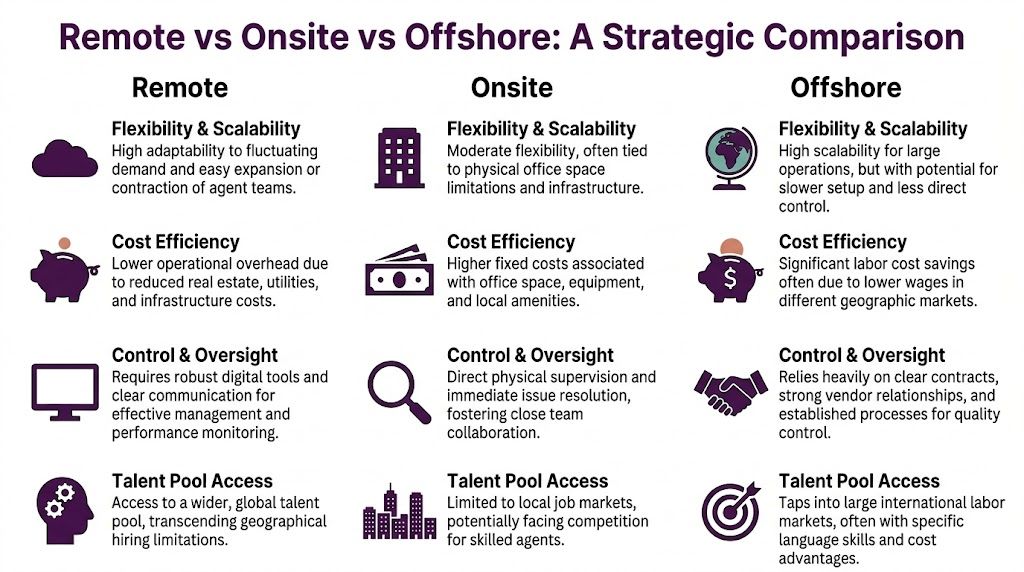
A side-by-side view of the real trade-offs
| Model | Best fit | Main strength | Common weakness |
|---|---|---|---|
| Onsite | Highly controlled local operations | Direct supervision and in-person culture | Higher fixed overhead and narrower hiring pool |
| Offshore | Large-scale cost-driven programs | Lower labor cost for high-volume work | More distance in timezone, communication style, and daily coordination |
| Fully remote US-based | Brands that want domestic coverage without office dependence | Flexible domestic hiring | Often expensive and harder to standardize at scale |
| Nearshore remote | US businesses needing bilingual support, close collaboration, and lower delivery cost | Balance of cost, culture, and timezone alignment | Requires a strong partner and clear operating standards |
The common mistake is assuming offshore and nearshore are the same thing. They are not. Distance changes management.
Why onsite still appeals to some operators
Onsite centers still make sense when physical control is the top priority. Managers can walk the floor, pull agents into quick coaching sessions, and run training in person. For highly customized teams with frequent process changes, that can feel simpler.
But onsite creates hard limits. You hire from one local market. You pay for space, equipment, and all the overhead that comes with a fixed footprint. If your area has tight labor competition, staffing becomes a recurring problem.
Why fully remote US-based teams aren’t always the best remote answer
A US-only remote model sounds ideal on paper. You keep domestic labor, remove office costs, and recruit broadly. In practice, execution can get messy.
You may end up with agents spread across many states, each with different availability, home setups, and training habits. Management can absolutely make this work, but internal teams need strong QA, scheduling discipline, and better tooling than they often expect.
This model also tends to be the most expensive version of remote if your business needs broad coverage and bilingual support.
Where offshore helps, and where it starts to strain
Offshore is often chosen for labor arbitrage. For very large, process-heavy programs, that can make sense. The model can scale well when scripts are stable and the work is highly standardized.
The pressure points show up in customer conversations that depend on timing, nuance, and close collaboration with US-side teams. Escalations slow down. Product changes take longer to reinforce. Meetings happen at awkward hours. That doesn’t mean offshore can’t work. It means it’s not automatically the best fit for every customer-facing function.
Why nearshore often hits the operational sweet spot
For US businesses, nearshore usually performs best when the program needs any combination of:
- English-Spanish bilingual support
- Fast collaboration with US managers
- Shared business hours
- More consistent culture and training
- A lower cost base than US domestic staffing
Tijuana is a good example of that advantage. According to the verified data tied to this Indeed market reference, Tijuana-based operations can cut costs by 30% to 50% compared to US rates while maintaining cultural alignment, and they achieve 25% higher agent retention than purely home-based US remote setups due to stronger training and community support.
That last point is usually undervalued. Retention isn’t just an HR metric. It affects service consistency, training costs, QA stability, and customer trust.
When support teams stay longer, supervisors spend less time rebuilding the floor and more time improving performance.
A practical way to choose
Ask four questions:
- Do you need bilingual support as a core capability or just occasional coverage?
- How much daily oversight does your process require?
- Will your US team need real-time collaboration with supervisors and QA leads?
- Are you optimizing for the lowest possible labor rate or the best total operating result?
If the answer includes close collaboration, customer nuance, bilingual service, and cost discipline, nearshore is usually the strongest fit.
For a deeper look at how nearshore and offshore differ in actual service delivery, this comparison of offshore vs nearshore contact center outsourcing is worth reviewing.
 Key Technologies That Power a Modern Remote Call Center
A remote agent call center runs on process, but process only works when the tools fit together. Bad technology creates lag, repeat contacts, blind transfers, and weak coaching. Good technology makes a distributed team feel local.
The foundation starts with routing. According to the verified data in LiveAgent’s call center requirements checklist, combining Automatic Call Distribution (ACD) with skill-based routing can reduce average handle time by 20% to 30% and lift first-call resolution to over 75% by matching customers to the most qualified agents.
ACD and IVR do more than move calls
Companies often think about routing as plumbing. It’s more strategic than that.
A well-designed ACD decides which queue and which agent should receive a contact. An IVR collects useful context before the handoff. Together, they reduce avoidable transfers and shorten the path to resolution.
A simple example:
- A patient calls with a billing issue
- The IVR captures language preference and issue type
- The ACD routes the call to a billing-trained bilingual agent
- The agent starts with context instead of discovery from scratch
That’s better for the customer and easier on the agent.
The rest of the stack has to work together
A remote team doesn’t need a long shopping list of disconnected apps. It needs a few systems that share information cleanly.
| Technology | What it does | What happens if it’s missing |
|---|---|---|
| CRM integration | Gives agents account history, prior contacts, and case status | Agents ask repeat questions and miss context |
| VoIP platform | Delivers voice calls through the internet with centralized controls | Audio issues and fragmented call handling increase |
| WFM software | Forecasts demand and manages schedules | Coverage gets uneven and adherence slips |
| QA and recording tools | Support coaching, compliance, and calibration | Managers coach from memory instead of evidence |
| Security controls | Protect access, devices, and customer data | Risk rises fast in regulated or payment-heavy workflows |
The smart way to evaluate the stack is by asking one question. Can a supervisor see what the customer experienced, what the agent did, and what should happen next, without switching between five systems?
Operational test: If a supervisor can’t audit a call, the case record, and the schedule context in one workflow, your stack is adding friction.
Security has to be part of the design
Security isn’t a bolt-on task for IT after launch. In remote operations, it shapes how the whole environment works.
For healthcare, finance, insurance, and retail support, that means controlled access, device standards, authenticated logins, and call recording practices that align with compliance requirements. It also means planning for the ordinary failures that hurt service most: dropped home internet, poor headset quality, unsecured browser sessions, and agents trying to work around process because the approved tools are slow.
Good remote technology reduces those workarounds. It makes the right process the easiest process.
If you’re comparing requirements at the feature level, this checklist of call center software features is a strong way to pressure-test whether a platform can support a serious remote operation.
How to Measure Success with Remote Agent KPIs
Remote teams don’t need more metrics. They need the right metrics, read in context, by managers who know what action to take.
That’s why dashboards matter. Verified data from IR’s guide to remote call center management shows that real-time analytics and remote management tools can improve agent performance by 18% to 25% and reduce attrition by 15%. Without that visibility, remote agents can face 20% to 30% higher idle time, while tools like whisper coaching let supervisors intervene during live calls.
Five KPIs that actually tell you something useful
A KPI is only helpful if it points to a management action.
First-call resolution
FCR tells you whether customers are getting a real answer the first time. In remote operations, weak FCR often points to one of three problems: bad routing, poor knowledge access, or training gaps.
If FCR drops after a new product launch, the issue usually isn’t agent effort. It’s that the frontline team didn’t get enough practical guidance.
Average handle time
AHT is often abused. Leaders push it down without checking whether they are creating repeat contacts. Used correctly, AHT helps identify friction in the workflow.
AHT rises when agents:
- Search too many systems
- Wait on slow approvals
- Handle mismatched call types
- Lack confidence on a new process
A high AHT isn’t always bad. A rising AHT without better outcomes is the warning sign.
Customer satisfaction
CSAT gives you the customer’s view of the interaction, but only when paired with call reviews. A low score may reflect agent tone, long hold time, a poor transfer, or a policy the agent couldn’t change.
That’s why good supervisors don’t coach to the score alone. They coach to the behavior behind it.
The management metrics that expose hidden issues
Occupancy rate
Occupancy shows how much of an agent’s logged-in time is spent handling customer work. In remote teams, low occupancy can indicate weak forecasting, poor queue design, or status misuse.
Very high occupancy creates a different problem. Agents burn out when there’s no recovery space between interactions.
Schedule adherence
Adherence tells you whether staffing plans are real or theoretical. In a remote environment, this metric matters because agents are not physically visible. If adherence slips, service level suffers before many managers notice.
A supervisor who watches adherence in real time can fix issues early by rebalancing queues, moving breaks, or stepping in before wait times climb.
Good remote management is less about surveillance and more about early correction.
Read KPIs as a pattern, not a scoreboard
One metric rarely tells the full story. Look for combinations.
| Pattern | Likely issue |
|---|---|
| AHT up, FCR down | Training or routing problem |
| CSAT down, AHT stable | Tone, empathy, or policy friction |
| Occupancy low, queues uneven | Forecasting or staffing mismatch |
| Adherence weak, service slipping | Schedule control problem |
| FCR strong, CSAT weak | The issue was solved, but the interaction felt frustrating |
That pattern reading is what separates a reporting culture from an operating culture.
If you want a more detailed view of the customer-service side of measurement, this guide to KPIs in customer service is a useful companion.
Finding Your Ideal Remote Call Center Partner
Who should run your remote agent operation when service quality matters, bilingual coverage matters, and your finance team is still pushing for lower cost?
The answer is rarely the cheapest US-only remote staffing option. For many US businesses, the better fit is a managed nearshore remote or hybrid partner that owns execution, not just recruiting. That model usually gives you lower labor cost, stronger bilingual hiring, and better retention than a fully remote domestic team. It also keeps collaboration easier than a far-off offshore setup, especially when your supervisors need same-day decisions and your customers switch between English and Spanish in the same interaction.
That difference shows up fast in operations. A vendor that only supplies remote agents leaves your team handling training gaps, schedule problems, QA disputes, and supervisor escalations. A managed partner takes responsibility for the operating system behind the agents: workforce management, coaching, reporting, quality control, and issue resolution.
What to test during vendor selection
Start by checking whether the partner can run your program with low friction for your internal team.
-
Operating model clarity
Ask who owns hiring, onboarding, nesting, QA, schedule adherence, and escalations. If ownership is vague during sales, it will stay vague after launch. -
Nearshore bilingual strength
For US brands serving English and Spanish speakers, this is often where nearshore providers pull ahead of US-only remote teams. Ask how bilingual agents are recruited, how fluency is tested, and how the team handles live code-switching without sounding scripted or awkward. -
Retention and staffing stability
High turnover destroys remote performance. Ask about average tenure, backfill process, and how quickly they can replace attrition without dropping service levels. Nearshore labor markets often give partners an advantage here because the role is more competitive locally and career paths are easier to build within a managed center. -
Training and QA discipline
Ask to see the onboarding plan, coaching cadence, calibration routine, and scorecard design. Strong operators can show how feedback moves from QA into behavior change on the floor. -
Management accessibility
Your team should be able to reach supervisors and account leads during normal US business hours. Nearshore teams usually make that easier than offshore vendors working across wide time gaps. -
Security and compliance controls
If your workflows touch payments, healthcare, or customer records, ask how access is controlled, how recordings are handled, and whether remote and hybrid seats follow the same standards.
The best partner removes work from your managers. They do not create a second management job on the client side.
Ask questions that expose how they really operate
Sales language tends to sound the same across vendors. Process detail separates experienced operators from firms that are still improvising.
Use questions like these:
- How do you calibrate QA scores with client stakeholders each month?
- What does the first two weeks of onboarding look like by day and by owner?
- How do team leads coach agents during live service risk, not just after the fact?
- What triggers an escalation to your account manager versus your operations manager?
- How do you measure bilingual quality beyond pronunciation and script compliance?
A strong nearshore partner should answer in workflows, meeting cadence, and accountability paths. If the answer stays at the slogan level, expect operating problems later.
Compare pricing models with the delivery model behind them
The rate matters. The management layer matters more.
| Pricing model | Best for | Watch out for |
|---|---|---|
| Per hour | Variable demand, blended support, seasonal flexibility | Weak forecasting can leave you paying for underused time |
| Per call or per transaction | Narrow, repeatable interactions | Agents may be pushed toward speed instead of resolution quality |
| Dedicated agent | Complex support, product knowledge, retention work, bilingual service | Volume needs to be steady enough to justify dedicated capacity |
For many midmarket and enterprise teams, dedicated nearshore teams outperform fully remote US agent models on total value, not just hourly cost. You usually get more schedule coverage, better bilingual consistency, and lower replacement churn. A domestic freelance-style remote model can work for simple queues, but it often gets expensive once you add supervision, QA, and turnover costs back into the picture.
Choose a partner that can run the work, not just staff it
A good remote call center partner should feel close to your operation, but still own its lane. You should know who is accountable for staffing, who reviews quality, who fixes service drift, and who can make a call the same day when volume or customer sentiment shifts.
If you are evaluating providers, contact the team and compare your requirements against an operating model that covers management, retention, bilingual quality, and day-to-day execution.
The Future Is Hybrid AI and Human Agents
The future of the remote agent call center isn’t AI alone, and it isn’t human-only either. It’s a hybrid model where automation handles the routine layer and skilled agents handle the complicated layer.
Verified data tied to this AI customer service job market reference says that by 2026, AI receptionists are expected to handle 80% of routine calls with 95% accuracy. The same source notes that 62% of financial and healthcare firms report AI alone fails compliance, and skilled bilingual agents resolve complex issues 40% faster than pure remote counterparts.
That mix lines up with what operators see in the field. AI is good at repetitive intake, appointment reminders, status checks, and other structured interactions. It is far less reliable when a customer is upset, switching languages, asking for exceptions, or dealing with sensitive financial or healthcare information.
A practical model looks like this:
- AI handles routine front-door tasks
- Human agents take escalations and edge cases
- Supervisors monitor exceptions and refine workflows
- Operations teams use AI to support agents, not just replace them
For teams exploring that shift, this AI Customer Service Agent Guide is a useful resource because it frames automation as part of a service design decision, not a shortcut.
The companies that win won’t be the ones that remove humans fastest. They’ll be the ones that decide carefully where automation belongs and where human judgment still matters most.
🚀 Ready to Build a High-Performance Remote Call Center?
Partner with CallZent to launch a nearshore remote agent call center that delivers better service, lower costs, and scalable growth.
Talk to an ExpertIf you’re weighing whether a remote agent call center, a fully remote US team, or a nearshore model makes the most sense for your business, CallZent can help you map the right fit. Their team supports North American businesses with bilingual nearshore customer service, back-office support, and scalable programs built for quality, cost control, and close collaboration.