
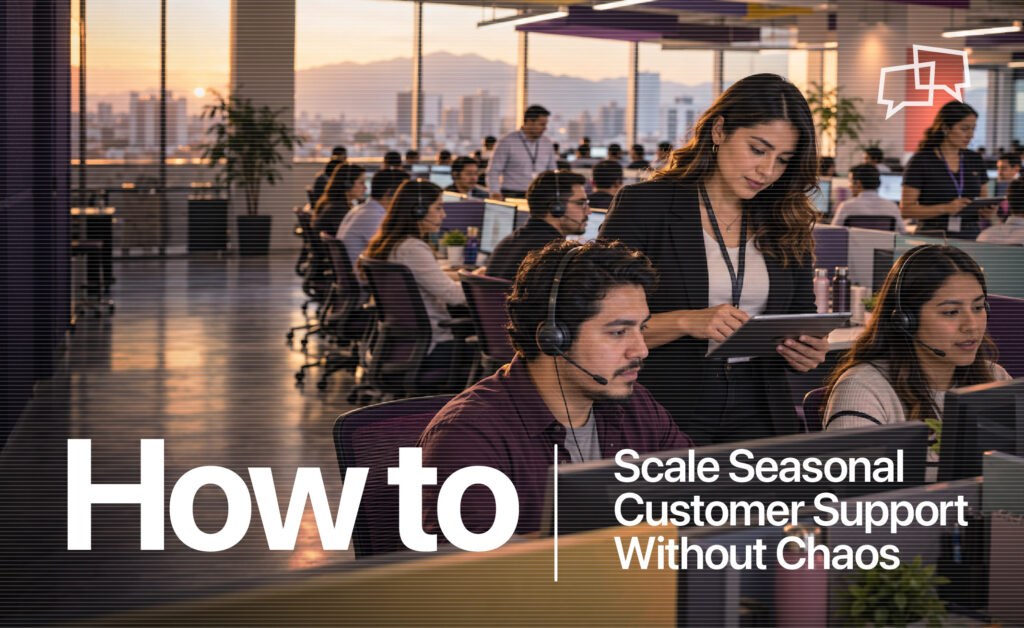
TL;DR — Quick Takeaways
- Build base, expected, and high-volume forecasts by channel, contact reason, and handling time—not total contacts alone.
- Keep sensitive, strategic, and highly specialized work in-house while routing repeatable interactions to trained seasonal agents.
- Start recruiting and training before queues grow; waiting until peak week makes quality problems harder to prevent.
- Nearshore teams in Mexico can add English-Spanish capacity, aligned operating hours, and closer collaboration for U.S. companies.
- Train for judgment and brand alignment, with clear authority limits, escalation triggers, and policy guardrails.
- Monitor resolution, customer satisfaction, accuracy, transfers, abandonment, and repeat contacts—not speed alone.
- Plan the ramp-down in advance so returns, billing questions, and unresolved cases remain covered after demand begins to fall.
A holiday promotion takes off. A weather event sends calls surging. Open enrollment, tax season, a product launch, or a viral social post suddenly multiplies customer questions. The challenge is not simply adding people. To scale seasonal customer support successfully, a business must protect response times, brand consistency, and the customer relationships it took months or years to earn.
For growing companies, seasonal volume can expose the limits of an in-house team quickly. Long hold times create frustration. Rushed agents make preventable mistakes. Salespeople and specialists get pulled into routine service. Managers become consumed by schedules and escalations instead of planning the next stage of growth.
A flexible support model can turn that pressure into an opportunity. The goal is to build enough capacity for the peak while preserving the controls, knowledge, and human connection that define the brand during the rest of the year.
Why Seasonal Demand Is an Operating Challenge
Seasonality is not always a neat, predictable increase. The number of contacts may rise, but the mix of those contacts can also change. A promotion may create more order questions. A winter storm can generate delays, cancellations, and anxious customers. A benefits enrollment period may increase long, detail-sensitive conversations. One operational plan rarely fits all three situations.
Peak periods also compress decision-making. When queues are growing, teams have less time to update documentation, coach new agents, correct schedules, or resolve system problems. Small gaps that were manageable at normal volume become highly visible under pressure.
Start With the Real Demand Forecast
Planning should begin before the busiest week appears on the calendar. Historical volume is useful, but last year’s total contacts do not tell the whole story. Identify when demand rose, which channels customers used, why they reached out, and how long each interaction took.
A 30% increase in tickets does not automatically mean a business needs 30% more agents. If the increase is concentrated in complex technical questions, payment disputes, or policy exceptions, average handling time may rise at the same time. If self-service absorbs simple questions, the remaining queue may be smaller but more demanding.
Forecast by the factors that drive workload
- Channel: voice, email, chat, SMS, social messaging, and back-office work.
- Contact reason: orders, returns, appointments, billing, troubleshooting, cancellations, or lead response.
- Handling time: conversation, hold, research, documentation, and after-contact work.
- Arrival pattern: day of week, time of day, campaign launch, shipment cycle, deadline, or weather event.
- Language: expected English and Spanish demand by queue and interaction type.
- Shrinkage: training, coaching, breaks, meetings, absence, and other time agents are not available for contacts.
The forecast should also account for what is changing. New products, expanded marketing, revised shipping policies, new customer segments, and larger service areas can all alter the contact mix. Because demand is never perfectly predictable, build a range instead of relying on one number.
| Scenario | What It Represents | Staffing Approach | Activation Trigger |
|---|---|---|---|
| Base | Normal seasonal growth with known promotions and recurring demand. | Core team plus planned seasonal coverage. | Calendar date or scheduled campaign. |
| Expected | Most likely demand based on current sales, marketing, backlog, and customer behavior. | Additional trained seats and extended coverage windows. | Sustained occupancy, backlog, or abandonment threshold. |
| High | Promotion overperformance, disruption, viral attention, or other exceptional demand. | Pre-approved overflow team, cross-trained agents, and prioritized workflows. | Real-time queue, sales, incident, or forecast variance trigger. |
Scenario planning makes the staffing conversation concrete. It clarifies how much capacity is needed, when it should activate, which work gets priority, and what service compromises—if any—are acceptable during extraordinary demand.
Decide What Must Stay In-House
Not every customer interaction should be handled the same way during a peak period. Internal specialists may be best positioned to manage executive escalations, strategic accounts, highly specialized troubleshooting, policy decisions, or cases involving unusual risk.
At the same time, trained external agents can often support order status, account questions, appointment scheduling, reservations, payment inquiries, returns, lead qualification, and many other repeatable interactions. The right division of work depends on complexity, risk, available documentation, system access, and customer expectations.
| Work Category | Typical Examples | Recommended Ownership | Required Control |
|---|---|---|---|
| Strategic or high-risk | Executive escalations, policy exceptions, sensitive accounts, specialized decisions. | Primarily in-house. | Named owner, priority path, response deadline, documented resolution. |
| Moderate complexity | Billing research, technical triage, retention requests, account corrections. | Shared or tiered. | Decision tree, approval limits, warm-transfer process, quality review. |
| Repeatable and documented | Order status, appointments, reservations, FAQs, returns, lead intake. | Well suited to trained seasonal or outsourced teams. | Current knowledge, system permissions, clear escalation triggers. |
A healthcare organization may require tightly controlled workflows for sensitive patient communications. An eCommerce brand may prioritize fast delivery updates, exchanges, and bilingual support during holiday volume. A legal practice may need intake agents who gather information accurately and route urgent cases immediately.
The goal is not to hand off every task. It is to design an operation in which each interaction reaches the team best equipped to handle it. That protects quality while giving internal employees more room for high-value work.
Scale Seasonal Customer Support With a Flexible Team
Seasonal staffing fails when hiring begins after the queue is already growing. Recruiting, onboarding, access provisioning, training, nesting, and coaching all take time. Even experienced customer service professionals need to learn the brand voice, systems, policies, products, and escalation paths before representing a business.
A call center outsourcing partner can add trained capacity without forcing the company to build every recruiting, scheduling, quality, technology, and supervisory layer internally.
Why nearshore support works well for seasonal programs
For U.S. companies, a nearshore call center in Mexico can provide compatible time zones, geographic proximity, cultural familiarity, and access to bilingual English-Spanish talent. Shared working hours make it easier to coordinate campaigns, answer policy questions, review performance, and adjust staffing while the operation is active.
Flexibility should still be governed by clear commercial terms. Ask how quickly the provider can add trained agents, which minimums apply, how overtime and holidays are billed, whether supervisors and technology are included, and how capacity is reduced after the season. The future invoice should be understandable before launch.
Questions to ask a seasonal support provider
- How many weeks are required to recruit, train, and certify the team?
- What is the smallest staffing increment that can be added or removed?
- Who owns workforce planning, schedule changes, and real-time queue management?
- How are temporary agents supervised and evaluated?
- Which fees apply to setup, training, licenses, overtime, holidays, and ramp-down?
- Can proven agents return for the next seasonal cycle?
Use a Deliberate Peak-Season Timeline
The exact schedule depends on team size and complexity, but a phased plan prevents the launch from becoming a last-minute handoff. Begin earlier when the program requires specialized recruiting, licensing, complex integrations, or extensive compliance review.
| Timing | Primary Work | Exit Criteria |
|---|---|---|
| 8–12 weeks before peak | Forecast demand, define scope, select delivery model, confirm budget and systems. | Approved scenarios, roles, service levels, governance, and commercial terms. |
| 5–8 weeks before peak | Recruit or assign agents, build training, configure access, clean the knowledge base. | Training-ready team, tested permissions, approved content, support contacts. |
| 2–4 weeks before peak | Train, test knowledge, simulate contacts, certify agents, begin controlled nesting. | Passing knowledge and quality scores with escalation fluency. |
| Peak period | Real-time management, daily reporting, quality calibration, rapid knowledge updates. | Stable service levels, controlled backlog, accurate resolutions. |
| Post-peak | Taper staffing, clear residual work, review results, retain lessons and talent data. | No unmanaged backlog and a documented plan for the next cycle. |
Train for Brand Alignment, Not Just Script Compliance
A seasonal agent who can read a script is not necessarily ready to protect the customer experience. Customers can tell when a representative does not understand the product, the policy, or the tone of the company they contacted.
Effective training combines practical knowledge with judgment. Agents should understand the highest-volume contact reasons, but they also need clarity about what they can resolve independently, when to escalate, how to document the interaction, and how to communicate when an ideal solution is unavailable.
For a seasonal program, a focused plan often works better than a broad information dump. Start with the interactions agents will actually handle and the mistakes that create the greatest customer or business risk. Then reinforce learning through simulations, nesting, live monitoring, coaching, and calibration. CallZent’s guide to call center training programs explains how training design connects to performance, retention, and measurable behavior.
Give agents authority with guardrails
When agents have clear authority to solve reasonable problems, customers receive faster answers and supervisors spend less time approving routine exceptions. Define refund limits, replacement policies, credits, scheduling rules, identity checks, approval thresholds, and escalation triggers before the peak begins.
If the program provides bilingual support, quality standards must remain consistent in both languages. Translated words are not enough. Agents need the product vocabulary, tone, empathy, and confidence to complete the same approved actions for English- and Spanish-speaking customers.
Build Quality Controls That Hold Up Under Pressure
High volume is not a reason to lower standards. It is when quality assurance matters most, because one unclear policy or incorrect answer can be repeated across hundreds of interactions.
Monitor more than speed. A fast answer that does not resolve the issue creates another contact and a more frustrated customer. Use a balanced scorecard that shows whether customers can reach the team, whether agents solve the need, and whether the work is accurate.
| KPI | What It Reveals | Peak-Season Response |
|---|---|---|
| Service level and response time | Whether customers receive timely access by channel. | Adjust schedules, priorities, and flexible capacity. |
| Abandonment | How often customers leave before receiving help. | Review staffing gaps, wait messaging, and callback options. |
| First-contact resolution | Whether the first interaction actually solves the need. | Improve knowledge, access, agent authority, or escalation design. |
| Transfer and reopen rates | Friction, misrouting, incomplete resolutions, or skill gaps. | Correct routing rules and coach recurring failure points. |
| Quality and accuracy | Policy adherence, communication, documentation, and risk. | Issue rapid updates and targeted coaching. |
| CSAT | How customers perceive the service interaction. | Analyze comments by reason, queue, language, and outcome. |
Daily reporting is often appropriate during a seasonal ramp. A short operating meeting can surface queue risks, policy questions, staffing gaps, customer complaints, and technology issues while there is still time to act. As volume stabilizes, the cadence can change, but visibility should remain consistent.
The ISO 18295-1 standard for customer contact centres provides an external framework for service requirements across in-house and outsourced contact center operations. It can help buyers evaluate whether seasonal flexibility is supported by disciplined operating practices.
Prepare the Systems Behind the Agents
Even an excellent team cannot deliver dependable service with incomplete information or disconnected tools. Before the season begins, test access to the CRM, help desk, phone platform, order system, scheduling application, payment workflow, and knowledge base. Confirm that agents can find the information required to answer questions and complete approved actions.
Create contingency procedures for system outages, delayed shipments, inventory discrepancies, missed appointments, payment failures, and policy changes. These are not remote possibilities during a peak period. They are foreseeable operating conditions.
Business continuity should include communication ownership, technology recovery, alternative workflows, and the resources required to maintain essential service. The U.S. government’s Ready Business continuity guidance offers a useful starting point for documenting how an organization will manage disruptions.
Keep one reliable source of truth
Seasonal conditions change quickly. If a return deadline changes, a location closes, or a product goes out of stock, the update should reach every affected agent promptly. Assign owners for publishing, approving, and retiring content. Use version control, date-stamped notices, supervisor reinforcement, and confirmation that agents have received critical changes.
Treat the Support Partner Like an Extension of the Team
Outsourced support works best when the relationship is operational, not transactional. The provider should understand the business goals behind the queue: protecting retention, converting inquiries, preserving compliance, reducing churn, completing appointments, or maintaining loyalty during a disruption.
Share forecasts, promotions, product updates, policy changes, and known risks early. Invite support leaders into planning conversations instead of notifying them after a campaign launches. Establish service levels, escalation ownership, quality standards, communication channels, and reporting formats before the first peak-week call arrives.
At CallZent, this partnership mindset is tied directly to agent experience. Agents who receive clear training, responsive coaching, and appropriate authority are better positioned to create genuine human connections. That improves consistency when demand is high and helps protect the customer loyalty that seasonal growth can strengthen—or weaken.
Companies comparing providers can also review CallZent’s call center outsourcing FAQs for implementation, pricing, team structure, and service considerations.
Plan the Ramp-Down With the Same Care
The end of the busy season creates its own risks. Returns may rise after a holiday rush. Billing questions can follow a promotional period. Customers who waited for a response may contact the company again. Removing support capacity the moment sales decline can create a second service failure.
Use recent contact trends to taper staffing gradually. Review unresolved cases, backlog, repeat contacts, return windows, billing cycles, and expected post-season activity. Define the order in which overflow seats, extended hours, and specialist coverage will be reduced.
Run a post-season review
- Which contact reasons exceeded or fell below the forecast?
- Where did customers experience the most friction?
- Which knowledge articles, scripts, or policies created confusion?
- Did bilingual demand match expectations?
- Which staffing triggers worked, and which activated too late?
- Which agents, supervisors, and workflows should return next season?
- What customer feedback should influence products, policies, or operations?
Seasonal demand does not have to force the organization into survival mode. With early forecasting, flexible bilingual staffing, empowered agents, reliable systems, and close operating partnership, peak volume can become proof that the business is ready to grow without leaving customers behind.
Frequently Asked Questions
Seasonal Customer Support FAQs
What is seasonal customer support?
Seasonal customer support is temporary or flexible service capacity added for a predictable or event-driven increase in customer contacts. It may cover voice, email, chat, SMS, social messaging, and related back-office work.
When should seasonal support planning begin?
Many programs should begin planning eight to twelve weeks before the expected peak. More time may be required for specialized recruiting, complex training, security review, licensing, or technology integrations.
How do you forecast seasonal contact volume?
Review historical volume by channel, interval, and contact reason; combine it with handling time, shrinkage, campaign plans, sales forecasts, operational changes, and known risks. Build base, expected, and high-volume scenarios with clear activation triggers.
Which work should remain in-house during a peak period?
Executive escalations, strategic accounts, sensitive policy decisions, and highly specialized work often remain in-house. Repeatable, documented interactions can be assigned to trained external agents with controlled access and clear escalation rules.
Why use a nearshore team for seasonal support?
For U.S. companies, nearshore teams in Mexico can offer compatible working hours, geographic proximity, bilingual English-Spanish talent, and easier real-time collaboration than many distant delivery models.
How can seasonal agents be trained quickly without sacrificing quality?
Limit the initial scope to the interactions agents will actually handle, teach critical policies and escalation rules, use realistic simulations, test knowledge, and require supervised nesting before independent production work.
Which KPIs matter most during peak season?
Track service level, response time, abandonment, first-contact resolution, transfers, reopen rates, quality, accuracy, backlog, and customer satisfaction. Review results by channel, reason, language, and interval.
How do you maintain quality when contact volume spikes?
Use a controlled scope, current knowledge, defined agent authority, live queue management, frequent quality sampling, daily calibration, and rapid communication when products, policies, inventory, or operating conditions change.
How should staffing ramp down after the peak?
Reduce capacity gradually based on backlog, unresolved cases, repeat contacts, returns, billing cycles, and post-season demand. Avoid removing all overflow coverage immediately when sales begin to decline.
What should a seasonal outsourcing agreement include?
Document the scope, forecast assumptions, staffing increments, service levels, training responsibilities, technology, security, quality standards, reporting, escalation ownership, fees, overtime, holiday rates, change approvals, and ramp-down terms.
Prepare Before the Queue Spikes
Build Seasonal Capacity Around Your Customers
CallZent provides bilingual nearshore customer support from Mexico for U.S. companies that need flexible capacity, stronger coverage, and accountable service during peak demand.