

Voice of Customer Programs
Voice of Customer Programs for Nearshore BPO and Contact Centers
Learn how Voice of Customer programs help contact centers turn feedback, surveys, transcripts, sentiment, and bilingual customer signals into retention, revenue, service recovery, and operational improvement.
TL;DR — Quick Takeaways
- Voice of Customer programs only matter when they change what a contact center does next.
- The best VoC programs combine structured surveys, support transcripts, live interactions, behavioral data, and customer sentiment.
- Contact centers are uniquely positioned to run VoC programs because they hear customer friction in real time across calls, chats, tickets, and escalations.
- Nearshore bilingual BPO teams can capture English and Spanish feedback in one operating model, reducing blind spots across customer segments.
- VoC programs should measure not only NPS, CSAT, and CES, but also response rate, coverage, closing-the-loop rate, retention, revenue growth, and customer profit margins.
- The dashboard is not the program. The owned action is the program.
Voice of customer programs only matter when they change what a contact center does next. That’s the hard line many miss. Aberdeen data cited by NICE shows 64% of contact center and CX leaders already use VoC programs, and organizations with VoC achieved 5.1x greater year-over-year customer retention growth than those without them, with retention rising 4.1% vs. 0.8% in the cited analysis (NICE brief on VoC ROI).
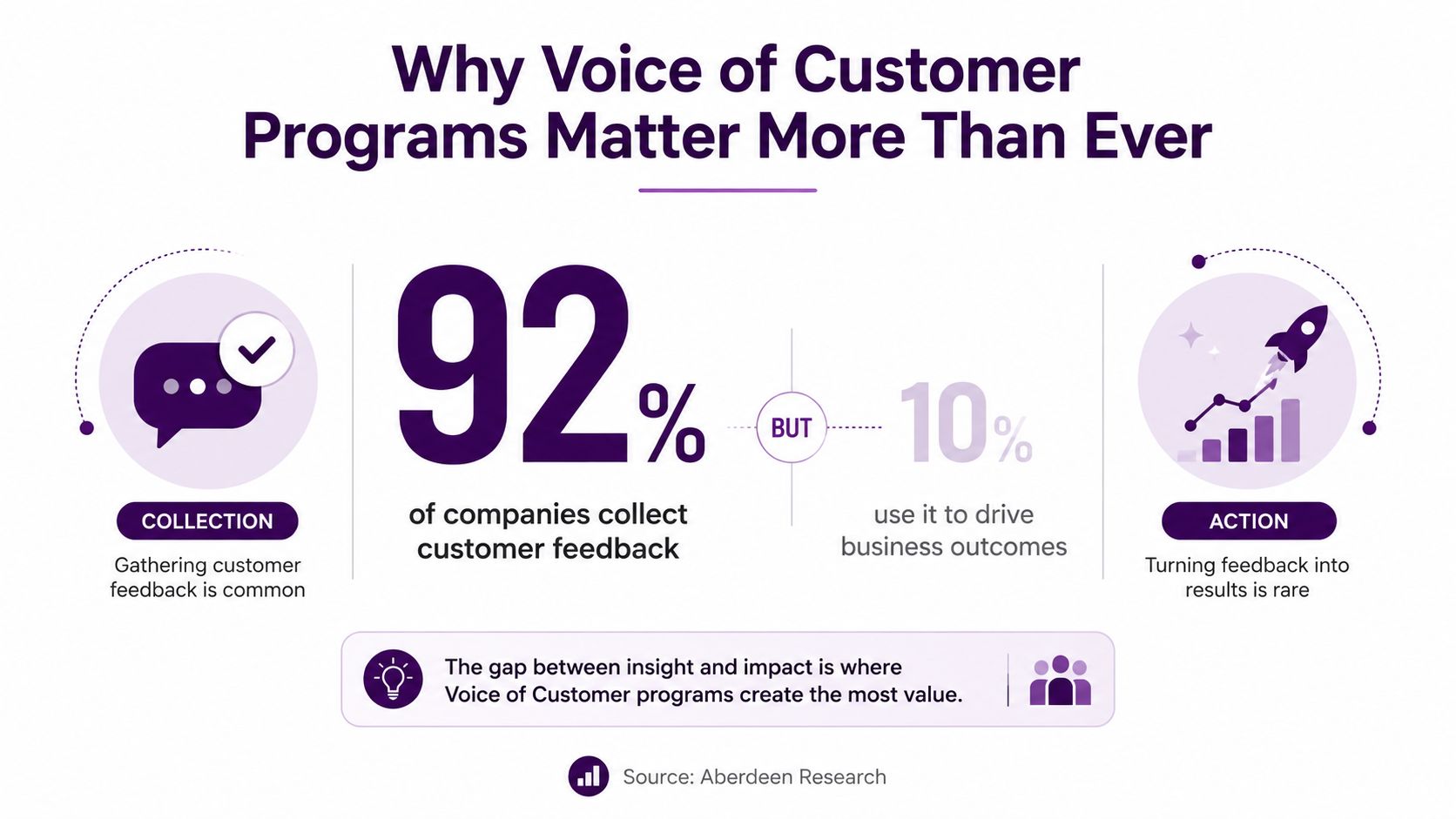
For nearshore bilingual BPO teams, that gap matters because the call center sits where feedback, behavior, and service recovery meet. A strong Voice of Customer program doesn’t just record what customers say. It helps teams decide which issues need a fix, which segment is churning, and where a better workflow can create revenue growth instead of just reducing complaints.
Why Voice of Customer Programs Matter More Than Ever
VoC used to mean a survey link and a monthly report. That model is too narrow for contact-center work now. In Aberdeen’s cited analysis, VoC users posted 95% greater year-over-year increase in annual company revenue and a 2.9x greater year-over-year increase in customer profit margins, along with stronger retention. The business case is plain, feedback programs stop being a reporting exercise once teams connect them to revenue, margin, and renewal behavior.
A bilingual nearshore contact center is a natural VoC engine because it already handles live complaints, escalation patterns, and the moments that shape loyalty. Every repeated call, every unresolved ticket, every confused customer in English or Spanish is a signal. If the operation treats those interactions only as service events, it leaves both recovery and revenue opportunities on the table.
Contact centers are where feedback becomes operational
VoC works when the same team can hear, classify, and act. That is why the contact center matters so much. It sees friction before product teams see churn, and it hears the exact language customers use before marketing turns it into a polished summary.
Practical rule: if feedback does not change a process, a script, a product decision, or a follow-up task, it is not yet a VoC program.
Gainsight’s guidance frames structured surveys such as NPS, CSAT, and CES as the backbone of many programs, while also pointing to reviews, support transcripts, and usage data as important inputs (Gainsight VoC guide). The shift is clear. Companies do not win by asking one question well. They win by listening across channels and acting quickly.
For call centers, that shift changes staffing logic too. Agents are not only resolution workers anymore. In the right setup, they become the front line of customer intelligence, especially when a nearshore team stays close enough to the U.S. market to keep context tight while serving both English and Spanish speakers. Training has to support that role, and customer care orientation gives teams a practical foundation for that discipline.
Why the old survey-only model breaks down
Traditional survey programs still matter, but they are not enough on their own. Participation is the problem. CustomerGauge reports average B2B response rates of about 12.4%, with a low end of 4.5% and a high end of 39.3% across contexts (Gainsight VoC guide). That is a reminder that a survey can only describe the slice of customers who felt enough pressure to answer.
When response is thin, the operation needs more than a quarterly score. It needs multiple listening channels, a tighter workflow, and a service culture that treats unresolved feedback as a business risk. That is why VoC has matured. Surveys still matter, but survey data alone cannot explain churn, loyalty, or growth.
The Core Mechanics of a Voice of Customer Program
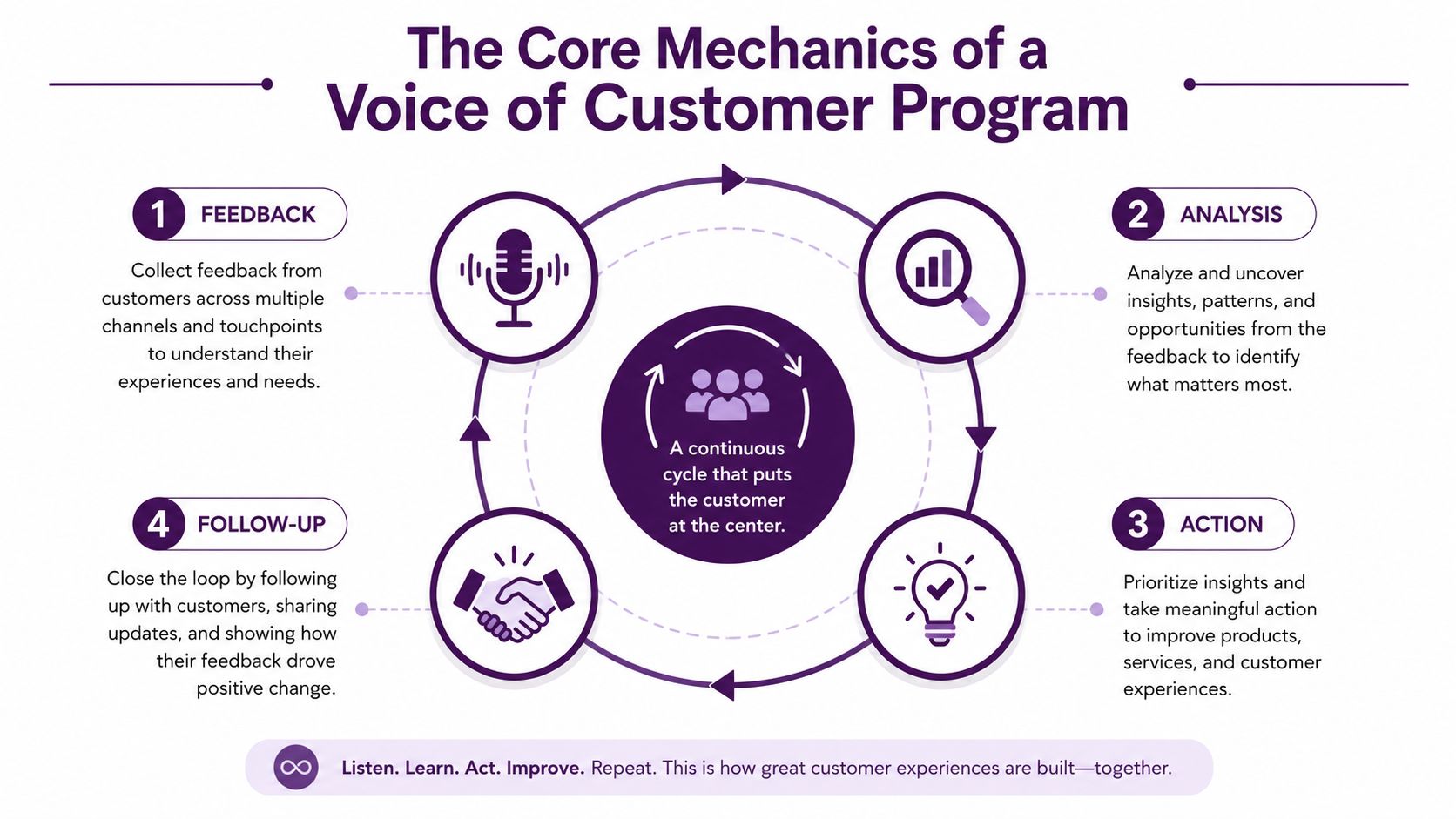
A practical Voice of Customer program works as a loop, not a static report. Academic research describes four repeating steps, Feedback Capture, Feedback Analysis, Act, and Monitoring (Politecnico di Milano research). That structure matters because a team only improves when it keeps moving from signal to action and back again.
Feedback capture needs more than one source
A mature program blends customer-sourced perceptual data with internally generated behavioral data. Perceptual data comes from surveys, reviews, interviews, and support transcripts. Behavioral data comes from support interactions, product usage, churn events, and purchase patterns (Zonka feedback metrics guide). The two tell different parts of the story. One shows how customers feel. The other shows what they did.
Nearshore bilingual contact centers usually see the gap first. A customer may give a low CSAT score after a billing call, while the operational signal is that the same account reached out three times in two weeks. The score shows frustration. The contact history points to a process failure, and that is often the detail that matters for service recovery and revenue protection.
Analysis must connect sentiment to action
The strongest programs do more than tag themes. They compare patterns across channels, then route the insight to the right owner. Harvard Business School’s guidance emphasizes closing the loop and making feedback actionable across the organization (Harvard Business School online guidance). Many teams struggle here. They can summarize customer pain, but they do not move the fix into production.
For a BPO team, that usually means three practical moves:
- Unify the sources: Put survey responses, transcripts, and call notes into one analysis layer.
- Find the trigger: Look for repeated contacts, negative sentiment, or escalation patterns tied to the same journey stage.
- Assign the fix: Give one owner a clear due date, then check back after the change ships.
A customer feedback for continuous improvement workflow helps keep that handoff from stalling, especially when contact-center leaders need the same insight to support both retention work and upsell opportunities. The point is not to collect more commentary. The point is to turn the recurring complaint into a named operational fix that someone owns.
Monitoring keeps the loop honest
A VoC program that stops after action turns into a dashboard with no follow-through. Continuous monitoring shows whether the fix worked. Did repeat calls fall off. Did a complaint theme shrink. Did Spanish-speaking customers stop surfacing the same confusion point. Those answers matter more than the original score because they show whether the operation changed behavior, not just reporting.
For teams that need a closer look at how sentiment gets analyzed in service environments, the sentiment analysis tools page is a practical reference point. If social feedback also matters, a guide to social listening software helps teams compare tools without turning the exercise into a product hunt. In contact-center work, the useful setup is the one that turns unstructured feedback into a clear next action, then shows whether that action changed the customer experience.
Listening Channels and Sampling Strategies
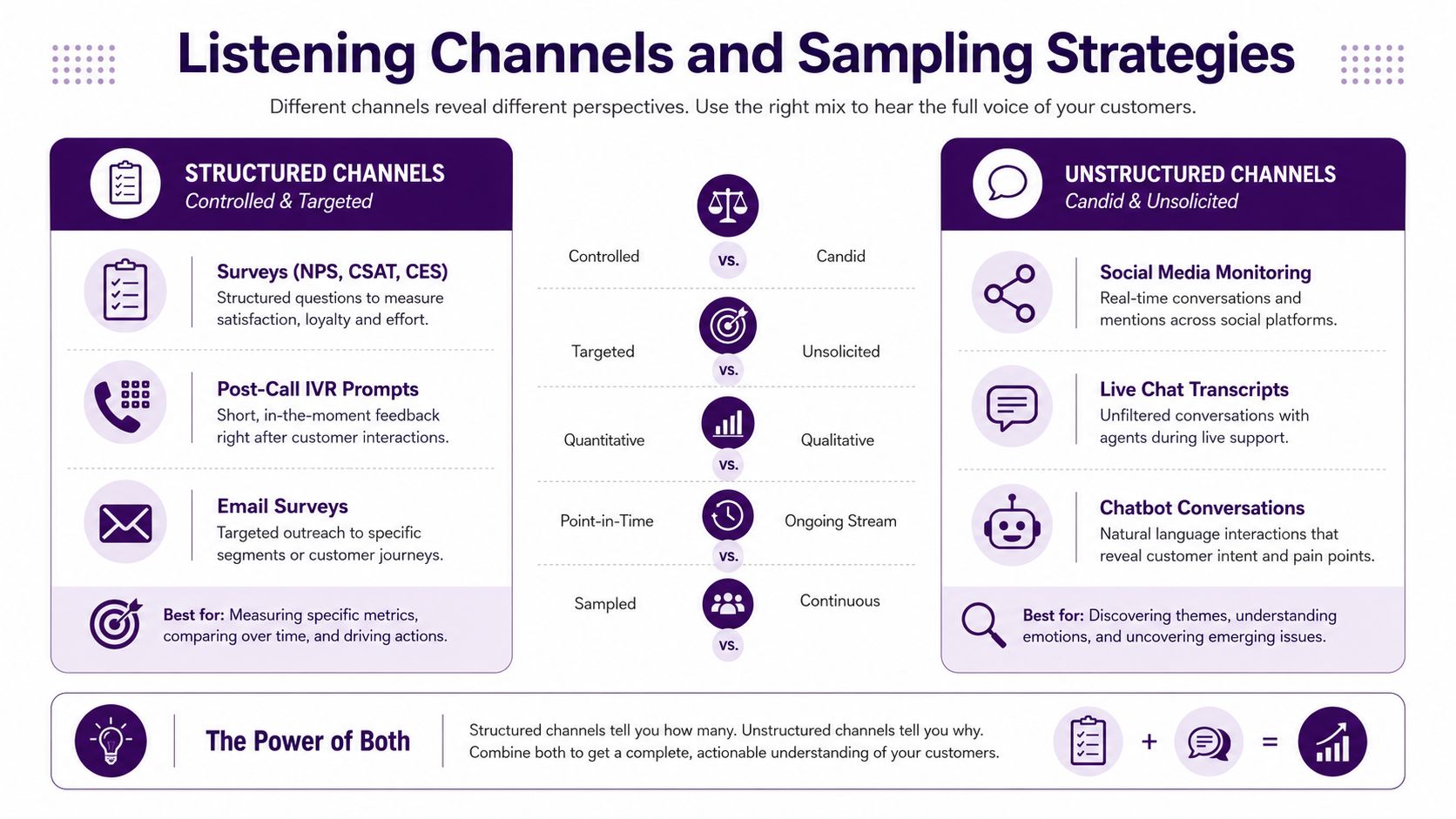
The best VoC programs don’t argue over one channel. They decide what each channel is good for. Structured inputs like surveys, NPS, CSAT, CES, and post-call IVR prompts are controlled and easy to benchmark. Unstructured inputs like social media monitoring, live chat transcripts, chatbot conversations, and website analytics are noisier, but they often show the language customers use.
Structured and unstructured channels serve different jobs
Structured channels work best when you need repeatability. They’re useful for trend lines, segment comparisons, and journey checkpoints. Unstructured channels work better when you want context, tone, and surprise. A live chat transcript can reveal confusion that a rating scale completely misses.
If you need a broader view of social listening, a guide to social listening software can help teams compare tools without turning the exercise into a product hunt. That kind of resource is especially useful when social feedback needs to be treated as an input to service operations rather than a separate marketing project.
The channel is only as useful as the sampling behind it. Ask who’s being heard, who’s missing, and whether the sample actually reflects the journey.
Sampling strategy matters as much as channel choice
CustomerGauge’s B2B response-rate data, cited earlier, shows why sample design matters. If the loudest responders dominate the dataset, the operation ends up optimizing for a narrow slice of customers. That’s how teams get a clean dashboard and a dirty reality.
A practical sampling approach in a contact center usually looks like this:
- Use structured surveys sparingly: Send them at the moments that matter, not after every interaction.
- Mix in passive listening: Review transcripts, chat logs, and service notes so non-responders still contribute signal.
- Segment by journey stage: New customers, repeat callers, and at-risk accounts shouldn’t be sampled the same way.
- Watch for channel bias: If one language group or customer segment is underrepresented, fix that before you trust the result.
What to prioritize first
Start with the channels closest to operational pain. For most BPO teams, that means support interactions, post-call feedback, and ticket notes before it means anything fancy. Once those are stable, layer in social and digital inputs. The point isn’t to collect everything. The point is to hear enough of the right things to change decisions.
KPIs and Measurement Approaches That Actually Matter
A VoC dashboard that only shows NPS, CSAT, and CES is incomplete. Those metrics are useful, but they’re not enough evidence on their own. Harvard Business School’s guidance and Qualtrics’ VoC analytics framing both point to the same reality, the program only works when feedback is tied to action and then measured again (Harvard Business School online guidance, Qualtrics VoC analytics).
Build the KPI stack in layers
A practical VoC measurement model needs three tiers.
| Metric Tier | KPI | What It Measures | Target Benchmark |
|---|---|---|---|
| Foundational | NPS | Likelihood to recommend | Use as a directional sentiment score |
| Foundational | CSAT | Immediate satisfaction after an interaction | Use for journey or interaction-level readouts |
| Foundational | CES | Customer effort in completing a task | Use to spot friction-heavy processes |
| Operational Health | Response rate | Whether the feedback sample is large enough to trust | Higher coverage is better, with attention to segment balance |
| Operational Health | Coverage | Whether key journeys and segments are being listened to | Measure across touchpoints, not just one channel |
| Operational Health | Closing-the-loop rate | Whether feedback led to an owned action and follow-up | Track by team, queue, or issue type |
| Business Outcome | Retention | Whether the program reduces churn | Compare against pre-program baselines |
| Business Outcome | Revenue growth | Whether customer insight supports expansion | Tie to customer segments and time periods |
| Business Outcome | Customer profit margins | Whether the program improves economics, not just sentiment | Review alongside retention and cost-to-serve |
Don’t trust a score without sampling discipline
A high NPS can still be misleading if the response base is tiny or skewed. The same is true for CSAT. If the team celebrates a clean number while repeat complaints keep coming in, the metric is functioning as a vanity score, not a management tool.
That’s why the operational metrics matter. Response rate tells you whether the sample is usable. Coverage tells you whether the right parts of the journey are visible. Closing-the-loop rate tells you whether insights turn into work. Without those three, the score may look polished while the operation remains blind.
Tie the dashboard to decisions
A good VoC report answers two questions. What did customers tell us. What did we do about it. If the report can’t answer both, it’s just documentation. CallZent’s call center KPIs resource is a useful operational reference for teams that want to align customer listening with service performance.
Implementation Roadmap and Governance Model
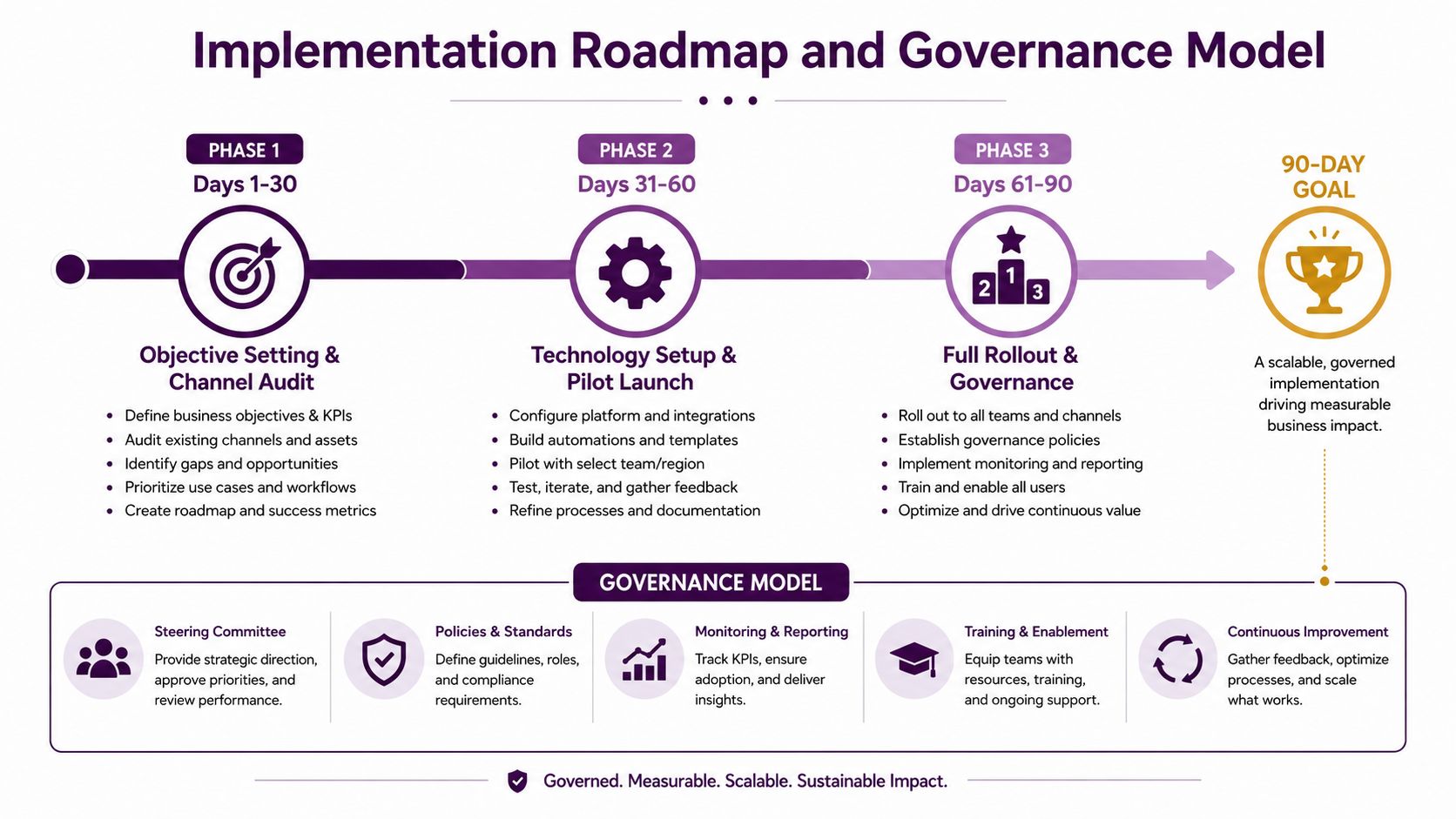
A mid-market e-commerce client once came to the same starting point many teams do. Support was busy, returns were messy, and product teams had opinions but little evidence. The cleanest path was to use the bilingual nearshore contact center as the operating hub, then build the VoC program around it instead of around a dashboard.
Days 1 to 30 set the target and the channels
The first phase is about deciding what the program is for. Is the main goal to reduce churn, improve returns, identify product friction, or surface upsell signals. Once that’s clear, audit the channels already in use. A lot of teams discover they have data in CRM notes, call recordings, and tickets, but nobody has stitched it together.
That’s also the point to define ownership. Someone needs to own the program, and someone else needs to own each fix. If one team collects insights and another team is expected to interpret them, the handoff breaks.
Days 31 to 60 connect the systems
The next phase is integration. CRM, ticketing, and analytics platforms need to feed a common view so survey results and conversation data don’t live in separate silos. The governance question here is simple. Who sees the signal first, and how fast does it move.
A vendor evaluation criteria page is helpful when teams are comparing tools or service partners for that stack. In a real deployment, the goal isn’t perfect software. It’s reliable routing, clean tagging, and enough automation that no issue disappears into a queue.
Days 61 to 90 launch the loop and enforce follow-up
The final phase is where most programs fail if nobody protects the process. A closed-loop workflow needs named owners, service-level expectations, and a review rhythm. If a customer issue is still sitting unresolved after the team said it mattered, the whole program loses credibility.
Key takeaway: the dashboard is not the program. The owned action is the program.
For a nearshore call center, the advantage is speed and language coverage. Agents can capture English and Spanish feedback in the same operating model, and the team can escalate issues before frustration hardens into churn. That makes the contact center more than a support function. It becomes the place where business signals get turned into decisions.
Common Pitfalls and How to Avoid Them
Survey fatigue is one of the easiest ways to weaken a VoC program. If the same customers get hit after every contact, response quality drops and the answers get less honest. The fix is simple in principle, harder in practice, sample smarter and rotate channels so you’re not overworking the same people.
Siloed data is the next failure point. Support transcripts sit in one system, product feedback sits in another, and leadership gets a disconnected summary. The result is predictable, teams debate anecdotes instead of solving the underlying issue. The countermeasure is cross-functional routing, with one shared analysis layer and a clear owner for each theme.
The vanity metric trap is real
Teams also get stuck celebrating a clean NPS while churn keeps moving in the wrong direction. That happens when the score gets treated as the objective rather than a signal. The fix is to pair the score with response rate, coverage, and action completion, then review business outcomes alongside sentiment.
A third mistake is treating VoC as only a problem-finding tool. Newer VoC guidance stresses growth opportunities too, including unmet needs, unexpected use cases, competitor-switching signals, and willingness-to-pay clues (Enterpret market-opportunity guide). That matters because the most useful customer feedback doesn’t just say what hurts. It also shows where customers are trying to go and what the business hasn’t supported yet.
A quick diagnostic for weak programs
- If insights pile up but nobody owns the fix, the loop is broken.
- If only one segment answers, the sample is biased.
- If feedback never reaches operations, the program is decorative.
- If the team only looks for complaints, it’s missing growth signals.
VoC works when every customer signal has a destination. Without that, the program becomes a filing cabinet with nicer charts.
ROI Examples Across Industries
In healthcare, post-visit feedback loops can help teams spot confusion about discharge instructions or scheduling friction before it turns into missed follow-up care. The mechanics are simple, ask, listen, act, then check whether the same issue keeps showing up. That’s where the operational value of VoC becomes visible, because the issue is handled in the process, not just documented after the fact.
In financial services, support transcripts often reveal churn intent before a customer closes the account. A frustrated caller may never fill out a survey, but the language in the interaction can still signal a risk. That’s why behavioral data and transcript analysis belong in the same program.
E-commerce and retail need the same loop, just different signals
E-commerce teams often find the biggest returns in returns. Customers say what’s wrong with sizing, packaging, or refund handling long before the warehouse team sees the pattern. Retail teams see a different version of the same problem, store-level service gaps often show up in repeated complaints from the same location or region.
Salesmotion’s customer success guide is a useful complement for teams that want to connect customer listening to retention and expansion motions. It fits naturally with VoC because the program shouldn’t end when an issue is solved. It should inform the next conversation, the next offer, or the next process fix.
Why bilingual nearshore teams matter in ROI
A bilingual nearshore contact center helps ensure English and Spanish-speaking customers are both represented in the dataset. That matters because invisible segments create blind spots, and blind spots create bad decisions. When the same team can capture, classify, and escalate feedback in both languages, the business gets a fuller view of what customers need.
ROI of VoC comes from making feedback operational, not ornamental. That’s the difference between a program that reports pain and one that helps prevent it, recover from it, and occasionally turn it into growth.
🚀 Turn Customer Feedback Into Action
If you want a VoC operating model that connects customer feedback to service recovery, escalation routing, and bilingual support workflows, CallZent can help you build a nearshore contact center program that turns English and Spanish customer signals into better decisions.
Talk to an ExpertIf you want a VoC operating model that connects customer feedback to service recovery, escalation routing, and bilingual support workflows, talk to CallZent about how our nearshore team in Tijuana can fit into your process. Visit CallZent to explore customer support, back-office help, and feedback capture models built for contact-center reality.