

Workforce Planning & Contact Center Operations
Workforce Management for Call Centers: Forecasting, Shrinkage, and Adherence
Turn interval demand into workable staffing, sustainable schedules, and informed intraday decisions for English-Spanish support.
TL;DR — Quick Takeaways
- Forecast by interval, queue, channel, and language; 15 or 30 minutes may be appropriate.
- Convert workload into staffing with a model suited to your channels and routing.
- Add measured shrinkage without counting the same unavailable time twice.
- Model shared bilingual agents once and keep language-specific results visible.
- Review adherence beside service, quality, occupancy, and actual available capacity.
Buying an AI scheduler does not automatically solve staffing problems. Workforce management for call centers connects demand forecasting, staffing requirements, schedules, and intraday decisions. Software can support that loop, but the assumptions and data still need an owner.
Start by identifying demand by queue, channel, language, and planning interval. Use a 15- or 30-minute view where appropriate, define service objectives, account for time agents are unavailable, and compare the day with the plan. Software can help establish and maintain this discipline; it cannot remove the need for accurate inputs and informed decisions.
Workforce Management for Call Centers at the Interval
A daily average can hide the hours when customers wait and agents sit idle. Workforce management works at the interval: match staffing to demand as it shifts through the day.
A billing queue may peak between 9 a.m. and 11 a.m. in the customer service time zone, then quiet down after 3 p.m. Staffing evenly across the day can leave customers waiting in the morning and agents idle in the afternoon, even when the daily total looks right.
Why the Interval Is the Unit of Work
Demand shifts with time zones, billing cycles, lunch hours, and campaign sends. English- and Spanish-language contacts may peak at different times. Forecast language demand separately, then model whether agents are dedicated or shared across queues. A bilingual agent cannot supply a full unit of capacity to both queues simultaneously. Align start times, breaks, and coaching with the resulting requirements.
Measure forecast accuracy and variance consistently. Without that comparison, it is difficult to separate a planning error from a scheduling constraint, a system issue, or an unexpected demand change.
Use a shared scoreboard to keep the operating measures visible. It supports day-to-day contact center management.
| What you plan | Check every | Working target | Failure signal |
|---|---|---|---|
| Contact forecast | 15 or 30 minutes by queue and language | Review accuracy by interval, not as a daily blend | Actual contacts regularly differ from forecast |
| Service level | 15 or 30 minutes | An agreed queue-specific response objective; 80/20 is only an example | Abandonment concentrates in one interval |
| Schedule adherence | 15 or 30 minutes | A documented activity-matching target with approved exceptions | Unexplained activity mismatches after checking system and schedule exceptions |
| Occupancy | 15 or 30 minutes | High enough for efficiency, with recovery time between contacts | Quality slips or agents have no recovery time |
| Skill mix | By queue and language | Forecast language demand and model shared bilingual capacity | One language has idle capacity while the other has a queue |
Read the measures together. For a hypothetical voice objective of 80/20, the goal is to answer 80% of eligible calls within 20 seconds under an agreed formula. Define the denominator, queue-entry timestamp, and treatment of short abandons. This is a service-level example, not an answer-rate definition or a universal benchmark. Urgent issues need an approved response and escalation model appropriate to their risk.
Adherence shows whether the schedule held up during the day. Occupancy helps balance efficient staffing with the time agents need between contacts. Skill mix exposes gaps that a single blended headcount can hide: an English queue may have capacity while Spanish-speaking customers wait. A workforce plan is useful only when these measures show where the interval is going off track.
How to Forecast Contacts and Required Staff
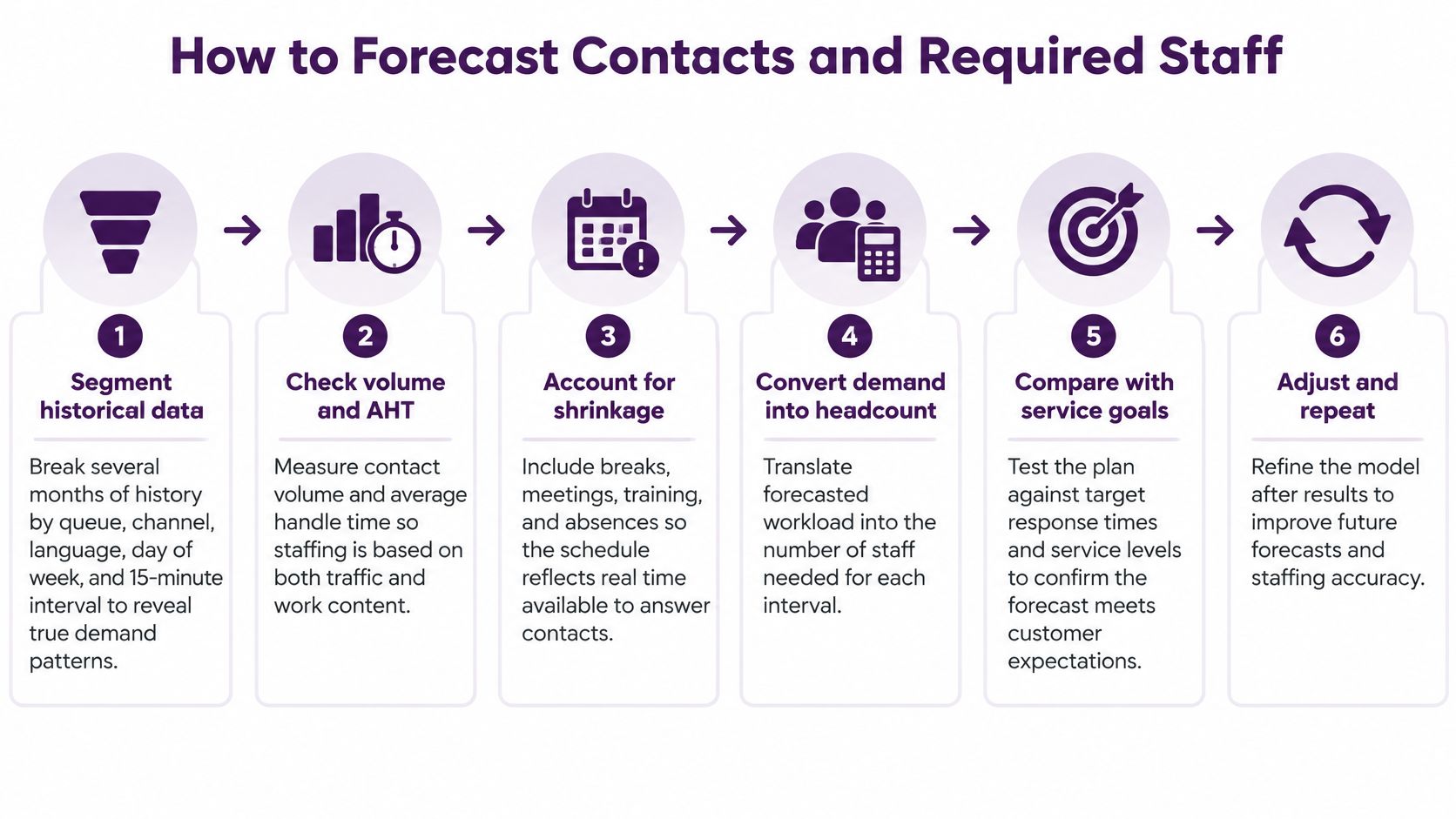
Forecast accuracy starts with the interval, not the daily total. A day can meet its volume target while one language queue waits and another sits idle. Build the forecast in six moves, then revise it as actual demand comes in.
The Six Moves in Order
-
Segment history. Use several months of data when available, split by queue, channel, language, day of week, and 15- or 30-minute interval. Choose the interval using arrival patterns, data reliability, and the decisions supervisors can make. Shorter is not automatically more useful for sparse queues. Daily totals hide when demand arrives.
-
Adjust for events. Account for promotions, seasonality, holidays, outages, billing cycles, product launches, and weather that may affect contact volume or handle time. Ask what is scheduled to ship, mail, or change before locking the forecast. A baseline that omits a known campaign can be less useful than a rough forecast that includes it.
-
Convert contacts to workload. Multiply forecast contacts by average handle time in consistent units, including the handling components your system measures. Divide workload time by interval duration to express offered load; workload alone does not determine the agents needed to meet a waiting-time target. Technical support and order-status calls can take different amounts of time, and chat concurrency and asynchronous backlogs need channel-appropriate modeling. Blended handle time can understate staffing needs for complex queues.
-
Model the queue. For a suitable inbound voice queue, Erlang C can estimate base staffing under simplifying assumptions, including no abandonment and a pooled skill group. It is not a universal model for blended channels or complex skill routing. Where abandonment, shared bilingual skills, concurrency, or backlog deadlines materially affect demand, use an appropriate model or simulation and validate results against actual performance.
-
Add off-queue time. Apply measured shrinkage after estimating the available staffing requirement. Distinguish planned activities from unplanned absence and check what the scheduling tool already includes. Do not add the same break or training allowance twice. Forecast language demand separately while accounting for any shared agent pool.
-
Reforecast intraday. Compare actual arrivals and handle time with the forecast, then account for who is logged in. If the morning runs above plan, update the afternoon outlook while there is still time to adjust.
Track Error Where It Happens
Review both the size and direction of forecast errors. Mean absolute percentage error (MAPE) is undefined when actual volume is zero and can be unstable on low-volume intervals. Consider absolute contact error, weighted absolute percentage error (WAPE), and signed bias alongside interval-level results. Define handling for zero totals and do not let aggregate accuracy hide a language or peak-hour miss. Amazon Forecast’s metric definitions provide a reference for distinguishing these measures; they are not call-center performance targets.
Keep paid hours distinct from productive queue time, account for off-queue work, and avoid combining English and Spanish demand into one forecast. Each choice affects whether the planned staffing matches the actual queue.
For a new program with limited history, use low, expected, and high demand scenarios plus explicit handle-time assumptions. Replace those assumptions with actual data as it accumulates. When scoping a CallZent program, review historical or projected demand alongside service objectives, required skills, hours, and operating constraints before committing to staffing.
Schedules That Survive Shrinkage and Turnover
A common scheduling mistake is treating the modeled available staffing requirement as the entire roster. Agents may be handling contacts or available for the next one; that available capacity also includes the idle time needed to meet response objectives. The paid roster must additionally account for measured unavailability such as breaks, training, meetings, and absence. Attrition affects the longer-term hiring pipeline and should not be counted again as the same absence allowance.
From Base Staff to a Workable Roster
Build the schedule in layers and defend each one. If finance asks why you rostered more people than the model asked for, this table is your answer.
| Staffing layer | What it covers | If you skip it |
|---|---|---|
| Base staff | Agents available to handle contacts or wait for the next one under the modeled service target | You hit the daily average and miss the queue |
| Shrinkage | Breaks, training, meetings, absence, non-queue work | Scheduled people are not actually available |
| Attrition pipeline | Hiring, training, and nesting before someone is productive | Vacancies persist while replacements train and become proficient |
| Overtime cap | Extra hours only as a controlled valve | Fatigue creates the next vacancy |
| Language split | Separate English and Spanish requirements | Idle time in one queue and waits in the other |
Shrinkage is the defined share of scheduled or paid time when agents are unavailable for contact handling. Use a consistent denominator and mutually exclusive activity categories. Idle ready time is available capacity, and after-call work is normally part of handling time; counting either again as shrinkage can inflate staffing. Use your own attendance and activity data with a consistent shrinkage factor calculation. Stagger breaks and coaching while protecting required rest and agreed training.
Illustrative calculation: If a simplified interval requires 10 available agents and total shrinkage is 25% of the roster, rostered agents = 10 ÷ (1 − 0.25) = 13.33. Round up to 14 whole agents for that interval, then validate skills, shift feasibility, and actual timing. Multiplying 10 by 1.25 would understate the requirement. If some activities are already scheduled explicitly, adjust only for unavailability not already covered.
Turnover Is a Staffing Input
Use your own turnover, hiring lead time, training completion, nesting, and time-to-proficiency data to plan replacement capacity. Segment voluntary exits, internal moves, and early-training departures where useful. A single industry statistic cannot tell you how many qualified people will be available for a particular shift.
Those numbers change how you schedule. Healthcare, finance, telecom, retail, and e-commerce programs can’t hire the week the queue breaks, because domain knowledge and compliance training stretch the time to full productivity. Plan hiring classes and nesting around projected vacancies and demand, and revise those assumptions as conditions change. A resignation shouldn’t become tomorrow’s overtime by default.
If an interval requires ten available agents, ten rostered seats cannot also cover time those agents are unavailable.
Match skills to the hour. Place qualified billing agents where billing demand peaks and verify specialist and supervisor access. When planning a CallZent team, discuss the required skills, channels, hours, systems, and performance objectives. Document the time zone and daylight-saving treatment for each location. Forecast English and Spanish demand separately, but allocate shared bilingual agents once across the routing model. Protect sustainable hours and review overtime rather than relying on it as permanent capacity.
Intraday Management and Schedule Adherence
Schedule adherence measures how closely actual activity matches scheduled activity over the eligible scheduled period, using your platform’s mapping, tolerances, and exception rules. Review it alongside effective staffing, queue length, abandonment, handling time, quality, and service level. A legitimate call overrun or system outage is not automatically agent misconduct.
Set adherence expectations using documented activity rules and achievable scheduling assumptions. Define occupancy separately: for a simple voice queue, it is generally handling time divided by handling plus ready idle time. Specify whether handling includes talk, hold, and after-call work. It is not the same as the share of all paid time spent working. Multi-channel systems may calculate it differently, so confirm your platform’s definition.
Run the Day in Five Moves
- Publish with protection built in. Schedules go out with breaks, coaching, and training already placed, so supervisors aren’t inventing coverage at 9 a.m.
- Compare planned versus actual. Check staffed versus required at each interval, not at lunch when it’s too late.
- Name the cause. Late login, legitimate handling overruns, technical faults, approved exceptions, absence, and demand shocks need different responses.
- Use controlled moves only. Voluntary time off, overtime, skill moves when the agent is qualified, callback offers where appropriate, or an approved break shift within applicable requirements. No random break cancellations.
- Close the loop after the day. Tie adherence misses to service level misses and to what the customer felt, then fix the plan if the same move repeats daily.
Use this diagnosis table to investigate a long queue with good adherence before attributing it to agent behavior. These are hypotheses to test, not automatic diagnoses.
| What you see | Likely cause | Controlled move |
|---|---|---|
| Long queue, adherence on target | Demand or handling-time miss, routing constraint, system fault, or insufficient scheduled capacity | Validate data and routing; consider qualified coverage, callbacks, and reforecasting |
| Adherence down, volume normal | Late login, extended after-call work, offline codes | Check activity mappings, approved exceptions, technical issues, and individual patterns |
| One language waiting, the other idle | Skill routing, availability, or language demand is mismatched | Move only agents qualified for that language |
| Occupancy stuck at the ceiling | Meetings or shrinkage stacked on the peak | Find the capacity shortfall, protect breaks, and add or move qualified coverage if available |
| Abandons jump after a campaign | The event was never in the baseline | Reforecast today and edit tomorrow’s roster |
Two habits weaken intraday control: treating sustained maximum occupancy as success and using adherence as an isolated leaderboard. Review the cause of reduced recovery time and distinguish schedule errors, client-driven work, legitimate overruns, and system issues from unexplained deviations. Keep quality, coaching, and workforce planning connected so a short-term staffing move does not undermine accurate resolution.
Give the data a rhythm or it won’t get used. Check interval adherence and service level at the end of each half hour block, review forecast error by queue and language in a weekly planning meeting, and send a monthly KPI pack covering service level, abandonment, adherence, occupancy, forecast accuracy, and turnover to the client and leadership. Keep the same definitions in every report, aligned to your core call center KPIs, so a number means the same thing in the morning huddle and the monthly review.
Adherence is useful only next to interval service level and quality, never as a solo ranking.
Pick WFM Software Only After the Data Is Ready
Don’t start by shopping. A workforce system should automate four linked jobs: forecast workload, schedule skills to the hour, track adherence, and report whether the miss was the forecast or the execution. That loop is worth software. It is not worth software on messy data.
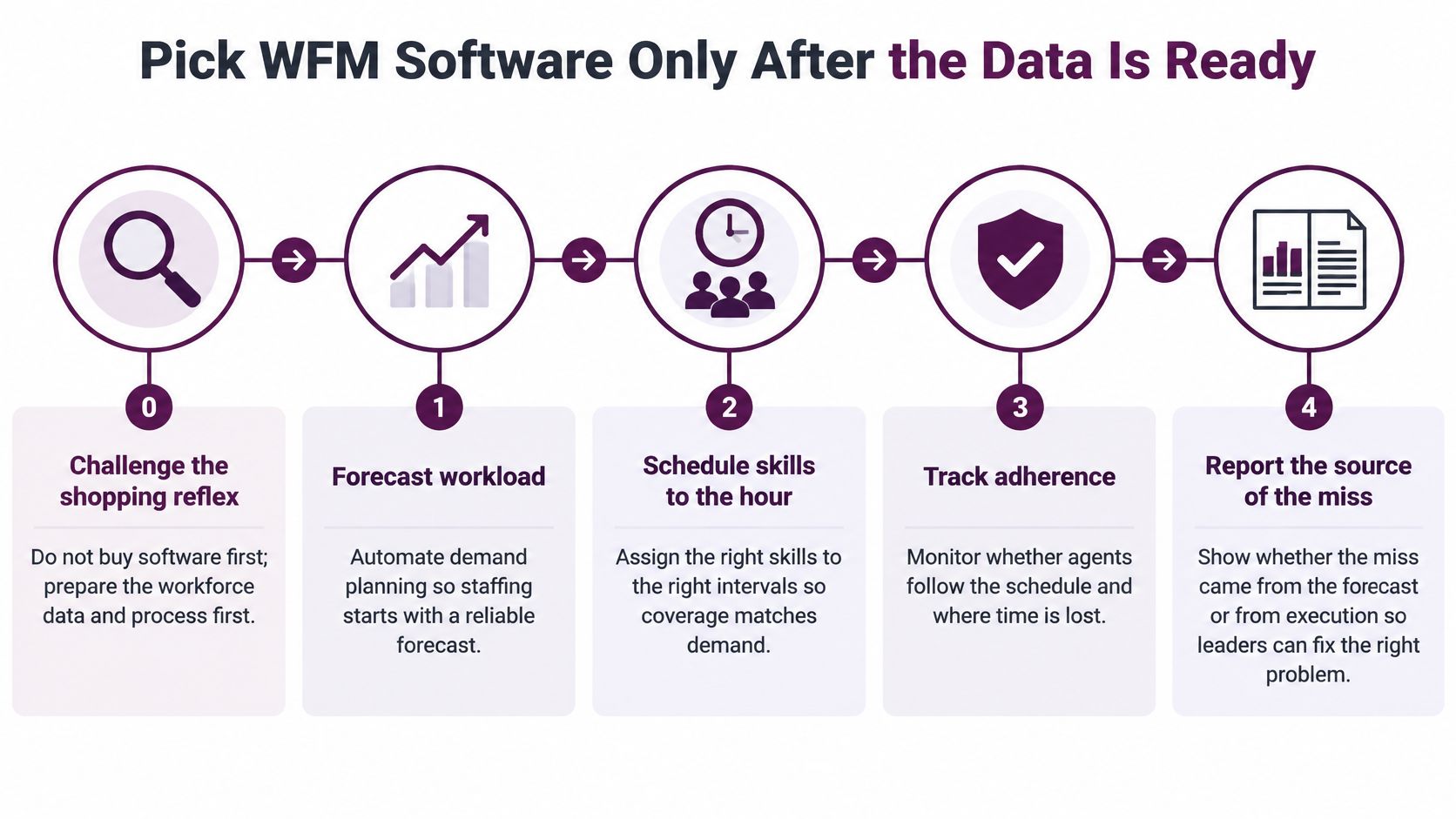
Check readiness with a representative export and a pilot reconciliation. Can you align contact arrivals, handle time, activity states, schedules, and skills on the same clock? Do event tags explain known spikes? Can a supervisor trace a staffing recommendation back to its assumptions? These checks are more useful than assuming a vendor’s AI label establishes data quality.
Use Readiness as the Buying Gate
| Prerequisite | Ready looks like | If it is missing |
|---|---|---|
| History | Interval volume and handle time by queue, channel, and language | Use scenarios and comparable evidence; test the model as history accumulates |
| Event tags | Promotions, holidays, outages, and weather marked on the history | The model gets blamed for spikes you already knew |
| Connected reporting | Schedule, phone system, and quality data in one place | Reconcile definitions and timestamps; scope an integration or cleanup plan |
| Human override | A planner can reject a recommendation and record why | A bad week gets locked in |
| Fallback | A written intraday playbook | Document how supervisors will operate when the tool or feed is unavailable |
New programs and campaigns often need low, expected, and high scenarios because their history is limited. Keep forecast uncertainty visible and test pooled bilingual staffing rather than applying a blended center-wide average. Zendesk’s WFM forecasting documentation illustrates adjustable historical periods, event adjustments, outlier treatment, and staffing parameters. Those controls are useful evaluation questions, not a recommendation that every operation use that platform.
Cleaner intervals and a scenario for the campaign week will beat a new AI scheduler that no one is allowed to overrule.
Buy or upgrade when the expected benefit of reliable forecasting, scheduling, or intraday visibility justifies the cost and implementation effort. Address data gaps alongside the rollout when the tool can help resolve them; do not assume manual spreadsheets are safer at every scale. Require a pilot, reconciliation, planner overrides, access controls, and a fallback. Amazon Connect’s capacity-planning documentation shows how scenarios can combine occupancy, attrition, channel objectives, and staffing with or without shrinkage. Verify the assumptions in the platform you actually choose.
Roll Out the Plan With a Team That Can Keep It
Don’t roll this out to the whole center at once. Adoption fails when every queue changes its forecast, schedule, and adherence rules in the same week. Start small and prove the loop.
Five Rollout Moves
- Pick one queue. Publish the interval scoreboard and agree the service level in writing with the client or internal owner.
- Pilot across a representative demand cycle. Review error by interval, language, and client, not as one centerwide average, and change one assumption at a time.
- Explain adherence before scoring it. Tell agents what the metric is for, protect breaks and coaching, and show the exception codes. The metric should never arrive as a surprise punishment.
- Give supervisors a menu. Voluntary time off, overtime, qualified skill moves, callbacks, and approved break shifts. Ban heroics that max out occupancy to save one interval and cost you the week.
- Review the pilot against agreed criteria. Compare data reliability, staffing fit, planner effort, service outcomes, and operating risks before expanding the process or technology.
Expect changes and questions. Explain activity codes and exceptions before using adherence reports, involve agents and supervisors in review, and record campaign changes as they occur. Assign an owner to each corrective action and check whether it improved coverage or service. A single four-week pilot may not capture seasonal demand, so extend observation when the decision needs it.
Sometimes a sound plan reveals a capacity gap. Cost depends on required coverage hours, language and technical skills, supervision, training, systems, and schedule constraints. A 24/7 design may require a different staffing structure from business-hours coverage. Request a current, scoped quote rather than using a general hourly range or a calculator total as the staffing decision.
If you need English-Spanish coverage aligned with U.S. operations, discuss a call center team in Tijuana with CallZent. Confirm skills, shift coverage, routing rules, reporting access, ramp time, and responsibilities for intraday decisions. Decide whether dedicated language queues or a shared bilingual pool best fit the demand and service objectives.
Frequently Asked Questions
What is workforce management for call centers?
It is the operating cycle that forecasts workload, estimates staffing, builds schedules, monitors actual activity, and adjusts coverage. A practical plan connects service goals, agent skills, language demand, availability, and customer outcomes.
Should call centers plan in 15-minute or 30-minute intervals?
Either can be appropriate. Choose using arrival patterns, data quality, queue size, and the decisions supervisors can make. A short interval can expose peaks but may be noisy for low-volume queues. Keep longer-term capacity planning connected to the interval view.
How do you calculate call center workload?
Multiply forecast contacts by average handle time in consistent units. Dividing that workload by interval duration gives offered load, not the full staffing requirement for a response-time objective. Apply a suitable queue or channel model and validate against actual performance.
When is Erlang C useful for staffing?
It can estimate staffing for suitable inbound voice queues under simplifying assumptions, including no abandonment and a pooled skill group. Complex skills, abandonment, concurrent chats, and asynchronous backlogs may need different models or simulation.
How do you add shrinkage to required staffing?
For a consistent simplified model, divide required available staffing by one minus the shrinkage rate. Ten available agents at 25% shrinkage require 13.33 rostered agents, rounded up to 14 whole agents for that interval. Check activity timing and avoid counting already scheduled unavailability twice.
What is the difference between adherence and occupancy?
Adherence measures how actual activities match the schedule under defined mapping and exception rules. Voice occupancy generally compares contact-handling time with handling plus ready idle time. Neither is equivalent to the percentage of all paid time spent working.
What is a good service-level or adherence target?
There is no single target for every operation. Set service objectives using customer impact, channel, coverage, and achievable staffing. Define adherence expectations around clear activity rules and approved exceptions. An 80/20 service objective is an illustration, not a universal standard.
How should workforce planning handle bilingual agents?
Forecast demand by language and model agent proficiency, routing, and availability. Dedicated queues and shared bilingual pools have different staffing implications. Do not count one agent as fully available to two queues at once, and check language-specific waiting and quality outcomes.
How should a call center measure forecast accuracy?
Review interval errors, absolute contact differences, direction of bias, and suitable percentage measures. MAPE is undefined for zero actuals and can be unstable at low volumes. WAPE also needs a defined treatment when total actual volume is zero. Break results down by queue, language, and peak periods.
When should a call center buy WFM software?
Consider software when forecasting, scheduling complexity, intraday visibility, or manual effort justify the investment. Validate data, integrations, assumptions, overrides, security, and fallback procedures through a representative pilot. Data cleanup and implementation can proceed together when properly scoped.
Bilingual Nearshore Support in Mexico
Build Your Support Team Around Actual Demand
Discuss your volume patterns, service objectives, English-Spanish demand, and coverage needs with CallZent. Define a staffing scope with clear assumptions, sustainable schedules, and measurable outcomes.