

BPO Operations & Financial Controls
Accounting and Finance Outsourcing: A Practical Guide to Cost, Control, and Nearshore Support
Define the work you can delegate, the approvals you retain, and the evidence you need before moving financial processes to an external team.
TL;DR — Quick Takeaways
- Define the processing scope separately from approval authority and financial judgment.
- Compare total delivery cost, including review time, integration, controls, rework, and transition.
- Evaluate access rights, segregation of duties, control evidence, and escalation before launch.
- Nearshore bilingual support can help with working-hour overlap and exception communication.
- Begin with one controlled pilot and expand only after quality and oversight requirements are met.
Outsourcing finance is rarely a bookkeeping decision. It’s a control decision that happens to affect cost.
A provider can process invoices, reconcile accounts, support payroll, and prepare reports while your company keeps approval authority and financial judgment in-house. But if access rights, escalation paths, audit evidence, and review responsibilities aren’t designed before the handoff, outsourcing merely moves risk from an understaffed finance team to a less visible vendor relationship.
The right model can give a growing business more capacity without sacrificing oversight. The wrong model creates delayed closes, unexplained exceptions, weak payment controls, and uncomfortable questions during an audit. This guide takes a governance-first view of accounting and finance outsourcing, including vendor selection, nearshore delivery, AI controls, and a practical 30, 60, and 90 day transition plan.
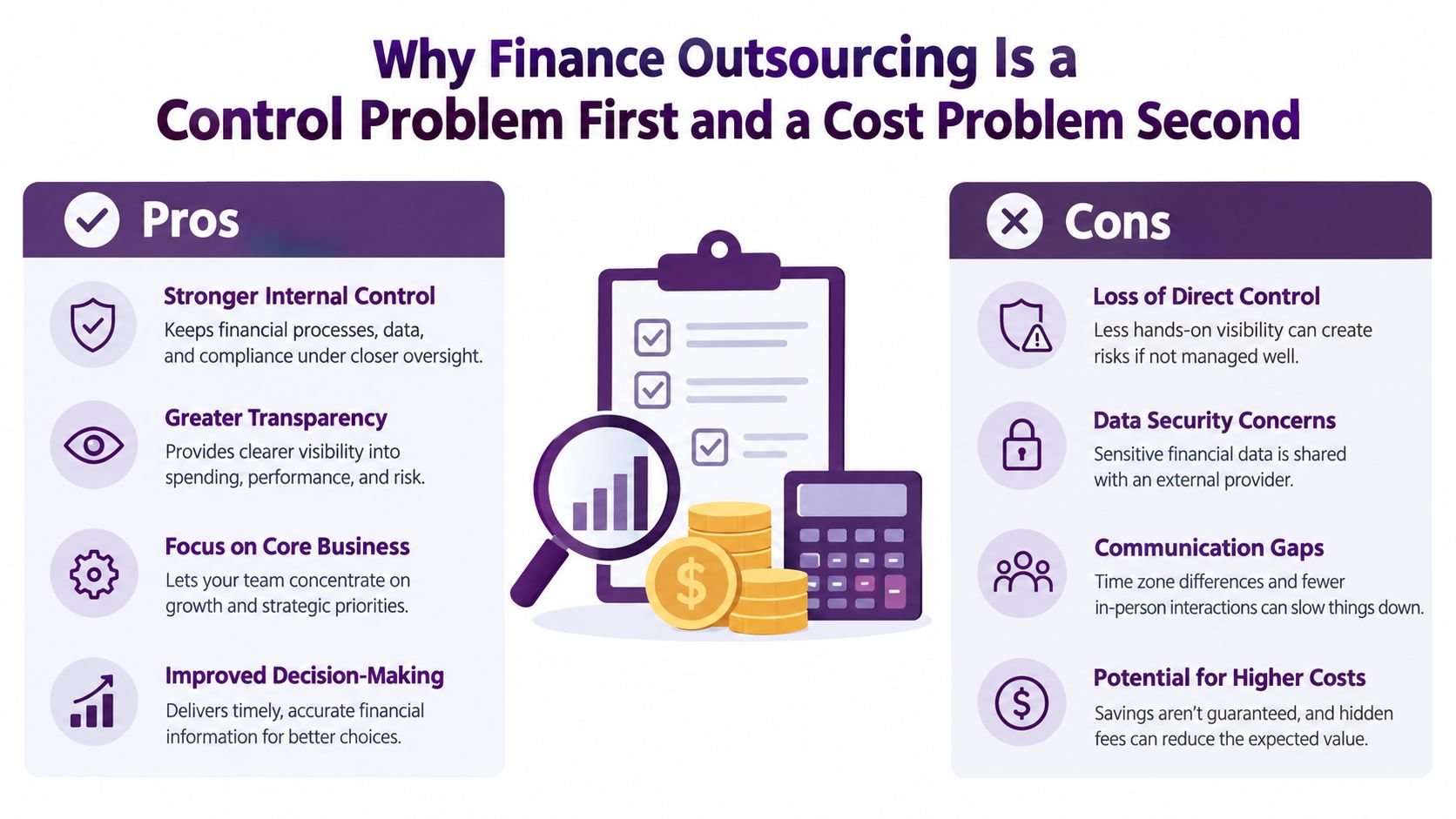
Why Finance Outsourcing Is a Control Problem First and a Cost Problem Second
The common pitch says finance outsourcing lowers labor costs. The more important question is whether your company can still prove who approved a payment, who changed a vendor record, who reviewed a reconciliation, and who owns the exception when something goes wrong.
Before comparing proposals, test four practical concerns: accuracy, retained control, communication, and system integration. Each should translate into a defined workflow, a named owner, and evidence that the control was performed.
Outsourcing redistributes risk
An internal team may struggle with hiring gaps, repetitive work, or an employee who knows a process no one else understands. An external team can reduce those constraints, but it introduces different exposures:
- Vendor oversight: Your finance leader must review service quality, access logs, exceptions, and unresolved items.
- Data access: The provider may handle bank details, payroll records, tax documents, customer balances, or payment instructions.
- Handoffs: A poorly defined boundary between the provider and your internal approver can leave ownership unclear.
- Escalation: A transaction that falls outside policy needs a named decision-maker, not a shared inbox with no response standard.
A strong operating model separates preparation from authorization. The outsourced team might enter an invoice, match it to a purchase order, document an exception, and prepare a payment batch. An internal manager should retain authority over approval thresholds, unusual payments, vendor additions, and final release.
Practical rule: Outsource defined processing while retaining approval authority and accountability.
This is why compliance should be assessed before a vendor quote is compared. Use the outsourcing compliance guide to frame the questions around data handling, accountability, and control evidence. Cost matters, but cost savings that depend on weaker approvals aren’t savings. They’re deferred exposure.
What Accounting and Finance Outsourcing Actually Covers
Accounting and finance outsourcing means assigning defined finance processes to an external team while your company retains oversight of financial policy, approvals, and business decisions. The scope can be narrow, such as invoice entry, or broad enough to include bookkeeping, close support, reporting, and controller-level review.
The work usually falls into connected service bundles:
- Bookkeeping and general ledger: The provider posts transactions, maintains account reconciliations, and prepares schedules that support the close.
- Accounts payable: A team receives invoices, validates required information, routes approvals, and prepares payment files. In the operating model described here, your authorized internal team releases the payment.
- Accounts receivable: Specialists issue invoices, apply cash, follow up on overdue balances, and escalate disputed accounts.
- Payroll support: The provider can prepare payroll inputs, maintain supporting records, and coordinate with an internal approver or payroll platform.
- Tax preparation support: The team organizes schedules, transaction records, and documentation for an internal or external tax professional.
- Management reporting: Analysts assemble recurring reports, investigate variances, and maintain reporting packages for leadership.
- Controller-level review: A senior finance professional reviews reconciliations, close status, reporting logic, and unresolved control issues.

Match the scope to the control boundary
In a hypothetical example, a 200-employee SaaS company might outsource invoice capture, vendor onboarding preparation, account reconciliation, and collections follow-up while keeping payment approval, revenue policy, forecasting, and final reporting review internal. A smaller e-commerce business might begin with accounts payable and bank reconciliation, then add accounts receivable after the provider demonstrates stable exception handling.
These are examples of the broader market’s finance-outsourcing scope, not a list of services every BPO provider offers. Confirm qualifications, accounting expertise, and responsibility for each deliverable before contracting. Licensed or credentialed professionals may be needed for specialized tax, accounting, or assurance work.
Document the process before sourcing a team. Define the systems, transaction types, approval points, reporting, and exceptions. A provider cannot design a reliable service around a vague request for help with accounting.
For teams starting with invoice processing, accounts payable outsourcing can be evaluated as a discrete workflow. The key is to connect AP performance to the close, cash planning, vendor relationships, and fraud prevention rather than treating it as data entry alone.
Onshore, Nearshore, Offshore, and Hybrid Models Compared
Geography affects finance delivery, but it doesn’t decide the model by itself. The useful comparison is operational: how quickly can a team resolve an exception, how easily can a finance lead speak with the person doing the work, and how clearly can the company supervise sensitive activity?
| Model | Relative Cost Profile | Time Zone Overlap | Oversight Considerations | Best Fit |
|---|---|---|---|---|
| Onshore | Higher | Strong | Verify process expertise, controls, and applicable reporting knowledge | Sensitive processes, complex reviews, and teams needing close collaboration |
| Nearshore | Moderate | Strong to substantial | Shared working hours can support clarification; controls still require verification | U.S.-facing SMBs and mid-market companies using bilingual support |
| Offshore | Lower | May be limited | Plan documentation, supervision, and escalation around actual working hours | Standardized, high-volume work with mature controls |
| Hybrid | Mixed | Designed around the process | Internal approvals with external processing | Companies balancing scale, oversight, and specialized finance work |
The table’s cost labels are directional, not vendor quotes. A low hourly rate can become expensive if it creates rework, delayed approvals, additional internal supervision, or integration problems. Use a total cost of ownership analysis that includes those operational effects.
Choose by process, not by slogan
For a 50-person U.S. e-commerce company, nearshore or hybrid delivery may fit well. The provider can process invoices, monitor receivables, and support reconciliations during overlapping business hours, while the owner or finance manager retains payment release and cash decisions.
A regulated health insurer should use a narrower boundary. It may keep sensitive approvals, final review, and policy interpretation internal while assigning standardized preparation work to an external team that can demonstrate appropriate access controls and documentation.
Nearshore delivery is especially useful when English and Spanish communication matters, when exceptions need quick verbal resolution, or when the finance team works closely with customer support and operations. Offshore delivery can work well for stable, rules-based activity, but it demands disciplined documentation because time zone gaps and communication delays make informal correction harder.
A hybrid model can provide a manageable starting boundary. Keep judgment, approval, and final review inside the company. Move repeatable preparation and transaction processing to a supervised external team.
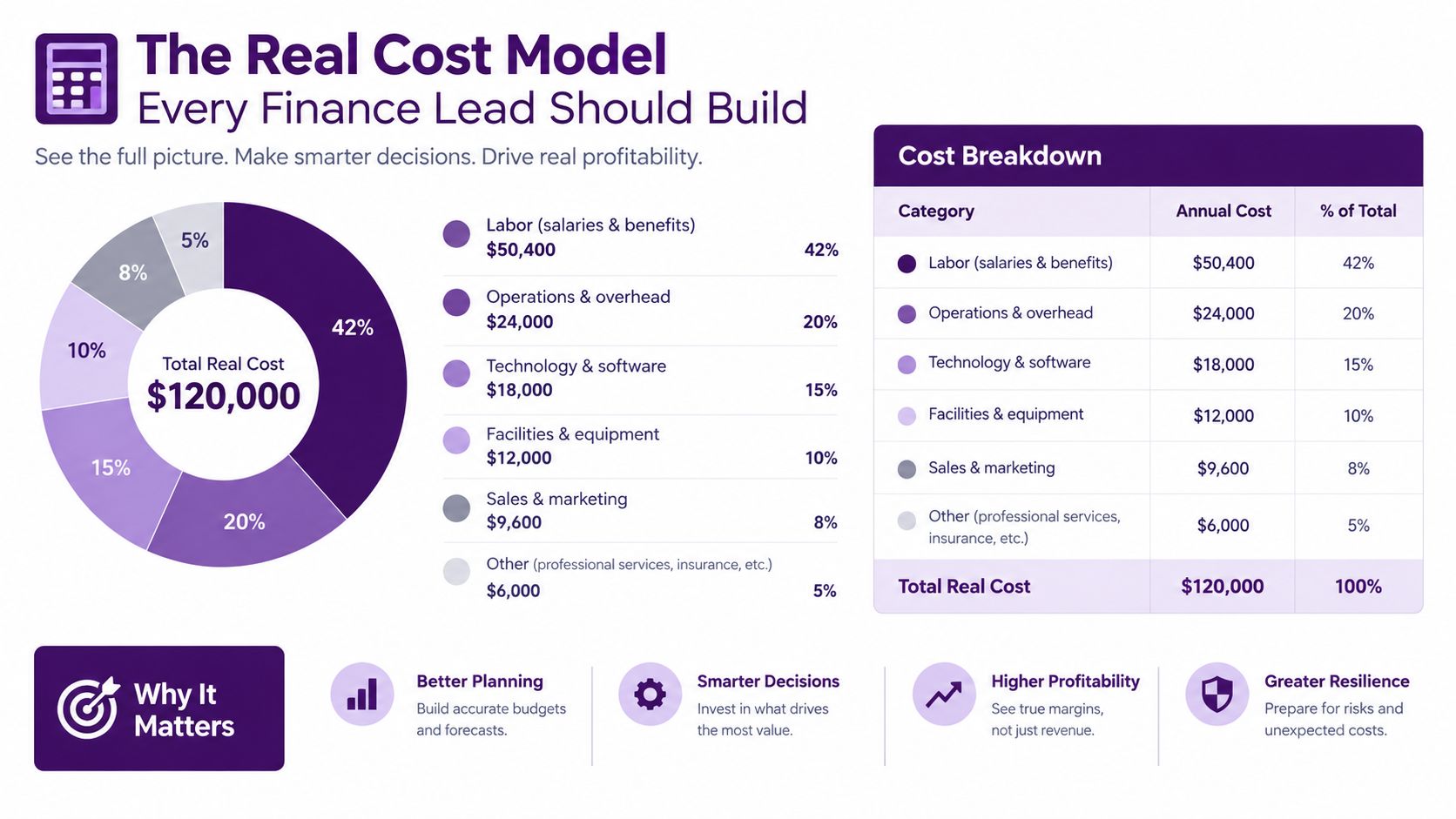
The Real Cost Model Every Finance Lead Should Build
A vendor invoice is only one part of the cost of your finance function. Build a fully loaded comparison that includes personnel, systems, supervision, allocated overhead, provider fees, and the internal work required to keep delivery accurate. Track one-time transition costs separately from recurring operating cost.
That definition matters because internal teams often look cheaper than they are. Payroll is visible. Management time, finance software, training, office infrastructure, controls, rework, transition effort, and escalation capacity are easier to miss.
Segment the baseline by process
Build the comparison separately for:
- Accounts payable: Cost per invoice, invoice cycle time, exception rate, and first-pass accuracy.
- Accounts receivable: Cost per account or transaction, cash application quality, collection follow-up, and dispute aging.
- General ledger: Reconciliation aging, journal-entry review, close-cycle days, and correction volume.
- Collections: Contact activity, escalation quality, dispute resolution, and recovered balances.
- Reporting: Preparation time, review effort, variance explanations, and report rework.
Track invoices per FTE where that measure fits the process, but don’t use headcount reduction as the only success test. A provider can process more transactions while creating more errors. Your model should separate recurring run-rate cost from temporary implementation and transition costs.
The right comparison is fully loaded internal cost versus fully loaded external delivery cost, measured alongside quality.
Process standardization, clear exception rules, and reliable systems can improve capacity without relocating every responsibility. Test whether the proposed team reduces rework and review effort as well as transaction-processing cost.
Use outsourcing cost-benefit analysis to document assumptions. Include internal review time, provider management, software connections, security requirements, quality checks, and the cost of exceptions. Approve the business case only when the projected savings remain after those controls are funded.
Vendor Selection Criteria That Actually Matter
A polished proposal proves very little. Select a provider by testing how it protects the close, payment workflow, and customer data when routine work becomes an exception.
Ask for control evidence, not assurances
AICPA describes SOC 1 as an examination of a service organization’s controls relevant to its customers’ internal control over financial reporting. A report should be evaluated for the actual system, services, controls, and period it covers. It is not a blanket guarantee that every outsourced process is controlled.
For an accounts payable provider, ask whether the report covers vendor onboarding, approval routing, payment authorization, access management, and change control. Match the report period and tested controls to the services you intend to outsource. Ask your finance or audit adviser to review the auditor’s opinion, exceptions, subcontractor treatment, and customer-side controls that your organization must perform. A logo or summary statement cannot replace that review.
Use the first discovery call to establish scope and accountability:
- Process boundaries: Which tasks does the provider perform, and which decisions remain internal?
- Team structure: Who performs the work, who reviews it, and who handles escalations?
- Systems: Which accounting platform, ticketing system, document repository, and communication tools will the team use?
- Service levels: How will you measure close-cycle days, exception response, reconciliation aging, and correction rates?
- Continuity: What happens when the assigned specialist is unavailable or leaves?
Use the second call to test control maturity:
- Segregation of duties: Can one person change bank details, approve an invoice, and release the payment? How are incompatible permissions prevented or independently reviewed?
- Security plan: Can the provider document safeguards, access restrictions, monitoring, testing, and incident response?
- Data lifecycle: Does the contract cover confidentiality, subcontractors, data return, and secure deletion?
- Escalation rights: Can your finance lead reach a decision-maker without passing through multiple layers?
- Industry familiarity: Has the team handled your reporting rules, customer data, tax workflow, or regulatory environment?
IRS guidance for tax professionals states that they need a written information-security plan and should assess risks, implement and test safeguards, and contract with service providers that protect customer information. This requirement concerns the tax-professional context; assess the obligations that apply to your specific business and outsourced work. The operational lesson is to request a documented, maintained security program that fits the data being handled.
Finish with a documented vendor scorecard covering process competence, evidence, access restrictions, continuity, system compatibility, and escalation. Choose a provider whose operating model can be tested and supervised.
Test a bank-detail change before the pilot
Give the provider a realistic scenario: a supplier emails new bank details just before a payment run. The team should flag the change, pause affected payment preparation, verify it through an approved independent channel using previously trusted contact information, and record the evidence. The person entering the change should not approve and release the payment.
Define the owner, response window, and release condition for that exception. Apply the same discipline to duplicate invoices, unusual credits, disputed balances, and requests to bypass the normal approval path.
Where Nearshore Bilingual Teams Change the Equation
Nearshore delivery changes more than the labor-cost profile. It can improve control when the finance team needs frequent clarification, bilingual communication, and fast escalation during the workday.
A Mexico-based team serving U.S. businesses can work in overlapping time zones, communicate in English and Spanish, and resolve an invoice exception while the internal finance lead is still available. That matters because many failures happen at the handoff. A ticket waits, an approval remains unclear, and a small discrepancy becomes a close problem.
A U.S. e-commerce finance lead might assign invoice intake, three-way matching, payment-run preparation, cash application, and overdue-account follow-up to a nearshore team. The internal team keeps vendor approval, payment release, credit policy, refund authority, and final reconciliation review. The provider handles the repeatable work and flags exceptions. The company keeps the decisions that affect cash and risk.
Communication becomes part of the control system
Bilingual capability helps when an exception involves operations, a customer, a supplier, or a regional team. It reduces the temptation to “fix it later” because the person processing the transaction can explain the issue directly and escalate it with context.
Nearshore teams can also support continuity. When process knowledge stays with a stable team, the provider learns the client’s chart of accounts, approval habits, exception patterns, and reporting calendar. That knowledge only creates value when the provider documents it and makes coverage resilient, so ask how procedures are recorded and how a replacement team member is trained.
The strongest nearshore model isn’t “send everything across the border.” It’s a deliberate division of responsibility. External specialists process, document, and escalate. Internal leaders approve, interpret, and remain accountable.
Outsourcing and AI Without Building an Ungoverned Black Box
AI can classify transactions, suggest account codes, identify reconciliation differences, summarize collections activity, and draft management-report commentary. Those capabilities don’t answer the most important control question: who is responsible when the output is wrong?
An outsourced team using an undisclosed AI tool can create risks involving inaccurate classifications, retained client data, unexplained decisions, or outputs no reviewer can reproduce. Approve tools and use cases before they touch live records.
Put human review into the workflow
Separate automation from authorization. A useful control matrix looks like this:
| Activity | AI may assist with | Human control required |
|---|---|---|
| Invoice classification | Suggest account and department codes | Reviewer confirms exceptions and unusual vendors |
| Reconciliation | Identify matching items and variances | Finance reviewer approves the reconciliation |
| Collections | Prioritize accounts and draft outreach | Authorized team member approves communications and concessions |
| Cash forecasting | Organize historical inputs and scenarios | Internal finance leader approves assumptions and decisions |
| Reporting | Draft commentary and summarize changes | Controller or finance lead validates figures and narrative |
Ask the vendor:
- Which AI tools are used, and for which processes?
- Is client data used to train a model or retained outside the approved environment?
- How are outputs sampled, reviewed, corrected, and logged?
- Can the provider disable the tool and return to a controlled manual process?
- Who approves a new AI use case?
- How are errors reported to the client?
- Do existing security reports and contractual safeguards cover the AI workflow?
Require a pilot with measurable checks such as exception rates, reconciliation accuracy, close speed, and decision usefulness. Don’t accept “percentage of tasks automated” as the primary success measure. Automation that hides errors is a control failure, not an efficiency gain.
Your contract should require disclosure of material AI use, human review for defined finance activities, data-retention limits, access restrictions, audit evidence, incident notification, and rollback procedures. If the provider can’t explain the workflow in plain language, don’t authorize it in a live finance process.
Your 30, 60, and 90 Day Plan to Move Finance Work Out the Right Way
A controlled transition begins with one process and a clean baseline. Don’t start by outsourcing the entire finance function because a provider promises a lower monthly fee.
Days 1 to 30
Map the current workflow from source document to final posting or approval. Identify every person, system, decision point, exception, and report involved.
Build the baseline for AP, AR, general ledger, collections, or reporting. Capture cost per transaction, cycle time, exception rate, first-pass accuracy, reconciliation aging, correction work, and internal review time. Then create a shortlist based on process experience, security evidence, system compatibility, language coverage, and escalation capacity.
Days 31 to 60
Run vendor due diligence. Review relevant assurance reports where available and appropriate, the documented information-security program, access model, subcontractor policy, data-return terms, and incident process. Ask the provider to walk through a realistic exception, such as a duplicate invoice, changed bank details, disputed customer balance, or unreconciled payment.
Select one process for a paid pilot. Keep approval authority internal, limit system access, define the evidence the provider must retain, and schedule recurring quality reviews. A pilot should test the operating model, not merely demonstrate that the team can complete transactions.
Days 61 to 90
Expand only after the pilot meets the agreed quality and control requirements. Finalize service-level indicators, escalation windows, review responsibilities, access rights, business-continuity procedures, AI rules, audit support, and exit assistance.
Document who owns each activity in a simple responsibility matrix. The finance lead should be able to answer, without contacting the vendor, who prepares, reviews, approves, records, and escalates every material process.
Outsource the work, keep the decision, and design the handoff like an audit reviewer is already watching.
Start this week by choosing one process, gathering its baseline, and writing down the approvals that cannot leave your organization. Then compare providers on the controls they can demonstrate, not only the price they quote.
Frequently Asked Questions
What is accounting and finance outsourcing?
It means assigning defined finance processes to an external team while retaining oversight of policy, approvals, and financial decisions. Scope may include transaction preparation, invoice processing, reconciliations, reporting support, or specialist accounting work, depending on provider qualifications.
Which finance tasks are suitable for an initial outsourcing pilot?
A bounded workflow such as invoice intake, document validation, cash-application preparation, or reconciliation support can be a useful starting point. Define inputs, permissions, review responsibilities, exceptions, and acceptance criteria before launch.
Which responsibilities should remain with the company?
For the model described here, retain payment release, vendor and bank-change approval, policy decisions, approval thresholds, and final reporting review with authorized internal leaders. Any delegated authority should be explicit, controlled, and independently reviewed.
How should a company compare outsourcing costs?
Compare equivalent scopes using fully loaded cost. Include provider fees, retained internal review, software, integration, supervision, security, rework, and exit costs. Separate one-time transition spending from recurring operating cost and test uncertain assumptions.
Does a SOC 1 report guarantee an outsourcing provider is suitable?
No. SOC 1 concerns controls relevant to customer financial reporting. Assess the specific services, systems, period, opinion, exceptions, and customer-side controls covered. Match the evidence to your proposed workflow with finance or audit support.
How should AI use be controlled in outsourced finance work?
Require disclosure and approval of tools and use cases, limits on client-data handling, documented human review, error reporting, and rollback procedures. Keep payment authorization and material financial decisions within the approved authority structure.
Bilingual Nearshore BPO Support
Add Operational Capacity With Clear Ownership
Discuss your back-office workflow with CallZent. Confirm which processing and communication tasks fit a bilingual Mexico-based team, along with the systems, review responsibilities, and escalation rules required.