CALLZENT INSIGHTS / CUSTOMER EXPERIENCE
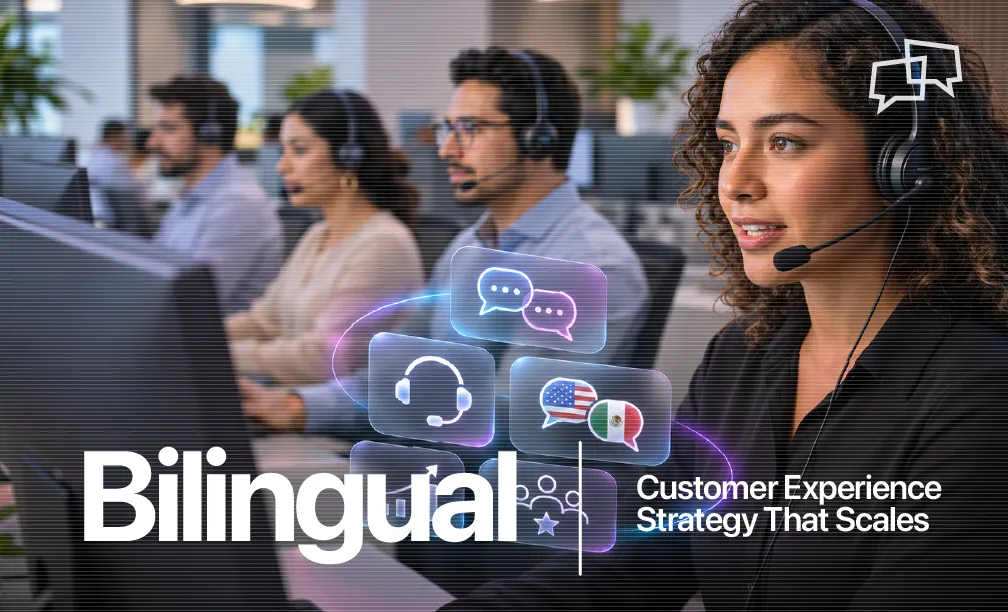
Bilingual Customer Experience Strategy:
Build Trust in Every Language.
Learn how to turn English-Spanish customer support
into stronger relationships, clearer resolutions,
better operational performance, and a consistent
brand experience across every channel.
Bilingual CX
English + Spanish
Customer Retention
Nearshore BPO
A customer who has to switch languages
to get an answer is already doing more
work than they should.
When that happens during a billing issue,
a healthcare question, a technical problem,
or a time-sensitive order, the cost is not
just frustration. It can be a lost sale,
a repeat contact, a poor review, or a
customer who decides your business is
harder to work with than a competitor.
A bilingual customer experience strategy
turns language support from a basic coverage
requirement into a retention and growth advantage.
For U.S. businesses serving English- and
Spanish-speaking customers, it creates more
confident conversations, clearer resolutions,
and a brand experience that feels consistent
at every stage of the customer journey.
THE BUSINESS CASE / 01
01
Why Bilingual Customer Experience Is a Business Strategy
Bilingual support is often treated as a staffing
question: How many Spanish-speaking agents
do we need? That is part of the answer,
but it is not the strategy.
A stronger approach asks where language affects
trust, where misunderstandings create operational
risk, and what customers need to feel understood
when they contact your business.
Translation Is Not the Same as Resolution
This distinction matters because a translated
interaction is not automatically a good interaction.
Customers need accurate information,
but they also need empathy, product knowledge,
and an agent who can take ownership.
A customer calling about a declined payment
does not only need a Spanish translation
of a policy. They need a clear explanation
of what happened, what they can do next,
and whether someone is accountable
for helping them resolve it.
BASIC LANGUAGE COVERAGE
Translate the Answer
An agent can communicate the policy,
but may not own the next action or resolution.
BILINGUAL CUSTOMER EXPERIENCE
Resolve the Need
An agent explains, verifies, takes
authorized action, and confirms the outcome
in the customer’s preferred language.
Why the U.S. Market Matters
The
U.S. Census Bureau’s 2024 American Community Survey
provides national data on languages spoken
at home, including Spanish.
It is a useful starting point for understanding
the potential scale of language needs,
but national averages cannot replace
your own customer data.
For growing companies, better language access
can improve first-contact resolution, reduce
transfers and repeat calls, strengthen customer
satisfaction, and help protect revenue.
It also gives internal teams more capacity
by reducing the need for managers or bilingual
employees in unrelated roles to step in
and translate.
The right model depends on your volume, industry,
customer geography, and the complexity of
your support needs. A low-volume business
may need bilingual coverage during key hours.
An eCommerce brand with seasonal demand
may need a flexible team that can expand quickly.
A healthcare, legal, or financial services
organization may require more specialized
training and quality controls.
The goal is not to offer bilingual service
everywhere without purpose. It is to
provide it where it makes the customer
experience better and the operation more effective.
Bilingual experience is not just about
speaking the customer’s language.
It is about completing the journey in that language.
UNDERSTANDING THE JOURNEY / 02
02
Start With Customer Demand, Not Language Coverage
Before building a program, look at where
customers are already signaling a language need.
Review call recordings, chat transcripts,
form submissions, abandoned calls,
escalations, and customer satisfaction comments.
If customers are asking for Spanish support
after reaching an English-only channel,
that is a clear gap.
But quieter signals matter too,
such as lower conversion rates on Spanish
campaigns or higher handle times for customers
who need clarification.
Map the Moments That Matter Most
Not every interaction has the same business impact.
A bilingual greeting on a general inquiry line
is helpful, but a bilingual agent during a
cancellation request, claims intake,
technical troubleshooting session,
or appointment booking can have a greater effect
on outcomes.
Map your customer journey and identify
the high-stakes moments.
For many businesses, those include:
First Contact
Prospect inquiries, product questions,
and early sales conversations.
Orders & Returns
Changes, delivery concerns,
refund questions, and exceptions.
Billing & Payments
Charge explanations, payment questions,
and collection conversations.
Technical Issues
Troubleshooting, access problems,
and service interruptions.
Scheduling & Intake
Appointments, healthcare coordination,
and legal intake.
Retention & Escalations
Cancellation requests, difficult cases,
and specialist handoffs.
This exercise helps determine where bilingual
capacity should begin. It also prevents
a common mistake: investing in front-end
language support while leaving critical
back-office processes, follow-up messages,
and escalation paths in English only.
Understand Dialect, Context, and Preference
Spanish-speaking customers are not
a single audience with identical expectations.
Regional vocabulary, formality,
and communication styles can vary.
Agents do not need to mimic every dialect,
but they should use clear, respectful language
and avoid scripts that sound overly literal
or unnatural.
Customer preference also matters.
Some people may speak Spanish at home
but prefer English for a technical product discussion.
Others may start in English and switch
to Spanish when the issue becomes more complicated.
Give customers an easy way to choose,
and make sure the handoff does not
force them to repeat their story.
CallZent’s
omnichannel customer support
approach is relevant when designing
connected conversations across channels.
Let customers choose their preferred language,
then preserve their context through the entire interaction.
DESIGNING THE OPERATION / 03
03
Build a Bilingual Customer Experience Strategy Around Ownership
The strongest bilingual programs
are designed around end-to-end ownership.
If an agent can greet a customer in Spanish
but must transfer them for account changes,
payment assistance, or troubleshooting,
the experience quickly loses momentum.
Each transfer increases effort and creates
more room for errors.
Start by defining which issues bilingual
agents should fully resolve.
Give Agents the Tools to Complete the Work
Give bilingual agents the same access,
knowledge, and decision authority available
to the rest of your customer service team
whenever possible and appropriate
to their responsibilities.
This may require translated knowledge base content,
bilingual templates, system permissions,
and escalation procedures that work in both languages.
Knowledge
Accurate policies, product information,
and bilingual resources.
Authority
Defined permissions for changes,
exceptions, and approved resolutions.
Escalation
Clear owners, complete context,
and follow-up in the chosen language.
Protect Your Brand Voice
A well-designed program also protects your brand voice.
Your English support team may be known for being
warm, precise, upbeat, or highly consultative.
Those traits should carry into Spanish interactions.
Translation alone cannot accomplish that.
Agents need to understand what your brand promises,
what tone fits sensitive situations,
and when to move beyond a script.
This is where agent empowerment becomes
operationally valuable. When well-trained agents
can make reasonable decisions, clarify a policy,
offer an approved solution, or escalate
with complete context, customers receive
faster and more human support.
At CallZent, that connection between empowered agents
and stronger customer outcomes is central
to how outsourced teams become an extension
of a client’s business.
Explore our
bilingual customer service
capabilities for programs built around
English-Spanish communication.
The customer should not lose ownership,
authority, or momentum when the language changes.
PEOPLE & PERFORMANCE / 04
04
Train for More Than Language Fluency
Fluency is the entry point, not the finish line.
A bilingual agent must be comfortable navigating
the customer’s language and your business
systems at the same time.
They need product knowledge, process discipline,
listening skills, and the confidence to explain
complex information in plain language.
Practice Real Customer Scenarios
Training should include real scenarios from
your operation. Use examples of difficult refunds,
service outages, account verification,
confusing invoices, and emotionally charged calls.
Let agents practice both languages, especially
if customers commonly switch mid-conversation.
Review how to confirm understanding
without sounding repetitive or patronizing.
CallZent’s guide to
agent training for the modern call center
offers additional context on developing
capable frontline teams.
Build a Consistent Bilingual Knowledge Base
Quality assurance should evaluate more than
grammar and script adherence. Listen for whether
agents identified the actual issue,
set clear expectations, used the correct terminology,
and left the customer with a next step.
In regulated industries, verify that required
disclosures and documentation are accurate
in both languages.
Your Bilingual Knowledge Base Should Include
- Approved product and service terminology
- Clear explanations for billing
and technical procedures - Brand tone examples in English and Spanish
- Industry-specific terms and required disclosures
- Escalation templates and case documentation
- A review owner and update schedule
Maintain a bilingual glossary for product names,
technical terms, billing language,
and industry-specific phrases.
This reduces inconsistent wording
across agents and channels.
The
NIST guidance on customer-facing communication
emphasizes clear, usable information,
plain language, and avoiding unnecessary jargon.
Those principles are also useful for
designing understandable bilingual content.
Update your glossary and training resources
as products, policies, and customer questions change.
This is also an opportunity to incorporate
feedback from experienced agents rather than
treating scripts as fixed documents.
Strong bilingual support combines language,
judgment, product knowledge, and brand consistency.
MEASURING CUSTOMER OUTCOMES / 05
05
Measure What Customers Actually Experience
A bilingual customer experience strategy
needs performance measures that reveal whether
language support is improving the journey.
Overall averages can hide problems.
If English satisfaction is high while Spanish
satisfaction falls behind, the program
needs attention even if the combined score
looks acceptable.
Track results separately by language,
then interpret them alongside interaction complexity,
channel, customer needs, and time period.
Bilingual Customer Experience KPI Framework
| Metric | What to Compare | What It Reveals |
|---|---|---|
| Customer Satisfaction (CSAT) | English vs. Spanish feedback by issue type | Differences in the perceived quality of support |
| First-Contact Resolution | Resolved cases in each language | Whether customers receive a complete answer |
| Average Handle Time | Time by language and case complexity | Workload and explanation requirements |
| Transfer Rate | Language-related transfers and specialist handoffs | Coverage gaps and authority limitations |
| Repeat Contacts | Customers returning for the same issue | Incomplete or unclear resolutions |
| Abandonment Rate | Abandonment by language and time of day | Staffing and accessibility problems |
| Quality Assurance | Accuracy, empathy, terminology, compliance | Consistency across both languages |
| Sales & Appointment Conversion | Conversions and show rates by language | Whether support advances business outcomes |
Track customer satisfaction, first-contact resolution,
average handle time
,
transfer rate, repeat contacts, abandonment rate,
and quality scores by language.
For sales and appointment-setting programs,
compare conversion and show rates as well.
Trends matter more than one isolated metric,
so review results regularly and pair the numbers
with call observations and customer feedback.
Avoid Measuring Speed Without Resolution
Be careful with handle time as a standalone measure.
A bilingual call may take longer because the customer
needs a more detailed explanation,
not because the agent is inefficient.
Pressuring agents to rush can lead
to incomplete resolutions and additional contacts later.
A better standard is whether the interaction
moved the customer forward with clarity
and confidence.
Review CallZent’s
customer service KPI guide
for additional performance considerations.
A bilingual program should be evaluated
on successful customer outcomes,
not only on how fast calls end.
THE NEARSHORE ADVANTAGE / 06
06
Use Nearshore Support to Keep Collaboration Close
For U.S. companies, a
nearshore bilingual team
can offer practical advantages over
distant offshore models.
Time-zone alignment makes coaching, reporting,
and program adjustments easier.
Cultural familiarity can support more natural
conversations with North American customers.
Geographic proximity also helps leadership teams
stay engaged with training and quality management.
Shared Working Hours
Easier operational reviews, live coaching,
escalation, and communication.
Bilingual Talent
Customer interactions in English and Spanish
aligned with program requirements.
Flexible Capacity
Staffing models that can adapt
to demand, coverage, and growth.
Brand Collaboration
Closer alignment on training,
standards, reporting, and customer needs.
Evaluate the Entire Operating Model
Cost efficiency still matters,
especially for businesses facing rising labor expenses.
But the best outsourcing decision is not simply
about a lower hourly rate.
It is about building dependable capacity
without sacrificing brand alignment,
responsiveness, or control.
Flexible staffing and transparent program design
allow companies to add coverage as demand grows
rather than carrying the full overhead
of a large in-house team before it is needed.
Choose a partner that asks detailed questions
about your customers, processes, and goals.
A provider should be able to explain
how agents are recruited, trained, coached,
and measured.
They should also be prepared to adapt the program
as call drivers, operating hours,
and customer expectations change.
Use CallZent’s
BPO pricing models
as an additional reference when comparing
program structures.
Nearshore support should improve
collaboration and customer outcomes,
not just reduce hourly costs.
LONG-TERM CUSTOMER EXPERIENCE / 07
07
Keep Improving the Experience After Launch
A bilingual program should not be treated
as a one-time translation project.
Customer needs shift, product updates introduce
new terminology, and recurring contact reasons
reveal where your communication can improve.
Make language-specific feedback part
of your regular operating rhythm.
A Practical Improvement Cycle
01
Listen and Identify
Review interactions, customer complaints,
transfers, abandoned journeys,
and language-related challenges.
02
Improve the Process
Update scripts, translated resources,
knowledge articles, agent training,
and escalation workflows.
03
Measure and Refine
Compare results by language and issue,
confirm that changes improve outcomes,
and repeat the review cycle.
Review a sample of interactions each month.
Ask which issues create the most transfers,
which policies are hardest to explain,
and where Spanish-speaking customers
abandon the journey.
Then use those findings to improve scripts,
self-service content, agent training,
and internal processes.
Language Access and High-Stakes Interactions
For covered healthcare organizations,
language access may also involve specific
legal obligations.
The
U.S. Department of Health and Human Services’
Section 1557 language-access guidance
explains meaningful access for individuals
with limited English proficiency in covered
health programs and activities.
That guidance also highlights how a person
who can communicate in English in everyday
situations may still struggle with specialized
medical terminology.
Requirements depend on the applicable organization,
service, and current legal framework;
bilingual staffing alone does not establish compliance.
The most effective bilingual customer experience
feels less like a separate service and more like
evidence that your business is prepared
to meet customers where they are.
When every conversation is handled with clarity,
respect, and real ownership, language becomes
a reason to build trust rather than
a barrier customers have to work around.
A successful bilingual strategy makes
language feel like a natural part
of the customer experience.
FREQUENTLY ASKED QUESTIONS
10 FAQs About Bilingual Customer Experience Strategy
1. What is a bilingual customer experience strategy?
A bilingual customer experience strategy
is a coordinated approach to supporting
customers in two languages, typically English
and Spanish for U.S.-focused programs.
It includes staffing, training, workflows,
language preference, brand voice,
escalation, and performance measurement
to deliver consistent customer outcomes.
2. Why is bilingual customer support important for U.S. businesses?
Bilingual customer support helps businesses
communicate with customers who prefer English
or Spanish. When properly designed,
it can reduce communication barriers,
improve clarity, support resolution,
and strengthen trust. The business value
depends on customer demand, service quality,
and the operational model.
3. How is bilingual customer experience different from translation?
Translation communicates content in another
language. Bilingual customer experience
also includes empathy, cultural context,
product knowledge, issue ownership,
authorized decision-making, and follow-up.
The goal is to resolve the customer’s need
rather than simply translate a response.
4. Which industries benefit from bilingual customer service?
Bilingual service can be valuable in eCommerce,
healthcare, financial services, insurance,
legal intake, technical support,
home services, hospitality,
and appointment scheduling.
Each industry requires different terminology,
permissions, workflows, and quality controls.
5. What KPIs measure bilingual customer experience?
Important metrics include customer satisfaction,
first-contact resolution, average handle time,
repeat contacts, transfer rates,
abandonment, quality assurance,
and conversion or appointment completion.
Compare results by language, channel,
and issue complexity rather than
relying only on combined averages.
6. How should companies train bilingual customer support agents?
Training should cover language proficiency,
product knowledge, brand voice,
technical terminology, system navigation,
empathy, customer verification,
and escalation procedures.
Use realistic scenarios in both languages,
quality reviews, coaching, and an updated
bilingual glossary.
7. Can bilingual support improve customer retention?
Bilingual support can help retention
when it reduces misunderstandings,
prevents unnecessary transfers,
improves problem resolution,
and makes customers feel understood.
Measure its contribution through satisfaction,
repeat contacts, cancellations,
and retention outcomes instead
of assuming language coverage alone
produces improvements.
8. What are the advantages of nearshore bilingual outsourcing?
Nearshore outsourcing may provide
time-zone alignment, bilingual talent,
closer collaboration with U.S. teams,
competitive costs, and flexible capacity.
Mexico-based teams can be useful for programs
requiring frequent coaching, quality reviews,
and coordinated customer interactions.
Results depend on the specific provider.
9. How can companies maintain brand consistency across languages?
Define brand tone, approved terminology,
service standards, escalation rules,
and customer communication examples
in both languages. Maintain translated
knowledge resources, review interactions,
and calibrate quality assurance
across English and Spanish teams.
10. How do you start implementing a bilingual customer experience strategy?
Start by reviewing customer demand and
identifying high-impact language gaps.
Define which interactions bilingual agents
must resolve, prepare knowledge resources
and escalation rules, establish quality
and performance measures, and launch
a focused pilot. Review outcomes by language,
improve weak workflows, and expand coverage
based on demonstrated customer needs.
TWO LANGUAGES. ONE CONSISTENT EXPERIENCE.
Better Conversations.
Stronger Customer Relationships.
CallZent builds bilingual nearshore customer support
programs from Tijuana, Mexico, connecting
English-Spanish communication with trained agents,
clear workflows, and measurable customer outcomes.
Let’s discuss a support model designed
around your customers and your business.